The four taxes at a card show
Sales tax, income tax, self-employment tax and reporting forms are four separate things, and each has its own trigger. Sales tax belongs to the state where the table is. The other three are federal and follow you home.
| Tax or form | What triggers it | Key number for 2026 | Where to read more |
|---|---|---|---|
| State sales tax | A retail sale at a table in a state with a sales tax | 35 of 46 sales tax states require registration before one show; 11 give an occasional vendor another route | Card show sales tax index |
| Income tax | Profit, whether or not any form arrives | No minimum. Tax is on profit, not on sales | Taxes on selling sports cards |
| Self-employment tax | Net earnings of $400 or more from a card business | 15.3% | Card vendor tax guide |
| Estimated payments | Expecting to owe $1,000 or more for the year | April 15, June 15, September 15, 2026 and January 15, 2027 | Quarterly estimated taxes |
| Form 1099-K | A platform or payment app paid you | More than $20,000 and more than 200 transactions, lower in some states | 1099-K threshold by state |
| Form 8300 | More than $10,000 in cash from one buyer | File within 15 days | Form 8300 guide |
The IRS sets the self-employment rate and the $400 trigger on its self-employment tax page. Whether your selling is a business or a hobby changes which rows apply, and the hobby or business guide walks through the IRS factors. An LLC does not decide that question, as the LLC guide explains.
Before the show
Start with the state where the show is held, because the permit can take longer than the packing. Selling in person creates duties that a marketplace never handled for you. Deadlines run up to 30 days before a show in North Dakota and Pennsylvania.
- Look up the state in the card show sales tax index: permit, cost, notice period and promoter duties for all 50 states and DC.
- Read the state's own page if we have one: New Jersey, New York, Pennsylvania, Texas, California, Florida, Ohio, Illinois, Virginia, North Carolina, Georgia, Michigan or Massachusetts. Every other state is in the state by state guide.
- Register, or print the event return, and find the venue's combined rate. Confirm both on the state revenue site.
- List what you are bringing with each card's cost on the card show inventory sheet. A card with no recorded cost is a card with no provable basis.
- Price the cards with how to price cards for a card show, and set your buy prices with the buy percentage calculator.
- Work out what the table must sell to pay for itself with the card show profit calculator.
- Pack from the card show vendor checklist, and save the table invoice and travel bookings.
- Count your starting cash and write it down.
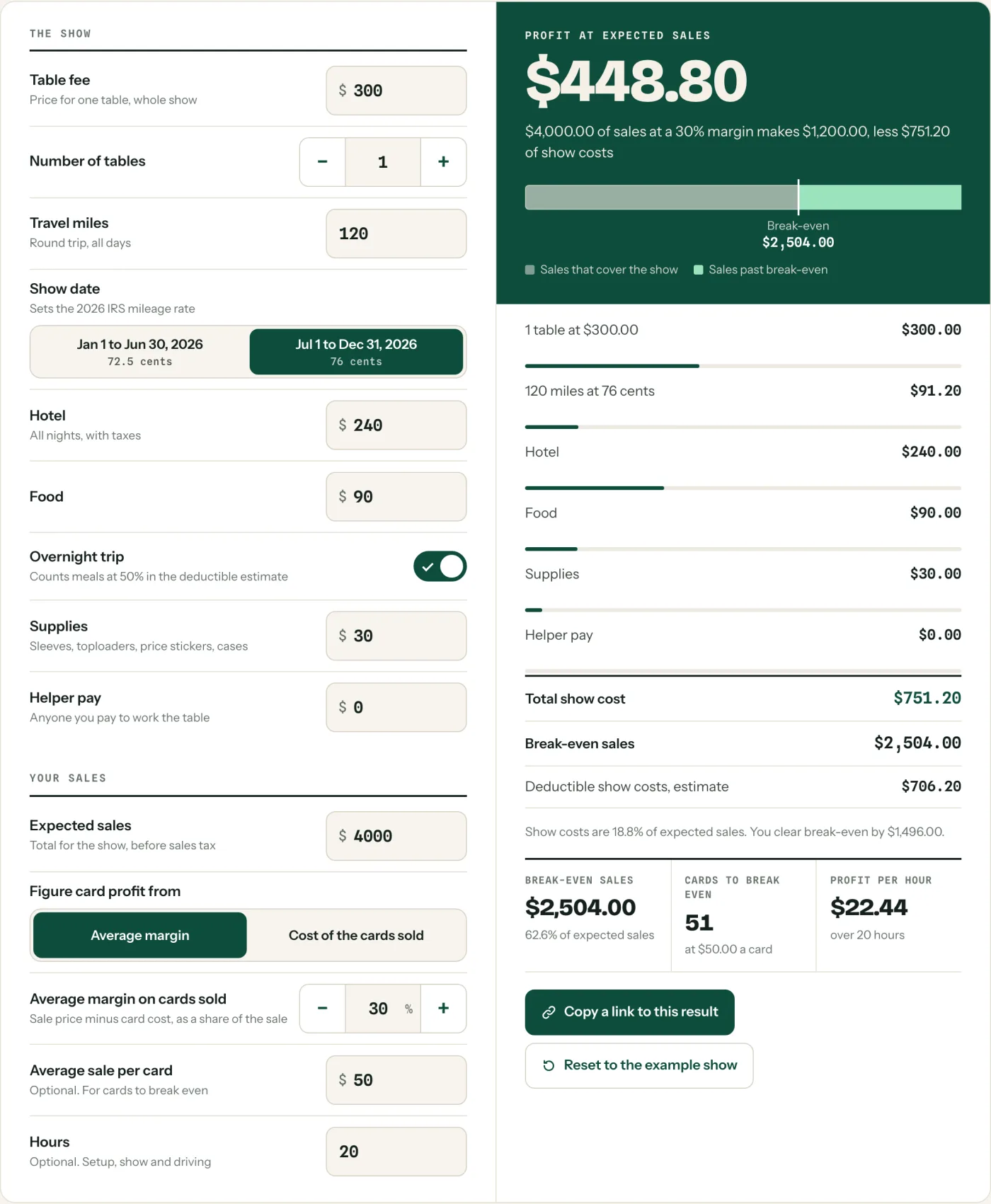
First show ever? How to become a card show vendor covers finding a show, booking the table and what promoters ask for.
At the table
Write each deal down while it is still fresh, because the record made at the table is the tax record. The IRS recordkeeping guidance describes the supporting documents a business needs for receipts, purchases and expenses.
| Record | What to capture | Why it matters later |
|---|---|---|
| Sale | Date, show, card, price before tax, sales tax collected, payment method. | Price is income. Tax collected goes to the state. |
| Purchase | Date, seller's name, card or lot, amount paid, how you paid. | This is your cost basis when the card sells. |
| Trade | Cards out and in, the agreed value of each, cash either way, what the outgoing cards cost you. | A trade is a sale of the cards you give. |
| Expense | Who you paid, date, amount, what it was for, receipt. | Table fees, supplies and travel reduce profit. |
Cash sales count exactly like card sales. A paper cash and trade log works when the table is busy, and how to track card show sales compares paper, a spreadsheet and an app.
Trades are where new vendors lose the thread. The IRS's bartering guidance treats an exchange of property as income at fair market value, even when no cash moves. The card trade calculator shows the gain on the cards going out and the basis of the card coming in. The cost basis guide has the receipt wording for a cash buy.
Three table situations have their own rules.
- A buyer hands you more than $10,000 in cash. You file Form 8300 within 15 days. Do not split the payment to get under the line.
- You buy a lot or a box and sell singles from it. Split the cost across the cards with the cost basis calculator.
- You pay a helper. From 2026 payments, a Form 1099-NEC is due once you pay one person $2,000 or more in the year.
Close out the weekend
Reconcile the cash and the card reader before calling the weekend profitable. The two totals describe the same business, and neither replaces the other.
CASH CONTROL
Starting cash + cash received + cash added - cash purchases - cash expenses - cash removed = expected closing cash. Count the actual cash and explain any difference. Money you added or took out belongs in the count, even though it is not a card sale.
- Match the card reader's gross sales, refunds and fees to the deposit.
- Move the sales tax you collected out of your spending money. It was never yours.
- Match each sold card to its cost. Chase a missing cost now, while you remember the deal.
- Log the drive. The IRS mileage rate is 72.5 cents a mile from January 1 to June 30, 2026, and 76 cents from July 1.
- File the table fee, hotel, supplies and meal receipts. Meals on an overnight trip count at 50%. The write-off guide has the conditions for each.
- Add the cards you bought at the show to inventory with their cost.
The mileage rates are on the IRS standard mileage rates page. The IRS small business tax guide explains cost of goods sold for a reseller.
One weekend, worked
Here is one example weekend from sales to set-aside, with every number invented for illustration. It uses the same inputs as the calculator pictured above and a venue with a 6% sales tax.
AN EXAMPLE WEEKEND, WORKED
A two day show in the second half of 2026, 120 miles round trip, one night in a hotel.
The arithmetic: $4,000.00 less $2,800.00 leaves $1,200.00 on the cards. Deductible show costs are $300.00 + $91.20 + $240.00 + $45.00 + $30.00 = $706.20. $1,200.00 less $706.20 is $493.80. The cash result is lower, $448.80, because all $90.00 of food left your pocket. Setting aside 25% of $493.80 puts $123.45 away for income and self-employment tax. The 25% is a rule of thumb, not your rate, and the card sale tax calculator estimates it from your own bracket.
The $240.00 of sales tax appears nowhere in the profit. It goes on the state return.
The month after the show
File the state sales tax return on the state's date, even if the form shows zero. Many states want a return for every period once you are registered, including periods with no shows. Each of our state pages gives the due date, the form and the late penalty.
- File and pay the sales tax for the show's period. Some states use an event return due within days: Georgia's Form FS-32 allows 3 days by mail.
- If you registered for one show and will not return, ask the state how to close the account so zero returns stop.
- Move the income tax set-aside into a separate account.
- Check the next estimated payment date: April 15, June 15, September 15, 2026 or January 15, 2027.
- List the cards that did not sell on the platform with the lowest fees for that card, and check the net with the card profit calculator.
The dates and the $1,000 test are in the IRS's Form 1040-ES instructions.
Prepare for tax season
Bring your preparer records that explain both the money that came in and the cost behind it. A Form 1099-K reports gross payments, not profit. A reporting threshold is not a tax-free allowance, and show cash appears on no form at all.
- Sales by channel: each show, eBay, Whatnot and any other platform, with refunds.
- Every 1099-K, matched to your own sales with the 1099-K reconciliation calculator. The 1099-K guide covers what the form includes.
- Cost of the cards sold, and a count of what is left. The year-end inventory count explains how.
- Expenses by category with receipts, and the mileage log.
- Estimated payments made, with dates.
- Personal collection sales flagged separately, so they are not treated as inventory.
The Schedule C guide for card sellers shows where each total goes, and the 2026 tax reference sheet lists the year's figures on one page. Missing receipts are not the end of the road: see card sales with no receipts. Keep records for at least 3 years, per the IRS.
Common mistakes and what they cost
The expensive mistakes are the quiet ones, where nothing goes wrong until a notice arrives. Each has a fix you can start this week.
| Mistake | What it costs | If you already did it |
|---|---|---|
| Treating the sales total as profit | You overstate income and overpay, or misjudge the show | Rebuild cost per card from purchase records and bank statements |
| Selling in a state without registering | The tax is still owed, plus that state's penalty | Read the state page, then contact the state revenue office |
| Spending the sales tax collected | It is due on the return whether or not you still have it | Set it aside from the next deposit and file on time |
| Skipping zero returns after one show | Late filing penalties in many states, even with no tax due | File the missed periods and ask about closing the account |
| Not recording trades | The new card has no provable basis, so more of its sale is taxed | Write down the trade values now, with photos or messages |
| Leaving cash sales off the books | Unreported income, with a 20% accuracy penalty on the tax | Report all of it. Amend if a filed return left it out |
| Filing the federal return late | 5% of unpaid tax per month, up to 25% | File now and pay what you can. A filed return ends the filing penalty |
The federal penalty figures are on the IRS failure to file page. State penalties differ, and each state page prints its own.
Find the right guide or tool
Pick the row that matches your question.
| Your question | Start here |
|---|---|
| Do I owe tax on card sales at all? | Selling sports cards, selling Pokemon cards |
| Do I need a permit for this show? | Sales tax index, state by state guide |
| What should I pay for a card at my table? | Buy percentages, buy percentage calculator |
| Is this trade fair, and what is my new basis? | Trade calculator, cost basis guide |
| What did I really make on this card? | Card profit calculator, platform fee research |
| Are grading fees deductible? | Grading fees guide |
| Will I get a 1099-K, and what do I do with it? | Threshold by state, Whatnot, eBay under $20,000, PayPal, Venmo and card readers |
| What can I write off? | Write-off guide, year-end equipment |
| I need a spreadsheet, not an app. | Inventory spreadsheet, show inventory sheet, cash log |
| Which app fits a card show vendor? | Vendor apps compared, Comped for show vendors |
Comped records the buy, sale or trade when you scan the card at the table, with its cost, so the weekend's books do not start from memory.
How this looks in the Comped app
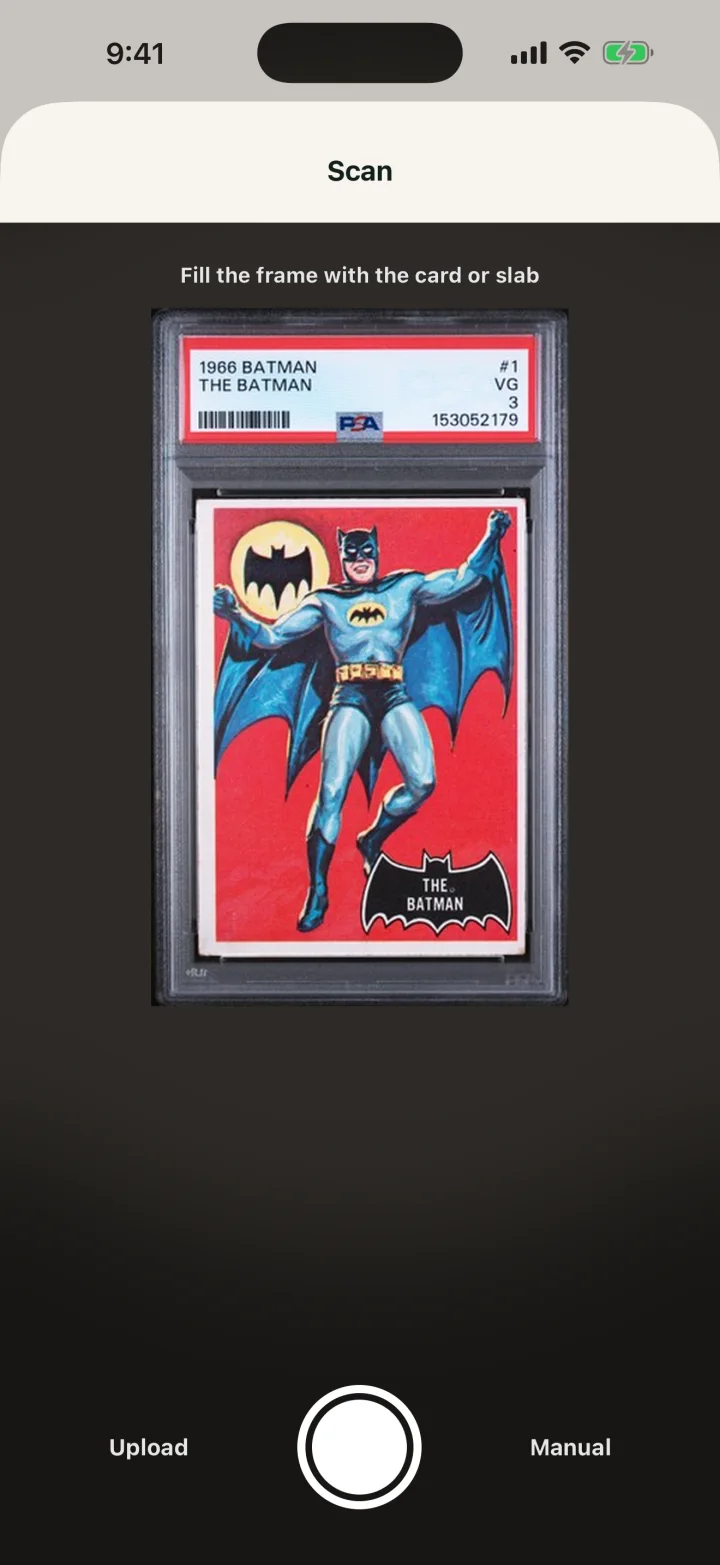
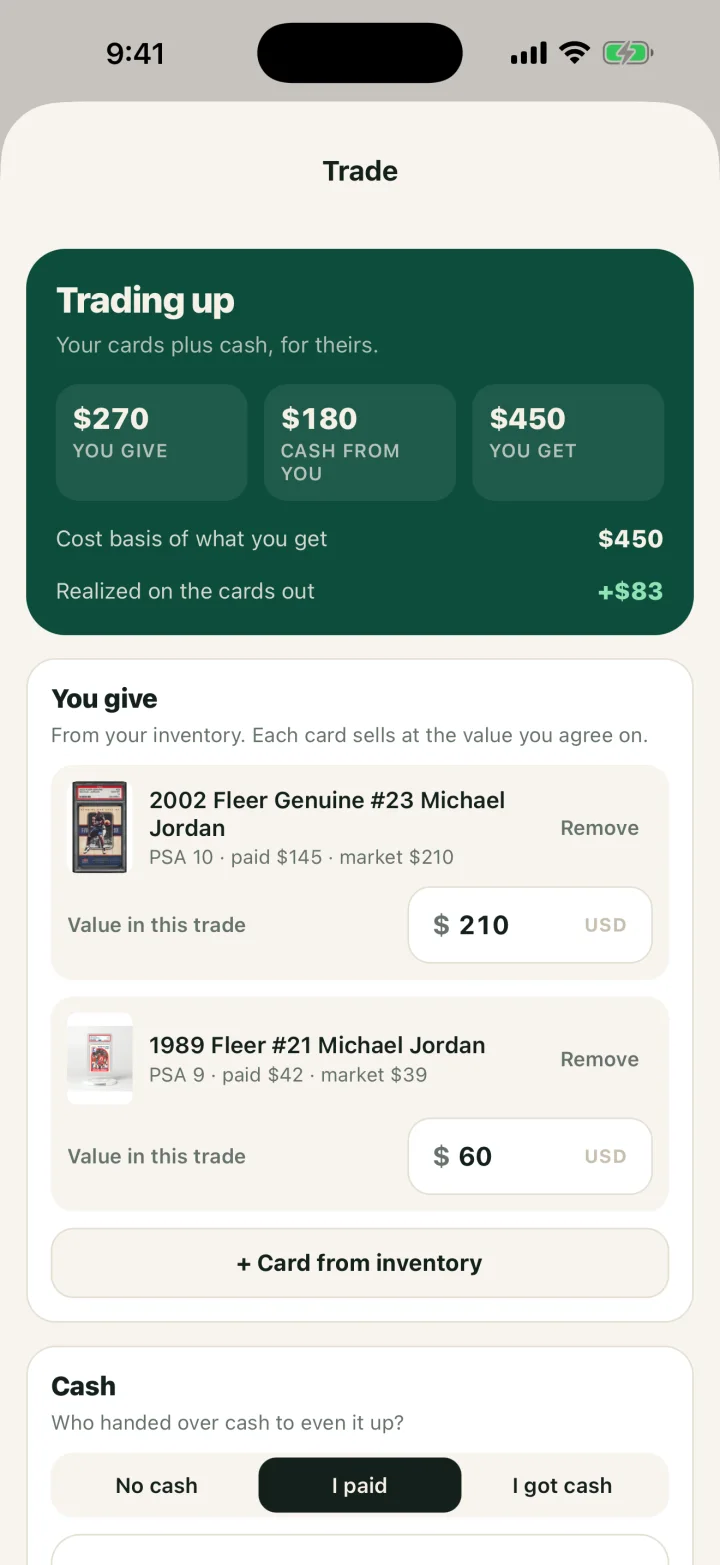
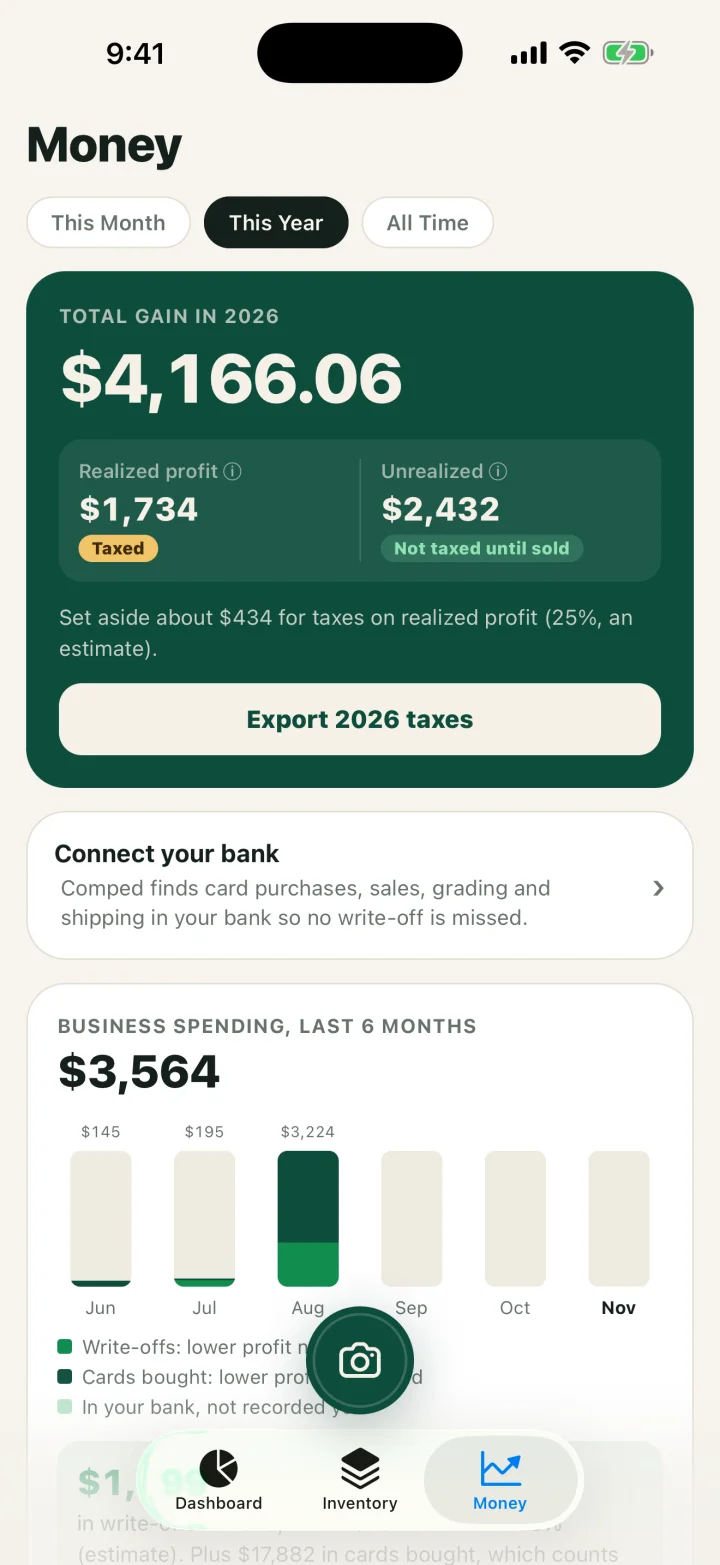
These are the current app's screens with demo data. Scan identifies a card or slab and shows a value from recent sales. Trade takes the cards you give, any cash, and the cards you get, then shows the new basis and the gain on what went out. The Money tab shows realized profit for the year, a 25% set-aside estimate and the tax export. Comped does not compute or file sales tax.
FAQ
Do I have to pay taxes on card show sales?
Yes, on the profit. There is no minimum amount of profit before income tax applies, and cash counts the same as card payments. A card business also owes 15.3% self-employment tax once net earnings reach $400 for the year.
Do I need a permit to sell at a single card show?
In most states, yes. In 2026, 35 of the 46 states with a sales tax require registration before one show, and it is free in 21 of them. In the other 11 an occasional vendor can sell at one show without registering first. Six take a return after the event, four run the tax through the promoter, and Rhode Island's promoter issues a permit at the show. Each route has limits, and the tax is still owed.
Do I charge sales tax on cash?
Yes. Sales tax applies to the retail sale, not to the way the buyer pays. Record the price and the tax separately so the tax does not get counted as income.
Does the promoter collect sales tax for me?
Usually not. In 33 states the promoter has a legal duty of their own, such as keeping a vendor list or checking certificates. In 4 of those the promoter collects the vendors' tax. Everywhere else you collect and file yourself.
Nobody is handing out tax forms at card shows. Do I still report it?
Yes. Tax is owed on profit whether or not a form arrives. A 1099-K only reports what platforms and payment apps paid you, and show cash appears on no form.
Do trades count as sales?
Yes. A trade is treated as selling the cards you give at their fair market value, and that value becomes the cost of the card you receive. Write down both values and any cash at the table.
What records do I need from a card show?
Every sale with its price and tax collected, every buy with the seller, date, card and price, every trade with both values, and receipts for the table, travel and supplies. Add a starting and closing cash count. Keep them at least 3 years.
How much should I set aside for taxes after a show?
All of the sales tax collected, since it belongs to the state. For income tax, 25% of profit is a common starting estimate, and your own bracket may be higher or lower. If you expect to owe $1,000 or more for the year, estimated payments are due quarterly.
SOURCES AND SCOPE
- What kind of records should I keep, IRS, checked November 13, 2026.
- Self-employment tax, IRS, checked November 13, 2026.
- Topic no. 420, Bartering income, IRS, checked November 13, 2026.
- Standard mileage rates, IRS, checked November 13, 2026.
- Publication 334, Tax Guide for Small Business, IRS, checked November 13, 2026.
- Form 1040-ES, Estimated Tax for Individuals, IRS, checked November 13, 2026.
- Understanding your Form 1099-K, IRS, checked November 13, 2026.
- Form 8300 reference guide, IRS, checked November 13, 2026.
- Failure to file penalty, IRS, checked November 13, 2026.
- Card Show Sales Tax Index 2026, Comped, for the state counts, built from state revenue pages.
The checklist is a recordkeeping workflow, not a determination of your tax liability. Read how to use our sources and estimates.
This is general information for card sellers, not tax or legal advice for your situation. Rules change and states differ; a CPA who knows your numbers wins every time.