The out-of-state show seller rule
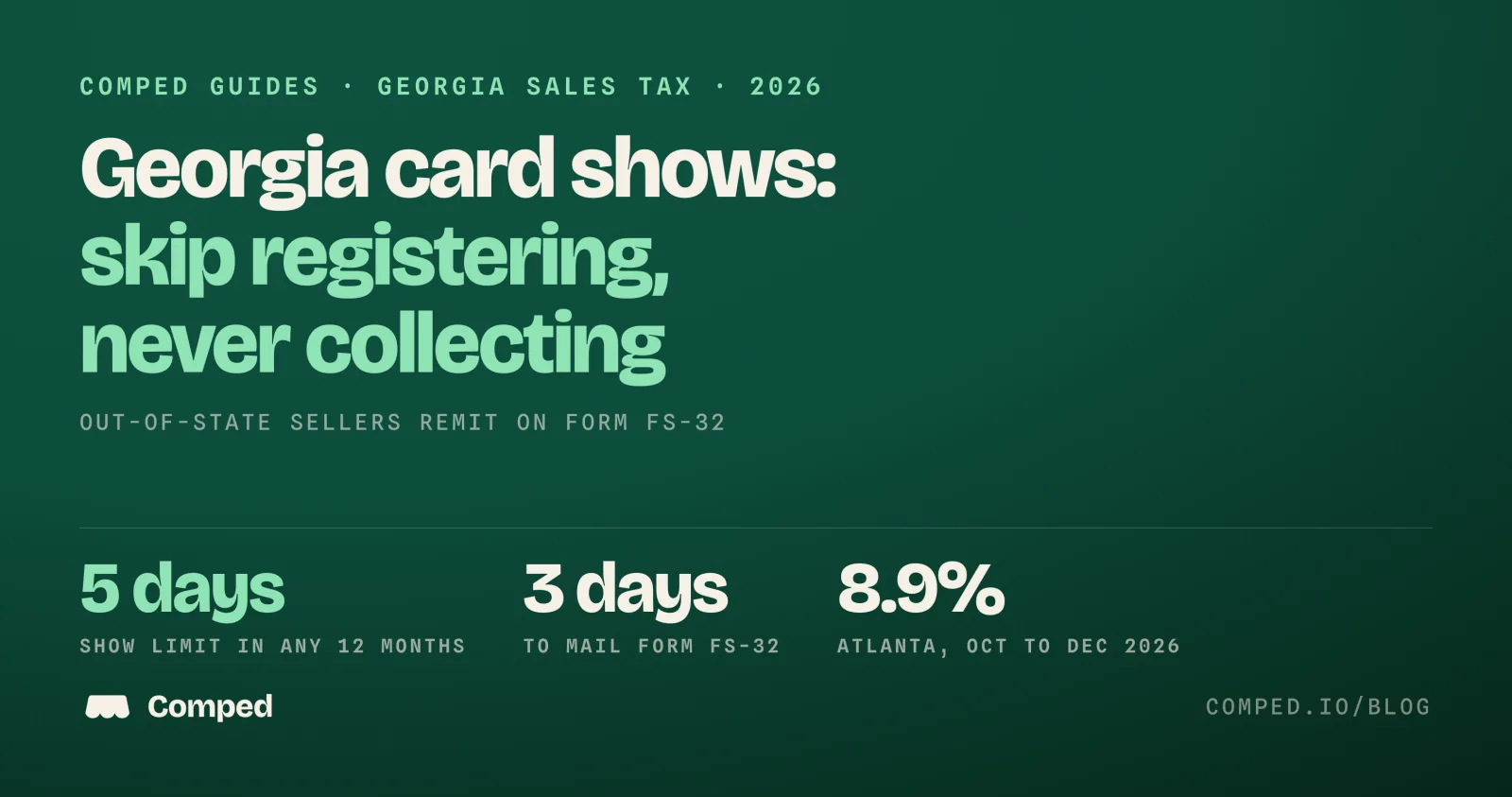
Georgia separates registering from collecting. The Department of Revenue's out-of-state sellers page says registration is not required for some out-of-state sellers at conventions and trade shows. It cites O.C.G.A. 48-8-2(8)(I)(iii). Three conditions must all be true.
- Convention and trade show activity is the seller's sole physical presence in Georgia.
- The seller does that activity in Georgia for no more than 5 days during any 12 month period.
- The seller did not derive more than $100,000 of net income from that activity in Georgia during the prior calendar year.
The page does not define a convention or trade show. Treating a card show as one is our reading, not a Department ruling, so ask the Department if you rely on it.
The tax is still due. The same page says out-of-state sellers must collect tax on all sales of tangible personal property made at a convention or trade show. Orders taken at the show are covered too. Trading cards and slabs are taxable tangible personal property, as in every state in the state by state sales tax guide.
THE RULE MOST VENDORS GET WRONG
"I do not need to register" is not "I do not charge tax". The exception removes the registration step only. A visiting dealer who works one Georgia weekend still collects at the venue's rate on every sale and sends the money in.
How to remit without registering
Use Form FS-32, Miscellaneous Sales Event. The out-of-state sellers page says tax should be remitted using that form. The current form is revised September 25, 2026.
The form asks for your name and address, the event, its jurisdiction and that jurisdiction's tax rate. You report taxable sales and tax collected. If you made no taxable sales, you enter a zero.
At the close of the event, the form and all taxes collected go one of two ways. You return them to the Revenue Agent on duty, or you mail them within 3 days. Payment is by check or money order to the Georgia Department of Revenue. The form says not to send cash.
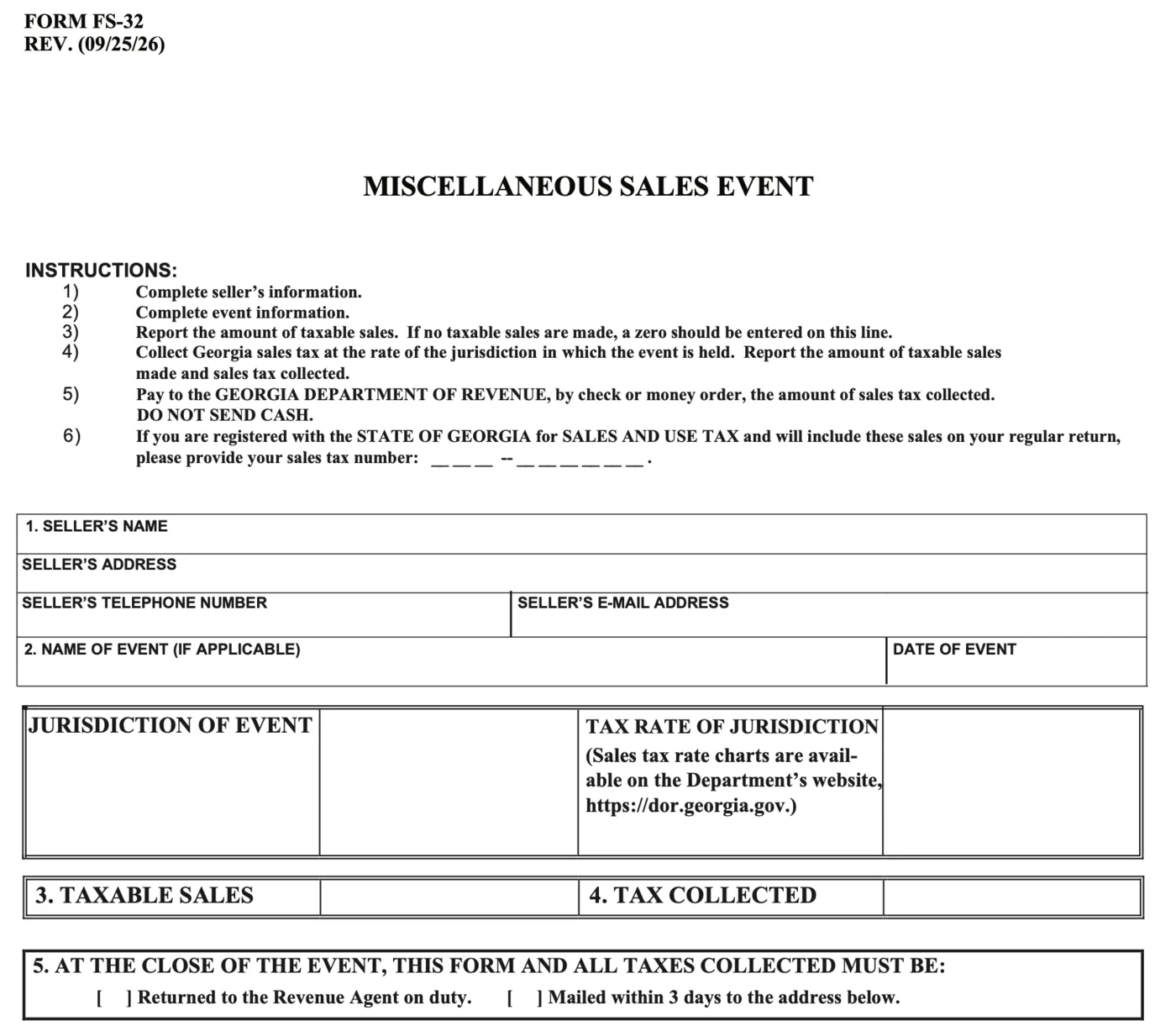
Fill it in this order. Box 1 is your name, address, phone and email. Box 2 is the event name and date. Then write the jurisdiction and its rate from the Department's chart. Box 3 is taxable sales without the tax, and box 4 is the tax collected. Tick how you are returning it.
When you must register
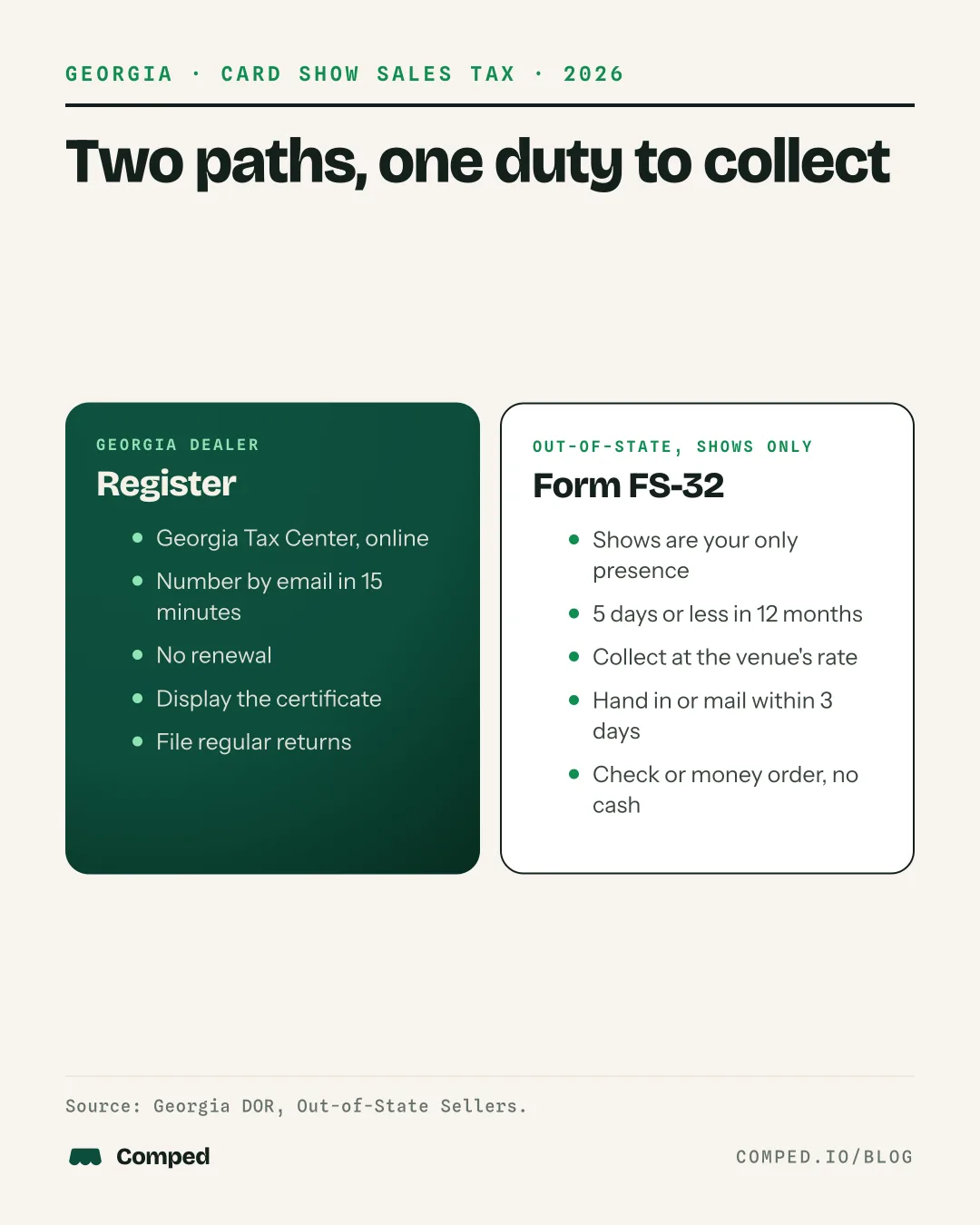
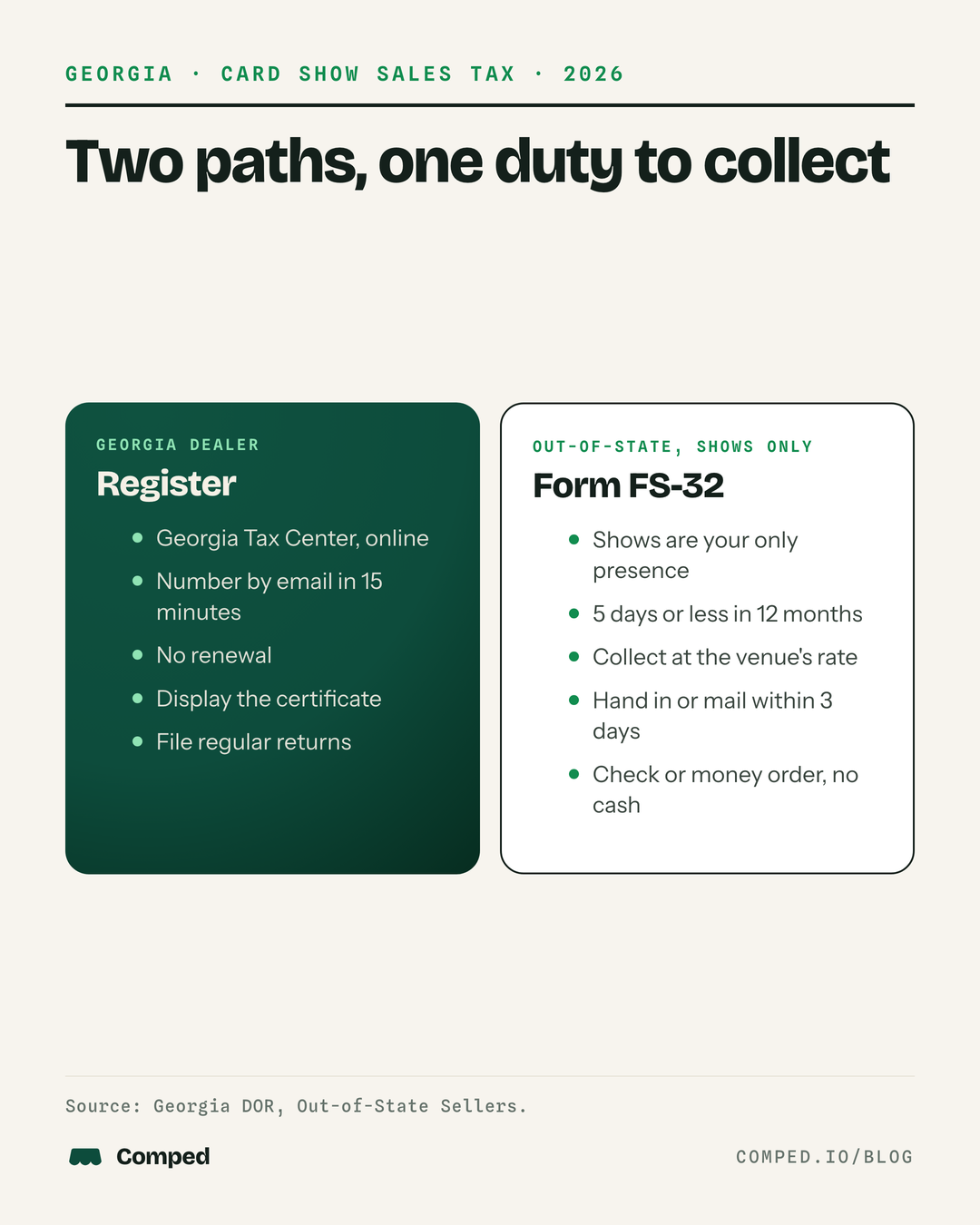
Register if you are based in Georgia or fail any of the three conditions. A sixth show day in 12 months, or any other physical presence in Georgia, ends the exception. Dealers who work Georgia shows year round should register.
Registration runs through the Georgia Tax Center. The Department's registration page says you should receive your account number within 15 minutes by email. Sales and use tax registration does not require renewal. The page lists no fee.
The registration FAQ says a dealer's certificate of registration must be conspicuously displayed at all times. Keep it at the table. A registered dealer can put the sales tax number on Form FS-32 and report the show on the regular return.
What rate to charge
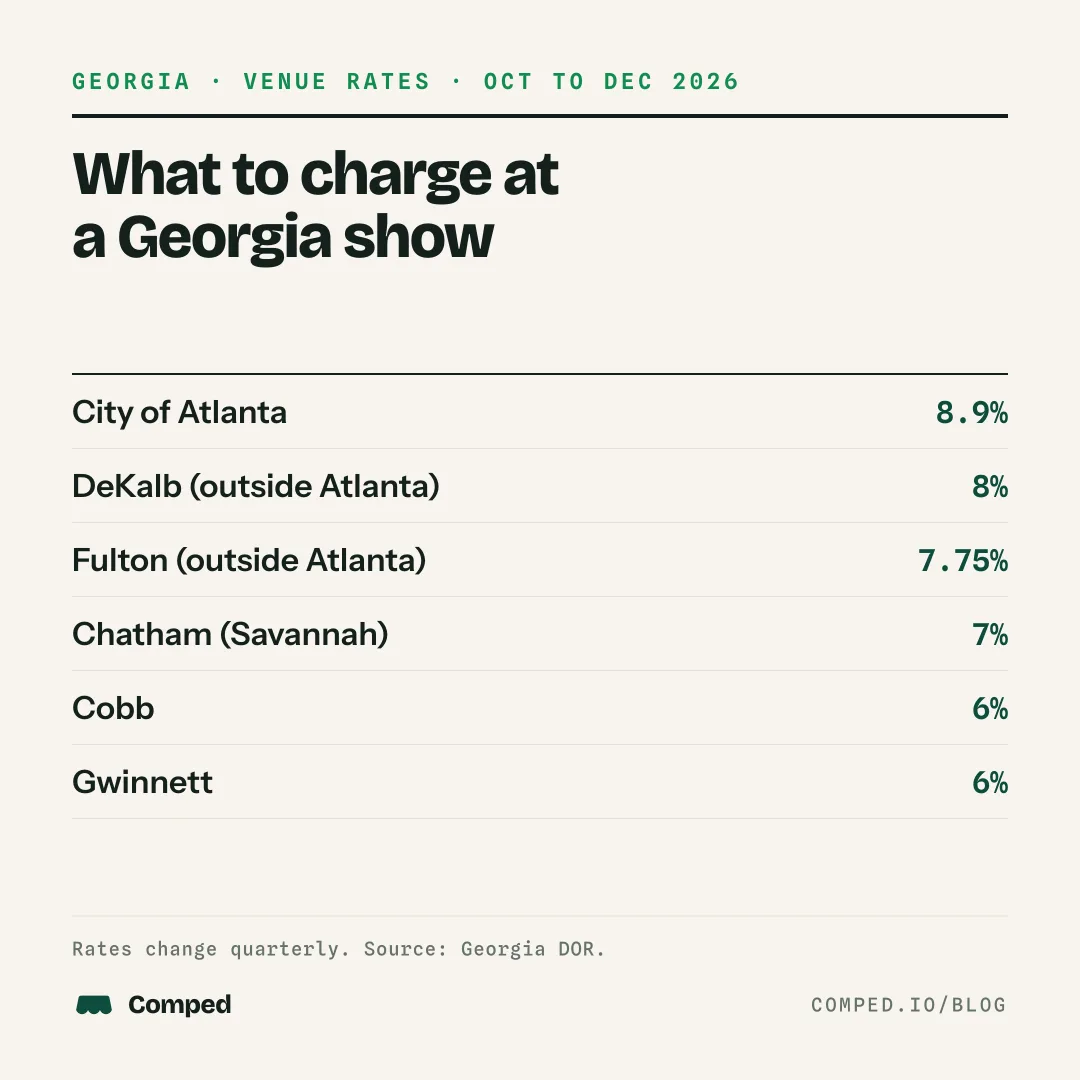
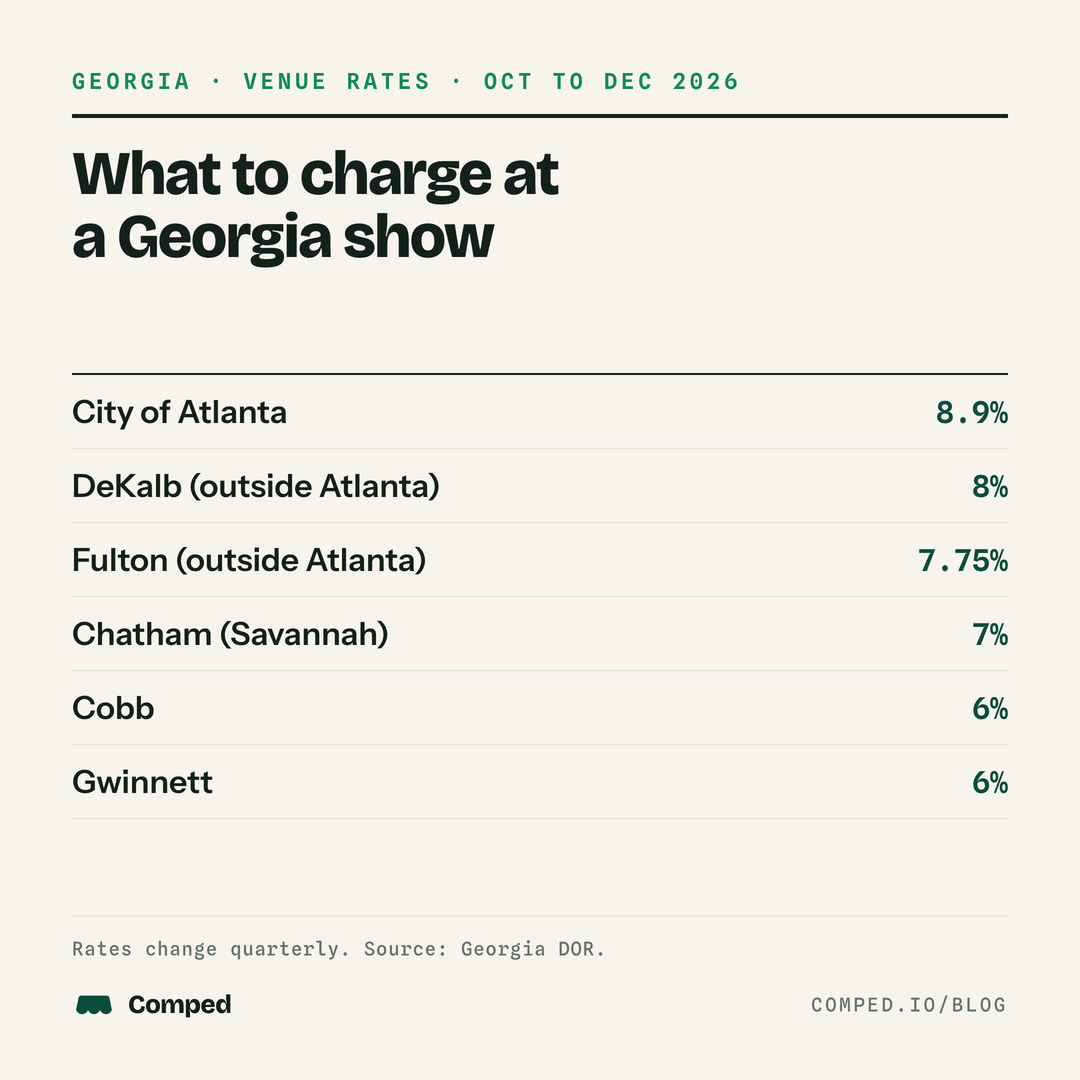
Charge the total rate for the jurisdiction where the show is held. The state rate is 4%, and counties and some cities add local taxes. The Department's general rate chart for October 1 to December 31, 2026 runs from 6% to 9% by county. Charts are updated each quarter.
| Georgia item | Rule for show vendors | Figure |
|---|---|---|
| State rate | Included in every county total | 4% |
| City of Atlanta | Total rate, October to December 2026 | 8.9% |
| DeKalb County outside Atlanta, Clayton County outside College Park | Total rate, October to December 2026 | 8% |
| Fulton County, outside Atlanta and three other cities | Total rate, October to December 2026 | 7.75% |
| Chatham County (Savannah) | Total rate, October to December 2026 | 7% |
| Cobb and Gwinnett counties | Total rate, October to December 2026 | 6% |
| Out-of-state show exception | Show days in Georgia in any 12 months | 5 days |
| Form FS-32 | Mail deadline after the event closes | 3 days |
| Resale certificate | Sales Tax Certificate of Exemption | ST-5 |
Timeline, counted back from show day
Decide which path you are on before anything else, because Form FS-32 leaves only 3 days after the show. The dates below use an example show on Saturday and Sunday, December 12 and 13, 2026. Rows marked as suggestions are ours, not state deadlines.
| When | What to do | Where it comes from |
|---|---|---|
| 2 weeks before | Count your Georgia show days in the last 12 months, this show included. Six or more, or a Georgia base: register in the Georgia Tax Center. | Out-of-state sellers page; our suggestion on timing |
| 1 week before | Find the venue's city and county, then its rate in the chart for the quarter of the show. | General rate chart |
| 1 week before | Print Form FS-32. Bring a check or money order, because the form does not take cash. | Form FS-32 |
| Show days | Charge the venue's rate on every retail sale and record each sale. | Form FS-32, instruction 4 |
| Close of the event, December 13 | Total taxable sales and tax. Hand the form and payment to the Revenue Agent on duty if one is there. | Form FS-32, box 5 |
| By December 16, 2026 | Otherwise mail the form and payment within 3 days. | Form FS-32, box 5; date is our count |
The form does not say whether the 3 days are calendar or business days. Counting calendar days is the safe reading. The card show vendor checklist has room for the form and the check on its packing list.
When registered dealers file
Registered dealers file monthly, quarterly or annually. The Department's due dates page lists each date. Most fall on the 20th of the month after the period, and a few fall a day or two later. The 2026 annual return is due January 20, 2027.
A show with no sales still gets paperwork on the FS-32 path. The form says to enter a zero if no taxable sales are made. For registered dealers, the pages we read do not spell out a no-sales return, so ask the Department before skipping a period.
Late returns are priced on the Department's penalty page. For sales and use tax, failure to file costs the greater of 5% of the tax or $5 for each late month. The cap is the greater of 25% or $25. Failure to pay carries the same amounts. The page also says a return owing more than $500 must be filed and paid electronically.
Comped records each table sale with the card, price, venue and date, so the sales behind either form are on record.
Buying inventory with Form ST-5
Yes, with a sales tax number. Form ST-5, the Sales Tax Certificate of Exemption, has a box for purchases for resale only. The form says a sales and use tax number is required for that box, apart from a short list of exempt organizations.
The form is headed "Georgia Purchaser". We found no Department page saying a supplier must accept another state's number, so ask the supplier first. Tax charged on a cash buy with no certificate is part of the card's cost, as the cost basis guide explains.
eBay and Whatnot versus your table
eBay has collected and remitted Georgia sales tax on eBay orders since April 1, 2020, per its marketplace tax page. Georgia requires a marketplace facilitator to collect once its Georgia sales reach $100,000 in the previous or current calendar year. You file nothing for the tax on those orders.
A table is different. Every card sold face to face at a Georgia show is taxed at the venue's rate, collected and remitted by you.
What the promoter handles
The promoter does not collect your tax. We found no vendor list or promoter filing duty on the Department's sales tax pages. Form FS-32 mentions a Revenue Agent on duty, so an agent may be at the event to take forms and payments.
Georgia and the 1099-K
We found no lower Georgia threshold on a Department of Revenue page, so this page states the federal rule only. Platforms file a 1099-K when gross payments exceed $20,000 and transactions exceed 200, per the IRS FAQs. Tax is owed on profit whether or not a form arrives. The 1099-K guide covers what the form includes.
A show weekend, worked
Here is a $4,000 weekend at a table in the City of Atlanta, at the 8.9% rate in effect from October to December 2026.
A $4,000 WEEKEND IN ATLANTA, WORKED
Two days at a table inside the City of Atlanta, $4,000.00 in card sales, every sale taxed at 8.9%.
The same weekend in Cobb or Gwinnett County, at 6%, collects $240.00. That is a $116.00 difference for venues a short drive apart. A buyer who pays more than $10,000 in cash for one card triggers Form 8300, a separate federal duty.
Common mistakes and what they cost
Georgia's mistakes come from reading the exception too widely. Each item below rests on the Department's own wording.
- Reading "no registration" as "no tax". The out-of-state sellers page says tax must be collected on all show sales.
- Losing count of days. The limit is 5 days in any 12 month period, so a three day show in spring and another in fall is 6.
- Using the county rate inside a city with its own rate. On the $4,000.00 example, charging Fulton's 7.75% inside Atlanta under-collects $46.00.
- Using last quarter's chart. Georgia's rates can change each quarter.
- Mailing Form FS-32 late or with cash. The form allows 3 days and says not to send cash.
- Filing a registered return late. The penalty is the greater of 5% or $5 a month, up to the greater of 25% or $25.
Orders taken at the show for later delivery are covered too, so write those down with the table sales. The cash and trade log and the guide to tracking card show sales cover the record itself.
Georgia shows
The Front Row Card Show lists an Atlanta show on its site. Metro Atlanta venues sit in several jurisdictions with different rates. Confirm the venue's city and county on the promoter's page, then read the rate from the Department's chart.
How this looks in the Comped app
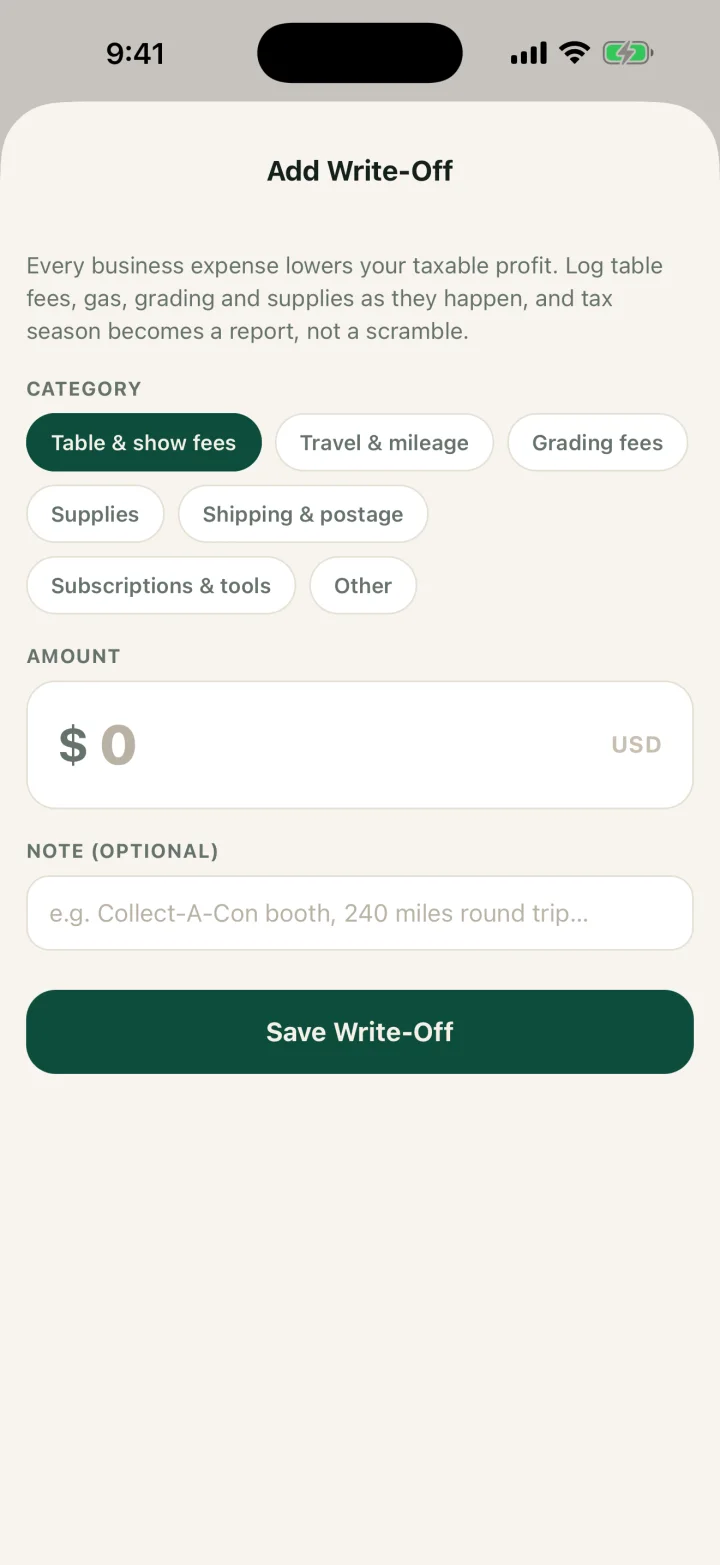
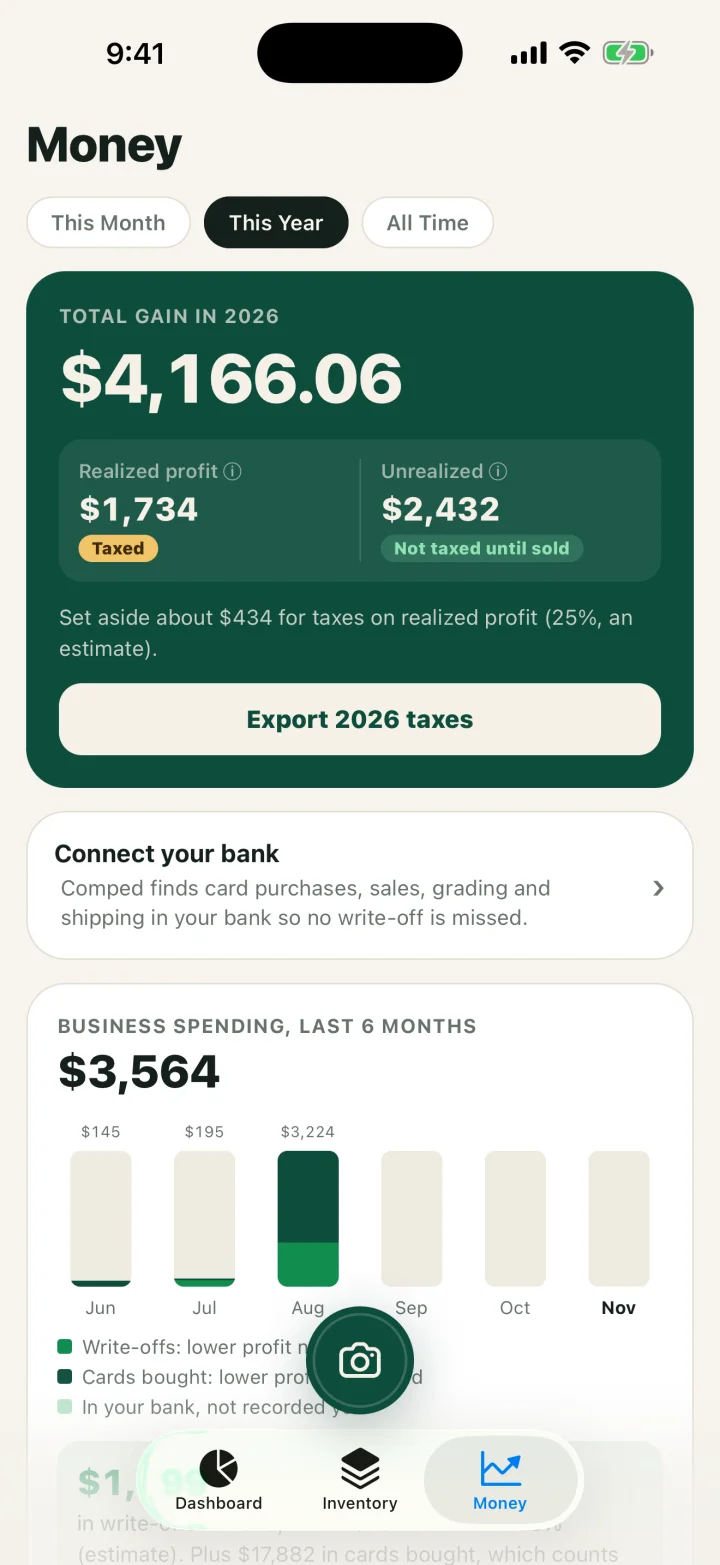
Comped does not compute or file Georgia sales tax. It keeps the records Form FS-32's taxable sales box is built from. The Transaction screen shows one sale with its price, fees and cost. Add Write-Off files the table fee under Table and show fees. The Money tab totals the year and exports it as a CSV.

Related guides
- State by State: Sales Tax and Show Permits for Card Vendors: every state's permit, rate and rules in one place.
- Florida card show sales tax (2026): free dealer registration and a county surtax capped at $5,000 per item.
- North Carolina card show sales tax (2026): the opposite rule, where a single event requires registration.
- Card show sales tax index 2026: the 51-state comparison of permits, fees and promoter duties.
FAQ
I travel to shows in other states, do their rules apply to me?
Yes. In Georgia an out-of-state seller at shows for 5 days or less in any 12 months may not need to register. That seller must still collect tax on every show sale and remit it on Form FS-32.
Do I need a permit to sell at a single card show?
A Georgia-based dealer registers through the Georgia Tax Center. An out-of-state seller who meets all three trade show conditions does not register. Both collect tax at the venue's rate.
How do I pay Georgia the tax if I am not registered?
Complete Form FS-32, Miscellaneous Sales Event, with your taxable sales and the tax collected. Hand it to the Revenue Agent on duty at the close of the event or mail it within 3 days. Pay by check or money order.
What if I made no sales at the Georgia show?
Form FS-32 says to enter a zero on the taxable sales line if no taxable sales are made. The form still goes to the Revenue Agent on duty or in the mail within 3 days of the close of the event.
What is the penalty for filing Georgia sales tax late?
The Department's penalty page lists the greater of 5% of the tax or $5 for each late month, for failure to file. The maximum is the greater of 25% or $25. Failure to pay carries the same amounts.
Does the promoter collect it for me?
No. Each seller collects tax on their own sales. We found no promoter collection or vendor list duty on the Georgia Department of Revenue's sales tax pages.
Do I charge sales tax on cash?
Yes. The venue's total rate applies to every retail sale at the table. Cash, card or a payment app makes no difference to the tax.
What is the sales tax rate at an Atlanta card show?
Inside the City of Atlanta the total rate is 8.9% for October to December 2026. Cobb and Gwinnett counties are 6%. Georgia updates its rate chart each quarter, so check the chart for the show date.
SOURCES
- Out-of-State Sellers, Georgia Department of Revenue, checked November 13, 2026.
- Form FS-32, Miscellaneous Sales Event (Rev. 09/25/26), Georgia Department of Revenue, checked November 13, 2026.
- Penalty and Interest Rates, Georgia Department of Revenue, checked November 13, 2026.
- Tax Registration, Georgia Department of Revenue, checked November 13, 2026.
- Sales and Use Tax Registration FAQ, Georgia Department of Revenue, checked November 13, 2026.
- Sales Tax Rates, General (chart effective October 1, 2026), Georgia Department of Revenue, checked November 13, 2026.
- Sales and Use Tax Due Dates, Georgia Department of Revenue, checked November 13, 2026.
- Form ST-5, Sales Tax Certificate of Exemption (Rev. 07/11/22), Georgia Department of Revenue, checked November 13, 2026.
- Marketplace Facilitators, Georgia Department of Revenue, checked November 13, 2026.
- Taxes and import charges, eBay, checked November 13, 2026.
- IRS issues FAQs on Form 1099-K threshold, IRS, checked November 13, 2026.
This is general information for card sellers, not tax or legal advice for your situation. Rules change and states differ; a CPA who knows your numbers wins every time.