What a record needs for taxes
A record has to show what came in, what went out, and what each card cost. The IRS says you may choose any recordkeeping system suited to your business that clearly shows your income and expenses. Publication 583 adds that, except in a few cases, the law does not require any specific kind of records.
Publication 583 lists the documents that support each number. For gross receipts: cash register tapes, bank deposit slips, receipt books, invoices, credit card charge slips and Forms 1099-MISC and 1099-NEC. For the cost of inventory: canceled checks, cash register tape receipts, credit card sales slips and invoices. For expenses: canceled checks, account statements, invoices and petty cash slips for small cash payments.
A show table has no cash register, so the log you keep is the receipt book. Tax is owed on profit, and the master tax guide explains how that profit is taxed. Profit needs both halves of the deal on record.
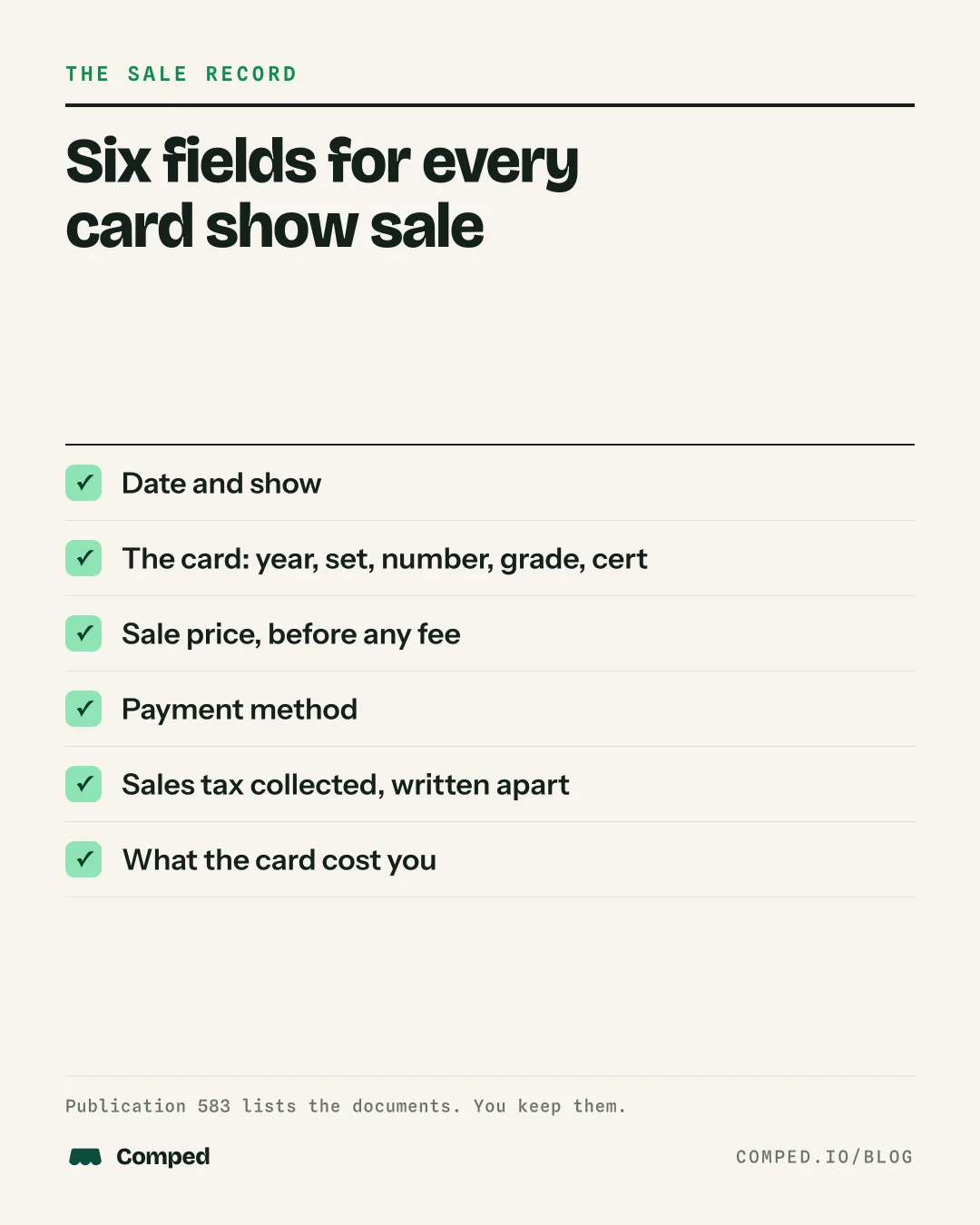
| Field | Why it is there |
|---|---|
| Date and show | Puts the sale in a tax year and a state |
| Card | Year, set, number, grade and cert, so the sale matches one card in inventory |
| Sale price | Gross, before any fee, the same way a 1099-K counts it |
| Payment method | Cash, card reader, payment app or trade, so deposits and forms can be matched |
| Sales tax collected | Owed to the state, so it is written apart from the price |
| Cost of the card | Without it the IRS can treat the cost as zero |
The six fields are our reading of what the IRS lists, not an IRS form. Buys and trades need a record too, and a later section covers each kind of deal.
The paper log
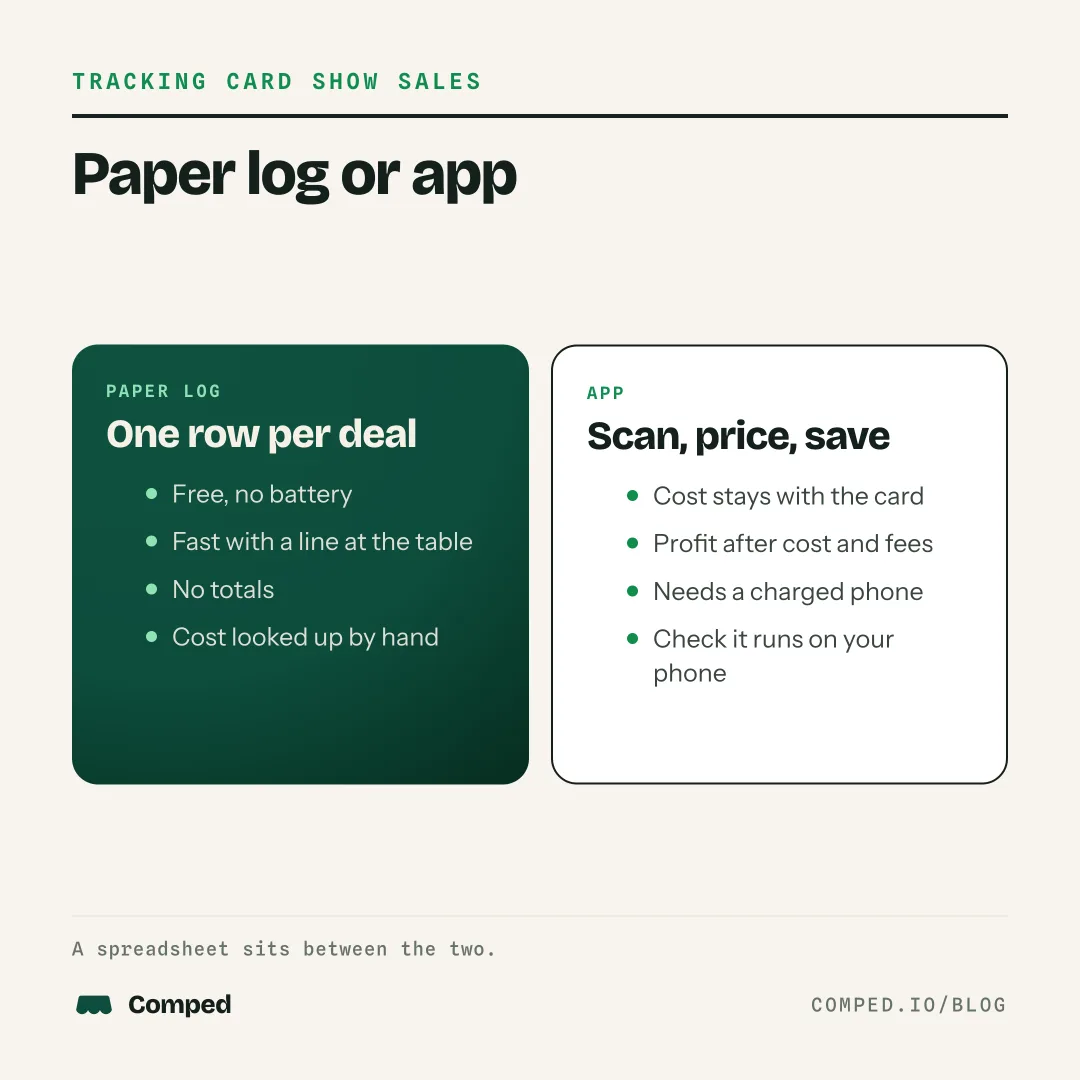
A paper log is one sheet per show with one row per deal. It costs nothing, needs no battery and works with a line at the table. Our printable card show cash log has a row for each buy, sale or trade. Each row takes the time, the cards, cash in and out, trade value in and out, the payment method, sales tax collected and a note.
The weakness is everything after the show. Paper does not add itself up, and it does not know what a card cost. You have to look the cost up and type the day into something else. A sheet can also get lost or wet, so photograph it before you pack up.
Paper suits a vendor who does a few shows a year, or anyone as a backup.
The spreadsheet
A spreadsheet holds every card on one row, from the buy to the sale, and does the arithmetic. Our card inventory and profit spreadsheet has 21 columns per card. Cash paid, trade value, grading fee and other costs add up to the card's basis. The sale side subtracts fees and shipping to show profit, and a Summary sheet totals the year.
For the show itself, the card show inventory sheet is the list of what is in your cases. Print it, mark cards off as they sell, and update the main file that night. Vinnie Rullo describes the same routine in his All Vintage Cards guide: write down what you sell at the show and update the tracker later.
The weakness is the table. Typing into cells on a phone with a buyer waiting is slow. Writing on paper and entering it later works if you do it the same night. It fails if the sheets sit in a bag until April. Volume is the other limit. A seller in an Elite Fourum thread on inventory trackers warned that a detailed sheet gets very time-consuming at high sales volume.
An app
An app records the deal on your phone while the buyer is still at the table, and keeps the cost attached to the card. Several apps are built for show vendors. Our comparison of card show vendor apps lists what each one's own site says it does and what it costs.
Our own app, Comped, runs on iPhone only: it scans a card, records the buy, sale or trade, and keeps cost per card and write-offs.
The limits are real for any app. It needs a charged phone, and it has to run on the phone you own. Check the platform, the free limits and the price on the comparison before the show, not at the table. A card reader's sales report is a record too, but only of card payments. It supports gross receipts and says nothing about cost.
The three methods compared
All three can produce a record that holds up. They differ in when the work happens.
| Method | At the table | After the show | Weak point | Suits |
|---|---|---|---|---|
| Paper log | Write one row per deal | Add it up and match each sale to a cost by hand | No totals, no cost, easy to lose | A few shows a year, or a backup |
| Spreadsheet | Usually paper, typed in later | Enter the day; formulas give profit and yearly totals | Slow on a phone, depends on the night-of entry | A seller who also sells online and likes one file |
| App | Scan or type the card, enter the price | Little, if every deal was entered | Needs a charged phone, and one the app runs on | Frequent shows and many cards |
Mixing is fine. A paper log beside the cash box is a sensible backup even with an app, for the moments when the table is three deep.
Totals and a count, the common shortcut
Many vendors skip per-card tracking and keep totals, which can work for taxes only if a real inventory count backs it. In a 2025 Elite Fourum thread, one vendor records starting cash, cash paid out and electronic payments each day, not each item. Another counts inventory after every show. Two said they do not track deals closely at all.
The first two habits together are how Schedule C figures cost of goods sold. Part III starts with inventory at the beginning of the year, adds purchases, and subtracts inventory at the end. An example: you start 2026 with $6,000 of cards at cost, buy $14,000 more, and hold $8,500 at cost on December 31. Cost of goods sold is $11,500.
The shortcut has three weak points. You still need a cost for every card you hold at year end, so the purchase records cannot be skipped. You never learn which cards made money. And a missing card looks the same as a sold one. If you use it, record sales totals by payment method every day and keep every purchase receipt.
How to record each kind of deal
Each kind of deal needs the same six fields, plus one or two of its own. The table covers the ones that cause trouble.
| Deal | What to write | Why |
|---|---|---|
| Cash sale | Item number, price, tax collected, "cash" | No form reports it, so this row is the only record |
| Card reader or payment app sale | The same, with the method named | The total must match the processor's report. Its fee is an expense |
| Bundle | One price, split across the cards in proportion to their stickers | Three cards stickered $60, $40 and $25 sold for $100 are $48, $32 and $20 |
| Dollar box | A tally of cards sold and the money taken | Cost per card comes from the lot. See the cost basis calculator |
| Buy at the table | Seller's name, date, item and price, on a written receipt | This is the proof of cost when the card sells |
| Trade, with or without cash | The value of what you got, the value of what you gave, cash either way | A trade is barter under Tax Topic 420. The trade calculator does the math |
| Card sent for grading | Add the fee to that card's cost | Our reading, since no IRS guidance covers grading. A $20 card with a $25 fee costs $45 |
| Box or break opened for singles | Split the box cost across the cards you keep to sell | A reasonable method used every time. No IRS ruling is specific to cards |
| Refund | Its own row, and the card back in inventory at its cost | Returns have their own line on Schedule C, line 2 |
| Card moved to your collection | Mark it withdrawn, with the date | Line 36 is purchases less items withdrawn for personal use |
| Show in another state | The state on every row | Sales tax goes to the state where the sale happened |
| More than $10,000 in cash from one buyer | The buyer's details, that day | Form 8300 is due within 15 days. See Form 8300 for card dealers |
The cost basis guide works a cash buy and a trade from start to finish.
Tracking inventory
Vendors track inventory by giving every card one line with its cost, and marking the line when the card sells. A short item number on the price sticker ties the card in the case to its row. When the card sells, write the item number on the sale row and the cost follows.
Bulk boxes get one line per box or lot, with a count before and after the show. A slab's cert number already works as its ID.
Cards you still hold at year end are not an expense yet. A small reseller deducts a card's cost in the year the card sells, which is why the list has to be right on December 31. Our guide to the year-end card inventory count covers that day.
ONE SALE, ONE ROW
An example: card A14, stickered at $220, sells for $190 cash at a New Jersey show. It cost $140.
The record holds the price you took, not the sticker. How to price cards for a card show covers the sticker.
Tracking expenses and miles
Track show expenses the day you pay them, with the receipt and one line saying what it was for. The table fee, supplies, postage and lodging each lower your profit. Keep the promoter's receipt or the signed contract for the table.
Miles need their own log. The 2026 rate is 72.5 cents a mile to June 30 and 76 cents from July 1. Schedule C asks for your business miles and whether you have written evidence for them. One line per trip with the date, the show and the round-trip miles answers both. The write-offs guide lists what a vendor can deduct.
After the show: the cash count
Close the day by counting the cash against the record. Starting cash, plus cash sales and tax collected, minus cash you paid for cards, should equal what is in the box. Publication 583 shows a daily summary of cash receipts built the same way.
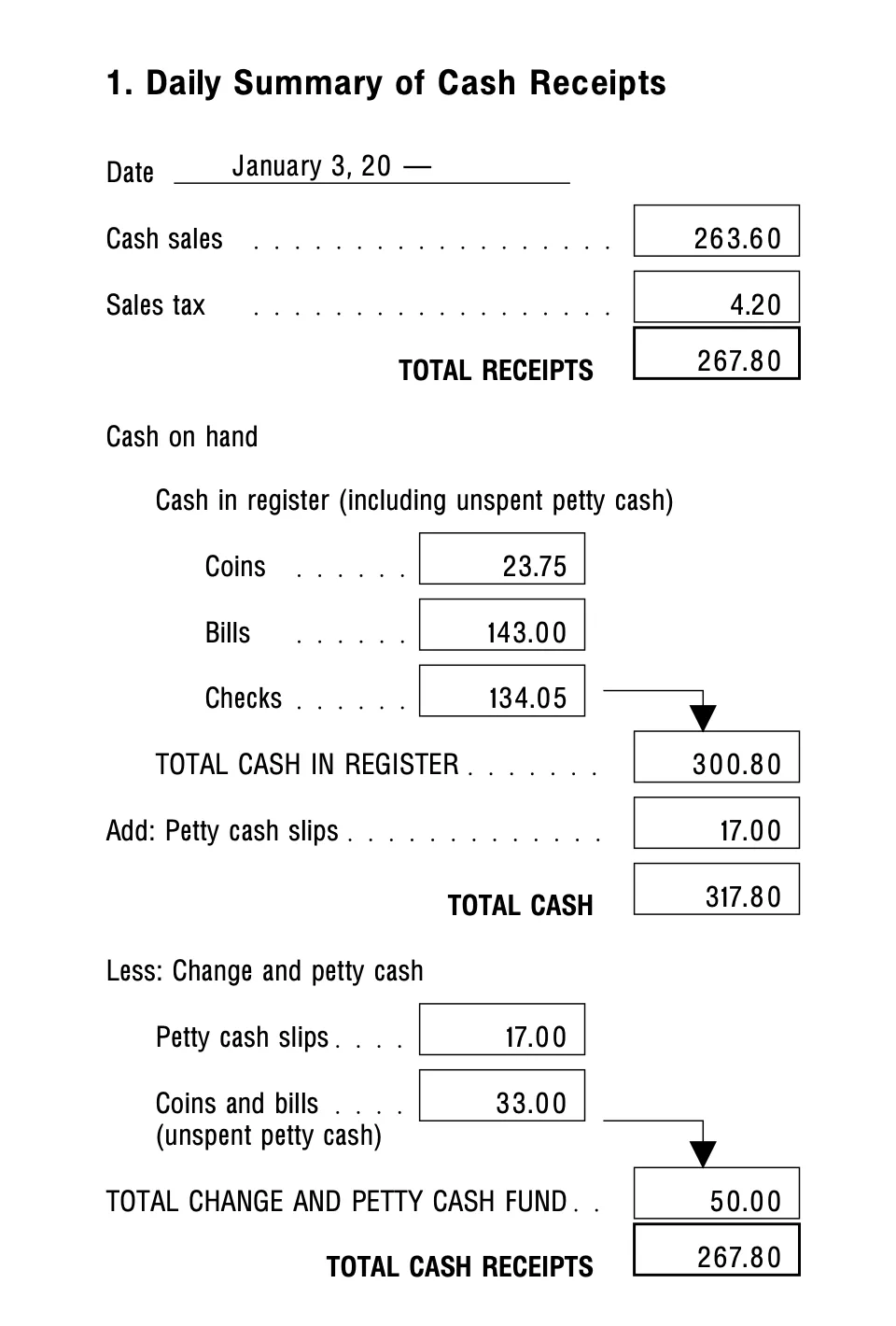
A SHOW DAY, COUNTED
An example for a New Jersey show, where every cash sale had 6.625% tax added.
Write down any difference while you still remember the day. A small one is usually change. A large one is a deal that never reached the log.
Deposit show cash in a business account kept apart from your personal one, as Publication 583 advises. Card reader and payment app totals should match your rows by payment method. A Form 1099-K reports gross payments and subtracts nothing, so your rows are how you show fees and cost. The 1099-K reconciliation calculator walks from the form's total to your profit.
Keep the records for 3 years after you file, per the IRS records page. Keep them 6 years if income was under-reported by more than 25%. Publication 583 applies the same rules to electronic records as to paper ones.
Where the records go on Schedule C
The sales log feeds line 1 of Schedule C and the cost records feed Part III, which carries to line 4. The form below is the 2026 version. The line matches in the table are our reading; a CPA may place an item differently.
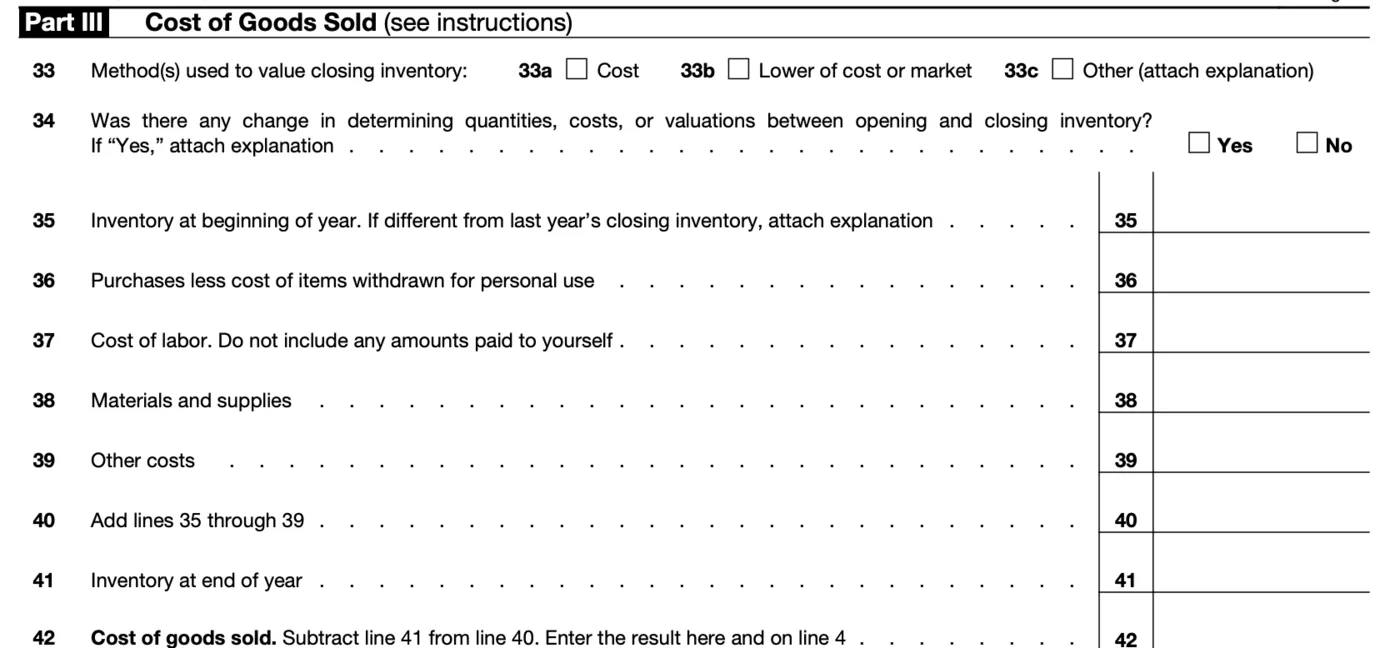
| Your record | Schedule C line |
|---|---|
| Total of sale prices for the year, all payment methods | Line 1, gross receipts or sales |
| Refunds you gave | Line 2, returns and allowances |
| Cards bought during the year, less cards moved to your collection | Line 36, purchases |
| Unsold cards at cost on December 31 | Line 41, inventory at end of year |
| Cost of the cards sold | Line 42, carried to line 4 |
| Business miles | Line 9, with the miles in Part IV |
| Marketplace and payment fees | Line 10, commissions and fees |
Sales tax is why it gets its own column. The Schedule C instructions for 2025 treat it two ways. Tax imposed on the buyer, which you collect and pay over, is left out of gross receipts and is not an expense. Tax imposed on you as the seller goes in line 1 and is deducted on line 23. Which one applies depends on the state. A separate column lets your preparer do either.
If you have not been tracking
If the year is partly gone and nothing is written down, rebuild it now, while the evidence still exists. Work in this order.
- Pull every bank deposit, card reader report and payment app history for the year. Those are your sales that left a trail.
- Estimate cash sales that were never deposited from what you remember of each show, and label them as estimates.
- List every card you still hold, and find what each cost: order histories, bank statements, messages and photos.
- Do the same for the cards you sold. A sale with no cost on record can be taxed in full.
- Start a log today, so the rest of the year is not rebuilt too.
Our guide to card sales with no receipts covers what counts as proof when the receipt is gone.
How this looks in the Comped app
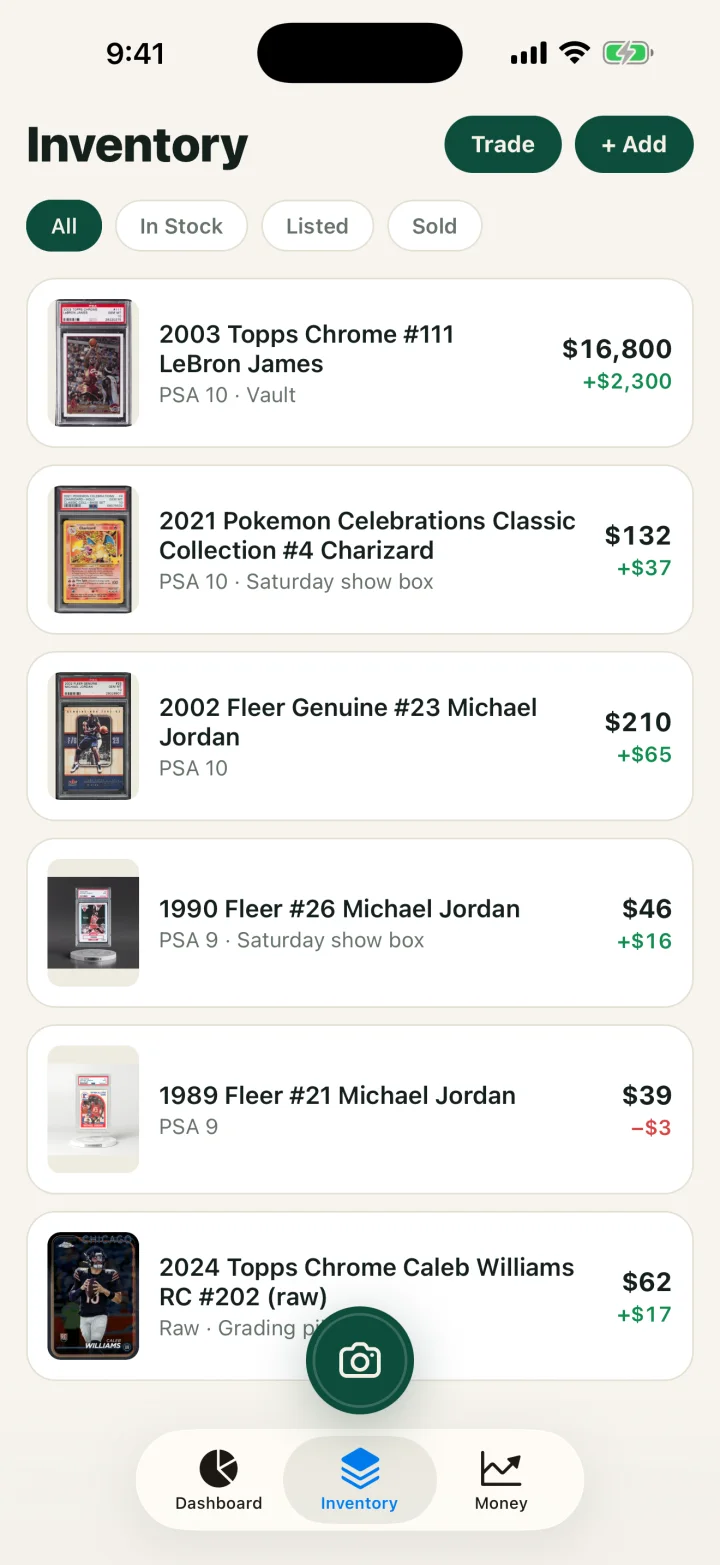
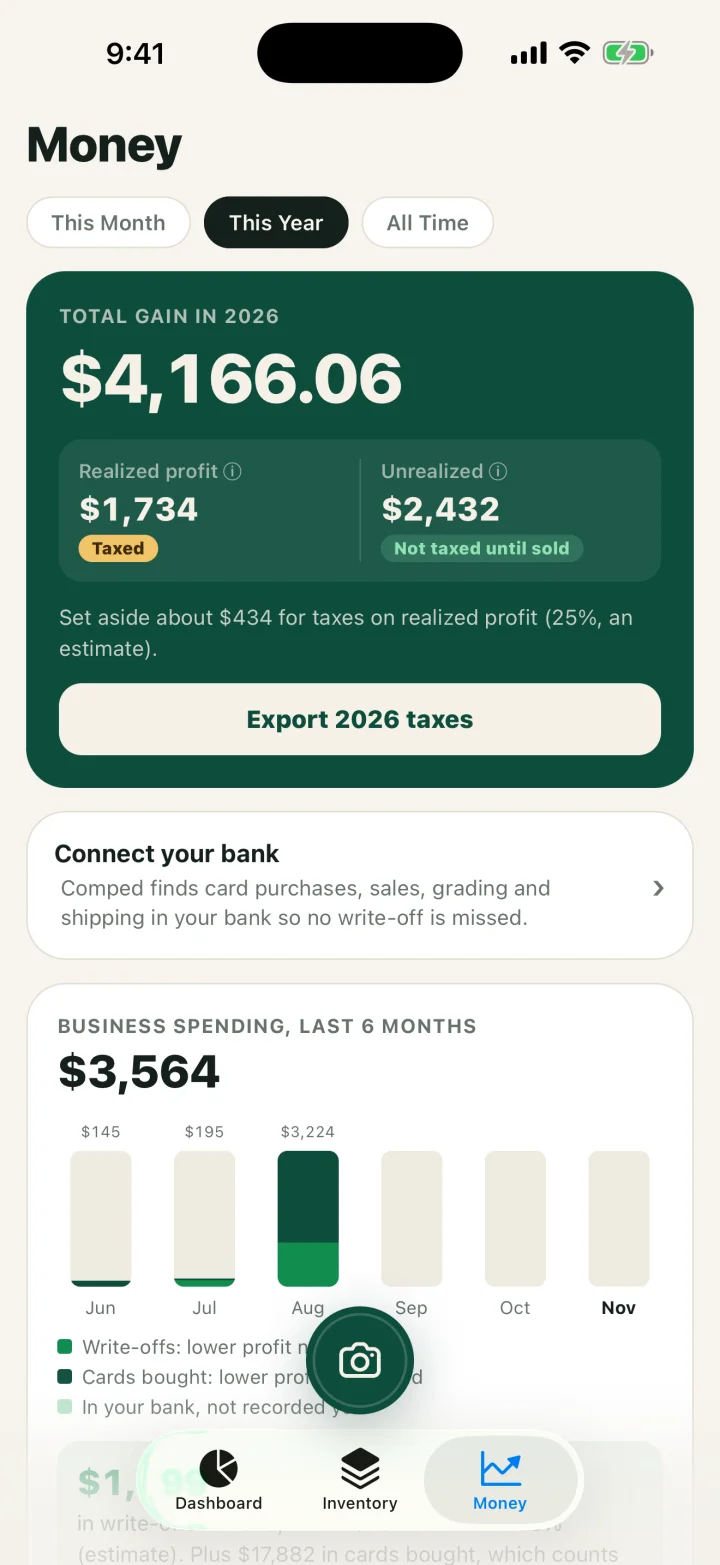
These three screens are the current iPhone app with demo data. The transaction screen breaks one sale into price, fees, cost basis and true profit. Inventory marks each card In Stock, Listed or Sold. The Money tab exports the year as a CSV: a Schedule C style summary, then every sale, card bought and write-off. The app has no separate field for sales tax collected, so keep that column on the cash log.

Related guides
- The Card Vendor's Master Guide to Taxes: where the sales, the costs and the expenses land on the return.
- Cost basis for cards bought with cash or by trade: the receipt behind the cost column.
- How to become a card show vendor: the table, the sales tax registration and the first tax year.
- Card sales with no receipts: what to do about the deals that were never written down.
FAQ
How do vendors track inventory at a card show?
Each card gets one line with its cost, and a short item number on the price sticker ties the card to that line. When the card sells, the vendor writes the item number, the price and the payment method. Slabs can use the cert number. Bulk boxes are counted before and after the show.
What should a card show sales log include?
Six things for each sale: the date and show, the card, the sale price, the payment method, the sales tax collected and what the card cost. Buys need the seller's name, the date, the item and the price. Trades need the value of both sides and any cash.
Does the IRS require a certain app or format?
No. The IRS says you may choose any recordkeeping system suited to your business that clearly shows your income and expenses. Publication 583 says the law does not require any specific kind of records, except in a few cases. Paper, a spreadsheet and an app can all do the job.
Do I have to record cash sales?
Yes. A cash sale is taxable like any other sale, and tax is owed on the profit whether or not a form reports it. No one issues a form for cash at a table, so your own record is the only one.
Is the sales tax I collect part of my income?
It is money you hold for the state, so record it apart from the sale price. The Schedule C instructions leave out of gross receipts a sales tax imposed on the buyer that you collect and pay over. Where the tax is imposed on the seller, it is included and then deducted. Ask your preparer which applies in your state.
Nobody is handing out tax forms at card shows. What proves my numbers?
Your own records made at the time. Publication 583 lists receipt books, invoices, bank deposit slips and credit card charge slips. At a show that means your sales log, written receipts for cash buys and your deposits. A record written the same day is easier to stand behind than one rebuilt months later.
What if I never tracked my sales this year?
Rebuild the year now. Pull bank deposits, card reader reports and payment app history for sales, then find the cost of each card from order histories, statements and messages. Label estimates as estimates, and start a log today so the rest of the year is recorded as it happens.
How long do I keep card show records?
Keep them 3 years after you file the return they support. Keep them 6 years if income was under-reported by more than 25 percent, and indefinitely if no return was filed. A card bought years before it sells needs its purchase record for that whole time.
SOURCES
- Publication 583, Starting a Business and Keeping Records (rev. December 2024), IRS, checked November 2026.
- Recordkeeping, IRS, checked November 2026.
- Schedule C (Form 1040), 2026, IRS, checked November 2026.
- Instructions for Schedule C (Form 1040), 2025, IRS, checked November 2026.
- Topic no. 420, Bartering income, IRS, checked October 2026.
- How long should I keep records?, IRS, checked October 2026.
- Form 1099-K FAQs, general information, IRS, checked October 2026.
- Standard mileage rates, IRS, checked October 2026.
- Publication 334, Tax Guide for Small Business, IRS, checked October 2026.
- Vendor threads and guides read November 13, 2026, linked where cited: the Elite Fourum forum and All Vintage Cards.
This is general information for card sellers, not tax or legal advice for your situation. Rules change and states differ; a CPA who knows your numbers wins every time.