THE LOT
THE CARDS
THE BOX, CASE OR BREAK SPOT
THE CARDS YOU KEEP TO SELL
THE CARD YOU BOUGHT
TOTAL COST BASIS, 5 CARDS
$1,000.00
Split by each card's share of $2,500.00 in comp value
Every dollar of the price lands on a card, once. No IRS ruling is specific to cards, so keep this split with the receipt and use the same method on the next lot.
COST BASIS PER CARD
| Card | Comp value | Share | Cost basis |
|---|---|---|---|
| Rookie card, PSA 9 | $800.00 | 32% | $320.00 |
| Vintage star, raw | $500.00 | 20% | $200.00 |
| Insert, PSA 10 | $450.00 | 18% | $180.00 |
| Autograph, raw | $350.00 | 14% | $140.00 |
| Bulk, sold as one lot | $400.00 | 16% | $160.00 |
| Total | $2,500.00 | 100% | $1,000.00 |
LIST TO COPY
COMPED DOES THIS AT THE TABLE
The record you make at the table is also the tax record. Comped keeps each card in inventory with its cost, and when the card sells that cost comes off inventory and into the profit on the sale.
How the split works
The calculator spreads one price across the cards so the per-card costs add back to the price, to the cent. By value share, each card takes the same fraction of the cost that it holds of the total comp value. Evenly, each card takes an equal slice. Sales tax or shipping you paid on the buy is added to the price first, because it is part of your cost.
Basis decides the taxable profit. Profit is the sale price minus basis minus selling costs, and tax is owed on that profit, not on the sale. The cost basis guide for cash and trade buys explains each rule this page applies, and the master tax guide covers where the number lands on the return.
What goes into a card's cost basis
Basis is everything you paid to get the card, and nothing you paid to sell it. Publication 551 defines cost as "the amount you pay in cash, debt obligations, other property, or services" and lists sales tax and freight as part of it.
| What you paid | In the basis? | Why |
|---|---|---|
| The price of the card, lot, box or break spot | Yes | It is the amount you paid (Publication 551) |
| Sales tax charged on the buy | Yes | Publication 551 lists sales tax as part of cost |
| Shipping to get the cards to you | Yes | Publication 334 counts freight-in on merchandise bought for sale in cost of goods sold |
| An auction buyer's premium | Yes, our reading | It is part of the amount you paid |
| The value of a card you traded in | Yes | Barter, Tax Topic 420 |
| A grading fee paid later | Yes, the common treatment | No IRS guidance exists on grading fees |
| Platform fees and postage when the card sells | No | Selling costs, deducted on Schedule C as expenses |
| Table fees, mileage, sleeves and top loaders | No | Expenses of the business, not of one card |
A lot bought for one price
A lump sum for a collection is one basis spread across many cards. The IRS states the general rule in Publication 551: "If you buy multiple assets for a lump sum, allocate the amount you pay among the assets you receive." It names no method for trading cards. Our reading is to split the price in proportion to each card's value on the day you bought, write the split down and use the same method next time.
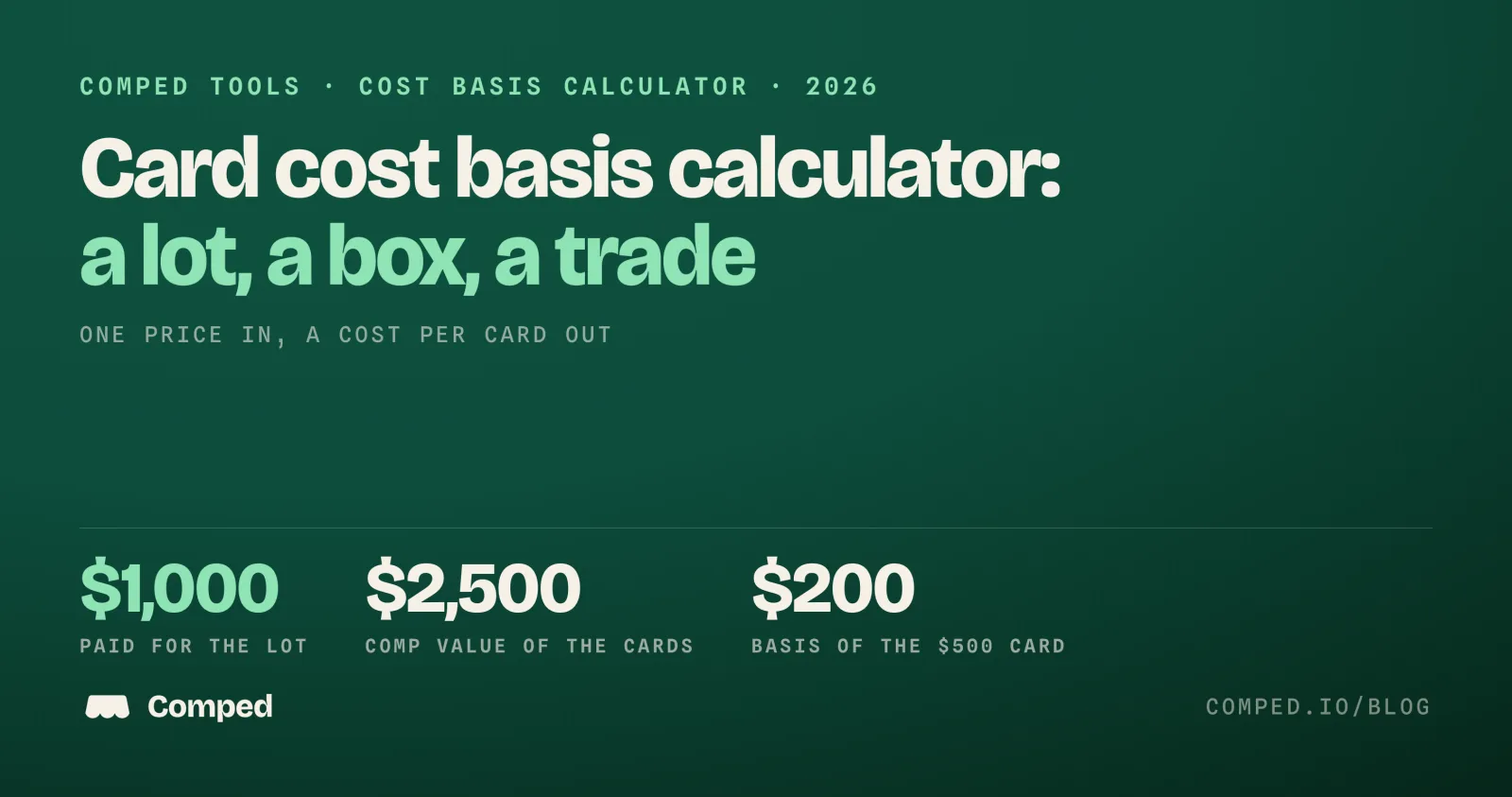
Say you pay $1,000 for a collection whose sold comps add to $2,500. A card that comps at $500 is 20% of the value and gets $200 of basis. Bulk you will sell as one lot can be one line with one basis. Use the even split when the cards are close in value and comping each one is not worth the time. The card price lookup gives a recent sale price for each card in the lot.
| What you bought | Mode | What gets split |
|---|---|---|
| A collection or a stack of cards for one price | A lot for one price | The price, across every card or bulk line |
| A sealed box or case you opened | A box, case or break | The box cost, across the cards you keep to sell |
| A spot in a break | A box, case or break | The spot price, across the cards you received |
| One card for cash plus a card of yours | Cash plus a trade | Nothing. Cash and trade value add up |
A box, a case or a break
A card pulled from a pack has a basis equal to its share of what the pack or box cost. No IRS ruling covers cards, so this is the reasonable method, not a published rule. Say a $120 box yields one hit that comps at $400 and bulk worth $50. By value share the hit carries $106.67 and the bulk $13.33.
A $120 BOX, SPLIT BY VALUE
The hit is not free, and the whole box is not the hit's basis either.
Sellers ask whether the one good card can carry the whole box. With a value split it nearly does, and the math decides it for you. Leave out cards with no resale value, or enter $0 for them, and they take no cost. If the bulk in this box is worthless, the hit carries all $120. What does not hold up is putting the whole cost on the hit and then selling the other cards as pure profit. Every dollar lands on a card once.
A break spot works the same way: the price of the spot is the cost, spread across the cards you received. Here is an example with made-up comps.
A $300 BREAK SPOT, THREE CARDS, EXAMPLE
Sell card one for $250 and the profit before fees is $35.71, not $250.
List the cards you keep to sell. A card you move to your personal collection should be listed too, so it takes its share. That share comes out of purchases instead of going into cost of goods sold, per Publication 334. A spot that returns no cards leaves nothing to carry the cost, and no IRS guidance covers it. Keep the receipt and ask your preparer.
A card bought with cash plus a trade
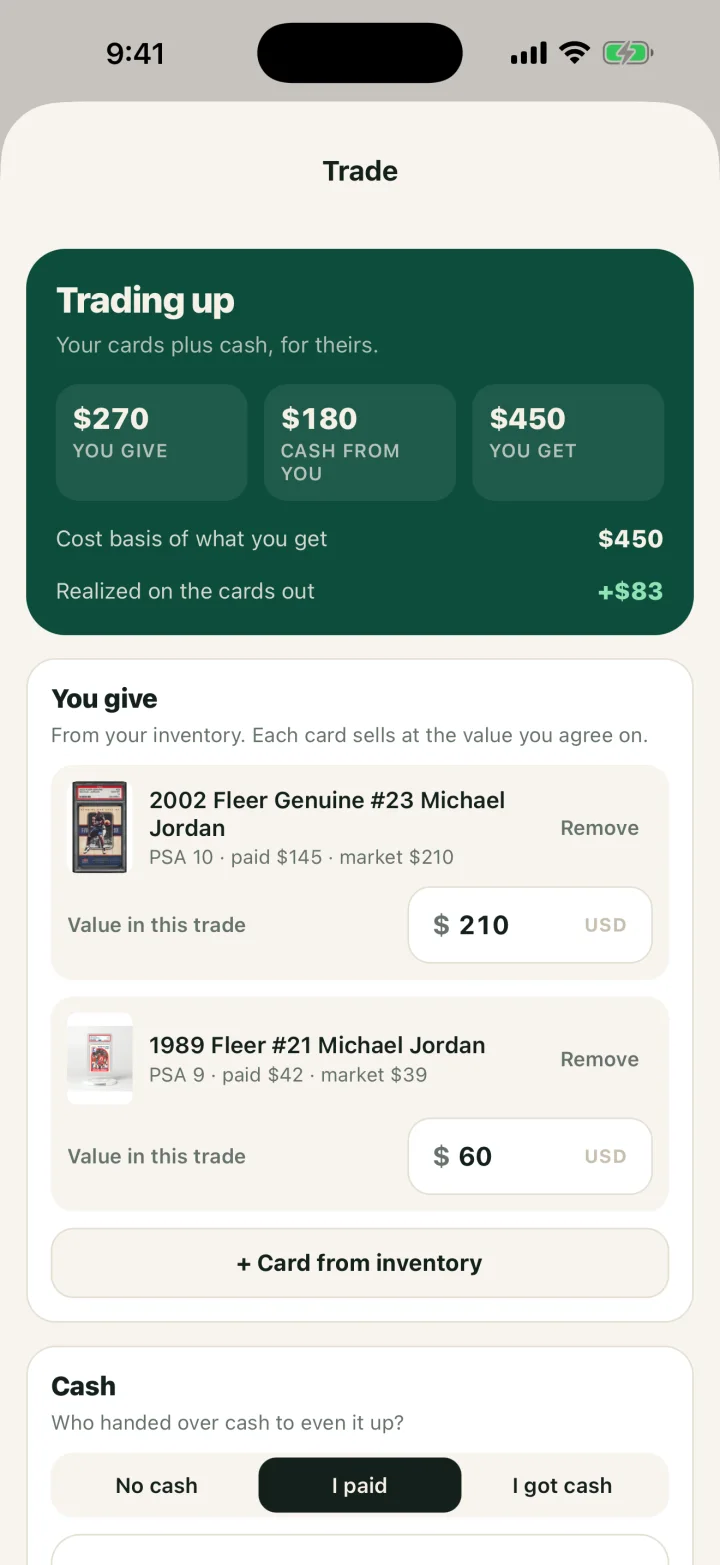
The basis is the cash you paid plus the value of the card you gave. A trade is barter under Tax Topic 420: the value you receive is income, and that value becomes the new card's basis. The card you handed over is sold at its trade value, with its own gain or loss.
The default in this mode is a real deal. A 1966 Topps Batman #1 PSA 3 was bought at a show for $2,100 cash plus a card valued at $75, so its basis is $2,175. The traded card had cost $90, which makes a separate $15 loss. For trades with several cards or a trade percentage, use the card trade calculator.
The Trade screen in the Comped app does this sum for a trade of cards from your inventory. It shows the cost basis of what you get and the gain or loss on the cards going out.
Cards you did not simply buy
Some cards reach your inventory without a purchase price, and each has its own starting point.
| Situation | Where basis starts | Source |
|---|---|---|
| A card you inherited | Generally its fair market value on the date of death | Publication 551 |
| A card you were given | For a gain, the giver's adjusted basis | Publication 551 |
| A childhood collection you now sell | The original cost if you know it. With nothing documented the IRS can assert zero | See the guide on card sales with no receipts |
| A card you keep for yourself | Its share of the lot comes out of purchases | Publication 334 |
| A sealed box you have not opened | The whole cost stays on the box until you sell or open it | Our reading |
| A lot you sell off over two years | Each card keeps its share. Unsold shares stay in inventory at year end | Schedule C, line 41 |
Common mistakes and what they cost
- Putting the whole lot on the first card sold. This year's profit looks too low, and every later card from the lot sells with no cost against it.
- Splitting evenly when values differ. In the default lot an even split puts $200 on the rookie card instead of $320. Sell that card alone this year and profit is overstated by $120.
- Splitting by what the cards later sold for. Use values on the day you bought. That is the day the price was set.
- Leaving out sales tax and shipping you paid. New Jersey's 6.625% on a $1,000 lot is $66.25 of cost that never reaches the return.
- Adding selling fees to basis. Platform fees are already an expense on Schedule C, so they would be deducted twice.
- Keeping no record. With nothing to show what a lot cost, the IRS can assert zero basis and tax the whole sale.
If you already split a lot the wrong way, fix what is still open. For cards not yet sold, redo the split with values from the purchase date and note when and why you changed it. For cards sold in a year you have filed, the total cost of the lot is the same and the error is which year it landed in. Ask a CPA whether an amended return is worth it.
Where the numbers go on Schedule C
Each card's basis feeds Part III of Schedule C, which figures cost of goods sold. What you bought in the year goes on line 36, less the cost of cards you took for yourself. The basis of every card still unsold on December 31 is line 41, inventory at end of year. Line 42 is the cost of the cards you sold, and it carries to line 4.
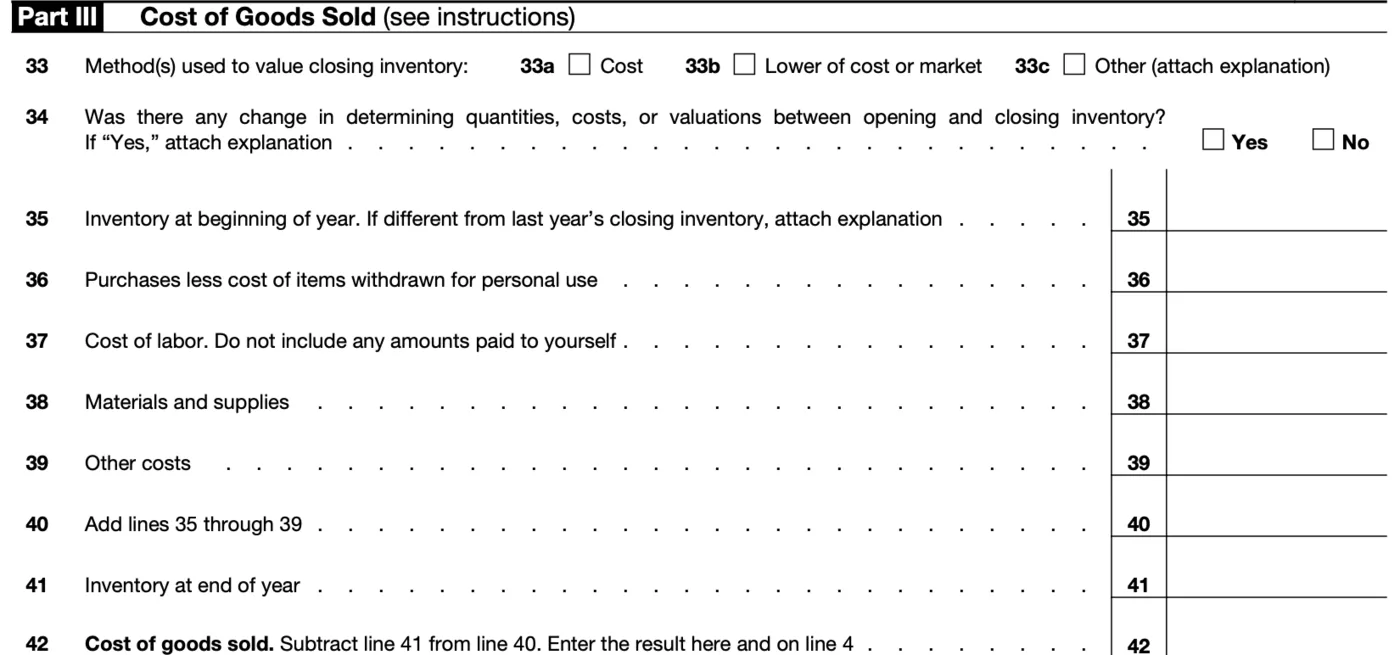
A reseller with average gross receipts of $31 million or less for 2025, or $32 million for 2026, may skip formal inventory accounting and deduct a card's cost when the card sells, per Publication 334. The Schedule C instructions add that the method must still clearly reflect income. Either way a card's cost is deducted in the year it sells, which is why each card needs its own number. The year-end inventory count covers lines 35 and 41.
A grading fee paid later is added to that card's cost. No IRS guidance exists on grading fees, and the post on whether grading fees are deductible explains the common reading. The card inventory spreadsheet has a cost column for the list you copy from this page. When a card sells, the card profit calculator subtracts that basis and the channel's fees from the sale.
Keep the split with the receipt. Publication 583 lists the records that support a purchase, and for a cash buy at a show that means a written receipt with the seller's name, the date, the item and the price. The post on card sales with no receipts covers rebuilding what you can.
Related guides
- The Card Vendor's Master Guide to Taxes: inventory methods and where basis lands on Schedule C.
- Cost basis for cards bought with cash or by trade: the rules behind all three modes.
- Card trade calculator: both sides of a trade, with the cash to make it even.
- Year-end card inventory count: what to do with unsold cards and their cost in December.
- 1099-K vs your real profit: where a year of basis comes off the gross on the form.
FAQ
What is the cost basis for a card pulled from a pack?
Its share of the pack or box cost, spread across the cards you keep and sell by a reasonable method, usually in proportion to value. No IRS ruling is specific to cards. Write the method down and use it for every box.
Can I put the whole box cost on the one hit?
Only if the other cards have no resale value. A value split already puts most of the cost on the hit: $106.67 of a $120 box when the hit comps at $400 and the bulk at $50. If you sell the other cards later, they need their share of the cost, and the total cannot exceed what you paid.
How do I split the cost of a collection I bought for one price?
Divide the price in proportion to each card's value on the day you bought. On a $1,000 lot with $2,500 of comps, a $500 card gets $200. Publication 551 says to allocate a lump sum among the assets you receive but names no method for cards, so keep the split with the receipt and stay consistent.
Should I split by value or evenly?
By value when the cards differ a lot, because an even split would put too little cost on the best card and too much on the bulk. An even split is fine for cards of similar value. Either way, use one method and keep using it.
Is shipping or sales tax part of cost basis?
Yes, when you paid it to buy the cards. Publication 551 lists sales tax and freight as part of cost, and Publication 334 counts freight-in on merchandise in cost of goods sold. Postage you pay to ship a card to your buyer is a selling expense, not basis.
What is the basis of a card I got for cash plus a trade?
The cash plus the agreed value of the card you gave. A card bought for $2,100 cash and a $75 card has a $2,175 basis. The card you gave is treated as sold at $75, with a gain or loss against what you paid for it.
Are grading fees part of basis or an expense?
No IRS guidance exists. For a dealer the fee is a direct cost of the card and is recovered when the card sells. A $20 raw card with a $25 grading fee has a $45 basis, so a $120 sale is a $75 profit.
What if I have no record of what a lot cost?
Document what you can: when and where you bought, from whom, and what you paid. Old statements and purchase histories count. With no record at all the IRS can assert zero basis, and then the whole sale is taxable.
SOURCES
- Publication 551, Basis of Assets (Rev. December 2025), Internal Revenue Service, checked November 13, 2026.
- Publication 334, Tax Guide for Small Business (for 2025 returns), Internal Revenue Service, checked November 13, 2026.
- Topic no. 420, Bartering income, Internal Revenue Service, checked October 2026.
- Publication 583, Starting a Business and Keeping Records, Internal Revenue Service, checked October 2026.
- Schedule C (Form 1040), Profit or Loss From Business, 2026, Internal Revenue Service, checked November 13, 2026.
- Instructions for Schedule C (2025), Internal Revenue Service, checked November 13, 2026.
This is general information for card sellers, not tax or legal advice for your situation. Rules change and states differ; a CPA who knows your numbers wins every time.