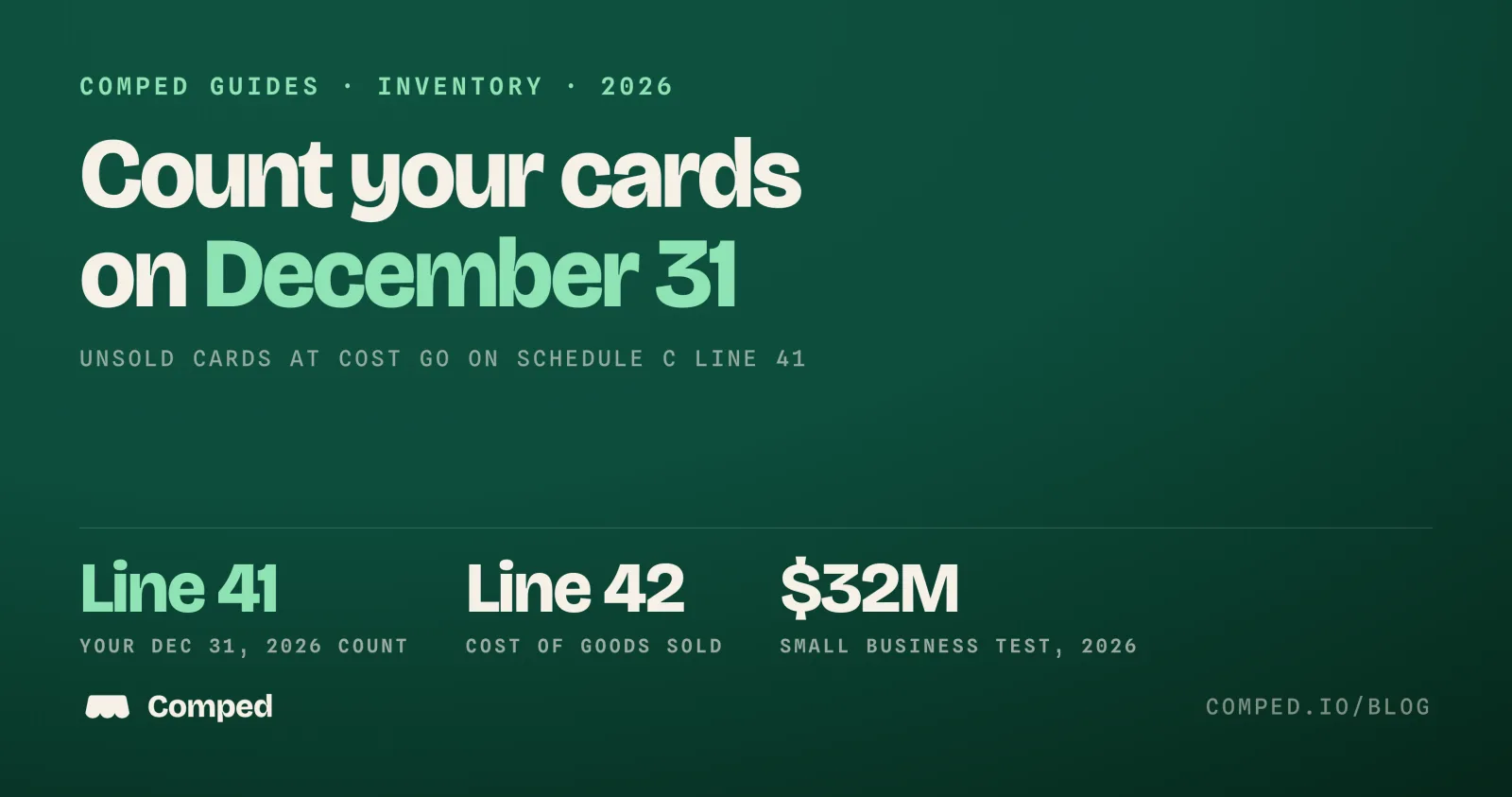
Why the December 31 count matters
The count decides how much of what you bought this year you can deduct this year. Cost of goods sold is not what you spent on cards. It is what you spent on the cards that sold. The master tax guide covers where that number sits in the full return.
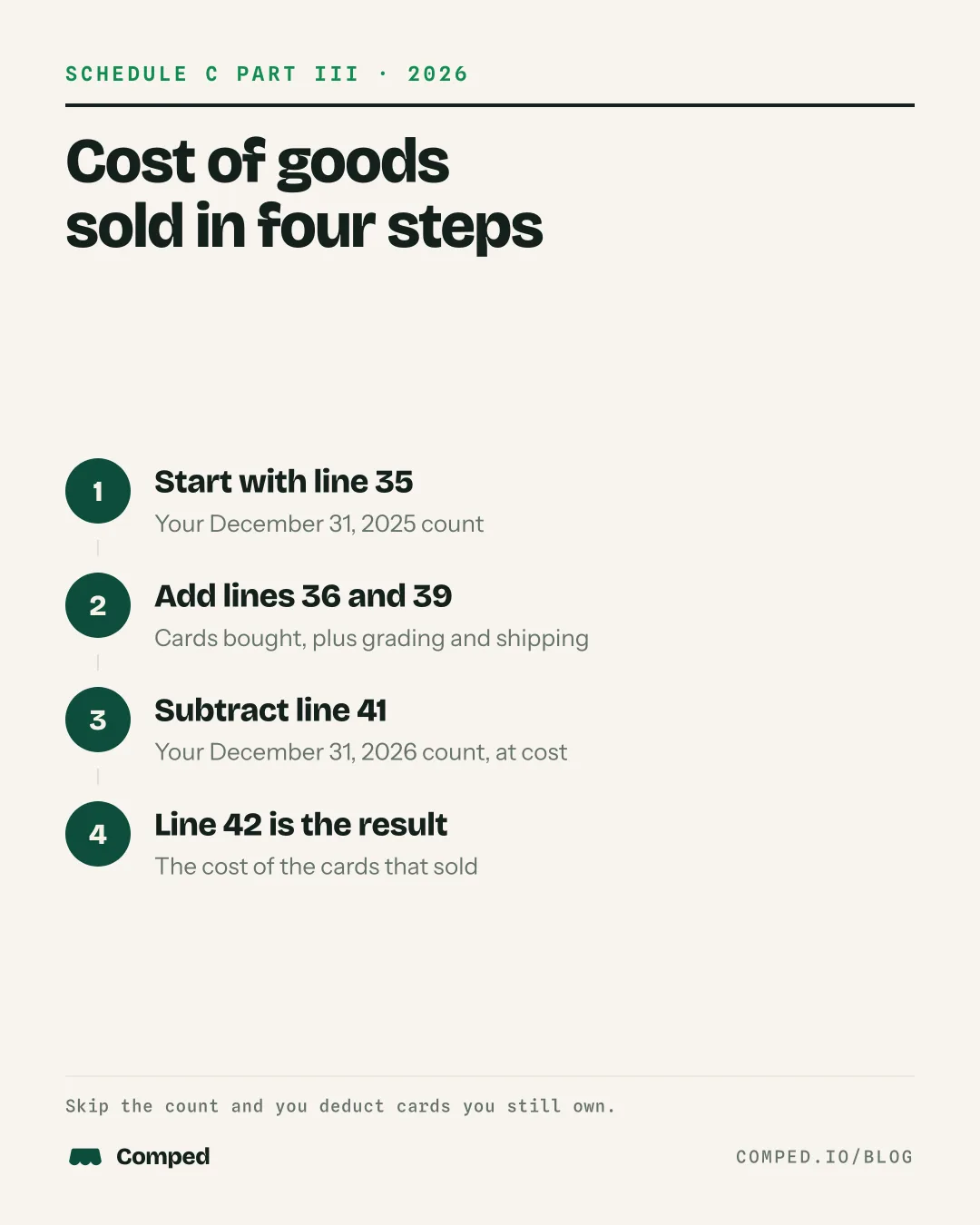
Part III of Schedule C does the math in eight lines. Line 35 is inventory at the start of the year. Lines 36 to 39 add purchases and other costs, line 40 totals them, and line 41 subtracts the inventory left at the end. Line 42, cost of goods sold, carries to line 4.
| Line | What it is | For a card seller |
|---|---|---|
| 33 | Method used to value closing inventory | Cost, or lower of cost or market |
| 35 | Inventory at beginning of year | Your December 31, 2025 count |
| 36 | Purchases less items withdrawn for personal use | Cards bought for resale, minus cards moved to your collection |
| 39 | Other costs | Grading fees and shipping to the grader |
| 40 | Add lines 35 through 39 | Everything you had available to sell |
| 41 | Inventory at end of year | Your December 31, 2026 count |
| 42 | Cost of goods sold | Line 40 minus line 41 |
The count does two jobs. It is line 41 for 2026 and line 35 for 2027. If line 35 differs from last year's closing inventory, the form asks for an explanation. A skipped count follows you into next year.
The small business exception
Most card sellers qualify for it, and it changes the method, not the timing. Publication 334 lets a small business taxpayer choose not to keep a formal inventory. The test is average annual gross receipts for the 3 prior tax years.
The limit is $31 million for 2025. For tax years beginning in 2026, Rev. Proc. 2025-32, section 4.30, sets it at $32,000,000. That is section 471(c), which borrows the gross receipts test of section 448(c).
Under the exception you pick one of two methods. You treat cards as non-incidental materials and supplies, deducted when they are sold, or you follow your own books. Publication 334 says either way you must still use a method that clearly reflects income.
THE RULE PEOPLE GET WRONG
Forum answers say a small seller can skip the count. The exception lets you skip formal inventory accounting, not the fact that a card is deducted when it sells. To know which cards sold, you need to know which ones did not.
Cost or lower of cost or market
You value the count at cost, or at the lower of cost or market, and you check the box on line 33. Cost means what you paid, plus grading and shipping to the grader. Our post on PSA grading fees explains why the fee belongs to the card.
Lower of cost or market lets you write a card down when its price has fallen. Publication 538 defines market as the usual bid price on the date of inventory. For cards, that is what you would pay to buy the card again, not your sticker price.
Publication 538 says to value each item separately, so a write-down is card by card. Say a slab cost $400 and dealers are buying it at $250 on December 31. Under lower of cost or market it goes on the sheet at $250, and $150 more comes off in 2026. You never write a card up above cost.
Lower of cost or market cannot be used with LIFO. Cards that cannot sell at normal prices, such as damaged ones, go on at their bona fide selling price minus the direct cost of selling. Pick one method and keep it, because inventory practices must be consistent from year to year.
How to count slabs, raw, sealed and lots
Count every card you own for resale on December 31, 2026, at the cost you can prove. December 31 is a Thursday this year. If you are at a show that week, count the nearest quiet day and adjust for what you bought and sold in between.
Publication 538 says to take a physical inventory at reasonable intervals and adjust your book figure to agree with it. That is the count.
- Slabs: one line per slab, by cert number. Cost is the purchase price plus grading and shipping to the grader.
- Raw singles over a few dollars: one line per card, with the receipt date. Cheap raw cards can go by box or binder at the price you paid.
- Sealed product: one line per product, at cost per box or case. A box you opened is no longer sealed; its cost moves to the cards you pulled.
- Lots: split the lot price across the cards the same way every time, by count or by rough share of value. Cards you already sold from the lot carry their share out with them.
- Cards with no receipt: record what you can prove, such as a bank withdrawal, a message or a show date. The IRS can treat an undocumented card as having zero basis.
Cards you moved to your personal collection come off the sheet and out of purchases on line 36. Our post on cost basis for cash and trade buys covers the receipt that proves a show purchase.
The worked example
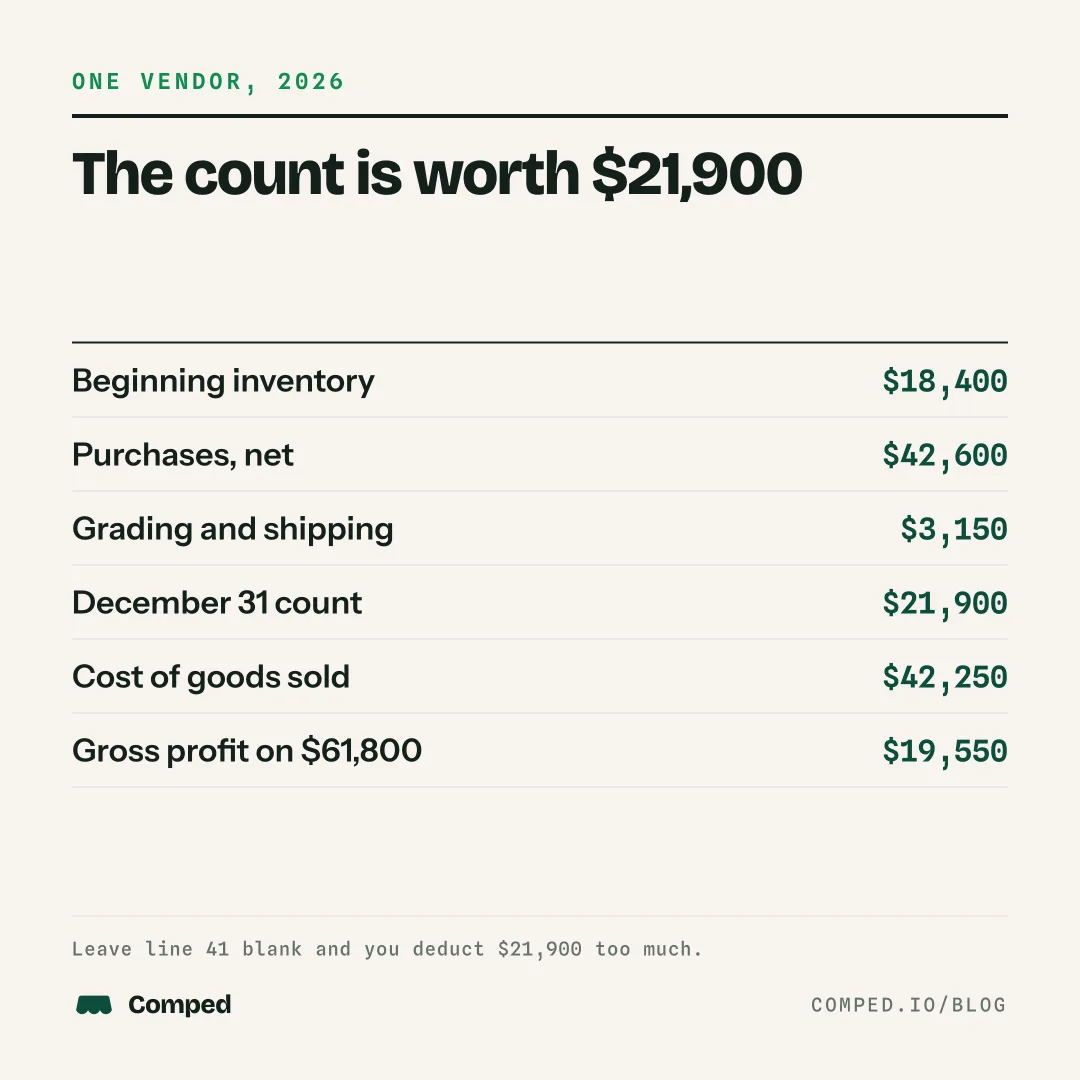
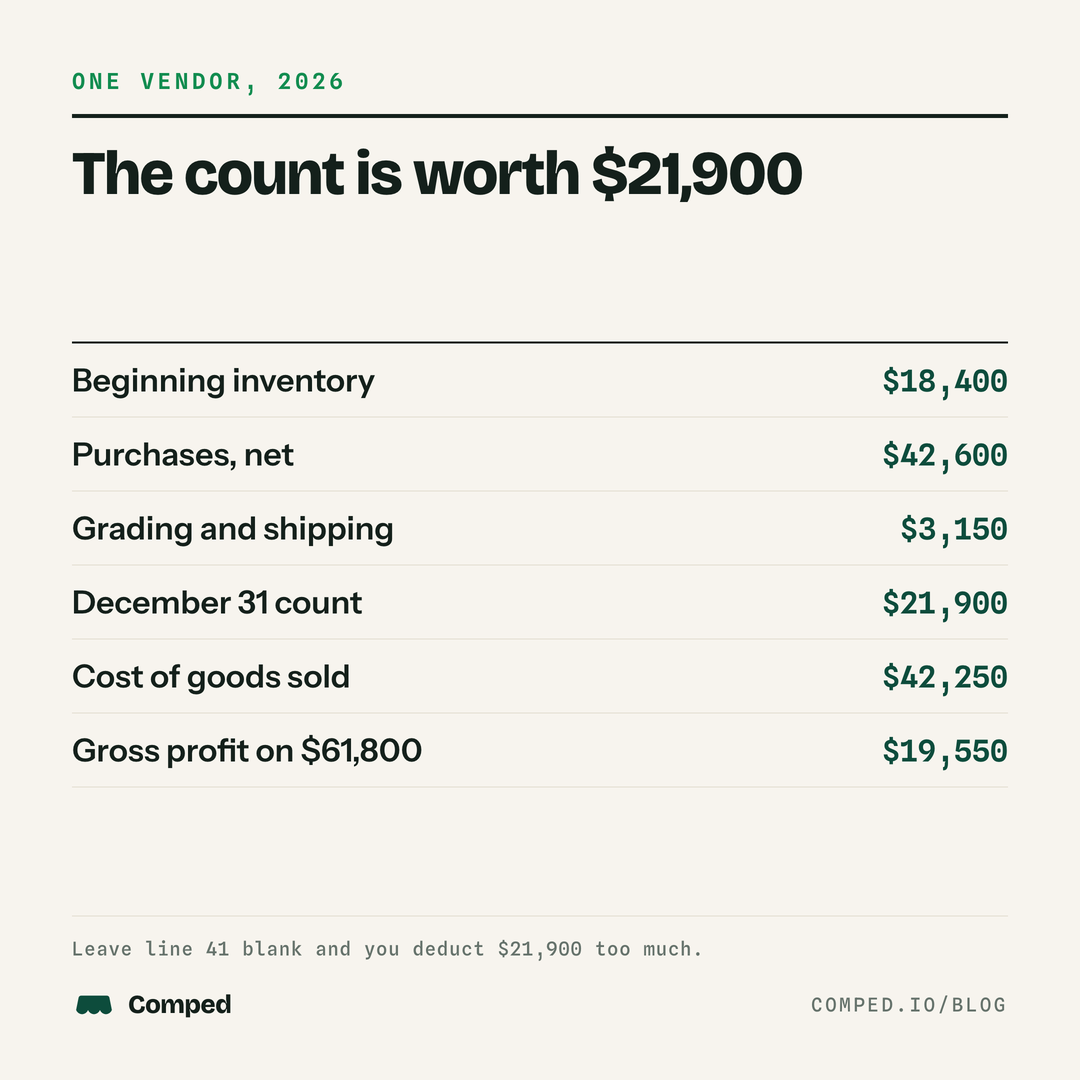
Say a vendor counted $18,400 of cards on December 31, 2025. During 2026 they bought $43,800 of cards, moved $1,200 to their own collection, and paid $3,150 in grading and shipping to the grader. They sold $61,800 of cards, and the December 31, 2026 count comes to $21,900 at cost.
ONE YEAR, WORKED
Schedule C Part III for tax year 2026, with the count done.
On $61,800 of sales, gross profit is $19,550. Leave line 41 blank and cost of goods sold becomes $64,150, a $2,350 loss. That loss deducts $21,900 of cards still in the boxes. Those cards then start 2027 at zero, so every one of them sells as pure profit next year.
The count sheet
The count sheet is one row per item, with what it cost and how you prove it. Print this page, or copy the columns into a spreadsheet. The first three rows are filled in as examples; the rest are for your boxes.
| Item | Type | Cert or ID | Date bought | Proof | Cost | Grading | Value on sheet |
|---|---|---|---|---|---|---|---|
| Example slab, PSA 9 | Slab | Cert number | 2026-03-14 | Show receipt | $400.00 | $25.00 | $425.00 |
| Example hobby box | Sealed | Box 1 of 2 | 2026-09-02 | Invoice | $180.00 | $0.00 | $180.00 |
| Example binder lot, 300 cards | Lot | Binder A | 2026-06-20 | Written receipt | $600.00 | $0.00 | $600.00 |
| Total, line 41 |
Using lower of cost or market? Add a column for the December 31 bid price and put the lower figure last. Sign and date the sheet, and keep it with the return for at least 3 years, per the IRS page on keeping records sets out.
Buying gear before the year closes is a separate question with its own rules. Our post on Section 179 and the $2,500 rule covers cases, scanners and lights.
Run a sale through the card sale tax calculator to see the tax to set aside.
Related guides
- The Card Vendor's Master Guide to Taxes: hobby or business, Schedule C, and every tax a card seller pays.
- Cost basis for cards bought with cash or by trade at a show: the receipt that proves what each card on the sheet cost.
- Are PSA grading fees tax deductible?: why the grading fee belongs to the card on the count sheet.
- Buying a scanner or cases before December 31: Section 179, bonus depreciation and the $2,500 rule for show gear.
FAQ
Do I really have to count my cards if I am a small seller?
The small business exception lets you skip formal inventory accounting if your average gross receipts are $32 million or less for 2026. It does not let you deduct cards that have not sold. A count is the plain way to show which cards are left.
What goes on Schedule C line 41?
The cards you still hold for resale at year end, valued at cost or at the lower of cost or market. For tax year 2026 that is your December 31, 2026 count. The same number becomes line 35 for 2027.
Can I value my inventory at what the cards would sell for?
No. Inventory goes on at cost, or at the lower of cost or market, never above cost. Publication 538 defines market as the usual bid price on the date of inventory, which is a buying price, not a sticker price.
What if I bought the cards years ago with no receipt?
Record whatever proves the cost, such as a bank withdrawal, a message or a show date, and value the card at that cost. If nothing proves it, the IRS can treat the basis as zero. Start written receipts now so next year's count is easier.
Does a card I moved to my personal collection count?
No. It comes off the count sheet, and its cost comes out of purchases on Schedule C line 36. A later sale of that card is a personal sale, not a business sale.
What is the cost of goods sold for trading cards?
Beginning inventory plus purchases and other costs such as grading, minus ending inventory. It is the cost of the cards that actually sold during the year. It comes off sales before any other expense.
SOURCES
- Schedule C (Form 1040) 2026, Part III, IRS, checked November 4, 2026.
- Instructions for Schedule C (Form 1040), IRS, checked November 4, 2026.
- Rev. Proc. 2025-32, section 4.30, IRS, checked November 4, 2026.
- Publication 334 (2025), Tax Guide for Small Business, IRS, checked November 4, 2026.
- Publication 538, Accounting Periods and Methods, IRS, checked November 4, 2026.
- How long should I keep records?, IRS, checked November 4, 2026.
This is general information for card sellers, not tax or legal advice for your situation. Rules change and states differ; a CPA who knows your numbers wins every time.