THE DEAL
YOU
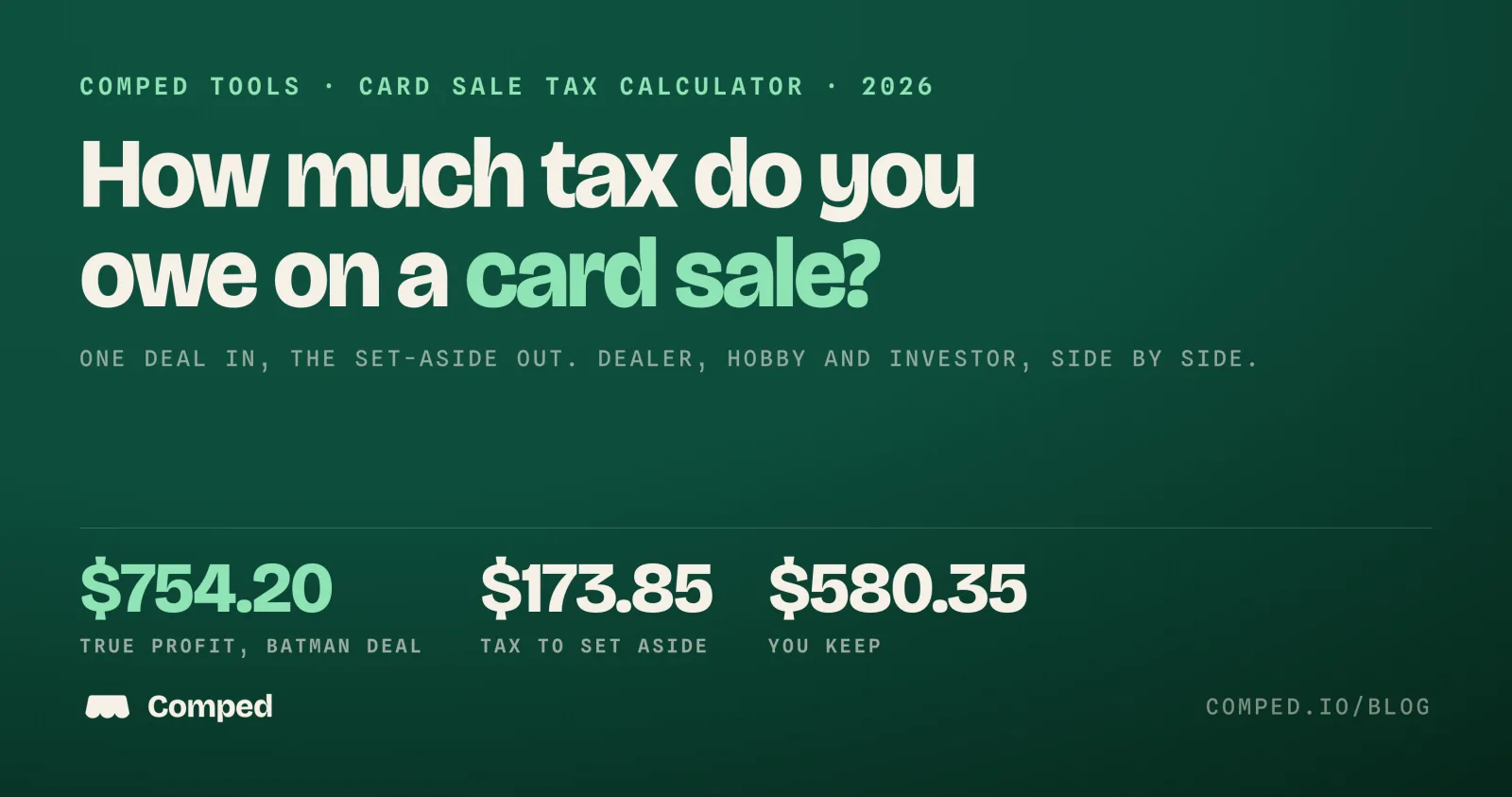
TRUE PROFIT ON THIS DEAL
$754.20
$3,400.00 sale, less $470.80 in fees and shipping, less $2,175.00 basis
As a dealer on Schedule C. That is 23.1% of the profit and 5.1% of the sale price.
DEALER · SCHEDULE C
$173.85
keep $580.35
HOBBY · NO EXPENSES
$147.00
keep $607.20
INVESTOR · CAPITAL GAIN
$90.50
keep $663.70
How the calculator works
Every column starts from the same number: true profit, which is the sale price minus fees and shipping minus what the card cost you. Cost means the cash you paid, the value of any card you traded, and the grading fee if you graded it. Tax is figured on that profit, never on the sale price. The master tax guide explains why each treatment exists; this page just does the arithmetic for one deal.
The dealer column is the one that applies to most people who sell at shows or online with any regularity. Self-employment tax is 15.3% of 92.35% of the profit (12.4% Social Security up to the 2026 wage base of $184,500, plus 2.9% Medicare), per the IRS self-employment tax page. Half of that tax is deductible. Then the qualified business income deduction removes 20% of what is left, with a $400 minimum for 2026 when qualified income is at least $1,000, per Publication 505. The remainder is taxed at your marginal rate, which the calculator finds by stacking the deal on top of your other income after the 2026 standard deduction.
The hobby column taxes the sale minus the cost of the card and nothing else. Fees, shipping and grading are not deductible for a hobby, a rule the July 2025 law made permanent, so a hobby seller pays income tax on a bigger number but no self-employment tax. The investor column treats the card as a capital asset: selling costs reduce the amount realized, and a gain on a card held more than one year is taxed at your ordinary rate but capped at 28%, the collectibles ceiling in Tax Topic 409.
The example deal, worked
The default numbers are a real deal: a 1966 Topps Batman #1 PSA 3, bought at a show for $2,100 cash plus a card worth $75 in trade, sold on eBay for $3,400 with $450.80 in fees and $20 of shipping. For a single filer with $60,000 of wages, the three columns come out like this.
THE BATMAN DEAL · SINGLE FILER · $60,000 OF OTHER INCOME · 2026
The card given in trade had cost $90, so its own sale at $75 is a separate $15 loss on the books. The cost basis guide walks that deal line by line.
Notice the dealer owes more than the hobby seller on this single deal. That is the self-employment tax, and it is the price of being a business. Over a year the business deducts table fees, mileage, supplies, grading and a losing deal against other income; the hobby deducts none of it. Run a deal that lost money and the difference shows: the dealer column turns into a tax refund, the hobby column stays at $0.
The 2026 numbers inside the calculator
All federal figures are the tax year 2026 amounts from the IRS inflation adjustments. The standard deduction is $16,100 for single filers and $32,200 for married couples filing jointly.
| Rate | Single, taxable income over | Married filing jointly, over |
|---|---|---|
| 10% | $0 | $0 |
| 12% | $12,400 | $24,800 |
| 22% | $50,400 | $100,800 |
| 24% | $105,700 | $211,400 |
| 32% | $201,775 | $403,550 |
| 35% | $256,225 | $512,450 |
| 37% | $640,600 | $768,700 |
Self-employment tax: 15.3% of 92.35% of net profit, Social Security portion capped at $184,500 of earnings. QBI deduction: 20% of qualified business income after the half-SE deduction, $400 minimum when that income is at least $1,000. Collectibles: long-term gains capped at 28%.
What the calculator leaves out
- State income tax beyond the flat rate you type in. New Jersey, New York and Pennsylvania each tax business income differently; the flat field is an estimate.
- Sales tax. That is collected from the buyer at the table and remitted to the state; it is not your income and not in this tool. The state sales tax guide covers it.
- The $400 annual threshold for self-employment tax, the Social Security wage base when your job already pays you more than $184,500, the 3.8% net investment income tax, and the capital loss limit for investors.
- Head of household and married filing separately brackets. Use single or joint for a close estimate.
- Your other business deductions for the year. This is one deal; the write-offs guide covers the rest.
Related guides
- The Card Vendor's Master Guide to Taxes: dealer, hobby and investor explained, and which one you are.
- Do you have to pay taxes on selling sports cards?: the rules behind the dealer column.
- Cost basis for cards bought with cash or by trade: how to prove the cost you typed in.
- The 1099-K for card sellers in 2026: why the form shows the sale price and you report the profit.
FAQ
How accurate is this?
It uses the 2026 federal brackets, standard deduction, self-employment tax and QBI rules exactly as published, applied to one deal stacked on top of the other income you enter. It is a close estimate of the federal tax a single deal adds. Your full return has more moving parts, so treat the result as the amount to set aside, not the amount to pay.
Why does the hobby column show less tax than the dealer column?
Self-employment tax. A dealer pays 15.3% of 92.35% of the profit on top of income tax; a hobby seller pays income tax only. On a single profitable deal with low fees that can make the hobby number smaller. Over a year the dealer deducts every business cost and any losing deal, and the hobby seller deducts nothing beyond the cost of the cards, which is why the hobby classification usually costs more.
Do I owe this now?
Federal tax on self-employment income is paid through the year. If you expect to owe $1,000 or more for 2026, estimated payments are due April 15, June 15, September 15, 2026 and January 15, 2027. Setting aside the number from this calculator on each deal is how vendors avoid an April surprise.
What if the deal lost money?
Enter it and look at the columns. A dealer's loss reduces other income, so the dealer column shows tax saved. A hobby loss deducts nothing. An investor's capital loss offsets capital gains first and then other income up to a yearly limit, which the calculator does not model.
Does it include state tax?
Only the flat rate you type in, applied to the profit. State rules vary, and some states have no income tax at all. Sales tax at the table is a separate thing and is not part of this tool.
Is this tax advice?
No. It is the published 2026 federal math applied to the numbers you enter. A CPA who knows your whole year will give you a better number, and the calculator is a good thing to bring to that conversation.
SOURCES
- IRS releases tax inflation adjustments for tax year 2026, Internal Revenue Service, checked October 2026.
- Self-employment tax (Social Security and Medicare taxes), Internal Revenue Service, checked October 2026.
- Publication 505, Tax Withholding and Estimated Tax, Internal Revenue Service, checked October 2026.
- Topic 409, Capital gains and losses, Internal Revenue Service, checked October 2026.
- Topic 420, Bartering income, Internal Revenue Service, checked October 2026.
- Tips for taxpayers who make money from a hobby, Internal Revenue Service, checked October 2026.
- Form 1040-ES, Estimated Tax for Individuals (2026), Internal Revenue Service, checked October 2026.
This is general information for card sellers, not tax or legal advice for your situation. Rules change and states differ; a CPA who knows your numbers wins every time.