What the IRS thinks you are
Every tax question about selling cards starts with one classification. The IRS sees a card seller as one of three things, and each one gets a completely different tax treatment.
| Classification | Your gains are | Your losses are | SE tax |
|---|---|---|---|
| Dealer | Ordinary income on Schedule C, any holding period | Fully deductible against other income | Yes, 15.3% |
| Investor | Capital gains. Held over a year, taxed at up to 28% | Capital losses, capped at $3,000 per year net | No |
| Collector | Capital gains, same rates as an investor | Not deductible at all. Personal-use property | No |
A dealer holds cards as inventory, primarily for sale to customers. Every flip is ordinary income, reported on Schedule C, and subject to self-employment tax. In exchange, a dealer deducts everything: table fees, mileage, supplies, grading, shipping, platform fees. If you set up at shows regularly, buy collections to break up and resell, or list on eBay and Whatnot week after week, you are almost certainly a dealer.
An investor buys cards to hold for appreciation. Gains on cards held over a year are capital gains, but not at the friendly 15% or 20% rates stocks get. Trading cards are treated as collectibles, and long-term collectibles gains are taxed at your ordinary rate up to a ceiling of 28%. IRS Topic 409 states the 28% maximum directly. One honest footnote a lot of articles skip: the tax code lists art, rugs, antiques, metals, gems, stamps, coins, and alcoholic beverages as collectibles, plus anything else the Treasury designates, and the Treasury has never designated trading cards. Treating cards as collectibles is the prevailing professional position, and it is how every major tax firm plays it, but no court or IRS ruling has ever decided it for physical cards.
The 28% is a ceiling, not a flat rate. If your ordinary bracket is 22%, your long-term card gains are taxed at 22%. But cards are a worse tax deal than stocks at every bracket, because long-term card gains never get the 0%, 15%, or 20% rates stocks enjoy. Middle brackets just pay their ordinary rate, and high earners hit the cap at 28% instead of 20%. High earners also add the 3.8% net investment income tax on investment gains above $200,000 single or $250,000 married filing jointly, which makes the true top federal rate on long-held cards 31.8%.
A collector holds cards for enjoyment. Gains are still taxable when you sell. Losses are not deductible, ever, because the IRS treats a personal collection like any other personal-use property.
THE PLANNING POINT MOST ARTICLES MISS
You can be a dealer and an investor at the same time. In Williford v. Commissioner, a part-time art dealer kept an investment collection segregated from his sale inventory, and the Tax Court respected both. His show inventory was ordinary income. His segregated collection got capital treatment. The catch is real segregation: separate records, separate storage, and the personal collection never cycles through the case at your table. Do that, and your long-held personal grails can sell at capital rates instead of ordinary income plus 15.3% self-employment tax.
The hobby trap: the worst outcome on the board
People assume "hobby" is the safe, casual answer. For anyone selling in volume, it is the most expensive classification the IRS can hand you.
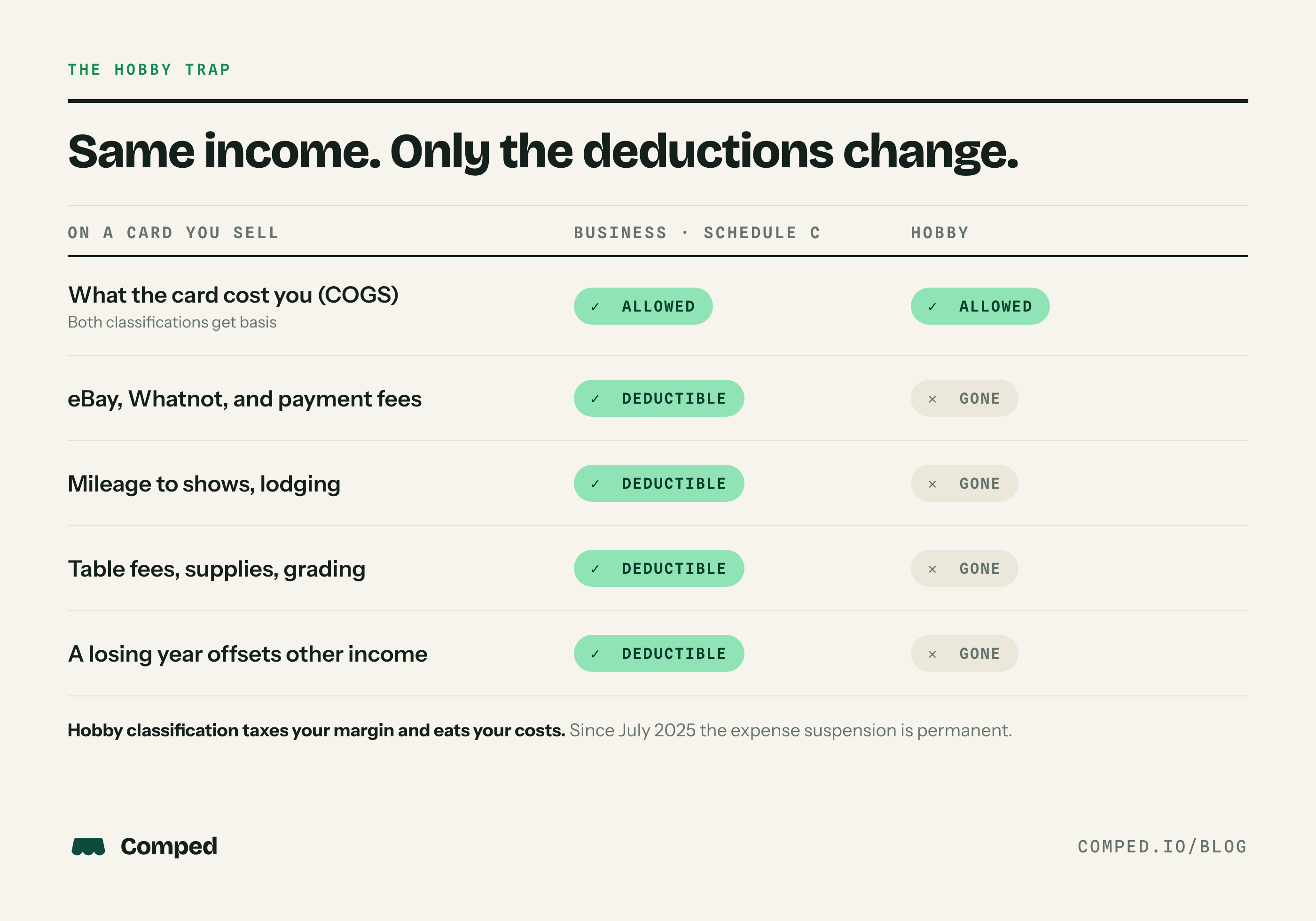
Here is what hobby classification means since the 2017 tax law, made permanent in July 2025: your sales income is fully taxable, reported on Schedule 1 of your 1040, and your expenses are deductible at exactly zero. Not table fees, not eBay fees, not shipping, not mileage, not grading. The old rule that let hobbyists deduct expenses against hobby income was suspended in 2018 and the 2025 tax law made the suspension permanent.
You do keep one thing: cost of goods sold. Treasury Regulation 1.183-1(e) lets even a hobby seller subtract what a card cost from what it sold for, applied consistently, so a hobbyist who buys at $80 and sells at $100 reports $20, not $100. But every cost around the sale is gone. On thin flipping margins, hobby classification can tax "profit" that never existed after fees.
Whether you are a business or a hobby comes down to profit motive. The IRS weighs nine factors from Treasury Regulation 1.183-2, and no single factor decides it:
- Whether you run the activity in a businesslike way, with real books and records
- Your expertise, or your use of people who have it
- The time and effort you put in
- Whether you expect the assets themselves to appreciate
- Your track record in other ventures
- Your history of income or losses in this activity
- The size of the profits you do earn
- Your overall financial picture
- How much personal pleasure is involved
There is also a safe harbor: show a profit in three of the last five years and the law presumes you are a business. The presumption only works in one direction. Failing it does not make you a hobby, it just means the nine factors decide. A card business with honest startup losses can still win on businesslike records, real time invested, and real expertise. And note the fourth factor, expecting your assets to appreciate, is unusually friendly to card people.
The practical takeaway runs against the internet's usual advice. If you are moving real volume, you want business classification, and you earn it the boring way: separate accounts, real records of every buy and sale, and conduct that looks like a business. That is precisely the paper trail Comped builds for you at the table.
Sole prop, LLC, or S corp
Vendors overthink this one early and underthink it late.
Day one, you are a sole proprietor. No paperwork, no election. Your card business lives on Schedule C of your personal return. This is the correct answer for most vendors and there is nothing wrong with staying here for years.
An LLC changes your liability, not your taxes. A single-member LLC is a disregarded entity by default. The IRS is explicit: its activity goes on the owner's return, same Schedule C, same self-employment tax, nothing about your federal income tax changes. What you get is a state-law liability shield between your personal assets and a business that hauls valuable inventory to public venues, plus a cleaner setup for a business bank account. Form one for protection and professionalism, not for a tax cut. When that day comes, you do not need a lawyer or a week of paperwork: Comped forms your LLC from inside the app, one flat price, everything filed.

The S corp election is a real tax lever, later. An S corp pays you a reasonable W-2 salary, and profit above that salary passes through free of the 15.3% self-employment tax. The savings are real, but so are the costs: payroll processing, a separate business tax return, and CPA fees that together typically run a few thousand dollars a year. CPAs generally start running the numbers when net profit clears roughly $40,000 to $80,000 a year. Below that range, the admin usually eats the savings. There is no IRS rule here, just arithmetic, so have a professional run your specific numbers before electing.
The 1099-K, explained
The 1099-K is the form eBay, PayPal, Whatnot, and other payment platforms file with the IRS reporting the gross payments they processed for you. After four years of Congress moving the goalposts, the rule is settled again.
The federal threshold is back to $20,000 and more than 200 transactions, and both must be exceeded. The July 2025 tax law restored the old threshold retroactively, and the IRS confirmed it in Fact Sheet 2025-08: the planned $600 threshold is dead, and the rule applies for tax year 2025 and forward. Any article you read from before mid-2025 about $600 or $2,500 thresholds is obsolete.
Three things every vendor needs to internalize about this form:
1. No form does not mean no tax. The IRS says it in one sentence: all income, no matter the amount, is taxable even if you do not get a Form 1099-K. Sell $15,000 on eBay, $12,000 on Whatnot, and $8,000 through PayPal, and you may receive zero 1099-Ks because each platform is under its own threshold. You still owe tax on all of it. Cash deals at the show are the same story. The form is a reporting mechanism, not a permission slip.
2. The form reports gross, not profit. Box 1a includes every dollar buyers paid, with no reduction for eBay final value fees, Whatnot commission, refunds, shipping labels, or the cards' cost. Report the 1099-K number as your income and you overpay badly. Report less than the form without showing your fees and costs properly and you invite an IRS matching notice. The correct pattern on Schedule C: full gross receipts on line 1, refunds on line 2, cost of goods sold in Part III, fees under expenses.
3. Your state may not honor the $20,000 line. Several states force platforms to issue 1099-Ks at much lower levels. PayPal's own tax page lists at least Maryland, Massachusetts, Vermont, and Virginia at $600, and Illinois at $1,000 with four or more transactions, and a few other states set their own lines too. If you sell from one of those states, behave as if the $600 era never ended, because for you it never did.
SELLING PERSONAL STUFF AT A LOSS
Cleared out childhood binders below what the cards cost you? The loss is not deductible, and the IRS has a specific method if a 1099-K shows up anyway: report the proceeds on Schedule 1 line 8z, then back out the same amount, capped at the proceeds, on line 24z. Zero income, no audit bait. Personal cards sold at a gain go on Form 8949 and Schedule D instead, and the gain is taxable.
One more thing that does not work: routing sales through PayPal friends and family, or Zelle, or cash. That removes the paper trail, not the tax. It also violates PayPal's terms and strips your buyer of protection, which is a bad look for a vendor with a reputation.
Selling online vs selling at the table
Most vendors do both, and the tax math is identical either way. Every sale lands on the same Schedule C, cash included. What changes between the two channels is the paper trail, and the paper trail decides how you have to keep your books.
| On each sale | Online | At the table |
|---|---|---|
| What the IRS sees | A 1099-K of your gross sales once you cross the threshold | Nothing, until an audit finds the deposits |
| Fees | Taken out before the payout, deductible if your books claim them | None, but your costs are cash and easy to lose |
| Sales tax | Collected and remitted by the platform | Yours to register, collect, and remit |
| The record | The platform keeps a history | Only what you write down |
Online, the platform documents you
eBay and Whatnot report your gross to the IRS, so the bookkeeping job online is reconciliation. The 1099-K can say $42,000 while your bank only ever saw $36,500 in payouts, because fees, refunds, and shipping labels came out in between. Your books have to bridge that gap line by line: gross receipts on Schedule C line 1, refunds on line 2, fees and labels as expenses. Miss the bridge and you either overpay on the gross number or under-report and trip the IRS matching computer. Sell on three platforms and you have three partial pictures that only your own ledger can merge.
At the table, you document yourself
In person the problem is the opposite. Nothing is recorded unless you record it. There is no form for the $2,100 cash deal, no fee statement, no one collecting sales tax for your table, and no history to download in April. The IRS closes that gap in an audit with bank-deposit analysis, where deposits are presumed income until your records prove otherwise. So the whole game in person is the record you make at the moment of the deal: date, card, amount, how paid. That one record is your income figure, your basis, and your audit defense at the same time.
And one card routinely crosses both channels. The Batman deal worked later in this guide was bought with cash and a trade at a show, then sold on eBay days later. Its true profit only exists in a ledger that follows the card from the table to the platform and holds the cash basis, the trade loss, and the eBay fees together.
The consignment middle ground
Consignment sits between the channels. Send cards to COMC, Fanatics Collect, or an eBay consignor and the platform sells for you, takes its cut, and pays you out. The tax frame is simple: the platform paying you is the one that issues your 1099-K if you cross the threshold, the gross sale still belongs on your Schedule C, and consignment fees are deductible selling expenses. Flip it around and buy at auction, and the buyer's premium is not a fee you expense. It is part of what the card cost you, so it goes into basis.
WHY WE BUILT COMPED THIS WAY
This split is the exact problem Comped exists to solve. Scan a card at the table and the deal is recorded on the spot, priced from real comps. Platform sales and payouts reconcile against your connected bank feed, and the AI reads every transaction to work out what is a real business expense and what is not, and what you really made on each card after fees and basis. One ledger, both channels, so you pay tax on true profit and not a dollar more.

Self-employment tax and the QBI deduction
Dealers pay two taxes on profit: regular income tax at your bracket, and self-employment tax, which is the 15.3% that covers Social Security and Medicare. It applies to 92.35% of your net Schedule C profit, and it starts at just $400 of net earnings for the year. This is the tax that surprises first-year vendors, because it bites before income tax does. A vendor with $5,000 of net profit might owe zero income tax after the standard deduction and still owe about $706 in self-employment tax.
Softeners, all current for 2026:
- You deduct half of your self-employment tax when figuring adjusted gross income.
- The 12.4% Social Security piece stops at $184,500 of earnings in 2026. The 2.9% Medicare piece never stops, and an extra 0.9% kicks in above $200,000 single or $250,000 married filing jointly.
- You are buying real Social Security credits with this tax, which pure investors do not get.
The QBI deduction is the quiet 20% discount. The qualified business income deduction lets a card dealer deduct 20% of business profit before income tax, and the July 2025 law made it permanent. Card dealing is ordinary retail, not a restricted service business, so below the 2026 income thresholds of $201,750 single or $403,500 married filing jointly there are no hoops: the deduction is essentially 20% of your profit, automatically. Starting with tax year 2026 there is also a floor: with at least $1,000 of qualified business income from a business you actively run, your deduction is at least $400, even when 20% would be less. Note QBI reduces income tax only. It does nothing against self-employment tax.
The state layer
Everything above is federal, and your state taxes the same profit again. Most states with an income tax treat capital gains as ordinary income at their regular rates, generally with no special collectibles break, and most do not allow the QBI deduction on the state return. The spread is wide. Nine states tax none of it, including Florida, Texas, Tennessee, Nevada, and, since 2025, New Hampshire, while California tops out at 13.3%. One surprise: Washington has no income tax but levies a 7% excise on large long-term gains, above roughly $278,000 and indexed, and it can reach collectibles. Check your state before you model a big sale.
Inventory, basis, and COGS at the card show
You are taxed on margin, not on sales. Cost of goods sold is how the tax code gets there: gross receipts minus what the cards cost you. Schedule C Part III does the math, and the quality of your basis records decides whether you keep that margin or hand it back in an audit.
The timing myth
You will read online that small sellers can deduct inventory the moment they buy it. That is a half-truth with a trap. Small businesses, under $32 million in average receipts for 2026, are allowed a simplified method that treats inventory as non-incidental materials and supplies. Under that method the regulation is explicit: the cost is deducted in the year the card is provided to the customer, or the year you pay for it, whichever is later. Buy a monster box in December and it is not a December deduction. It becomes a deduction card by card, as they sell. There is a narrower books-and-records path that can support expensing purchases sooner, but it is a formal accounting method with real downsides in a liquidation year. If you want it, get a CPA to set it up properly.
Basis, deal by deal
Card vendors acquire inventory four ways, and each has its own basis rule.
Cash at the table. Basis is what you paid. The problem is proof, and the fix is cheap: a dated log of every buy with the venue, the cards, the amount, and how you paid, backed by ATM records and a photo. The IRS itself says you may use any recordkeeping system suited to your business that clearly shows income and expenses. A contemporaneous log made at the show beats a year-end reconstruction every time. This is exactly what Comped records the moment you scan a card and log the deal.

The lump-sum collection buy. One price, four hundred cards. IRS Publication 551 says to allocate the price across what you bought by relative fair market value, on the day you bought it. Value the hits at that day's comps, spread the remainder across the bulk, and keep the worksheet. The pattern that loses audits is claiming most of the purchase price against the three cards you flipped in month one while the shoebox quietly carries the same basis again, or none.
Cards from your own collection. Converted personal cards carry a dual basis: original cost for measuring gain, but the lesser of cost or conversion-date value for measuring loss. You cannot buy at the 2021 peak, convert to inventory at a fraction of that, and harvest the crash as a business loss. Think hard before converting long-held winners at all. Once a card is genuinely inventory, all of its appreciation, including the years it sat in your closet, becomes ordinary income plus self-employment tax when it sells. Selling it as investment property at capital rates is often the better outcome.
Gifts and inheritances. Gifted cards keep the giver's basis, which for vintage is usually close to zero, so nearly the whole sale price is gain. Inherited cards reset to value at the date of death. On a vintage collection that difference is worth five figures, so before you liquidate a family collection, establish which one it was and, for an inheritance, build the date-of-death comp file immediately.
Keeping one for yourself
Pull a card from inventory for your personal collection and there is no tax on the pull. Its cost simply comes out of cost of goods sold, on the Schedule C line that says purchases less items withdrawn for personal use. Date it, note the cost, and it leaves the business at basis. Just know the pattern the IRS watches for: every card that mooned was "personal," every dud was "business." Real segregation, physical and in the ledger, is what makes withdrawals safe.
Grading fees
No IRS document mentions card grading by name, so this is applied principle, and it depends on which hat you wear. A dealer whose graded card sold this year deducts the fee this year either way. For cards still in the case at year-end, the safe treatment is to fold the fee into the card's inventory cost and recover it when the card sells. Small dealers exempt from the capitalization rules have a defensible argument for deducting fees currently, but match it to your books and get professional advice before taking it. Investors and collectors get no current deduction at all since the 2025 law permanently ended miscellaneous itemized deductions. For them the fee adds to the card's basis: buy at $100, grade for $20, sell at $300, and the taxable gain is $180. Any article telling investors to write off grading fees is citing pre-2018 law.
MARKET CRASHES ARE NOT DEDUCTIONS
Undamaged cards that fell 70% sit at cost until they sell. Under the standard cost method there is no write-down for a price collapse. The narrow exception is for damaged or defective goods, and it requires actually offering them at the marked-down price within 30 days after year-end, with records. If the loss is real, realize it: sell the lot.
Trades are taxable
The most common tax mistake in the hobby: treating a trade as a non-event because no cash moved. Since 2018 there is no ambiguity. The like-kind exchange rules that once let you argue about deferring trades now apply to real estate only, and the IRS lists collectibles by name among the property that no longer qualifies. Every card-for-card trade, at the table, on a trade night, in a group chat, is a taxable disposition.
The mechanics are simple once you see a trade as two transactions:
- You sold the card you gave up. Amount realized equals the fair market value of what you received, plus any cash on top. Gain or loss is that number minus your basis in the card you surrendered.
- You bought the card you received. Its basis is its fair market value on the trade date. That is settled law, and it protects you: vendors who forget to book trade-ins at value over-report profit when the card resells.
Trade a $200-basis card straight up for a card worth $500 and you have $300 of income today, and a $500 basis going forward. For a dealer trading inventory it is ordinary income. Losses work symmetrically: give up more value than you receive and the shortfall is a loss, with two caveats. Losses on deals with related parties are disallowed, and a loss built on friendly self-graded valuations will not survive scrutiny.
NO WASH-SALE RULE ON CARDS
The wash-sale rule that blocks stock loss harvesting covers shares of stock and securities only, so selling a card at a loss and buying it back is not mechanically disallowed the way it is with stocks. Two cautions still stand: losses on deals with related parties are disallowed, and the sale has to be real, at market, with real risk, not a prearranged round trip. And one mechanical note for investors: selling fees reduce your amount realized on the sale, they are not a separate deduction.
The discipline that makes all of this painless is capturing value at the moment of the trade. Screenshot the comps on the trade date. That one record is simultaneously your income substantiation for the card that left and the basis substantiation for the card that arrived. Comped books a trade as both sides automatically, priced from real comps, the moment you record it.
A real deal, worked start to finish
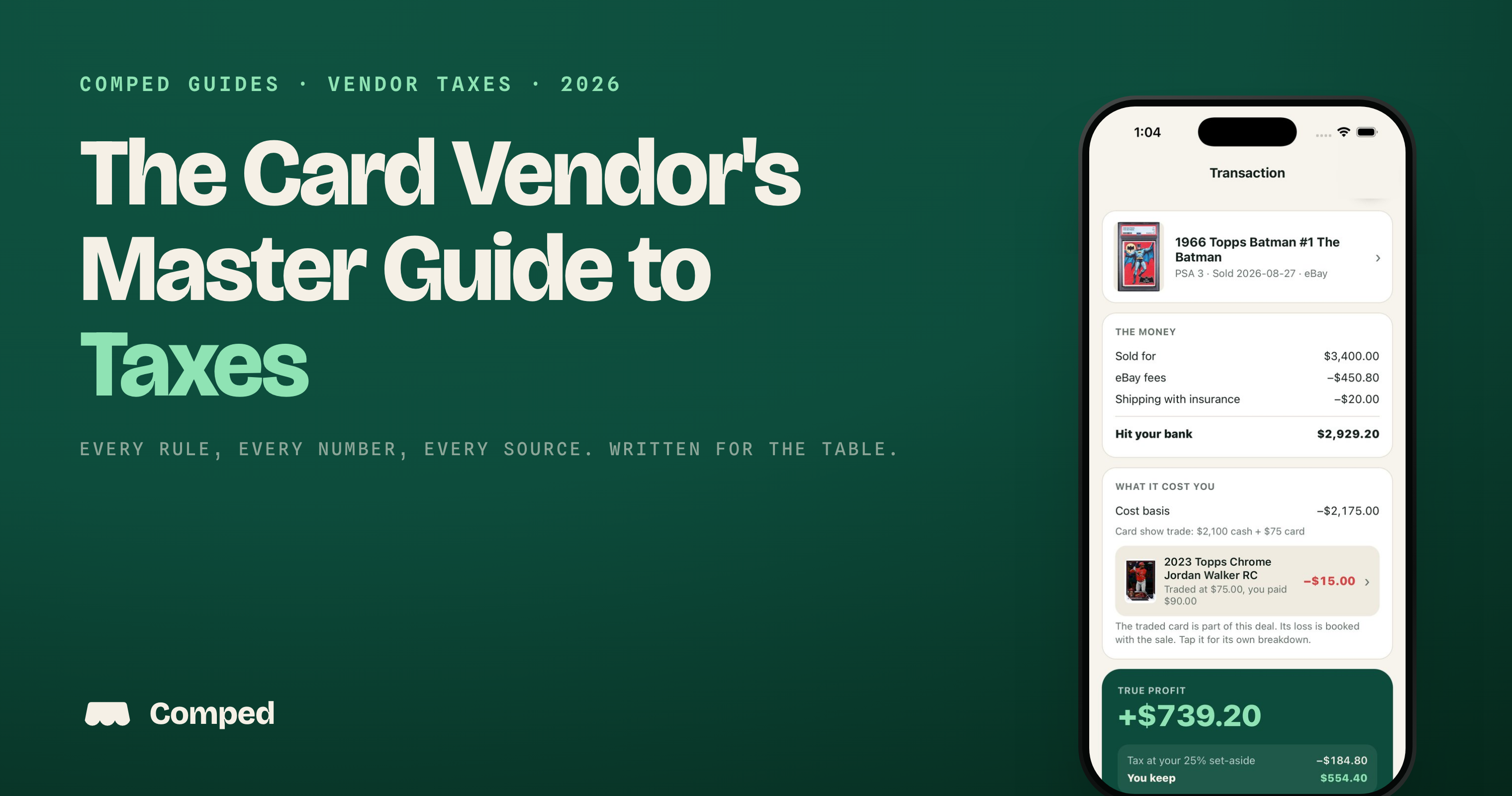
This is an actual deal recorded in Comped, and it exercises almost every rule above: a cash-plus-trade purchase at a show, a trade-in loss, a gross-versus-net eBay sale, and the tax set-aside.
At an August 2026 show, our founder bought a 1966 Topps Batman number 1, graded PSA 3, for $2,100 in cash plus a trade-in card the seller credited at $75. He had paid $90 for that trade-in card, so handing it over booked a $15 loss. The Batman's basis is the full $2,175 he gave up. Days later the card sold on eBay for $3,400.
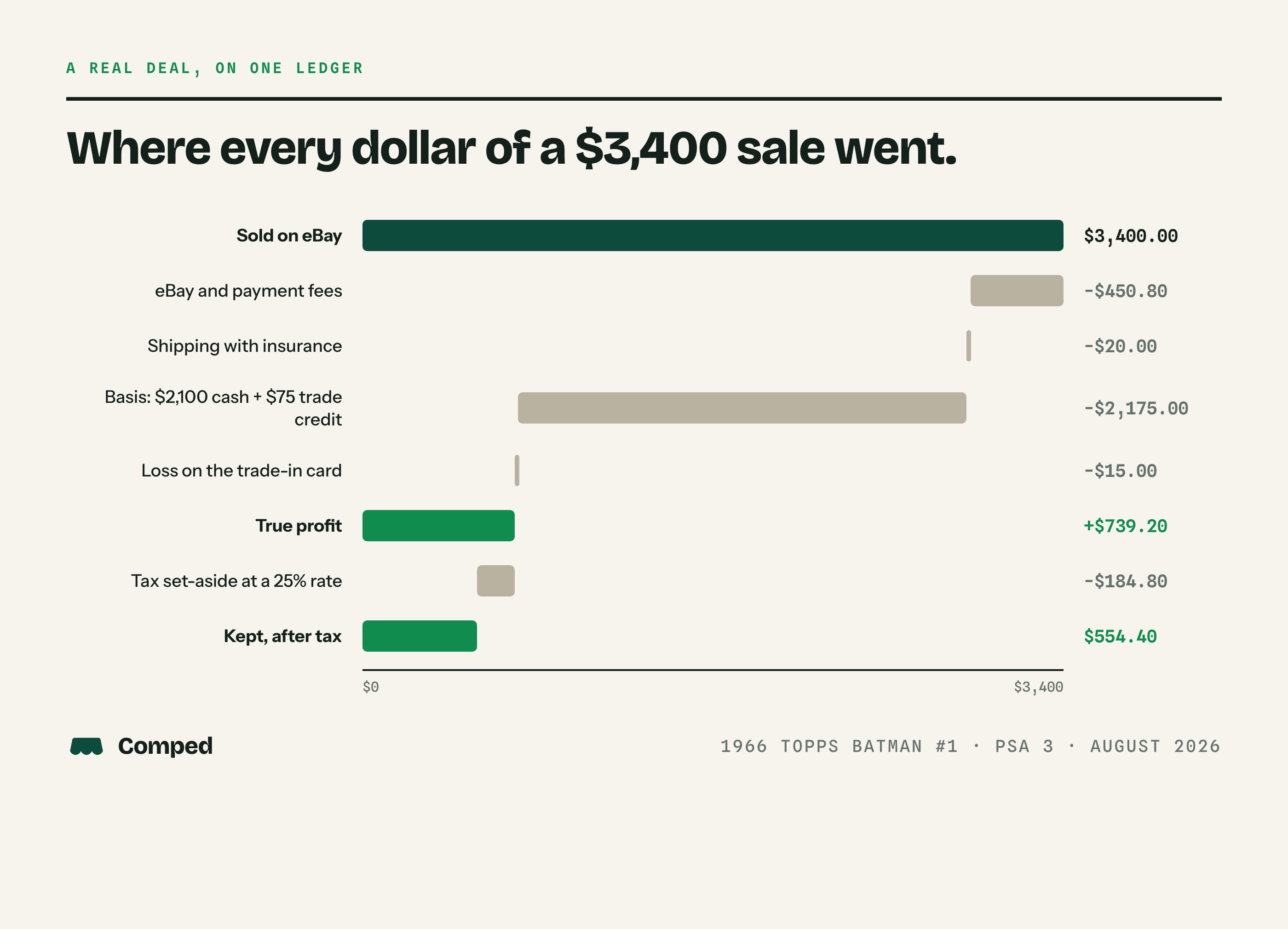

Now look at what the paperwork would say without records. A 1099-K, if one issued, reports $3,400 gross. A vendor with no basis trail pays tax on far more than $739.20 of "profit," and a vendor who guesses gets to defend the guess in an audit. The entire difference between overpaying and keeping $554.40 is a basis record made at the table on the day of the deal.
What a dealer deducts
The deal-level math above only works if the costs around it get captured too. Here is the dealer's deduction stack at a glance. Our Master Guide to Write-Offs covers every line in depth, with the record that proves it.
| Bucket | What counts | Worth knowing |
|---|---|---|
| The show | Table and booth fees, helper pay, promoter insurance, permits | Permits and license fees are deductible business taxes |
| The road | Mileage, lodging, half of travel meals | 2026 mileage runs 72.5 cents per mile through June, 76 cents from July |
| The product | Grading, sleeves and supplies, shipping and labels | Grading on unsold cards is safest in the card's basis |
| The platforms | Final value fees, commissions, promoted listings, payment processing | Invisible if you only look at payouts. Book gross, book fees |
| The desk | Software and comp tools, phone and internet share, home office | Simplified home office: $5 per square foot, up to 300 |
| The gear | Display cases, lighting, laptop, camera | Section 179 lets small vendors deduct equipment in year one |
The retirement lever is the big one. A profitable dealer's largest legal shelter is usually a solo retirement plan: a SEP-IRA takes up to 25% of compensation with a $72,000 cap for 2026, and a solo 401(k) takes a $24,500 deferral plus catch-ups on top of the employer share. Contributions cut income tax, not self-employment tax, and unlike every other line here, this deduction is money you keep.
Paying help now has a higher paperwork line. Pay any one helper $2,000 or more during 2026 and you owe them and the IRS a 1099-NEC. That threshold was $600 for years; the July 2025 law raised it to $2,000 for payments made starting in 2026, indexed after. Collect a W-9 before the first payment either way.
Donating cards is its own maze. Noncash donations over $500 need Form 8283, anything over $5,000 needs a qualified appraisal, and if the charity does not use the cards for its exempt purpose your deduction drops to basis. Dealers donating inventory deduct basis, not market value, full stop. Generous instincts, professional advice.
Quarterly estimated taxes
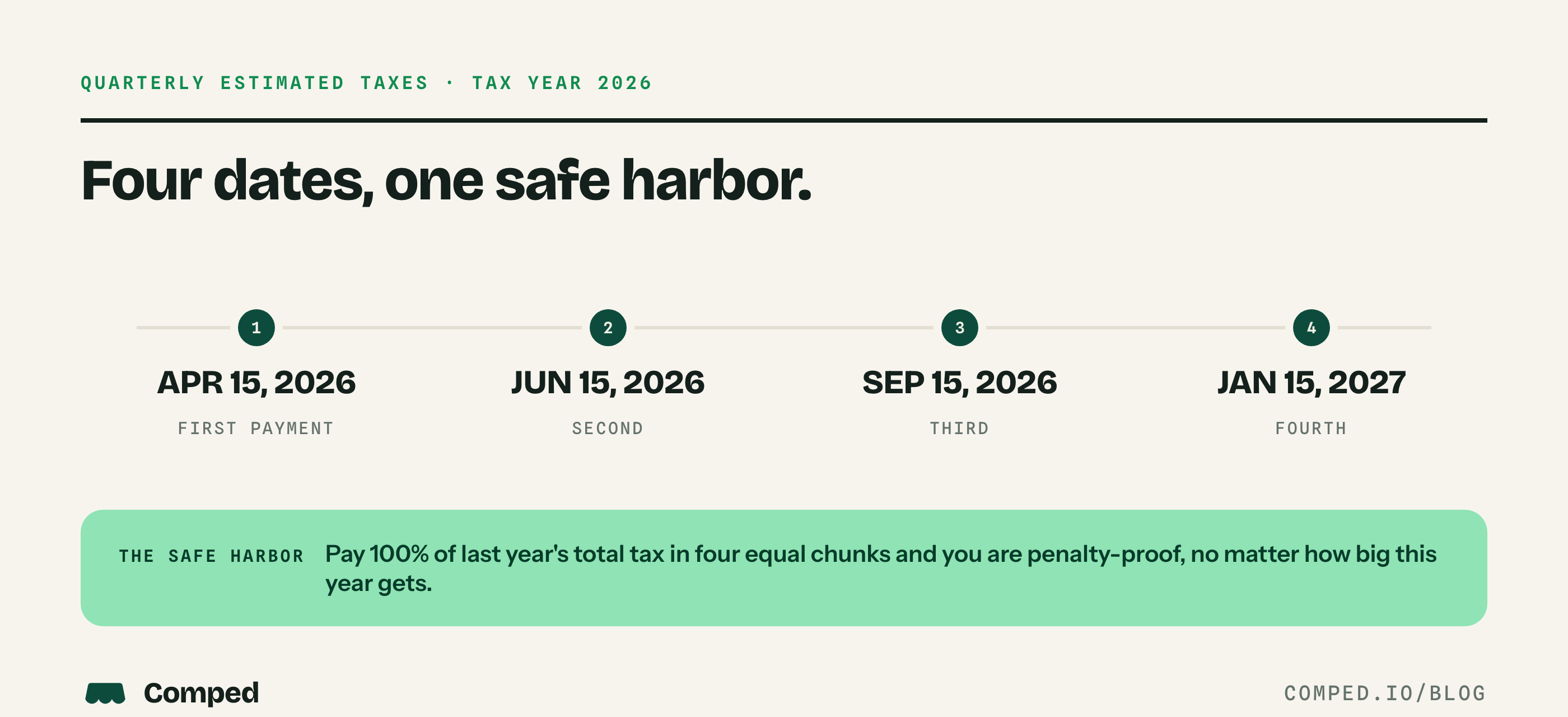
The US tax system is pay-as-you-go. A W-2 job handles that through withholding. A card business does not, so if you expect to owe $1,000 or more for the year, the IRS expects four estimated payments. For tax year 2026 they are due April 15, June 15, and September 15 of 2026, and January 15 of 2027.
Miss them and there is no drama, just interest. The underpayment penalty is computed per installment at the IRS underpayment rate, currently 7% a year compounded daily. Skipping quarterlies is an expensive loan, not a crime.
The safe harbor is the card vendor's best friend. Card income is lumpy. One National weekend or one big collection buyout can blow up any projection. You are penalty-proof for the year if your four payments total either 90% of this year's tax or 100% of last year's tax, whichever is smaller. The prior-year option rises to 110% if your adjusted gross income last year topped $150,000. Pay 100% of last year's total tax in four equal chunks and it does not matter how good this year gets, there is no penalty. That is far simpler than projecting a volatile year quarter by quarter.
Pay online in minutes with IRS Direct Pay or EFTPS. One timing note: platforms send 1099-Ks by January 31, but the fourth estimate is due January 15. If you wait for forms to learn your own numbers, you are structurally late. Your books, not the platforms, have to drive the estimate. Comped keeps a running tax set-aside from every recorded deal precisely so this number is never a surprise.
Records that survive an audit
Everything in this guide runs on records. Here is what the IRS expects, how long to keep it, and what actually happens when a cash-heavy card business gets examined.
What to keep, and for how long
The IRS names the categories for a small business: gross receipts, purchases, expenses, assets. Deposit records, invoices, receipts, canceled checks, card statements. Digital is fine, and has been since 1997: a phone photo of a handwritten show receipt is acceptable if it is legible, organized, and producible on demand. That is Revenue Procedure 97-22, and it is why an app that photographs the card and logs the deal at the table is not a convenience, it is your audit file.

| Situation | Keep records |
|---|---|
| General rule | 3 years |
| Unreported income over 25% of gross | 6 years |
| Cards you still hold | As long as you own the card, plus 3 more years after the year you sell it |
| No return filed, or fraud | Forever |
Read that third row again, because it is the one built for card people. The receipt for a card you hold ten years needs to survive about thirteen. And the second row is the cash-sale trap: skip reporting show income worth more than a quarter of your gross and you have doubled the IRS's look-back window.
Mileage: the biggest deduction, the strictest rule
Driving to shows is often a vendor's largest single deduction, and it lives under the strictest substantiation regime in the tax code. Section 274(d) demands a record of date, destination, business purpose, and miles, made at or near the time of the trip. Courts routinely throw out logs reconstructed at tax time, and the Cohan estimation fallback that can rescue other sloppy records is explicitly unavailable here. Log the drive the week you take it or lose it.
What an audit of a card vendor actually looks like
Schedule C filers get examined well above the overall individual rate, several times higher once receipts pass six figures, and the IRS publishes a playbook for cash businesses. The examiner's manual requires income probes on every business audit, and the standard tool is bank-deposit analysis: total the deposits across every account you own, subtract what you can prove is non-taxable, and presume the rest is income. Every Venmo, Zelle, and cash deposit is income unless your records say otherwise. That is the honest answer to the forum question "do they ever find out about cash deals." They do not have to find the deal. They find the deposit.
Before a full audit there is a cheaper tripwire: the CP2000 matching notice, generated automatically when a 1099-K does not reconcile with your return. Report the full gross on Schedule C line 1 and deduct fees and costs on their own lines, and the computer match passes. Net them together and you have volunteered for correspondence.
The penalty ladder, for motivation: 20% accuracy penalty on careless understatements, 5% a month up to 25% for not filing, 0.5% a month for not paying, 75% for fraud, plus 7% interest compounding daily on all of it. None of this is scary with records. All of it is expensive without them.
Over $10,000 in cash has its own form
One more rule written for exactly our world. Receive more than $10,000 in cash in one deal, or in related deals inside 24 hours, and federal law requires you to file Form 8300 within 15 days. Sole proprietors count. Sell your case's grail for $11,000 cash at a show and you owe the government that form. Penalties are steep and indexed, and deliberately splitting a payment to stay under $10,000 is called structuring, which is a crime on its own, even when the underlying money is clean. Big cash deals are normal in this hobby. Paper them.
Sales tax at the table
Income tax is federal. Sales tax is state, and it is the compliance gap nearly every card vendor is standing in without knowing it.
Start with the good news. In the 45 states with a sales tax, trading cards are ordinary taxable goods, but every one of those states now has a marketplace facilitator law, which means eBay and Whatnot calculate, collect, and remit sales tax on your platform sales automatically. You cannot opt out and you do not need to do anything. Your online sales are, for sales tax purposes, mostly handled.
Your table is not. Facilitator laws cover marketplace transactions only. Sell a card face to face at a show and you are the retailer, and the state expects you to be registered, collecting, and remitting. This is the part no ranking tax article covers, and it is not theoretical. Three examples straight from state sources:
- Texas requires show sellers to hold its regular sales tax permit, which is free, and puts teeth in it through the promoter: event organizers are liable for tax on sales by any vendor without an active permit, which is why legitimate shows check. A narrow escape exists for individuals making two or fewer sales in any 12-month period, or no more than $3,000 selling their own personal items.
- Ohio sells a transient vendor license for $50 covering sales at shows and flea markets in counties where you have no fixed location, and you charge the rate of the county where the show sits.
- California issues a free temporary seller's permit for selling at a location for less than 90 days, often same day, and one permit can cover multiple locations in that period.
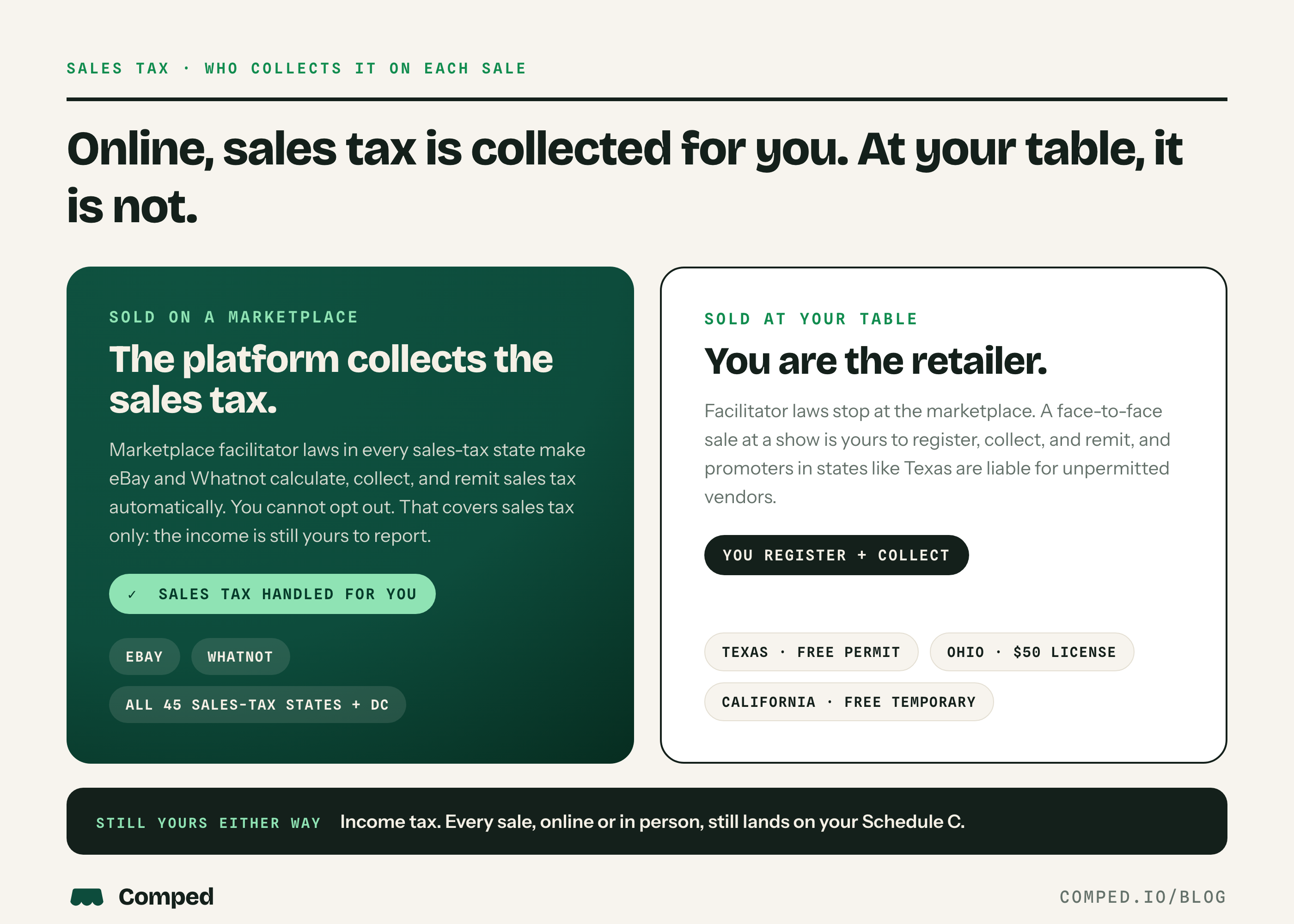
Every state does this differently, which is why our state-by-state guide covers permits, rates, and thresholds for all 50 states and DC.
Two more pieces close the loop. A resale certificate, issued against your sales tax registration, lets you buy inventory tax-free from shops and distributors, because sales tax is collected once, from the end customer. Buying collections from private individuals generally involves no sales tax anyway, so the certificate matters for shop and wholesale buys. And if you sell through your own website into other states, economic nexus rules can require registration once you pass a threshold, typically $100,000 of sales into a state. Marketplace sales do not usually create filing work on their own, but they can count toward that threshold.
Card vendor tax FAQ
Are taxes different for online sales and card show sales?
No. Income tax treatment is identical: every sale belongs on the same Schedule C whether it happened on eBay or across your table in cash. What differs is the reporting around you. Platforms report gross sales on a 1099-K and collect sales tax for you, while in-person sales generate no paperwork at all, which makes your own records the only evidence of income, basis, and expenses.
Do I owe taxes on card sales if I never got a 1099-K?
Yes. The IRS states that all income is taxable even if you do not receive a form. The 1099-K threshold of $20,000 and 200 transactions only controls when platforms report, not when you owe. Cash sales at shows and sales spread across platforms are taxable exactly the same.
I am selling off my personal collection. Is that a business?
Usually not. Selling your own long-held collection is a capital transaction, not a business: gains go on Form 8949 and Schedule D, and long-term gains are taxed at up to 28%. Losses on personal cards are not deductible. It starts becoming a business when you buy cards in order to resell them, regularly and for profit.
Are card trades really taxable?
Yes. Like-kind exchange treatment has been real estate only since 2018, and the IRS names collectibles among property that no longer qualifies. A trade is a sale of the card you gave up, at the value of what you received, and the card you received takes that value as its basis.
How do I prove what I paid for cards I bought with cash years ago?
With whatever records you can assemble: a purchase log, ATM withdrawals, photos, messages arranging the deal. The IRS accepts any recordkeeping system that clearly shows income and expenses, and courts can estimate basis in a pinch, but estimates run conservative. Going forward, record every buy the day it happens.
Do card show vendors have to collect sales tax?
In states with a sales tax, yes. Marketplace facilitator laws cover your eBay and Whatnot sales, but a face-to-face sale at a show makes you the retailer. Most states require a permit, some sell temporary event licenses, and in states like Texas the show promoter is liable for unpermitted vendors, so real shows check.
Can I deduct the boxes I rip?
Only inside a real business, and then as inventory cost recovered when the singles sell, not when you buy the box. In a hobby, box costs count only as cost of goods sold against the cards you sell from it, and never produce a deductible loss. Ripping for fun is consumption, not a write-off.
What rate do I pay on a card I held for years?
If you are an investor or collector, long-term gains on cards are taxed at your ordinary rate capped at 28%, the collectibles ceiling. If your bracket is 22%, you pay 22%. If the cards are dealer inventory, holding period is irrelevant: profit is ordinary income plus 15.3% self-employment tax.
Do I need an LLC to sell cards?
No. You can run a legitimate card business as a sole proprietor on Schedule C from day one. A single-member LLC changes your liability protection, not your federal taxes. The S corp election is the tax lever, and it only starts paying for itself at roughly $40,000 to $80,000 of yearly net profit. When an LLC does make sense for you, Comped forms it from inside the app.
When do quarterly estimated taxes start?
Once you expect to owe $1,000 or more for the year. Payments for 2026 are due April 15, June 15, September 15, and January 15, 2027. The simplest protection is the safe harbor: pay 100% of last year's total tax in four equal installments and you owe no penalty no matter how big this year turns out.
I pulled a big card from a cheap box. Do I owe tax on the pull?
No. Ripping is not a taxable event. The box's cost becomes basis, allocated across what you pulled by relative value for the meaningful hits, and tax happens when you sell. In a business the box is inventory. In a hobby the cost still offsets the sale price as cost of goods sold. What you cannot do is deduct a box because the pulls were bad.
Can I sell a card at a loss and buy it back?
The wash-sale rule covers stock and securities, not collectibles, so a genuine loss sale of a card followed by a repurchase is not mechanically disallowed. It has to be a real sale at market price, not to a relative or your own company, and not a prearranged round trip. Related-party losses are disallowed outright.
What actually happens if I report nothing?
Platforms report your gross to the IRS, mismatches generate automated CP2000 notices, and in an audit the IRS totals deposits across your bank and payment apps and presumes they are income unless you prove otherwise. Add a 20% accuracy penalty, up to 25% for late filing, and 7% daily-compounding interest. Records are cheaper.
SOURCES · ALL ACCESSED SEPTEMBER 3, 2026
- 26 U.S.C. §183, activities not engaged in for profit. law.cornell.edu/uscode/text/26/183
- Treas. Reg. §1.183-2, the nine profit-motive factors. law.cornell.edu/cfr/text/26/1.183-2
- Treas. Reg. §1.183-1(e), cost of goods sold allowed in hobby activities. law.cornell.edu/cfr/text/26/1.183-1
- IRS, hobby or business guidance. irs.gov, hobby vs business
- IRS Topic 409, collectibles gains taxed at a maximum 28%, $3,000 capital loss limit. irs.gov/taxtopics/tc409
- 26 U.S.C. §408(m), the statutory definition of collectibles. law.cornell.edu/uscode/text/26/408
- Williford v. Commissioner, T.C. Memo. 1992-450, dual dealer and investor status for a segregated collection.
- IRS, single-member LLCs as disregarded entities. irs.gov, single-member LLCs
- IRS, S corporations and reasonable compensation. irs.gov, S corporations
- IRS, Understanding your Form 1099-K. irs.gov, understanding your 1099-K
- IRS Fact Sheet 2025-08 FAQs, 1099-K threshold reverts to $20,000 and 200 transactions under the One Big Beautiful Bill. irs.gov, 1099-K threshold FAQs
- IRS, what to do with Form 1099-K, including personal items sold at a loss. irs.gov, what to do with a 1099-K and irs.gov, 1099-K received in error
- PayPal, IRS reporting and state 1099-K thresholds. paypal.com, 1099-K help
- eBay, Form 1099-K for sellers. ebay.com, 1099-K
- IRS Topic 554, self-employment tax. irs.gov/taxtopics/tc554
- IRS, Additional Medicare Tax questions and answers. irs.gov, Additional Medicare Tax
- Social Security Administration, 2026 fact sheet, $184,500 taxable maximum. ssa.gov, 2026 COLA fact sheet
- Rev. Proc. 2025-32, 2026 inflation adjustments, including QBI thresholds and the $400 minimum deduction. irs.gov, Rev. Proc. 2025-32
- IRS Fact Sheet 2026-07, the QBI deduction made permanent. irs.gov, FS-2026-07
- IRS, estimated taxes, Publication 505, and the 2026 Form 1040-ES. irs.gov, estimated taxes and irs.gov, Form 1040-ES
- IRS Topic 306 and Form 2210 instructions, underpayment penalty; IR-2026-98, 7% underpayment rate for Q4 2026. irs.gov/taxtopics/tc306
- 2025 Schedule C and instructions, including Part III cost of goods sold. irs.gov, Schedule C instructions
- Treas. Reg. §1.471-1(b), small-business inventory methods under section 471(c). law.cornell.edu/cfr/text/26/1.471-1
- 26 U.S.C. §263A(i), small-business exemption from capitalization rules. law.cornell.edu/uscode/text/26/263A
- IRS Publication 551, basis of assets: lump-sum allocation, property converted to business use, gifts, and inheritances. irs.gov/publications/p551
- 26 U.S.C. §1031 and IRS like-kind exchange guidance, real property only since 2018. irs.gov, like-kind exchanges
- IRS Topic 420, bartering income. irs.gov/taxtopics/tc420
- Treas. Reg. §1.1001-1(a), amount realized; Philadelphia Park Amusement Co. v. United States, basis equals value in a taxable exchange. law.cornell.edu/cfr/text/26/1.1001-1
- IRS, how long to keep records and what records to keep. irs.gov, record retention and irs.gov, what records to keep
- Rev. Proc. 97-22, electronic records. IRS Publication 463, travel substantiation. irs.gov/publications/p463
- Internal Revenue Manual 4.10.4, examination of income, and the IRS Cash Intensive Businesses Audit Techniques Guide. irs.gov, IRM 4.10.4 and irs.gov, cash business audit guide
- IRS penalty pages: accuracy-related, failure to file, failure to pay, CP2000 notices. irs.gov, accuracy-related penalty
- Texas Comptroller Publication 96-211, fairs, festivals, markets and shows. comptroller.texas.gov, 96-211
- Ohio Rev. Code 5739.17, transient vendor license. codes.ohio.gov/5739.17
- California CDTFA, temporary sellers permits. cdtfa.ca.gov, temporary sellers
- eBay, taxes and import charges, marketplace collection. ebay.com, marketplace tax collection; Whatnot, US sales tax collection. help.whatnot.com, sales tax
- IRS Form 8300 reference guide and 26 U.S.C. §6050I, cash over $10,000 and structuring. irs.gov, Form 8300 reference guide
- 26 U.S.C. §1091, wash sales limited to stock and securities; IRS Publication 544, selling expenses reduce amount realized. law.cornell.edu/uscode/text/26/1091
- 26 U.S.C. §6041 as amended by the One Big Beautiful Bill Act §70433, $2,000 information-return threshold for payments after 2025. law.cornell.edu/uscode/text/26/6041
- IRS, simplified home office deduction. irs.gov, simplified home office
- IRS standard mileage rates, including the July 2026 increase to 76 cents. irs.gov, standard mileage rates
- IRS Notice 2025-67 and IR-2025-111, 2026 retirement plan limits. irs.gov, 2026 retirement limits
- IRS Publication 526, charitable contributions: Form 8283, appraisals, related use, and ordinary income property. irs.gov/publications/p526
- IRS, net investment income tax questions and answers. irs.gov, NIIT Q&A
- New Hampshire DRA, interest and dividends tax repeal; Washington DOR, capital gains excise tax. dor.wa.gov, capital gains
This guide is general information for United States federal taxes, current as of September 2026. It is not tax, legal, or accounting advice, and Comped is not a CPA firm. Rules change and individual facts matter. Confirm how these rules apply to your situation with a tax professional.