The one rule that gates everything
The tax code's test for a business deduction is short: ordinary and necessary expenses of carrying on a trade or business. Ordinary means common in your line of work. Necessary means helpful and appropriate, not indispensable. A table at a regional show, a mileage log, a box of toploaders, a Card Ladder subscription: all ordinary, all necessary, all deductible for a card business.
The gate is the word business. Every deduction in this guide belongs to vendors the IRS classifies as a business. Hobby sellers deduct none of it. Since the 2017 tax law, made permanent in July 2025, hobby expenses are deductible at exactly zero, and only cost of goods sold survives. If you have not settled which one you are, start with our Master Guide to Taxes, because classification decides whether this entire page applies to you.
One more framing rule before the list. A deduction is not a coupon. It removes income from tax, so a dollar deducted saves you your tax rate on that dollar, roughly 25 to 40 cents for most vendors once self-employment tax is counted. The game is not inventing expenses. It is capturing every real one, because vendors who track nothing routinely pay tax on money they never kept.
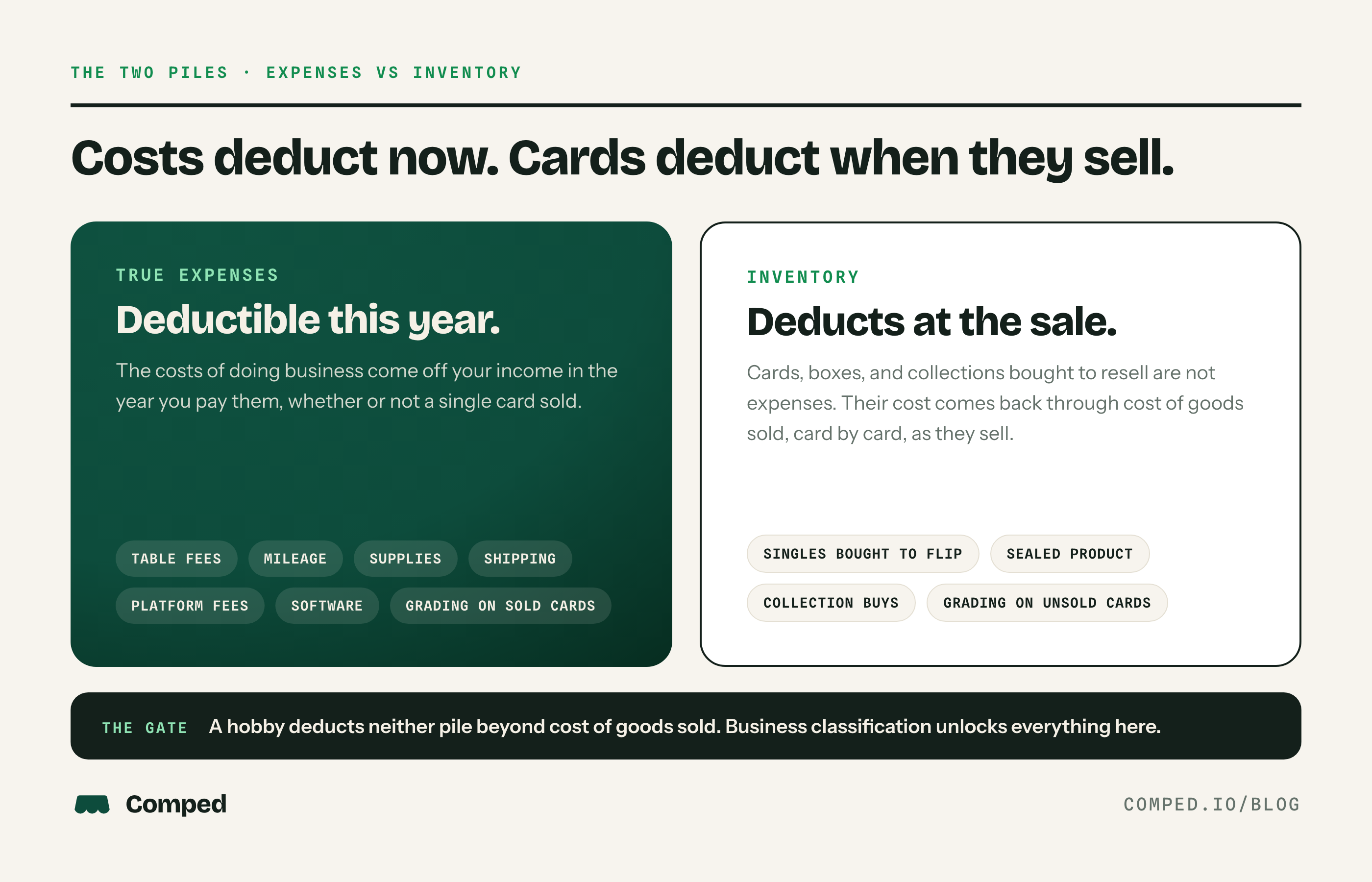
Inventory is not a write-off
The most expensive misunderstanding in the hobby: treating card purchases as expenses. Cards you buy to resell are inventory, and inventory becomes a deduction through cost of goods sold in the year the card sells, not the year you buy it. Buy $8,000 of inventory in December and sell none of it, and your December deduction is zero. The full mechanics, including the small-business methods and the trap in the timing rule, are in the inventory section of the tax guide.
Why lead a write-offs guide with something you cannot write off? Because every category below is different. Table fees, mileage, grading, and supplies are true expenses, deductible in the year you pay them, sold cards or not. Keeping the two piles separate, cards in one, costs of doing business in the other, is the whole structure of a card vendor's books.
Every deduction at a glance
The full stack, in one place. Every line is covered in detail below, with the record that proves it.
| Write-off | What counts | The record |
|---|---|---|
| Show costs | Table and booth fees, setup entry, case rental, promoter insurance, permits | Receipt or confirmation email, same-day log for cash |
| Mileage | Driving to shows, the post office, the LCS, supply runs | Contemporaneous log: date, destination, purpose, miles |
| Lodging and meals | Hotels on overnight show trips, meals at 50% while traveling | Folio and receipts, note the business company |
| Grading | PSA, BGS, CGC, SGC submission fees and return shipping | Submission invoice, tied to sold vs held cards |
| Supplies | Sleeves, toploaders, team bags, magnetics, boxes, labels | Order history and receipts |
| Shipping | Labels, insurance, tracking, mailers, the eBay standard envelope | Platform label history, postage receipts |
| Platform and payment fees | Final value fees, commissions, promoted listings, processing | Monthly platform statements |
| Software | Pricing and comp tools, bookkeeping, listing tools, Comped | Subscription receipts |
| Phone and internet | The business-use percentage of both | The bill plus a written, consistent percentage |
| Home office | A space used regularly and exclusively for the business | Square footage, photos, the simplified method math |
| Equipment | Display cases, lighting, laptop, camera, label printer | Invoice, business-use percentage for mixed items |
| Insurance and storage | Inventory coverage, a storage unit, a safe | Policy and unit invoices |
| Helper pay | Table help, packers, day labor | W-9 on file, payment records, 1099-NEC at $2,000 |
| Startup costs | Spending before your first sale | Receipts dated before launch |
| Health insurance | Premiums for you and your family, rules below | Premium statements |
| Retirement | SEP-IRA or solo 401(k) contributions | Plan statements |
| Professional fees | Tax prep, bookkeeping, legal, bank and payment account fees | Invoices and statements |
| Half of SE tax | Automatic with a correct return | Schedule SE |
Print it, or let Comped do this automatically: the AI reads your deals and your connected bank feed, flags which transactions look like real business expenses, and suggests the right category for each with its record attached.
The show weekend
A two-day show three hours away generates more deductions than most vendors capture.
Table and entry fees
Table rent, booth fees, show entry for setup days, and case rentals are straight business expenses. So are the show-specific costs around them: a helper's day rate, promoter-required insurance, and the temporary sales tax permit some states charge for. Keep the confirmation email or receipt. If the promoter takes cash only, note it in your log the same day.
Mileage: the biggest number, the strictest rule
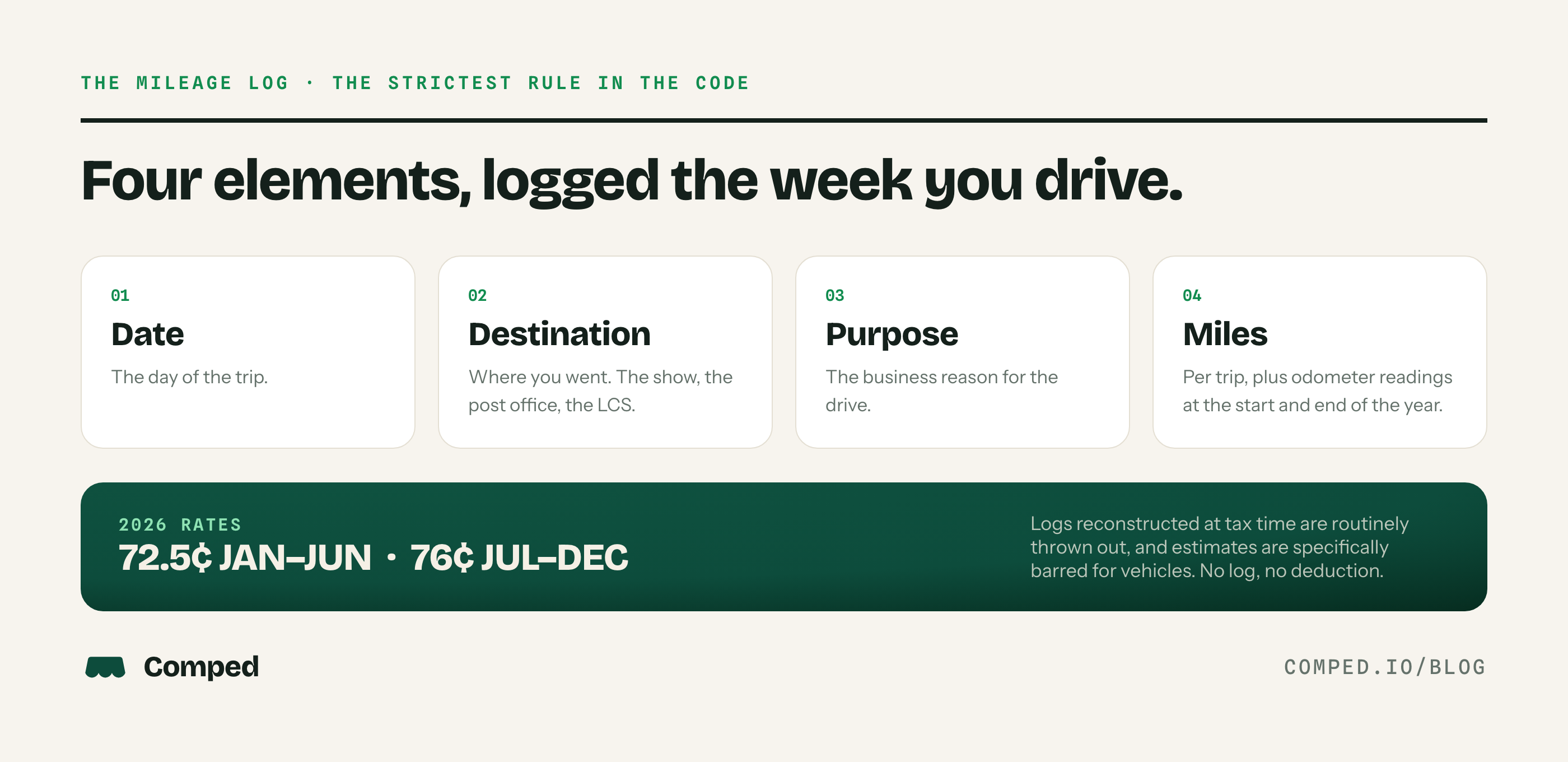
Driving to shows is usually the show circuit's biggest out-of-pocket cost, and it lives under the strictest substantiation rule in the tax code. Section 274(d) demands a record with four elements, made at or near the time of the trip: the date, the destination, the business purpose, and the miles. Courts throw out logs reconstructed in April, and the estimation fallback that rescues other sloppy records is specifically unavailable for vehicles. The rate itself is set annually by the IRS at 72.5 cents per business mile through June 2026 and 76 cents from July, a rare mid-year increase, and it covers gas, maintenance, and depreciation in one number. A 300-mile round trip is about $218 to $228 off your taxable income, every show, if the log exists.
Lodging and meals
Overnight at a show away from home makes the hotel deductible in full and meals deductible at 50%. The trip has to be primarily business, which a vendor working a table all weekend clears easily. Keep the folio and the restaurant receipts, and note who the meal was with when it was a business conversation with another dealer or a customer. Family along for the weekend? Your costs deduct, theirs do not: you claim the single-room rate for the hotel, the full drive since the car costs the same either way, and none of their meals or tickets.
Grading, supplies, and shipping
Grading fees
Grading is deductible, with one timing nuance the tax guide covers in depth. Fees on cards that sold this year are deductible this year. Fees on cards still in your case at year-end are safest folded into the card's inventory cost, recovered when it sells. Either way the money comes back off your taxes; the only question is which year.
Supplies
Sleeves, toploaders, team bags, magnetics, display cases under the equipment threshold, price stickers, tape, boxes: all deductible when bought. This category leaks constantly because it is a stream of small purchases across Amazon, the LCS, and show floors. It adds up to real money for a vendor moving volume, and it is exactly the kind of spending a connected bank feed catches automatically.
Shipping and postage
Labels, insurance, tracking upgrades, padded mailers, and the eBay standard envelope cost are all deductible selling expenses. Remember the 1099-K reports gross, so if a buyer paid you $110 with $10 shipping, the $110 is in your reported receipts and your $10 label cost must show up as an expense or you are paying tax on postage.
Platform fees, payments, software, and your phone
Platform and payment fees
eBay final value fees, Whatnot commission, promoted listing costs, PayPal and card processing fees, and payout fees are deductible in full. On $60,000 of platform sales these run into the thousands, and they are invisible if you only ever look at what hit your bank. Book gross sales and book the fees; the difference is real deductible money.
Software and subscriptions
Tools you use to run the business are deductible: pricing and comp services, inventory software, a bookkeeping app, listing tools, cloud storage for your records, and yes, Comped itself. So is the business share of services you also use personally, at a documented percentage.
Advertising and swag
Social ads, show banners, business cards, and your table signage are deductible advertising. Mass giveaways to the crowd count as advertising too, and identical imprinted items costing $4 or less, the pens and keychains of the world, are specifically blessed. The one cap: gifts to a specific person, a good customer, a promoter, top out at $25 per person per year.
Education
A course that maintains or improves skills in the business you already run, a grading course, a bookkeeping course, is deductible on Schedule C. Education that qualifies you for a new line of work is not.
Phone and internet
The business-use percentage of your phone plan and home internet is deductible. Be honest and consistent: a vendor listing, sourcing, and selling from a phone can defend a substantial percentage, but 100% on your only phone line is a classic audit flag. Pick a defensible number, write down how you got it, and use it every year.
The home operation
Home office
A space in your home used regularly and exclusively for the card business, an office, a card room, a corner where you photograph and pack, qualifies for the home office deduction. The simplified method is $5 per square foot up to 300 square feet, a maximum of $1,500 a year, and requires no depreciation math. The regular method deducts the business percentage of actual home costs and can be larger, at the price of more records. Exclusive use is the test people fail: the kitchen table does not qualify, the spare room that is only cards does.
Storage and insurance
A storage unit for inventory, a safe, and insurance on your inventory are deductible. If you carry a rider on your homeowner's policy for the collection you sell from, the business share of that premium counts too.
Equipment
Display cases, lighting, a laptop, a label printer, a camera for listings: equipment used for the business is deductible, and under Section 179, whose 2026 limit of $2,560,000 no card vendor will ever brush against, or 100% bonus depreciation, permanent again for property acquired after January 19, 2025, a small vendor deducts the full cost in the year of purchase rather than depreciating it over years. For mixed personal and business items like a laptop, deduct the business percentage.
People, startup costs, and the retirement lever
Paying help
A friend working your table, a breaker you pay to run lots, a teenager who sleeves and ships: their pay is deductible. Pay any one person $2,000 or more during 2026 and you owe them and the IRS a Form 1099-NEC. That threshold was $600 for years; the July 2025 law raised it to $2,000 for payments made starting in 2026, indexed after, and most of the internet has not caught up. Collect a W-9 before the first payment, not after.
Startup costs
Money spent before your first sale counts too. Up to $5,000 of startup spending is deductible in year one, shrinking dollar for dollar once total startup costs pass $50,000, with the rest spread over 15 years. Market research, travel to line up suppliers, training, ads for your launch, and formation costs like state LLC filing fees all qualify. One current-events note: posts are circulating that the 2025 tax law raised this to $50,000. It did not. The statute still says $5,000.
Health insurance
Buy your own coverage and the premiums for medical, dental, and vision, for you, your spouse, your dependents, and your children under 27, are deductible. This one is taken on your 1040 rather than Schedule C, so it cuts income tax but not self-employment tax. It cannot exceed the business's profit, and any month you were eligible for an employer plan, through a job or your spouse's job, is excluded even if you never enrolled.
The retirement lever
A SEP-IRA takes up to 25% of your compensation, which works out to about 20% of net profit for the self-employed, with a $72,000 cap for 2026. A solo 401(k) takes a $24,500 elective deferral, more with catch-ups after 50, plus an employer share on top. For a profitable vendor, a solo retirement plan is usually the single largest legal deduction available, and it is money you keep instead of money you spend. Contributions cut income tax, not self-employment tax.
And the automatic ones
Two more come nearly free. The qualified business income deduction takes 20% of your profit off the top of your income tax, permanently, with no hoops below the income thresholds, and it is covered in depth in the tax guide. And half of your self-employment tax is deductible without doing anything except filing correctly. It is computed on Schedule SE and taken against income, and it exists so the self-employed are not taxed on the employer half of payroll tax the way no employee is.
What you cannot deduct
- Your personal collection. Cards you keep are not expenses, and pulling a card from inventory for the PC removes its cost from your books rather than creating a deduction.
- Commuting. Driving to a fixed shop or office you rent is commuting. Show travel is different and deductible.
- Clothing. Normal clothes worn to shows are not deductible, logo or not, unless they are true branded uniforms unsuitable for street wear.
- Meals alone at home base. Grabbing lunch during a normal local workday is living, not business. Meals travel with overnight trips and business company.
- The hobby version of any of this. Every line in this guide requires business classification.
- Fines and penalties. A parking ticket at the show is yours.
- Sales tax you collected. Tax you collect from buyers and remit to the state is not income and not an expense. It passes through you.
The record that proves each one
A deduction without a record is a future repayment with penalties. The proof standard is not complicated, and photos count: the IRS has accepted legible electronic images since 1997. What each category needs:
| The strict ones | What survives |
|---|---|
| Mileage | A log made at or near the time of each trip with date, destination, purpose, and miles. April reconstructions lose in court, and estimation is specifically barred for vehicles |
| Cash spending | A dated entry the day it happened, what it was for, backed by ATM records and a photo of the receipt when one exists |
| Meals | The receipt plus who you were with and the business reason, noted at the time |
| Home office | Measured square footage and photos showing exclusive business use |
| Helpers | A W-9 collected before the first payment, and every payment on the books |
Two audit notes from the deduction side specifically. Round numbers read as estimates, and estimates read as fiction; real records produce numbers like $451, not $500. And deductions wildly out of proportion to your revenue are widely reported to score against you in the IRS's return-selection models. Neither matters if every line has a receipt behind it, which is the entire point of recording deals and expenses the day they happen.
A $100k vendor, worked
Here is the whole guide as one model year, using the same defaults as our savings calculator: a vendor moving $100,000 of cards a year across 12 shows and the platforms.
| The year's deduction stack | Amount |
|---|---|
| Table and booth fees, 12 shows | $1,140 |
| Mileage, about 2,250 logged miles | $1,670 |
| Lodging on the two long weekends | $700 |
| Travel meals after the 50% haircut | $300 |
| Supplies | $620 |
| Grading on cards sold this year | $640 |
| Shipping and labels | $520 |
| Software and comp tools | $480 |
| Phone and internet share | $300 |
| Home office, simplified method, 48 square feet | $240 |
| Total deductions | $6,610 |
| Tax saved at a combined 30% rate | $1,983 |
Every line above is ordinary vendor spending, none of it is aggressive, and all of it disappears if nobody writes it down. $1,983 is the tax difference between a vendor who tracks and a vendor who guesses, before counting basis records, and it is the same order of savings the calculator on our home page shows for a vendor this size. Platform fees are on top of this stack, deducted against the gross the 1099-K reports.

Card vendor write-off FAQ
Can I write off the cards I buy?
Not when you buy them. Cards bought to resell are inventory, and their cost comes back through cost of goods sold when each card sells. The true expenses around the cards, fees, supplies, grading, travel, deduct in the year you pay them. A card bought for your personal collection is never deductible.
Standard mileage or actual car costs?
Both methods exist. The standard rate, 72.5 cents per mile through June 2026 and 76 cents from July, is simpler and bundles gas, repairs, and depreciation into one number. Actual costs can come out higher for an expensive vehicle but demand complete expense records and a business-use percentage. Either way, the trip log with date, destination, purpose, and miles is mandatory.
Can I deduct my phone?
The business-use share, yes. A vendor who lists, prices, and sells from a phone can defend a substantial percentage of the bill. Pick a number you can justify, write down how you got it, and apply it consistently. Claiming 100% of your only phone line is a known audit flag.
Does my kitchen table count as a home office?
No. The home office deduction requires a space used regularly and exclusively for the business. A spare room or a dedicated corner that is only cards qualifies, and the simplified method pays $5 per square foot up to 300 feet. The table where your family eats dinner fails the exclusive-use test.
Are grading fees deductible?
For a business, yes, with timing: fees on cards sold this year deduct this year, and fees on cards still in inventory at year-end are safest added to the card's cost, recovered at sale. Investors and collectors get no current deduction and add the fee to basis instead.
I paid cash at a show and lost the receipt. Is the deduction dead?
Not automatically. A dated log entry made at the time, ATM withdrawals, photos, and messages arranging the deal can carry it, and courts can estimate expenses in a pinch, though they estimate low. What kills deductions is reconstructing everything in April. Record it the day it happens and the question never comes up.
Can I bring my family to a show and deduct the trip?
You deduct your share, not theirs. The drive deducts in full since the car costs the same with them in it, your hotel deducts at the single-room rate, and your travel meals deduct at 50%. Their meals, their tickets, and the extra room cost are personal.
Do I need an LLC to take these write-offs?
No. A sole proprietor on Schedule C takes every deduction in this guide from day one. An LLC changes liability protection, not deductions, and when one makes sense for you, Comped forms it from inside the app. What actually gates the write-offs is business versus hobby classification, which is about how you operate, not what entity you file.
Are giveaways at my table deductible?
Yes. Mass giveaways to the crowd are advertising, and identical imprinted items costing $4 or less are specifically excluded from gift limits. A gift to one specific person is capped at $25 per person per year, so the $100 thank-you slab for your best customer is mostly on you.
How much does a write-off actually save me?
Your combined marginal rate on that dollar, which for most vendors runs 25% to 40% once self-employment tax is counted. A deduction is not a coupon and never makes spending free. The win is not paying tax on money that real business costs already consumed.
SOURCES · ALL ACCESSED SEPTEMBER 3, 2026
- IRS Publication 334, business expenses and advertising. irs.gov/publications/p334
- 2025 Schedule C instructions: line 23 taxes and licenses, sales tax treatment, health insurance note. irs.gov, Schedule C instructions
- IRS Publication 463: travel, 50% meal limit, family companions, mileage substantiation, the $25 gift limit. irs.gov/publications/p463
- IRS standard mileage rates, including the July 2026 increase to 76 cents. irs.gov, standard mileage rates
- IRS, simplified home office deduction. irs.gov, simplified home office
- Rev. Proc. 2025-32, 2026 Section 179 limit of $2,560,000. irs.gov, Rev. Proc. 2025-32
- IRS and Notice 2026-11, 100% bonus depreciation permanent for property acquired after January 19, 2025. irs.gov, bonus depreciation guidance
- 26 U.S.C. §195, startup costs: $5,000, the $50,000 phase-down, 180-month amortization. law.cornell.edu/uscode/text/26/195
- IRS Form 7206 instructions, self-employed health insurance deduction. irs.gov, Form 7206 instructions
- IRS Topic 513, work-related education. irs.gov/taxtopics/tc513
- 26 U.S.C. §6041 as amended by the One Big Beautiful Bill Act, the $2,000 information-return threshold for payments after 2025. law.cornell.edu/uscode/text/26/6041
- IRS Notice 2025-67 and IR-2025-111, 2026 retirement plan limits. irs.gov, 2026 retirement limits
- Treas. Reg. §1.471-1(b), small-business inventory timing and average cost. law.cornell.edu/cfr/text/26/1.471-1
- Treas. Reg. §1.183-1 and the 2025 law, hobby expenses permanently nondeductible beyond cost of goods sold. law.cornell.edu/cfr/text/26/1.183-1
- IRS record rules: what to keep, how long, and electronic records under Rev. Proc. 97-22. irs.gov, what records to keep
- IRS Topic 554, self-employment tax and the deduction for half of it. irs.gov/taxtopics/tc554
- Cohan v. Commissioner, 39 F.2d 540 (2d Cir. 1930), estimation as a last resort, unavailable for vehicle expenses under §274(d).
This guide is general information for United States federal taxes, current as of September 2026. It is not tax, legal, or accounting advice, and Comped is not a CPA firm. Rules change and individual facts matter. Confirm how these rules apply to your situation with a tax professional.