What basis is
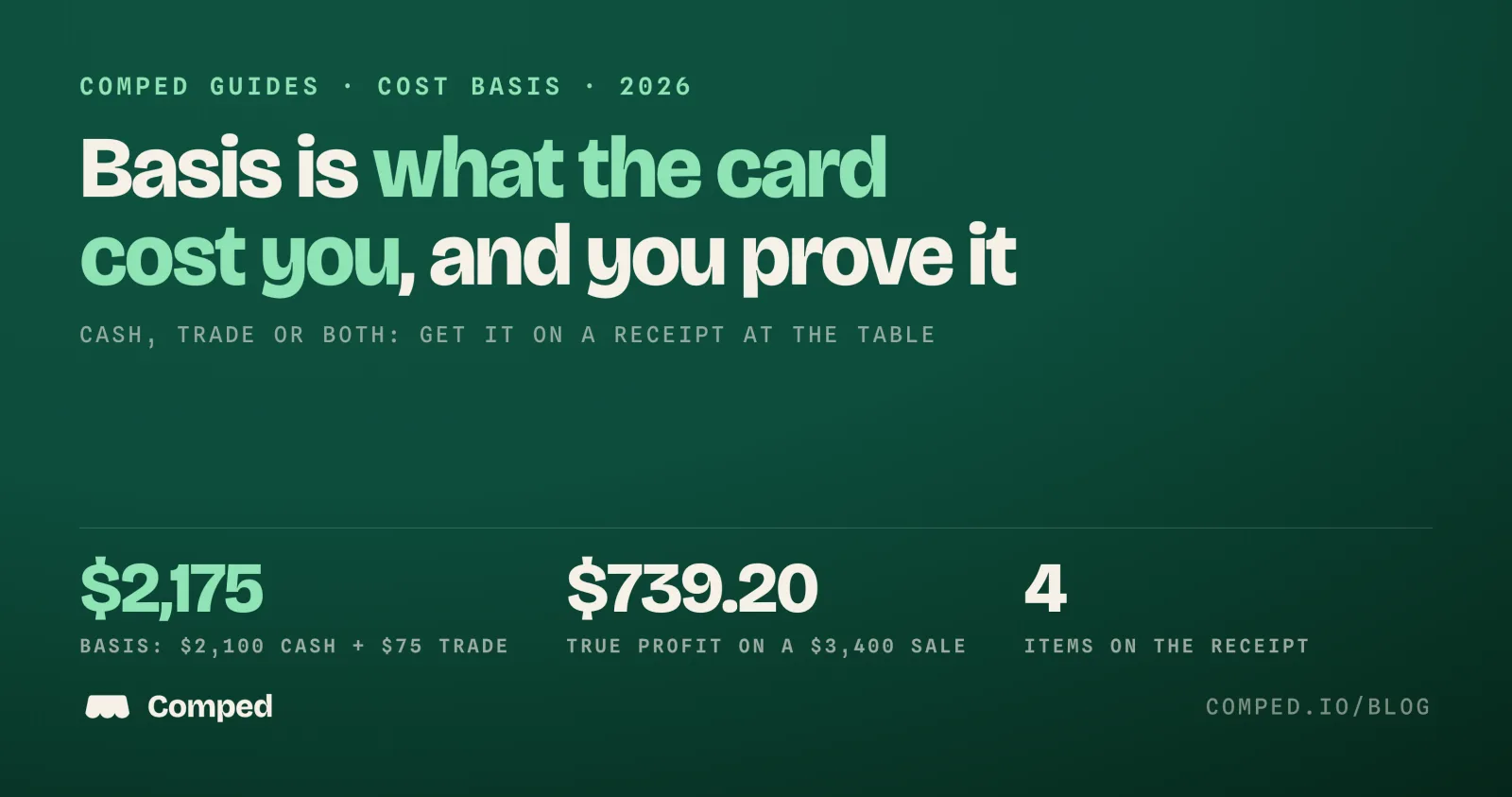
Basis is what the card cost you, and it decides the tax. Profit is the sale price minus basis minus selling costs, and tax is owed on the profit, not the sale. A $3,400 sale with a $2,175 basis is a $1,225 margin before fees. The same sale with no provable basis is taxed on almost all of it.
The 1099-K from eBay or Whatnot reports gross, with nothing subtracted, as the IRS 1099-K FAQs say. Basis is what you subtract on the return, and you prove it, not the platform. The 1099-K reconciliation calculator walks a form down to profit. The master tax guide covers the inventory methods; this post covers where the number comes from.
Basis by how the card arrived
Basis depends on how you got the card. Publication 551, Basis of Assets (revised December 2025) sets the general rules. No IRS ruling is specific to trading cards, so the rows marked "our reading" apply those general rules to cards.
| How you got the card | Basis | Record that proves it |
|---|---|---|
| Cash buy at a show | Price paid, plus any sales tax you paid | Written receipt: seller, date, item, price |
| Straight trade | Fair market value of the card you received, on the trade date | Trade receipt with both cards and values, plus saved comps |
| Trade plus cash you paid | Value of the card you gave plus the cash | One receipt, two lines: the card and the cash |
| Trade plus cash you received | Fair market value of the card you received | Receipt showing the card, the cash and the values |
| Collection or lot for one price | The price, split across the cards (our reading: by share of value) | Receipt plus the split sheet |
| Pack, box or case you opened | The cost of the product, split across what came out (our reading) | Store or online receipt plus the split sheet |
| Break spot | What you paid for the spot, plus shipping, split across the cards you got (our reading) | Order confirmation and payment record |
| Gift | The giver's basis, with one exception covered below | The giver's receipt or a written note of their cost |
| Inherited | Generally fair market value on the date of death | Appraisal or dated comps for that date |
| Your own collection, moved to inventory | Original cost, if you can show it | Old receipts, statements, purchase history |
What goes into basis
Basis is more than the sticker price. Publication 551 says cost is the amount you pay in cash, debt obligations, other property or services, and it includes sales tax and freight. For a card, that covers the price, sales tax the seller charged you, and shipping to get it to you.
Our reading adds two items the publication does not name. A buyer's premium at auction is part of the amount you pay. A grading fee is a direct cost of that card, recovered when the card sells. The post on grading fees works an example.
Selling costs are not basis. Platform fees, payment fees and outbound shipping come off the sale side. Keeping the two apart makes the 1099-K match your records.
The cash buy and the receipt
A cash buy at a show is proven by a written receipt. Publication 583 lists the documents that support a purchase. They are canceled checks, cash register tapes, account statements, credit card sales slips, invoices, and petty cash slips for small cash payments. A dealer's table produces none of those, so you make the document at the table.
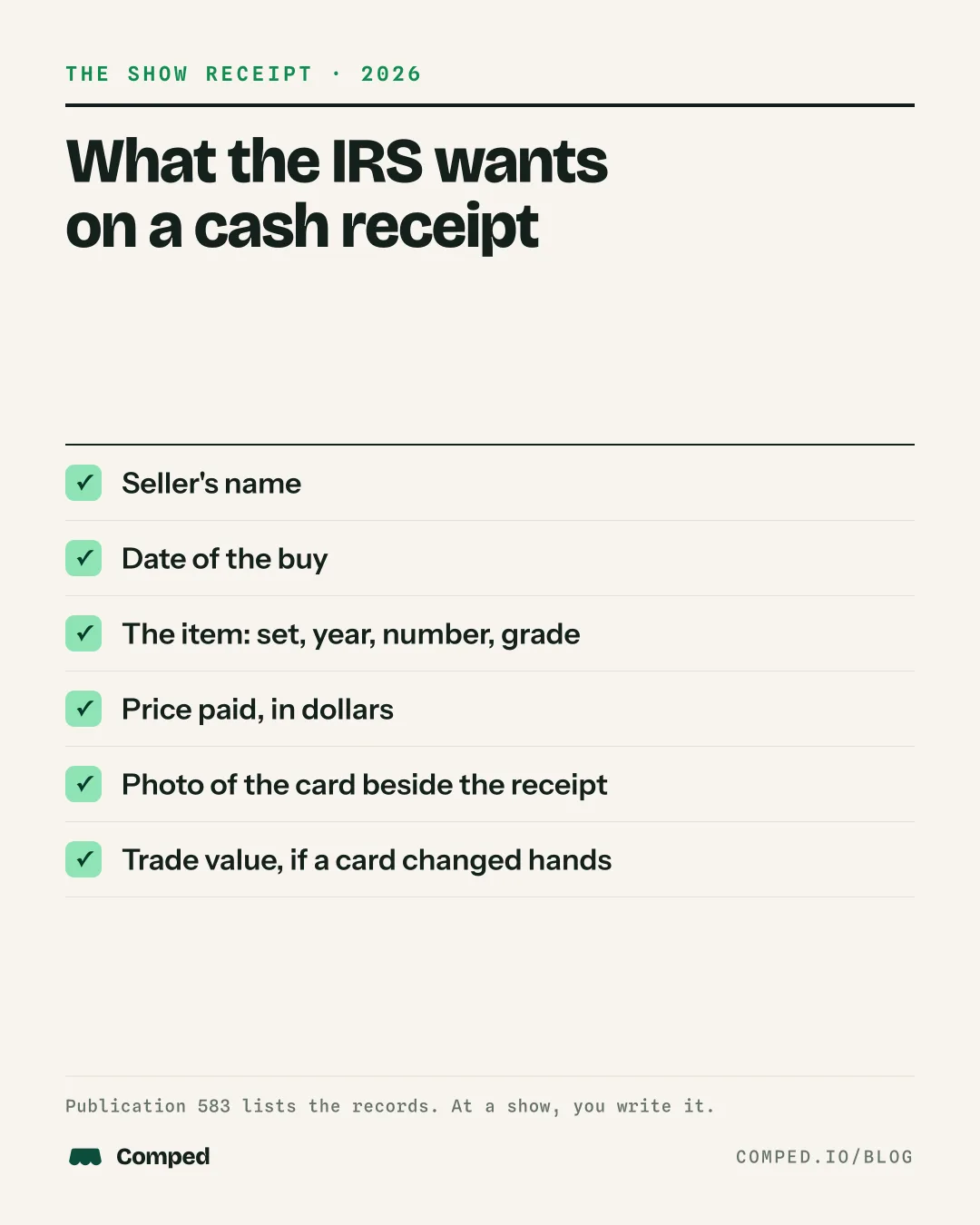
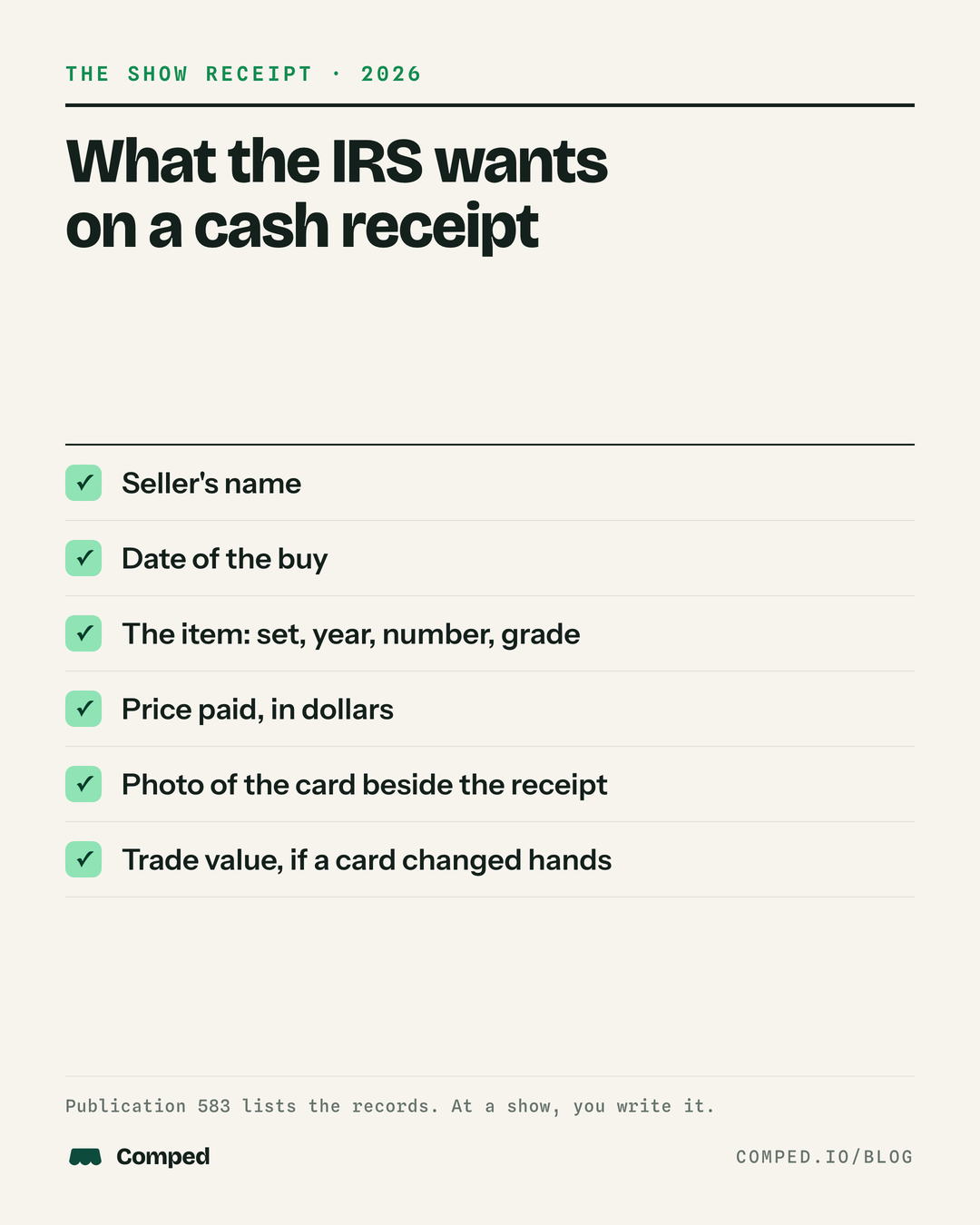
Four items, every time. The seller's name, because the IRS wants to know who was paid. The date, because basis attaches to a tax year. The item, specific enough to match the card later: set, year, number, grade, cert number if slabbed. The price, in dollars. A photo of the card beside the receipt ties the two together.
Keep that record with the card. The free card show cash log has these columns ready to print. If you paid sales tax to the dealer because you had no resale certificate, that tax is part of your cost. Our New Jersey sales tax post covers the ST-3 resale certificate that avoids it.
The trade
A trade is barter, and it is taxable with no cash in it. Tax Topic 420 says you include in gross income, in the year received, the fair market value of goods received from bartering. Publication 551 adds that property received in a taxable exchange usually takes its fair market value as basis. For a business, barter income goes on Schedule C.
The card you hand over is sold, for tax purposes, at that same value. Say you trade a card you paid $90 for against a card worth $75. You have a $75 sale with a $90 cost, a $15 loss on the way out, and a $75 basis in the card you got. Write both values on the receipt, with the other dealer's name and the date.
Fair market value is what the card would sell for between willing parties. Recent sold comps for the same card and grade, saved the day of the trade, are the proof. Both sides of a dealer trade should agree the number and keep it.
Dealers often credit trades below comp. Say your card comps at $100 and the dealer credits it at $80 toward an $80 card. Our reading: you sold your card for $80, the value you actually received, and the new card's basis is $80.
A trade with cash either way
When you add cash, your basis is the value of the card you gave plus the cash. Say you hand over a card valued at $200 plus $300 cash for a slab. Your basis in the slab is $500. You also sold the $200 card, and its profit or loss depends on what it cost you.
When cash comes to you, the cash is part of your sale price. Say you give a card valued at $500 and get a $350 card plus $150 cash. You sold your card for $500. The card you received has a $350 basis, and the $150 is sale money.
The receipt needs five items: the other party, the date, each card with its agreed value, and the cash with its direction. Write the cards and the cash as separate lines. The card trade calculator does this arithmetic and shows the tax view of your side.
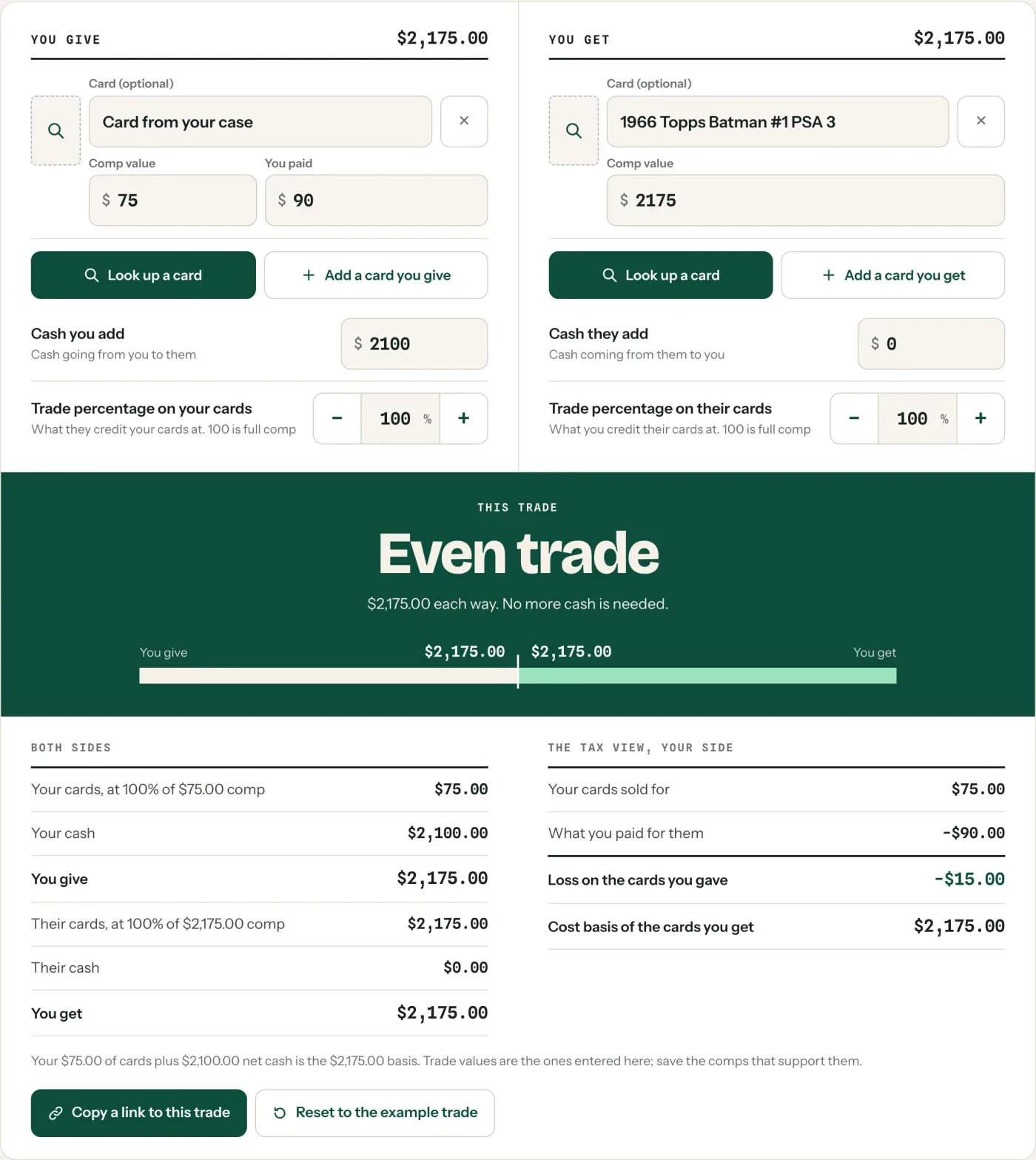
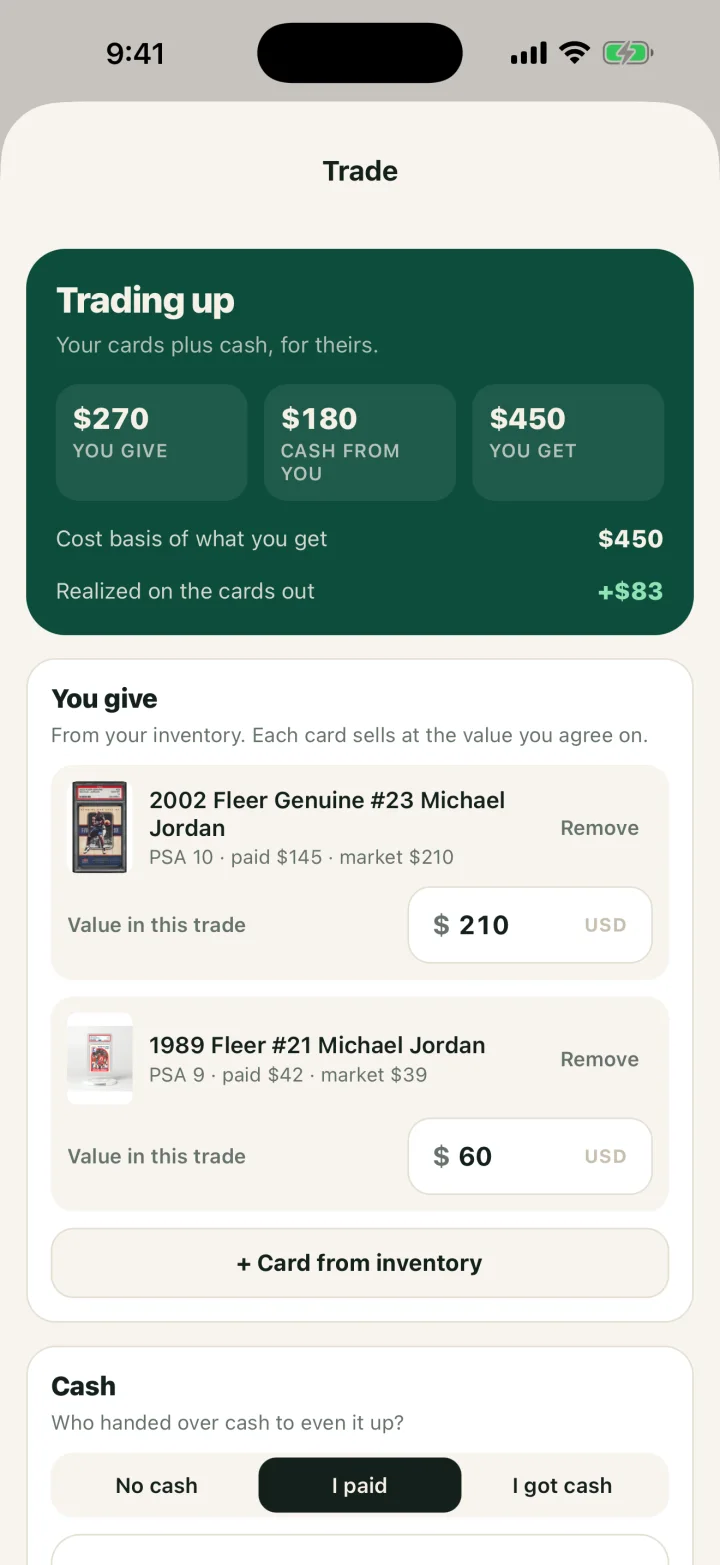
In Comped, the Trade screen takes cards out, cash either way and cards in, then shows the new basis and the gain or loss.
Collection and lot buys
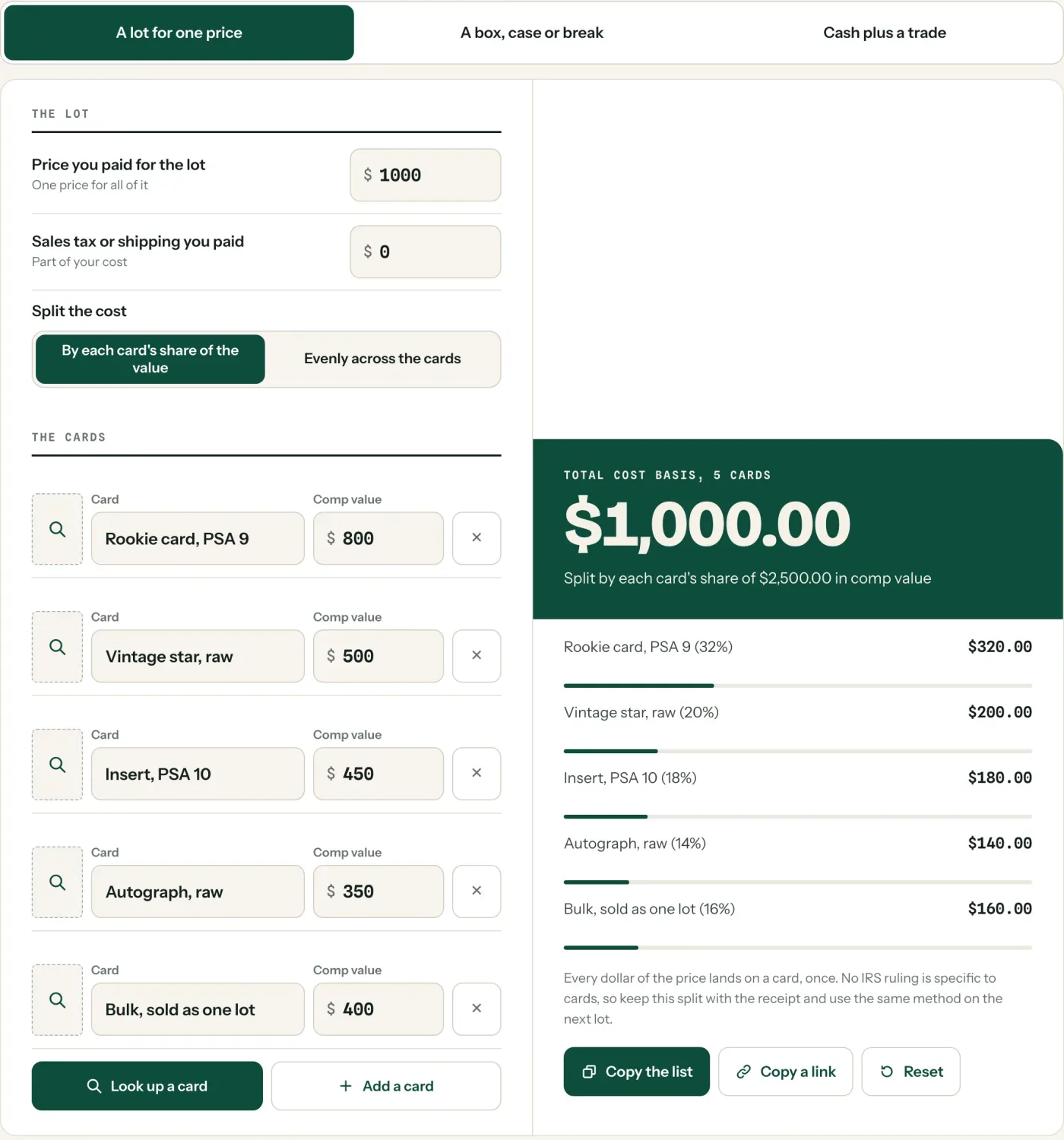
A lump sum for a box of cards is one basis spread across many cards. Publication 551 states the general rule: if you buy multiple assets for a lump sum, allocate the amount you pay among the assets you receive. Its own examples multiply the lump sum by each asset's share of fair market value. No IRS method is specific to cards, so write yours down.
Say you pay $1,000 for a collection whose sold comps add to $2,500. A card comping at $500 is 20% of the value and gets $200 of basis. Bulk you will sell as a lot can be one line with one basis.
Every dollar of the $1,000 lands on something, once, and the next collection is split the same way. The card cost basis calculator does the split and gives you a list to keep with the receipt.
Pack pulls and break spots
A card pulled from a pack has a basis equal to its share of what the pack or box cost. Our reading follows the same lump sum rule: split the cost across what came out, in proportion to value, and keep using that method. Say a $120 box yields one $400 hit and bulk worth $50. The hit is 400 of 450 in value and carries $106.67. The bulk carries $13.33.
The hit is not free, and the whole box is not the hit's basis either. An even split per card is simple, but it puts most of the cost on cards that never sell. Putting the whole box on one card leaves every other card at zero.
A break spot works the same way. Your basis is what you paid for the spot plus shipping, split across the cards you received. Our reading: the market value of a big hit does not raise your basis, and the gain is taxed when you sell or trade the card. A spot that returns nothing you keep or sell has nothing to carry its cost; ask your CPA how to treat it.
Gifts and inherited cards
A gifted card generally keeps the giver's basis, not zero and not today's value. Publication 551 says your basis is the donor's adjusted basis when the card was worth at least that much at the gift. If it was worth less than the donor paid, the basis for figuring a loss is the value on the gift date.
An inherited card generally takes its fair market value on the date of death. Publication 551 allows an appraised value at that date when no estate tax value was reported to you. Dated sold comps or a written appraisal are the record. Ask the giver or the estate for paperwork now, while someone still has it.
Your personal collection as inventory
When cards you bought for yourself move into the business, basis is the original cost if you know it. A 2004 receipt, a card statement, an eBay purchase history: any of them works. If the cost is unknown, document what you can, including when and roughly where you bought and what the card went for then.
The IRS can assert zero basis where there is no record, and then the whole sale is taxable. The question "What if I bought the cards 20 years ago with no receipt?" has that answer: rebuild what you can, in writing, now. Whether that sale is a business sale or a collector's sale is a separate question. Our post on taxes on selling sports cards covers the split.
Where basis goes on the return
For a dealer, basis reaches the return through Schedule C Part III, lines 35 to 42. Line 36 is the year's purchases, less cards you pulled out for your own collection. Line 41 is the cost of cards still unsold at year end. Line 42 is cost of goods sold, and it carries to line 4.
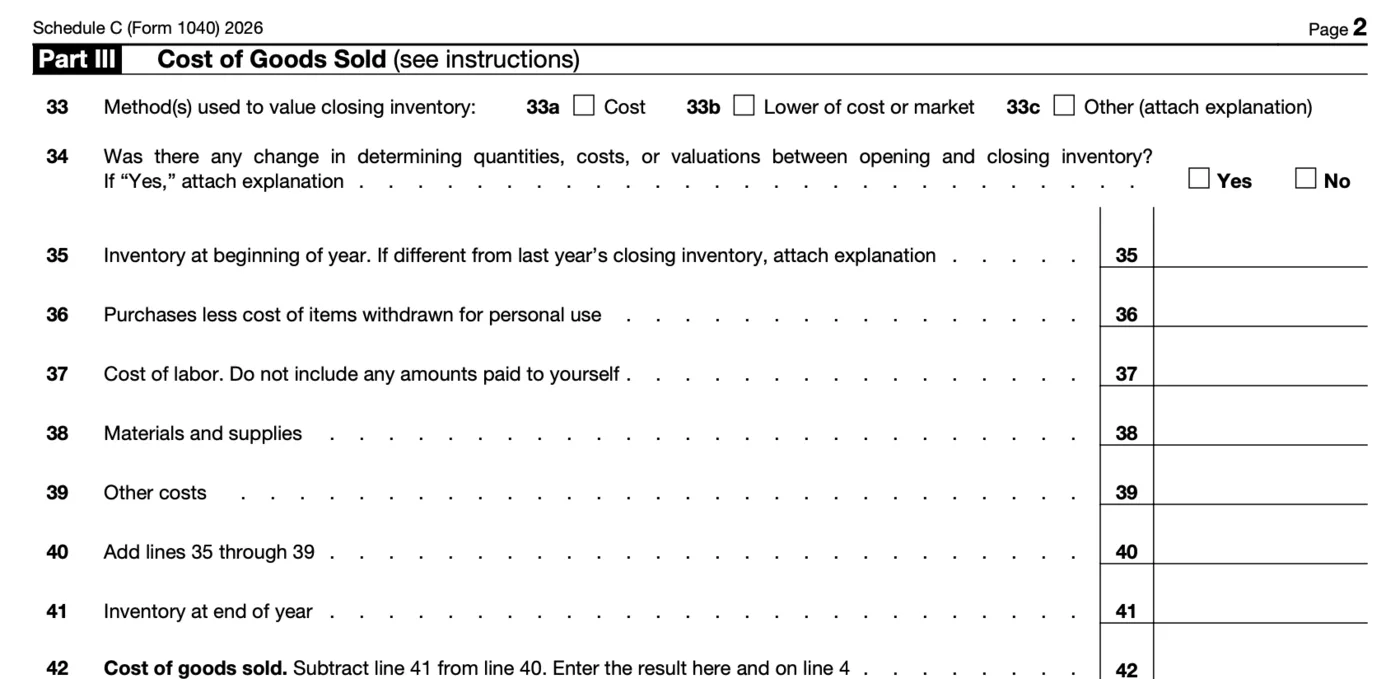
Only sold cards reduce this year's income. Buy $10,000 of cards, sell cards that cost $6,000, and cost of goods sold is $6,000. The other $4,000 waits on line 41. Publication 334 covers the simpler method small resellers may use, and the year-end inventory count post covers line 41.
A trade touches both sides. Our reading: the value of the card you received is a sale in gross receipts, and the same value is a purchase on line 36. A per-card ledger such as the sports card inventory spreadsheet produces these totals.
No record
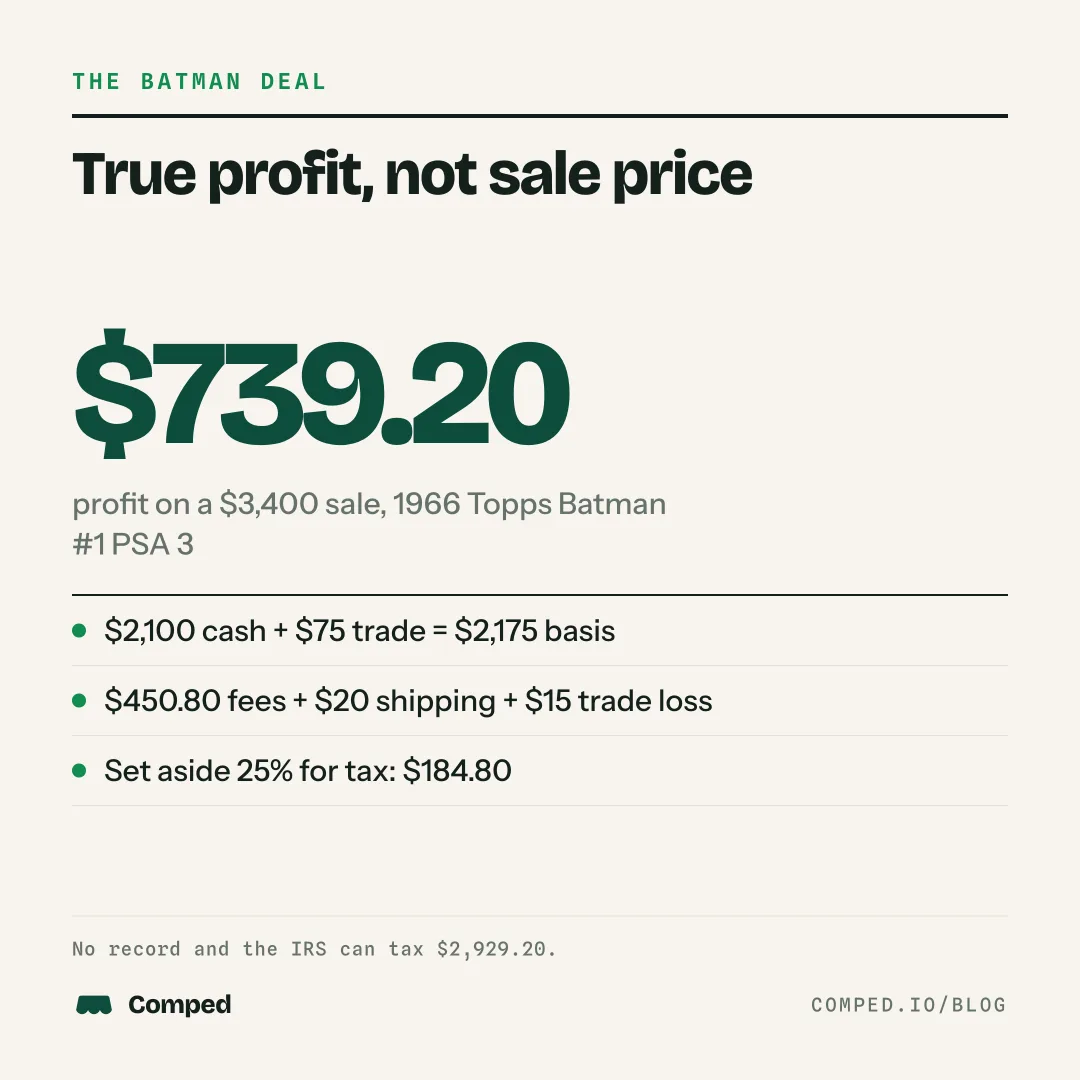
With no record, the IRS can assert zero basis, and nearly the whole sale becomes profit. The Batman below would show $2,929.20 of profit instead of $739.20. Publication 551 says you must keep accurate records of all items that affect basis.
Rebuild before you give up. Bank and card statements, ATM withdrawals on show dates, texts with the seller, marketplace order history and dated photos all help. Write one dated memo per card that says what you paid and how you know. Our post on card sales with no receipts goes through each source.
Keep basis records 3 years after you file the return that reports the sale, per the IRS records page. Make it 6 years if income was under-reported by more than 25%. A card held three years before it sells means a six-year-old receipt still matters. Cash over $10,000 in one deal adds a filing of its own, covered in Form 8300 for card dealers.
Common mistakes and their cost
Each of these changes the profit you are taxed on. The dollar figures are examples, using this post's deals and a 25% set-aside.
| Mistake | What it does | Example cost |
|---|---|---|
| No receipt for the cash buy | Basis can be read as zero. Batman profit is $2,929.20, not $739.20 | $547.50 more set aside |
| Leaving the traded card off the receipt | Batman basis drops to $2,100 and the $15 loss vanishes. Profit is overstated by $90 | $22.50 |
| Whole box cost on the hit | Hit basis is $120, not $106.67. The bulk shows zero cost when it sells | $13.33 misplaced |
| Deducting every purchase in the year bought | Unsold cards belong on line 41. $4,000 of cost is claimed early | $4,000 overstated |
| Leaving the grading fee out | A $20 card with a $25 fee has a $45 basis. Profit is overstated by $25 | $6.25 |
Past trades you never recorded
Rebuild them now, starting with cards you still hold. For each trade, write the date, the other party, both cards and the values. Use texts, show photos, social posts and sold comps from that date as support. A dated memo written today is weaker than a receipt from the day, and far stronger than nothing.
Then fix it going forward: one receipt per trade, two lines, made at the table. If trades were left off a return you already filed, take the rebuilt list to a CPA. They can tell you whether an amended return is needed.
The Batman deal, worked
Say you buy a 1966 Topps Batman #1 PSA 3 at a show for $2,100 cash plus a card from your case. The other dealer values your card at $75; you paid $90 for it. Your basis in the Batman is $2,175, and the trade line shows a $15 loss. It sells on eBay for $3,400 with $450.80 in fees and $20 shipping.
A REAL DEAL, WORKED
Say the Batman, bought with cash and a trade, sold on eBay the same year.
The receipt for the buy carries the seller's name, the date and the card with its cert number. It also shows the $2,100 cash and the traded card at its $75 value. Without it, the IRS can tax $2,929.20, the sale less fees and shipping.
Run your own deal through the card sale tax calculator to see the tax to set aside, or the card profit calculator to see fees by platform.
Terms
- Basis: what a card cost you, including sales tax, shipping in and grading.
- Fair market value: what the card would sell for between a willing buyer and seller, shown by recent sold comps.
- Boot: the cash added to one side of a trade to even it up.
- Cost of goods sold: the basis of the cards you sold this year, Schedule C line 42.
How this looks in the Comped app
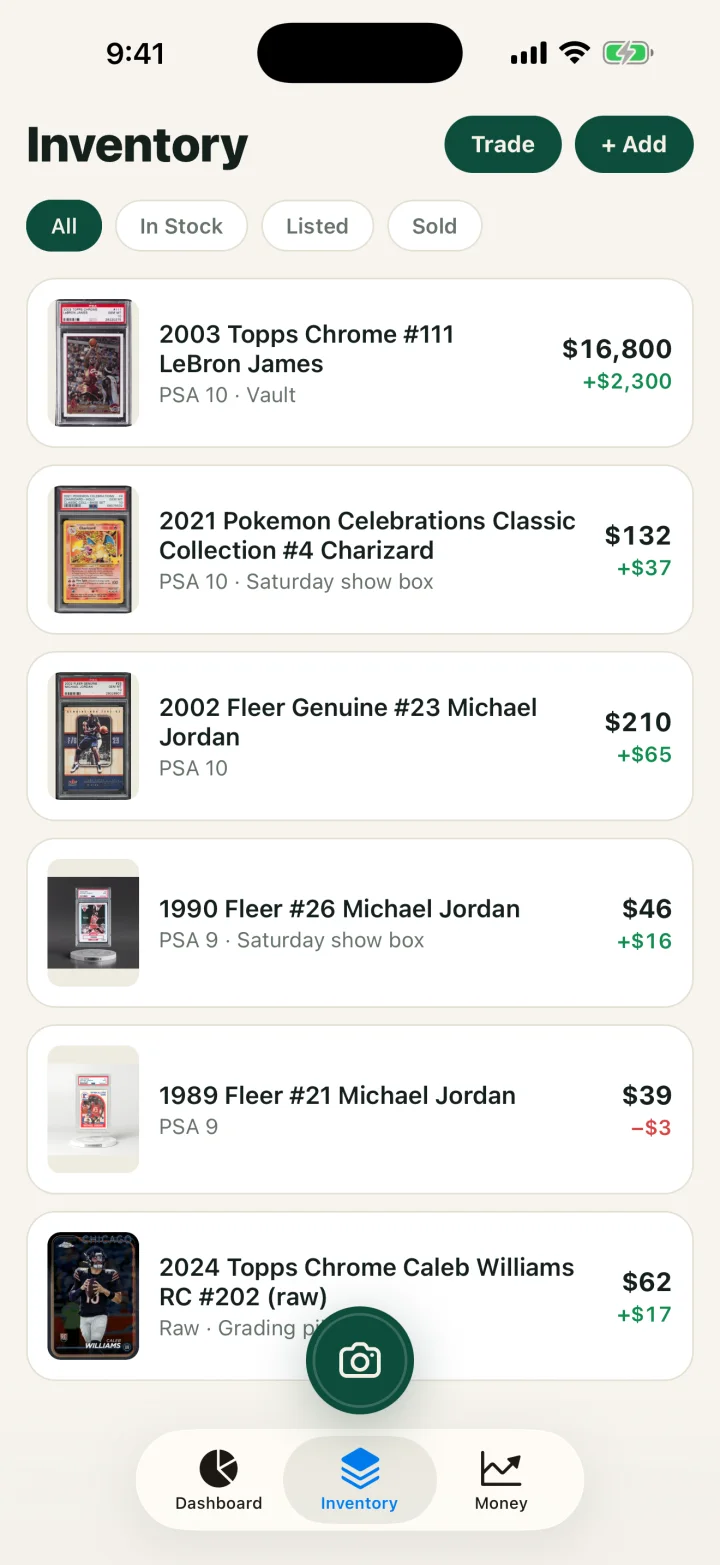
The Trade screen shows what you give, the cash, what you get, the basis of the new card and the gain realized. A sale's Transaction screen shows the cost basis behind it, including a card given in trade. Inventory lists each card with its value and gain.

Related guides
- The Card Vendor's Master Guide to Taxes: inventory methods, Schedule C and where basis lands on the return.
- Are PSA grading fees tax deductible?: the grading fee is part of basis too.
- Card sales with no receipts: how to rebuild cost when the paper is gone.
- Form 8300 for card dealers: what a cash deal over $10,000 adds.
- Do you have to pay taxes on selling sports cards?: profit, not sale price, and who owes it.
FAQ
Do trades count as sales?
Yes. A trade is barter, and the card you receive is income at its fair market value in the year you get it. That value becomes the new card's basis, and the card you gave up is treated as sold at the same value. Business barter goes on Schedule C.
Is a card for card trade taxable if no cash changes hands?
Yes. Tax Topic 420 taxes the fair market value of goods received in barter, cash or no cash. You have a gain or loss on the card you gave, measured against what it cost you.
What if I bought the cards 20 years ago with no receipt?
Basis is the original cost if you can show it, so look for old receipts, statements or purchase histories. If nothing exists, write down what you know about when, where and for how much you bought. With no record at all the IRS can assert zero basis and tax the whole sale.
What is the cost basis for a card pulled from a pack?
Its share of the pack or box cost, split across what came out by a reasonable method, usually in proportion to value. No IRS ruling is specific to cards. Write the method down and use it for every box.
Do I split the cost of a box evenly or put it all on the hit?
Neither is our reading of the rule. Publication 551 says a lump sum is allocated among the assets received, and its examples use each asset's share of value. On a $120 box with a $400 hit and $50 of bulk, the hit carries $106.67 and the bulk $13.33.
What is my basis in a card someone gave me?
Generally the giver's basis, not zero. Publication 551 says you take the donor's adjusted basis when the card was worth at least that much at the gift. An inherited card generally takes its fair market value on the date of death instead.
Is it profit or the whole sale that is taxed?
Profit: sale price minus basis minus selling costs. On the Batman deal that is $3,400 minus $2,175 minus $450.80 in fees, $20 shipping and a $15 trade loss, or $739.20. The 1099-K shows the $3,400; you prove the rest.
Would a spreadsheet of my buy prices work for the IRS?
A spreadsheet is a summary, and it works when documents stand behind it. Publication 583 lists receipts, invoices, statements and canceled checks as the support for a purchase. For cash buys at a show, a dated handwritten receipt with the seller's name, the item and the price is that document.
SOURCES
- Publication 551, Basis of Assets (revised December 2025), IRS, checked November 2026.
- Topic no. 420, Bartering income, IRS, checked November 2026.
- Publication 583, Starting a Business and Keeping Records, IRS, checked November 2026.
- Schedule C (Form 1040) 2026, Profit or Loss From Business, IRS, checked November 2026.
- Publication 334, Tax Guide for Small Business, IRS, checked November 2026.
- Form 1099-K FAQs, general information, IRS, checked November 2026.
- How long should I keep records?, IRS, checked November 2026.
This is general information for card sellers, not tax or legal advice for your situation. Rules change and states differ; a CPA who knows your numbers wins every time.