What the log looks like
This is the printed page with two example deals written in: a buy for cash plus a traded card, and a cash sale. The show, the amounts and the starting cash are examples.
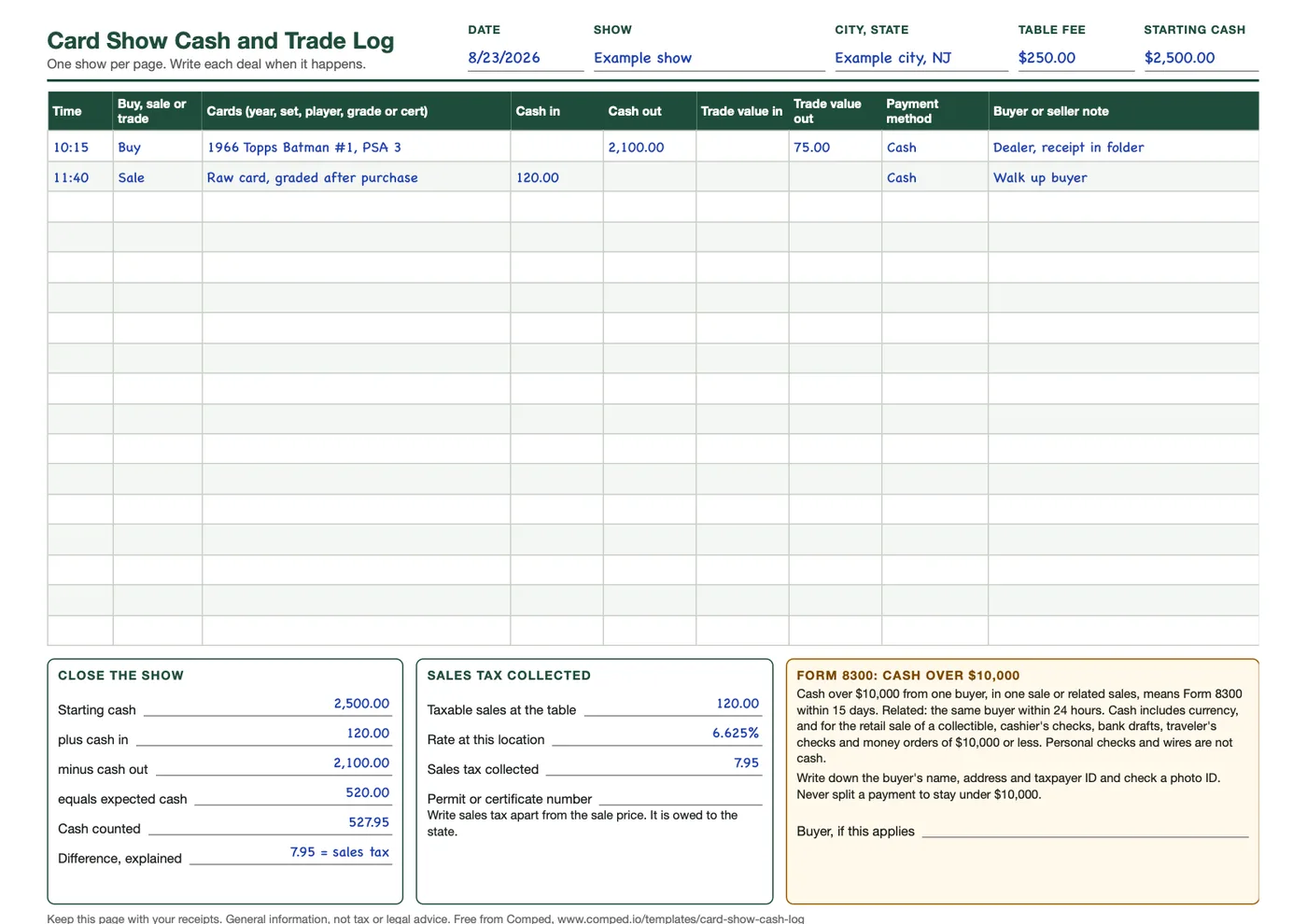
Free sales logs online are mostly a date, an item and a price. A card table needs more: money goes out as well as in, cards change hands for cards, and the cash has to be counted at the end. This page has columns for all three.
What is on the log
Each page covers one show. The header takes the date, the show name, the city and state, the table fee and the cash you started with. Below it, every deal gets one row.
| Field | What to write |
|---|---|
| Time | When the deal happened. It ties related cash payments together later. |
| Buy, sale or trade | One word, so the row is read the right way at year end. |
| Cards | Year, set, player or character, number, and the grade or cert |
| Cash in | Money you received for the cards |
| Cash out | Money you paid for cards |
| Trade value in | The agreed value of cards you received |
| Trade value out | The agreed value of cards you gave |
| Payment method | Cash, card reader, payment app, check |
| Buyer or seller note | Name or table number, and where the receipt is |
The bottom of the page has three boxes: closing the show, sales tax collected, and the Form 8300 reminder. The extra rows page repeats the table with page totals and space for notes.
The card show vendor tax checklist lists the records to have before, during and after a show. This log is the during part.
How to fill it in
Write each deal on its own row when it happens, and close the page before you pack up.
- Before the doors open, fill in the header: date, show, city and state, table fee and starting cash. Count the cash to get that number.
- For a sale, write the time, "Sale", the card, and the price in Cash in. Write how the buyer paid in Payment method.
- For a buy, write "Buy", the card, and the price in Cash out. Put the seller's name in the note and get a receipt.
- For a trade, write "Trade" and fill in Trade value in and Trade value out. Add any cash in Cash in or Cash out.
- If you collect sales tax, keep it out of Cash in. Tally it in the margin and total it in the sales tax box.
- At the close, total the columns, fill in the three boxes and count the cash.
A sale paid by card reader or payment app still gets a row, because it is still a sale. The Payment method column is what keeps it out of the cash count.
Taxes on cash sales
A cash sale is taxed like any other sale. You owe tax on the profit whether or not a 1099-K or any other form reports it. Form 1099-K is a reporting rule for payment apps and marketplaces, not a tax threshold, and nobody issues one for cash at a table.
That makes your own record the only record. The IRS recordkeeping page says a business may use any system that clearly shows income and expenses. Publication 583 lists the documents that back a purchase, including petty cash slips for small cash payments.
For a cash or trade buy, that means a written receipt with the seller's name, the date, the item and the price. The log row is the summary; the receipt is the proof. The master tax guide covers how profit on those sales is taxed for dealers, hobby sellers and investors.
On a business return, cash sales go on the same line as every other sale. That line is Schedule C line 1, gross receipts or sales. Cost of goods sold comes off on line 4.

A dated log with receipts is what answers a question about cash sales, and the guide to card sales with no receipts shows how hard it is to rebuild one later.
Trades on the log
A trade goes on one row with both sides filled. Write the agreed value of the cards you received in Trade value in and the value of the cards you gave in Trade value out. Add any cash that changed hands in Cash in or Cash out.
Trades are barter. Under IRS Tax Topic 420, the fair market value of the card you receive is income in the year you receive it, and that value becomes the new card's basis. A business reports barter on Schedule C.
ONE TRADE, ONE ROW
A vendor buys a 1966 Topps Batman #1 PSA 3 for $2,100 cash plus a card both sides value at $75. The card given had cost $90.
The cost basis guide for cash and trade buys follows this same card to its $3,400 eBay sale.
The sales tax box
Sales tax at a show is usually your job, not the promoter's and not a marketplace's. eBay and Whatnot collect on their own orders, but in-person table sales are the seller's own responsibility. Trading cards and graded slabs are taxable in New Jersey, New York and Pennsylvania.
The box takes taxable sales at the table, the rate at that location, the tax collected and your permit or certificate number. Write sales tax apart from the sale price, because it is owed to the state.
| State | What a show vendor needs | Rate |
|---|---|---|
| New Jersey | Certificate of Authority (form CA-1), displayed at the show | 6.625% |
| New York | Certificate of Authority at least 20 days before the show | 4% plus local, 8.875% in New York City |
| Pennsylvania | Transient Vendor Certificate, notice 30 days before each show | 6%, 7% Allegheny, 8% Philadelphia |
Every other state is in the card show sales tax index and the state by state guide.
Closing the show
The close-out box checks the cash against the log: starting cash plus cash in, minus cash out, equals expected cash. Count the cash, write the figure, and explain any difference before you leave the hall.
THE EXAMPLE PAGE, CLOSED
The page in the picture above: one buy, one cash sale in New Jersey, and $2,500.00 brought to buy cards and make change.
Sales tax collected in cash is the one difference you should expect, because it is in the box but not in Cash in. Write it on the difference line. Any other gap means a deal is missing from the log, so find it while the day is fresh.
Only rows marked Cash count toward cash in and cash out. To check the other methods, add the rows for each one and compare the totals with the card reader's report and each payment app's history. Do that the same night.
The table fee in the header is not part of the cash count unless you paid it in cash that day. It is there so the page shows what the show cost. The card show profit calculator adds the fee, travel and food to find the sales a show needs to break even.
The Form 8300 box
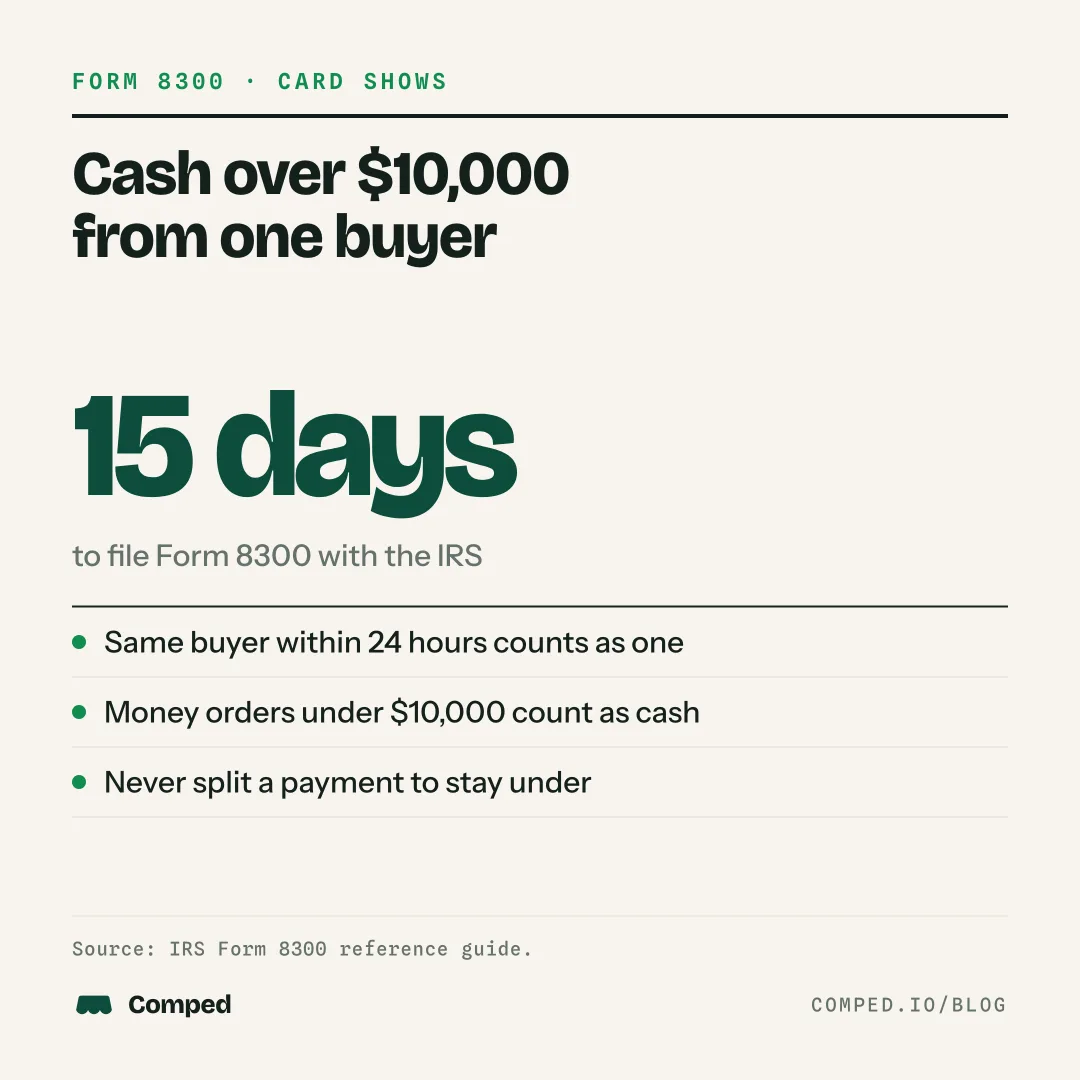
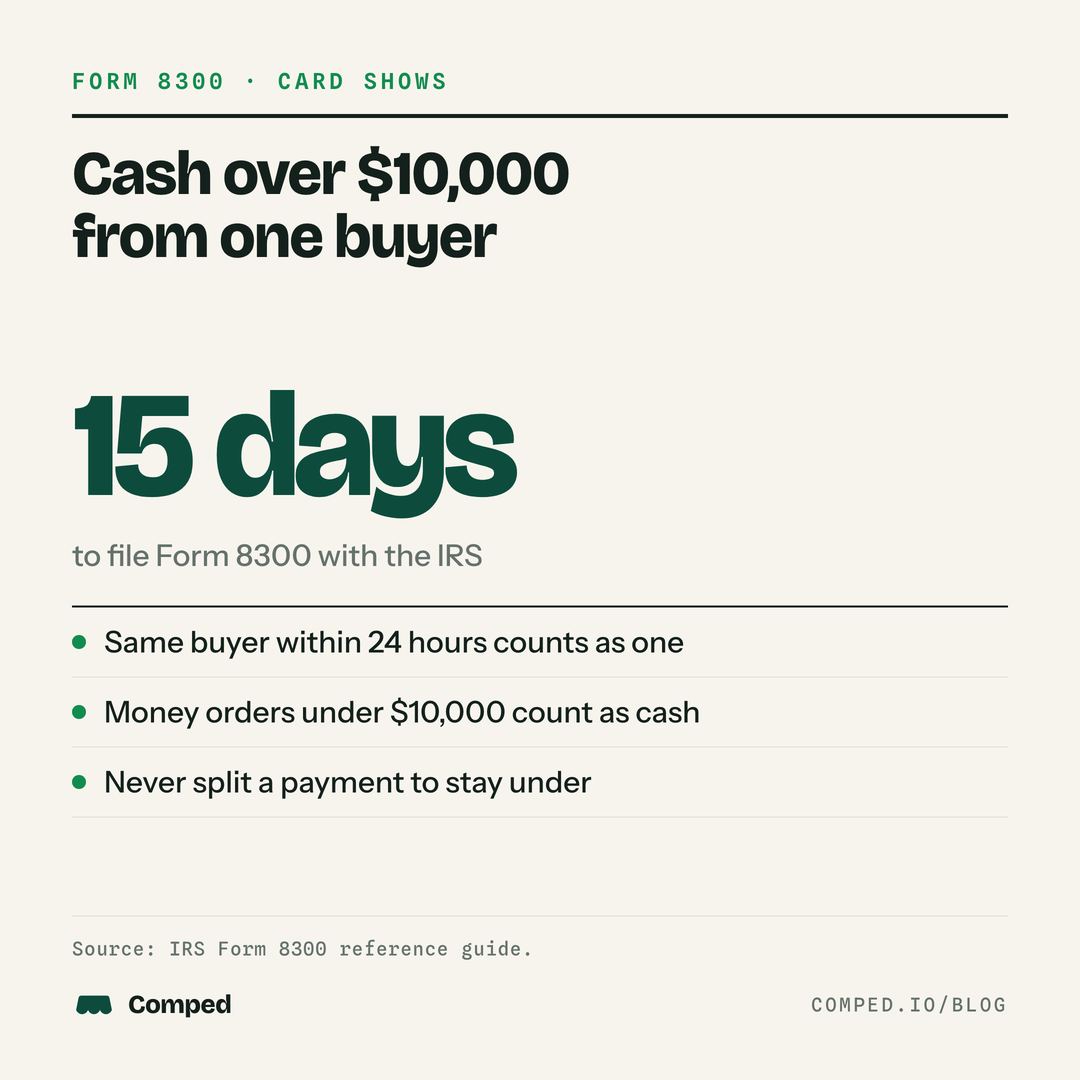
A business that receives more than $10,000 in cash from one buyer, in one sale or related sales, files Form 8300 within 15 days. Payments from the same buyer within 24 hours count as related.
For the retail sale of a collectible, cash includes currency plus cashier's checks, bank drafts, traveler's checks and money orders with a face amount of $10,000 or less, per the IRS reference guide. Personal checks and wire transfers are not cash.
The form asks for the buyer's name, address and taxpayer identification number, and the ID you checked. The box on the log is a reminder to collect those at the table. Never split a payment to stay under $10,000. The Form 8300 guide for card dealers walks through filing, the January 31 buyer statement and penalties.
What the log does not track
The log records money and cards moving. It does not record what each card cost you, so it cannot show profit. That is deliberate: there is no room to look up costs in the middle of a deal.
| You want | Use |
|---|---|
| Every deal in time order, and a cash count | This log |
| Each card's cost, sticker price and lowest price for one show | The card show inventory sheet |
| Profit per card and the year's totals | The card inventory and profit spreadsheet |
| Everything to do before, during and after | The card show vendor checklist |
A receipt for the buyer is a separate thing. Our reading is that federal tax rules ask you to keep your own record of a sale, not to hand every buyer a receipt. The exception on this page is Form 8300, which requires a written statement to the payer. A state may have its own rule, so check the state where the show is held.
Common mistakes
Five habits make a cash log useless at year end.
| Mistake | What it costs |
|---|---|
| Writing the day up from memory that night | Small sales and trades are the ones forgotten, and the cash will not match |
| Logging sales but not buys | No record of what the new cards cost, so their whole sale price looks like profit later |
| Writing a trade as "even swap" with no values | A trade is a sale of one card and a purchase of the other. Without values there is nothing to report or to use as cost. |
| Mixing sales tax into Cash in | Income is overstated and the state's money is spent |
| Not writing the starting cash | The close-out cannot be done at all |
If earlier shows went unlogged, start now and rebuild what you can from payment app history, bank deposits, photos and messages. Report the income either way.
After the show
Close the page before you pack up. The close-out box runs the cash count: starting cash plus cash in, minus cash out, equals expected cash. Count the drawer, write the actual figure and explain any difference.
- Staple the receipts for buys and the table fee invoice to the page.
- Copy each row into an inventory record, such as the free card inventory and profit spreadsheet.
- Set the sales tax collected aside for the state return.
- File any Form 8300 within 15 days of the cash.
- Keep the pages for at least 3 years, longer in the cases the IRS lists.
The IRS record period is 3 years, 6 years if income was under-reported by more than 25%, and indefinitely if no return was filed. Form 8300 copies are kept for 5 years.
How this looks in the Comped app
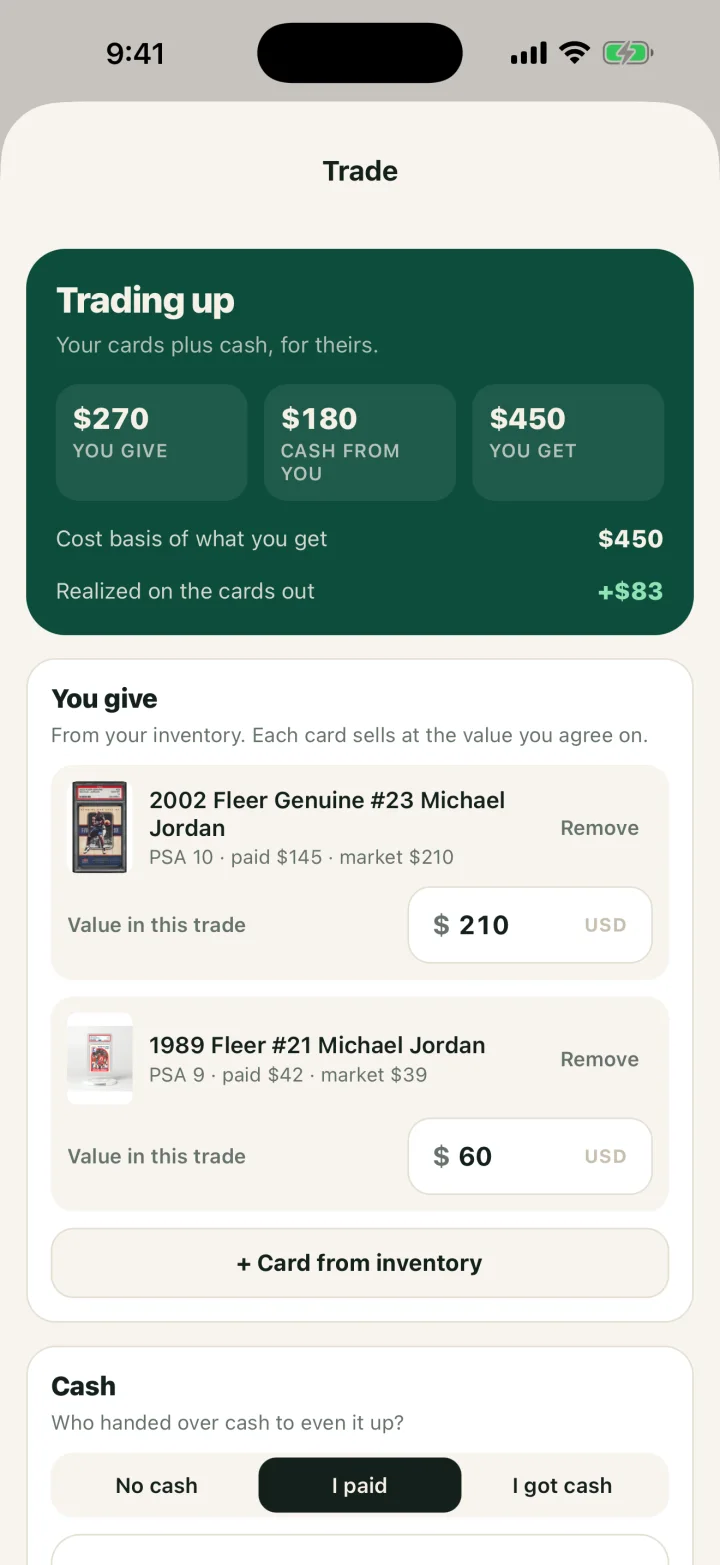
Comped records a buy, a sale or a trade on an iPhone when it happens, with each card's cost attached. These are captures of the current app with demo data. The Trade screen takes the cards you give, the cash and the cards you get, and shows the cost basis of the new card. A sale is broken down to what hit the bank, the cost and the true profit.

Related guides
- The Card Vendor's Master Guide to Taxes: how the profit on these rows is taxed.
- Form 8300 for card dealers: three cash scenarios, worked.
- Cost basis for cards bought with cash or by trade: what the trade columns become at year end.
FAQ
Do I owe tax on cash sales at a card show?
Yes. Cash sales are income the same as card or app payments. You owe tax on the profit whether or not any form reports the sale.
Do I have to report card sales if no Form 1099-K arrives?
Yes. The 1099-K is a reporting rule for payment apps and marketplaces, not a tax threshold. Tax is owed on profit with or without a form, and nobody issues one for cash at a table.
How do I track cash sales at a card show?
Write one row per deal when it happens: the time, the card, the cash in or out and how it was paid. Count the cash at the start and the end. The difference should equal cash in minus cash out, plus any sales tax taken in cash.
Do I charge sales tax on cash?
Yes, where the sale is taxable. Sales tax depends on the item and the state where the show is held, not on how the buyer pays. Trading cards are taxable in New Jersey, New York and Pennsylvania.
Do trades count as sales?
Yes. A trade is barter, and the fair market value of the card you receive is income. Write the value in and the value out on the same row of the log.
Do people still pay cash at card shows?
Yes, alongside payment apps and card readers. Log every sale the same way and write the method in the Payment method column. Only the cash rows go into the cash count at the close.
What if someone pays more than $10,000 in cash?
File Form 8300 within 15 days and collect the buyer's name, address, taxpayer identification number and ID at the table. Never split the payment to avoid the form.
How long should I keep the log pages?
At least 3 years after you file the return they support. Keep them 6 years if income was under-reported by more than 25%, and keep Form 8300 copies for 5 years.
SOURCES
- What kind of records should I keep, IRS, checked November 2026.
- Publication 583, Starting a Business and Keeping Records, IRS, checked November 2026.
- Topic no. 420, Bartering income, IRS, checked November 2026.
- Form 8300 and reporting cash payments of over $10,000, IRS, checked November 2026.
- IRS Form 8300 reference guide, IRS, checked November 2026.
- Understanding your Form 1099-K, IRS, checked November 2026.
- How long should I keep records, IRS, checked November 2026.
- Schedule C (Form 1040), 2026, IRS, downloaded November 13, 2026.
- Vendors and promoters, New Jersey Division of Taxation, checked November 2026.
This is general information for card sellers, not tax or legal advice for your situation. Rules change and states differ; a CPA who knows your numbers wins every time.