THE SHOW
YOUR SALES
PROFIT AT EXPECTED SALES
$448.80
$4,000.00 of sales at a 30% margin makes $1,200.00, less $751.20 of show costs
Show costs are 18.8% of expected sales. You clear break-even by $1,496.00.
BREAK-EVEN SALES
$2,504.00
62.6% of expected sales
CARDS TO BREAK EVEN
51
at $50.00 a card
PROFIT PER HOUR
$22.44
over 20 hours
COMPED DOES THIS AT THE TABLE
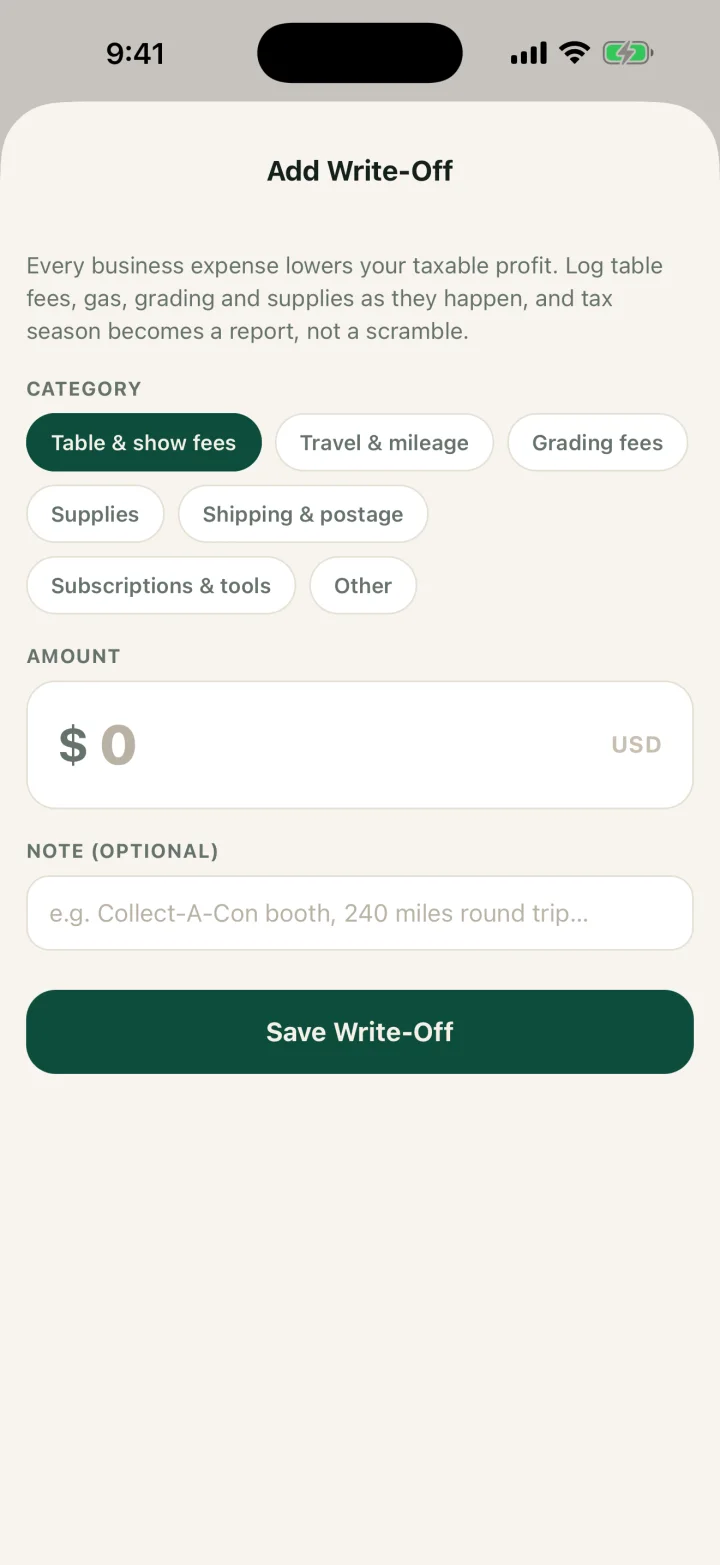
Comped logs the table fee, travel and mileage as write-offs beside your sales. The profit it shows already has those costs taken out, and the same entries are your tax record.
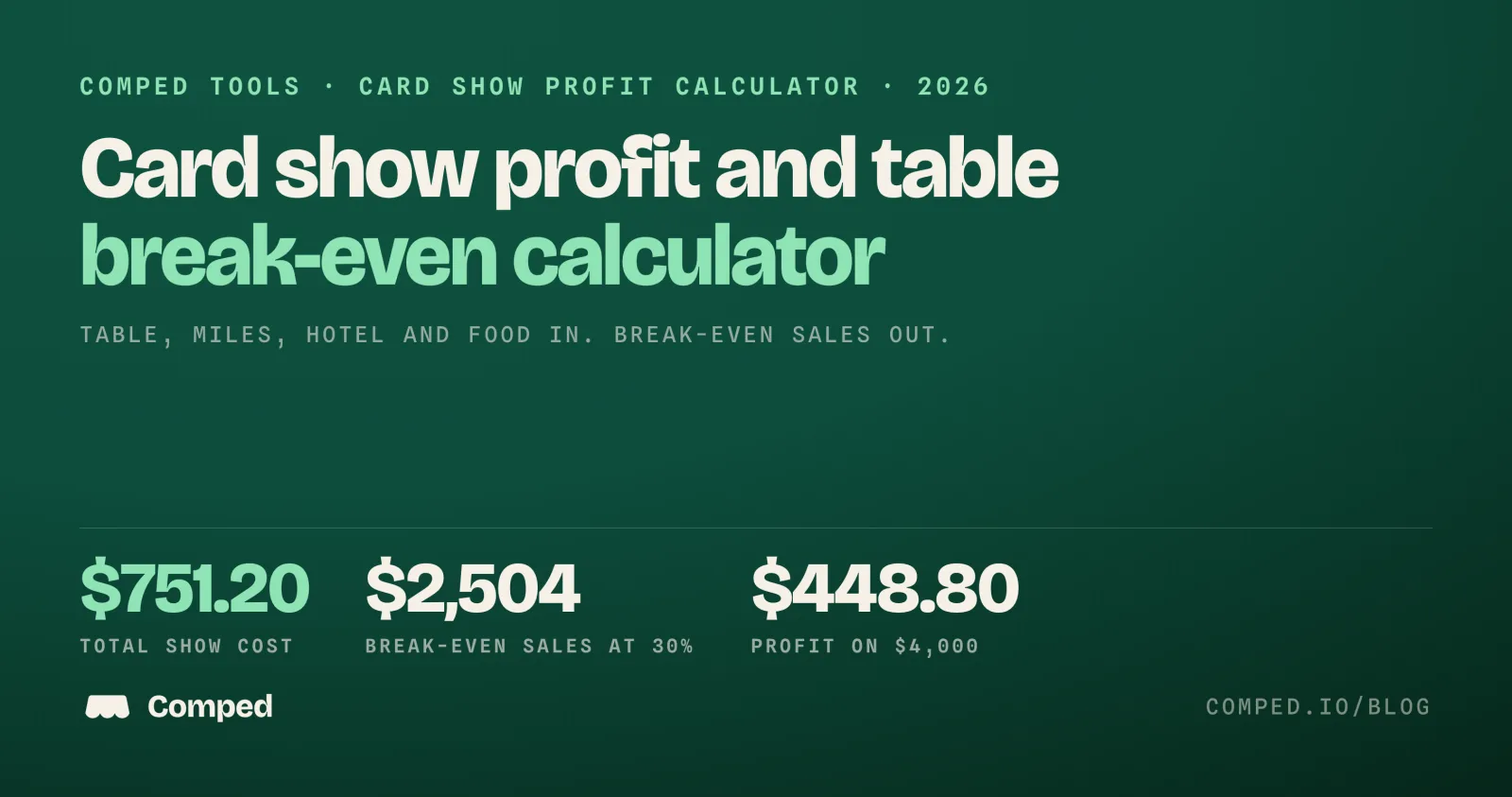
How the calculator works
Total show cost is every dollar the show costs you before a card sells. That is the table fee times the number of tables, plus mileage, hotel, food, supplies and helper pay. The cost of the cards themselves is not in that number. It is handled by the margin.
Margin is the share of each sales dollar left after the cost of the card. A card bought for $35 and sold for $50 has a 30% margin. If you know what the cards cost, switch the calculator to cost of the cards sold and it works out the margin for you. The buy percentage calculator shows how the percentage you pay sets that margin.
Break-even sales is total show cost divided by margin. Profit is expected sales times margin, minus total show cost. Cards to break even is break-even sales divided by your average sale, rounded up. Profit per hour divides the profit by the hours you enter.
THE EXAMPLE SHOW, WORKED
One table at a three-day show in November 2026, 60 miles from home, two hotel nights.
At $2,504 of sales the weekend pays for itself. Every $100 of sales past that adds $30.
What a card show table costs
A single table at a large three-day show cost $250 to $375 in dealer contracts Comped collected in October 2026. A one-evening local show was $100. Those prices are in the card sale fees by platform research. The table below adds prices from two vendor listings read on November 13, 2026.
| Show | Table | Price |
|---|---|---|
| Palm Beach Card Show, November 13 to 15, 2026 | 6 ft, value or regular | $175 or $200 |
| The same show | 8 ft, regular, premium or premier | $250, $400 or $600 |
| South Carolina Card Show, June 5 to 7, 2026 | 8 ft, regular or premium | $200 or $250 |
| The same show | 8 ft plus 6 ft | $350 |
| Large three-day shows, Comped research | One table | $250 to $375 |
| One-evening local show, Comped research | One table | $100 |
Position changes the price more than size does. The same 8 ft table runs from $250 to $600 in one room. A July 2025 Sports Illustrated article put a table at under $100 for a one-day local show and several hundred dollars at a larger venue.
A table fee usually covers the table, a chair or two and vendor passes. The Palm Beach listing includes two chairs and two passes, and charges $50 for each extra badge. Ask what is included before you compare prices. The guide to becoming a card show vendor covers the setup, and the card show vendor checklist lists what to bring.
Three example shows
The table is rarely the whole cost, and the share changes with distance. These three shows are examples run through the calculator, all in the second half of 2026.
| Line | Local one-day | Regional weekend | Major show, two tables |
|---|---|---|---|
| Tables | $75.00 | $300.00 | $1,200.00 |
| Mileage (40, 120 and 300 miles) | $30.40 | $91.20 | $228.00 |
| Hotel | $0.00 | $240.00 | $660.00 |
| Food | $20.00 | $90.00 | $180.00 |
| Supplies | $15.00 | $30.00 | $60.00 |
| Helper pay | $0.00 | $0.00 | $300.00 |
| Total show cost | $140.40 | $751.20 | $2,628.00 |
| Margin | 30% | 30% | 25% |
| Break-even sales | $468.00 | $2,504.00 | $10,512.00 |
| Cards to break even | 19 at $25 | 51 at $50 | 71 at $150 |
| Expected sales | $1,200.00 | $4,000.00 | $15,000.00 |
| Profit | $219.60 | $448.80 | $1,122.00 |
| Profit per hour (9, 20 and 40 hours) | $24.40 | $22.44 | $28.05 |
The table fee is 53% of the local show's cost, 40% of the weekend's and 46% of the major show's. Open the calculator with your own numbers before you book.
Break-even sales by show cost and margin
Break-even sales rise fast as margin falls. The same $750 show needs $1,500 in sales at a 50% margin and $3,750 at 20%.
| Total show cost | 20% margin | 30% margin | 40% margin | 50% margin |
|---|---|---|---|---|
| $250 | $1,250 | $833 | $625 | $500 |
| $500 | $2,500 | $1,667 | $1,250 | $1,000 |
| $750 | $3,750 | $2,500 | $1,875 | $1,500 |
| $1,000 | $5,000 | $3,333 | $2,500 | $2,000 |
| $1,500 | $7,500 | $5,000 | $3,750 | $3,000 |
What margin to enter
Your margin is one minus what you paid divided by what you sold for. The table turns a buy percentage and a selling price, both as shares of comp, into the margin to type in.
| You buy at | Sell at 80% of comp | Sell at 90% | Sell at comp |
|---|---|---|---|
| 50% of comp | 37.5% | 44.4% | 50.0% |
| 60% of comp | 25.0% | 33.3% | 40.0% |
| 70% of comp | 12.5% | 22.2% | 30.0% |
| 80% of comp | 0.0% | 11.1% | 20.0% |
Margin is not markup. A card bought for $35 and sold for $50 has a 30% margin and a 42.9% markup. Enter the margin. The guide to card show buy percentages explains where those buy numbers come from.
What the calculator does not count
It takes your expected sales as given and counts six kinds of cost. Other show calculators and dealers' own write-ups count a few things differently.
| Not counted | What to do |
|---|---|
| A sales forecast from foot traffic | Enter your own number. Use your last show, or cards you expect to sell times the average price |
| Your time as a cost | Read profit per hour. Compare it with what those hours are worth to you |
| Card reader fees | Add them to supplies. Square's in-person rate is 2.6% plus $0.15, or $1.45 on a $50 sale |
| Parking, tolls, airfare, extra badges, electricity | Add them to the hotel or supplies field |
| Sales tax | Leave it out of sales. You collect it for the state and send it on |
| Cards you buy at the show | Leave them out. They are inventory, and their cost counts when they sell |
| Fees on cards you sell online later | Use the card profit calculator |
As an example, say half of $4,000 in sales goes through a card reader at $50 a sale. That is 40 sales and $58.00 in fees.
The mileage rate the calculator uses
The calculator prices each mile at the IRS business standard mileage rate, and the rate depends on the show date. For 2026 it is 72.5 cents per mile from January 1 to June 30. It is 76 cents per mile from July 1 to December 31, per the IRS standard mileage rates page. A spring show and a fall show use different numbers.
The IRS rate is a tax figure. Here it stands in for what the drive costs you. Pick the half of 2026 the show falls in. A 120 mile round trip is $87.00 in the first half and $91.20 in the second.
Parking fees and tolls are deductible on top of the mileage rate, per IRS Topic 510. The same page says the law requires adequate records. Part IV of Schedule C asks for your business miles and whether your evidence is written. Note the date, the show and the miles on the day you drive.
Which show costs are deductible
For a seller running a business, most of the show cost is deductible on Schedule C. A hobby seller cannot deduct these expenses at all. The master guide to write-offs covers each category and the records behind it. The line for each cost is our reading of the form.
| Cost | How it is treated for 2026 taxes | Schedule C line, our reading |
|---|---|---|
| Table fees and show admission | An ordinary and necessary business expense | 20b, rent of other business property |
| Mileage | 72.5 cents per mile through June 30, 2026 and 76 cents from July 1, plus parking and tolls | 9, car and truck expenses |
| Hotel | Lodging is deductible when you travel away from home overnight | 24a, travel |
| Food | Business meals on an overnight trip are 50% deductible | 24b, deductible meals |
| Supplies | An ordinary and necessary business expense | 22, supplies |
| Helper pay | Deductible pay. A Form 1099-NEC is due at $2,000 paid to one person in 2026 | 11, contract labor |
| Card reader fees | A cost of making the sale | 10, commissions and fees |
| The cards you sold | Not a show cost. Card cost is cost of goods sold, recovered when the card sells | Part III, to line 4 |
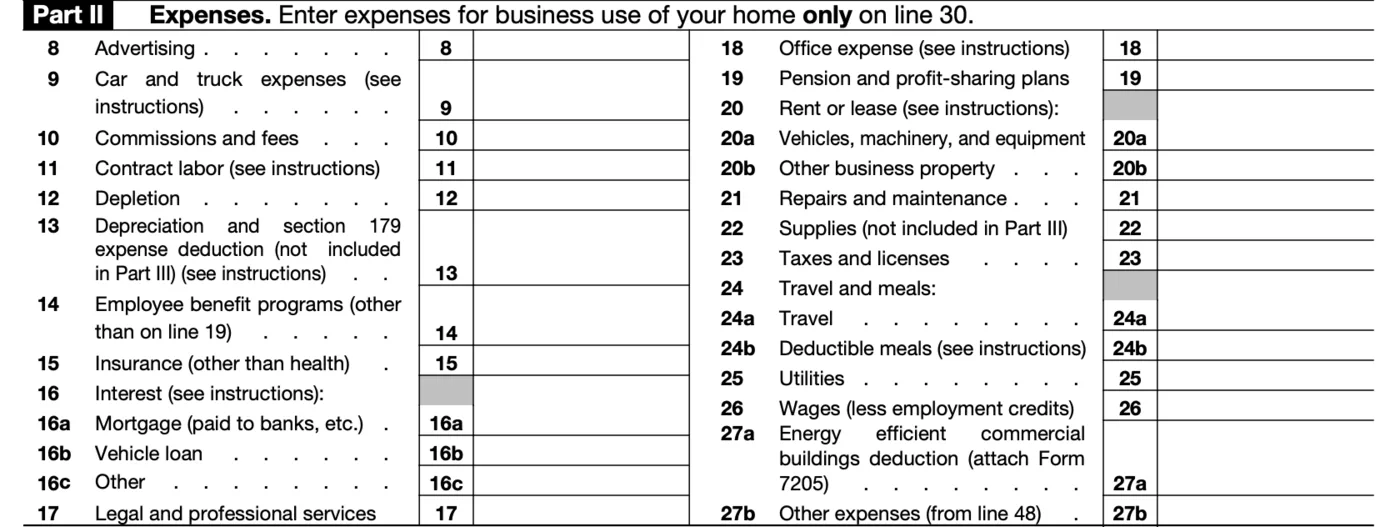
The deductible estimate adds the table, mileage, hotel, supplies and helper pay. It adds half the food when the overnight box is checked. Helper pay is in the estimate because the write-offs guide treats a helper's day rate as a deductible show cost. The other rules come from IRS Tax Topic 511 for travel and Publication 334 for business expenses. The 1099-NEC threshold rose from $600 to $2,000 for payments after December 31, 2025. The 1099-NEC guide for helpers covers it.
A day trip is different. Publication 463 says you are traveling away from home only when you need to sleep or rest to do the work. Our reading is that food on a same-day drive is not deductible, so the calculator counts it at $0 unless the overnight box is checked.
Sales tax is separate. It is collected from the buyer and sent to the state, so leave it out of expected sales. The state sales tax guide covers permits and rates.
Common mistakes
The usual error is reading sales as profit. Each line uses the example show above.
- Counting sales as money made. $4,000 of sales at a 30% margin is $1,200 before the show costs and $448.80 after.
- Counting only the table. The table is $300 of a $751.20 weekend.
- Typing markup as margin. Entering 42.9 instead of 30 shows break-even near $1,750 instead of $2,504.
- Putting sales tax in sales. It was never yours.
- Calling cards bought at the show a show cost. They are inventory until they sell.
- Skipping the mileage note. Without a written record the deduction is hard to support.
Related guides
- The Card Vendor's Master Guide to Write-Offs: every show cost and the record that supports it.
- Card show buy percentage calculator: the offer that produces the margin you entered here.
- Card profit calculator: one card across eBay, Whatnot and show cash.
- How to track card show sales: getting the sales number this calculator needs.
FAQ
How much does it cost to set up a table at a card show?
One table at a large three-day show cost $250 to $375 in dealer contracts Comped collected in October 2026. A one-evening local show cost $100. In the example on this page a $300 table becomes a $751.20 weekend with mileage, a hotel, food and supplies.
How much do I need to sell to break even at a card show?
Divide your total show cost by your margin. A $751.20 show at a 30% margin needs $2,504 in sales. At a 20% margin the same show needs $3,756, and at 40% it needs $1,878.
How many cards do I have to sell to cover the table?
Divide break-even sales by your average sale price and round up. With $2,504 of break-even sales and a $50 average card, that is 51 cards. Enter your own average and the calculator does the division.
Is it worth setting up at a card show?
It is when your expected sales clear break-even with room to spare. The local example on this page needs $468 in sales, and the two-table major show needs $10,512. Run the show before you book, and check profit per hour against what else those hours could earn.
What is included with a vendor table?
It varies by show. One November 2026 listing includes the table, two chairs and two vendor passes, with extra badges at $50 each. Another includes a tablecloth, one chair, WiFi, two wristbands and a parking pass. Ask before you pay.
Are card show table fees tax deductible?
Yes, for a seller running a business. Table fees and show admission are ordinary and necessary expenses on Schedule C. A hobby seller cannot deduct expenses, only the cost of the cards sold.
Which mileage rate applies to a 2026 card show?
It depends on the date. The IRS business rate is 72.5 cents per mile for January 1 to June 30, 2026. It is 76 cents per mile for July 1 to December 31, 2026. Parking and tolls are deductible on top.
Does profit per hour count my driving time?
It counts whatever hours you enter. Include setup, show hours and driving for an honest number. Leave the field at zero and the calculator skips it.
SOURCES
- Standard mileage rates, Internal Revenue Service, checked November 13, 2026.
- Topic 510, Business use of car, Internal Revenue Service, checked November 13, 2026.
- Topic 511, Business travel expenses, Internal Revenue Service, checked November 13, 2026.
- Publication 463, Travel, Gift, and Car Expenses, for 2025 returns, Internal Revenue Service, checked November 13, 2026.
- Schedule C (Form 1040), Profit or Loss From Business, 2026, Internal Revenue Service, downloaded November 13, 2026.
- Instructions for Schedule C, 2025, Internal Revenue Service, checked November 13, 2026.
- Publication 334, Tax Guide for Small Business, Internal Revenue Service, checked October 2026.
- Tips for taxpayers who make money from a hobby, Internal Revenue Service, checked October 2026.
- What are Square's fees, Square, checked November 13, 2026.
- What a trading card sale nets on each platform, Comped research, table prices from dealer contracts as of October 29, 2026.
This is general information for card sellers, not tax or legal advice for your situation. Rules change and states differ; a CPA who knows your numbers wins every time.