THE CARD
THE SELLER'S NUMBER
YOUR OFFER
$140.00
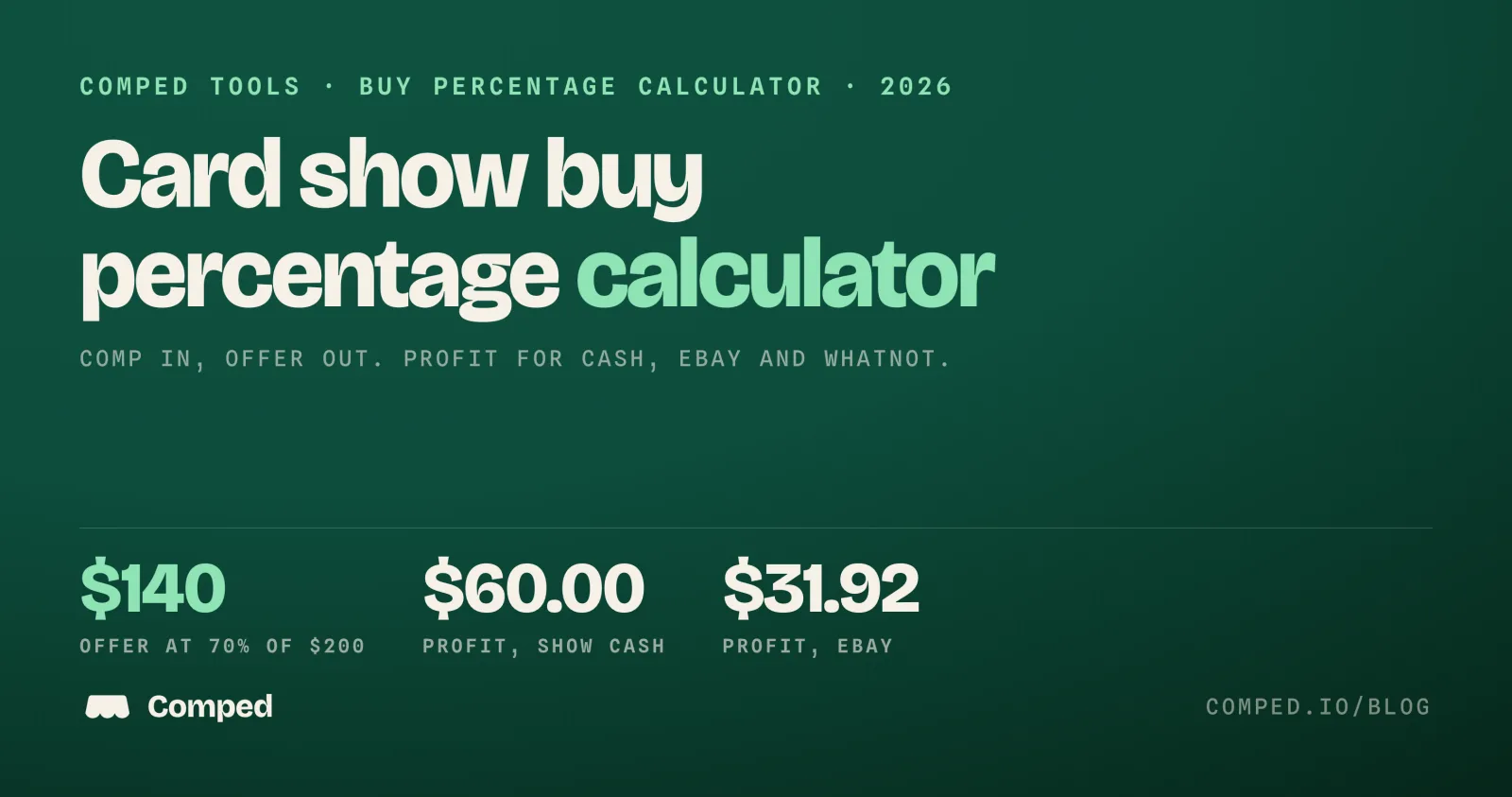
70% of a $200.00 comp. That is $60.00 under comp.
Break-even is the percentage of comp at which a resale at comp makes $0 after that channel's fees. Fees as of October 29, 2026.
Profit resold at comp
SHOW CASH · NO FEES
$60.00
nets $200.00 · 30% margin
at the ask: $40.00
EBAY · FEES $30.08
$31.92
nets $171.92 · 16% margin
at the ask: $11.92
WHATNOT · FEES $22.80
$37.20
nets $177.20 · 18.6% margin
at the ask: $17.20
COMPED DOES THIS AT THE TABLE
Scan the card or slab and Comped shows a price from recent sales, then records what you paid. That record is the card's cost for your profit and for your taxes.
How the buy percentage math works
The offer is the comp multiplied by the buy percentage. A $200 comp at 70% is a $140 offer, and the $60 difference is your room before any selling cost. The comp is the recent sale price for that exact card and grade, not an asking price.
The reverse works the same way. Divide what the seller wants by the comp to get the percent. A seller asking $160 on a $200 comp is asking 80%. The calculator shows that percent and the profit at the ask on each channel. The guide to card show buy percentages covers the reasoning behind the number you pick.
The three cards under the offer assume you resell at comp. Margin is profit as a share of the sale price.
How to use it at the table
Five steps take a walk-up seller from a card to a number you can say out loud.
- Find the comp. Look the card up above, or type the recent sold price for that grade.
- Set your buy percentage with the slider or the quick buttons.
- Type what the seller wants. The result shows the ask as a percent of comp.
- Read the three channels. Check the profit where you plan to sell the card, not the best one.
- Agree a price, then write the buy down before the seller leaves.
Copy the link if you want the same numbers open on another phone.
Card show buy percentage chart
This chart shows the offer at each common buy percentage for six comp values.
| Comp | 50% | 60% | 70% | 75% | 80% | 85% | 90% |
|---|---|---|---|---|---|---|---|
| $20 | $10.00 | $12.00 | $14.00 | $15.00 | $16.00 | $17.00 | $18.00 |
| $50 | $25.00 | $30.00 | $35.00 | $37.50 | $40.00 | $42.50 | $45.00 |
| $100 | $50.00 | $60.00 | $70.00 | $75.00 | $80.00 | $85.00 | $90.00 |
| $250 | $125.00 | $150.00 | $175.00 | $187.50 | $200.00 | $212.50 | $225.00 |
| $500 | $250.00 | $300.00 | $350.00 | $375.00 | $400.00 | $425.00 | $450.00 |
| $1,000 | $500.00 | $600.00 | $700.00 | $750.00 | $800.00 | $850.00 | $900.00 |
What dealers pay at card shows
There is no set rate, and published figures run from 40% to 94% of comp by buyer and by card. One account is a July 2025 Sports Illustrated collectibles article by Scott Orgera, Why Dealers Rarely Pay Full Price When Buying Cards. It says most local card shop owners "won't budge above the 60-70 percent mark" when buying from customers. It says show dealers "often pay around 60 percent of comp".
| Who is buying | Published figure | Source |
|---|---|---|
| Dealers at card shows | Around 60 percent | Sports Illustrated, July 21, 2025 |
| Local card shops | 60 to 70 percent | Sports Illustrated, July 21, 2025 |
| Some show dealers | 50 to 60 percent | Sports Collectors Digest, July 24, 2022 |
| Buyers at trade nights | 80 to 90 percent | Sports Collectors Digest, July 24, 2022 |
| Local card shop, Pokemon | 50 to 65% cash, 60 to 70% trade | Card Codex, August 27, 2025 |
| One shop's own offers | Raw 60 to 80%, graded 70 to 90% | Giant Sports Cards buying page, undated |
These are writers' observations and one shop's advertising, not a rule. The full list is in the guide. The Sports Illustrated article lists the costs behind the gap: table fees, travel, gas, hotels and tolls for show dealers, and rent, payroll and card payment fees for shops. The card show profit calculator adds up those show costs for your own weekend.
What the card nets when you resell it
A cash sale at your table has no per-sale fee, so a card sold at comp nets the full comp. eBay and Whatnot each take a cut, and that cut sets the highest percentage you can pay and still make money.
| Sold at comp | Show cash nets | eBay nets | Whatnot nets |
|---|---|---|---|
| $20 | $20.00 | $17.44 | $17.19 |
| $50 | $50.00 | $43.19 | $43.86 |
| $100 | $100.00 | $86.10 | $88.31 |
| $250 | $250.00 | $214.83 | $221.65 |
| $500 | $500.00 | $429.39 | $443.89 |
| $1,000 | $1,000.00 | $858.50 | $888.38 |
The fee figures come from Comped's card sale fees by platform research, dated October 29, 2026, and use its assumptions. On eBay with no Store subscription, the trading card fee is 13.25% of the item price, shipping and sales tax. There is also a $0.40 order fee. The buyer pays $10 shipping and 7% sales tax, and your label costs $8. On Whatnot the standard commission is 8% of the first $1,500 of the item price, and payment processing is 2.9% of the order total plus $0.30. Whatnot was rechecked on November 13, 2026.
From a $50 comp to a $1,000 comp, eBay break-even sits near 86% of comp and Whatnot near 88% to 89%. Pay more than that and a resale at comp loses money on that channel. Above $1,500 the Whatnot figure rises. Since January 14, 2026, Whatnot charges 0% commission on the part of a single card's price over $1,500, under a promotion it calls limited-time. Breaks are excluded, and sellers with $15,000 or more in four-week sales pay less than 8% on the first $1,500. On a $5,000 comp, Whatnot break-even is 94.5%. For other channels, use the card profit calculator.
Profit at each buy percentage, resold on eBay
This chart shows the dollars left after an eBay sale at comp, for each buy percentage. It uses the eBay nets in the table above.
| Comp | Buy at 50% | 60% | 70% | 80% | 90% |
|---|---|---|---|---|---|
| $20 | $7.44 | $5.44 | $3.44 | $1.44 | -$0.56 |
| $50 | $18.19 | $13.19 | $8.19 | $3.19 | -$1.81 |
| $100 | $36.10 | $26.10 | $16.10 | $6.10 | -$3.90 |
| $250 | $89.83 | $64.83 | $39.83 | $14.83 | -$10.17 |
| $500 | $179.39 | $129.39 | $79.39 | $29.39 | -$20.61 |
| $1,000 | $358.50 | $258.50 | $158.50 | $58.50 | -$41.50 |
The percentage is the same across a column, and the dollars are not. A $20 card bought at 70% leaves $3.44 for the listing, the packing and the trip to the post office. That is why cheap cards draw lower percentages or get bought as a lot.
The most you can pay for the profit you want
Subtract the profit you need from what the sale nets, and the rest is the most you can pay. The table does it for a $1,000 comp. Divide by 10 for the buy percentage.
| Profit you want | Cash at comp | Cash at $900 | eBay | Whatnot |
|---|---|---|---|---|
| $0, break-even | $1,000.00 | $900.00 | $858.50 | $888.38 |
| $100, 10% of comp | $900.00 | $800.00 | $758.50 | $788.38 |
| $200, 20% of comp | $800.00 | $700.00 | $658.50 | $688.38 |
| $300, 30% of comp | $700.00 | $600.00 | $558.50 | $588.38 |
Table buyers negotiate, so the $900 column is the safer cash plan. A promoted listing lowers the eBay column. The fee research records eBay's lowest general ad rate at 2% of the sale total, which is $21.60 on this card. It moves eBay break-even from $858.50 to $836.90.
ONE BUY AT THE TABLE, WORKED
A seller walks up with a slab that has a $200 comp and asks $160. You are buying at 70%.
Meeting at $150 is 75% of comp. That leaves $50.00 on a cash sale and $21.92 on eBay.
What this calculator does not do
It prices one card for cash, resold at comp. Other deal tools add features this one leaves out, and each has a place to go.
| Not in this calculator | What to do |
|---|---|
| A separate trade credit percentage, or a deal that is part cash and part trade | Use the card trade calculator, which takes a percentage on each side plus cash |
| A lot, a binder or a collection in one offer | Agree one price, then split it per card with the cost basis calculator |
| Condition or grade adjustments | Enter the comp for the exact grade or condition in front of you |
| Price tiers, such as a lower percentage under $20 | Set the percentage by hand and read the profit chart above |
| A resale below comp, a Store subscription or a promoted listing | Use the card profit calculator with your own sale price and fees |
| The table fee, travel and your time | Use the card show profit calculator for the whole weekend |
| Tax on the profit | Use the card sale tax calculator |
Common mistakes
Most bad buys come from the comp, not the percentage. Check these before you quote.
- An asking price used as the comp. 70% of a $240 ask is $168, which is 84% of a $200 comp.
- The wrong grade. A PSA 9 comp on a PSA 8 card overstates every number on the page.
- One old sale. Use several recent sales, and lean low when prices are falling.
- The best channel instead of your channel. If you sell on eBay, read the eBay card.
- No record of the buy. The price you paid is the cost that comes off the sale.
The buy is also your cost basis
The price you pay is the card's cost basis, the number that comes off the sale when you figure profit and tax. The record you make at the table is also the tax record, so write it down before the seller walks away.
IRS Publication 583 lists the documents that support a purchase. For a cash buy at a show that means a written receipt with the seller's name, the date, the item and the price. The cost basis guide for cash and trade buys covers deals with a card in trade. The card show cash and trade log is a free sheet for those receipts.
Related guides
- Card show buy percentages: the chart and the reasoning behind the number you offer.
- How to price cards for a card show: the selling side of the same comp.
- Cost basis for cards bought with cash or by trade: how to prove what you paid.
- The Card Vendor's Master Guide to Taxes: where the buy price lands on your return.
FAQ
How much do vendors pay for cards at card shows?
It varies by card and by dealer, and there is no set rate. A July 2025 Sports Illustrated collectibles article reported that show dealers often pay around 60 percent of comp. It put most local card shops at 60 to 70 percent.
What is 70% of comp on a $100 card?
$70. Multiply the comp by the percentage: $100 times 0.70 is $70, and 80% is $80. The chart on this page lists the offers for comps from $20 to $1,000.
How do I work out what percent of comp a seller is asking?
Divide the ask by the comp. A $160 ask on a $200 comp is 80%. Type the ask into the calculator and it shows the percent and the profit you would make at that price.
What is the most I can pay and still make money on eBay?
About 86% of comp for cards from $50 to $1,000, if the card resells at comp. That uses eBay's 13.25% trading card fee and $0.40 order fee as of October 29, 2026. A 2% promoted listing lowers it to about 84%, and Whatnot break-even is about 88% to 89%.
Why do dealers pay less than comp?
A dealer has to resell the card and cover costs first. Sports Illustrated's July 2025 article lists table fees, travel, hotels, payment fees and money tied up in unsold cards. Marketplace fees take roughly 11% to 14% of a sale at comp in the examples on this page.
Is 50% of comp a lowball?
It depends on the card. On a $20 card resold on eBay, 50% leaves $7.44 for the work. On a $1,000 card it leaves $358.50, and most published figures for cards like that are higher than 50%.
Do dealers pay more in trade than in cash?
Usually. Published figures put trade credit 5 to 20 points above cash at the same shop. This calculator prices a cash buy, and the card trade calculator handles a trade percentage with cash either way.
Does the buy price matter for taxes?
Yes. What you pay is the card's cost basis, and tax is figured on the sale price minus that cost and your selling costs. Keep a written record of each cash buy with the seller's name, the date, the item and the price.
SOURCES
- Why Dealers Rarely Pay Full Price When Buying Cards, Scott Orgera, Sports Illustrated, July 21, 2025, read November 13, 2026.
- Night Moves: How Trade Nights became fun, popular after-hours events for card collectors, Clemente Lisi, Sports Collectors Digest, July 24, 2022, read November 13, 2026.
- What a trading card sale nets on each platform, Comped research, fee data as of October 29, 2026.
- Selling fees, eBay, checked November 13, 2026.
- Whatnot seller fees, Whatnot, checked November 13, 2026.
- Reduced Commission on High-Value Orders, Whatnot, checked November 13, 2026.
- Publication 583, Starting a Business and Keeping Records, Internal Revenue Service, checked November 13, 2026.