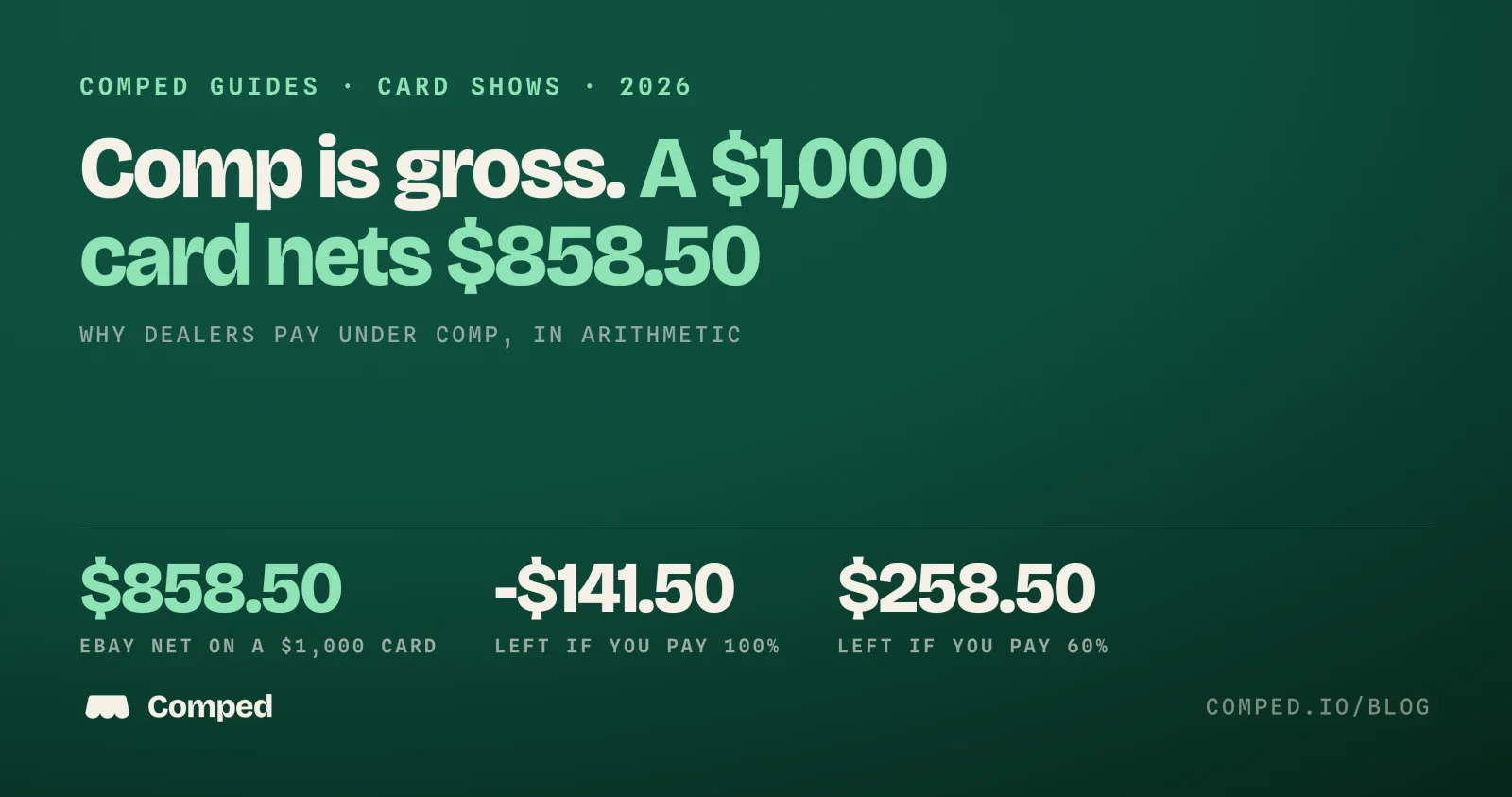
What a buy percentage is
A buy percentage is the share of a card's comp that a dealer pays for it. Comp means recent sold prices for the same card in the same grade. A dealer who pays $700 for a card with $1,000 in recent sales is buying at 70%.
The gap is not all profit. It pays the selling fees, the table, the travel and the dealer's time, and it covers the cards that sell for less than planned. What is left after those is the dealer's profit, and tax comes out of that. The master tax guide covers how that profit is taxed.
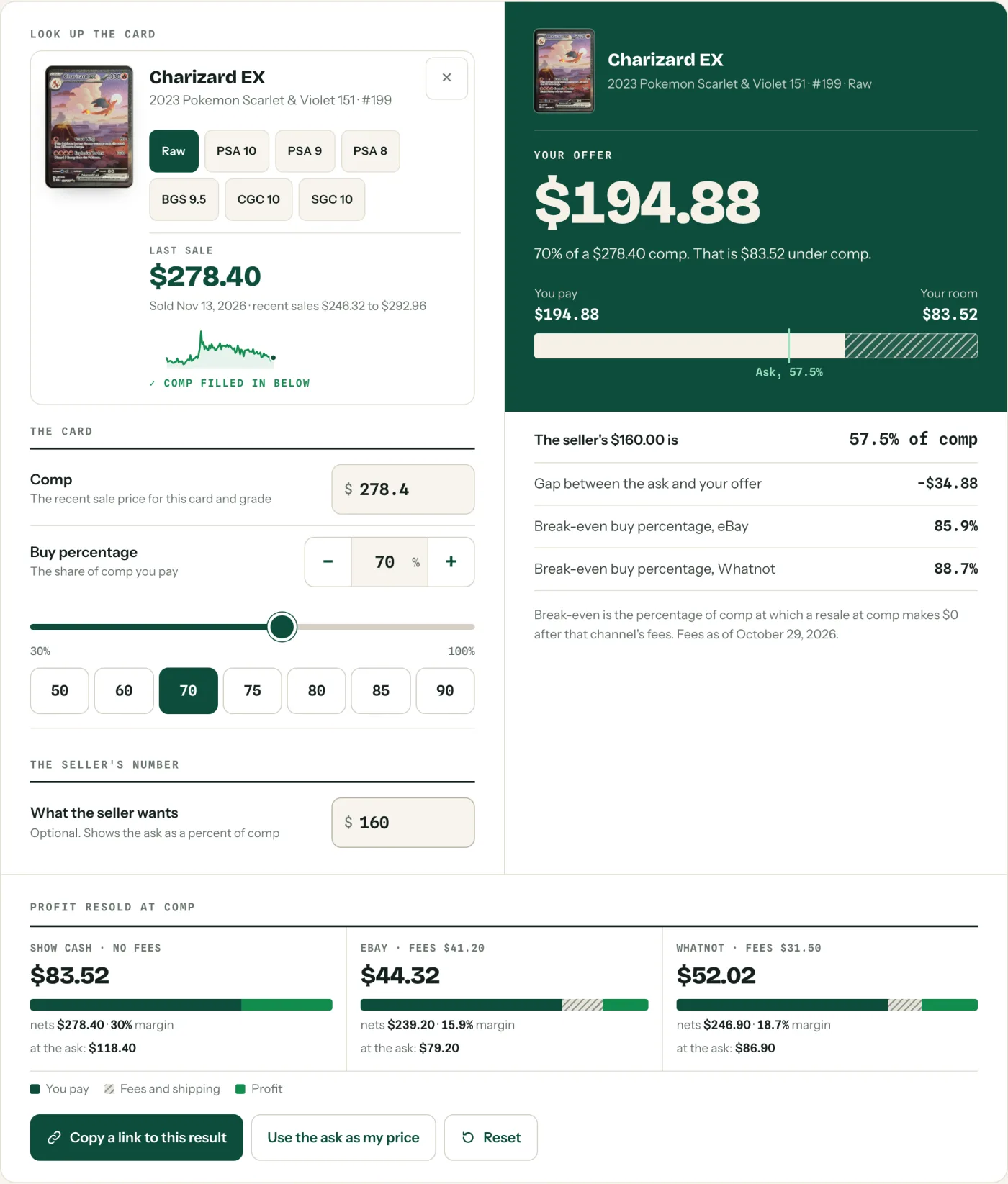
The card show buy percentage calculator does this arithmetic for any card. This page explains the numbers behind it.
Percentages reported in print
Published figures run from 40% to 94% of comp, and each one describes a different buyer or a different kind of card. No rule sets a percentage. The table lists every figure we could read at its source on November 13, 2026.
| Who is buying | Figure | Source |
|---|---|---|
| Dealers at card shows | "around 60 percent of comp" | Sports Illustrated, Scott Orgera, July 21, 2025 |
| Local card shops | "the 60-70 percent mark" | The same article |
| Some show dealers | 50 to 60 percent | Sports Collectors Digest, Clemente Lisi, July 24, 2022, citing collector Ryan Nolan |
| Buyers at trade nights | 80 to 90 percent | The same article |
| Dealer cash offers, Pokemon | "Expect 60-80% of its market value." | Card Codex, October 30, 2025 |
| Local card shop, Pokemon | 60 to 70% in trade, 50 to 65% in cash | Card Codex, August 27, 2025 |
| "Most shops", Pokemon | 40 to 60% cash, 60 to 80% trade credit | PokePrices deal calculator page, undated |
| One shop's own offers | Graded "70-90% on average", raw "60-80%" | Giant Sports Cards buying page, undated |
| One seller at a major show | 62 cards "for 75 percent of recent comps" | Collectors Universe forum post, August 22, 2025 |
| Liquid slabbed singles, one host's view | "somewhere around 90 to 94%" | Slabnomics podcast, episode 50, April 20, 2026 |
These are observations and one shop's advertising, not a survey. The Sports Illustrated article gives the reasons as overhead, time and unsold inventory. It puts a single show table anywhere from under $100 at a one-day local show to several hundred dollars at a larger venue. The pattern across the sources is consistent: cash pays less than trade, raw pays less than graded, and a bulk lot pays less than a single wanted card.
Fees
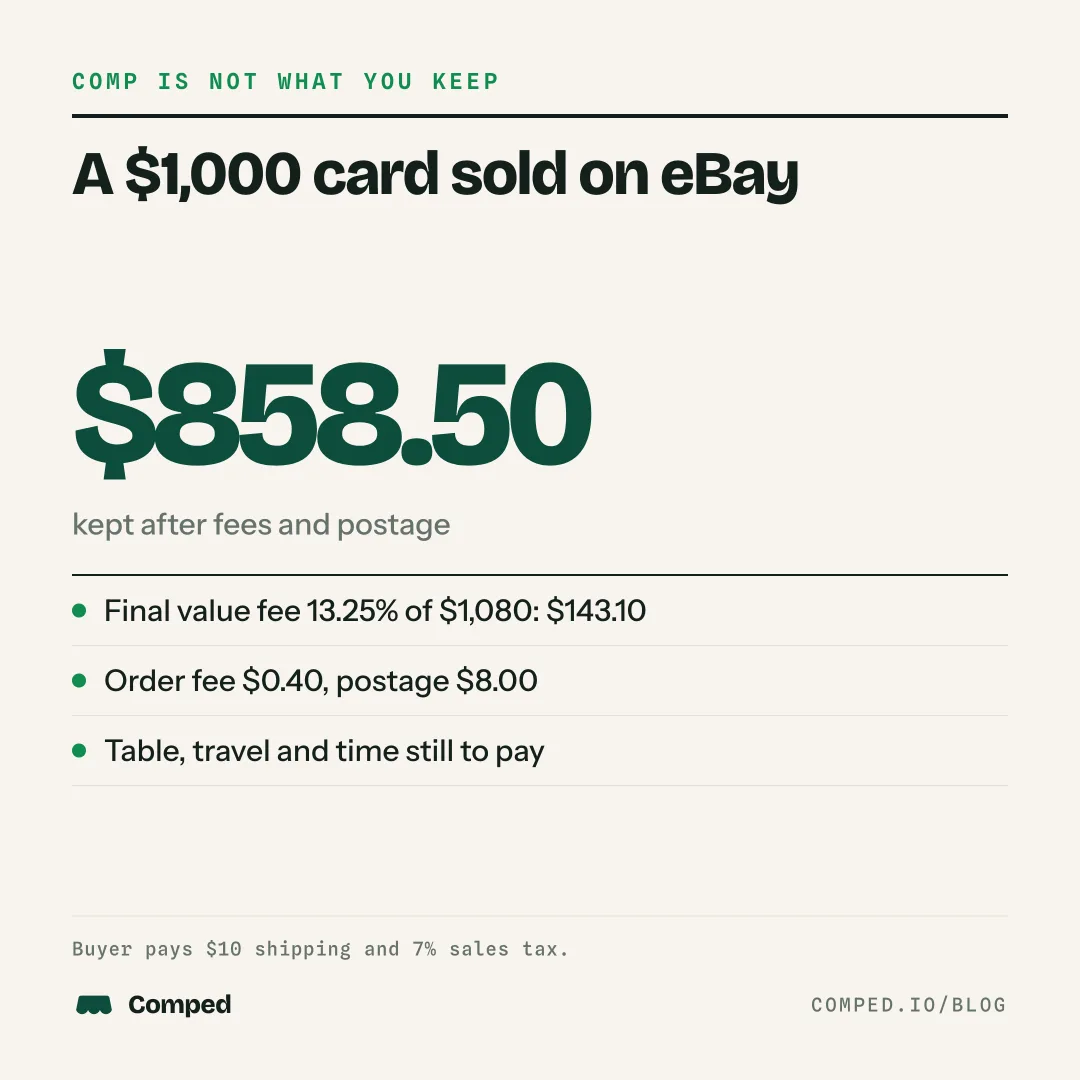
Fees take the first cut, and the size depends on where the card is sold. Our platform fee research uses eBay's published rate for trading cards: 13.25% of the sale total, plus $0.40 per order. The sale total includes the shipping the buyer pays and the sales tax eBay collects.
A $1,000 CARD SOLD ON EBAY
Say the buyer pays $10 shipping and 7% sales tax, and postage and supplies cost the seller $8.
A dealer who paid $1,000 for that card is down $141.50 before any other cost. A promoted listing costs more. The same research records eBay's lowest general ad rate at 2% of the sale total, which is $21.60 here and leaves $836.90.
A cash sale at the table has no per-sale fee. A card reader does: Square's in-person rate in the same research is 2.6% plus $0.15, or $26.15 on $1,000. Table buyers also negotiate, so a table price is often under comp too. The card profit calculator compares what one card nets on each channel.
Buy percentage chart
The chart below shows what is left on a $1,000 card at each buy percentage. The eBay column uses the $858.50 from the panel above. The table column assumes a cash sale at $900, which is 90% of comp, with no fee.
| Buy percentage | Dealer pays | Left after an eBay sale | Left after a $900 cash sale |
|---|---|---|---|
| 100% | $1,000 | -$141.50 | -$100.00 |
| 90% | $900 | -$41.50 | $0.00 |
| 80% | $800 | $58.50 | $100.00 |
| 70% | $700 | $158.50 | $200.00 |
| 60% | $600 | $258.50 | $300.00 |
| 50% | $500 | $358.50 | $400.00 |
Neither column has paid for the table, the travel or the dealer's hours yet. Those come out of the same gap. The calculator's cash figure assumes a sale at full comp, so it reads $100.00 higher than the cash column here.
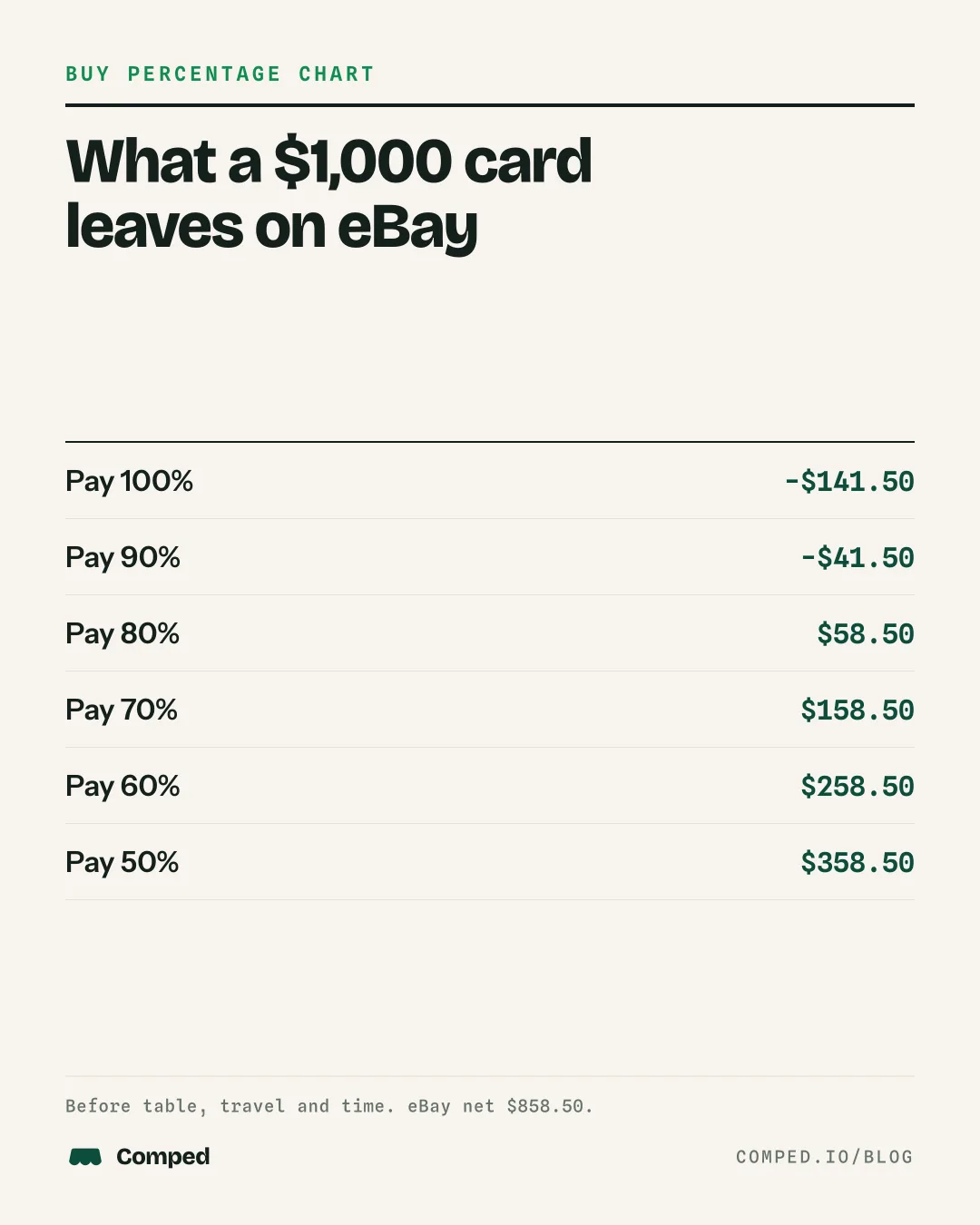
Table cost and travel
The table and the trip are paid before the first sale, so every card bought has to carry a share. Say a table costs $300 for the weekend and the show is a 200 mile round trip. At the IRS mileage rate of 76 cents for July to December 2026, the drive is $152.00. The weekend starts at minus $452.00.
Buying at 80% and selling on eBay leaves $58.50 per $1,000 card. It takes 8 of those cards to cover $452.00. Buying at 60% leaves $258.50 per card, and 2 cards cover it. That difference is most of the reason offers sit where they do.
The card show profit and table break-even calculator runs this with your own table price and miles. Table fees and business mileage are deductible expenses, covered in the write-offs guide.
Time and risk
Time is a cost with no receipt. A card bought at a show has to be priced, then listed or cased. It is carried to the next show, shown to buyers and sometimes packed and shipped. The dealer's cash is tied up in it until it sells.
Risk is the price moving after the buy. Say a dealer pays 80%, or $800, and recent sales slip 10% to $900 before the card sells. On the same eBay assumptions the sale nets $772.68. The dealer loses $27.32 on a card bought at a 20% discount.
Dealers also pay sellers on the spot. The seller gets cash today with no listing, no fee, no shipping and no return. Part of the discount is the price of that.
How a dealer sets the percentage
A dealer works backward from what the card will net to the most it can cost. The percentage is the result, not the starting point. The steps are the same for a $40 card and a $4,000 one.
- Find the comp. Use recent sold prices for the same card and grade, not asking prices.
- Pick where the card will sell and what that sale nets after fees and postage.
- Subtract the card's share of the show. Divide the weekend's costs by expected sales to get a rate per sales dollar.
- Subtract the profit the card has to make to be worth the work and the risk.
- Divide what is left by the comp. That is the highest buy percentage for this card.
A $400 CARD, WORKED BACKWARD (EXAMPLE NUMBERS)
The dealer plans to sell it from the case for $360 cash. The weekend costs $751.20 against $4,000 of expected sales, so 18.78 cents of each sales dollar goes to the show.
The same card listed on eBay from home nets $343.57 on the fee assumptions above. Less the same $40.00, the ceiling is $303.57, or 75.9%. One dealer can fairly quote both numbers.
Cash offer or trade credit
Trade credit runs higher than cash because the dealer pays it in cards that cost less than their sticker price. The published figures above put trade 5 to 20 points over cash at the same shop.
Here is an example. A dealer offers 60% cash or 80% trade on a $1,000 card. The cash offer costs the dealer $600. The trade offer is $800 of cards from the case. If the dealer bought those cards at 70% of their price, they cost $560. The higher offer is the cheaper one for the dealer.
Trade also keeps the customer's money at the table. For the person selling, trade is only worth more if they wanted those cards at those prices. A trade is still a sale for tax purposes on both sides. The card trade calculator works out who owes cash and the cost basis of what each side receives.
What moves the percentage
The same dealer pays different percentages on different cards, and the main driver is how many dollars the card leaves for the work. In our fee research a $50 card sold on eBay nets $43.19. Bought at 70%, it leaves $8.19 for the same listing, packing and post office trip as a $1,000 card.
| Card comp | Paid at 70% | eBay net | Left |
|---|---|---|---|
| $50 | $35.00 | $43.19 | $8.19 |
| $1,000 | $700.00 | $858.50 | $158.50 |
| $5,000 | $3,500.00 | $4,291.40 | $791.40 |
A dealer can pay a higher percentage on the $5,000 card and still be paid for the work. On the $50 card there is little room at any percentage, which is why low-priced cards draw low offers or get bought as a lot. The other factors work the same way.
| Factor | Higher offer | Lower offer |
|---|---|---|
| Price of the card | Hundreds of dollars or more | Under about $50 |
| How fast it sells | Many recent sales in a tight range | Few sales, or a wide range |
| Graded or raw | A slab with a known grade | A raw card the dealer has to judge |
| One card or a collection | A single card the dealer wants | A lot the dealer must take whole |
| How you are paid | Trade credit | Cash |
| Price trend | Flat or rising sales | Sales falling week to week |
| The dealer's own stock | None in the case | Several copies already |
Selling to a dealer or selling it yourself
Selling the card yourself keeps more money, and selling to a dealer gets paid today with no work. On a $1,000 card the difference is $58.50 to $258.50 against eBay, depending on the offer.
| Route for a $1,000 card | You keep | What it takes |
|---|---|---|
| Dealer at 60% | $600.00 | Nothing. Cash today |
| Dealer at 70% | $700.00 | Nothing. Cash today |
| Dealer at 80% | $800.00 | Nothing. Cash today |
| eBay with a 2% promoted listing | $836.90 | Photos, listing, packing, shipping, the wait, returns |
| eBay | $858.50 | The same |
| Whatnot | $888.38 | A live show or a listing, packing and shipping |
| Your own table, $900 cash | $900.00 | A table fee, travel and a weekend |
The eBay and Whatnot rows use the October 2026 fees and assumptions in our fee research and a sale at full comp. To raise a dealer's offer, bring recent sold prices, sort the cards before you walk up, and ask more than one dealer. Offer the wanted cards alone, since a mixed lot is priced as a lot. How to price cards for a card show covers the selling side of the same table.
Common mistakes and what they cost
The costly mistakes are all versions of treating comp as money in hand. Each line below uses the $1,000 card from this page.
- Using an asking price as the comp. Paying 70% of a $1,200 ask is $840, which is 84% of the real comp. It leaves $18.50 on eBay instead of $158.50.
- Counting the gap as profit. An 80% buy looks like $200.00. After eBay fees and postage it is $58.50, before the table and tax.
- Quoting one percentage for every card. At 70%, a $50 card leaves $8.19 and a $5,000 card leaves $791.40.
- Ignoring a falling price. A 10% slip turns an 80% buy into a $27.32 loss.
- Buying for cash with no receipt. With no record of cost, the IRS can treat the cost as zero, and the whole $1,000 sale is taxed as profit.
If cards were already bought without records, write down what you can now: the date, the show, the seller and the price. Card sales with no receipts covers how to rebuild the cost.
The buy as a tax record
For the dealer, the price paid is the card's cost basis, and it has to be provable. Publication 583 lists the documents that back up the cost of inventory: canceled checks, cash register tape receipts, credit card sales slips and invoices. A cash buy at a table produces none of them. The dealer writes a receipt with the seller's name, the date, the item and the price.
On the return, the year's card buys go into cost of goods sold in Part III of Schedule C. The total on line 42 carries to line 4 and comes off sales.
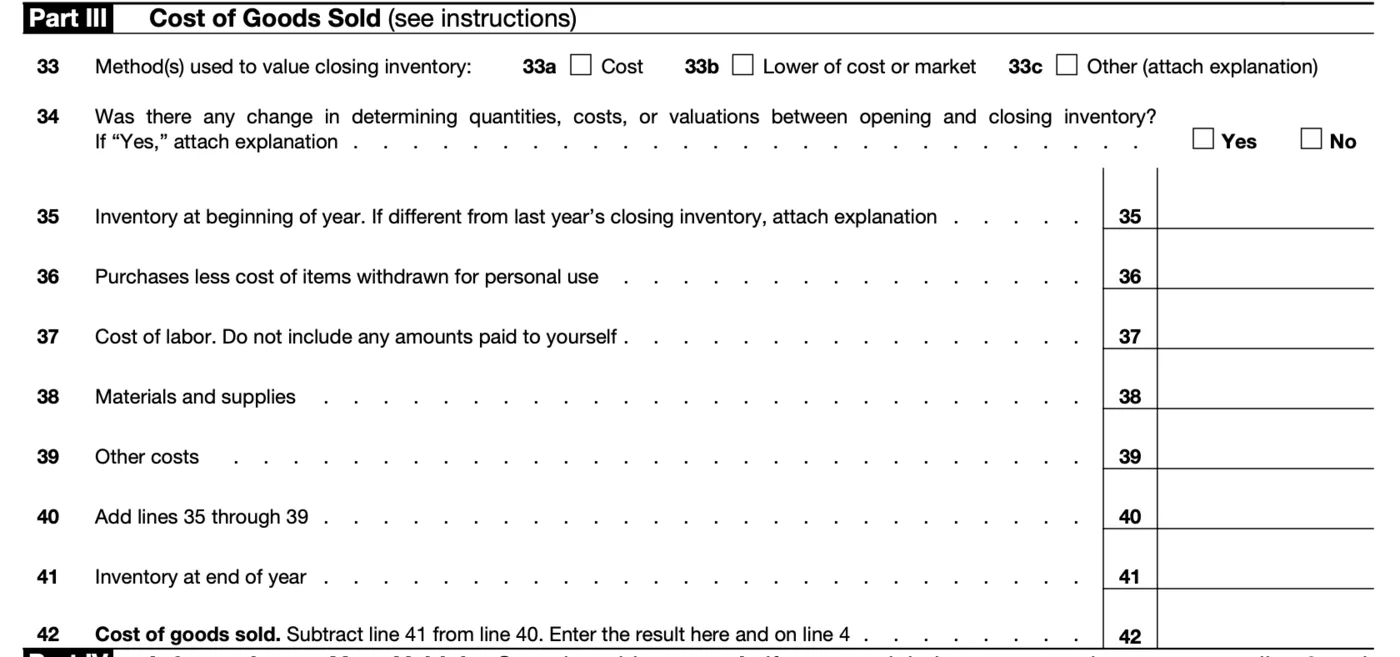
Profit on the later sale is the sale price minus that basis minus selling costs. A dealer's net earnings also carry self-employment tax of 15.3%, which is one more claim on the gap. Comped records the buy price when you scan the card at the table, and the sale later shows profit after cost and fees.
Four cases need more than one number.
- A lot or a collection. One price covers many cards, so the cost has to be split. The card cost basis calculator does the split.
- A raw card you will grade. No IRS guidance covers grading fees. Our reading is that the fee is added to the card's cost, as the grading fee guide explains.
- A card taken in trade. Its trade value is its cost. Our cost basis guide covers cash buys and trades.
- More than $10,000 in cash. A person in business who receives it for a card files Form 8300 within 15 days.
For the person selling to the dealer, tax is owed on profit over what the card cost. No form is issued at a show, and the sale is taxable anyway.
Terms
These are the words used at the table and on this page.
| Term | Meaning |
|---|---|
| Comp | Recent sold prices for the same card in the same grade |
| Buy percentage | The price paid divided by the comp |
| Room | Comp minus the price paid, before any selling cost |
| Trade credit | Value given in cards from the case instead of cash |
| Net | What a sale leaves after fees and postage |
| Margin | Profit divided by the sale price. Buy at $700, sell at $1,000: 30% |
| Markup | Profit divided by the cost. The same card: 42.9% |
| Cost basis | What the card cost you, the number that comes off the sale for tax |
How this looks in the Comped app
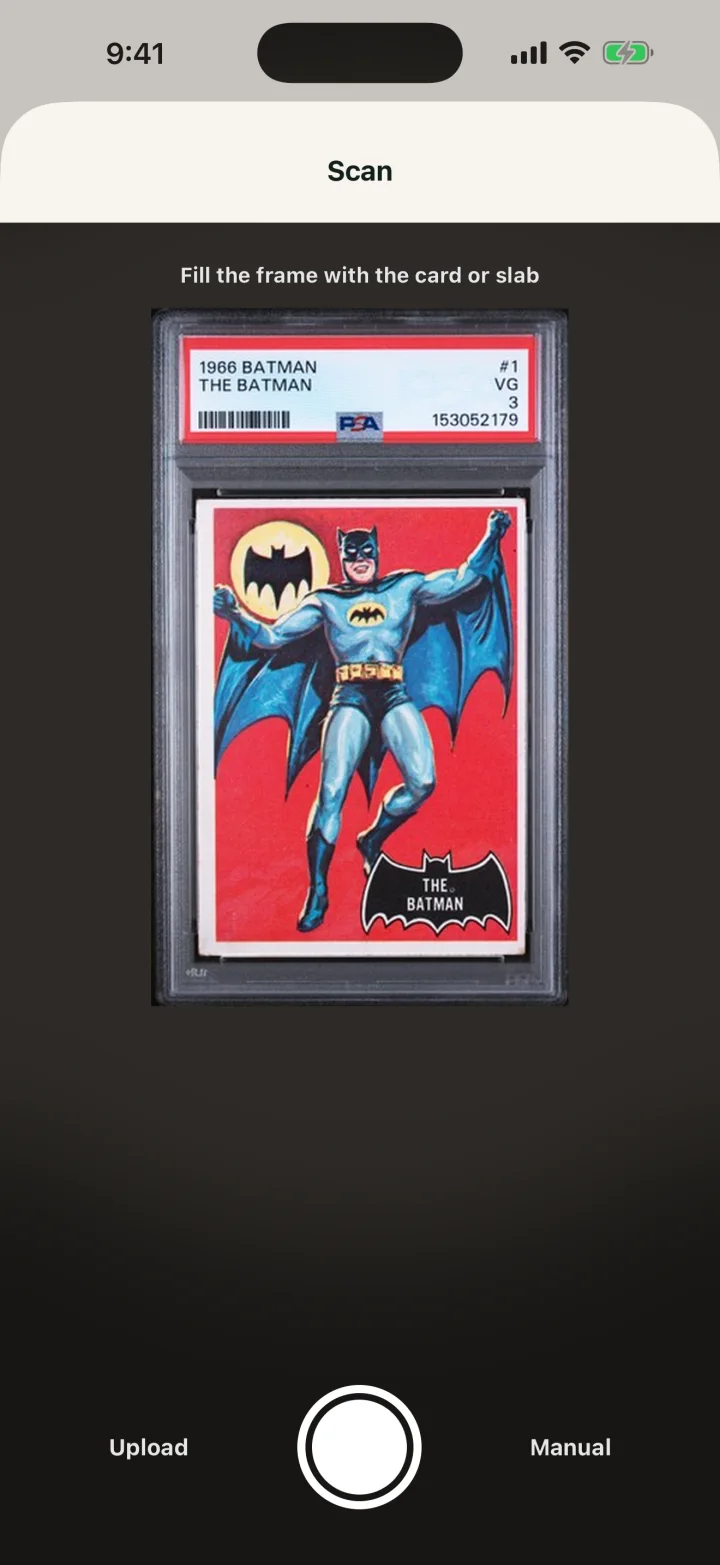
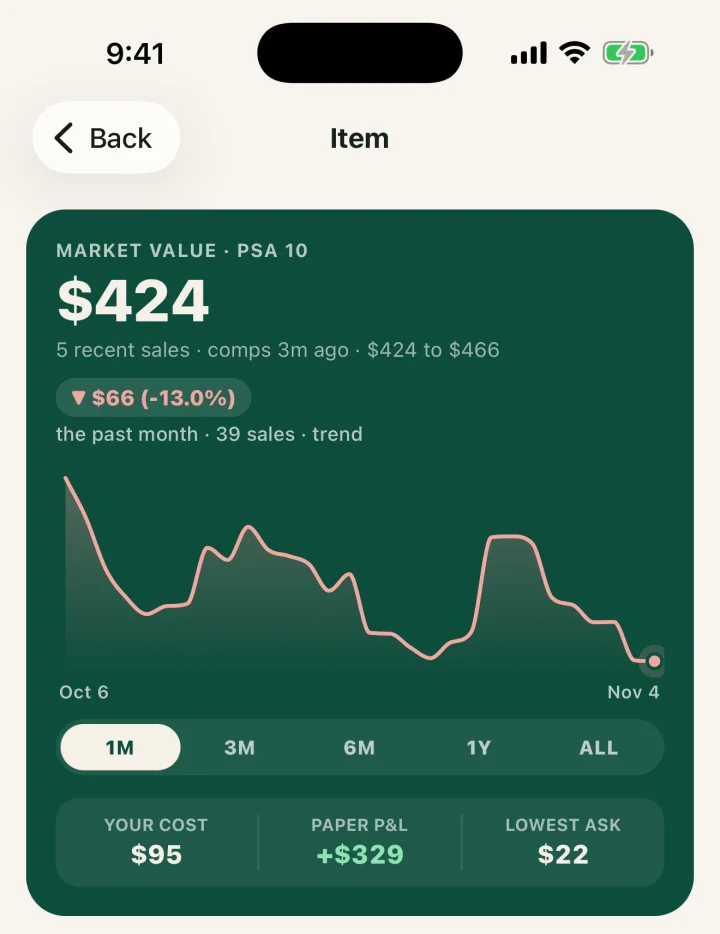
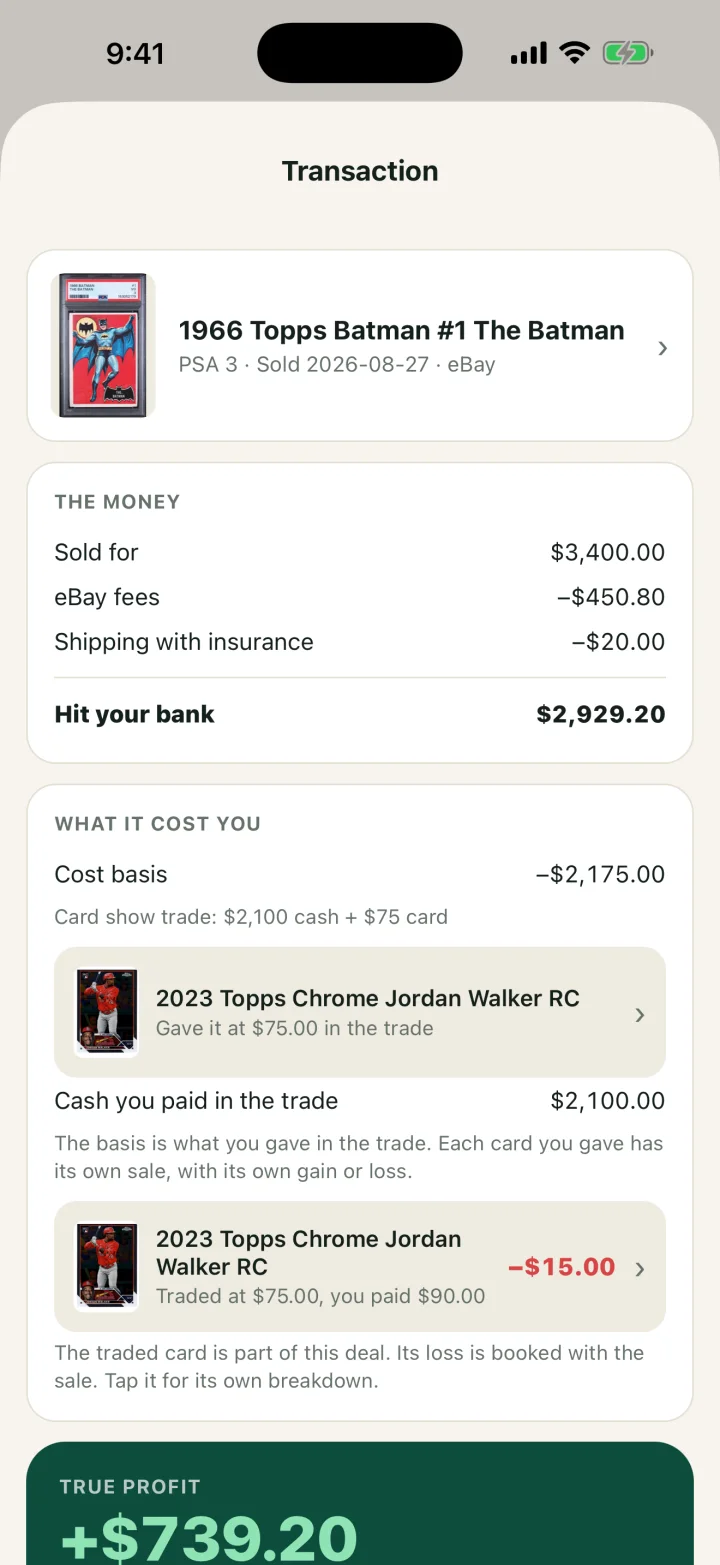
The first screen is the scan, which identifies the card or slab from the camera. The second is the card's page, with a market value from recent sales, a price line, your cost and current listings. The third is a finished sale: price, fees, shipping, cost basis and true profit.
Related guides
- The Card Vendor's Master Guide to Taxes: how the profit left in the gap is taxed.
- How to price cards for a card show: sticker price, lowest price and the cost behind both.
- Cost basis for cards bought with cash or by trade: the receipt a cash buy needs.
- How to track card show sales: keeping each buy and sale in one record.
FAQ
How much do vendors pay for cards at card shows?
Less than recent sold prices, and the amount varies by card and by dealer. Sports Illustrated reported in July 2025 that show dealers often pay around 60 percent of comp. Other published figures run from 40 percent for shop cash offers to 90 percent and up for slabbed singles that sell fast. No rule sets the figure.
What percent of comps do dealers pay?
There is no standard. Sports Illustrated put show dealers at around 60 percent and local card shops at 60 to 70 percent. A card that sells fast and carries a high price can draw a higher percentage, because the dollars left still cover the work.
Is 50% of comp a lowball?
It depends on the card. On a $20 card, 50 percent leaves a dealer $7.44 after an eBay sale on the assumptions used here, which is thin for the work. On a $1,000 slab with steady sales it leaves $358.50, and most published figures for that kind of card are higher than 50 percent.
Do dealers pay more in trade than in cash?
Usually. Published figures put trade credit 5 to 20 points above cash at the same shop. The dealer pays trade in cards that cost less than their sticker price, so a higher trade offer can cost the dealer less than a lower cash offer.
Do dealers pay more for graded cards than raw cards?
Often. A slab has a known grade and a tighter range of recent sales, so the dealer takes less risk on condition. One shop's buying page quotes 70 to 90 percent for graded cards and 60 to 80 percent for raw cards.
Should I sell to a dealer or on eBay?
A $1,000 card sold on eBay nets $858.50 on the assumptions used here, against $600 to $800 from a dealer at 60 to 80 percent. eBay takes photos, a listing, packing, shipping and a wait, and it carries return risk. A dealer pays today.
Is it profit or the whole sale that is taxed when I sell to a dealer?
Profit. That is what the dealer paid you minus what the card cost you. A sale made for cash is taxable the same as any other sale, whether or not a form reports it.
Does the dealer need a receipt when buying from me for cash?
Yes, for the dealer's own books. The price paid is the dealer's cost in the card. A written receipt with your name, the date, the item and the price is the record that supports it.
SOURCES
- Why Dealers Rarely Pay Full Price When Buying Cards, Scott Orgera, Sports Illustrated, July 21, 2025, read November 13, 2026.
- Night Moves: How Trade Nights became fun, popular after-hours events for card collectors, Clemente Lisi, Sports Collectors Digest, July 24, 2022, read November 13, 2026.
- Selling fees, eBay, checked November 13, 2026.
- What are Square's fees, Square, checked November 13, 2026.
- Standard mileage rates, IRS, checked November 13, 2026.
- Publication 583, Starting a Business and Keeping Records, IRS, checked November 13, 2026.
- Schedule C (Form 1040), Profit or Loss From Business, 2026, IRS, downloaded November 13, 2026.
- Self-employment tax, IRS, checked October 2026.
- What a trading card sale nets on each platform, Comped research, fee data as of October 29, 2026.
This is general information for card sellers, not tax or legal advice for your situation. Rules change and states differ; a CPA who knows your numbers wins every time.