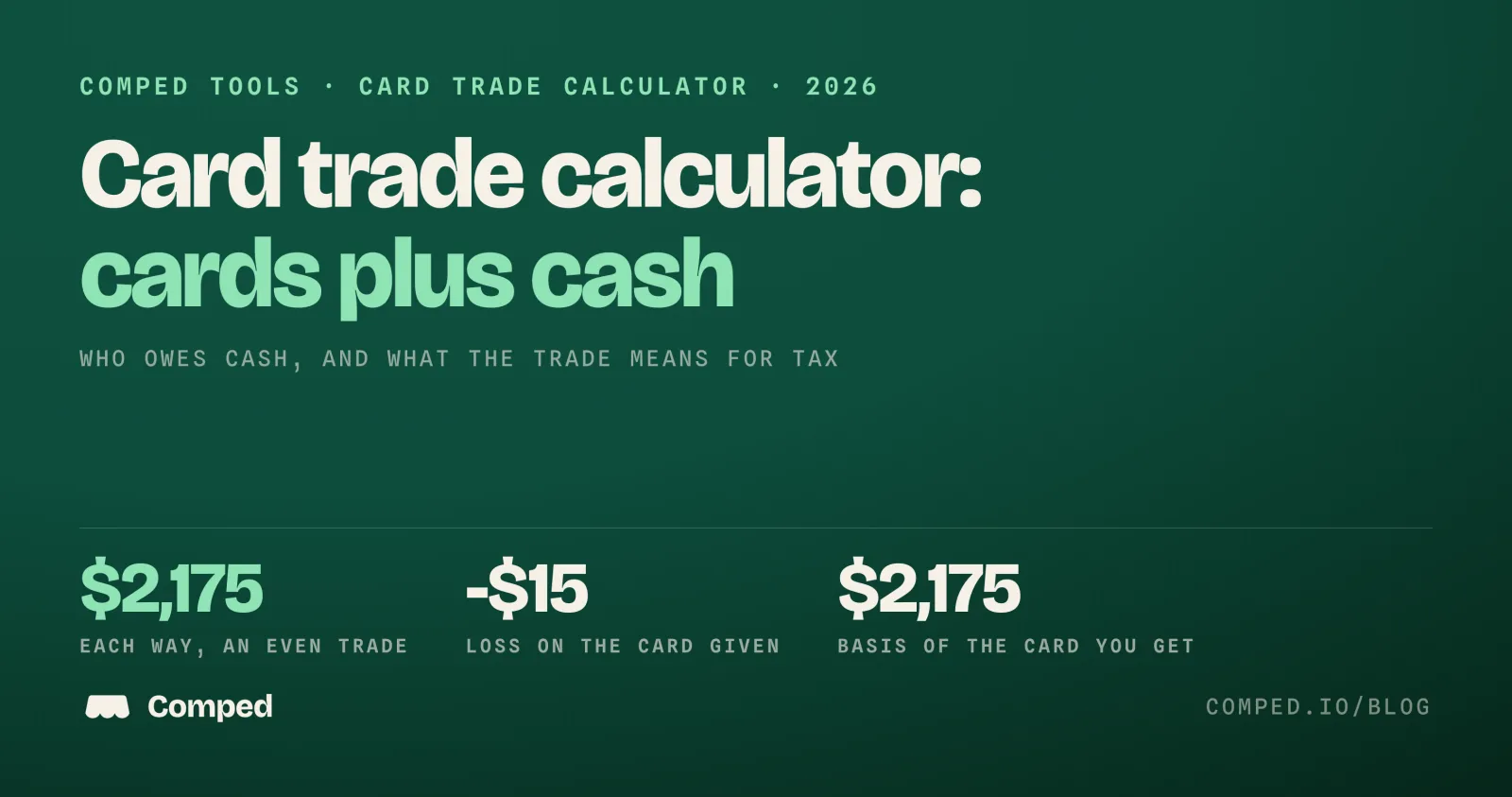
YOU GIVE
$2,175.00YOU GET
$2,175.00THIS TRADE
Even trade
$2,175.00 each way. No more cash is needed.
Both sides
THE TAX VIEW, YOUR SIDE
Your $75.00 of cards plus $2,100.00 net cash is the $2,175.00 basis. Trade values are the ones entered here; save the comps that support them.
COMPED DOES THIS AT THE TABLE
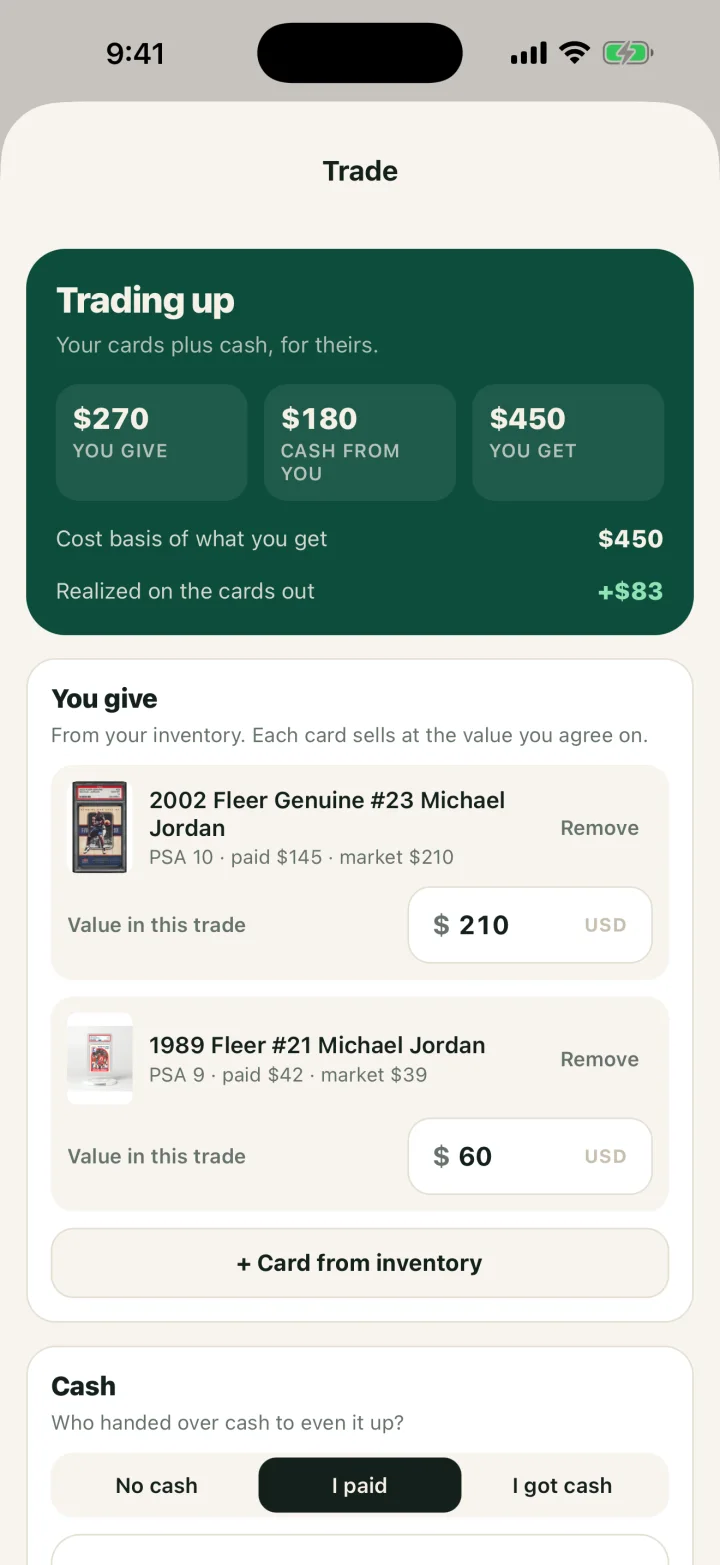
The record you make at the table is also the tax record. Comped's Trade screen takes the cards you give, cash either way and the cards you get. It shows the cost basis of what you receive and the gain or loss on the cards going out.
How the trade math works
Each side is cards plus cash. The calculator adds the comp value of the cards on a side, applies that side's trade percentage, and adds the cash. The side with the smaller total owes the difference in cash. When the two totals match, the trade is even.
Comp value is what the card has sold for recently in the same grade. Use the same kind of number on both sides. Mixing an asking price on one side with a sold price on the other is how a trade ends up lopsided. The guide on how to price cards for a card show covers which sales to use.
Sports cards and Pokemon cards work the same way here. The calculator needs values, not card names. Names are optional and only label the lines.
What the trade percentage does
The trade percentage is the share of comp a side's cards are credited at. At 100 a card counts for its full comp value. At 80 a card with a $500 comp counts for $400. Vendors often credit the other side's cards below comp, because they still have to sell those cards and pay fees on the way out.
Each side has its own percentage. Say you bring $500 of cards to a vendor who gives 80% in trade. You pick a $300 card from the case at full price. Your side is worth $400 and theirs $300, so the vendor owes you $100 in cash, or you pick $100 more in cards.
| Comp of your cards | 70% | 75% | 80% | 85% | 90% |
|---|---|---|---|---|---|
| $100 | $70.00 | $75.00 | $80.00 | $85.00 | $90.00 |
| $250 | $175.00 | $187.50 | $200.00 | $212.50 | $225.00 |
| $500 | $350.00 | $375.00 | $400.00 | $425.00 | $450.00 |
| $1,000 | $700.00 | $750.00 | $800.00 | $850.00 | $900.00 |
Two checks keep the percentage honest. If both sides are credited at the same percentage, it cancels, and the trade is comp for comp. If the other side's sticker is above comp, enter the comp and raise their percentage above 100. A $400 sticker on a card that comps at $364 is 110%. Your $500 of cards at 80% then buys $364 of comp, which is 72.7%, not 80%.
Published figures for shop trade credit run from 60% to 80% of market value, above the same shops' cash offers. The guide to card show buy percentages lists them with sources, and the buy percentage calculator works out a cash offer the same way.
How a trade is taxed
A trade is a sale of the cards you gave. Tax Topic 420 says the fair market value of goods received in barter is income in the year you receive them. So the cards you hand over are sold at the value you got for them, and that value becomes the cost basis of the cards you received. No cash has to change hands for this to count.
The gain or loss is the trade value of your cards minus what you paid for them. For a dealer, barter income goes on Schedule C with every other sale. The basis of the new cards sits in inventory until they sell. The cost basis guide for cash and trade buys walks through each case.
| Line in the trade | What it is on your books |
|---|---|
| Trade value of the cards you gave | Sale price of those cards |
| What you paid for the cards you gave | Their cost, subtracted from that sale |
| Cash you added | Part of the cost of the cards you got |
| Cash you received | Part of what your cards sold for |
| Trade value of the cards you got | Their cost basis, until they sell |

The tax lines assume the trade is settled even, with the cash shown at the top of the result. The calculator uses the trade values you entered, the numbers both sides agreed to. The IRS measure is fair market value, so save the sold comps from the day of the trade. It shows gain or loss, not tax. The card sale tax calculator turns a profit into a tax estimate.
A card for card trade does not defer the tax
A swap of one card for another is not a tax-free like-kind exchange. The IRS page on like-kind exchanges says section 1031 now applies only to real property. It names collectibles among the exchanges that stopped qualifying on January 1, 2018.
So an even swap with no cash still closes a sale on each side. No form is sent for it. Topic 420 puts Form 1099-B on barter exchanges, and a handshake at a show goes through no exchange. The income is reported by you.
Who you are changes where it goes.
| Who is trading | How the card given is treated |
|---|---|
| A dealer trading inventory | An ordinary sale on Schedule C. A loss counts with the year's other sales |
| A collector or investor | Our reading: a sale of a collectible at the value received. Long-term gains are taxed at up to 28%. A loss on a personal-use card is not deductible |
| A hobby seller | Income on Schedule 1, line 8, less the cost of the card given. Other expenses are not deductible |
The hobby or business guide covers which one you are. Two edges come up at shows. Only the cash in a trade counts toward Form 8300, which applies above $10,000 in cash. Sales tax on a trade is a state question, covered in the state sales tax guide.
The Batman trade, worked
The default numbers are a real deal. A vendor buys a 1966 Topps Batman #1 PSA 3 at a show for $2,100 cash plus a card from the case. The other dealer values that card at $75. The vendor had paid $90 for it.
THE BATMAN TRADE · YOUR SIDE
The Batman later sold on eBay for $3,400 with $450.80 in fees and $20 shipping. Against the $2,175 basis and the $15 trade loss, the true profit was $739.20.
Two things happened in one handshake. A $75 sale closed at a $15 loss, and a $2,175 card entered inventory. Both lines belong in the books on the day of the trade, not the day the Batman sells.
Two more trades, worked
Trading up and trading down use the same rules with the cash moving in opposite directions. Both sets of numbers are examples you can type into the calculator.
TRADING UP AT 80% (EXAMPLE)
You bring two cards with comps of $300 and $200. You paid $180 and $150. The vendor credits them at 80% toward a $650 card.
TRADING DOWN, CASH BACK (EXAMPLE)
You give one card with a $1,200 comp that cost you $700. You take two cards with comps of $500 and $300, all at full comp.
The $500 gain is this year's, even though only $400 of it arrived as cash.
What this calculator does not do
It settles one trade between two sides and shows your side of the tax view. Some deal calculators add features this one leaves out.
| Not in this calculator | What to do |
|---|---|
| A blended deal, part cash and part store credit at two rates | Run the trade here at the credit rate. Price the cash part with the buy percentage calculator |
| A different percentage for each card | Type each card's agreed trade value as its comp and leave the percentage at 100 |
| Condition adjustments | Use the comp for the exact grade or condition |
| The other person's gain and basis | Swap the sides and add their costs |
| Splitting one price across a lot | Use the card cost basis calculator |
| Fees when the new card sells | Use the card profit calculator |
| The tax owed | Use the card sale tax calculator linked above |
Common mistakes
Trade mistakes are either a bad value at the table or a missing line in the books. Each one below has a number from this page.
- Sticker against sold. A $400 sticker on a $364 comp turns 80% trade into 72.7%.
- A percentage on one side only. A $500 for $500 swap at 80% one way is a $100 gap.
- Leaving the cash out of the basis. The Batman's cost is $2,175, not $75.
- Booking nothing because no cash moved. The trading up example has a $70 gain with cash going out.
- Carrying the old cost to the new card. In that example it gives $580 instead of $650 and skips the $70 gain.
If past trades were never recorded, rebuild them now. Use photos, messages and sold prices from the trade date to set a value for each side. Card sales with no receipts covers how to document what you can.
What to write down at the table
A trade with cash needs five items on the receipt: the other person's name, the date, the card you received, the cash, and the card you gave with its agreed value. Publication 583 describes the records that support a purchase, and for a cash or trade buy at a show a written receipt is the one that exists. Without it the IRS can treat your cost as zero.
Write it as two lines, one for each direction. The card show cash and trade log has a row for exactly this, and the guide on how to track card show sales shows where a trade fits in a day's records.
Related guides
- The Card Vendor's Master Guide to Taxes: where barter income and inventory cost land on the return.
- Cost basis for cards bought with cash or by trade: the rule behind the tax view on this page.
- Card cost basis calculator: split a lot, a box or a cash and trade buy into a cost per card.
- Card show buy percentages: why a vendor credits cards below comp.
FAQ
Do trades count as sales?
Yes. A trade is barter. The card you receive is income at its fair market value in the year you get it, and the card you gave is treated as sold at that value. For a dealer it goes on Schedule C like any other sale.
Do I owe tax on a trade if no cash changed hands?
You can. The gain is the trade value of the cards you gave minus what you paid for them, whether or not cash moved. A trade at a loss, like the $75 card that cost $90, produces a loss instead.
Is a card for card trade a like-kind exchange?
No. The IRS says section 1031 applies only to real property, and exchanges of collectibles stopped qualifying on January 1, 2018. Each side of a card trade is a sale at the value received.
What is the cost basis of the card I got in a trade?
Its value in the trade. In an even trade that equals the trade value of the cards you gave plus any cash you added. The Batman bought with a $75 card and $2,100 cash has a $2,175 basis.
What does 80% trade value mean?
Your cards are credited at 80% of comp toward the other side's cards. A $500 comp counts as $400. Enter 80 on your side and the calculator shows what the gap is worth in cash.
Does anyone report a card trade to the IRS?
Not for a trade made in person. Barter exchanges file Form 1099-B, and a trade at a show goes through no exchange. You report the income yourself, and a dealer includes it in Schedule C sales.
What if I do not know what I paid for a card I am trading?
Leave the field blank and the calculator counts the whole trade value as gain, which is how the IRS can treat a card with no record of cost. Look for an old receipt, a statement or a purchase history first, and write down what you can.
Can I deduct a loss on a card I traded?
A dealer's loss on an inventory card counts on Schedule C with the rest of the year's sales. A loss on personal-use property, such as a card from a personal collection, is not deductible.
SOURCES
- Topic no. 420, Bartering income, Internal Revenue Service, checked November 13, 2026.
- Like-kind exchanges, real estate tax tips, Internal Revenue Service, checked November 13, 2026.
- Schedule C (Form 1040), Profit or Loss From Business, 2026, Internal Revenue Service, downloaded November 13, 2026.
- Publication 583, Starting a Business and Keeping Records, Internal Revenue Service, checked November 13, 2026.
- Topic no. 409, Capital gains and losses, Internal Revenue Service, checked October 2026.
- Tips for taxpayers who make money from a hobby, Internal Revenue Service, checked October 2026.
- Publication 334, Tax Guide for Small Business, Internal Revenue Service, checked October 2026.
This is general information for card sellers, not tax or legal advice for your situation. Rules change and states differ; a CPA who knows your numbers wins every time.