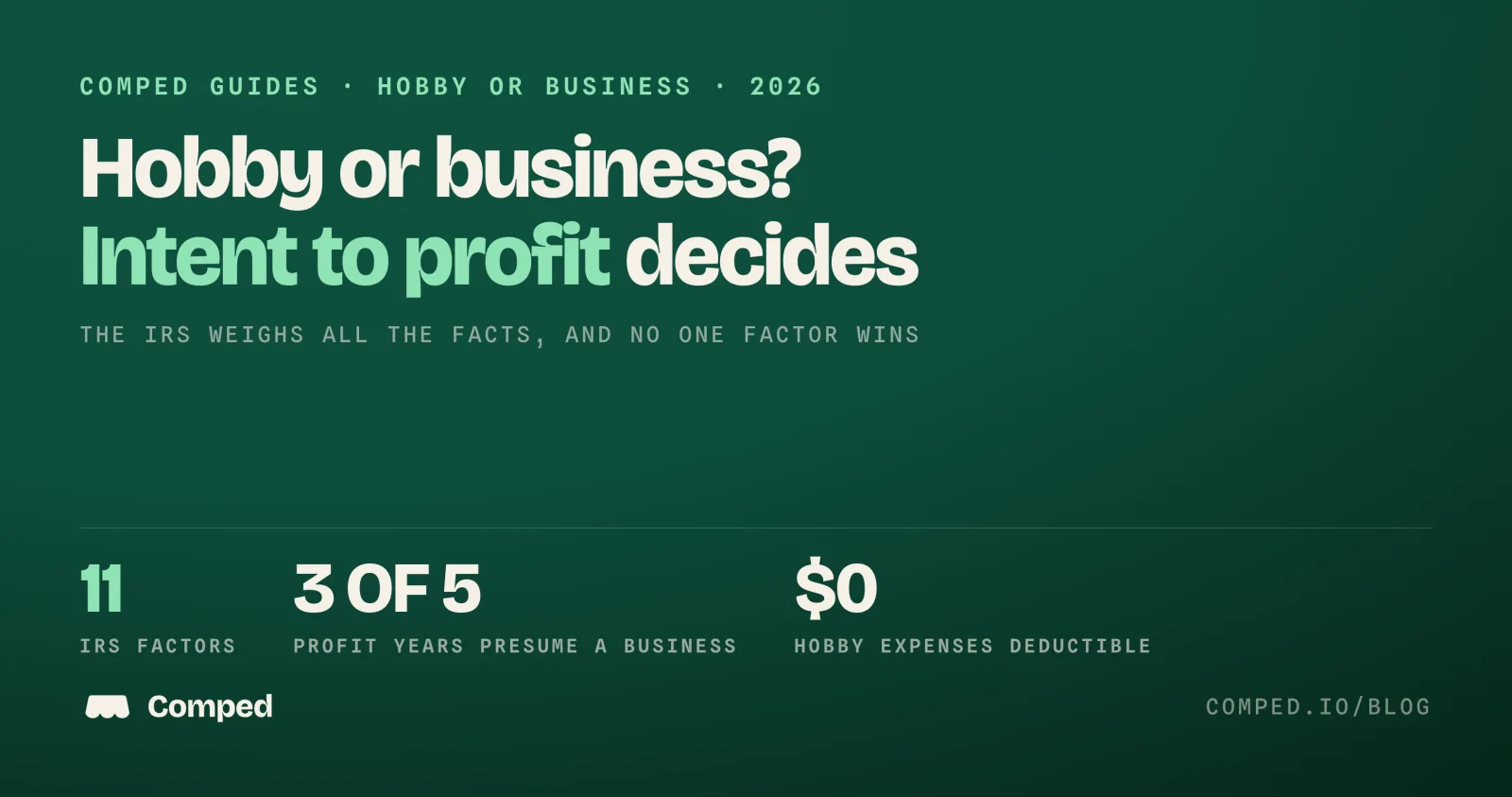
Who decides
You decide first, on your return, and the IRS can disagree later. The IRS defines a hobby as an activity a person pursues for enjoyment with no intention of making a profit. A business is operated with the intention of making a profit. That intent is the whole test, and the factors below are how it gets judged.
It is not a choice you make each year for the better result. The facts of how you buy and sell decide it. Publication 334 adds two points that fit most card sellers. You do not need to actually make a profit to be in a trade or business, as long as you have a profit motive. And a part-time business beside a regular job may be self-employment.
The master tax guide covers what follows once you are a business: Schedule C, inventory and self-employment tax.
The three outcomes, side by side
A person who sells cards is a dealer running a business, a hobby seller, or a collector selling investments, and each lands on a different form. The rows come from the IRS pages cited in each section below.
| Business (dealer) | Hobby seller | Collector | |
|---|---|---|---|
| What the cards are | Inventory, held mainly for sale | Bought for enjoyment, sold with no profit intent | Held as an investment or personal property |
| Where it goes | Schedule C | Schedule 1 (Form 1040), line 8j | Form 8949 and Schedule D |
| Card cost | Cost of goods sold, Part III | Subtracted from the sale | Basis, subtracted from the sale |
| Table fees, mileage, supplies, software | Deductible | Not deductible | Not a business expense |
| Self-employment tax | 15.3% on net earnings of $400 or more | Not addressed on the IRS pages we read; ask a CPA | None on a capital gain |
| A loss | Carries to Schedule 1, line 3 | Cannot offset other income | Not deductible on personal-use property |
| Rate on the profit | Ordinary income rates | Ordinary income rates | Up to 28% on a long-term collectible gain |
The IRS factors as a card seller's checklist
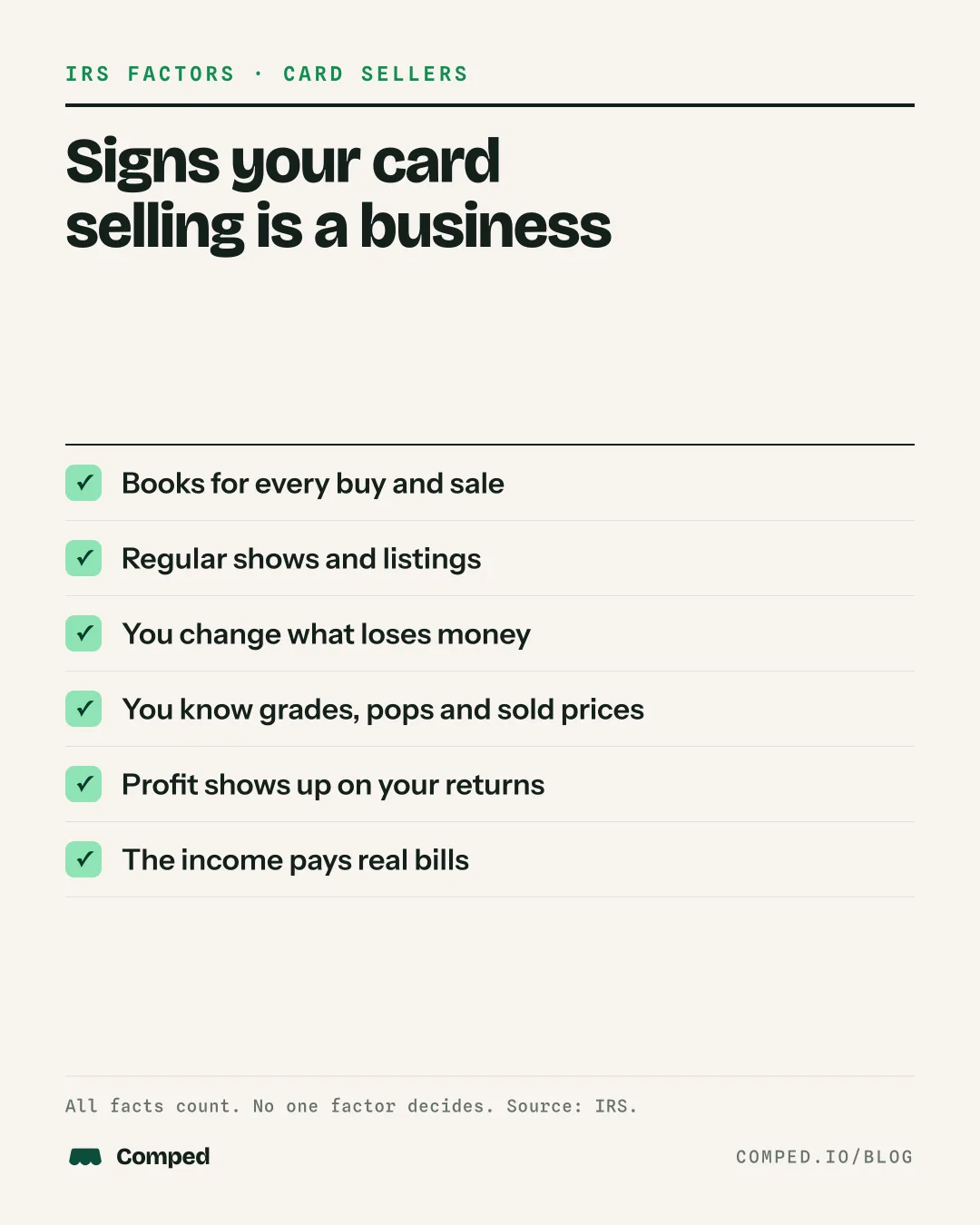
The IRS lists the factors in its hobby or business tax tip. It says all facts and circumstances count. It adds that no one factor is more important than another. The left column is the IRS factor. The right column is what it looks like at a card table, which is our reading and not IRS text.
| IRS factor | What it looks like for a card seller |
|---|---|
| Businesslike manner, with complete and accurate books and records | A record of every buy and sale with cost, a separate account, sales tax registration where you set up |
| Time and effort that show an intent to be profitable | Regular shows, listings, sourcing trips, comps checked before buying |
| Dependence on the income for your livelihood | Card profit pays bills, not only more cards |
| Personal motives such as enjoyment or relaxation | You keep the best cards and sell rarely; points toward hobby |
| Enough income from other sources to fund the activity | A salary covers years of card losses; points toward hobby |
| Losses beyond your control, or normal for a startup phase | A first year of table fees and inventory buys, or a market drop |
| Changes to methods of operation to improve profitability | Dropping shows that lose money, changing what you buy and at what percentage |
| Knowledge needed to run it as a successful business | You know grading, pop reports and sold prices in your niche |
| Success making a profit in similar activities in the past | Earlier reselling that made money |
| Profit in some years, and how much | Tax returns that show profit years |
| Expected future profit from appreciation of assets | Inventory held because it should rise in value |
Most of the list comes down to records. A seller who can show cost, sale and profit for each card has answered the first factor and has the proof for several others. Comped records the card, price, venue and date of each buy and sale, which is the kind of books the first factor names. The post on how to track card show sales covers doing it on paper.
Three sellers, decided
The factors are easier to read against real patterns. These three are made-up examples, and the conclusions are our reading of the factors.
| The seller | Facts that point to business | Facts that point away | Our reading |
|---|---|---|---|
| Sets up at a show most months, buys collections at 60% to 70% of comps, lists the rest online | Buys to resell, regular activity, tracks cost, changes what is bought based on what sells | Has a salary; enjoys it | Business. Enjoyment and a day job do not undo a profit motive |
| Opens a few boxes a year for fun and sells the duplicates | Some sales | Buys for enjoyment, no records, sells only what is unwanted | Hobby or personal sales. Any gain over what the cards cost is reported, and expenses are not deducted |
| Bought key rookie cards years ago, held them, sells three in one year | Profit, sometimes large | No regular selling, no inventory turned, held for appreciation | Collector. Capital gain on Form 8949 and Schedule D |
The hard cases sit between rows one and two: the collector who starts flipping to fund the collection. Once you are buying cards in order to sell them, on a regular basis, the first row describes you.
The 3 of 5 years presumption
Profit in 3 of 5 consecutive years presumes the activity is for profit. That is section 183(d) of the tax code. It is a presumption in your favor, not a requirement. A seller with fewer profit years can still be a business on the factors above.
It also does not work in reverse as a planning tool. A loss year is real or it is not. What the presumption rewards is a seller whose records show profit, year after year.
A new seller can ask the IRS to wait. The IRS says Form 5213 is used to elect to postpone an IRS determination of whether the presumption applies. Talk to a CPA before filing it. The election has conditions and consequences this page does not cover.
What a business owes
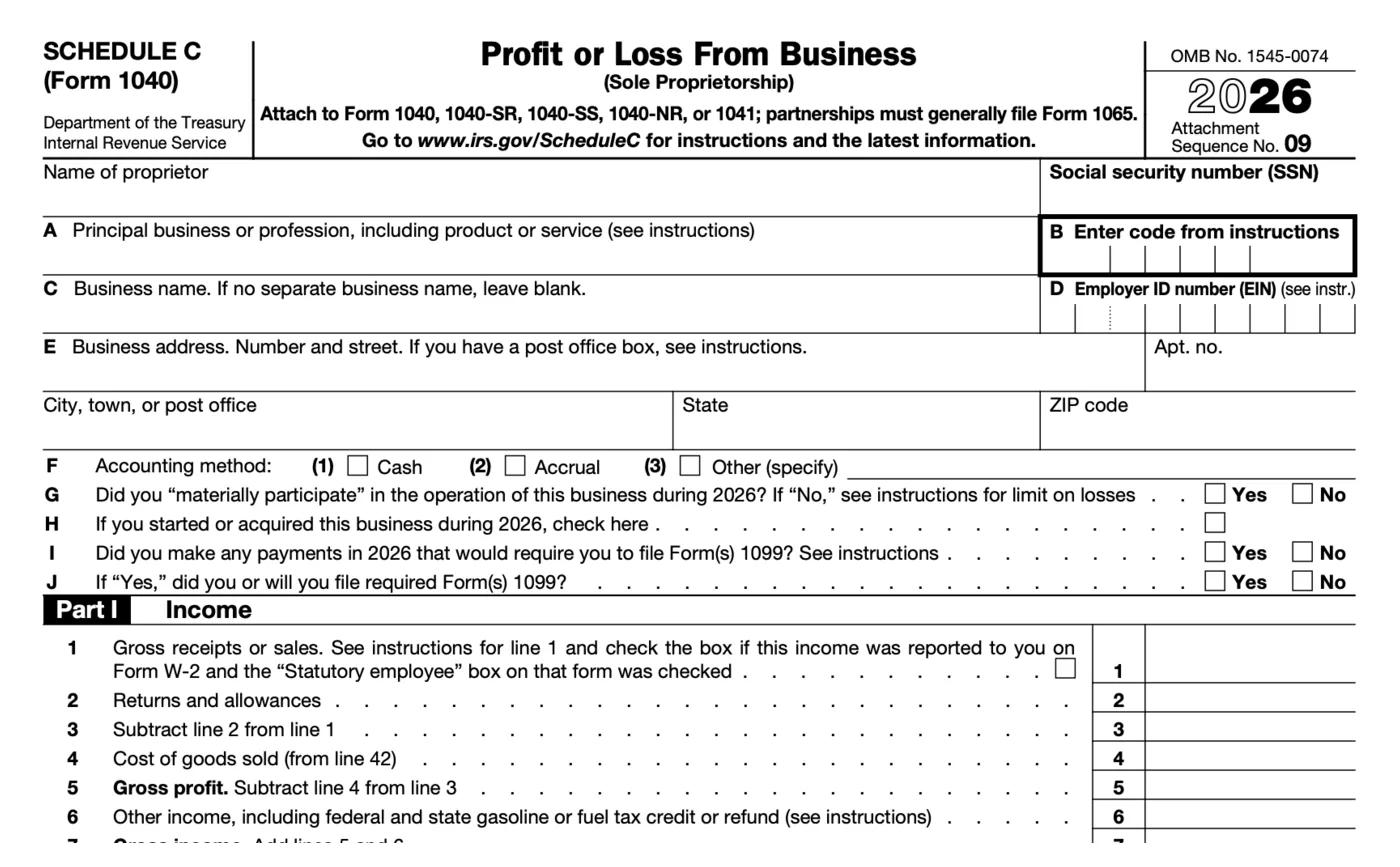
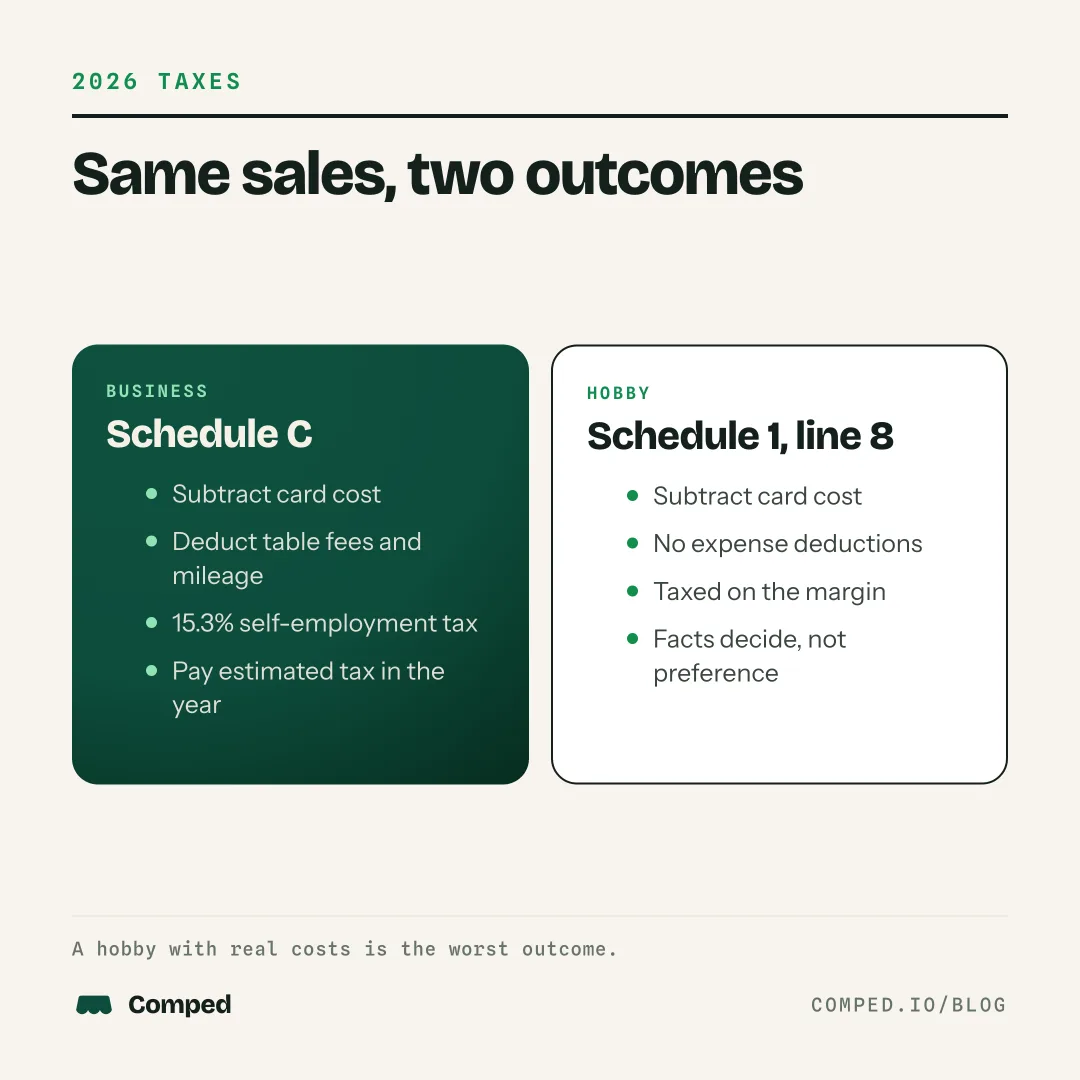
A business reports card sales on Schedule C and pays tax on net profit. Sales come in at the top. Card cost comes off through cost of goods sold, and table fees, mileage, supplies and software come off as expenses. For 2026, mileage is 72.5 cents a mile through June 30 and 76 cents from July 1.
The cost is self-employment tax. It is 15.3% on net earnings of $400 or more, on top of income tax, and half of it is deductible. A business may also qualify for the qualified business income deduction. And because nothing is withheld, a business usually pays through the year, which quarterly estimated taxes for card sellers covers.
Schedule C also asks for a business code on line B. The post on the Schedule C business code for card sellers lists the candidates.
What a hobby owes
A hobby seller reports the income on Schedule 1 (Form 1040), line 8, and deducts no expenses. The 2025 Schedule 1 prints it as line 8j, activity not engaged in for profit income. The IRS says hobby expenses are miscellaneous itemized deductions and can no longer be deducted. The July 2025 law made that permanent. A hobby seller still subtracts what the cards cost.
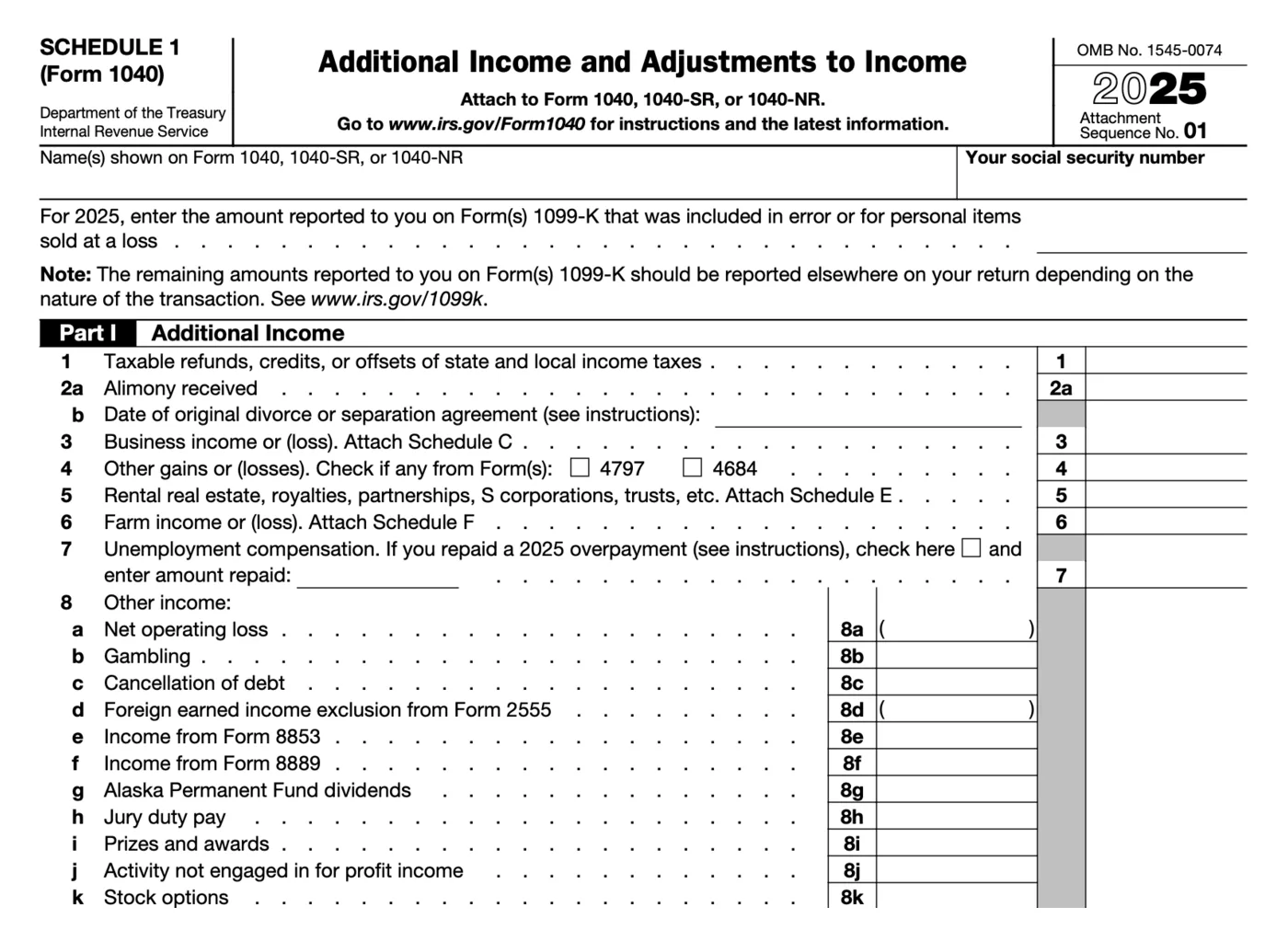
So a hobby is taxed on margin with nothing else off. Table fees, mileage, grading supplies and software all drop out. For a seller with real costs that is the worst of the outcomes, not a way to owe less.
A 1099-K does not settle the question either way. The IRS page What to do with Form 1099-K says the form may include payments from selling items as a hobby. The income is reported whether or not a form arrives.
The collector who sells from a collection
A third group is neither. A collector who sells cards held as an investment reports a capital gain, not business or hobby income. Long-term gains on collectibles are taxed at up to 28% under Tax Topic 409. The statute's list of collectibles does not name trading cards, but they are treated as collectibles in practice.
A dealer is different because the cards are inventory, held mainly for sale to customers. Dealer sales are ordinary income on Schedule C. One rule cuts against the collector: a loss on personal-use property is not deductible. The IRS 1099-K page says a gain on a personal item goes on Form 8949 and Schedule D.
Dealer and collector at once
Many dealers also keep a personal collection, and the two can sit side by side if the records keep them apart. The form itself expects this. Line 36 of Schedule C reads "Purchases less cost of items withdrawn for personal use".
The rest of this section is our reading, since no IRS page addresses a card dealer's personal collection. Mark a card as personal on the day you decide to keep it, and take its cost out of purchases. Do not move cards back and forth to pick the better tax result on each sale. A card that goes from the collection into the case becomes inventory at what you paid for it, if you can show that. Ask a CPA before selling a large personal card through the business.
Is selling Pokemon cards a business?
Yes, when you sell Pokemon cards to make a profit, and the test is the same one sports card sellers face. The IRS factors do not mention the product. Ripping boxes to sell the hits, buying collections to break up, and setting up at shows are all buying for resale.
Selling duplicates from your own binder a few times a year points the other way. Opening packs for fun and selling what you do not want looks like a hobby or a collector's sale. The post on selling Pokemon cards and taxes covers pack basis and what each kind of seller owes.
The same sale, both ways
Say a seller takes in $12,000 at shows in 2026. The cards cost $7,000, and table fees, mileage and supplies add up to $2,500. The numbers are an example, not a typical year.
ONE YEAR, TWO OUTCOMES
Say the sales and costs are identical and only the classification changes.
The business is taxed on $2,500 of profit, with self-employment tax on top of income tax. The hobby is taxed on $5,000, because the $2,500 of expenses is lost. Which bill is lower depends on your bracket, and you do not get to pick. The card sale tax calculator estimates the business side.
The self-employment tax on the business side is a known figure. Net earnings are $2,500 times 92.35%, or $2,308.75, and 15.3% of that is $353.24. Income tax is then figured on each taxable amount at your own rate.
Loss years
A business can have a loss, and a loss is where the hobby question usually gets asked. On Schedule C a loss goes to line 31, then to Schedule 1, line 3, where it is combined with your other income.
Publication 334 states the limit. If you do not carry on the activity to make a profit, there is a limit on the deductions you can take, and you generally cannot use a loss from it to offset other income. So a seller who reports losses year after year against a salary should expect the factors to be applied.
| Mistake | What it costs |
|---|---|
| Calling a real business a hobby to skip self-employment tax | Expenses are lost, and the IRS can reclassify it and add the tax and penalties |
| Deducting table fees or mileage against hobby income | The deduction is disallowed |
| Years of Schedule C losses with no records | The first factor fails, and the losses can be denied |
| Running personal collection sales through the business, or the reverse, sale by sale | Neither set of books holds up |
| Reporting nothing because it is "just a hobby" | Hobby income is still reported, on Schedule 1, line 8j |
If you filed it the wrong way
Amend the return. The IRS page on amended returns says to file Form 1040-X when your income, deductions or tax liability changed. Moving card sales from line 8j to Schedule C, or the reverse, changes all three.
The change can go either direction. A business that was filed as a hobby may get its expenses back and owe self-employment tax. A refund claim generally must be filed within 3 years of the original return, or 2 years of paying the tax, whichever is later. Rebuild the year's records before you amend, and have a CPA figure both versions.
How this looks in the Comped app
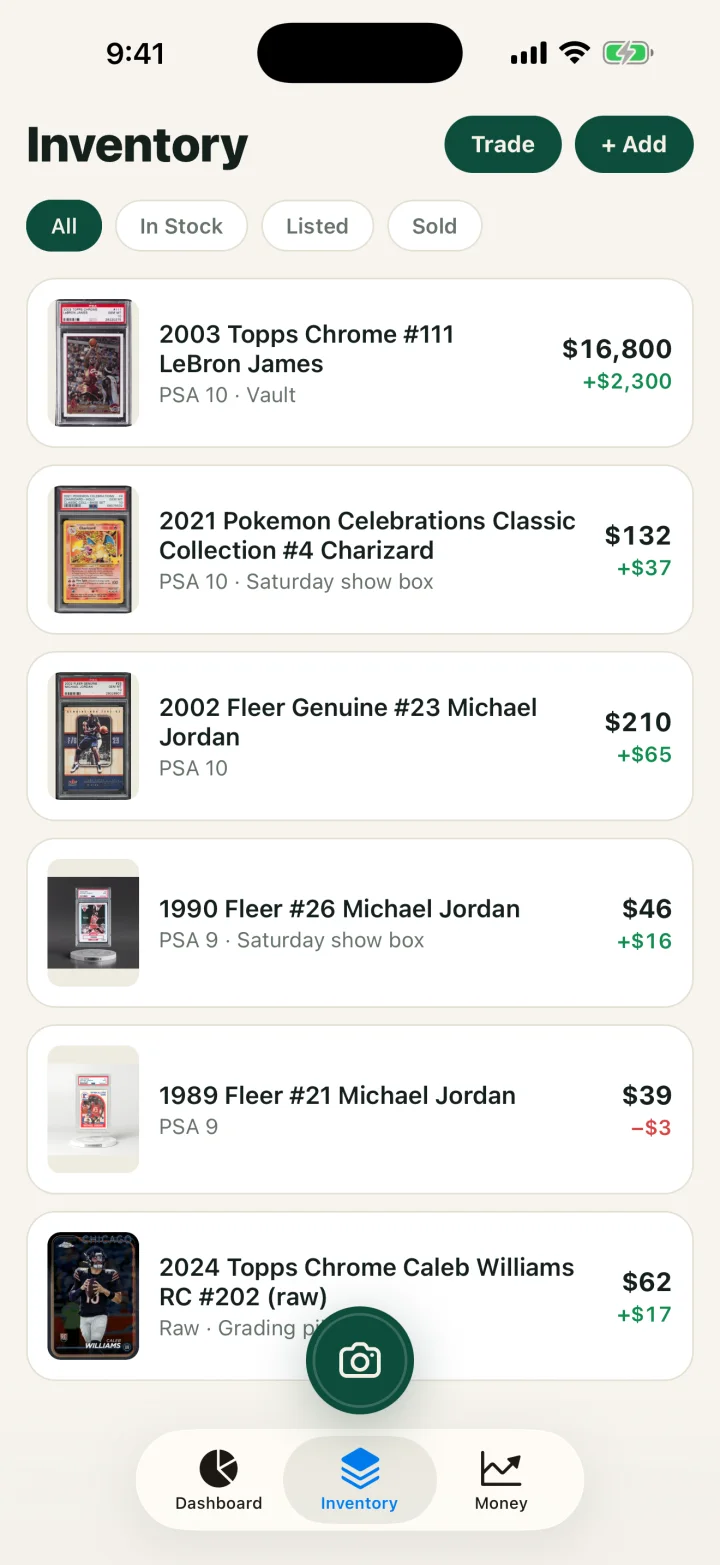
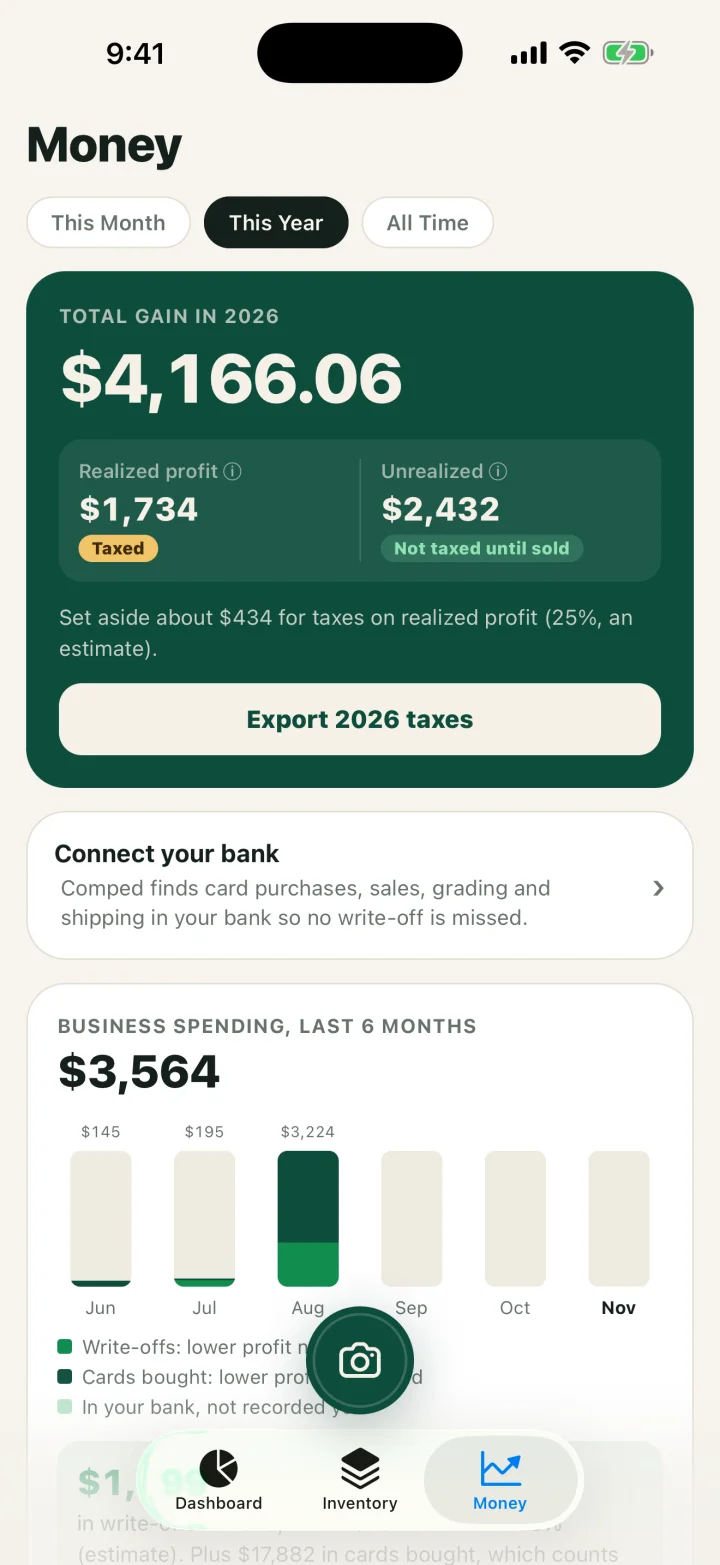
These screens are the books the first factor asks for. Inventory lists every card with its cost and current value, filtered by In Stock, Listed or Sold. The sale screen shows one card from price to true profit. The Money tab totals realized profit for the year and exports it.

Related guides
- The Card Vendor's Master Guide to Taxes: what a card business files and when.
- Do you have to pay taxes on selling sports cards?: dealer, collector and hobby seller side by side.
- Selling Pokemon cards and taxes: pack pulls, sealed product and what you owe.
- Quarterly estimated taxes for card sellers: paying through the year once you are a business.
FAQ
Hobby or business, who decides?
You report it one way on your return, based on the facts. The IRS can review that using its factors and reach a different answer. No single factor decides it, and the IRS says all facts and circumstances are considered.
Is selling Pokemon cards a business?
It is when you buy, open or trade Pokemon cards with the intent to make a profit and run it like one. Regular selling, records and changes to improve profit point to a business. Selling a few duplicates from a personal collection does not.
At what point does selling cards become a business?
There is no dollar amount or number of sales. It becomes a business when you are buying and selling with the intent to make a profit and act like it. Regular shows or listings, cost records and buying for resale are the signs.
Is it better to call my card selling a hobby?
It is not a choice, and for a seller with real costs it usually costs more. A hobby cannot deduct table fees, mileage, supplies or software for 2026 taxes. It subtracts only the cost of the cards and pays income tax on the rest.
Do I have to make a profit 3 years out of 5?
No. Profit in 3 of 5 consecutive years creates a presumption that the activity is for profit. A seller with fewer profit years can still be a business if the other factors show a real intent to make money.
Where does hobby income from cards go on the return?
On Schedule 1 (Form 1040), line 8, per the IRS. The 2025 form prints it as line 8j. Business income goes on Schedule C instead. Income is reported either way, whether or not a 1099-K arrives.
Can I be a collector and a dealer at the same time?
Yes, if your records keep the two apart. Schedule C line 36 subtracts the cost of items withdrawn for personal use. Mark personal cards when you decide to keep them, and do not switch a card's label to get a better result on one sale.
Can I use selling at a loss to owe nothing?
Only a real loss counts, and you have to prove the cost behind it. A business reports a loss on Schedule C with records for every card. A hobby cannot deduct expenses at all, and a loss on personal-use property is not deductible.
SOURCES
- Here's how to tell the difference between a hobby and a business for tax purposes, IRS Tax Tip 2022-57, checked November 2026.
- Tips for taxpayers who make money from a hobby, IRS Tax Tip 2019-85, checked November 2026.
- Schedule 1 (Form 1040), 2025, line 8j, IRS, checked November 2026.
- Schedule C (Form 1040), 2026, IRS, checked November 2026.
- Publication 334 (2025), Tax Guide for Small Business, IRS, checked November 2026.
- About Form 5213, IRS, checked November 2026.
- What to do with Form 1099-K, IRS, checked November 2026.
- File an amended return, IRS, checked November 2026.
- Self-employment tax, IRS, checked November 2026.
- Topic no. 409, Capital gains and losses, IRS, and Standard mileage rates, IRS, checked November 2026.
This is general information for card sellers, not tax or legal advice for your situation. Rules change and states differ; a CPA who knows your numbers wins every time.