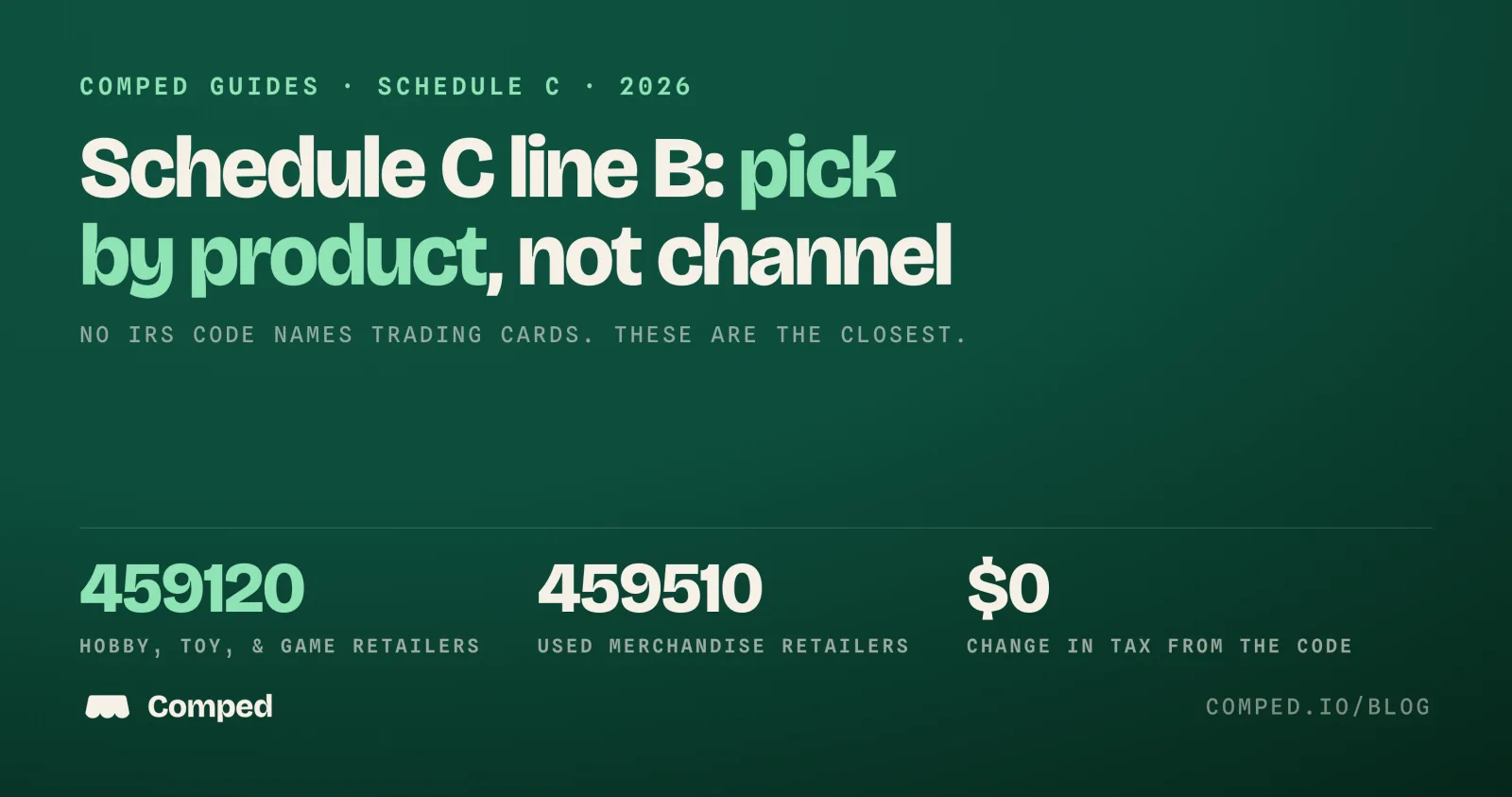
What line B asks for
Line B asks for a six-digit code from the chart at the end of the Schedule C instructions. The Instructions for Schedule C call it the Principal Business or Professional Activity code. The codes are based on the North American Industry Classification System, known as NAICS.
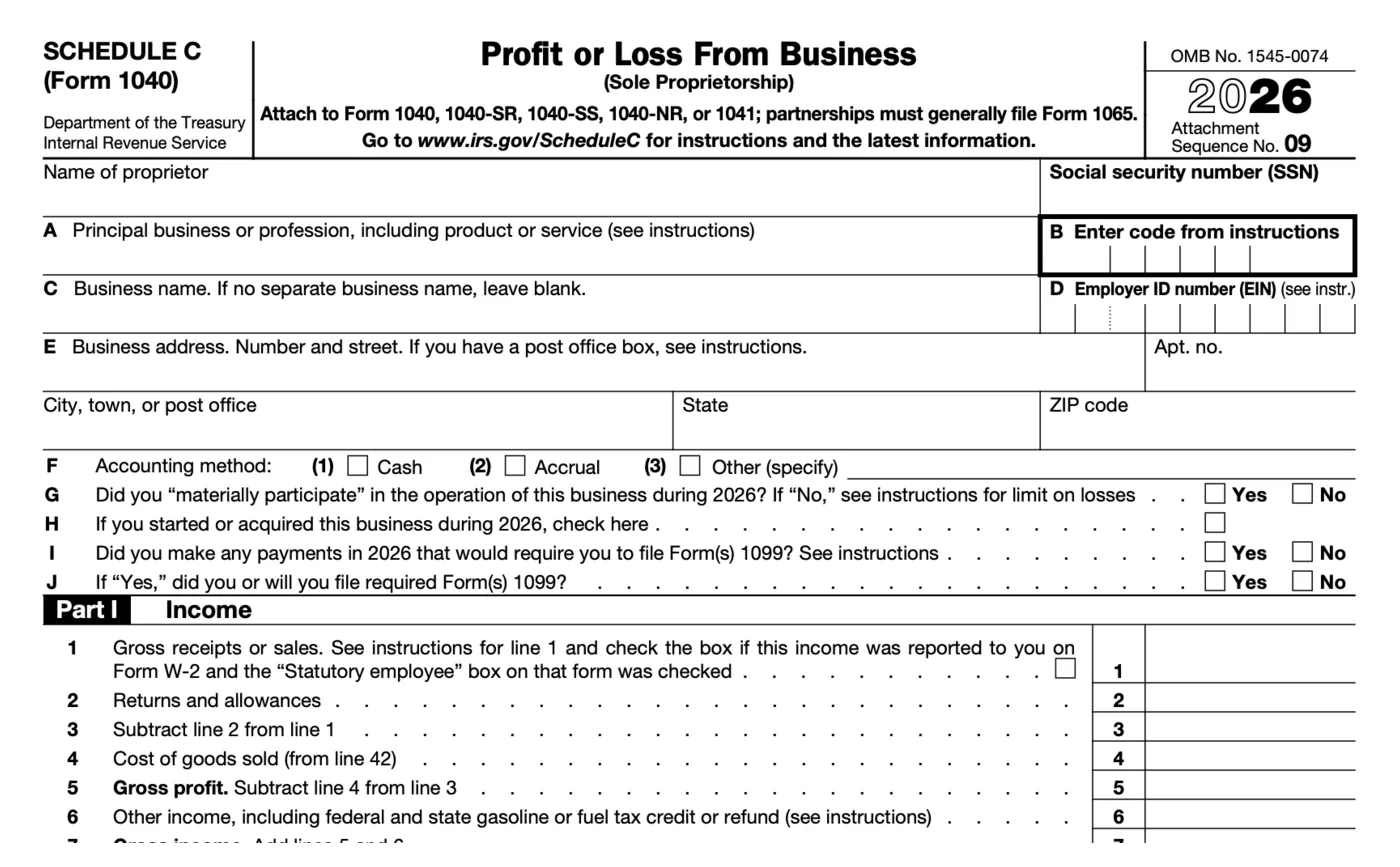
The IRS tells you how to choose. Select the category that best describes your primary business activity. Then select the activity that best identifies the principal source of your sales or receipts. The word is "best", so the IRS expects the closest fit, not a perfect one.
This page uses the 2025 instructions, the current ones on irs.gov on November 13, 2026. The IRS has posted the 2026 Schedule C form, where line B reads "Enter code from instructions". The 2026 instructions are not posted yet, so check the chart again when they are. The master tax guide covers the rest of Schedule C.
The candidate codes, as printed
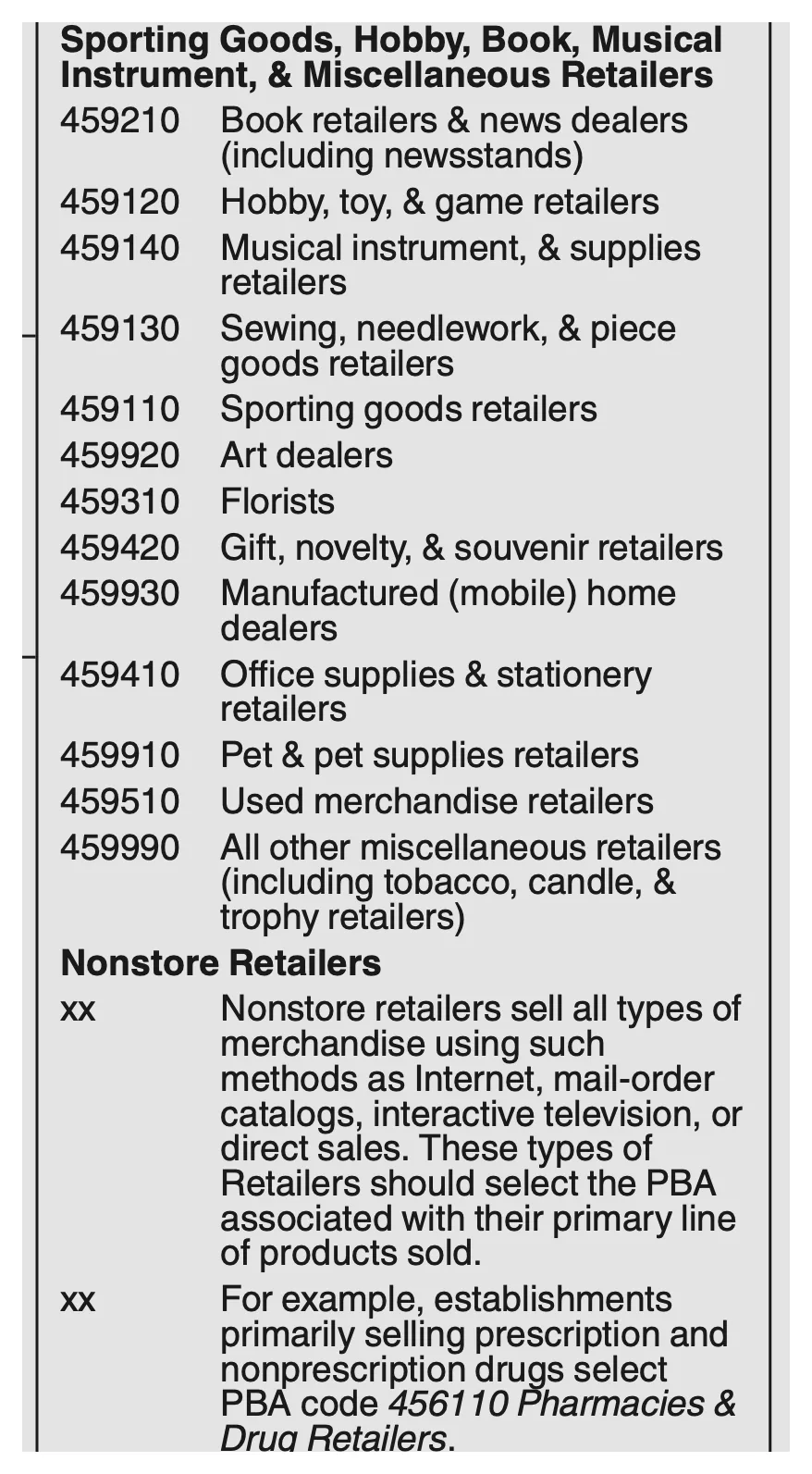
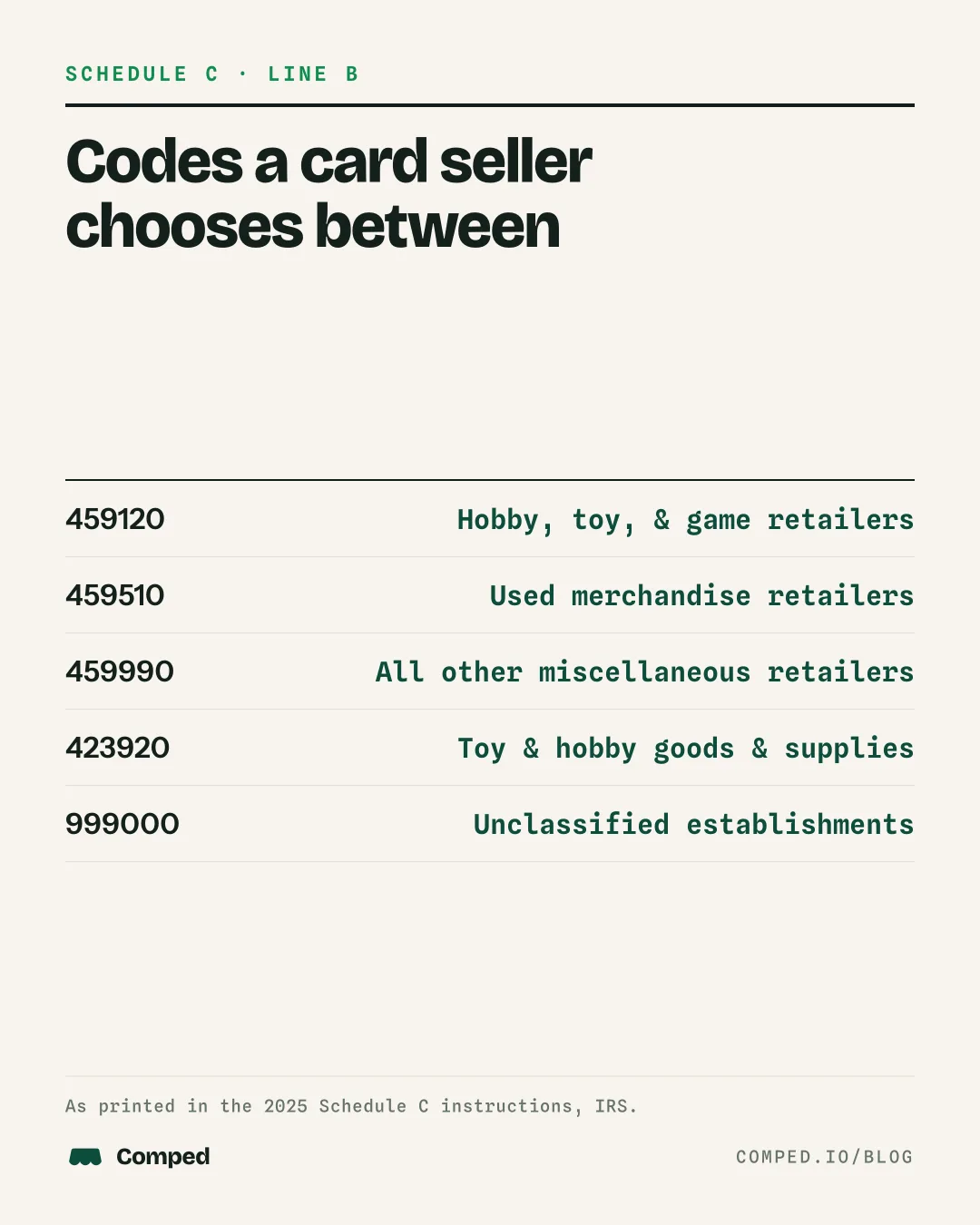
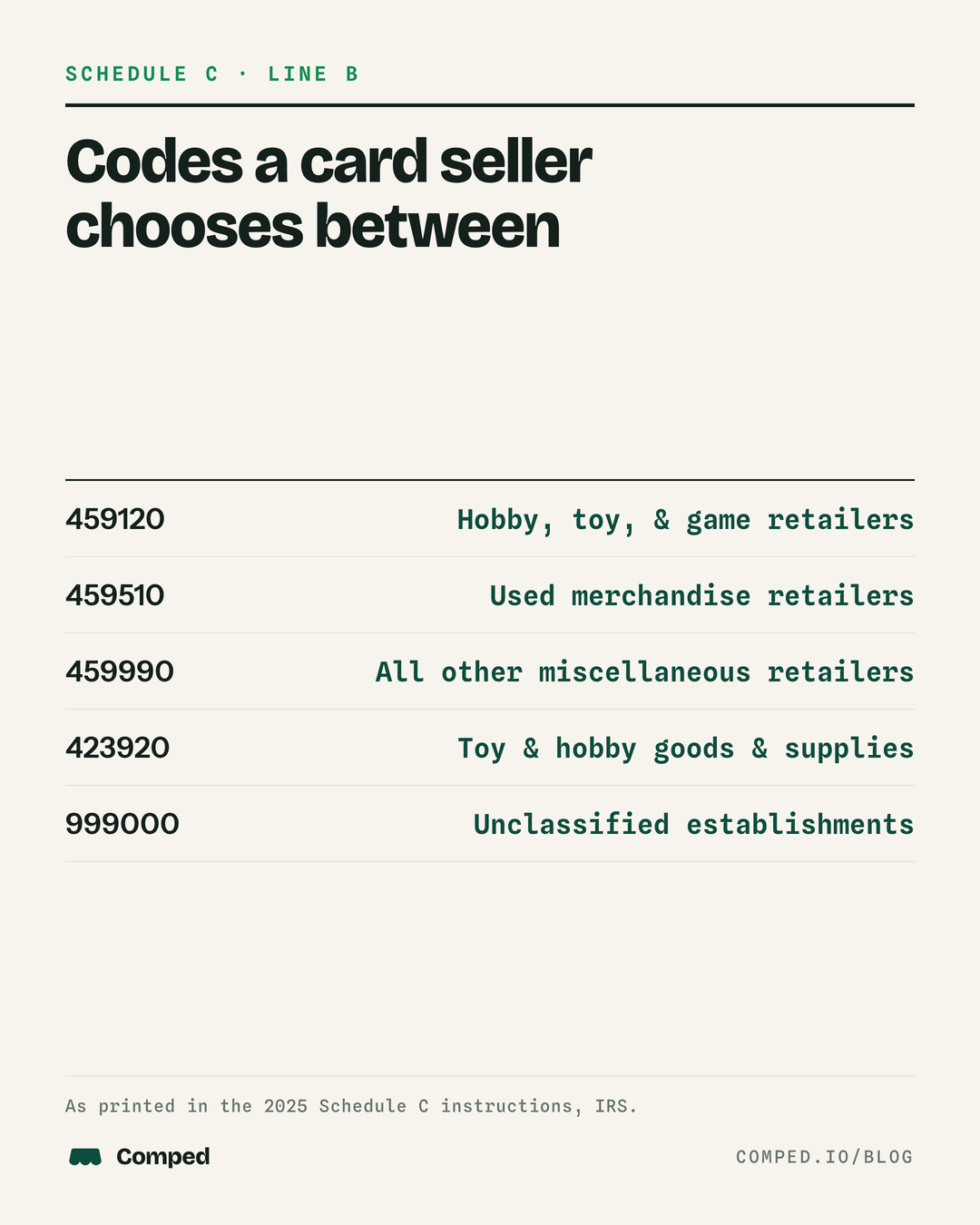
Nine codes on the chart could apply to someone who sells cards, and none of them names trading cards. The table gives each code and description as the IRS prints it, with the chart heading it sits under. The last column is our reading, not IRS text.
| Code | Description as printed | Chart heading | Our reading for card sellers |
|---|---|---|---|
| 459120 | Hobby, toy, & game retailers | Retail Trade: Sporting Goods, Hobby, Book, Musical Instrument, & Miscellaneous Retailers | Closest for sealed product, modern singles and trading card games |
| 459510 | Used merchandise retailers | Same heading | Closest for vintage and previously owned cards bought for resale |
| 459990 | All other miscellaneous retailers (including tobacco, candle, & trophy retailers) | Same heading | A fallback when neither code above describes the mix |
| 459110 | Sporting goods retailers | Same heading | Weak fit; a sports card is not sporting equipment |
| 459420 | Gift, novelty, & souvenir retailers | Same heading | Weak fit |
| 455000 | General merchandise retailers | Retail Trade: General Merchandise Retailers | Only if cards are a minor part of a mixed line |
| 423920 | Toy & hobby goods & supplies | Wholesale Trade: Merchant Wholesalers, Durable Goods | Sellers whose customers are mostly other dealers and shops |
| 425120 | Wholesale trade agents & brokers | Wholesale Trade: Wholesale Trade Agents & Brokers | Brokers who arrange dealer sales without owning the cards |
| 999000 | Unclassified establishments (unable to classify) | End of the chart | Last resort; a card seller can classify |
Pick by what you mostly sell
Follow the larger share of your sales dollars. The IRS rule is the principal source of sales or receipts. The match in this table is our reading.
| Most of your sales come from | Code | As printed |
|---|---|---|
| Sealed boxes and packs, current-year singles, Pokemon and other card games | 459120 | Hobby, toy, & game retailers |
| Vintage cards, slabs and collections bought from collectors and resold | 459510 | Used merchandise retailers |
| An even mix you cannot split, or cards plus memorabilia | 459990 | All other miscellaneous retailers |
| Bulk lots and cases sold to other dealers and shops | 423920 | Toy & hobby goods & supplies |
| Cards as a small part of general reselling | 455000 | General merchandise retailers |
A quick way to decide is to total last year's sales by type. If your records split sales by sealed, modern and vintage, the largest bucket picks the code.
Old codes that are gone
Several codes that older articles and forum answers give are not on the current chart. The nearest current code in the last column is our reading.
| Code you may see | Status on the 2025 chart | Nearest current code |
|---|---|---|
| 454110 | Not listed. No code begins with 454 | Choose by product under the Nonstore Retailers note |
| 453310 | Not listed. No code begins with 453 | 459510, Used merchandise retailers |
| 451120 | Not listed. No code begins with 451 | 459120, Hobby, toy, & game retailers |
| 459999 | Not listed | 459990, All other miscellaneous retailers |
| 999999 | Not listed | 999000, Unclassified establishments |
Use a code only if you can find it in the instructions for the year you are filing.
The online seller
An online seller picks the code for the product, not for the internet. The chart has a Nonstore Retailers note with no code of its own. It says nonstore retailers sell all types of merchandise using such methods as Internet, mail-order catalogs, interactive television, or direct sales. It tells them to select the code associated with their primary line of products.
The line B instruction repeats the rule and gives an example. Establishments primarily selling prescription and nonprescription drugs select 456110, Pharmacies & drug retailers. For a seller on eBay, Whatnot or TCGplayer, the same logic points to the code for what you sell.
In our reading that is 459120 for a seller of sealed boxes, packs and modern singles. A seller who mostly buys older cards and collections to resell is closer to 459510. Pick the one that matches the larger share of your sales.
The show vendor
A show vendor has no store, so the same nonstore rule applies: choose by primary product. A table is direct sales, one of the methods the note lists. A vendor whose case is mostly vintage and graded cards bought from collectors is closest to 459510, Used merchandise retailers.
A vendor selling mostly sealed product and current-year cards is closer to 459120. Many vendors sell at shows and online in the same year. That is one business with one Schedule C and one code, chosen by the principal source of sales.
If you are just starting at shows, how to become a card show vendor covers permits and setup.
The card shop
A shop with a storefront is a store retailer, and 459120 is the nearest description for most of them. A shop that sells cards, sealed product, supplies and game accessories matches Hobby, toy, & game retailers closely. A shop built mainly on buying and reselling collections can make the case for 459510.
459990 is the miscellaneous bucket under the same heading. It works when a shop's mix does not sit in either code. It is a better answer than 999000, which says the business could not be classified at all.
Sellers who sell mostly to other dealers
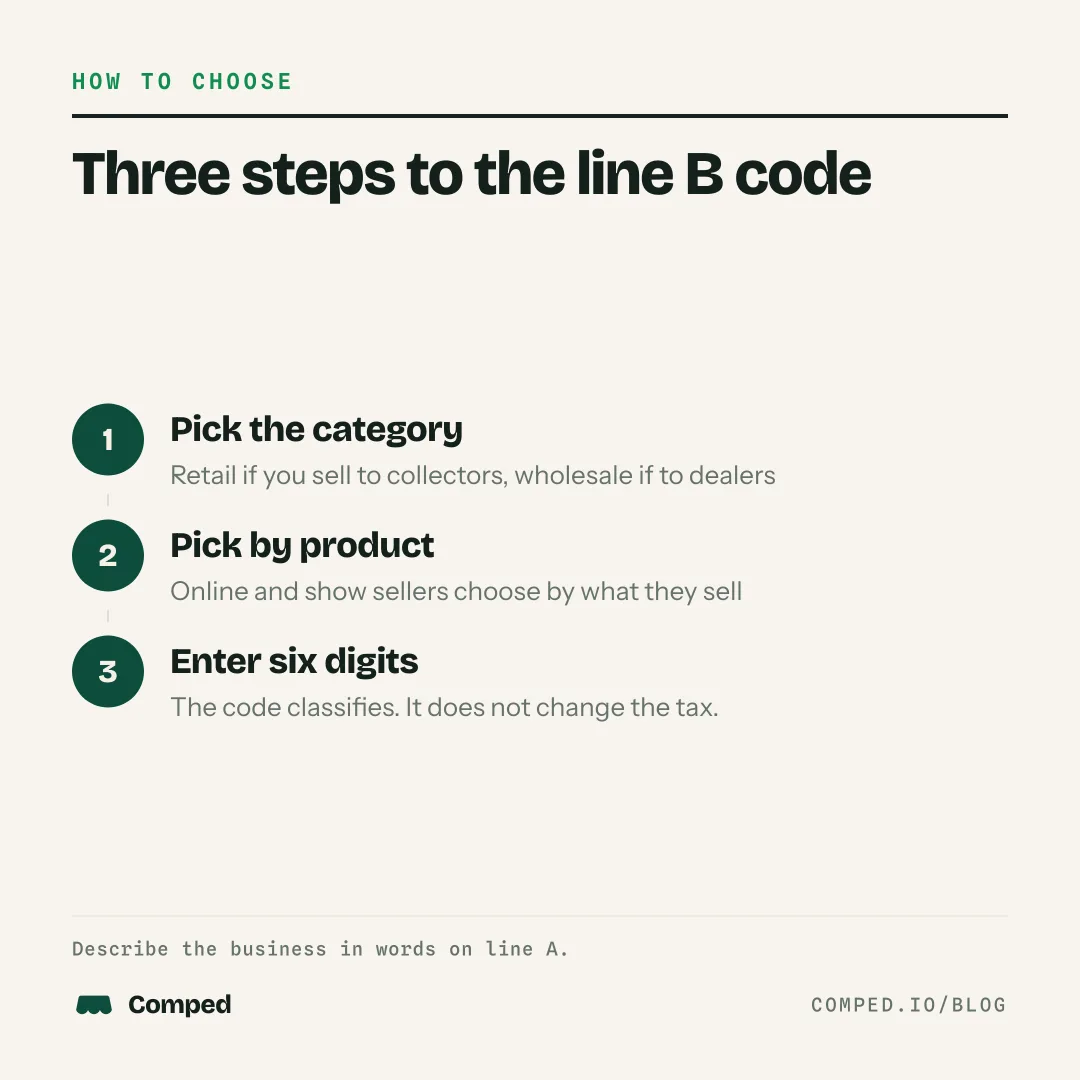
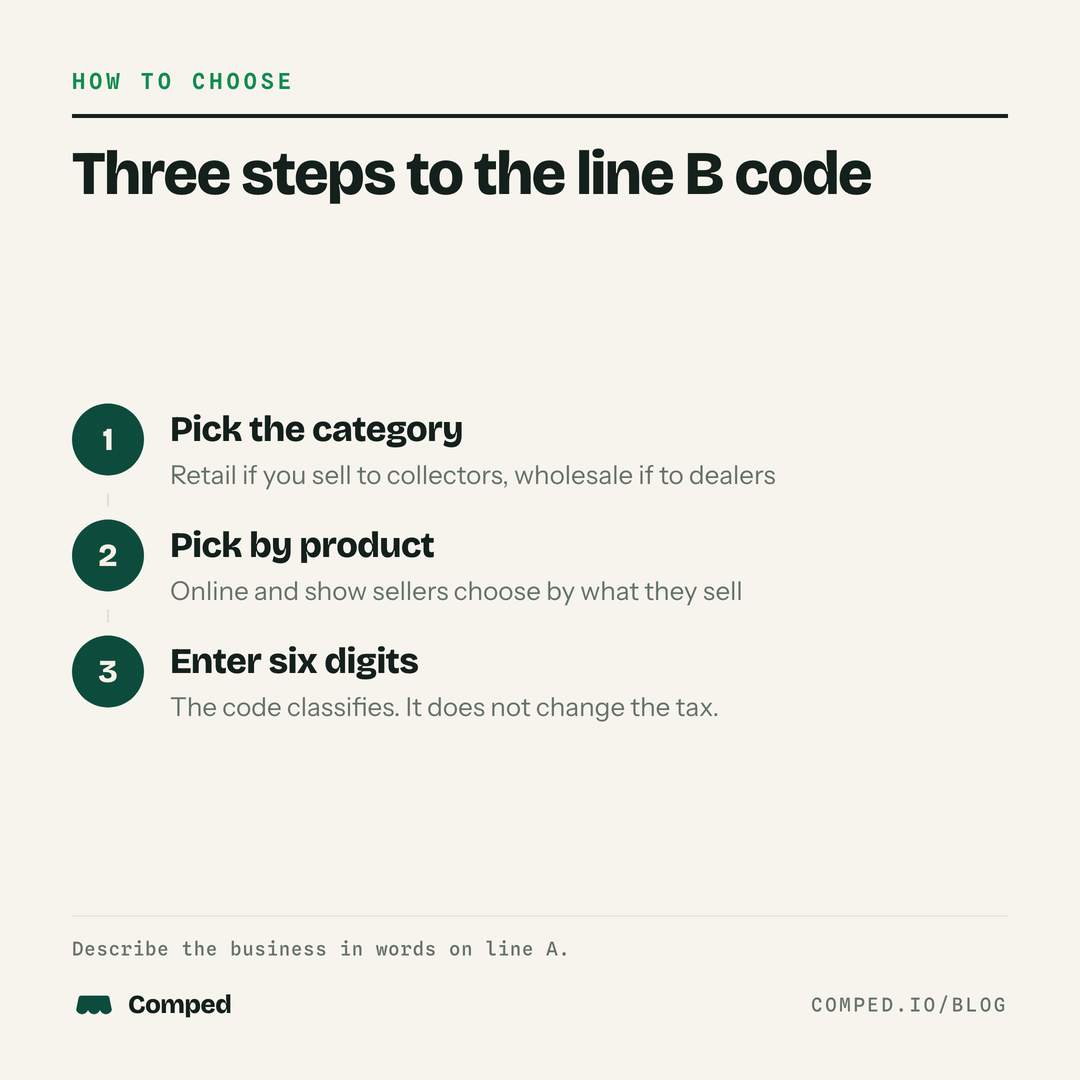
A seller whose customers are mostly other dealers and shops is a wholesaler on this chart. The durable goods wholesale list includes 423920, Toy & hobby goods & supplies. A seller who moves bulk lots and cases to dealers, not collectors, should weigh it.
Most card sellers do some of each. The instruction is to follow the principal source of sales or receipts. If most of your dollars come from collectors at retail, stay with a retail code.
Breakers and consignment sellers
A breaker who buys boxes and sells spots is selling cards, so a retail code by product fits. In our reading that is 459120. No IRS page addresses breaks.
A consignment seller is different. If you sell other people's cards for a commission and never own them, your receipts are fees for a service. The chart's 425120, Wholesale trade agents & brokers, describes arranging sales for others. If you both sell your own cards and take consignments, follow the larger source of receipts. Ask a CPA when the split is close.
One person with two unrelated activities may have two businesses. The instructions say to complete a separate Schedule C for each business you owned. Selling cards and running a paid grading-prep service for other collectors could be one business or two, depending on the facts.
Whether the code changes your tax
The code does not change your tax. The instructions say the codes classify sole proprietorships by type of activity to facilitate the administration of the Internal Revenue Code. No line on Schedule C multiplies, limits or adjusts an amount by the code. Your profit is still sales minus cost of goods sold and expenses.
What changes the tax is the amount on each line, and whether you are a business at all. The post on hobby or business for card sellers covers that question. Use the same code each year unless the business changes, so your returns describe one business consistently. Consistency is our advice, not an IRS rule we found.
The numbers that go under the code come from your records. Comped tracks cost per card and write-offs and shows profit after cost and fees, which are the figures Schedule C asks for.
If you already used the wrong code
Use the closer code on your next return. The instructions give no procedure for correcting a code on a filed return, and we found no IRS page that sets a penalty for the code alone.
The IRS page on amended returns lists the reasons to file Form 1040-X: a change to filing status, income, deductions, credits, dependents or tax liability. A code changes none of those. In our reading that means a wrong code by itself is not a reason to amend. If the same return also had a wrong number, amend for the number and fix the code with it.
This page makes no claim about how the IRS selects returns for review. We found no IRS statement on that tied to the code.
Line A and the rest of the top of the form
Line A is where you say what the code cannot. The instructions ask for the general field or activity and the type of product or service. For retail trade they also ask for the type of customer. "Retail sale of trading cards to collectors, online and at card shows" does that in one line.
The lines around it take a minute each. The middle column is from the form and its instructions. The right column is how it usually plays out for a card seller.
| Line | What the IRS asks | For a card seller |
|---|---|---|
| A | Principal business, including product or service | "Retail sale of trading cards, online and at shows" |
| B | Six-digit code from the instructions | 459120 or 459510 for most |
| C | Business name; leave blank if none | Blank unless you trade under a name |
| D | EIN if one was issued to you; do not enter your Social Security number; leave blank if you have no EIN | Blank for most sole proprietors with no employees |
| E | Business address; a street address, not a box number | See the instructions if you work from home |
| F | Accounting method: cash, accrual or other | Cash, for most small sellers |
| G | Whether you materially participated in 2026 | Yes, if you run it yourself |
| H | Check if you started or acquired the business in 2026 | Check it in your first year |
| I and J | Whether you made payments that require a Form 1099, and whether you filed them | Yes if you paid a helper $2,000 or more for services in 2026, or made another reportable payment |
Line F deserves one more sentence. The instructions say you must use an accrual method for sales and purchases of inventory unless you are a small business taxpayer. A card seller under the gross receipts limit is one, which is why the cash method is open to most. Lines I and J are covered in paying a booth helper or a breaker.
A seller with two different businesses files a separate Schedule C for each, per the same instructions. Selling cards online and at shows is one business. Card sales reported on a 1099-K go on that same schedule, as the 1099-K guide for card sellers explains.
How this looks in the Comped app
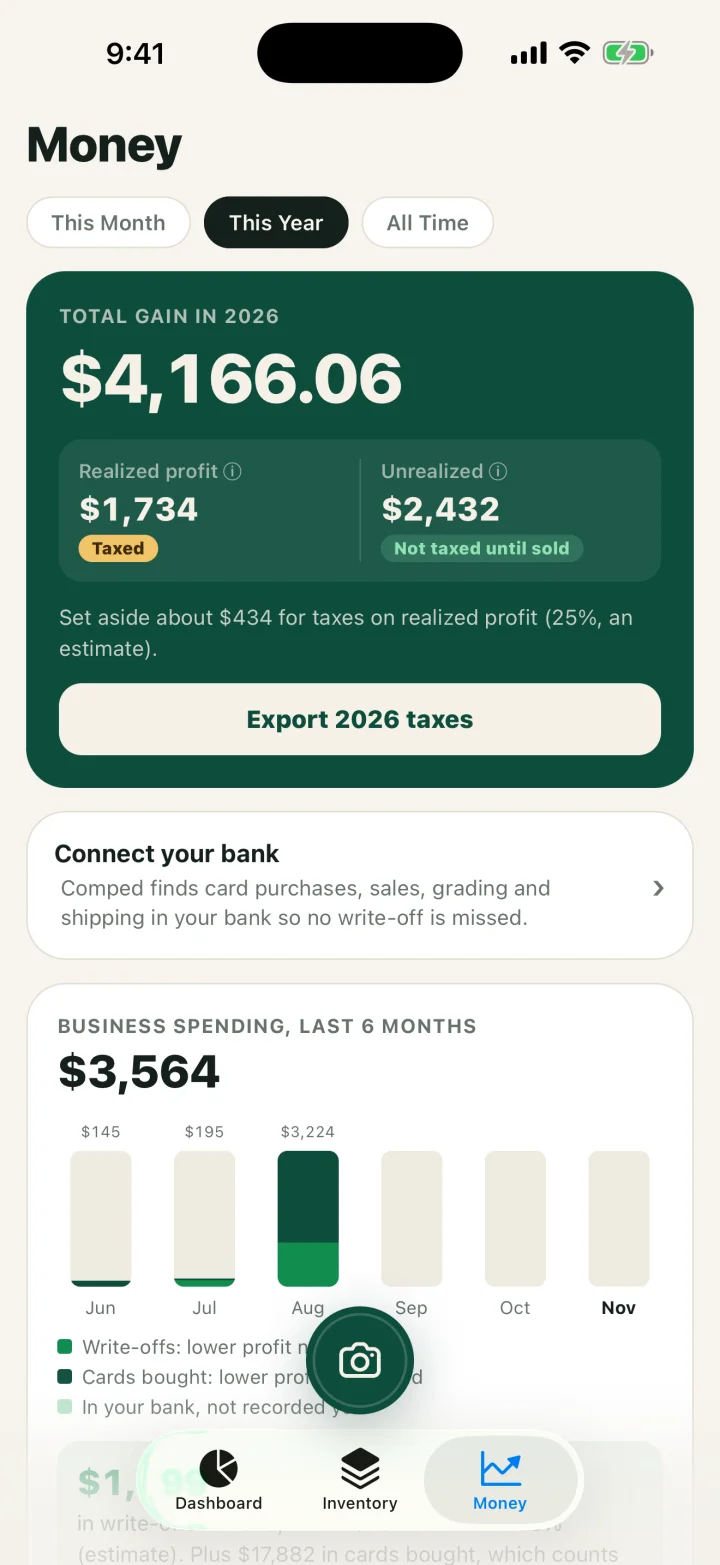
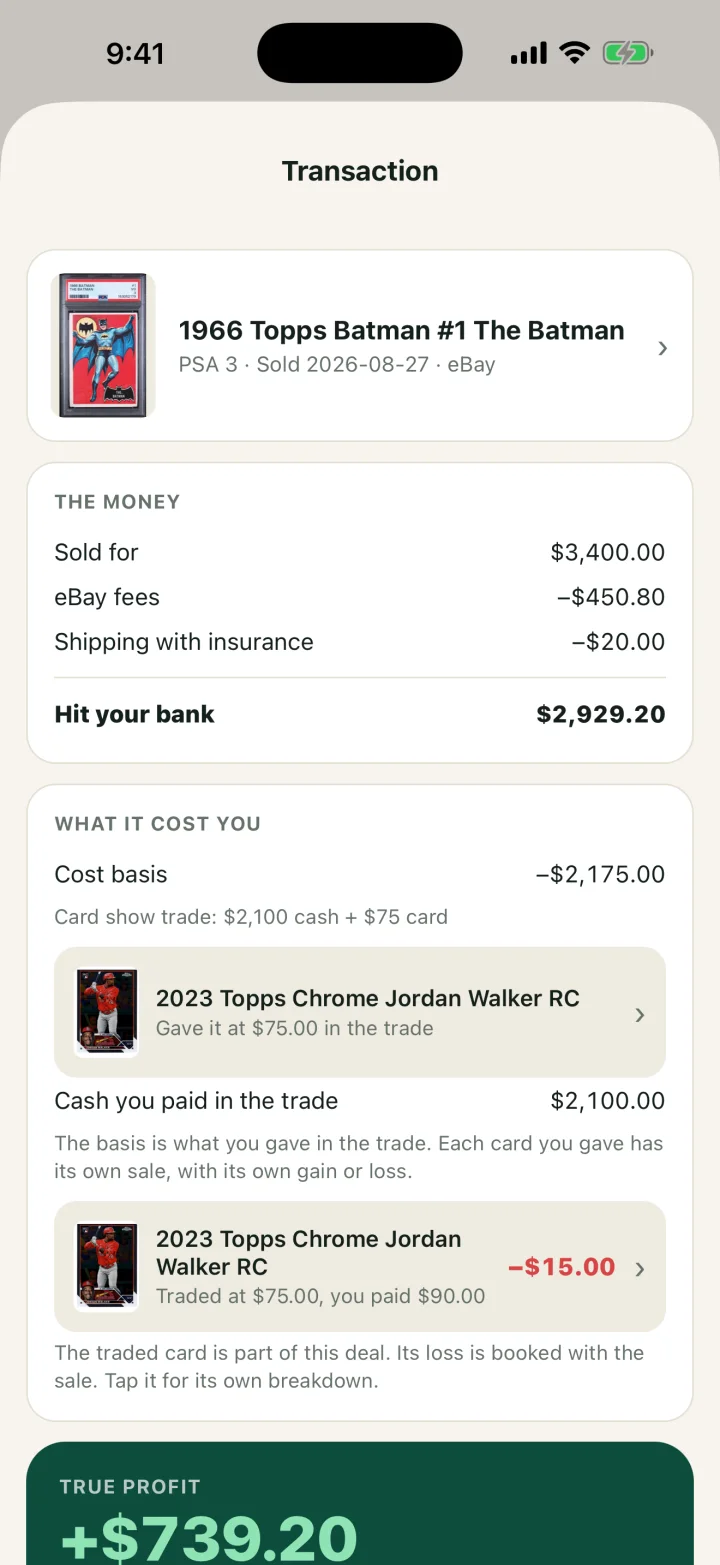
The code is one field. The lines below it need a year of numbers. The Money tab totals realized profit and business spending for the year, and Export taxes produces a CSV with a Schedule C style summary, every sale, every card bought and every write-off. The sale screen shows where one sale's numbers come from.
Related guides
- The Card Vendor's Master Guide to Taxes: every other line of Schedule C for a card seller.
- Hobby or business: selling cards: whether you file Schedule C at all.
- How to count card inventory at year end: Schedule C lines 35 to 42.
- Quarterly estimated taxes for card sellers: paying the tax Schedule C produces.
FAQ
What business code do I use for selling sports cards on Schedule C?
No code names sports cards. In the current IRS chart the closest retail codes are 459120, Hobby, toy, and game retailers, and 459510, Used merchandise retailers. Choose the one that best describes the main source of your sales.
What is the business code for selling Pokemon cards?
The same choice applies. A seller of sealed Pokemon product and modern singles is closest to 459120, Hobby, toy, and game retailers. A seller who mainly resells older cards bought from collectors is closer to 459510, Used merchandise retailers.
Is there a separate code for eBay or online sellers?
Not on the current chart. The IRS note for nonstore retailers covers sellers using the Internet, mail order or direct sales. It tells them to select the code for their primary line of products. An online card seller uses a product code, not a channel code.
What replaced code 454110?
Nothing one-for-one. No code on the current chart begins with 454. The Nonstore Retailers note tells online and mail-order sellers to use the code for the main product they sell, which for a card seller is 459120 or 459510 in our reading.
Does the wrong business code change how much tax I owe?
No. The code classifies the business and is not used in any Schedule C calculation. Tax depends on your income, cost of goods sold and expenses. Pick the closest code and describe the business clearly on line A.
Do I have to amend my return if I used the wrong code?
The IRS lists changes to filing status, income, deductions, credits, dependents or tax liability as reasons to amend, and a code changes none of them. In our reading, use the closer code on your next return. Amend only if a number was also wrong.
Can I use 999000 if I am not sure?
999000 is printed as Unclassified establishments, unable to classify. A card seller can classify the business as retail, so a retail code is the closer answer. Use the miscellaneous retail code 459990 before the unclassified one.
Do I need a different code for shows and for online sales?
No. Shows and online sales of the same cards are one business with one Schedule C and one code. The instructions call for a separate Schedule C only when you own more than one business.
SOURCES
- Instructions for Schedule C (Form 1040) (2025), lines A to J and the Principal Business or Professional Activity Codes chart, IRS, checked November 2026.
- Schedule C (Form 1040) 2026, Profit or Loss From Business, IRS, checked November 2026.
- About Schedule C (Form 1040), IRS, checked November 2026.
- 2025 Instructions for Schedule C, print version, IRS, checked November 2026.
- File an amended return, IRS, checked November 2026.
This is general information for card sellers, not tax or legal advice for your situation. Rules change and states differ; a CPA who knows your numbers wins every time.