Finding a show and applying for a table
You get a table by applying to the show's promoter. Most promoters post a vendor application or a dealer contract on the show's website or social page. Some list shows on a platform such as Treasure. Its vendor guide says to compare the vendor mix, the travel and the table price before applying.
Visit a show as a shopper before you sell at it. Rob Bertrand's Cardboard Connection guide calls this going as a mystery shopper. Note what sells, what is priced, and which tables are busy. Then start with a small local show, which costs less to attend and less to get wrong.
Read the contract before paying. It answers the questions below, and many applications also ask for your sales tax number. The master tax guide covers what happens to the money after the show.
| Check in the contract | Why it matters |
|---|---|
| Table size and what is included | Chairs, a table cover, electricity and showcases are often extra |
| Vendor badges | A helper may need a second badge |
| Load-in and load-out hours | Setup takes longer than you expect the first time |
| Sales tax certificate | Some contracts require the state certificate before you can set up |
| Deposit, refund and card payment terms | Paying for the table by card can carry a fee |
What a first show costs
A first show costs the table, the trip, supplies and change, and the table is only one part. Scott Orgera reported for Sports Illustrated in July 2025 on table prices. They run under $100 at a one-day local show and several hundred dollars at a larger venue, he wrote. A vendor on Elite Fourum put small local shows at about $50 for a weekend.
Large shows publish their prices. Our fee research read two dealer contracts in October 2026. The Philly Show listed $375 for one 8 foot table for its three-day December 2026 show, and required a Pennsylvania tax certificate. Dallas Card Show listed $250 for a standard table at its December 2026 Houston show, with showcase rental at $60.
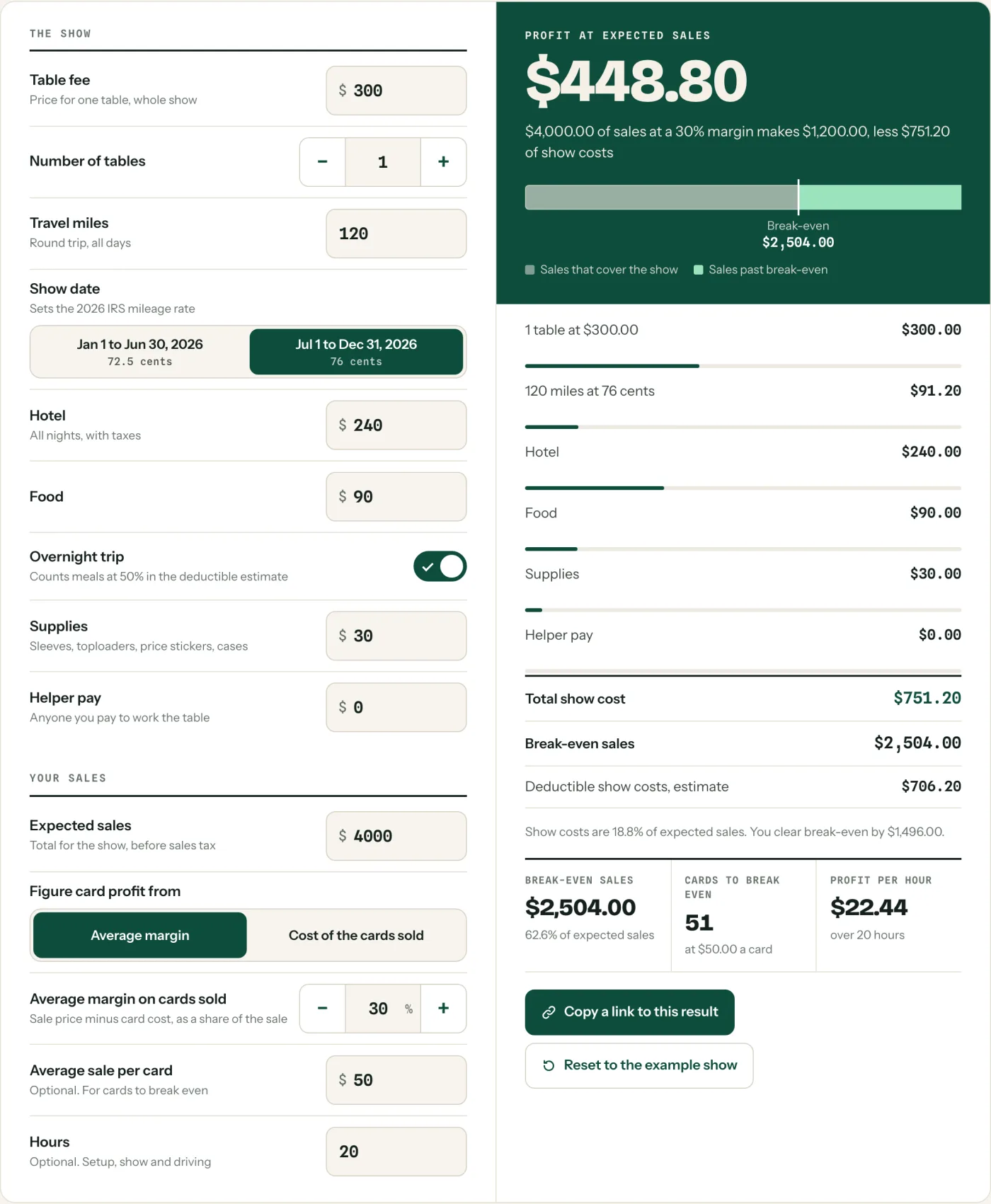
Add the trip before you judge the price. A dealer told Sports Collectors Digest in 2018 that a two-day show cost him $1,200 in travel, lodging, meals and the table. He needed about $2,400 in sales before the show earned anything. The card show profit calculator gives your own break-even.
Sales tax registration
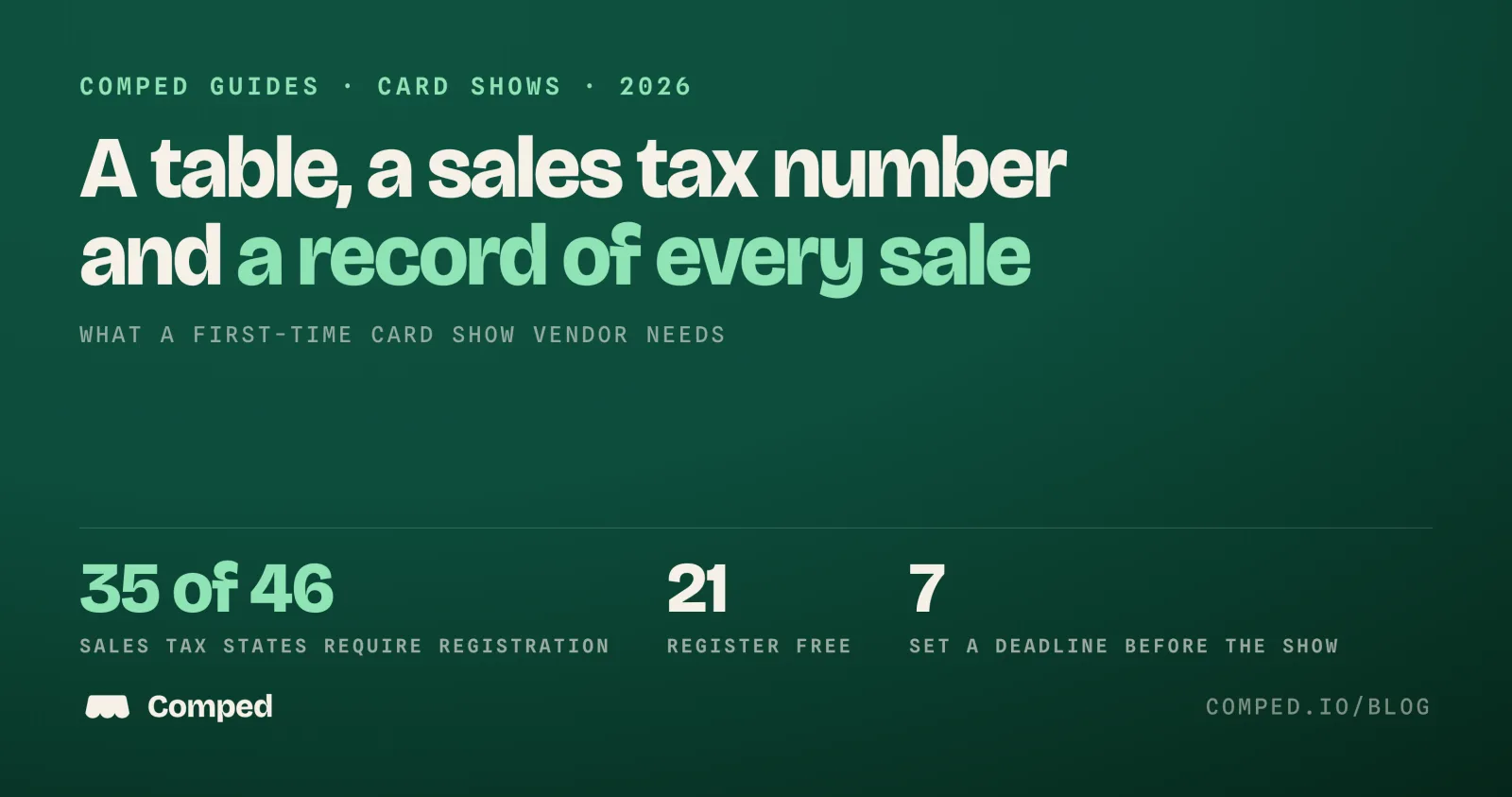
In most states you must register for sales tax before your first show, even if it is your only one. Our card show sales tax index covers 51 jurisdictions. 35 of the 46 states with a sales tax require a vendor to register before selling at a single show. Registration is free in 21 of them. In the 8 that publish a fee, it runs from $8 in Colorado to $100 in Connecticut.
In the other 11 states an occasional vendor can sell at one show without registering first. Kansas, Kentucky, Michigan, South Carolina, South Dakota and Virginia take a return after the event. Arkansas, Mississippi, Nevada and Oklahoma run the tax through the promoter, and Rhode Island's promoter issues a temporary permit at the show. Every route has a limit, such as Michigan's one or two events a year, and tax is still owed on every sale.
Trading cards and graded slabs are taxable in every state that has a sales tax. Alaska, Delaware, Montana, New Hampshire and Oregon have no state sales tax.
| State | What a show vendor needs | Deadline before the show | State rate |
|---|---|---|---|
| New Jersey | Form NJ-REG, then display the Certificate of Authority (CA-1) | 15 business days | 6.625% |
| New York | Certificate of Authority through NY Business Express | 20 days | 4% plus local |
| Pennsylvania | Sales tax license, or a Transient Vendor Certificate with no Pennsylvania location | 30 days | 6% |
| Texas | Texas Sales and Use Tax Permit | None published | 6.25% |
| California | Seller's permit, or a temporary seller's permit | None published | 7.25% |
| Florida | Sales and use tax registration (Form DR-1) | None published | 6% |
| Ohio | Transient Vendor's License | None published | 5.75% |
| Illinois | Sales tax registration (Form REG-1), or the special event return | None published | 6.25% |
Rates are state rates before county and city additions. We also have pages for Virginia, North Carolina, Georgia, Michigan and Massachusetts. Every other state is in the state by state guide.
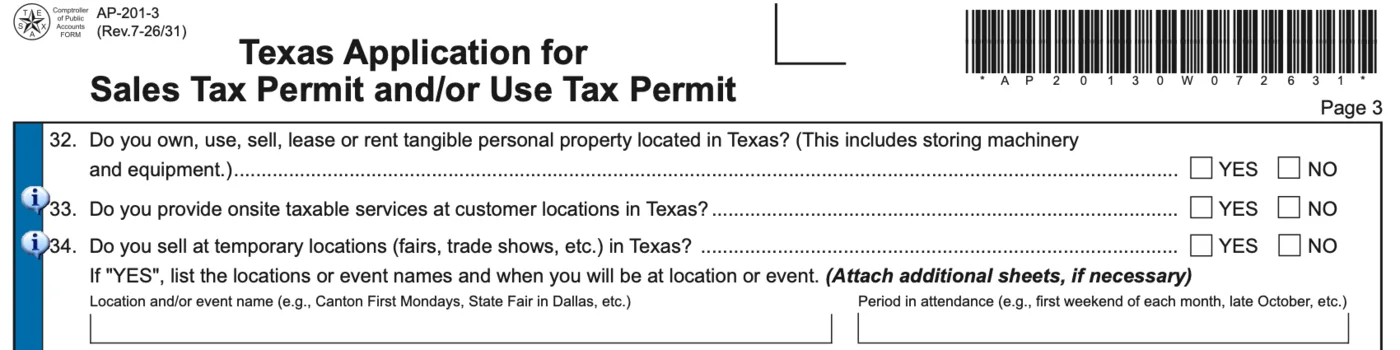
Seven states publish a deadline before the show: North Dakota, Pennsylvania, Missouri, New York, New Jersey, Louisiana and Vermont. The registration is for the state where the show is, not the state where you live. State applications ask about shows directly, as the Texas form does.
The promoter does not usually collect tax for you. In 33 states the promoter has a legal duty of their own, such as keeping a vendor list or checking certificates. That is why the application asks for your number.
Registering starts a filing duty. New Jersey's vendor page says a one-time vendor must file every required return until the registration is ended. A registration also lets you buy inventory for resale without paying sales tax, using the state's resale certificate.
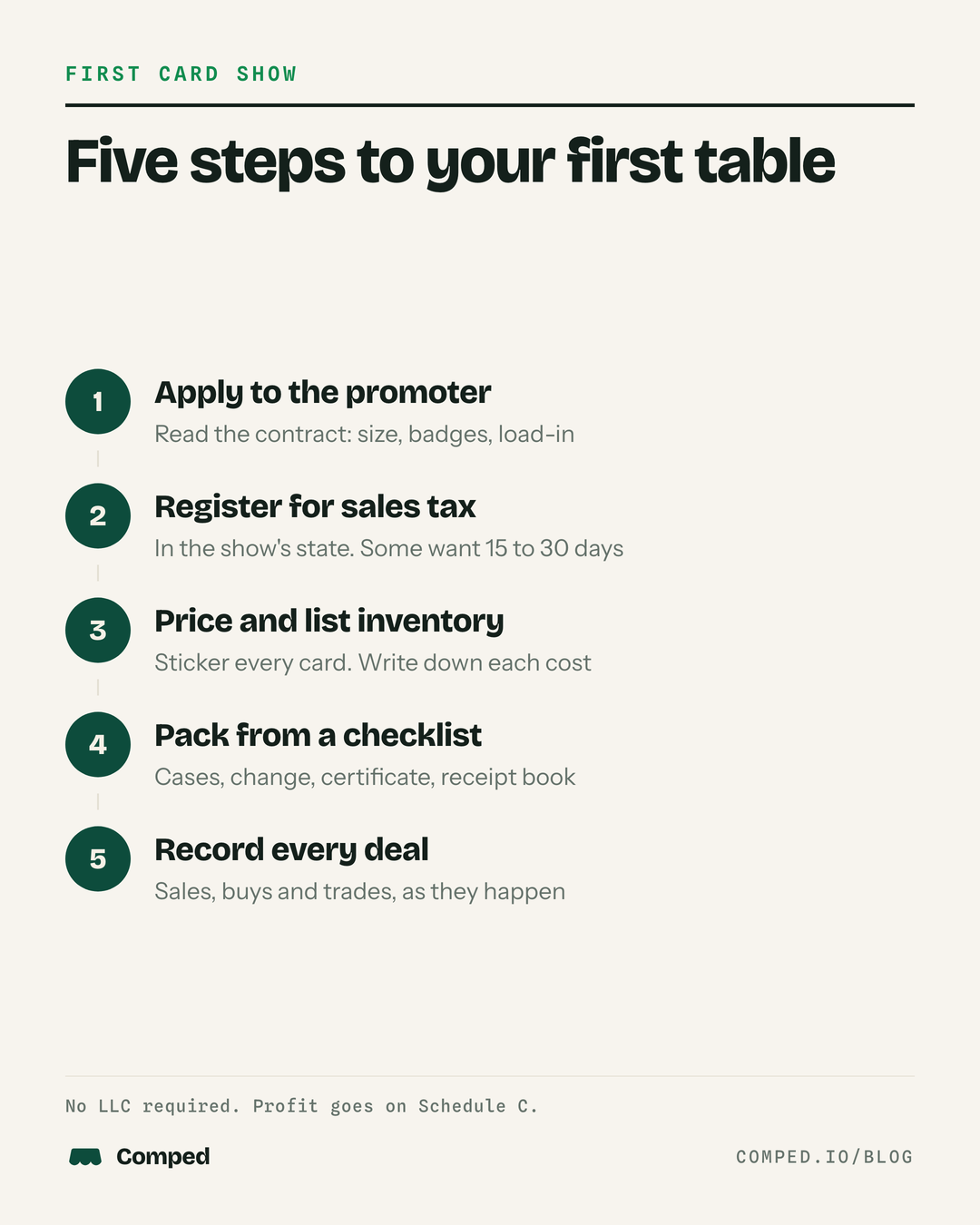
A timeline with dates
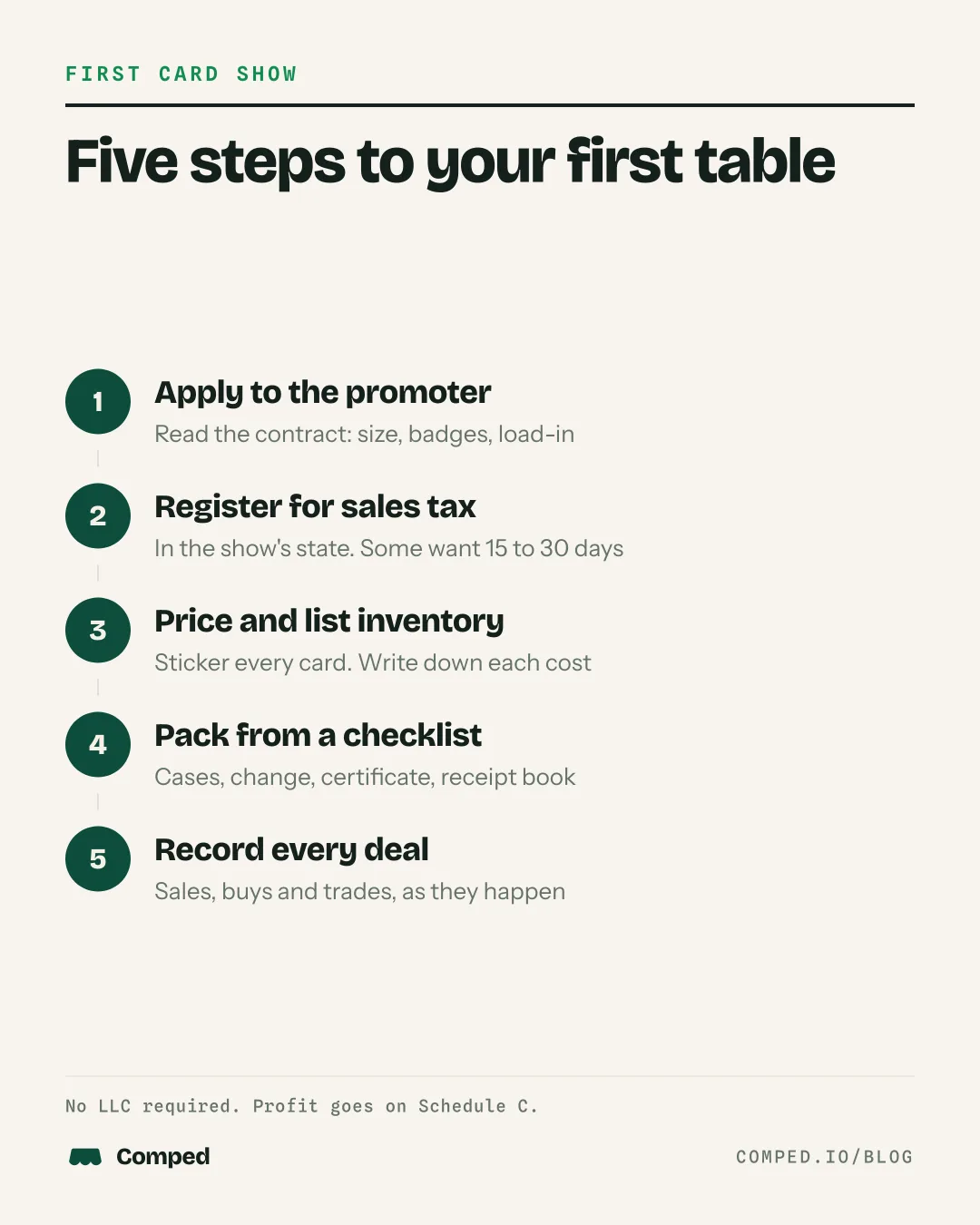
Start six weeks before the show, because the longest state deadline is 30 days. The dates in the last two rows are for a show in the fourth quarter of 2026.
| When | What to do |
|---|---|
| 6 weeks before | Visit a show, pick yours, read the contract, apply and pay for the table |
| 30 days before | Register for sales tax in the show's state. Pennsylvania and North Dakota want 30 days, New York 20 days, New Jersey 15 business days |
| The week before | List each card with its cost, check recent sales, sticker every card, and lay the table out at home |
| The day before | Pack from the checklist. Count your change and write the total down |
| Show day | Display the certificate where the state requires it. Record every sale, buy and trade |
| That night | Count the cash against the log. Deposit it in the business account |
| January 15, 2027 | Last 2026 estimated tax payment, if you expect to owe $1,000 or more for the year |
| January 20, 2027 | New Jersey's quarterly sales tax return (ST-50) for October to December. Other states set their own dates |
What to bring
Bring what you need to show cards, take money and keep records. The card show vendor checklist is a printable list. The short version is below.
- Priced inventory in cases, plus a list of what you brought and what each card cost.
- Showcases or stands, a table cover, and lights if the table has power.
- Top loaders, penny sleeves, team bags, spare price stickers, a marker and poster board for signs.
- Small bills for change, counted and written down before the doors open.
- A card reader or payment app if you will take more than cash, and a phone charger.
- Your sales tax certificate. New Jersey requires it to be displayed where customers can see it.
- A receipt book and a log for sales, buys and trades.
- Water, food, business cards and a dolly. All four are on Bertrand's list.
For change, a dealer on The Bench forum brings 20 ones, four $5 bills, three $10 bills, some $20 bills and coins. A dealer on Hobby Insider says to bring many $5 bills and few large ones. Bring only what you have priced. Our guide on how to price cards for a card show covers stickers, lowest prices and bulk boxes.
What to stock
Stock a range of prices, with more low-priced cards than you think you need. A first-time dealer on Hobby Insider sold large volumes of $0.25 to $5 singles and wished they had brought more. A vendor on Elite Fourum sells mostly raw cards, many at $10 and few at $200. Bertrand puts local team cards in the middle of the table, because they are what shoppers look for first.
Dealers interviewed by Sports Collectors Digest vary what they bring from show to show.
Decide what is inventory before you price it. Cards you bought to sell are inventory, and their cost is deducted when they sell. A card from your own collection that you put on the table carries its original cost, if you can show it. A card you take off the table for yourself comes out of your purchases. Write each move down on the day you make it.
Setting up the table
Set up so a buyer walking past can see cards and prices without asking. Put your best cards in the middle of the case, facing the aisle. Put bulk boxes at the end of the table where people can stand and dig without blocking the case.
Then check it from the buyer's side. Front Row Card Show, a promoter, tells dealers to walk to the front of their own table and ask whether they would stop there. The same guide says to stand, greet people at eye level and stay off your phone.
Protect the cards and the cash. Keep expensive cards in a locked case, and keep cash on your body or behind the table, not on it. Bring a helper, or agree with a neighbor to watch each other's tables. Stay until the show closes, because late arrivals still buy.
Cash, cards and payment apps
Take cash and at least one other way to pay, because buyers do not carry enough cash for a large card. Front Row Card Show tells dealers to accept credit cards, PayPal or Venmo. Each has a fee. Our fee research, dated October 29, 2026, lists Square at 2.6% plus $0.15 for a tapped card. A Venmo business profile is 1.9% plus $0.10.
Each also leaves a record that reaches the IRS. A card reader company reports card payments on Form 1099-K. The IRS says card payments have no minimum, and Square says it issues a form above $20,000 and 200 transactions in most states. Payment apps report above $20,000 and 200 transactions. Report every sale whether or not a form comes. Our guide to PayPal, Venmo and card reader 1099-K forms has the detail.
One cash rule applies to large sales. A business that receives more than $10,000 in cash in one sale, or in related sales, files Form 8300 within 15 days. See Form 8300 for card dealers.
Buying and trading at the table
If you plan to buy, put out a sign that says so and bring cash for it. Sellers bring collections to tables, and a Hobby Insider dealer advises carrying extra cash for that reason. Orgera's Sports Illustrated piece says show dealers often pay around 60 percent of comp. Our guide to card show buy percentages shows the math.
Every buy needs a receipt with the seller's name, the date, the item and the price. That receipt proves the card's cost when it sells. A trade needs the agreed value of both sides, because the IRS treats a trade as barter and the value you receive as income. The card trade calculator works out a trade with cash either way.
Records from the first sale
Record every sale, buy and trade when it happens. Cash sales are taxable like any other sale, and no form reports them. Your own record is the only one. The IRS says you may use any recordkeeping system that clearly shows your income and expenses.
For each sale write the card, the price, the payment method and the sales tax collected. A printable card show cash log holds all of it on one page per show. Count the cash at the end of the day and compare it with the log.
Publication 583 says to open a business checking account and keep it apart from the personal one. Deposit show cash there. Our guide on how to track card show sales compares paper, a spreadsheet and an app. Comped records each buy and sale from a scan of the card, with the cost per card, expenses and mileage.
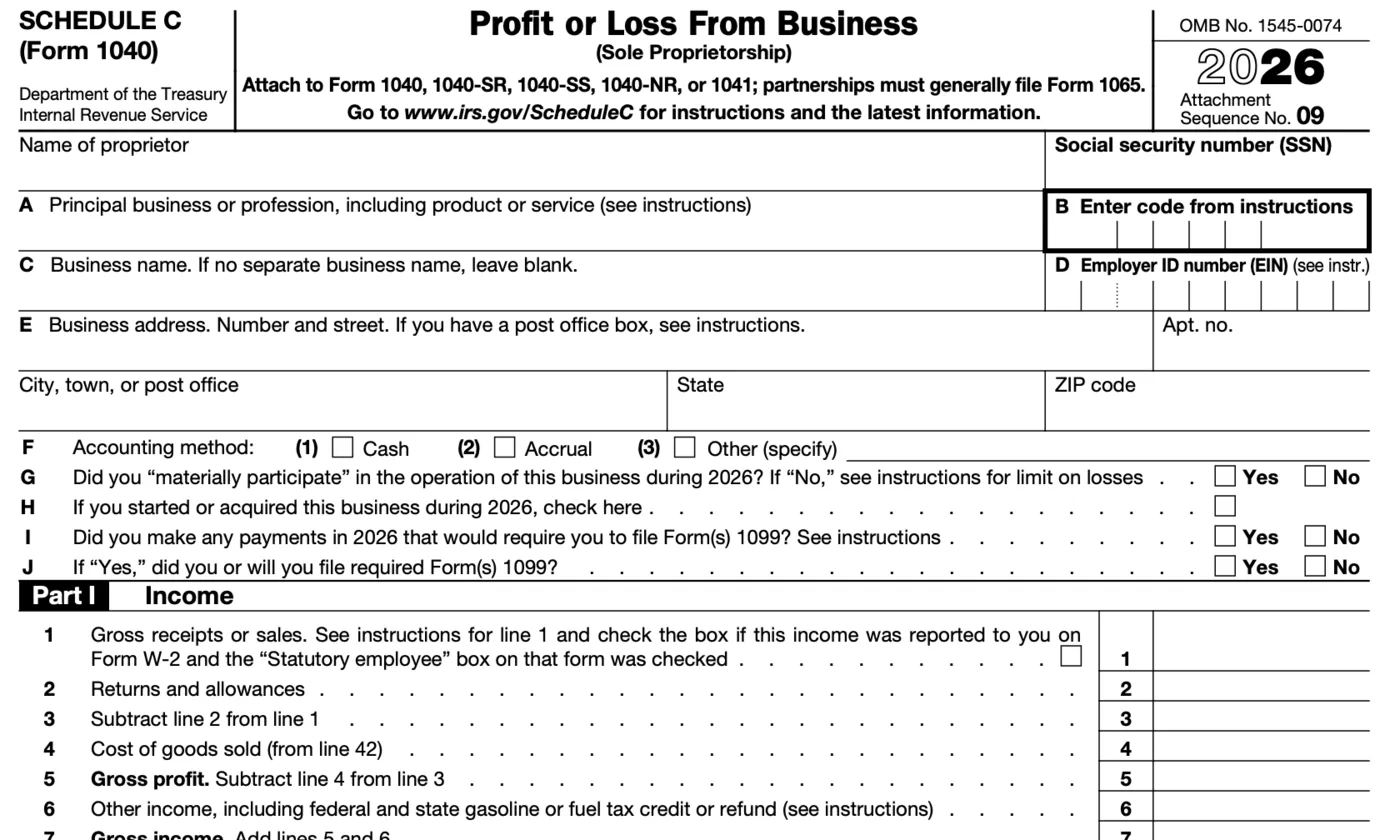
The first tax year
In the first year you report profit on Schedule C, and you owe tax on it whether or not any form arrives. Profit is sales minus the cost of the cards you sold minus expenses. A vendor who books tables to sell for profit is running a business; our guide to hobby or business covers the test.
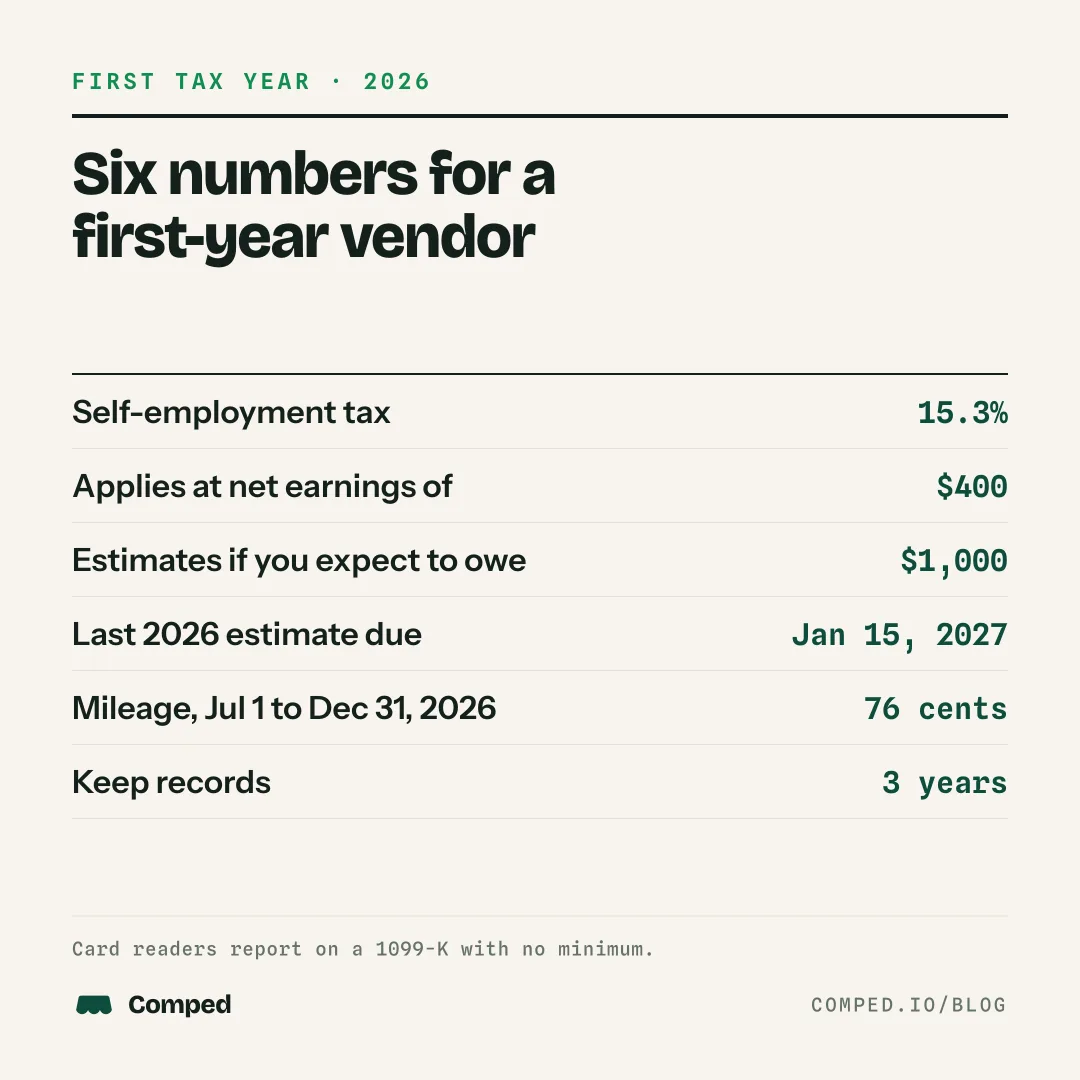
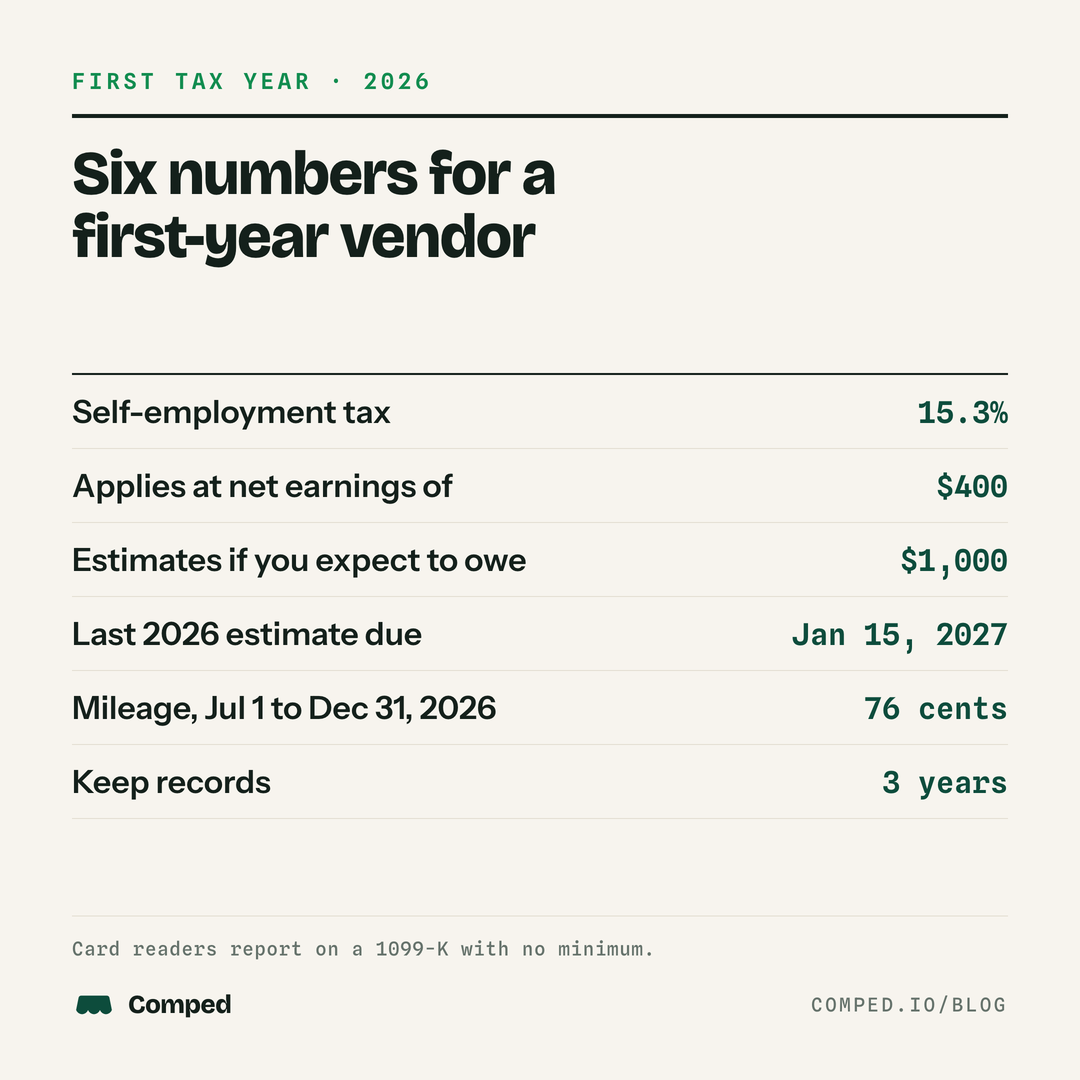
- Self-employment tax is 15.3% on net earnings of $400 or more, on top of income tax. Half of it is deductible.
- Estimated tax payments are required if you expect to owe $1,000 or more. The last 2026 payment is due January 15, 2027. See quarterly estimated taxes for card sellers.
- Table fees, supplies and business mileage are deductible. The 2026 mileage rate is 72.5 cents to June 30 and 76 cents from July 1.
- Cards you have not sold are not an expense yet. A small reseller deducts a card's cost in the year the card sells.
- No LLC is required, and a sole proprietor with no employees can use a Social Security number. An EIN is free from the IRS. See do card show vendors need an LLC.
Sales tax is separate from all of this. It is collected from buyers and sent to the state on the state's schedule. Keep records for 3 years after you file.
A first weekend, worked
This example is a one-day show in New Jersey in November 2026. The table costs $150 and the round trip is 120 miles.
A FIRST SHOW, WORKED
An example: sales of $2,400.00 before tax, on cards that cost you $1,500.00.
The $159.00 was never yours. The $598.80 is what goes toward Schedule C. The 25% is a savings habit, not a tax rate.
What first-timers get wrong
The expensive mistakes are made before the show, and most of them are about paperwork, not cards.
| Mistake | What it costs | If you already did it |
|---|---|---|
| Selling without the state registration | In New York, a penalty of up to $500 for the first day and $200 for each added day, to a $10,000 maximum | Register now and ask the state how to report the sales you made |
| No record of what cards cost | The IRS can treat the cost as zero and tax the whole sale | Rebuild cost from bank and payment app history. See card sales with no receipts |
| Treating sales tax as income | Money owed to the state gets spent | Total the tax collected and set it aside before the return is due |
| Pricing low to avoid haggling | It backfired for one Elite Fourum vendor, who now leaves room | Reprice with room, and set a lowest price |
| Mixing the collection with inventory | No clean cost for what sold | List what is on the table tonight, with a cost for each card |
Terms vendors use
A first-time vendor hears these words at the table and reads them on state forms.
| Term | Meaning |
|---|---|
| Comp | A recent sold price for the same card in the same grade |
| Raw and slab | A raw card is ungraded. A slab is a graded card in its sealed case |
| Seller's permit, sales tax license, Certificate of Authority | Different states' names for the sales tax registration |
| Resale certificate | The form a registered seller gives a supplier to buy inventory without sales tax |
| Cost basis | What a card cost you, including cash paid and the value of anything traded for it |
How this looks in the Comped app
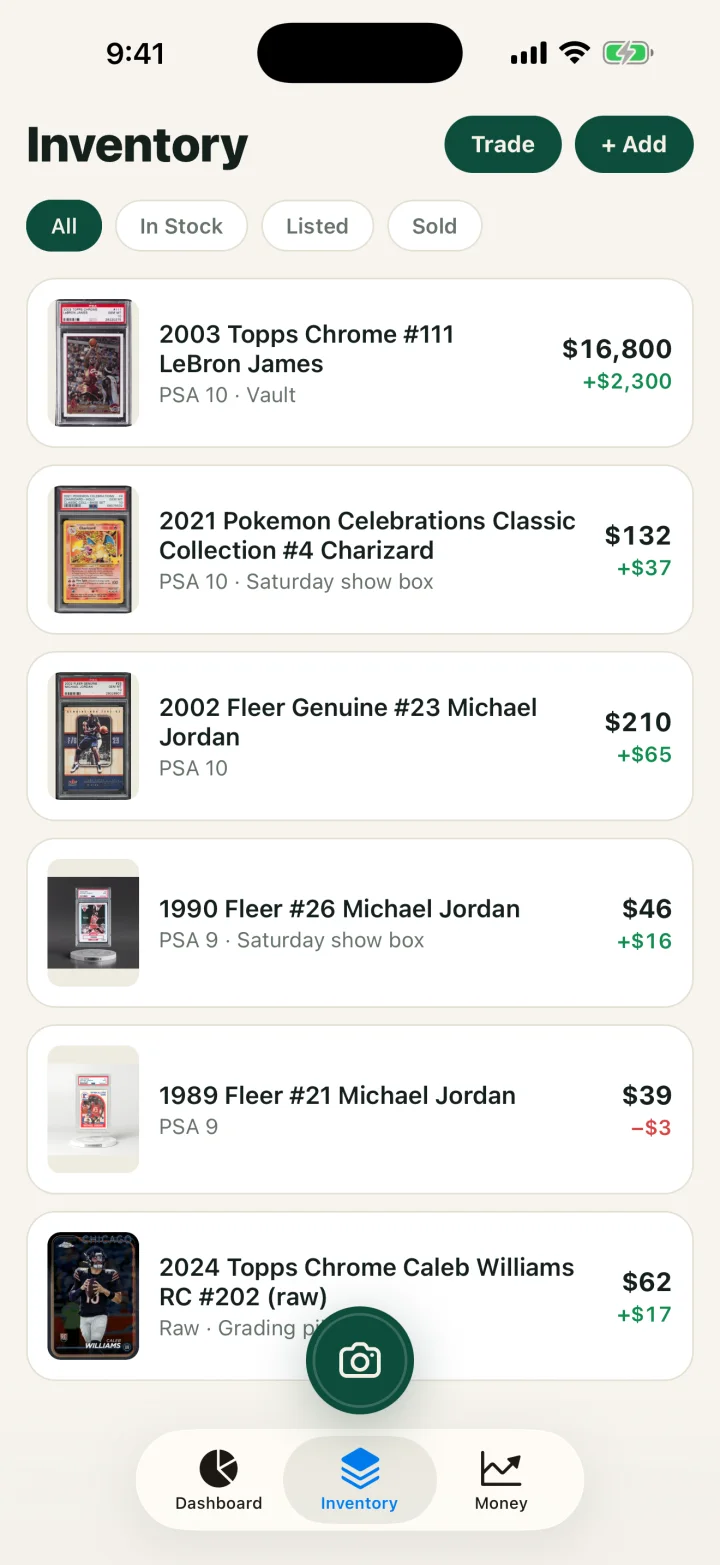
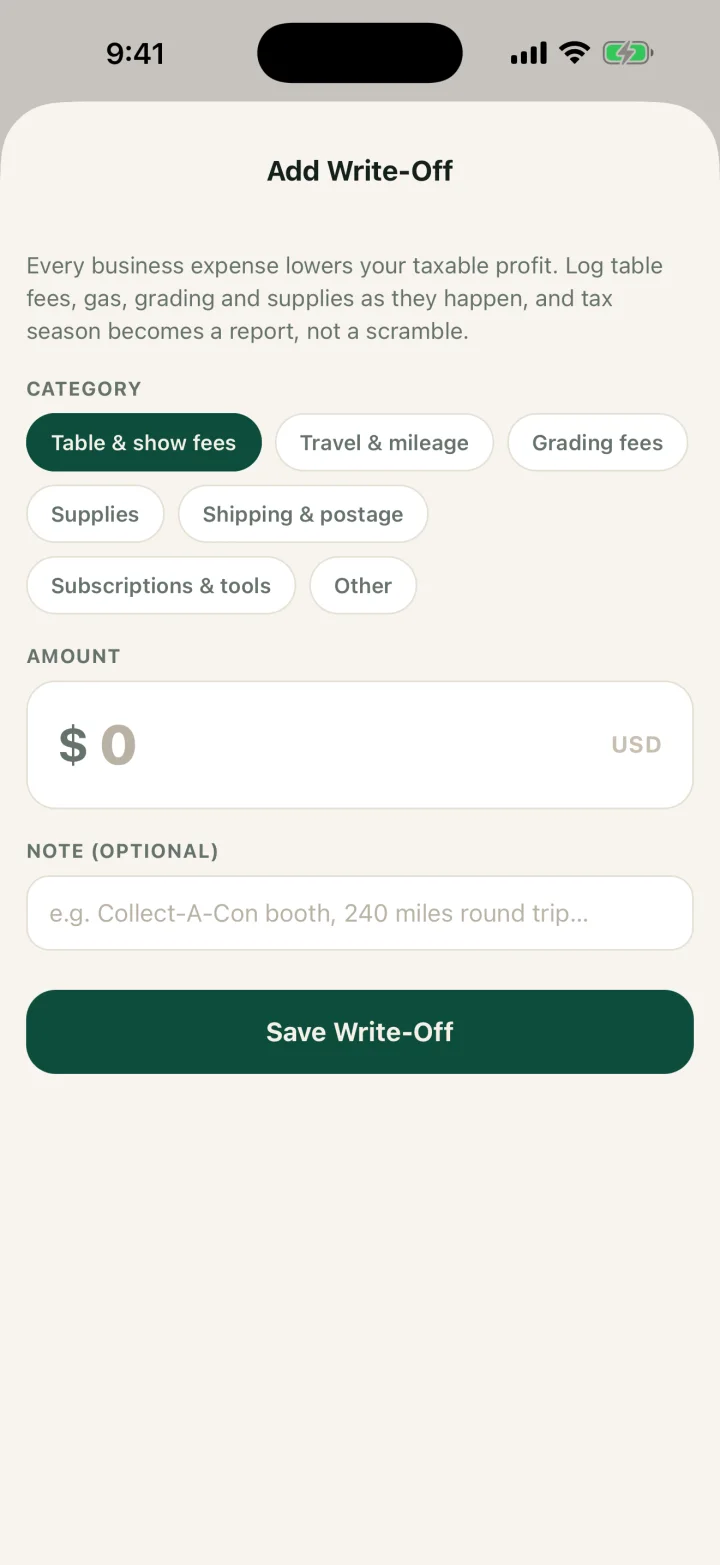
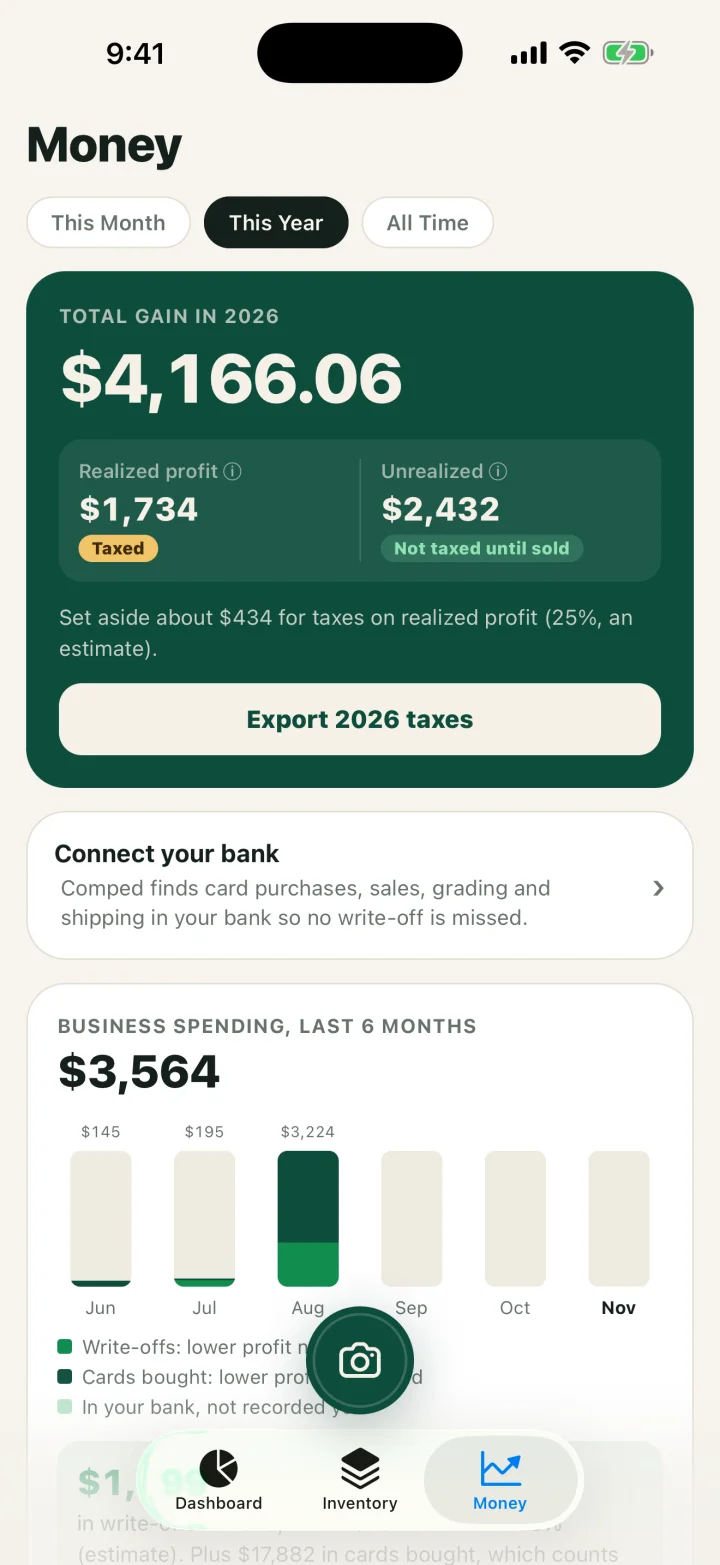
These three screens are the current iPhone app with demo data. Inventory lists each card with its value and gain. Add Write-Off logs a table fee or a trip under its category. The Money tab shows the year's realized profit, a 25% set-aside estimate and the tax export.
Related guides
- The Card Vendor's Master Guide to Taxes: Schedule C, self-employment tax and inventory for a first-year vendor.
- State by State: Sales Tax and Show Permits for Card Vendors: the permit, the form and the rate for every state.
- How to price cards for a card show: recent sales, stickers and bulk boxes.
- How to track card show sales: paper, spreadsheet or app.
FAQ
Do I need a permit to sell at a single card show?
In most states, yes. Our 2026 index found that 35 of the 46 states with a sales tax require a vendor to register before selling at one show. Registration is free in 21 of them. In the other 11 an occasional vendor has another route, with limits. Seven states set a deadline before the show, so check the state early.
How much does a table at a card show cost?
It depends on the show. Sports Illustrated reported in 2025 that tables run under $100 at a one-day local show and several hundred dollars at larger venues. Two large-show contracts we read for December 2026 listed $250 and $375 for one table for three days. Travel and lodging often cost more than the table.
Does the promoter collect it for me?
Usually not. In most states the vendor registers, collects and files. In 33 states the promoter has a duty of their own, such as keeping a vendor list or checking certificates. Four states, Arkansas, Mississippi, Nevada and Oklahoma, have the promoter collect an occasional vendor's tax, so read the state's page.
Do I need an LLC?
No. No LLC is required to sell cards. A sole proprietor with no employees can use a Social Security number, and an EIN is free from the IRS. A single-member LLC is taxed the same way as a sole proprietor.
How much change should I bring to a card show?
Enough small bills to break a $20 many times. One dealer on The Bench forum brings 20 ones, four $5 bills, three $10 bills, some $20 bills and coins. Count it before the doors open and write the total down, so the end-of-day count works.
Do I need to take cards, or is cash enough?
Cash alone works at a small show, but buyers rarely carry enough for an expensive card. A card reader or a payment app adds a fee of roughly 2 to 3 percent and a record of the sale. Report every sale either way, whether or not a 1099-K arrives.
I travel to shows in other states, do their rules apply to me?
Yes. Sales tax registration follows the state where the show is held. New Jersey, for example, treats out-of-state and one-time sellers at a show as vendors who must register. Check each state before you book the table.
What are the first time card show vendor tips that matter most?
Register for sales tax before the deadline, price every card before you leave home, and write down what each card cost. Count your starting cash. Record every sale, buy and trade when it happens, and count the cash against the log at the end of the day.
SOURCES
- Publication 583, Starting a Business and Keeping Records (rev. December 2024), IRS, checked November 2026.
- Recordkeeping, IRS, checked November 2026.
- Schedule C (Form 1040), 2026, IRS, checked November 2026.
- Self-employment tax, IRS, checked October 2026.
- Form 1040-ES, Estimated Tax for Individuals, IRS, checked October 2026.
- Standard mileage rates, IRS, checked October 2026.
- Understanding your Form 1099-K, IRS, checked October 2026.
- Form 8300 and reporting cash payments of over $10,000, IRS, checked October 2026.
- Vendors and promoters at flea markets, craft shows and trade shows, New Jersey Division of Taxation, checked November 2026.
- How to register for New York State sales tax, New York Department of Taxation and Finance, checked October 2026.
- Sales, use and hotel occupancy tax, Pennsylvania Department of Revenue, checked October 2026.
- Form AP-201, Texas Application for Sales Tax Permit and/or Use Tax Permit, Texas Comptroller, checked November 2026.
- Hobby reporting and vendor threads read November 13, 2026, linked where cited: Sports Illustrated, Sports Collectors Digest, Cardboard Connection, Treasure, Front Row Card Show, and the Elite Fourum, Hobby Insider and The Bench forums.
This is general information for card sellers, not tax or legal advice for your situation. Rules change and states differ; a CPA who knows your numbers wins every time.