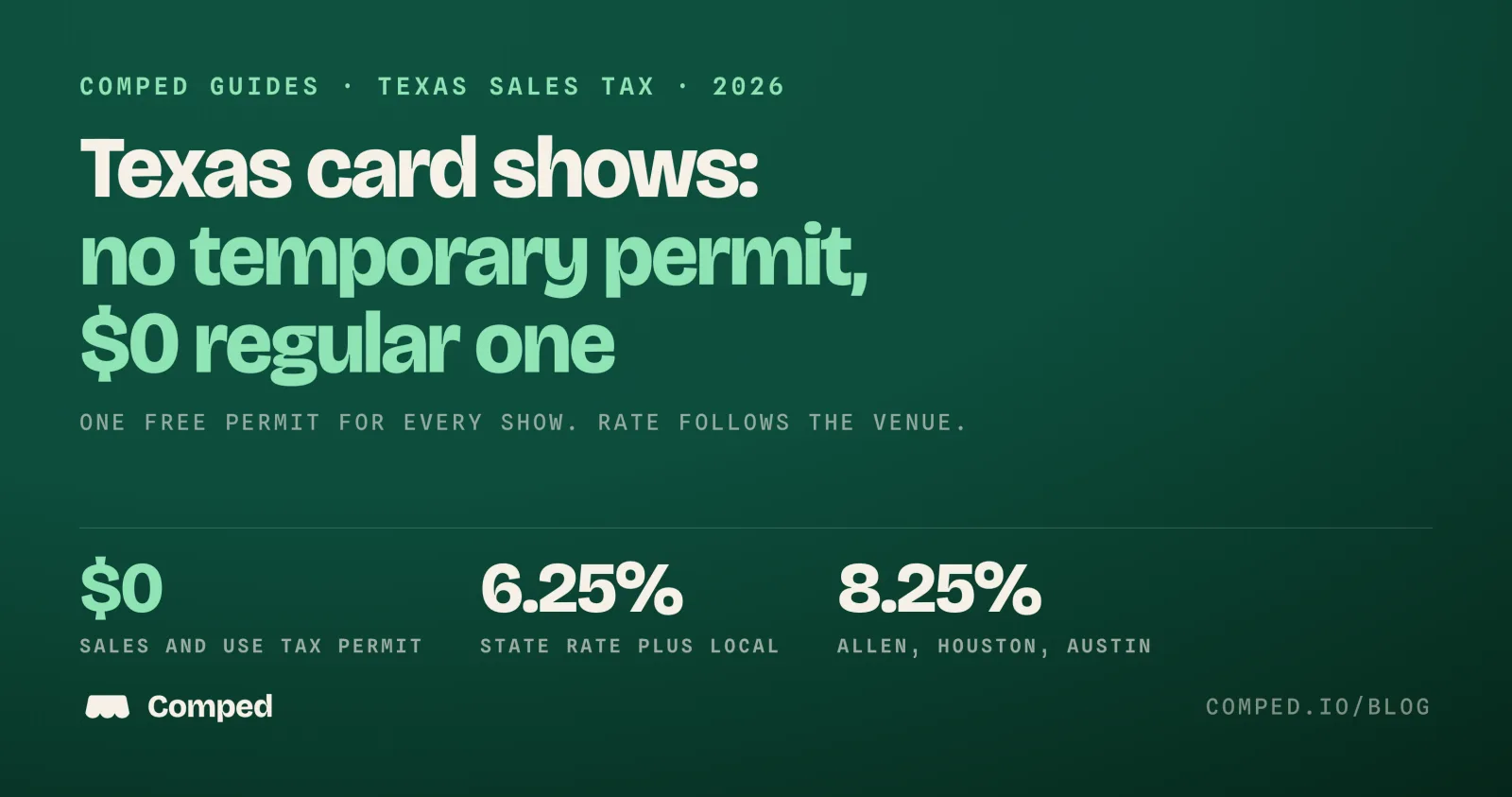
Who needs a permit in Texas
Anyone who sells taxable items at a Texas show needs a permit, and that includes sellers from other states. The Comptroller's Publication 96-211, Fairs, Festivals, Markets and Shows says so directly. A seller who sells, takes orders or uses the event to promote sales must hold a permit.
Out-of-state dealers are covered by name. A seller engaged in business in Texas, even temporarily, must hold the permit and collect all applicable local taxes.
| Who you are | Permit needed? | Why |
|---|---|---|
| Texas dealer who sells at shows | Yes | You sell tangible personal property in Texas |
| Texas seller with only eBay or Whatnot sales | Yes | The Comptroller says a Texas seller needs a permit even with only marketplace sales |
| Out-of-state dealer at one Texas show | Yes | Engaged in business in Texas, even temporarily |
| Collector with a paid table, one show a year | Yes | The occasional sale exemption is off at events that charge a booth or space fee |
| Person who buys or trades cards to resell | Yes | Buying, bartering or trading items to resell rules out the occasional sale exemption |
| Individual selling two cards in 12 months, no paid table | No | One or two sales in a 12 month period is an occasional sale |
Trading cards are tangible personal property, which the permit FAQ defines as property that can be seen, weighed or touched. Hobby or business for income tax is a separate question, covered in our guide to taxes on selling sports cards. The state by state sales tax guide covers every state's table rules.
The occasional sale rule and hobby sellers
The occasional sale exemption almost never covers a card show table. Tax Code Section 151.304 exempts one or two sales in a 12 month period by a person who is not in the business of selling. It also exempts up to $3,000 a calendar year of items an individual first bought for personal or family use.
Three things knock a card seller out. Section 151.008 treats a person who makes more than two sales of taxable items in 12 months as a seller. Publication 96-211 says you do not qualify if you buy, barter or trade taxable items to resell. You also do not qualify if you hold a sales tax permit from Texas or another state.
THE RULE MOST VENDORS GET WRONG
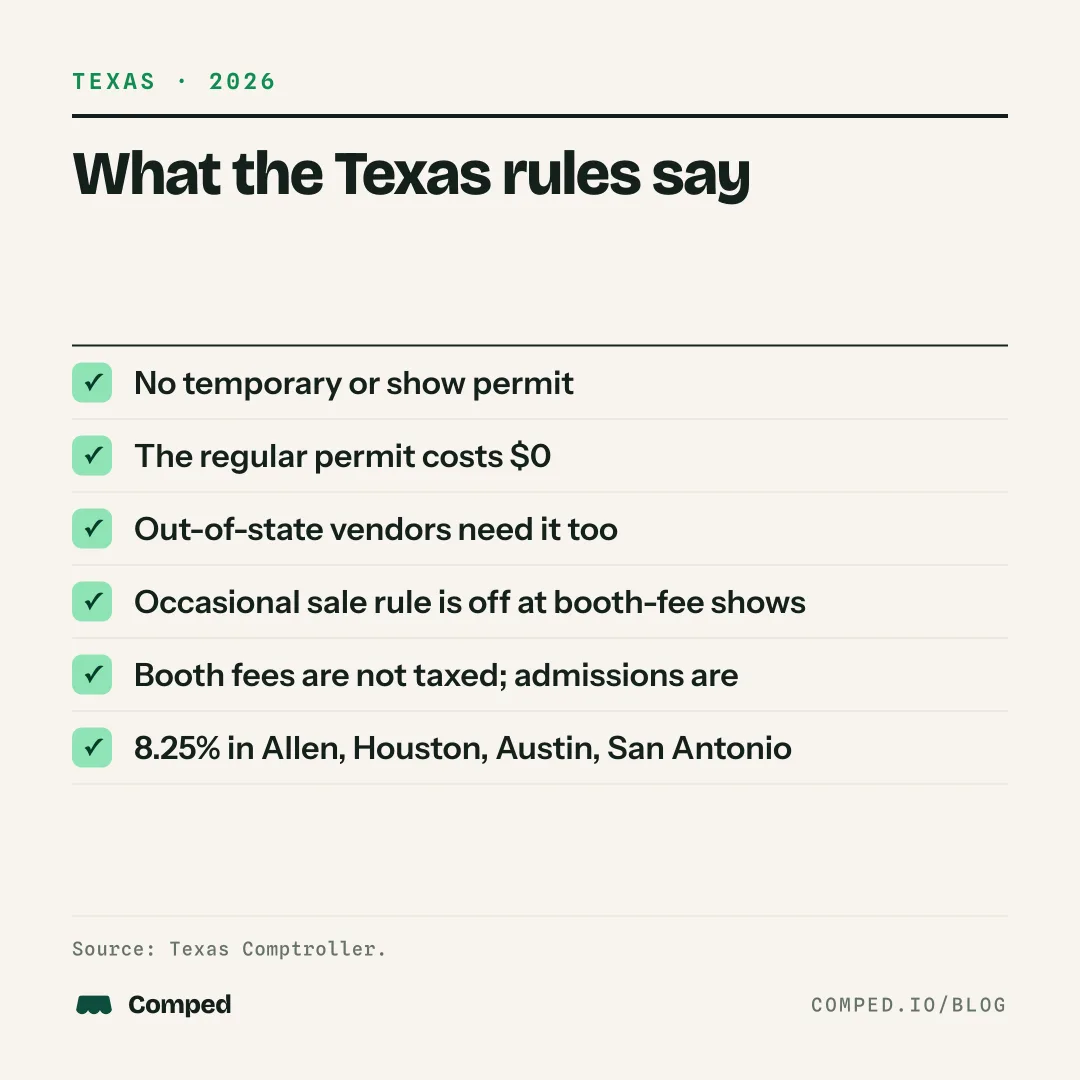
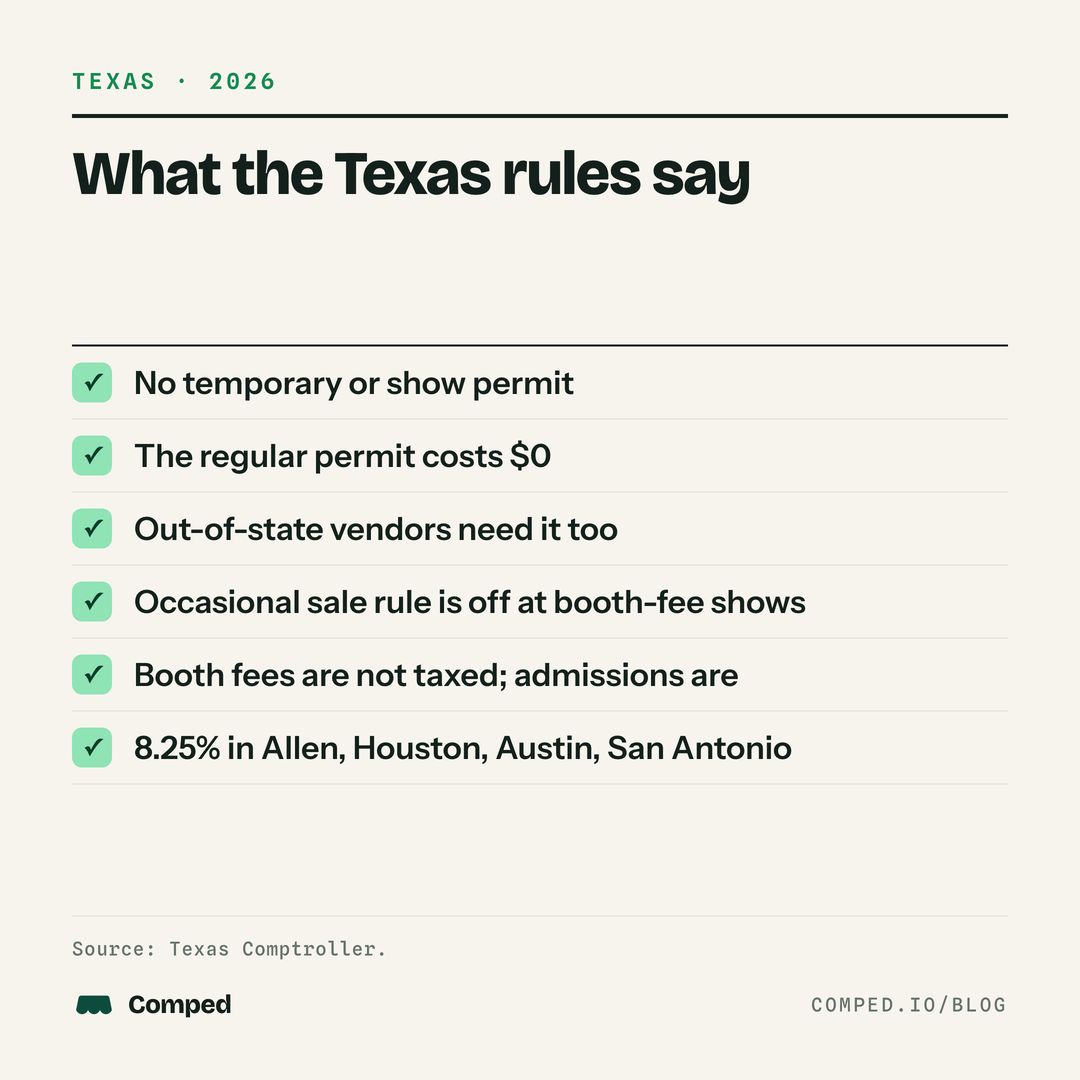
Texas lets an individual sell one or two items in 12 months, or up to $3,000 of personal items in a calendar year, tax free. Publication 96-211 switches that exemption off at flea markets, craft shows and similar third-party events that charge a booth or space fee. A card show table is that event.
A seller who does qualify must give the promoter a letter saying so, with name, address, phone number and driver's license. Both keep it for four years.
How to get the permit: the online application and Form AP-201
Apply on the Comptroller's Texas Online Tax Registration Application, which runs through its eSystems login. A sole owner needs a Social Security number and a NAICS code. Applicants must be at least 18.
The paper route is Form AP-201, Texas Application for Sales Tax Permit and/or Use Tax Permit. An owner with no Social Security number has to use it. The form gives three ways to send it: mail to 111 E. 17th St., Austin, TX 78774-0100, email to sales.applications@cpa.texas.gov, or fax to 512-936-0010.
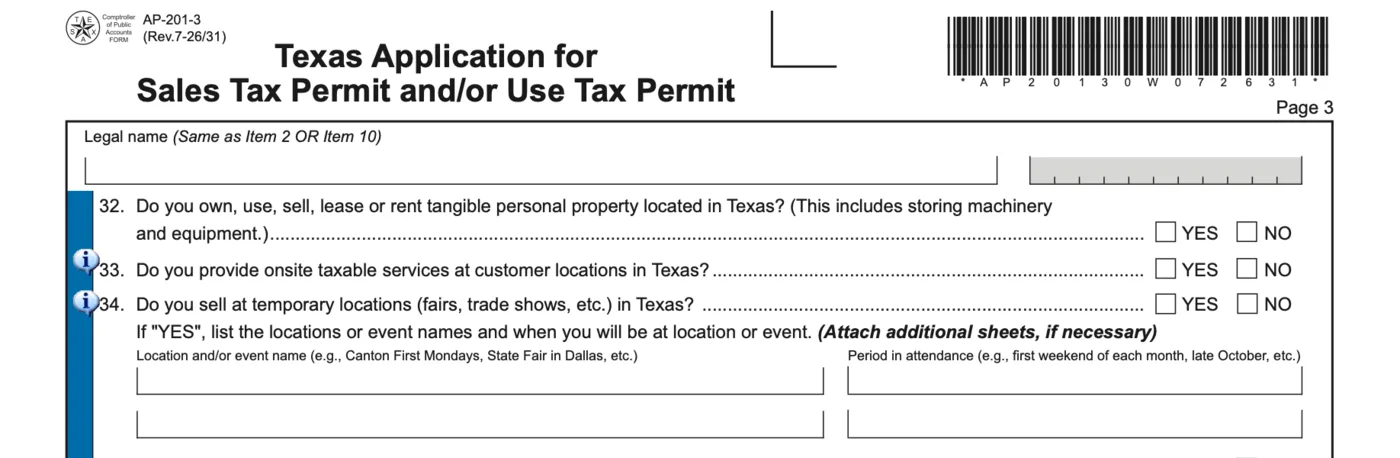
A sole proprietor starts at Item 10. A vendor with no Texas place of business skips Item 24. Item 34 asks whether you sell at temporary locations such as fairs and trade shows. Answer yes, then list each event and when you will be there.
There is no event permit in Texas. The statute does have a "temporary permit" in Section 151.252, but it is not for shows. It is a stopgap the Comptroller may issue while an applicant arranges a required bond. A vendor who works one show a year and a vendor who works twelve hold the same permit.
The $500,000 remote seller threshold does not help a show vendor. A table at a Texas show is physical presence.
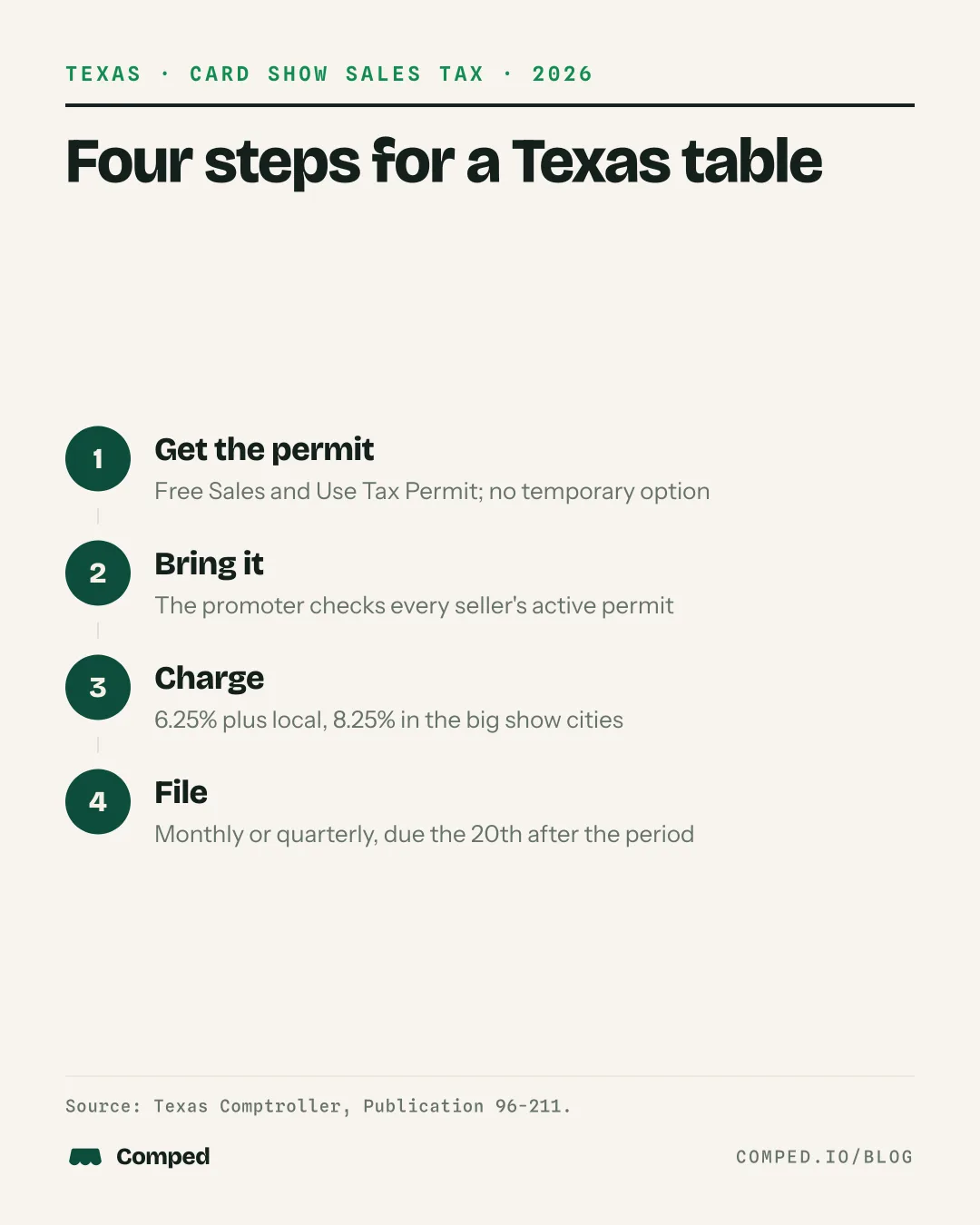
Cost, bond and lead time
The permit costs $0. The permit FAQ says there is no fee, but you may be required to post a security bond. Publication 96-211 says the Comptroller may require one when it has reason to believe a tax is likely to become delinquent.
The bond rules sit in Tax Code Section 151.253 and Comptroller Rule 3.327. The Comptroller fixes the amount case by case. The rule says an itinerant vendor, a seller with no place of business, may be asked for at least $500.
Lead time is two to four weeks. The online application page says to allow two to three weeks to receive your permit. The paper AP-201 says about four weeks after a complete, signed form arrives.
What to keep at the table
Keep your permit at the table, on paper and on your phone. Tax Code Section 151.201 says the holder must display the permit conspicuously in the place of business it applies to. Our reading is that a show table is where you do business that weekend, so bring it.
Expect to give your 11 digit number at load-in, since the promoter has to check it. The permit FAQ says permit holders keep records for at least four years. A card show cash log covers the cash side of that.
What rate to charge, by show city
Charge 6.25% state tax plus the local tax where the show is held. Local taxes can add up to 2%, for a maximum combined rate of 8.25%, per the Comptroller's sales and use tax page. Publication 96-211 says that if you sell at different events around Texas, you collect based on the location of each event.
Every large show city sits at the cap. These combined rates are from the Comptroller's city rate table, read on November 13, 2026.
| Show city | County listed by the Comptroller | City share | Combined rate |
|---|---|---|---|
| Allen | Collin | 2.00% | 8.25% |
| Arlington | Tarrant | 2.00% | 8.25% |
| Austin | Travis, Williamson | 1.00% | 8.25% |
| Dallas | Dallas and four others | 1.00% | 8.25% |
| Fort Worth | Tarrant, Denton | 1.00% | 8.25% |
| Frisco | Collin, Denton | 2.00% | 8.25% |
| Grapevine | Tarrant, Dallas, Denton | 1.50% | 8.25% |
| Houston | Harris, Fort Bend, Montgomery | 1.00% | 8.25% |
| San Antonio | Bexar | 1.125% | 8.25% |
Transit authorities and special districts fill the rest of the 2%. A venue outside city limits can be lower than 8.25%. For any other address, use the Comptroller's Sales Tax Rate Locator before you price.
You may price cards with tax included. Publication 96-211 says your receipt or invoice must separately show the tax or clearly indicate that tax is included in the price.
| Texas item | Rule for show vendors | Figure |
|---|---|---|
| State sales tax rate | All retail sales, cards and slabs included | 6.25% |
| Local tax | Cities, counties, transit and special districts | Up to 2% |
| Big show cities | Combined rate at the venue, 2026 | 8.25% |
| Permit fee | Texas Sales and Use Tax Permit, bond possible | $0 |
| Application | Online application, or paper Form AP-201 | AP-201 |
| Lead time | Weeks to receive the permit, online and paper | 2 to 4 |
| Event permit | Not offered; the regular permit covers shows | None |
| Return | Monthly or quarterly as assigned, due the 20th after the period | 20th |
| Timely filing discount | Share of the tax, when filed and paid on time | 0.5% |
| Late filing penalty | Every late return, even with no tax due | $50 |
| Resale certificate | Texas Sales and Use Tax Resale Certificate | 01-339 |
| Remote seller threshold | Total Texas revenue, preceding twelve months | $500,000 |
The timeline, counted back from show day
Start four weeks out. The dates in the right column are an example using the Dallas Card Show's Houston edition, which its site lists for December 18 to 20, 2026.
| When | What you do | Example date |
|---|---|---|
| 6 weeks before | Paper route only: send Form AP-201, which takes about four weeks | November 6, 2026 |
| 4 weeks before | Apply online. Allow two to three weeks for the permit | November 20, 2026 |
| 1 week before | Look up the venue's rate. Print the permit and blank 01-339 forms. Pack a cash log | December 11, 2026 |
| Show days | Charge the venue's rate on every sale. Record each sale as it happens | December 18 to 20 |
| End of the period | Total your Texas sales for the month or quarter | December 31, 2026 |
| 20th after the period | File and pay on Webfile. December and the fourth quarter share one due date | January 20, 2027 |
| Every period after | File a return, with zeros if you had no Texas sales, until you close the permit | Ongoing |
The card show vendor checklist has the rest of what to pack.
Filing the return after the show
You report the show on your regular Texas Sales and Use Tax Return, due the 20th after the period ends. Texas has no separate event return. File online through Webfile, or on the paper form the Comptroller mails you.
The Comptroller tells you by letter after approving your permit whether you file monthly or quarterly. Tax Code Section 151.401 sets the line. A taxpayer who owes less than $500 for a month or $1,500 for a quarter pays quarterly. Quarterly returns are due April 20, July 20, October 20 and January 20.
The paper return for a small seller is Form 01-117, the Short Form. It has ten items.
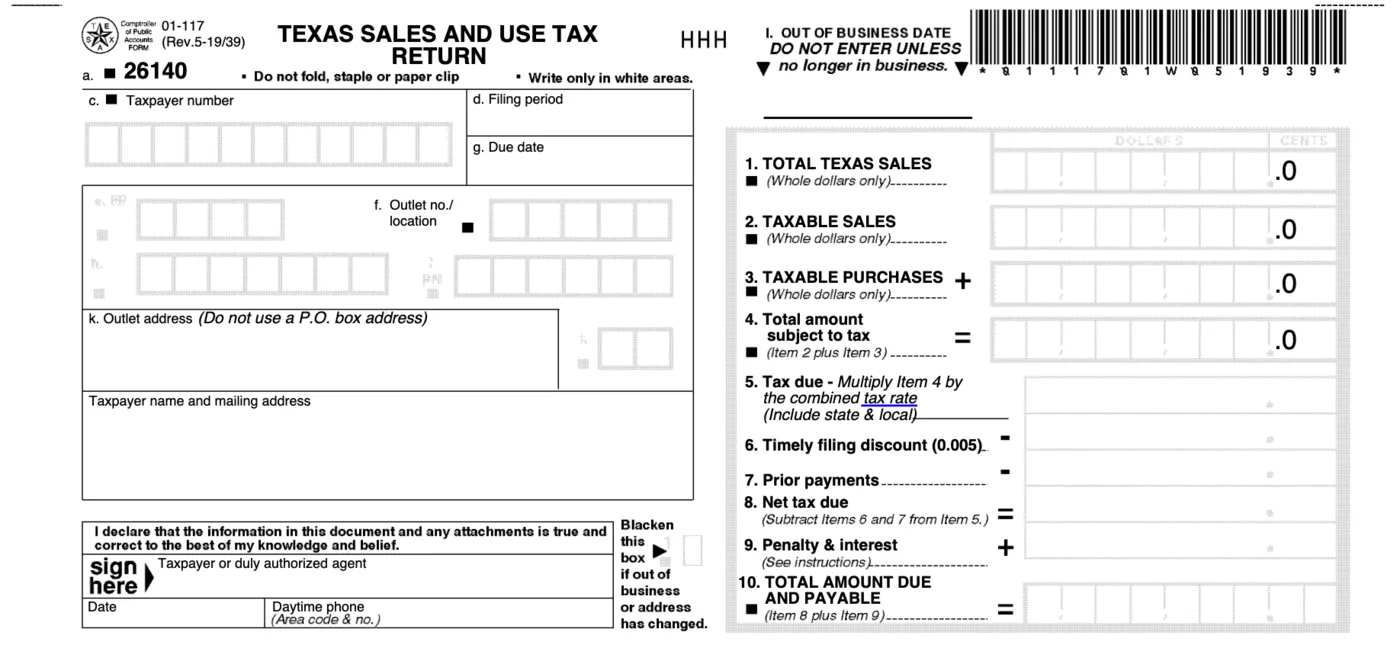
| Item on Form 01-117 | What goes there, per the form's instructions |
|---|---|
| 1. Total Texas Sales | All sales made in Texas in the period, not including tax, in whole dollars |
| 2. Taxable Sales | The taxable part of Item 1, not including tax |
| 3. Taxable Purchases | Items you used yourself without paying tax, such as a card taken out of resale inventory |
| 4. Total amount subject to tax | Item 2 plus Item 3 |
| 5. Tax due | Item 4 multiplied by the combined state and local rate |
| 6. Timely filing discount | Item 5 multiplied by 0.005, only when you file and pay on time |
| 8. Net tax due | Item 5 less Items 6 and 7 |
| 10. Total amount due and payable | Item 8 plus any penalty and interest from Item 9 |
One limit matters to travelling vendors. The form says the short form is for a business with a single Texas location that reports local tax only where it is located. Our reading is that a vendor collecting in several cities files the long form, 01-114, or files in Webfile, which lists each jurisdiction. Ask the Comptroller at 800-252-5555 if your letter does not say.
A period with no Texas sales still gets a return. The form says to enter "0" in Items 1 to 4 and that you must file even if you had no sales. A mailed return goes to Comptroller of Public Accounts, P.O. Box 149355, Austin, TX 78714-9355.
Filing and paying on time earns a discount of 0.5% of the tax, under Tax Code Section 151.423. Section 151.425 takes the discount away if the return or payment is late. Comped records each table sale with its price, venue and date, so the period's gross sales total is ready when you fill in the return.
If Texas was one show and you are done, close the permit, which Publication 96-211 allows. Until you do, a return is due every period.
Penalties
A late return costs $50 every time, even when no tax is due. Tax Code Section 151.703 sets that penalty, and the Comptroller's penalties page repeats it.
Late tax carries its own penalty. It is 5% of the tax when paid 1 to 30 days late and 10% after 30 days. Paying after the date on a Notice of Tax Due adds another 10%. Interest starts on the 61st day after the due date.
Selling without a permit is a crime on paper. Section 151.708 makes a first offense a Class C misdemeanor, and each day of selling is a separate offense. Repeat convictions carry fines up to $2,000, then $4,000. Section 151.7032 separately makes it an offense to knowingly keep tax you collected.
Buying inventory with a resale certificate
Yes. Give the selling dealer a completed Form 01-339, the Texas Sales and Use Tax Resale Certificate, and no tax is due on that purchase. The Comptroller's resale FAQ says the seller keeps the certificate for four years. A copy of your permit is not a substitute for the certificate.
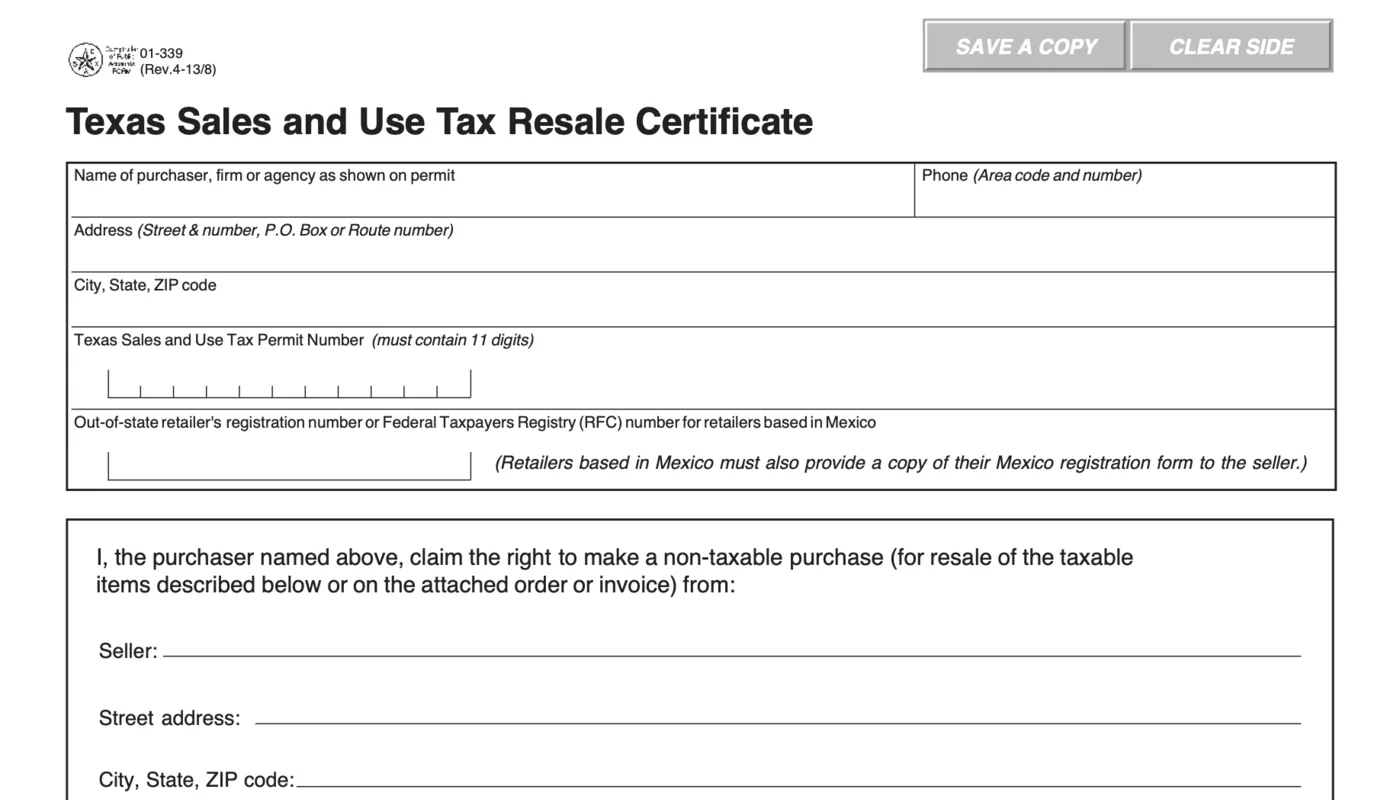
The form asks for your 11 digit Texas permit number. It also has a line for an out-of-state retailer's registration number. The resale FAQ says a seller can accept one blanket certificate from a customer who buys only for resale.
It works both ways at a show. When another dealer buys from you for resale, keep his completed certificate, because it is your proof for not charging tax. If you pull a card bought for resale into your own collection, you owe tax on it as a taxable purchase.
Most show buys between dealers are cash with no certificate in sight. Tax charged on such a buy is part of your cost, covered in the cost basis guide.
eBay and Whatnot versus your table
eBay has collected and remitted Texas sales tax on eBay orders since October 1, 2019, per its marketplace tax page. The Comptroller's marketplace page says you are not responsible for tax on marketplace sales once the provider certifies it is collecting. The same rule covers Whatnot or any other certified marketplace.
A Texas-based seller still needs the permit. The marketplace page says a Texas seller remains responsible for a permit and timely returns, even with only marketplace sales. Every card sold face to face at a Texas table is taxed, collected and remitted by you.
What the promoter handles
The promoter does not collect your tax if you hold a permit, but Texas makes the promoter answer for sellers who do not. Publication 96-211 says event promoters must collect and remit tax on their own sales and on sales by sellers without an active permit. Comptroller Rule 3.286 defines a promoter of a flea market, trade day or similar event as the seller responsible for that tax.
That is why a careful promoter asks for your permit number. The publication describes no vendor list for the promoter to file.
Booth fees, floor space fees and rental charges for a selling space are not subject to Texas sales tax. Admission fees are taxable, and the promoter collects that tax. Your own table sales and your return stay yours.
Texas and the 1099-K
Texas has no state 1099-K filing, so the federal rule is the only one. Platforms file a 1099-K when your gross payments exceed $20,000 and your transactions exceed 200 in the year, per platform. The IRS FAQs issued after the July 2025 law set that out. Stripe's state filing table lists Texas with no state filing, and Whatnot's 2026 Form 1099-K page lists no lower Texas threshold.
Texas has no personal income tax, so card profit faces federal tax only. A form is a reporting rule, not a tax rule. You owe federal tax on profit whether or not a 1099-K arrives, as the 1099-K guide explains. The state 1099-K threshold table lists every state.
A show weekend, worked
Here is an example: a $4,000 weekend at a table in Allen, at the 2026 combined rate of 8.25%. It is the only Texas selling in the period, and the return is filed on time.
AN EXAMPLE $4,000 WEEKEND IN ALLEN, ON THE RETURN
Two days at a table in Allen, Collin County, $4,000.00 in card sales before tax, every sale taxed at 8.25%.
The $330.00 was never your money. Your gross sales for federal income tax are $4,000.00, and profit is that less card cost and show expenses. The card show profit calculator works that out. A buyer who pays more than $10,000 in cash for one card triggers Form 8300, a separate federal duty.
Common mistakes, and fixing a missed show
Most Texas problems come from five habits.
- Looking for a temporary event permit. Texas has none, and the two to three week wait starts when you apply for the regular one.
- Counting on the occasional sale exemption at a paid table. The booth fee switches it off.
- Charging the home rate. The rate follows the event, so a Lubbock dealer in Houston charges Houston's rate.
- Skipping the return in a period with no shows. Each late or missed return costs $50.
- Leaving the permit open after a single show. Returns stay due until you close it.
The Comptroller publishes no step list for a seller who already sold without a permit, so this is our reading. Apply for the permit now, report the show's sales on your first return and pay the tax. Expect late penalties and interest if the due date has passed. Call the Comptroller at 800-252-5555 first, and ask a CPA about penalty relief.
Cash sales are taxed like any other sale. With the penny out of production, the Comptroller's penny guidance says to figure tax on the price before rounding. You may then round the cash total, and a difference of $0.04 or less draws no extra tax.
A trade is a sale for income tax, at the value of what you receive, and the card trade calculator does that math. We found no Comptroller page on sales tax for a card for card trade, so ask before you assume none is due.
A dealer who works shows in several states registers in each one, which the 2026 card show sales tax index compares. An out-of-state LLC or corporation should also read the franchise tax section of Publication 96-211, which has a trade show exemption.
Texas's recurring shows
The Dallas Card Show says it runs six times a year in Allen. Its Houston edition is listed for December 18 to 20, 2026, at the George R. Brown Convention Center. TXCardFest lists two day shows in San Antonio. Each of those cities is 8.25% in 2026, and each show charges for tables, so the occasional sale exemption is out. One permit covers all of them.
How this looks in the Comped app
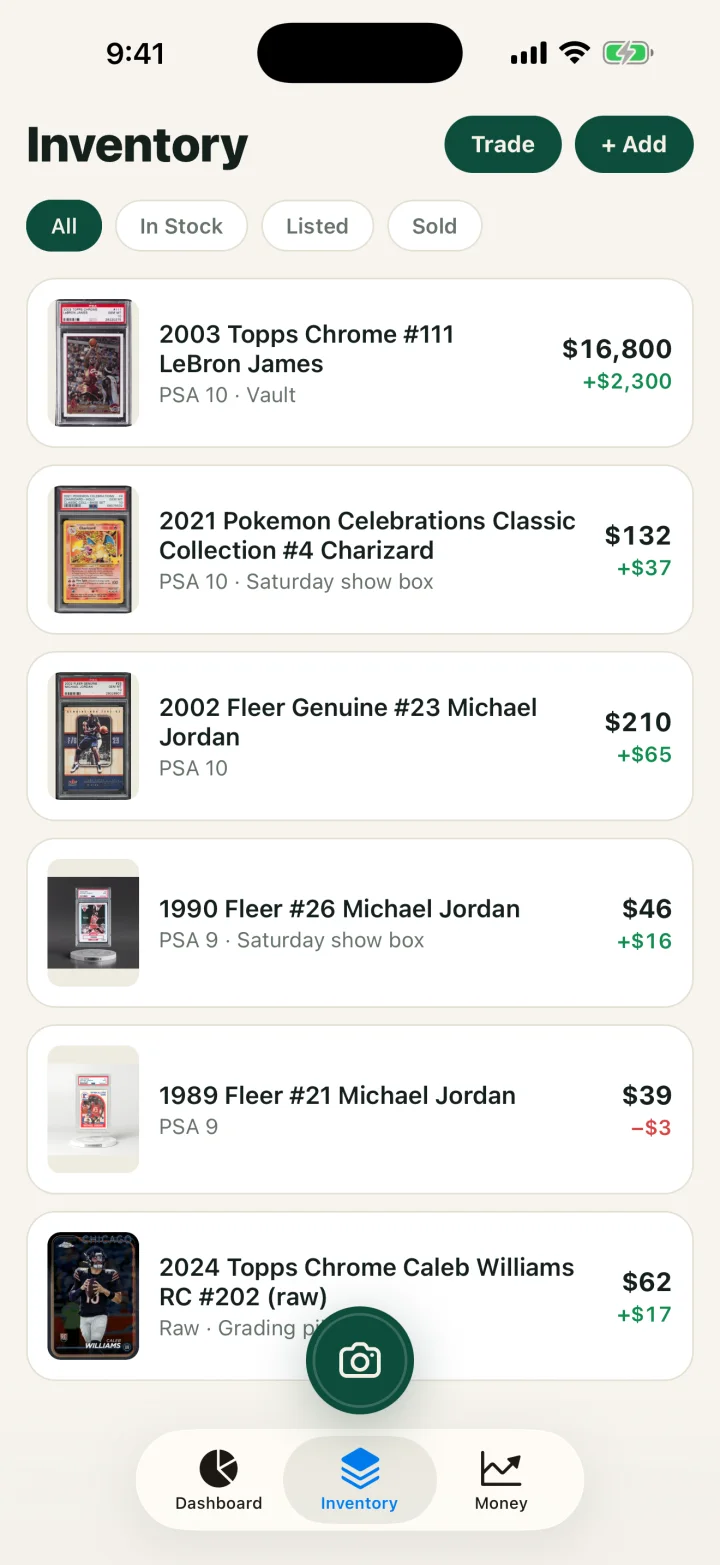
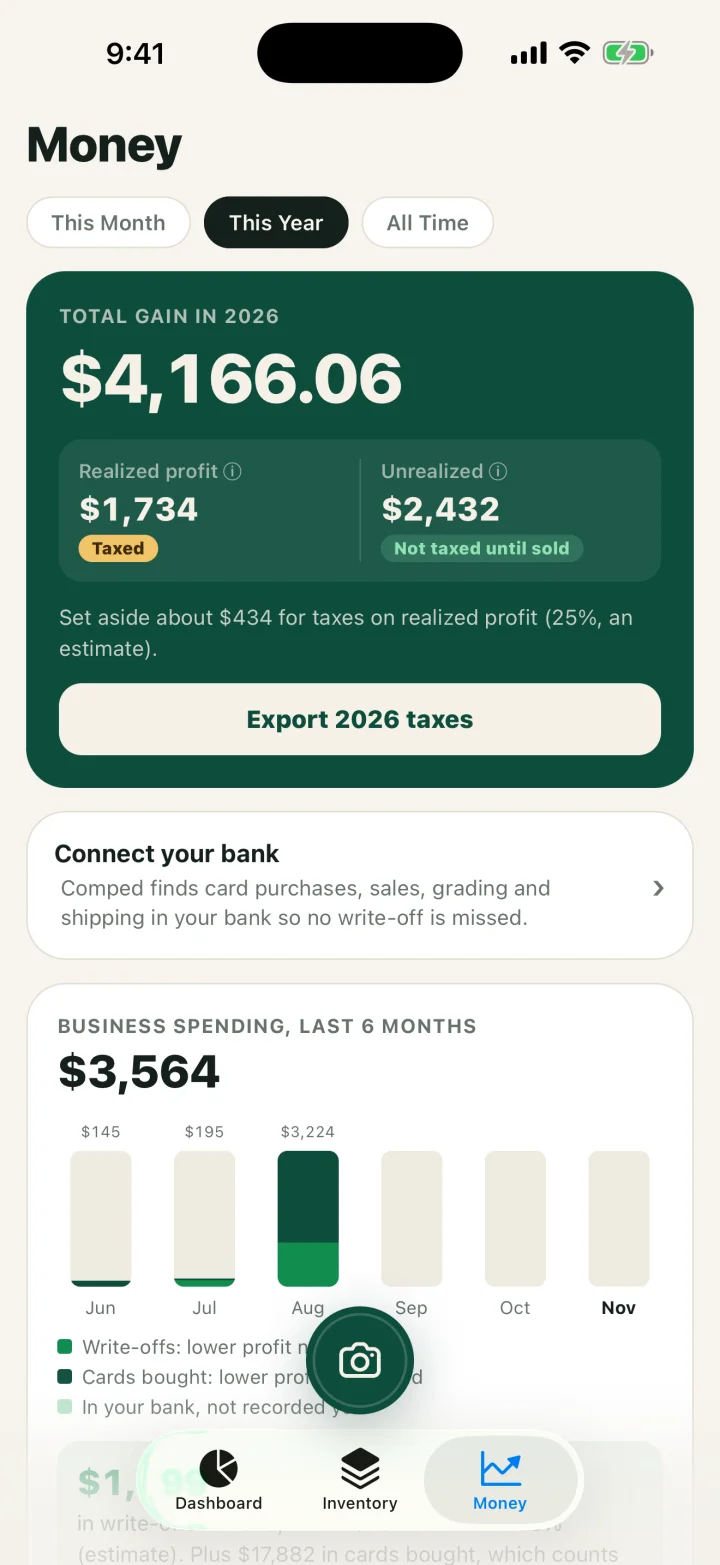
Item 1 of the Texas return asks for total sales in the period, and that figure comes from your sale records. In Comped each sale is its own record with the price, the date and where it sold. The Sold filter lists what left the table, and the Money tab exports the year. The app does not calculate or file sales tax.

Related guides
- State by State: Sales Tax and Show Permits for Card Vendors: every state's permit, rate and rules in one place.
- California card show sales tax (2026): a free temporary seller's permit for events of 90 days or less.
- Florida card show sales tax (2026): free dealer registration and a county surtax capped at $5,000 per item.
- Card show sales tax index 2026: the 51-state comparison of permits, fees and promoter duties.
FAQ
Do I need a sales tax permit to sell at a card show in Texas?
Yes. Anyone who sells taxable items at a Texas show needs a Texas Sales and Use Tax Permit, including out-of-state sellers. The permit is free, though the Comptroller may ask for a security bond. Apply online and allow two to three weeks.
Does Texas have a temporary sales tax permit for one event?
No. Texas has no event or show permit, so a one show vendor gets the regular Sales and Use Tax Permit. The temporary permit named in Tax Code Section 151.252 only covers the time an applicant needs to arrange a bond. When you are done selling in Texas, you can close the permit.
Do I need a permit to sell at a single card show?
Yes. One show is enough. The occasional sale exemption does not apply at third-party events that charge a booth or space fee, and card shows charge for tables.
How long does it take to get a Texas sales tax permit?
The Comptroller's online application page says to allow two to three weeks to receive the permit. The paper Form AP-201 says about four weeks after a complete, signed application arrives. Apply at least four weeks before your first show.
What is the sales tax rate at a card show in Dallas or Houston?
It is 8.25% in 2026: the 6.25% state rate plus 2% of local tax. The Comptroller's city rate table shows the same 8.25% for Allen, Arlington, Austin, Fort Worth, Frisco and San Antonio. Check any other venue in the Sales Tax Rate Locator.
Do I have to file a Texas return if I had no sales?
Yes. A permit holder files a return every period, with zeros when there were no sales. Each late return carries a $50 penalty even when no tax is due. Close the permit if you will not sell in Texas again.
Does the promoter collect it for me?
Not if you hold a permit. You collect the tax at your table and file the return. Texas makes the promoter responsible for tax on sales by sellers without an active permit, which is why promoters ask for permit numbers.
Can I buy inventory tax-free with a resale certificate?
Yes, with your permit. Give the selling dealer a completed Form 01-339 and no tax is due on that purchase. You charge the venue's rate when the card sells, and you owe tax on any card you keep for yourself.
SOURCES
- Fairs, Festivals, Markets and Shows (Publication 96-211), Texas Comptroller of Public Accounts, checked November 13, 2026.
- Texas Online Tax Registration Application, Texas Comptroller of Public Accounts, checked November 13, 2026.
- Form AP-201, Texas Application for Sales Tax Permit and/or Use Tax Permit (Rev. 7-26/31), Texas Comptroller of Public Accounts, checked November 13, 2026.
- Sales and Use Tax Permit FAQ, Texas Comptroller of Public Accounts, checked November 13, 2026.
- Sales and Use Tax, Texas Comptroller of Public Accounts, checked November 13, 2026.
- City Sales and Use Tax rates, Texas Comptroller of Public Accounts, checked November 13, 2026.
- Form 01-117, Texas Sales and Use Tax Return, Short Form (Rev. 5-19/39), Texas Comptroller of Public Accounts, checked November 13, 2026.
- Penalties for Past Due Taxes, Texas Comptroller of Public Accounts, checked November 13, 2026.
- Texas Tax Code Chapter 151, Sections 151.008, 151.201, 151.252, 151.253, 151.304, 151.401, 151.423, 151.425, 151.703, 151.7032 and 151.708, Texas Legislature, checked November 13, 2026.
- 34 Texas Administrative Code Section 3.286, Seller's and Purchaser's Responsibilities, as published by Cornell Legal Information Institute, checked November 13, 2026.
- 34 Texas Administrative Code Section 3.327, Taxpayer's Bond or Other Security, as published by Cornell Legal Information Institute, checked November 13, 2026.
- Form 01-339, Texas Sales and Use Tax Resale Certificate (Rev. 4-13/8), Texas Comptroller of Public Accounts, checked November 13, 2026.
- Resale Certificate FAQ, Texas Comptroller of Public Accounts, checked November 13, 2026.
- End of Penny Production, Texas Comptroller of Public Accounts, checked November 13, 2026.
- Remote Sellers, Texas Comptroller of Public Accounts, checked November 13, 2026.
- Marketplace Providers and Marketplace Sellers, Texas Comptroller of Public Accounts, checked November 13, 2026.
- Taxes and import charges, eBay, checked November 13, 2026.
- IRS issues FAQs on Form 1099-K threshold, IRS, checked November 13, 2026.
- 1099-K form state requirements, Stripe, checked November 13, 2026.
- 2026 Form 1099-K for U.S. Sellers, Whatnot, checked November 13, 2026.
This is general information for card sellers, not tax or legal advice for your situation. Rules change and states differ; a CPA who knows your numbers wins every time.