Who has to register in Florida
Anyone selling cards to the public at a Florida show must register as a dealer first. Section 212.18(3), Florida Statutes says the application must be submitted before the person may engage in business. Paragraph (g) covers shows directly. An exhibitor whose agreement authorizes retail sales must register as a dealer and collect the tax.
Living in another state does not change that, and neither does selling at only one show. The statute sets no minimum number of days or shows.
The hobby seller question has a rule of its own. Florida exempts "occasional or isolated" sales, but Rule 12A-1.037 takes that exemption away in three cases. One is a sale made from a location in competition with other persons required to collect tax. Our reading is that a table at a card show is the same thing, so a collector selling there registers too.
| Who you are | Register with Florida? | Where it comes from |
|---|---|---|
| Florida seller who only does shows | Yes, on Form DR-1, before the first show | Section 212.18(3)(a); DR-1 line 13 |
| Florida dealer already registered at a shop or home | Already a dealer. Ask the Department whether a show in another county needs its own registration | Section 212.18(3) issues a certificate for each place of business |
| Out-of-state dealer at one Florida show | Yes. Retail sales at the show require it | Section 212.18(3)(g)3 |
| Collector or hobby seller with a table | Yes, on our reading of the occasional sale rule | Rule 12A-1.037(5)(c) |
| Exhibitor whose agreement allows wholesale only | No, but you must get the buying dealer's resale certificate | Section 212.18(3)(g)2 |
| Exhibitor whose agreement bans sales | No | Section 212.18(3)(g)1 |
Trading cards are taxable tangible personal property in Florida, slabs included, with no collectibles exemption. Hobby or business for income tax is a separate question, covered in our guide to taxes on selling sports cards. The state by state sales tax guide covers every state's table rules.
How to register on Form DR-1
Register online through the Department of Revenue's business registration page, or fill in the paper Form DR-1. Both are the Florida Business Tax Application.
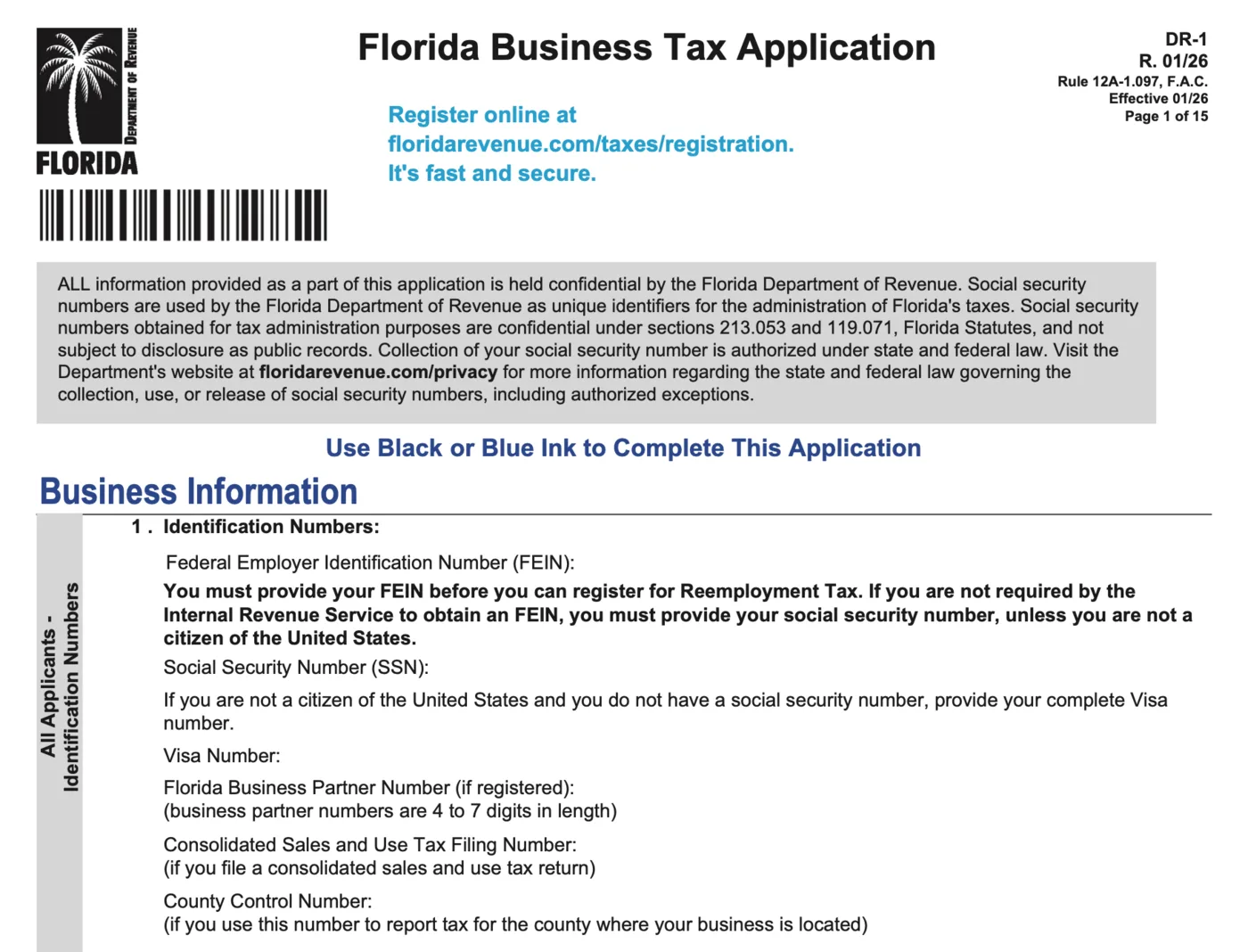
Have these ready, per the Department's DR-1N instructions:
- Your Social Security number if you are a sole proprietor, or your FEIN if the business has one.
- The legal name, any trade name, a mailing address and a physical address.
- The date of your first Florida taxable activity, which is the first day of your first show.
Line 13 is the one that matters for a show vendor. Tick "Sell products at retail (to consumers)" and "Sell products or goods from nonpermanent locations (such as flea markets or craft shows)."
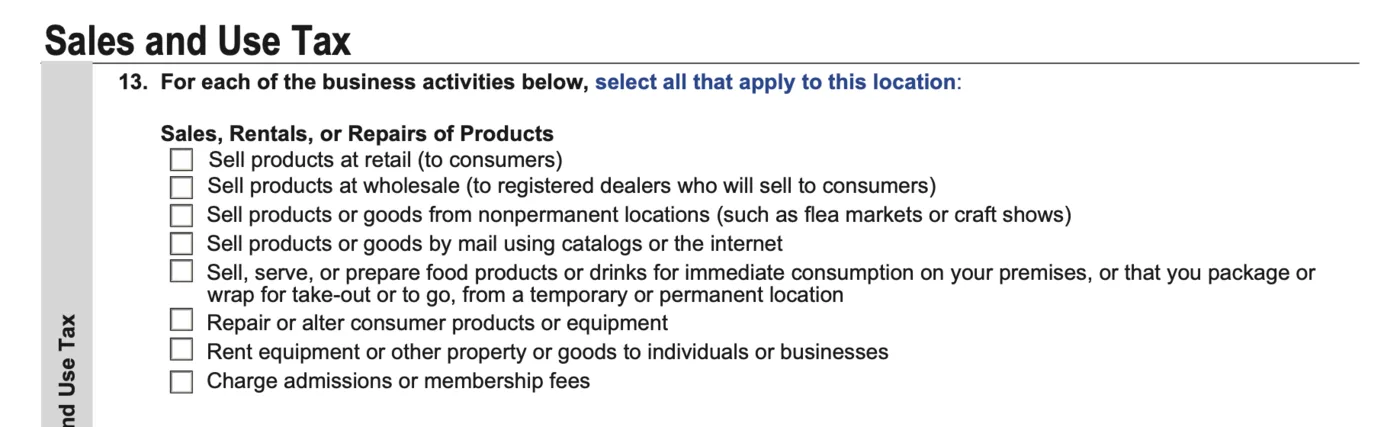
Mail a paper DR-1 to Account Management MS 1-5730, Florida Department of Revenue, 5050 W Tennessee St, Tallahassee FL 32399-0160. The form says you may also bring it to a taxpayer service center.
Florida has no event permit to apply for instead. Older forum posts describe a one-show "special event number" from a county service center. No current Department page we could open offers one. Georgia and Texas have their own show rules.
What it costs and how long it takes
Registration costs $0, online or on paper. The old $5 fee ended January 1, 2018, per TIP 18A01-02.
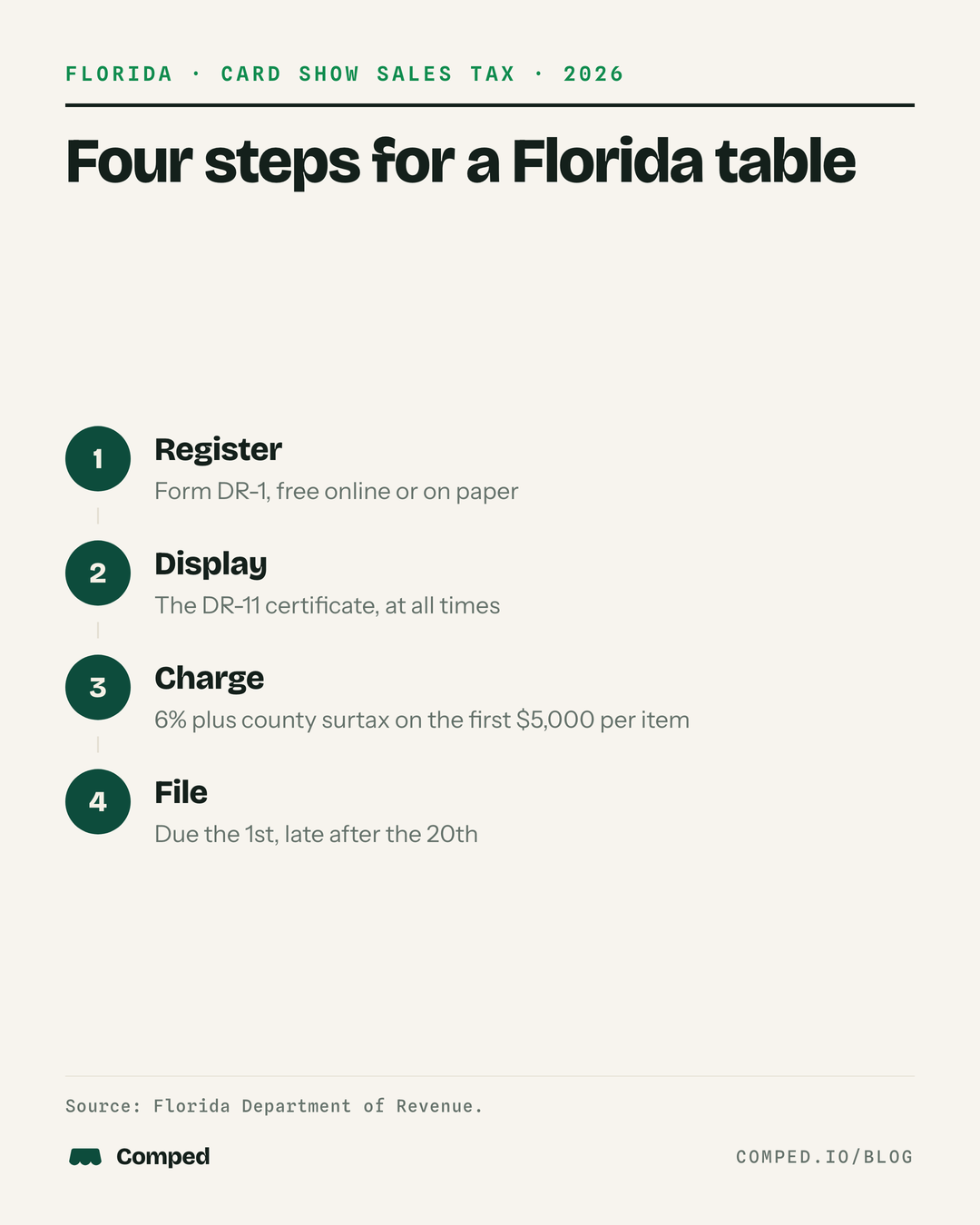
Online is the fast route. DR-1N says you can return to the site to retrieve your certificate number after three business days. The Department then mails a welcome package with the Certificate of Registration (Form DR-11) and an Annual Resale Certificate.
The Department states no processing time for a mailed DR-1. Our suggestion is to apply online at least two weeks before the show, so the mailed certificate arrives in time.
What to display at the table
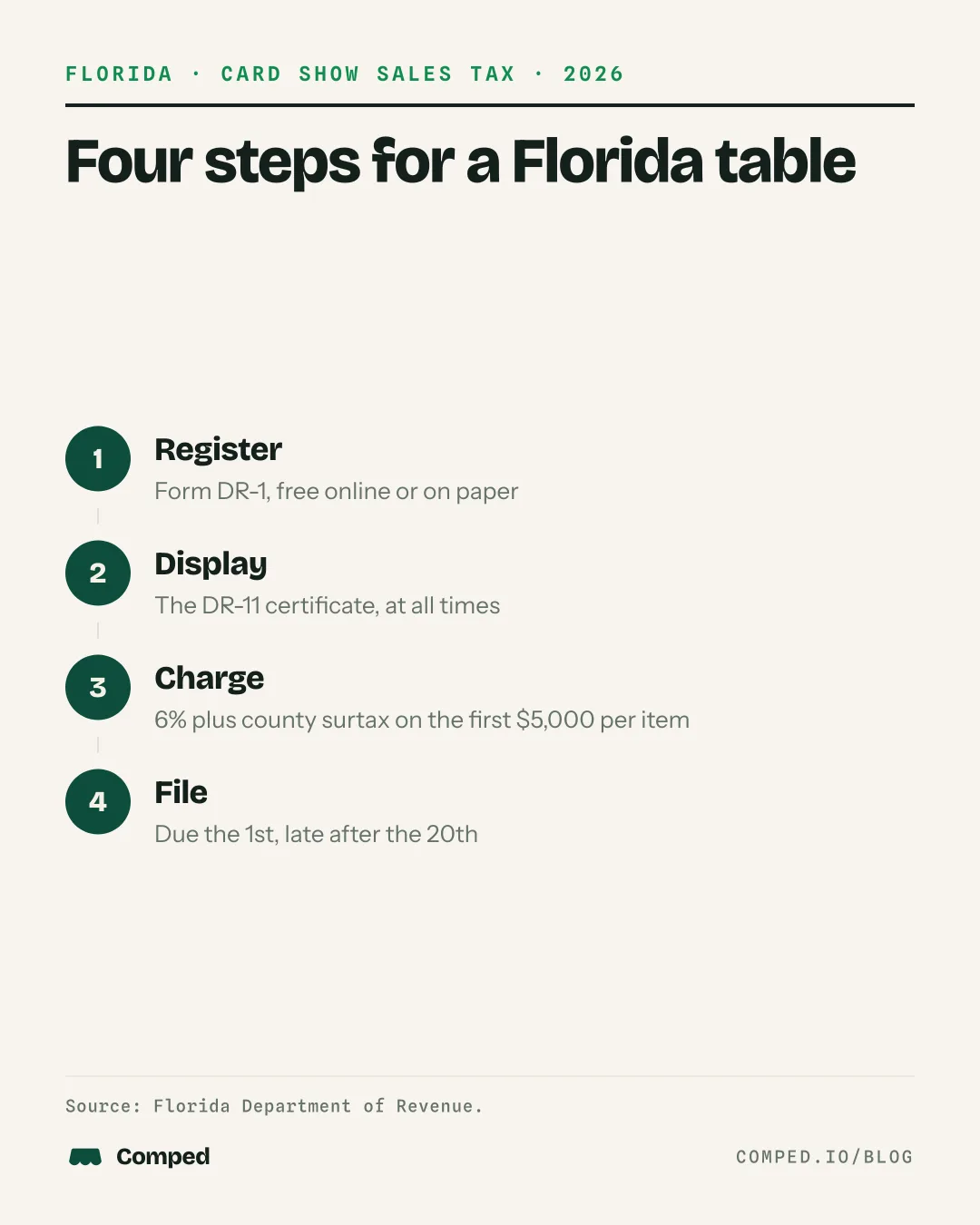
Display your Certificate of Registration (DR-11) where buyers and the Department can see it. Section 212.18(3)(b) says the certificate must be placed in a conspicuous place and displayed at all times. Our reading is that a show table is the place of business that day, so bring it.
What rate to charge, by show county
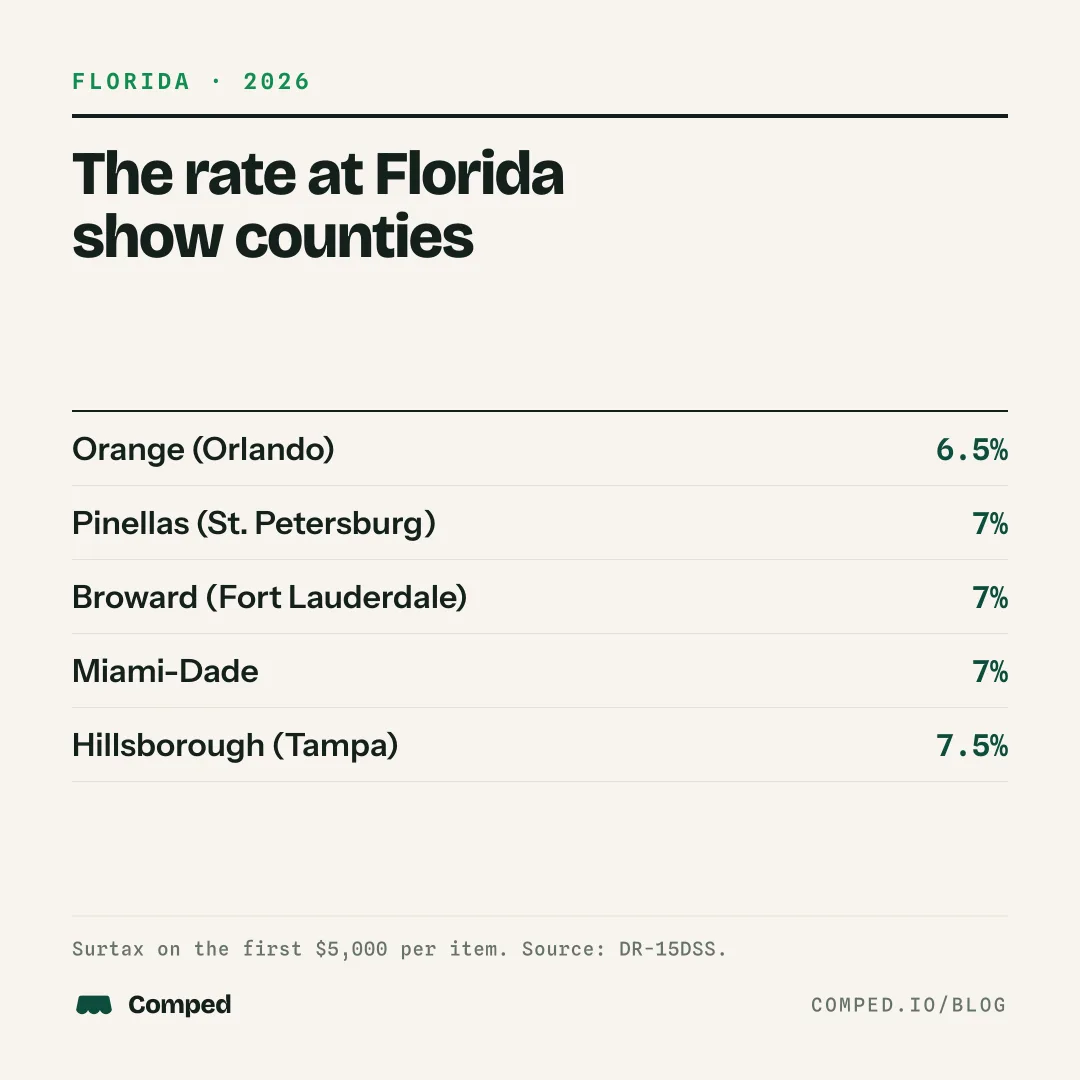
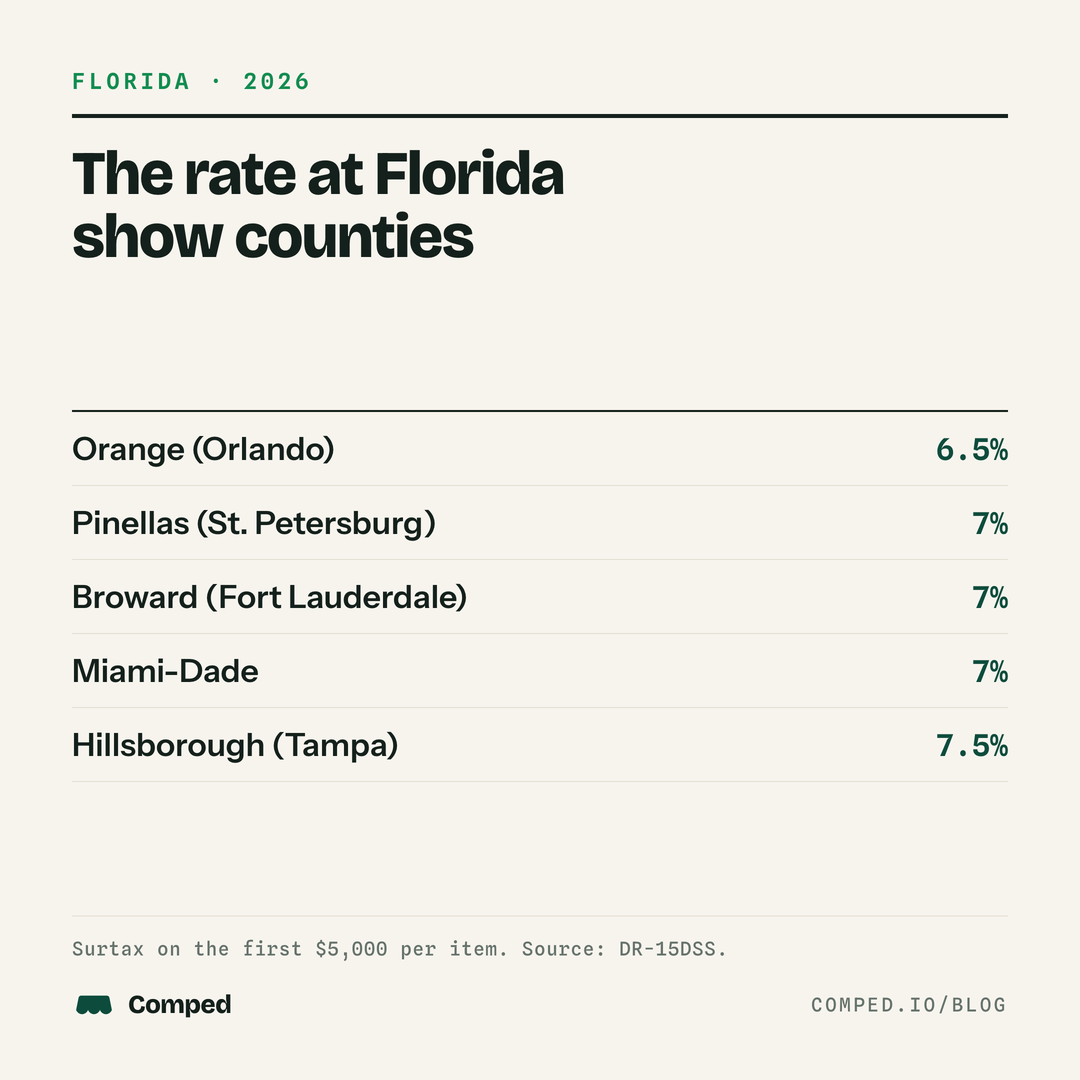
Charge Florida's 6% state rate plus the discretionary sales surtax of the county where the show is held. The Department's surtax page says surtax is collected at the rate of the county where delivery is made. At a show, the buyer takes the card at your table.
The rates below are from the Department's DR-15DSS surtax table for calendar year 2026 (R. 11/25).
| Show city | County | 2026 surtax | You charge |
|---|---|---|---|
| Orlando | Orange | 0.5% | 6.5% |
| Kissimmee | Osceola | 1.5% | 7.5% |
| Tampa | Hillsborough | 1.5% | 7.5% |
| St. Petersburg, Clearwater | Pinellas | 1% | 7% |
| Miami | Miami-Dade | 1% | 7% |
| Fort Lauderdale | Broward | 1% | 7% |
| West Palm Beach | Palm Beach | 0.5% | 6.5% |
| Jacksonville | Duval | 1.5% | 7.5% |
| Lakeland | Polk | 1% | 7% |
| Fort Myers | Lee | 0.5% | 6.5% |
| Daytona Beach | Volusia | 0.5% | 6.5% |
| Naples | Collier | None | 6% |
Palm Beach County changed for 2026. Its 1% surtax was repealed on December 31, 2025, and a new 0.5% surtax began January 1, 2026. The Department updates the table every November. Its forms page listed only the 2026 table on November 13, 2026, so recheck before a 2027 show.
The Department's Address/Jurisdiction Database at floridarevenue.com/taxes/pointmatch finds a venue's county by address.
THE RULE MOST VENDORS GET WRONG
The surtax stops at $5,000 per item; the 6% state tax does not. A $6,000 slab sold in Tampa carries 6% on the full $6,000 and the 1.5% surtax on the first $5,000 only. Charging 7.5% on the whole price overcharges the buyer by $15.00.
Two smaller rules come from the DR-15N return instructions. The tax must be shown separately on each invoice, so write it as its own line on a receipt. Figure the tax to the third decimal place and round up when that digit is greater than 4.
| Florida item | Rule for show vendors | Figure |
|---|---|---|
| State sales tax rate | All retail sales, cards and slabs included | 6% |
| County surtax, 2026 | Rate of the county where the show is held | 0% to 2% |
| Surtax cap | Surtax applies to the first part of each single item's price | $5,000 |
| Registration | Form DR-1, online or paper | $0 |
| Online lead time | Business days before you can retrieve the certificate number | 3 |
| Certificate | Certificate of Registration, displayed at all times | DR-11 |
| Return | Due the 1st, late after the 20th of the month after the period | DR-15 |
| Collection allowance | 2.5% of the first $1,200 of tax, e-file and e-pay on time only; up to | $30 |
| Late penalty | 10% of the tax owed, with a minimum, even on a zero return | $50 |
| Resale certificate | Annual Resale Certificate, expires December 31 each year | DR-13 |
The timeline, counted back from show day
Start two weeks out and the show's tax is finished by the 20th after your filing period ends. The dates on the right are an example for a show on Saturday, March 6, 2027, with quarterly filing.
| When | What you do | Example date |
|---|---|---|
| 14 days before | Submit the online Florida Business Tax Application. Read the exhibitor agreement for its sales terms | February 20, 2027 |
| About 10 days before | Log back in after three business days and retrieve your certificate number | February 25, 2027 |
| 7 days before | Look up the venue's county and its surtax. Enroll to file and pay online | February 27, 2027 |
| The day before | Pack the DR-11, copies of your Annual Resale Certificate, a receipt book and a cash log | March 5, 2027 |
| Show day | Charge 6% plus the county surtax on every retail sale. Log each sale as it happens | March 6, 2027 |
| End of the period | Total gross sales, without the tax collected | March 31, 2027 |
| 1st of the next month | The return and payment become due | April 1, 2027 |
| 20th of the next month | Last day before the return is late. Pay online by 5 p.m. ET the business day before | April 20, 2027 |
The card show vendor checklist has the rest of what to pack.
The return after the show, and zero returns
You report the show on your regular Florida return, Form DR-15, for the period that holds the show. Florida has no separate event return. The Department's sales and use tax page says returns are due on the 1st and late after the 20th of the following month.
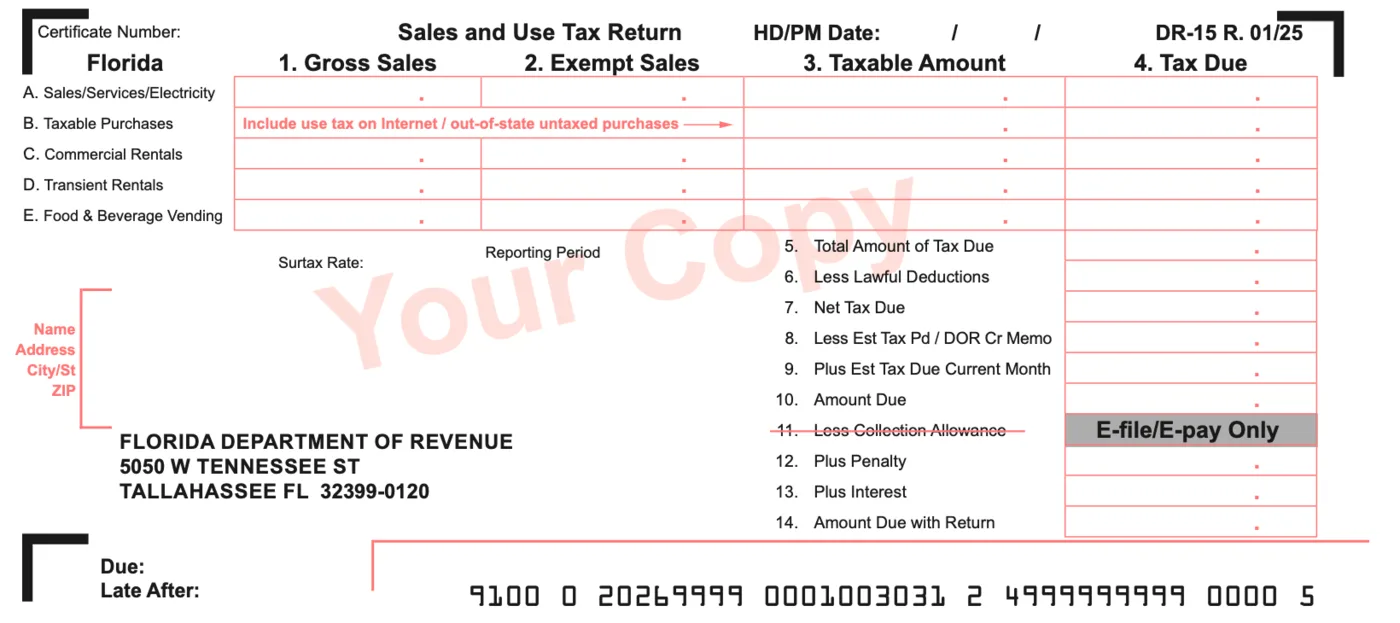
Fill it in this order:
- Line A, Column 1: gross sales for the period. The Department says not to include the tax you collected.
- Line A, Column 2: exempt sales, such as sales to dealers who gave you a resale certificate.
- Line A, Column 3: the taxable amount, Column 1 less Column 2.
- Line A, Column 4: tax due, the 6% and the surtax together.
- Lines 15(a) to 15(d) on the back: the surtax detail, shown below.
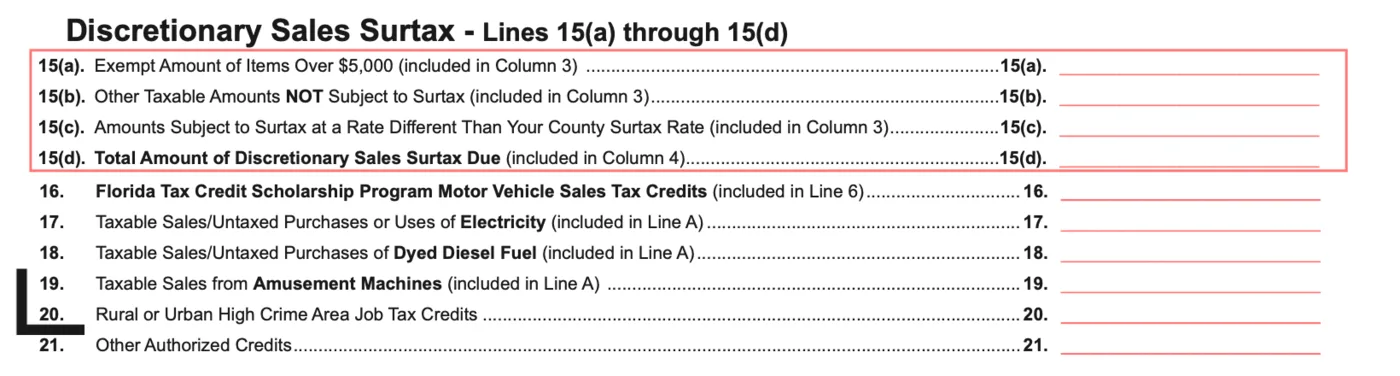
Line 15(a) takes the part of any single item's price above $5,000. Line 15(c) takes sales taxed at a surtax rate different from your home county's.
The short form, DR-15EZ, is off limits to most traveling dealers. Its instructions say you cannot use it if you sell into a county with a different surtax rate than your own. If the Department sends you a DR-15EZ, call 850-488-6800 and ask for a DR-15.
A return is due for every period, even when you sold nothing in Florida. The instructions list a telefile line, 800-550-6713, for returns with no tax due. Most new accounts file quarterly. The Department sets frequency by annual tax collected: over $1,000 is monthly, $501 to $1,000 quarterly, $101 to $500 semiannual, and $100 or less annual.
The collection allowance still exists. File and pay electronically and on time, and you keep 2.5% of the first $1,200 of tax due, up to $30.
If Florida was a one-time trip, tell the Department you have closed or suspended the business at floridarevenue.com/taxes/updateaccount. Until you do, the returns keep coming due.
Comped records each table sale with its price, venue and date, so the period's gross sales total is ready when you fill in Line A.
Penalties
Selling unregistered is a crime on paper, and a late return costs at least $50. Section 212.18(3)(d) makes failing to register a first-degree misdemeanor. It adds a $100 registration fee, which the Department may waive for reasonable cause. Willfully failing to register after written notice from the Department is a third-degree felony.
For returns, the Department's sales and use tax page sets the late penalty. A late filing or payment may be charged 10% of the tax owed, but not less than $50. The $50 minimum applies even if no tax is due. A floating rate of interest runs on late payments.
Buying inventory with a resale certificate
Yes, a registered dealer can buy cards for resale without paying Florida sales tax. Registered dealers receive the Florida Annual Resale Certificate (Form DR-13) with the welcome package. The Department's resale certificate page says certificates expire on December 31.
At a show it works in both directions. When you buy from another dealer for resale, hand over a copy of your certificate. When a dealer buys from you tax free, keep a copy of his current certificate, or get an authorization number from the Department. The return instructions list a verification line, 877-357-3725.
Two limits apply. A card you buy for resale and then keep owes use tax. An out-of-state dealer with no Florida certificate is a separate case under Rule 12A-1.0015(3), so ask the Department before you skip the tax.
Most show buys between dealers are cash with no certificate in sight. Tax charged on such a buy is part of your cost, covered in the cost basis guide.
eBay and Whatnot versus your table
eBay has collected and remitted Florida sales tax on eBay orders since July 1, 2021, per its marketplace tax page, checked November 13, 2026. The Department's sales tax page gives the same date for marketplace providers. Whatnot collects where required.
The table is yours. Marketplace provider laws reach the marketplace's own sales only, so every card sold face to face is yours to tax.
What the promoter handles
The promoter does not collect or remit your tax. Since July 1, 1999, Florida flea market vendors collect and remit directly to the Department, per TIP 99A01-27. Operators are no longer required or authorized to remit tax collected by vendors.
The promoter's paperwork still points at you. Section 212.18(3)(g) says a person who conducts a convention or trade show must make the exhibitor agreements available to the Department for inspection and copying.
Booth fees changed in 2025. Florida repealed its sales tax on rent and license fees for the use of real property, for periods beginning October 1, 2025, per TIP 25A01-04. The TIP does not name show booths. Our reading is that a 2026 table fee should not carry Florida sales tax.
One worry you can drop: Florida's secondhand dealer registration. Section 538.03(2)(g) says that chapter does not apply to any person at antique, coin, or collectible shows or sales.
Florida's 1099-K floor
Florida has no lower state 1099-K threshold, so the federal rule applies. Platforms file a 1099-K when your gross payments exceed $20,000 and your transactions exceed 200 in the year, per platform. The IRS FAQs set that out. Whatnot's page for 2026 sales, checked November 13, 2026, does not list Florida among states with lower thresholds.
Florida has no personal income tax, so card profit faces federal tax only. You owe federal tax on profit whether or not a 1099-K arrives, as the 1099-K guide explains. The state 1099-K threshold table lists every state.
A show weekend, worked on the DR-15
Here is an example weekend at a Tampa table with one big slab, at Hillsborough County's 2026 rates. The vendor is based in Orlando and sells $3,000.00 of singles plus one $6,000.00 slab.
AN EXAMPLE $9,000 WEEKEND IN TAMPA, ON THE DR-15
Two days in Hillsborough County: $3,000.00 of singles and one $6,000.00 slab, 6% state tax plus 1.5% surtax capped at $5,000 per item.
The surtax base is $8,000.00 because only the slab's first $5,000.00 counts. Filed on paper, the full $660.00 is due. Putting $8,000.00 on Line 15(c) is our reading of the instructions, which do not show an item over $5,000 there.
The $660.00 was never your money. Profit is the $9,000.00 less the cost of the cards and your show expenses, which the card show profit calculator works out. A buyer who pays more than $10,000 in cash for one card triggers Form 8300, a separate federal duty.
Common mistakes, and fixing a missed show
Most Florida problems come from five habits.
- Skipping registration because it is one show. The statute has no one-show exception for retail sales.
- Charging the home county's surtax. The rate follows the show's county.
- Charging surtax on the whole price of a card over $5,000. That overcharges the buyer.
- Putting tax collected into gross sales. The Department says that raises the tax due and brings a bill.
- Skipping the return in a period with no Florida sales. The $50 minimum penalty applies at zero.
If you already sold at a Florida show without registering, the Department publishes a way back. Its voluntary disclosure page says you qualify if the Department has not already contacted you about the liability. You apply in writing, and the Department looks back three years.
Once tax and interest are paid, penalties are waived, except a 5% penalty on tax you collected and kept. The page says not to register online if you are applying. A CPA can tell you whether disclosure fits your case.
Three edge cases come up at tables. Cash sales are taxed like any other sale. A trade is a sale for income tax, at the value of what you receive, and the card trade calculator does that math. We did not find a Department page on sales tax for a card for card trade, so ask before you assume. A dealer who works shows in several states registers separately in each one, which the 2026 card show sales tax index compares.
Florida's recurring shows
Card Show by the Bay was listed at the Hilton Carillon Park in St. Petersburg, Pinellas County, at 7%. The Tampa Bay Sports Card Show was listed in Tampa, Hillsborough County, at 7.5%. The Hobby Card Show was listed at the Broward County Convention Center in Fort Lauderdale, at 7%.
How this looks in the Comped app
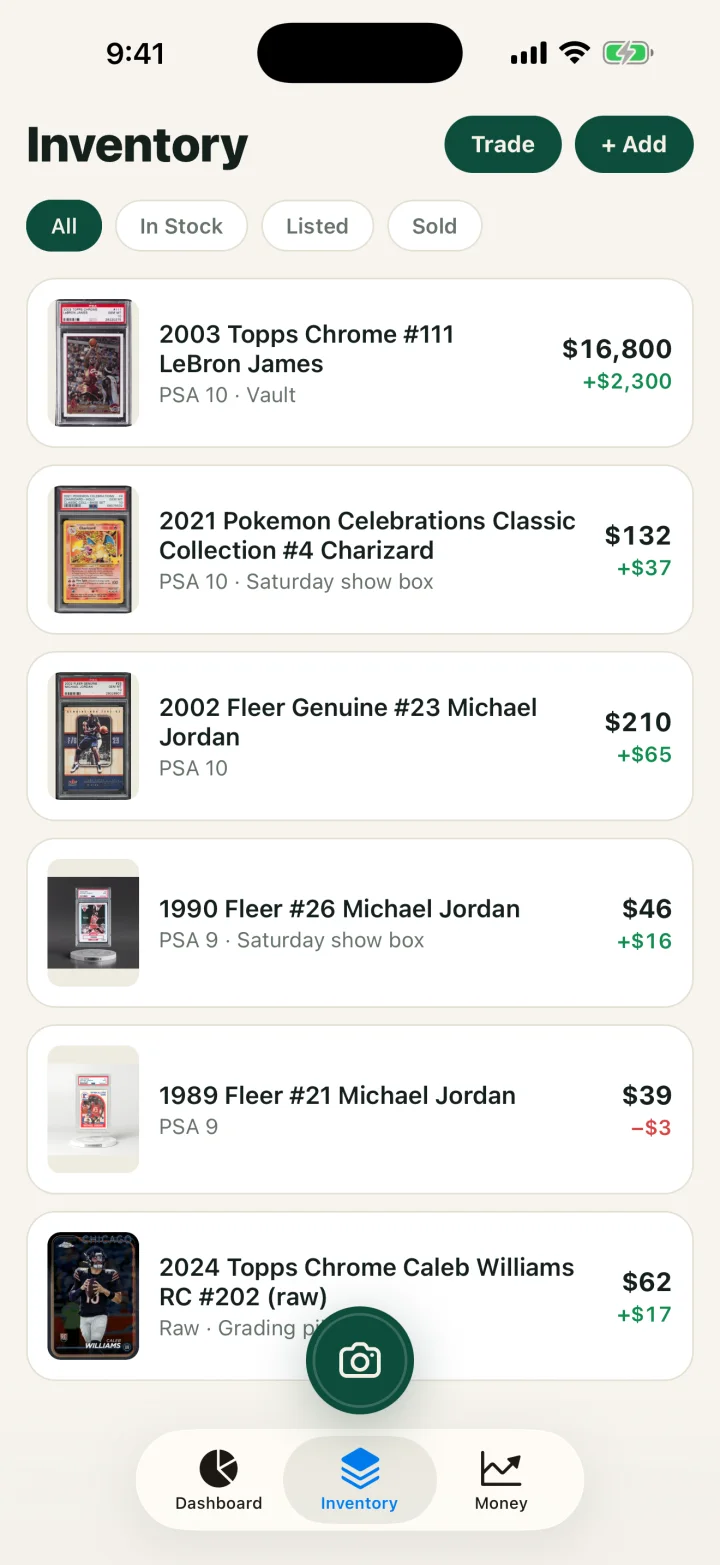
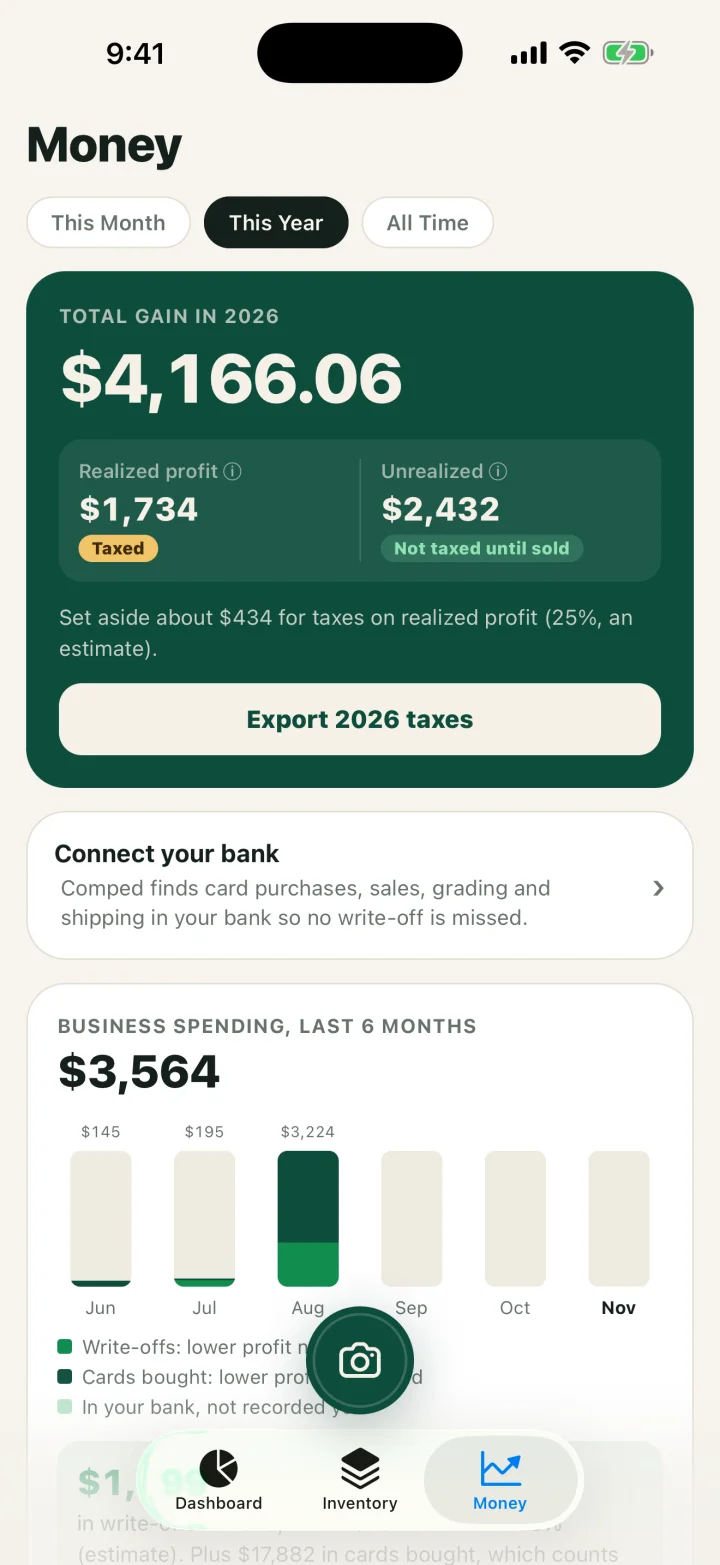
Line A of the DR-15 asks for gross sales for the period, and that number comes from your sale records. In Comped, each sale is its own record with the price, the date and where it sold. The Money tab exports every sale for the year. The app does not calculate or file sales tax.

Related guides
- State by State: Sales Tax and Show Permits for Card Vendors: every state's permit, rate and rules in one place.
- Georgia card show sales tax (2026): the next state up the circuit.
- Texas card show sales tax (2026): no temporary permit, a free regular one, 8.25% in the big show cities.
- California card show sales tax (2026): a free temporary seller's permit for events of 90 days or less.
- Card show sales tax index 2026: the 51-state comparison of permits, fees and promoter duties.
FAQ
Is there a temporary sales tax permit in Florida?
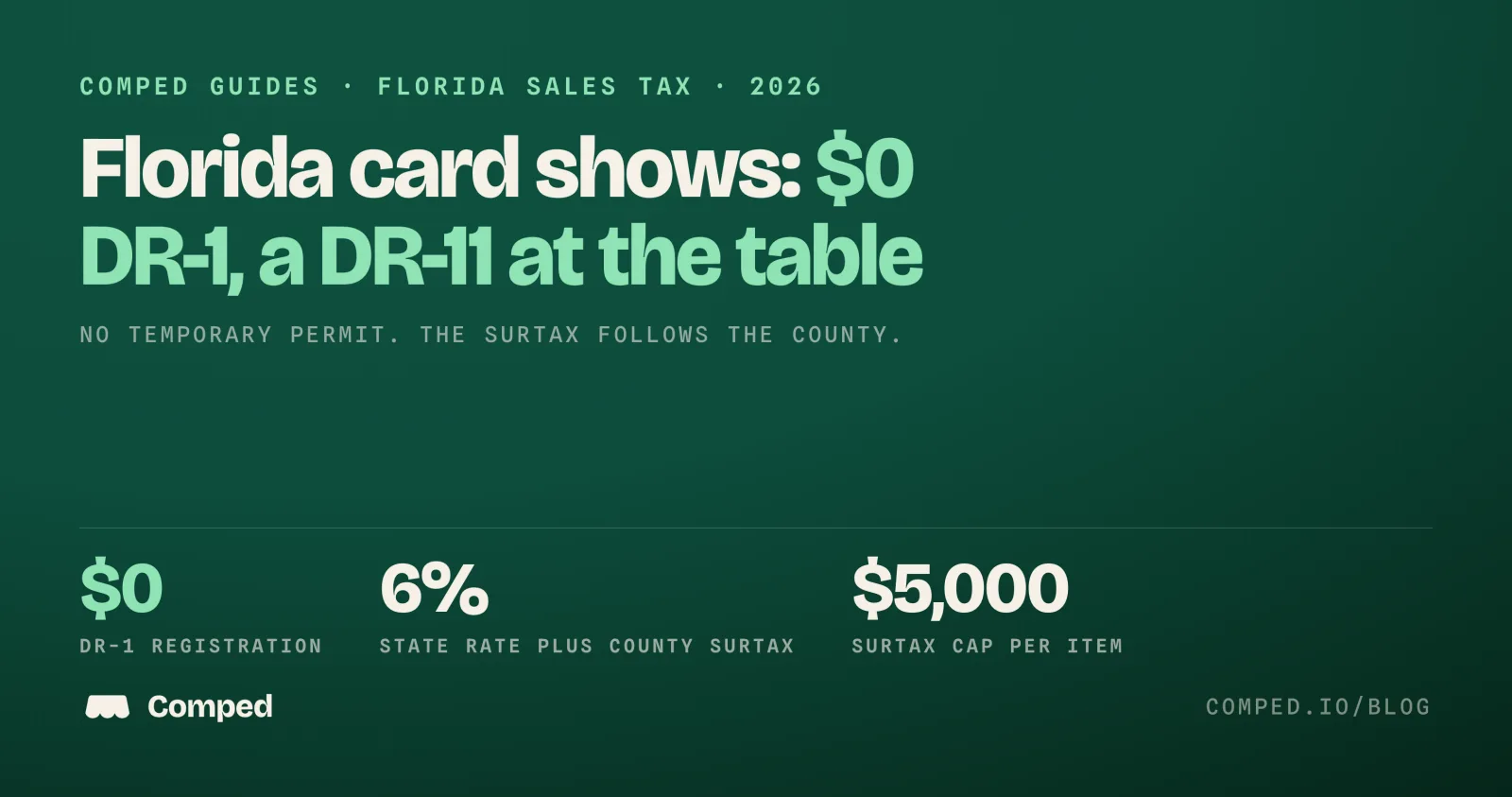
No. Florida show vendors use the regular dealer registration on Form DR-1, which is free online or on paper. The Department issues a Certificate of Registration (DR-11) that you display at the table.
Do I need a permit to sell at a single card show?
Yes. Florida law requires a dealer to register before engaging in business, and an exhibitor allowed to make retail sales must register. The statute has no one-show exception. Registration is free and takes about three business days online.
I only sell cards as a hobby. Do I still have to register?
On our reading, yes, if you take a table at a show. Florida exempts occasional sales, but not sales made from a location in competition with dealers who must collect tax. A card show floor is that kind of location.
I am from out of state. Do Florida's rules apply to me?
Yes. An exhibitor whose agreement authorizes retail sales in Florida must register as a dealer and collect the tax. You charge 6% plus the surtax of the show's county, and you file Florida returns until you close the account.
Does the promoter collect it for me?
No. Since 1999 Florida flea market vendors collect and remit their own tax, and operators may not remit it for them. You collect at the table and file the return.
Do I charge sales tax on cash?
Yes. The 6% and the county surtax apply to every retail sale at the table, whether the buyer pays cash, card or an app. Write the tax as its own line on the receipt.
Do I have to file a Florida return if I had no sales?
Yes. A return is due for every reporting period, even if no tax is due. A late zero return can still be charged the $50 minimum penalty. Close the account with the Department if you are done selling in Florida.
Can I buy inventory tax-free with a resale certificate?
Yes, once you are registered. Give the selling dealer a copy of your Florida Annual Resale Certificate and no tax is due on cards you will resell. You owe use tax on any card you keep.
SOURCES
- Section 212.18, Florida Statutes (2025), checked November 13, 2026.
- Florida Business Tax Application (Form DR-1, R. 01/26), Florida Department of Revenue, checked November 13, 2026.
- Registering Your Business (Form DR-1N, R. 01/26), Florida Department of Revenue, checked November 13, 2026.
- Florida Business Tax Registration, Florida Department of Revenue, checked November 13, 2026.
- Registration Fees Eliminated Beginning January 1, 2018 (TIP 18A01-02), Florida Department of Revenue, checked November 13, 2026.
- Rule 12A-1.037, Florida Administrative Code, occasional or isolated sales, checked November 13, 2026.
- Sales and Use Tax, Florida Department of Revenue, checked November 13, 2026.
- Discretionary Sales Surtax, Florida Department of Revenue, checked November 13, 2026.
- Discretionary Sales Surtax Information for Calendar Year 2026 (DR-15DSS, R. 11/25), Florida Department of Revenue, checked November 13, 2026.
- Sales and Use Tax Return (Form DR-15, R. 01/25), Florida Department of Revenue, checked November 13, 2026.
- Instructions for DR-15 (Form DR-15N, R. 10/25), Florida Department of Revenue, checked November 13, 2026.
- Instructions for DR-15EZ (Form DR-15EZN, R. 10/25), Florida Department of Revenue, checked November 13, 2026.
- Annual Resale Certificate for Sales Tax, Florida Department of Revenue, checked November 13, 2026.
- Sales Tax Changes for Flea Market Vendors and Operators (TIP 99A01-27), Florida Department of Revenue, checked November 13, 2026.
- Sales Tax on Commercial Rentals Repealed Effective October 1, 2025 (TIP 25A01-04), Florida Department of Revenue, checked November 13, 2026.
- Voluntary Disclosure of Tax Liabilities, Florida Department of Revenue, checked November 13, 2026.
- Section 538.03, Florida Statutes (2025), secondhand dealers, checked November 13, 2026.
- Taxes and import charges, eBay, checked November 13, 2026.
- 2026 Form 1099-K for U.S. Sellers, Whatnot, checked November 13, 2026.
- IRS issues FAQs on Form 1099-K threshold, IRS, checked November 13, 2026.
This is general information for card sellers, not tax or legal advice for your situation. Rules change and states differ; a CPA who knows your numbers wins every time.