Who counts as a vendor in California
Anyone selling taxable goods at a California show is a vendor who needs a seller's permit. The CDTFA's seller's permit FAQ covers anyone engaged in business in California who sells tangible personal property that is ordinarily taxable at retail. That includes individuals, partnerships, corporations and LLCs. A place of business counts even if it is only temporary, which describes a show table.
The only way out is the occasional seller rule, and a card vendor does not fit it. Publication 107 says an occasional seller makes no more than two sales in a 12-month period. A third sale in 12 months means you need a permit. A show table makes dozens of sales in a day.
Which permit you hold depends on where you are based and how often you sell. The CDTFA's temporary sellers page sorts convention and trade show sellers this way.
| Your situation | Permit | Cost |
|---|---|---|
| No permanent place of business, one show or a few inside 90 days | Temporary seller's permit, each location registered | $0 |
| California dealer in the business of selling cards | Regular (ongoing) seller's permit, plus a sub-permit for each show location | $0 |
| Out-of-state dealer at or under the CDTFA sales threshold | Temporary seller's permit for the show | $0 |
| Out-of-state dealer over the threshold | Ongoing seller's permit | $0 |
| No more than two sales in 12 months | None (occasional seller) | $0 |
The page sends out-of-state sellers to Publication 77 for the threshold. That publication's sales figure is more than $500,000 of goods delivered in California in the preceding or current calendar year. Our reading is that this is the threshold the temporary sellers page means.
Trading cards are taxable tangible personal property in California, slabs included, with no collectibles exemption. Hobby or business for income tax is a separate question, covered in our guide to taxes on selling sports cards. The state by state sales tax guide covers every state's table rules.
How to get a temporary seller's permit
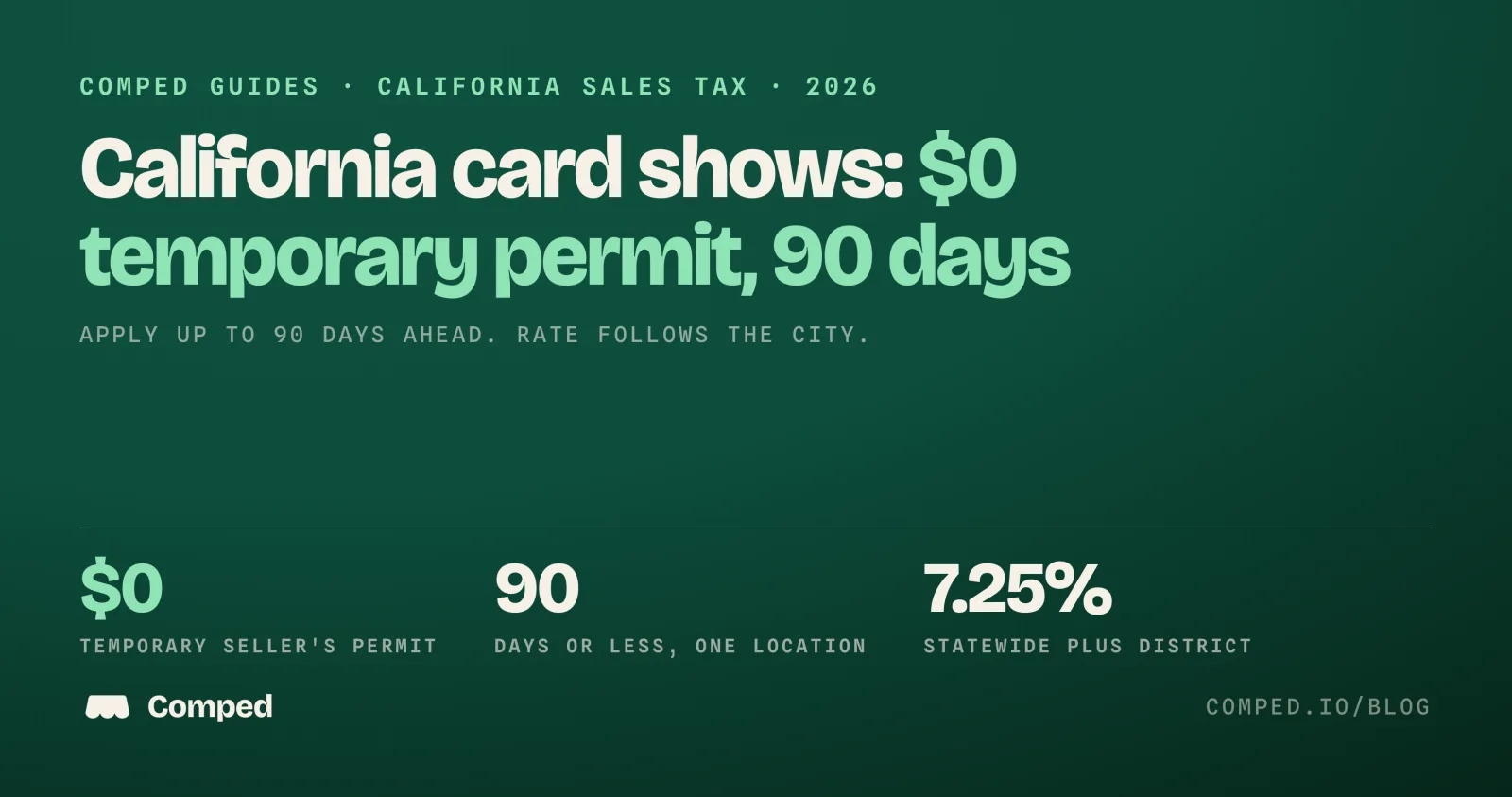
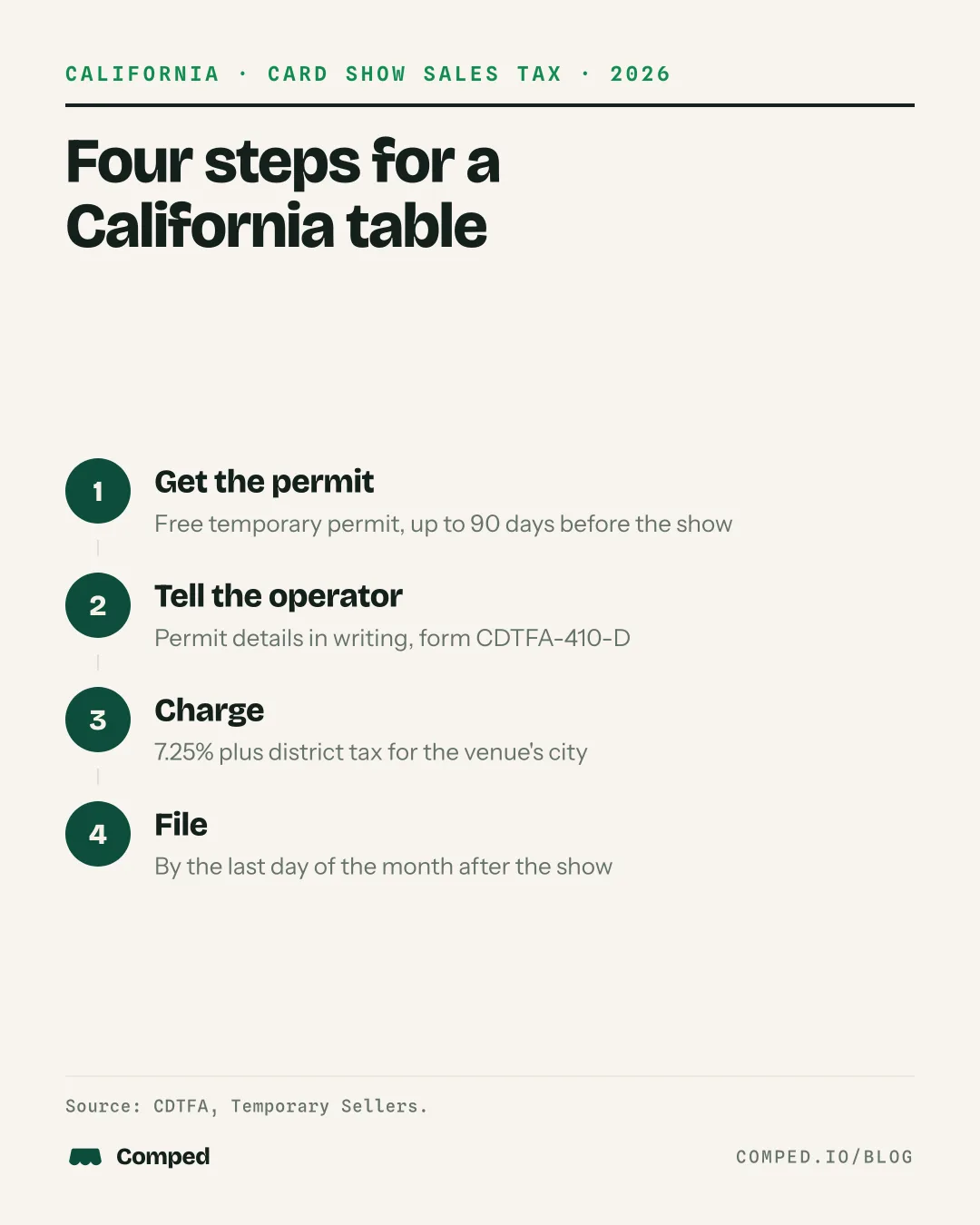
Register through CDTFA Online Services, under the Registrations tab. There is no paper application to mail. The temporary sellers page says a seller at a location for less than 90 days is a temporary seller. That seller must hold a temporary seller's permit. The permit is free, covers 90 days or less at one location, and can be obtained 90 days before your start date.
You give a valid start and end date for each temporary location. You can register several locations on one temporary permit if they all fall within the same 90-day period. You cannot add a new location to an existing temporary permit. Once you finish, you can print a permit for each location.
Use the show's address as the business address. Form CDTFA-410-D says the business address on a temporary permit should be the temporary selling location. The mailing address should be your home or permanent business.
A seller who already holds a regular seller's permit registers a sub-permit for each temporary location instead. Publication 111 says you can add one online or at a CDTFA office. If you live in California and work shows all year, that regular permit plus a sub-permit per show is the setup.
The seller's permit FAQ says there is no fee. CDTFA may require a security deposit in some cases, such as a history of nonpayment, per Publication 73. CDTFA's pages do not publish a processing time, so do not leave registration for the week of the show.
The timeline, counted back from show day
Start at 90 days out, because that is the earliest CDTFA issues a temporary permit. The dates below come from CDTFA's pages, except the two week line, which is our suggestion.
| When | What to do |
|---|---|
| 90 days before | Earliest day to register a temporary seller's permit for the show's dates and address. |
| When you book the table | Ask the operator for its deadline. Send form CDTFA-410-D with your permit number. |
| 2 weeks before (our suggestion) | Have the permit printed. Look up the venue's rate by address on CDTFA's rate page. |
| Show day | Display the permit. Charge the venue city's combined rate. Write down every sale. |
| After the last day | Total the show's sales. A sub-permit holder tells CDTFA the location has closed. |
| Last day of the next month | Temporary permit return due, even with no sales. |
Our card show vendor checklist has the packing list for the same weekend.
What to bring to the table
Bring a printed copy of the permit for that location and display it. CDTFA's permits and licenses page says a seller's permit must be prominently displayed at your place of business. Publication 111 adds that CDTFA staff visit selling events and may check that sellers are displaying their permits.
Bring a way to record each sale as well. Publication 73 says to keep sales and use tax records for at least four years. The card show cash log is a free sheet for that.
What rate to charge, by show city
Charge the combined rate for the city where the show is held. The statewide rate is 7.25%, and district taxes add 0.10% to 2.00% on top, per the CDTFA's sales and use tax rates page. Registering each temporary location is how the right city and county receive their local and district taxes.
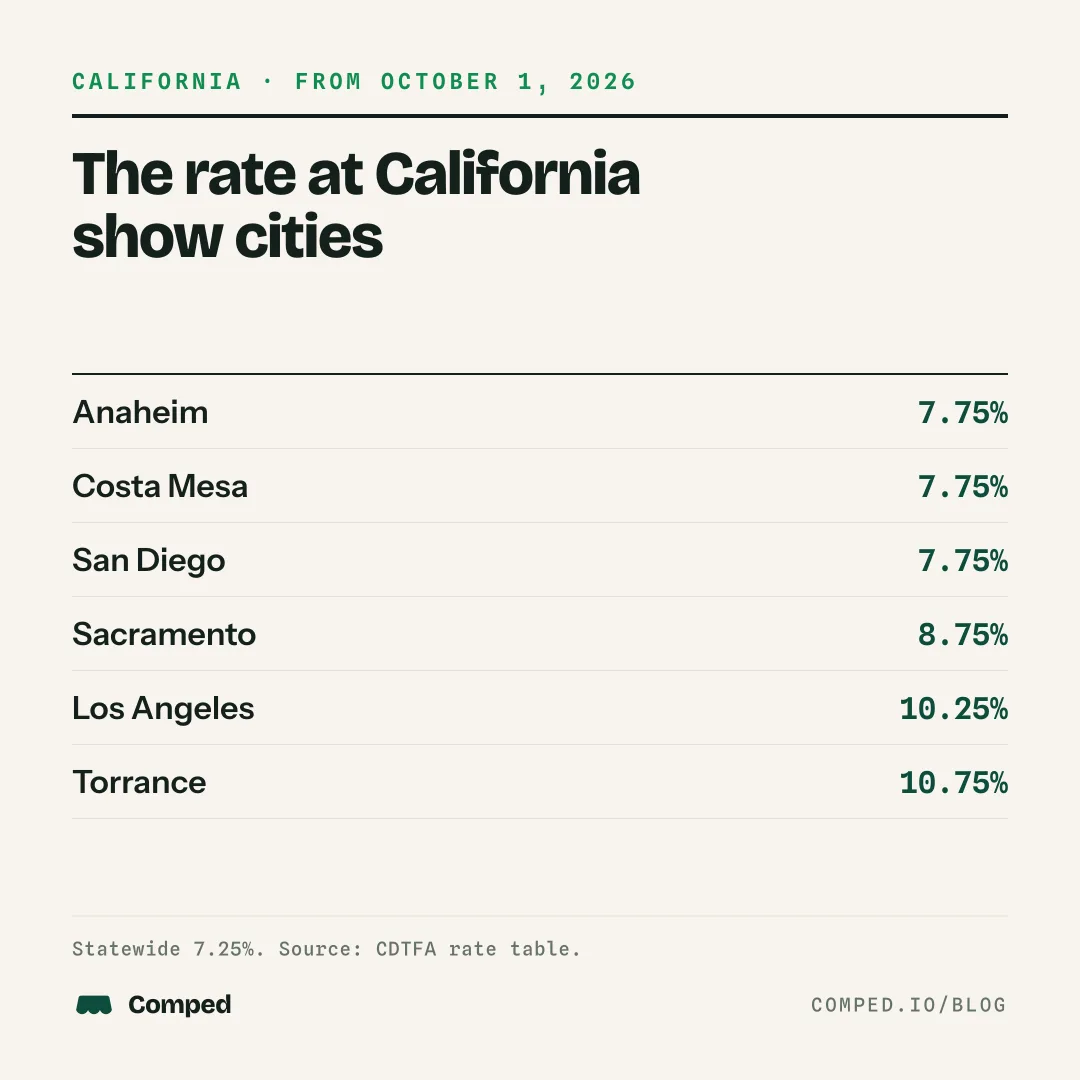
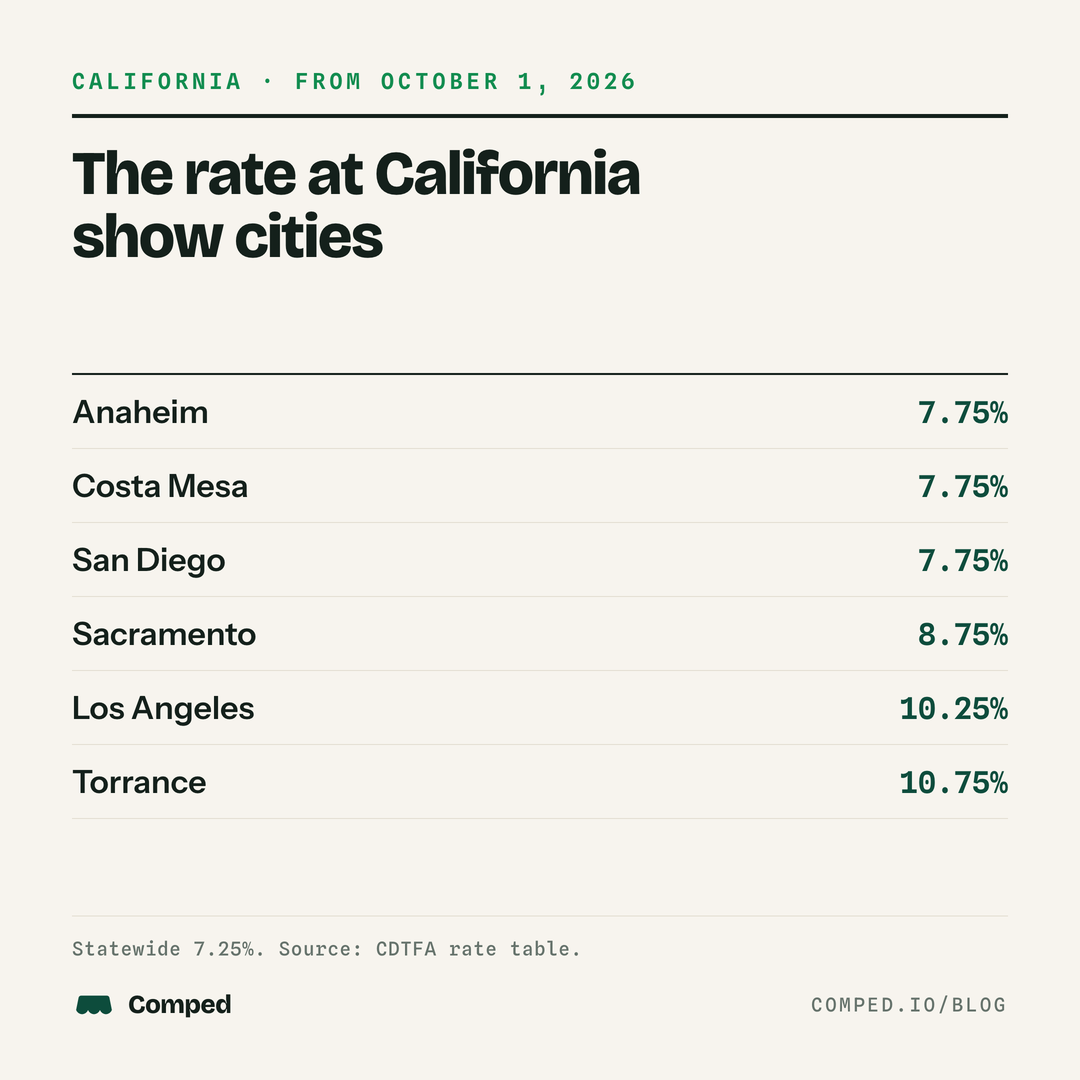
The spread across show cities is wide. The CDTFA's city and county rate table, effective October 1, 2026, shows the rates below. Rates can change each quarter, so look up the venue's street address before the show.
| Show city | County | Combined rate from October 1, 2026 |
|---|---|---|
| Anaheim | Orange | 7.75% |
| Costa Mesa | Orange | 7.75% |
| San Diego | San Diego | 7.75% |
| San Francisco | San Francisco | 8.625% |
| Ontario | San Bernardino | 8.75% |
| Sacramento | Sacramento | 8.75% |
| San Mateo | San Mateo | 9.625% |
| Santa Clara | Santa Clara | 9.75% |
| San Jose | Santa Clara | 10.00% |
| Los Angeles (city) | Los Angeles | 10.25% |
| Torrance | Los Angeles | 10.75% |
| Burbank, Long Beach, Pasadena, Pomona | Los Angeles | 11.00% |
How to file the return after the show
On a temporary permit you file one return, due by the last day of the month after the location closes. A show that ends August 9, 2026 has a return due September 30, 2026. You file through CDTFA Online Services under File a Return.
You file even if you sold nothing. CDTFA's filing dates page says a filing is required by the due date even if there are no sales to report. It also says you do not need to send a zero payment when no tax is due.
The return starts from total sales and works down to tax. The paper version, form CDTFA-401-A, shows the lines the online return follows.
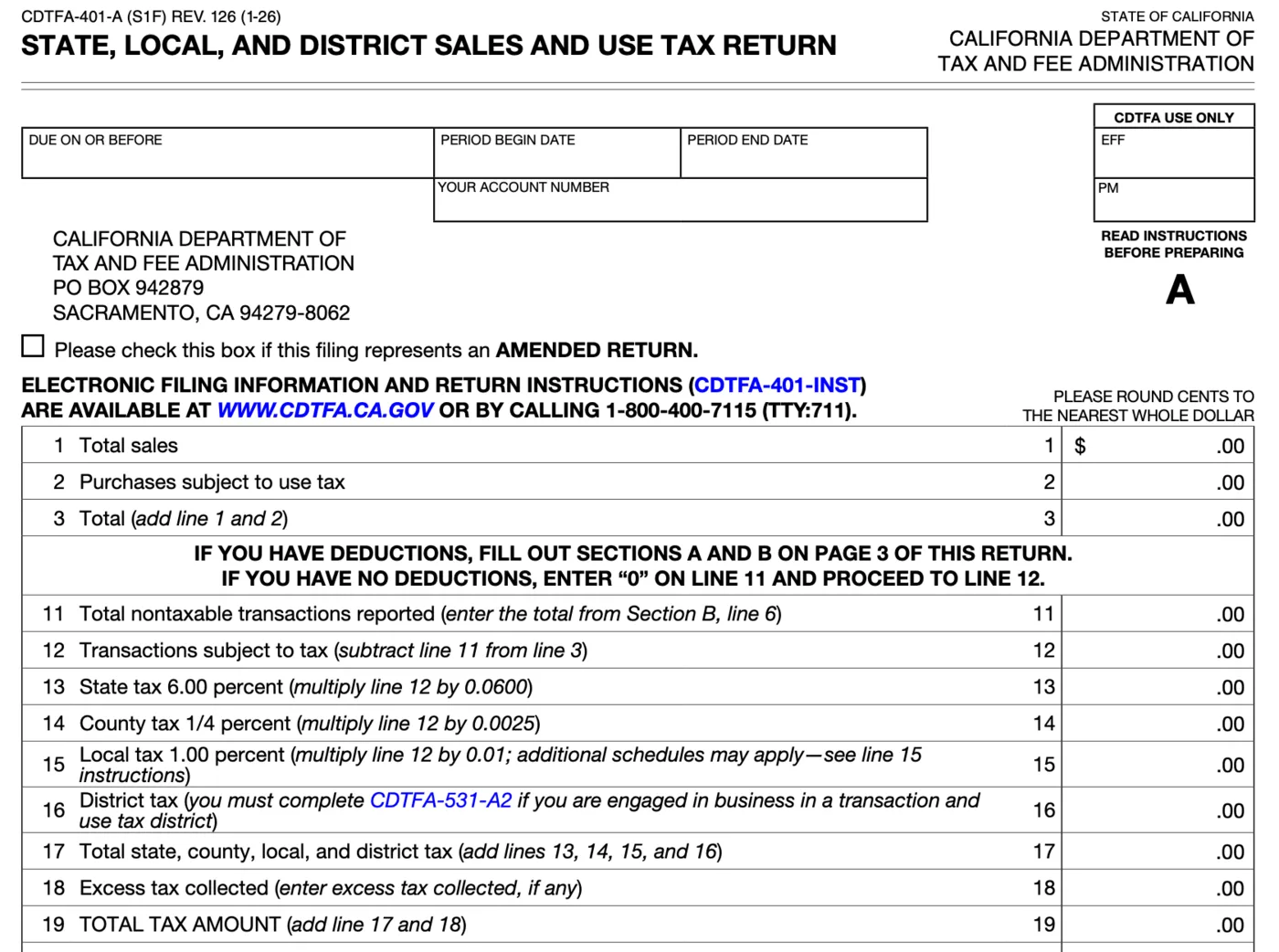
Line 1 is total sales. If your total includes the tax you collected, the form's Section A, line 9 removes it. Sales to other dealers for resale come off on Section A, line 4. Line 12 is what is left, the sales subject to tax.
The 7.25% statewide rate is three lines on the form: 6.00% state, 0.25% county and 1.00% local. District tax goes on line 16 from Schedule CDTFA-531-A2. The form asks you to round cents to the nearest dollar. Comped records each table sale with its price, venue and date, so one show's total sales can be added up from your own records.
On a regular permit, CDTFA assigns a filing frequency based on your reported or expected taxable sales. Quarterly returns are due April 30, July 31, October 31 and January 31. A due date on a weekend or state holiday moves to the next business day. Show sales on sub-permits go on that same return.
Penalties
A late return or late payment costs 10% of the tax, plus interest. CDTFA's Publication 75 sets a 10% penalty for filing late and a 10% penalty for paying late. Together they cannot exceed 10% of the tax due for the period. Interest runs for each month or part of a month.
Selling with no permit is its own violation. Publication 107 says making sales without first getting a seller's permit violates the law and subjects you to fines and penalties. It does not print a dollar figure.
| What went wrong | What CDTFA's publications say | Figure |
|---|---|---|
| Return filed late or tax paid late | Penalty on the tax due, plus monthly interest | 10% |
| Sales with no permit | Fines and penalties, amount not stated in Publication 107 | Not stated |
| Resale certificate used for cards you keep | The tax, plus 10% of the tax or this amount, whichever is more, per purchase | $500 |
| Operator rents to a seller with no valid permit and no record | Penalty on the operator, up to this amount per seller | $1,000 |
Buying inventory with a resale certificate
Yes. Give the selling dealer a resale certificate that carries your seller's permit number, and no tax is due on that purchase. Regulation 1668 lists the purchaser's permit number as a required element. CDTFA's own one page version is form CDTFA-230.
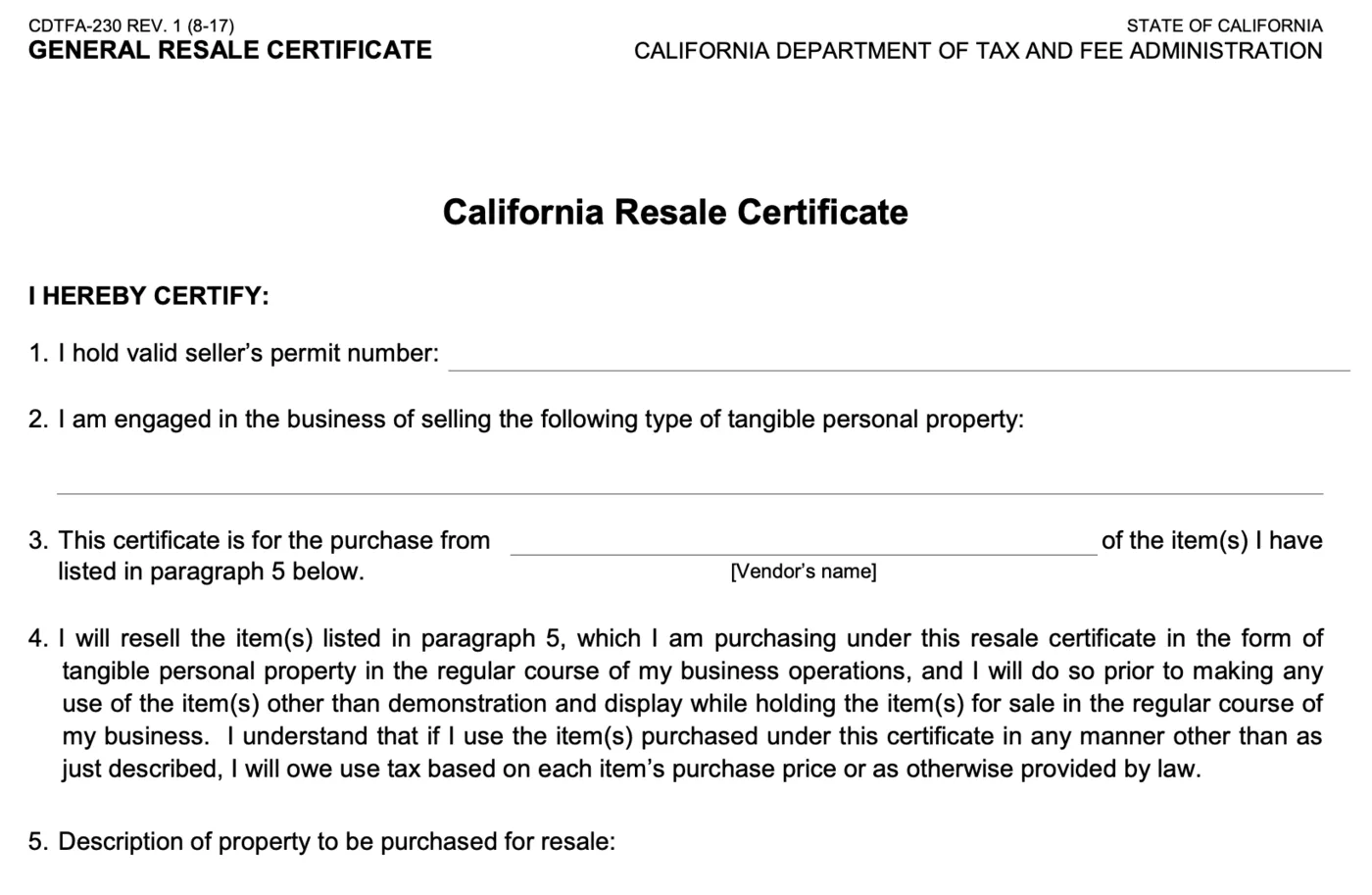
An out-of-state dealer who makes no sales in California has no permit number to give. Regulation 1668 lets that buyer write an explanation on the certificate instead. When you are the seller, take the certificate at the time of the sale and keep it. Without one, Regulation 1668 leaves the burden on you to prove the sale was for resale.
The certificate is only for cards you will resell. The form itself warns that misuse costs the tax plus a penalty of 10% of the tax or $500, whichever is more, for each purchase.
Most show buys between dealers are cash with no certificate in sight. If the other dealer charged you tax, that tax is part of your cost of the card. The cost basis guide covers the receipt that proves a cash buy at a show.
What the show operator handles
The operator checks your permit; it does not collect your tax. Under Revenue and Taxation Code 6073, swap meet, flea market and special event operators need written verification of a seller's permit before renting space. Publication 111 counts any event where two or more sellers pay for space, or buyers pay admission. A card show fits.
You give the operator six things in writing. They are your business name, mailing address, telephone number, driver license or state ID number, a description of what you sell, and your seller's permit number. Form CDTFA-410-D collects all six. CDTFA also recommends handing over a copy of the permit.
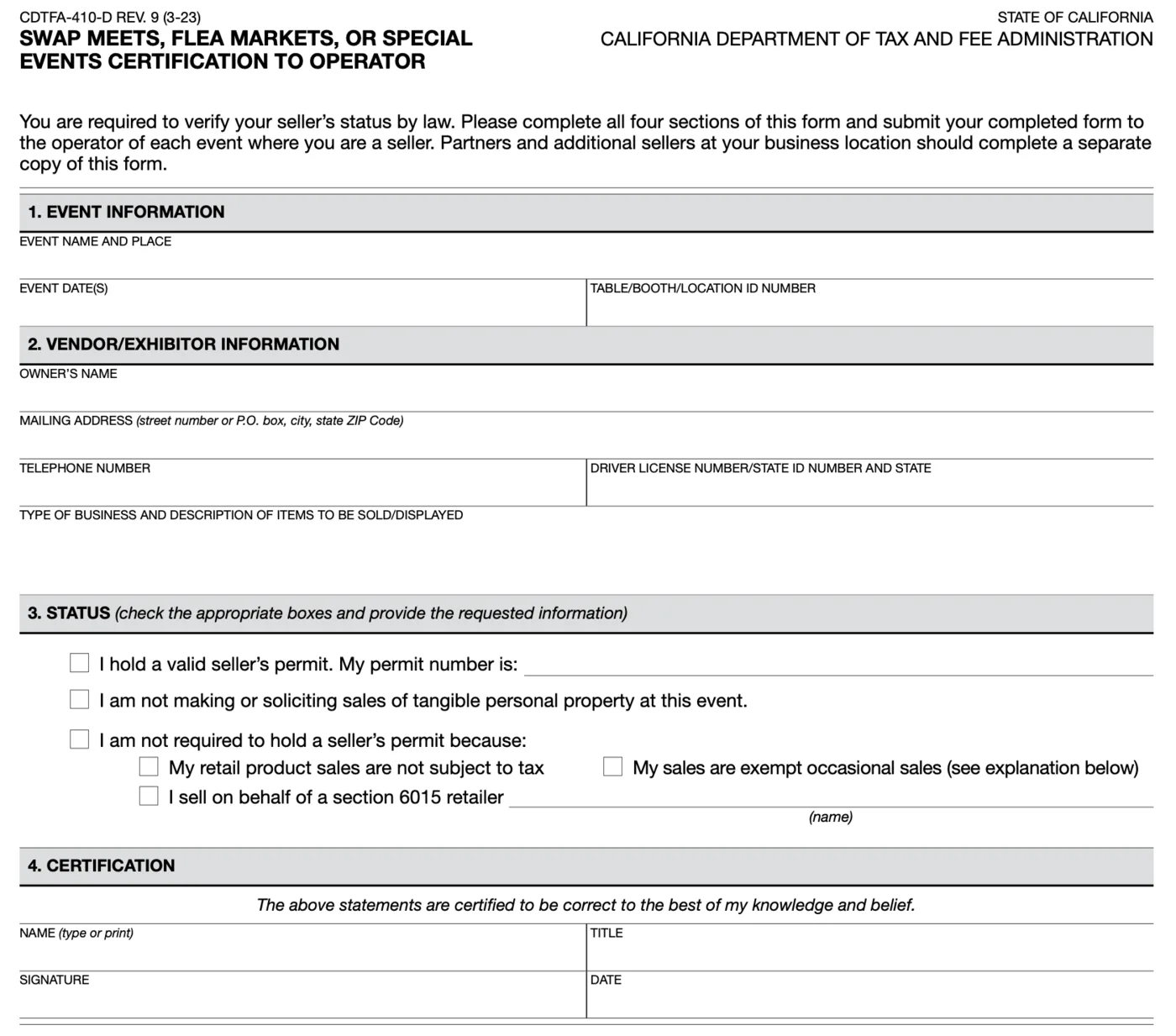
The operator's side explains why promoters are strict. Publication 111 says operators should keep seller records for at least four years. They must hand them to CDTFA within 30 days of a written request. The penalty is up to $1,000 for each seller who needed a permit, had none, and was not documented.
Send the form when you book the table, one per event. Your collection and your return are still yours.
Cash, trades and other edge cases
Cash sales are taxed like any other sale. The venue's rate applies whether the buyer pays cash, card or an app.
Trades are sales in California. Publication 73 says barters and exchanges are sales, and tax normally applies to the fair market value received. It also says you cannot deduct a trade-in from the selling price. As an example, say you sell a $500 card in Anaheim and take a $200 card plus $300 cash. Tax is figured on $500, which is $38.75 at 7.75%.
A dealer to dealer trade where both sides will resell is different. Each side can give the other a resale certificate, and neither sale is at retail. The card trade calculator works out the income tax side of a trade.
A show on a state-designated fairground adds one reporting line. The temporary sellers page says those sales are stated separately on the return, with no extra tax due.
Working shows in several states means one registration per state. California's permit covers California sales only. The 2026 card show sales tax index compares what each state asks before one show.
Common mistakes and how to fix them
The most common mistake is treating a temporary permit as a season pass.
THE RULE MOST VENDORS GET WRONG
A temporary permit is not a season pass. Several locations can share one only if they fall within the same 90-day period, and you cannot add a new location to it later. A vendor who works shows all year needs a regular seller's permit with a sub-permit for each show.
- Charging 7.25% everywhere. The Burbank rate is 11.00%. On $4,000 of sales there, charging 7.25% leaves you $150.00 short, and you owe the venue's rate either way.
- Skipping the return after a slow show. A filing is required even with no sales.
- Using the home address as the temporary permit's business address. CDTFA-410-D says to use the selling location.
- Subtracting a trade-in before figuring tax. Tax is on the full selling price.
- Taking a dealer's word that a buy is for resale. Get the certificate at the sale.
If you already sold at a California show with no permit, fix it before the next one. Our reading of CDTFA's pages is that you register through Online Services with your true start date. Then you file the return for that period and pay the tax, the 10% penalty and interest. CDTFA's Customer Service Center, 1-800-400-7115, can confirm the steps for your case.
eBay and Whatnot versus your table
eBay has collected and remitted California sales tax on eBay orders since October 1, 2019, per its marketplace tax page. Whatnot collects where required. You file nothing for the tax on those orders.
The table is yours. Marketplace facilitator laws reach the marketplace's own sales only. Every card sold face to face at a California show is taxed, collected and remitted by you.
California's 1099-K floor
California uses the federal test for a card seller. Platforms file a 1099-K when your gross payments exceed $20,000 and your transactions exceed 200 in the year, per platform. The IRS FAQs issued after the July 2025 law set that out, and Stripe's state filing table lists California as the same as the IRS.
Whatnot's list of states with lower thresholds for 2026 sales does not include California. Its earlier list for 2025 sales had shown $600. The state 1099-K threshold report tracks each state's source. Tax is owed on profit either way, as the 1099-K guide explains.
A show weekend, worked
Here is an example: a $4,000 weekend at an Anaheim table, at the combined rate of 7.75% in effect since October 1, 2026. The same weekend in Sacramento would collect $350.00 at 8.75%, and in Torrance $430.00 at 10.75%.
A $4,000 WEEKEND IN ANAHEIM, WORKED
Two days at a table in Anaheim on a temporary permit, $4,000.00 in card sales, every sale taxed at 7.75%.
The $310.00 was never your money. Collected sales tax is held for the state and sent in with the return. Your gross sales for income tax are $4,000.00, and profit is that less card cost and show expenses. The card show profit calculator works out the table's break-even. A buyer who pays more than $10,000 in cash for one card triggers Form 8300, a separate federal duty.
California's recurring shows
Collect-A-Con brings its 2026 tour to Los Angeles. The Showcase Card Show runs in Torrance and Anaheim. The Sacramento Card Show is at the SAFE Credit Union Convention Center. The OC Card Show is at the OC Fair in Costa Mesa. Each venue's city sets the rate, from 7.75% in Anaheim and Costa Mesa to 10.75% in Torrance.
How this looks in the Comped app
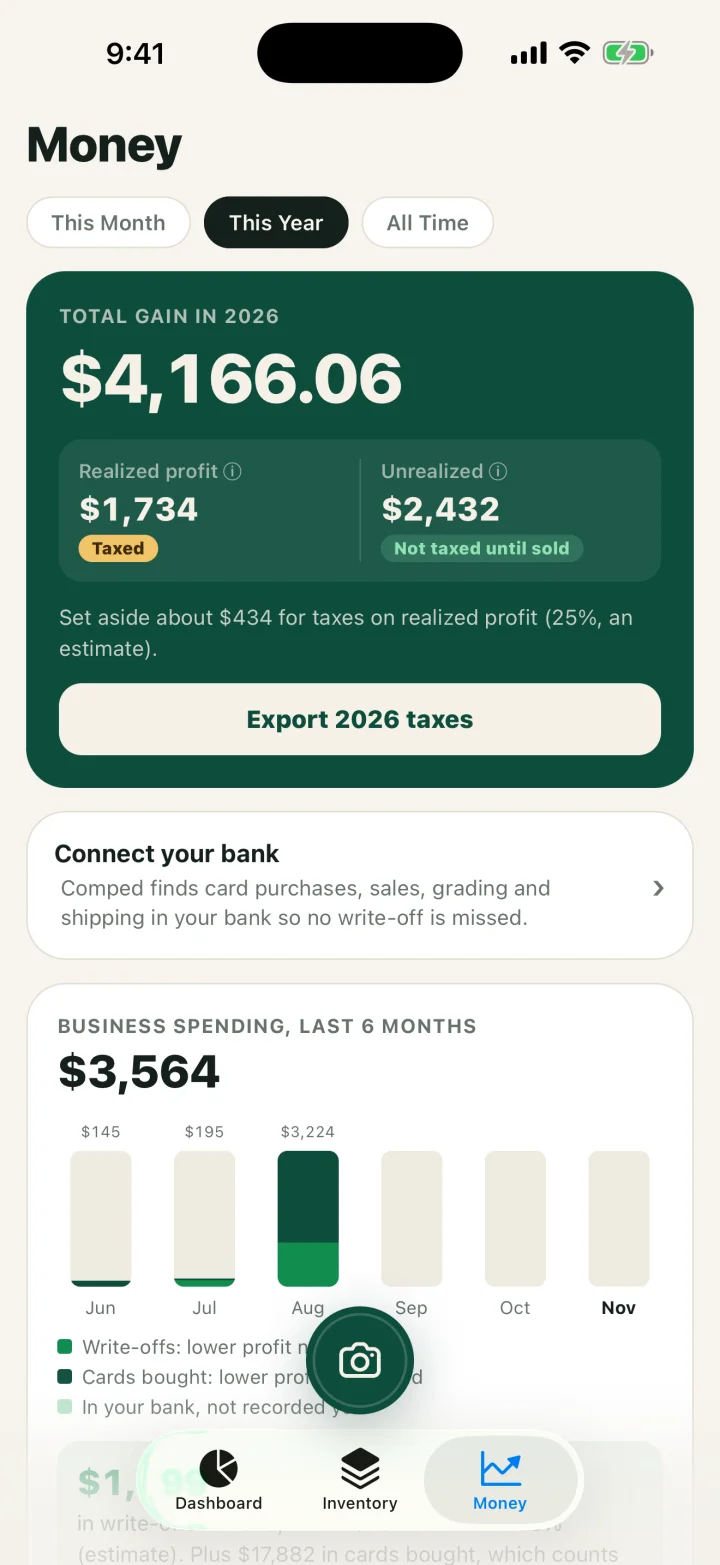
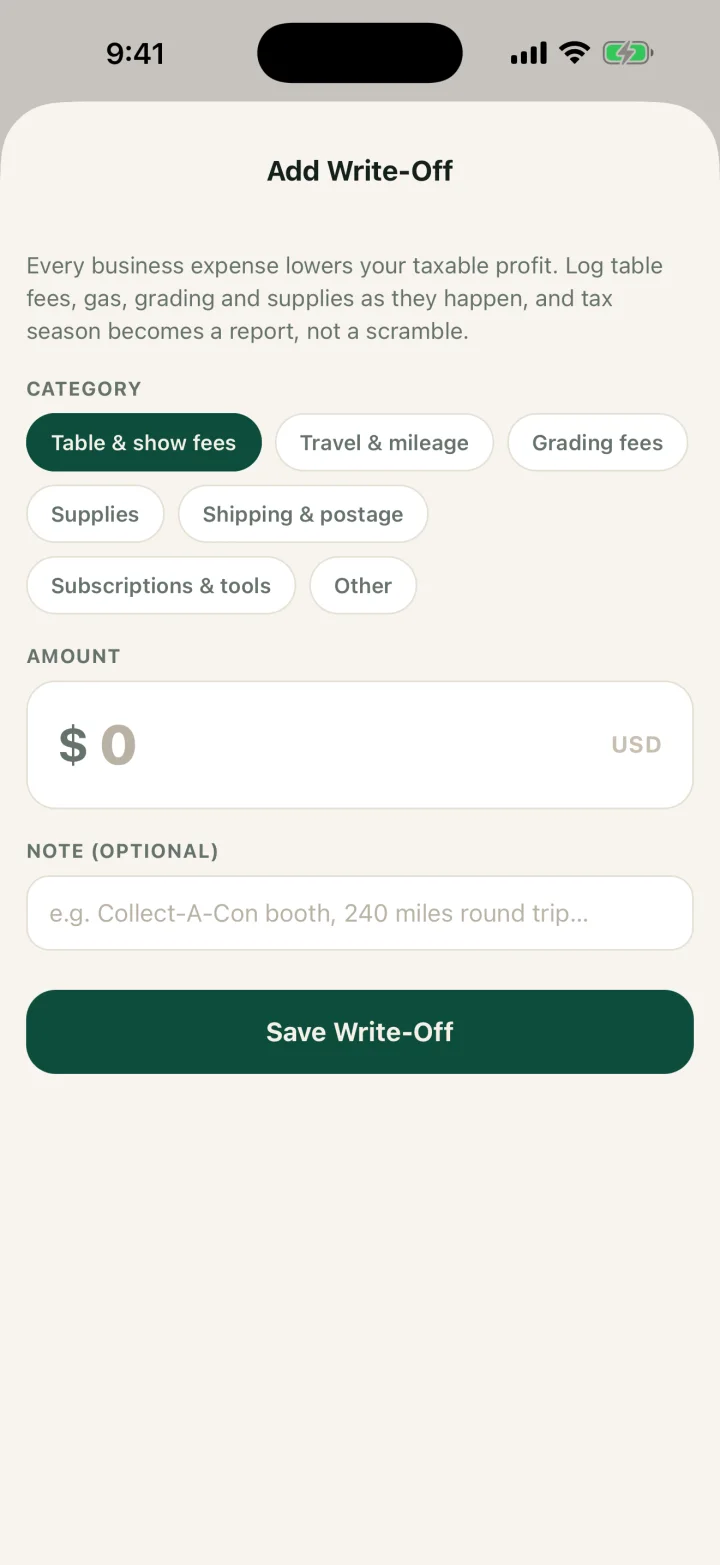
These are screens from the current iPhone app, with demo data. The first shows one recorded sale with its price, date and where it sold. The second is the Money tab, where Export 2026 taxes lists every sale for the year, and the third logs a table fee as a write-off. The app has no sales tax field and files no return; the sale prices are what you total for one.

Related guides
- State by State: Sales Tax and Show Permits for Card Vendors: every state's permit, rate and rules in one place.
- Texas card show sales tax (2026): no temporary permit, a free regular one, 8.25% in the big show cities.
- Florida card show sales tax (2026): free dealer registration and a county surtax capped at $5,000 per item.
- Card show sales tax index 2026: the 51-state comparison of permits, fees and promoter duties.
- How to track card show sales: the record that feeds both the sales tax return and Schedule C.
FAQ
How do I get a temporary sales tax permit in California?
Register through CDTFA Online Services with a start and end date for each show location. The temporary seller's permit is free and covers 90 days or less at one location. You can get it up to 90 days before the start date.
Do I need a permit to sell at a single card show?
Yes. An occasional seller makes no more than two sales in 12 months, and a show table makes far more. A single show on a temporary permit is the usual route.
I already have a California seller's permit. Do I need a temporary one for a show?
No. CDTFA says a seller with a permit for a permanent place of business registers a sub-permit for each temporary location instead. You report the show's sales on your regular return. Tell CDTFA when you stop selling at that location.
I travel to shows in other states, do their rules apply to me?
Yes. Out-of-state retailers under CDTFA's sales threshold hold a temporary permit for the show, and those over it need an ongoing permit. Texas has no temporary permit, and Florida uses its regular dealer registration.
What is form CDTFA-410-D?
It is the Swap Meets, Flea Markets, or Special Events Certification to Operator. You fill in the event, your contact details, your ID number and your seller's permit number, then give it to the show operator. It is not a permit and it does not go to CDTFA.
Does the promoter collect it for me?
No. The operator must verify your seller's permit in writing before renting you space, but you collect the tax and file the return.
Do I have to file a return if I sold nothing at the show?
Yes. CDTFA requires a filing by the due date even if there are no sales to report. You do not need to send a zero payment. A temporary permit return is due by the last day of the month after the location closes.
Do I charge sales tax on cash and on trades?
Yes. The venue's combined rate applies to every retail sale at the table, however the buyer pays. CDTFA treats a trade as a sale, and a trade-in does not reduce the taxable selling price.
SOURCES
- Temporary Sellers, California Department of Tax and Fee Administration, checked November 13, 2026.
- Obtaining a Seller's Permit (FAQ), CDTFA, checked November 13, 2026.
- Do You Need a California Seller's Permit? (Publication 107, revision July 2024), CDTFA, checked November 13, 2026.
- Operators of Swap Meets, Flea Markets, or Special Events (Publication 111, revision February 2024), CDTFA, checked November 13, 2026.
- Form CDTFA-410-D, REV. 9 (3-23), CDTFA, checked November 13, 2026.
- Your California Seller's Permit (Publication 73, October 2026), CDTFA, checked November 13, 2026.
- Out-of-State Sellers: Do You Need to Register with California? (Publication 77, revision May 2025), CDTFA, checked November 13, 2026.
- California City and County Sales and Use Tax Rates, effective October 1, 2026, CDTFA, checked November 13, 2026.
- Filing Dates for Sales and Use Tax Returns, CDTFA, checked November 13, 2026.
- Form CDTFA-401-A, State, Local, and District Sales and Use Tax Return, REV. 126 (1-26), CDTFA, checked November 13, 2026.
- Interest, Penalties, and Collection Cost Recovery Fee (Publication 75, revision June 2026), CDTFA, checked November 13, 2026.
- Regulation 1668, Sales for Resale, CDTFA, and form CDTFA-230, REV. 1 (8-17), checked November 13, 2026.
- IRS issues FAQs on Form 1099-K threshold, IRS, checked November 13, 2026.
- 2026 Form 1099-K for U.S. Sellers, Whatnot, and 1099-K state requirements, Stripe, checked November 13, 2026.
This is general information for card sellers, not tax or legal advice for your situation. Rules change and states differ; a CPA who knows your numbers wins every time.