Who files it
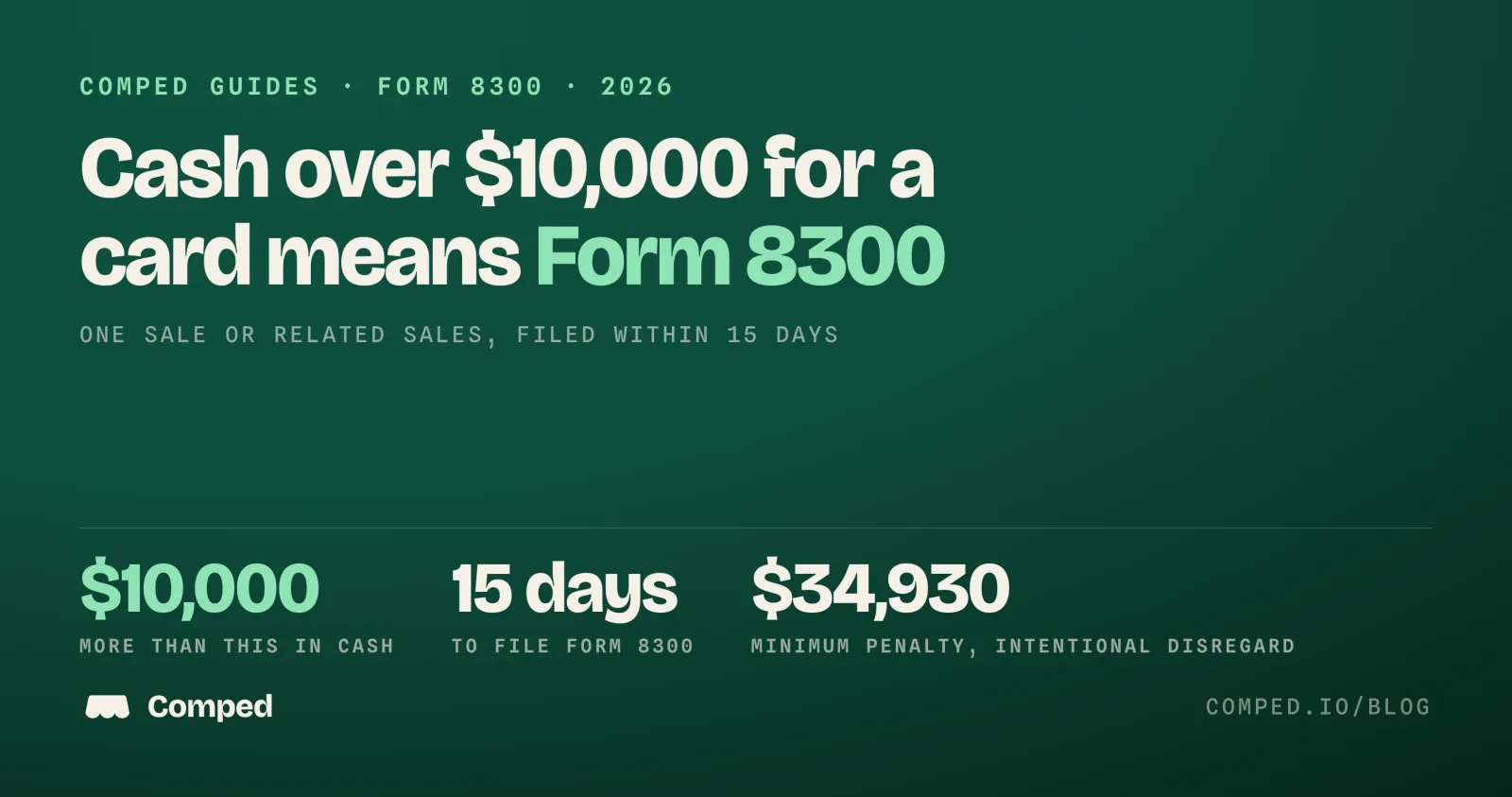
The person who receives the cash files, and only if the cash came in through a trade or business. The Form 8300 instructions put the duty on each person in a trade or business who receives more than $10,000 in cash. That covers one transaction or two or more related transactions. A dealer selling at a show is a trade or business. If you file a Schedule C for cards, assume it applies to you.
It is not a tax. Nothing is owed with the form; it is an information report to the IRS and FinCEN. The sale is taxed the way any sale is, on profit, as the master tax guide explains. The IRS page on Form 8300 and cash payments over $10,000 is the plain summary of the rule.
The duty follows the cash, so it flips when you are the buyer. This is the question dealers ask most.
| Deal | Who receives the cash | Who files Form 8300 |
|---|---|---|
| You sell a card to a collector for $12,000 in bills | You, a dealer | You |
| You sell to another dealer for $12,000 in bills | You, a dealer | You |
| You pay another dealer $12,000 in bills for inventory | The other dealer | The other dealer. You are the person named in Part I |
| You pay a private collector $13,500 in bills for a collection | A person not in the card business | No one, if the seller is not in a trade or business |
| You pay $13,500 for a collection by check | No cash changed hands | No one |
The private seller row comes from the IRS reference guide. Its example is a man who sells his old car for $11,000 in cash. He does not report, because he is not in the business of selling cars. A collector who sells again and again may be a business, which the hobby or business guide covers. When you pay cash to another dealer, expect to be asked for ID and your taxpayer number, and expect a statement the next January.
What counts as cash
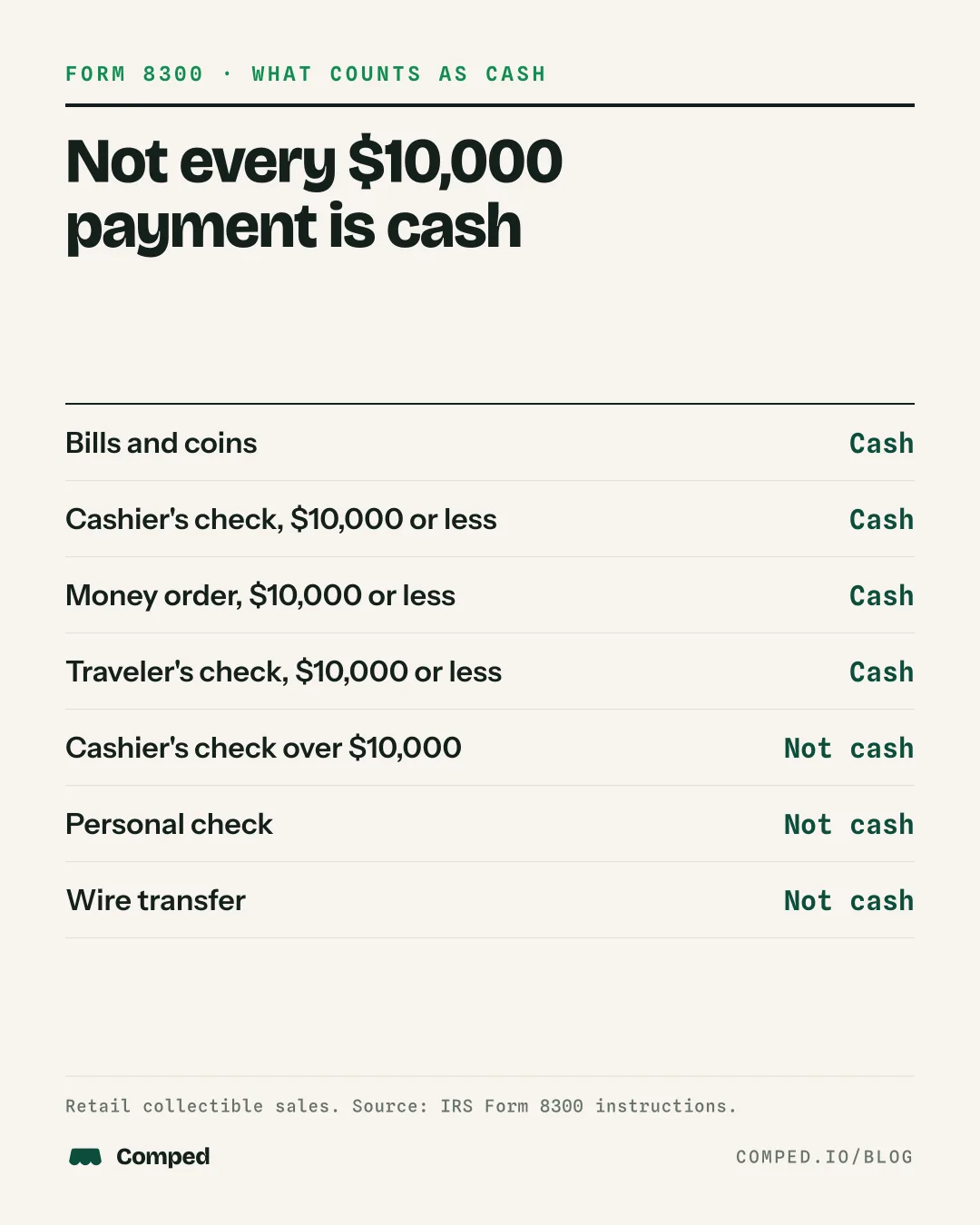
Cash means US and foreign currency, plus four kinds of paper with a face amount of $10,000 or less. The instructions name them: a cashier's check, a money order, a bank draft and a traveler's check. They count when received in a designated reporting transaction. That is a retail sale of a consumer durable, a collectible, or travel and entertainment.
The instructions define a collectible as "any work of art, rug, antique, metal, gem, stamp, coin, etc." Trading cards are not named. Our reading is that a card sold for five figures is a collectible under that list, and a dealer should treat it as one. Publication 1544 gives the closest example. A coin dealer is paid $6,200 in currency and a $7,000 cashier's check for gold coins. That dealer has received more than $10,000 in cash and must file.
| Payment | Cash for Form 8300? | Where the IRS says so |
|---|---|---|
| Bills and coins, US or foreign | Yes, always | Instructions, definition of cash |
| Cashier's check, $10,000 or less | Yes, in a retail collectible sale | Instructions; Publication 1544 coin dealer example |
| Money order, bank draft or traveler's check, $10,000 or less | Yes, in a retail collectible sale | Instructions, definition of cash |
| Cashier's check over $10,000 | No | Face amount is over the line |
| Cashier's check that is the proceeds of a bank loan | No | Publication 1544, bank loan exception |
| Personal check, any amount | No | Instructions, note under cash |
| Wire transfer | No | Reference guide example |
| Credit card, debit card or ATM card payment | No | IRS motor vehicle dealership Q&As |
| Zelle, Venmo, PayPal, Cash App | No, on our reading | Not named by the IRS; none is currency or one of the four instruments |
So a slab paid for with $9,500 in cashier's checks and $1,000 in bills is a $10,500 cash sale. A slab paid for with a $12,000 personal check is not a cash sale at all. The instrument's face amount, not the sale price, decides. Payment apps and card readers have their own form, covered in the PayPal, Venmo and card reader guide.
One condition is easy to miss. A retail sale means a sale by a business that mainly sells to ultimate consumers, whether or not this buyer plans to resell. A show dealer who mostly sells to collectors meets it. A business that mainly wholesales to other dealers is different. There the four instruments count only when it knows the buyer is using them to avoid the report. Bills count either way.
Related transactions
Payments from the same buyer within 24 hours are added together, and 24 hours means 24 hours, not a calendar day. The reference guide uses a motorcycle dealer: $9,000 at 10 a.m. and $9,000 that afternoon from one buyer is one $18,000 transaction. Payments more than 24 hours apart are also related when you know, or have reason to know, they belong to one series of deals.
Installments count too. Add the first payment and every later payment made within one year of it. Once the cash passes $10,000, file within 15 days of the payment that crossed the line. Then the count starts over, and another $10,000 in cash inside 12 months means another form.
A SHOW WEEKEND, WORKED
An example. One buyer pays bills for two cards at a two day show in March 2026.
NEVER SPLIT A PAYMENT
Breaking a cash payment into pieces to get under $10,000 is structuring. The reference guide defines it as breaking up a large cash transaction into small ones to disguise the true amount. The instructions say a single transaction may not be broken into multiple transactions to avoid reporting. The penalties reach the payer and anyone who helps. If a buyer proposes it, decline, take the sale as it is or not at all, and file.
The form, part by part
Form 8300 is one page with four parts, plus a second page for extra parties and comments. The current version is IRS Form 8300, Rev. December 2023, and the form says not to use older versions for 2024 or later sales. The excerpts below are from the official PDF, downloaded 13 November 2026. The item notes come from the instructions unless marked as our reading.
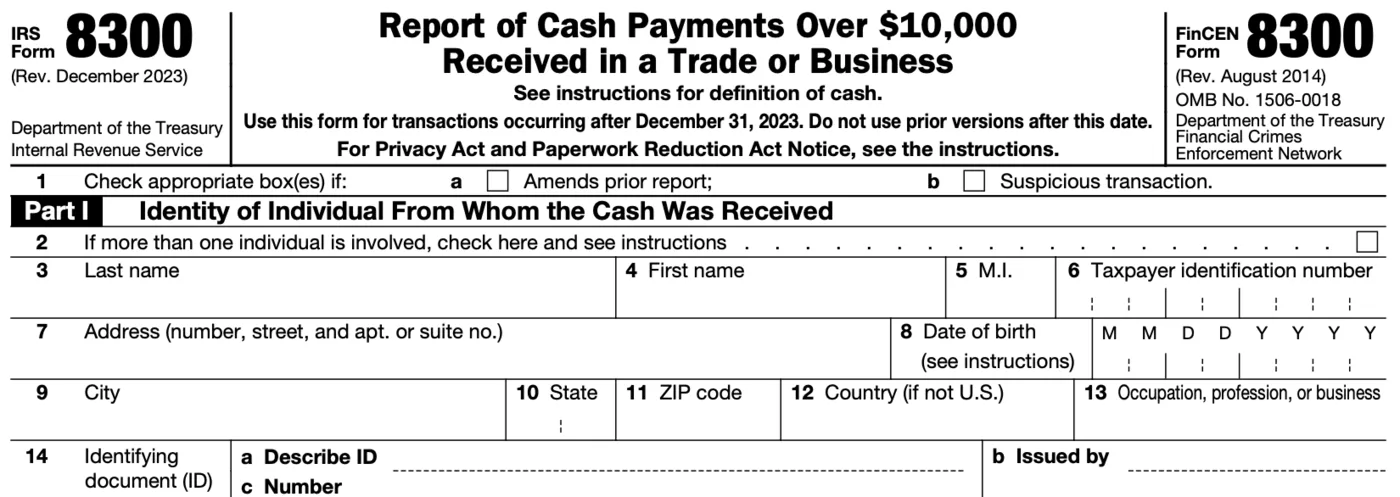
| Item | What a card dealer enters |
|---|---|
| 1a, 1b | Leave both blank on a normal filing. Check 1a only to amend an earlier form. Check 1b only for a suspicious transaction. |
| 2 | Check it if two or more people handed over the cash together. The others go on page 2. |
| 3 to 5, 7, 9 to 12 | The buyer's name and address, as shown on the ID you examined. |
| 6 | The buyer's taxpayer identification number. For an individual that is a Social Security number. |
| 8 | Date of birth in eight digits. 6 July 1960 is entered 07/06/1960. |
| 13 | The buyer's occupation, stated specifically. The instructions reject "businessperson" and "self-employed". |
| 14a, 14b, 14c | The ID you examined: its type, who issued it, and its number. A New Jersey driver's license is entered as "driver's license", "New Jersey" and the license number. All three are required. |
You must verify the name and address from a document normally accepted for cashing checks. The instructions list a driver's license, a passport and an alien registration card. Ask before the cash changes hands. It is far easier to ask a buyer who has not yet walked away.
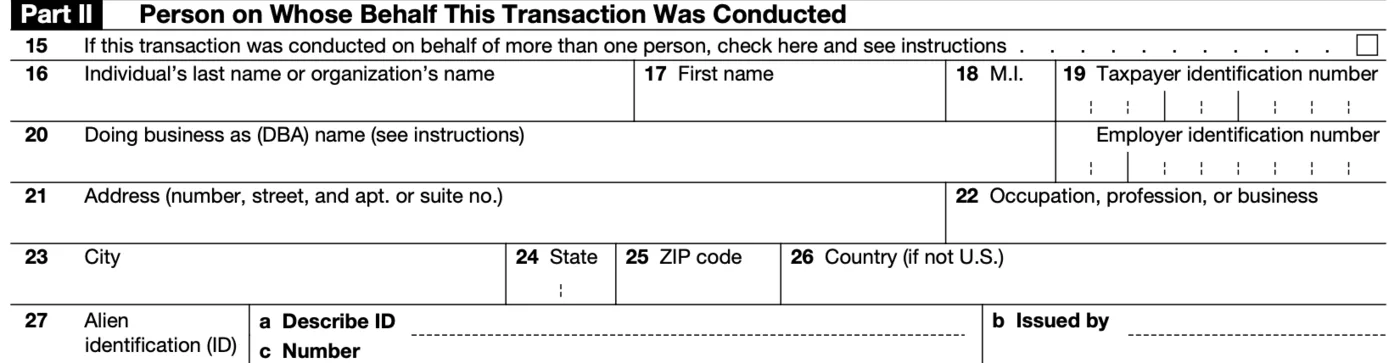
Skip Part II when the buyer in Part I is buying for himself. Fill it in when the person at your table is paying for someone else, such as a runner buying for a shop. The shop's legal name goes in item 16, its EIN in item 19 and any trade name in item 20.
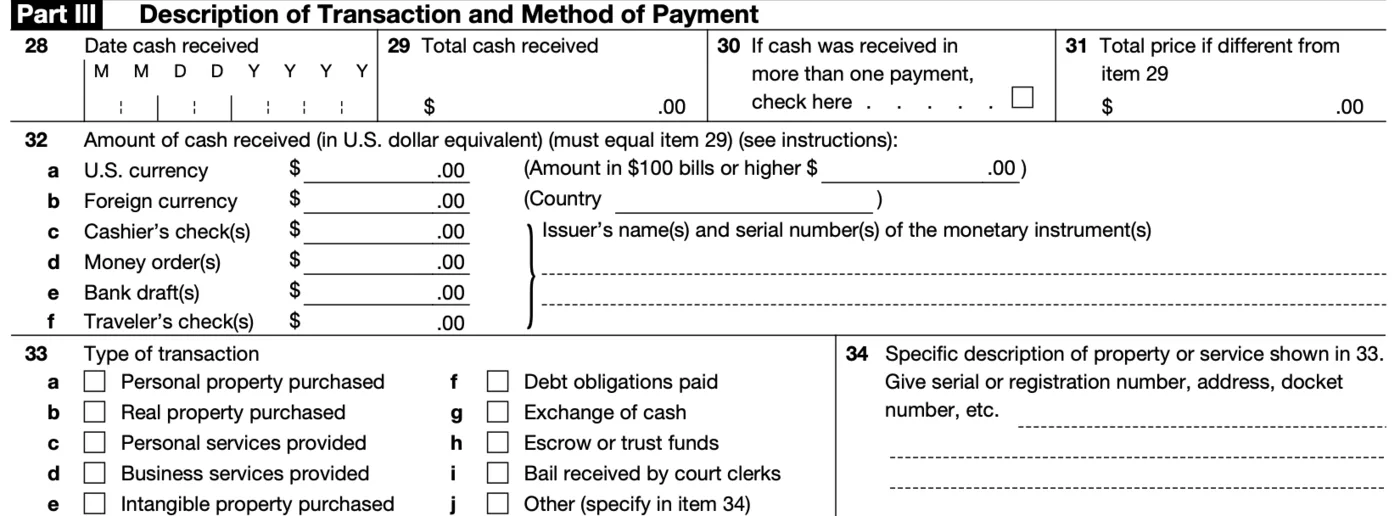
| Item | What a card dealer enters |
|---|---|
| 28 | The date you received the cash. With several payments, the date of the payment that took the total over $10,000. |
| 29 | Total cash received as of that date. |
| 30 | Check it if the cash in item 29 came in more than one payment. |
| 31 | The total price, if it differs from item 29. A $15,000 card paid with $11,000 in bills and a $4,000 personal check shows $11,000 in item 29 and $15,000 here. |
| 32a to 32f | The cash by kind. The lines must add up to item 29. Line a also asks how much came in $100 bills or higher. For each cashier's check, money order, bank draft or traveler's check, give the issuer's name and the serial number. |
| 33 | Type of transaction. Our reading is box a, Personal property purchased, for a card. The instructions do not define the boxes beyond bail and leases. |
| 34 | A specific description of what was sold. The form asks for a serial or registration number. Our suggestion is the year, set, card number, grader, grade and the certification number on the slab. |
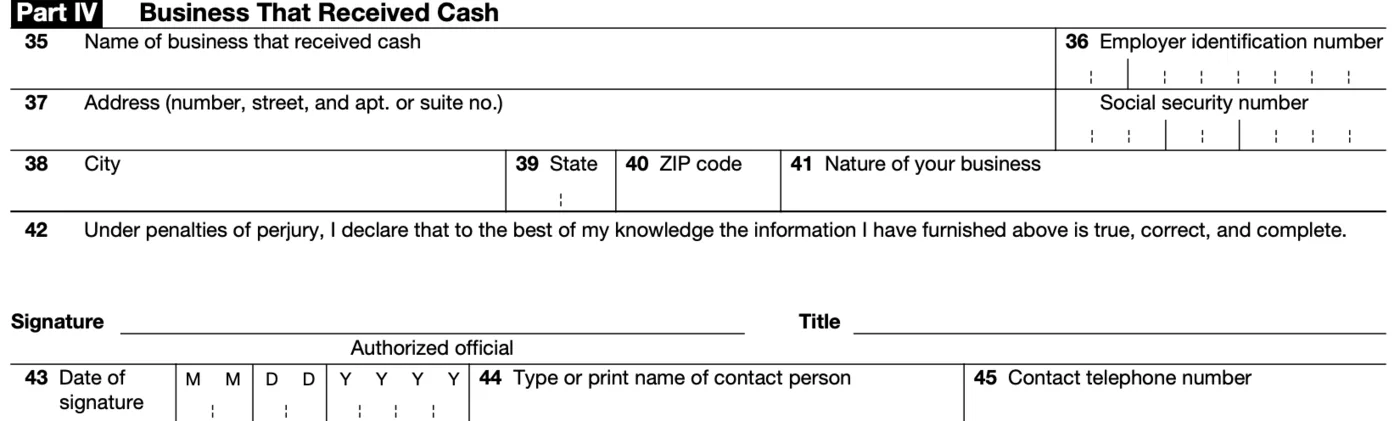
| Item | What a card dealer enters |
|---|---|
| 35, 37 to 40 | Your business name and address. |
| 36 | A sole proprietor must enter a Social Security number, and the EIN as well if the business has one. Every other entity enters its EIN. |
| 41 | The nature of your business, stated specifically. The instructions accept "jewelry dealer" and reject "business" or "store". "Sports card dealer" fits. |
| 42 to 45 | Signature of a person authorized to sign for the business, title, date, and a contact name and phone number. |
If the buyer refuses ID or a TIN
You still file, and you write down that you asked. The reference guide says a business must obtain the buyer's correct taxpayer identification number. If the customer refuses, a paper filer writes "customer refused" in item 6. An electronic filer leaves item 6 blank and notes the refusal in the comments.
The instructions add a rule for a number you asked for and could not get within 15 days. File anyway, and explain why in the Comments section on page 2. Keep a note of each attempt. The guide says a business may avoid the penalty for a missing number when reasonable cause applies. A foreign buyer with no US business ties may not need a number; item 27 takes the passport details instead.
You are free to turn the sale down. If you take it, the filing duty stays with you.
How and where to file
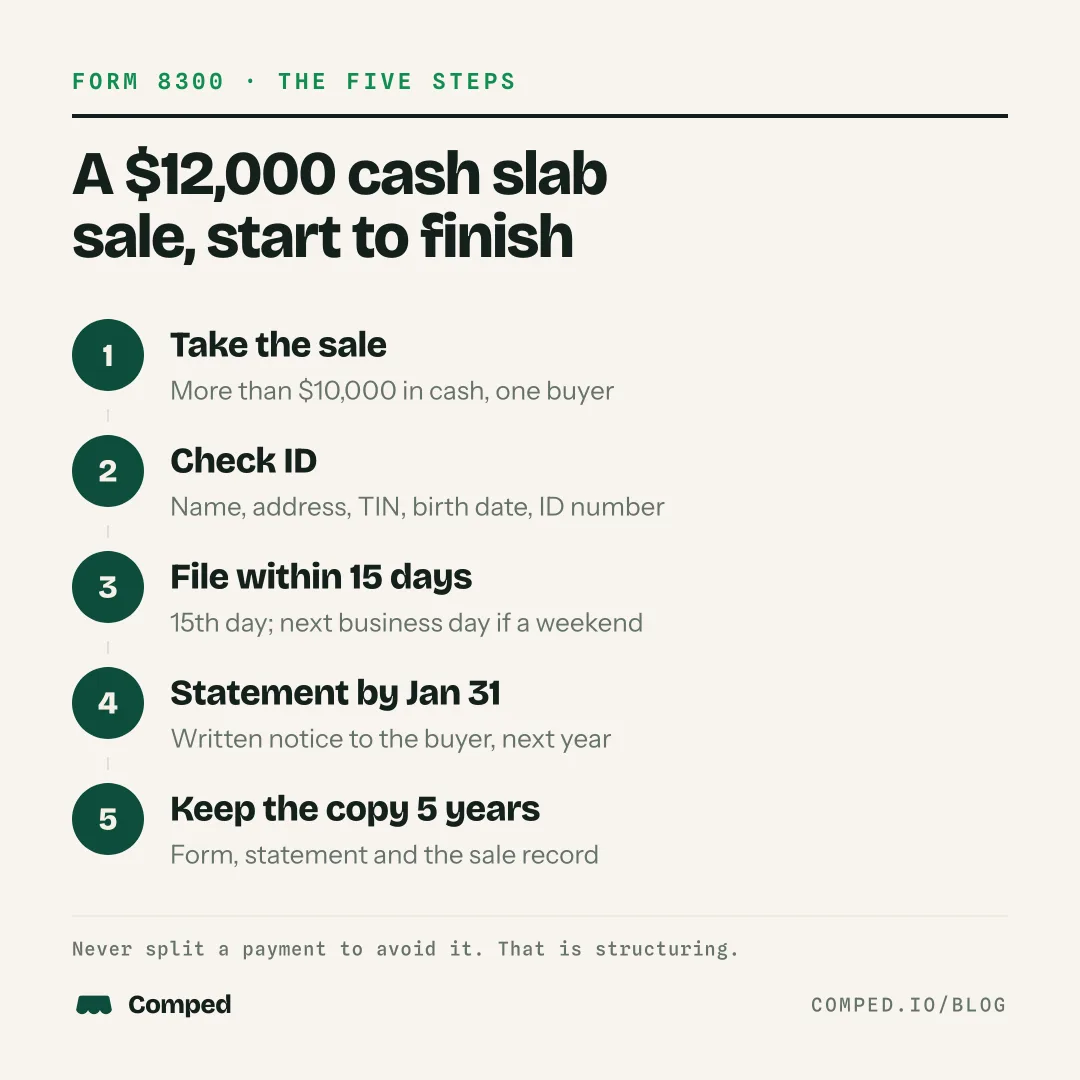
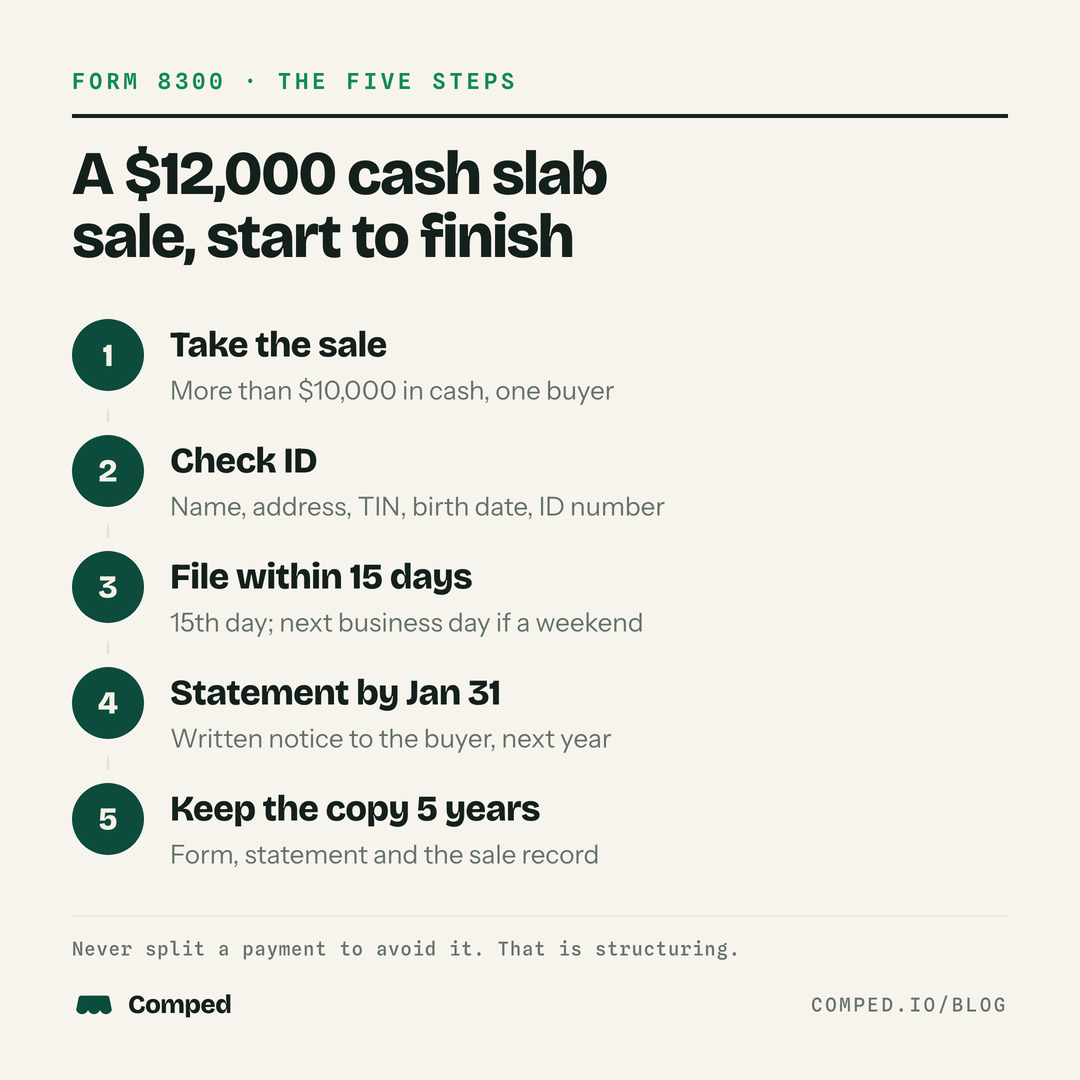
File by the 15th day after you receive the cash, online or on paper. If the 15th day is a Saturday, Sunday or legal holiday, the form is due the next business day. Online filing is through FinCEN's BSA E-Filing System, and the reference guide says it is free.
Paper forms go to the address in the instructions: Internal Revenue Service, Detroit Federal Building, P.O. Box 32621, Detroit, MI 48232.
E-filing is mandatory only for a business that must file 10 or more other information returns in the calendar year, such as 1099s and W-2s. Forms 8300 do not count toward the 10. A dealer who must e-file and mails paper instead is treated as late. Most part-time dealers are under 10 and may choose either.
Keep a copy of every Form 8300 for 5 years from the date filed, with the buyer statement and the sale record. An e-file confirmation is not a copy of the form. Save or print the completed form before you submit it.
| Deadline | Rule | Example: $12,000 in bills on Saturday 7 March 2026 |
|---|---|---|
| File Form 8300 | 15th day after the cash is received, moved to the next business day | Monday 23 March 2026, because 22 March is a Sunday |
| Statement to the buyer | 31 January of the next year | 31 January 2027 |
| Keep the copy | 5 years from the date filed | Into March 2031 |
The IRS runs a Form 8300 help line at 866-270-0733, Monday to Friday, for questions about completing the form.
The written statement to the buyer
By 31 January of the year after the sale, you give each person named on a required Form 8300 a written or electronic statement. It shows your business name and address, a contact name and telephone number, and the total reportable cash received from that buyer. It must say the information was furnished to the IRS. For a March 2026 sale the statement is due by 31 January 2027.
That date is a Sunday. The instructions state a weekend rule for filing the form and none for the statement, so send it by Friday 29 January 2027.
The format is up to you. The reference guide says an invoice works if it carries every required item. The IRS advises against handing over a copy of the form itself, because it shows your Social Security number or EIN. The statement is a separate duty from the filing, not a substitute for it.
Trades plus cash
Only the cash counts toward $10,000; a card taken in trade is not cash. The definition covers currency and the four instruments, and nothing else. That is our reading of the definition, since the IRS gives no trade example.
An example. A buyer gives you $8,000 in bills and a card you both value at $6,000 for a $14,000 slab. Cash received is $8,000, so no form is required. Change the bills to $11,000 and the trade card to $3,000, and you file: $11,000 in item 29 and $14,000 in item 31.
The trade is still a taxable sale of the card you gave up, at its value that day. The cost basis guide works a cash plus trade deal line by line. For the profit on the sale itself, the card profit calculator has a show cash setting with no platform fees.
The suspicious transaction box
Box 1b is for a deal where the buyer seems to be trying to stop the form from being filed. It also covers an attempt to get a false form filed. The instructions also allow it when a deal looks suspicious for any other reason. You may file voluntarily for a suspicious deal of $10,000 or less. Describe what was suspicious in the Comments section.
Two rules follow. Do not send the January statement for a voluntary filing. On a required filing, the statement must not say you marked the deal as suspicious. The IRS says the people named on a suspicious filing should never be told about it.
Penalties
A late, missing or incomplete Form 8300 costs $340 per return, for returns required to be filed in 2026 or in 2027. It drops to $60 if you correct the failure within 30 days of the due date. Intentional disregard costs the greater of a fixed floor or the cash received. The amounts are indexed each year.
| Form 8300 penalty | Form due in 2026 | Form due in 2027 |
|---|---|---|
| Late, missing or incorrect, per return | $340 | $340 |
| Corrected within 30 days of the due date | $60 | $60 |
| Intentional disregard, floor | $34,150 | $34,930 |
| Intentional disregard, most the cash amount can raise it to | $136,500 | $139,500 |
The 2026 column is from Rev. Proc. 2024-40 and the 2027 column from Rev. Proc. 2025-32. On a $12,000 sale with a form due in 2026, intentional disregard costs $34,150, nearly three times the sale. A missing or late buyer statement carries its own penalty.
Willful failure to file is a felony. The reference guide lists a fine of up to $25,000 for an individual and up to five years in prison. Structuring penalties reach the buyer too. Against that, filing is free.
If you missed the 15 days
File now, and mark the form late. The instructions say a late Form 8300 is filed the same way as a timely one. On paper, write "LATE" at the top center of page 1. Online, put the word "LATE" in the Comments section.
Then send the buyer statement if it is due, and write down why the form was late. The lower $60 penalty applies when the failure is corrected within 30 days of the due date. After that, relief depends on reasonable cause. The instructions describe that as ordinary business care, plus mitigating factors or events beyond your control. This is the point to call a CPA. To fix a wrong form already filed, file a complete new one with box 1a checked. Do not attach the original.
Common mistakes
- Treating a $9,000 cashier's check as a check. In a retail card sale it is cash, and it adds to any bills paid with it.
- Counting by calendar day. A Saturday afternoon payment and a Sunday morning payment are inside 24 hours.
- Counting 15 days from the end of the show. The clock starts the day the cash that crossed $10,000 arrived.
- Asking for ID after the sale. The form needs the ID type, issuer and number, and the buyer may be gone.
- Entering "self-employed" for the buyer or "business" for yourself. The instructions ask for a specific occupation and trade.
- Leaving out the issuer and serial number of a cashier's check or money order in item 32.
- Filing the form and forgetting the January statement, which is its own duty.
- Keeping the e-file confirmation and not the form. The confirmation does not meet the 5 year rule.
- Thinking the form replaces the sale record. The profit still goes on Schedule C, and a state's sales tax still applies. A dated card show cash log covers the record.
Comped records each sale with its date, price and cost at the table, which gives you the date the 15 days run from.
Three examples, worked
An example. A buyer at a New Jersey show pays $12,000 in bills for a slab on Saturday 7 March 2026. File Form 8300 by Monday 23 March 2026 and send the statement by 31 January 2027. Sales tax is also due on that sale, which our New Jersey post covers. The profit is taxed as income, as the sports card tax guide explains.
A second example. A buyer pays for a $12,000 card in three cash installments of $4,000, on 10 January, 10 February and 10 March 2026. The total passes $10,000 on 10 March. File by 25 March 2026, with 10 March in item 28, $12,000 in item 29 and item 30 checked.
A REAL DEAL, WORKED
A third example: a $9,500 cashier's check plus $1,000 in bills, for one $10,500 slab, from one buyer. The check is $10,000 or less in a retail collectible sale, so it is cash.
Terms on the form
- TIN: taxpayer identification number. A Social Security number for an individual, an EIN for a company.
- Designated reporting transaction: a retail sale of a consumer durable, a collectible, or travel and entertainment. It is what turns a small cashier's check into cash.
- Related transactions: deals between the same payer and you within 24 hours, or further apart when you know they are connected.
- Recipient: the person who receives the cash. The recipient files.
- Structuring: breaking up a cash payment to keep the form from being filed.
- FinCEN: the Treasury's Financial Crimes Enforcement Network, which receives the form along with the IRS.
How this looks in the Comped app
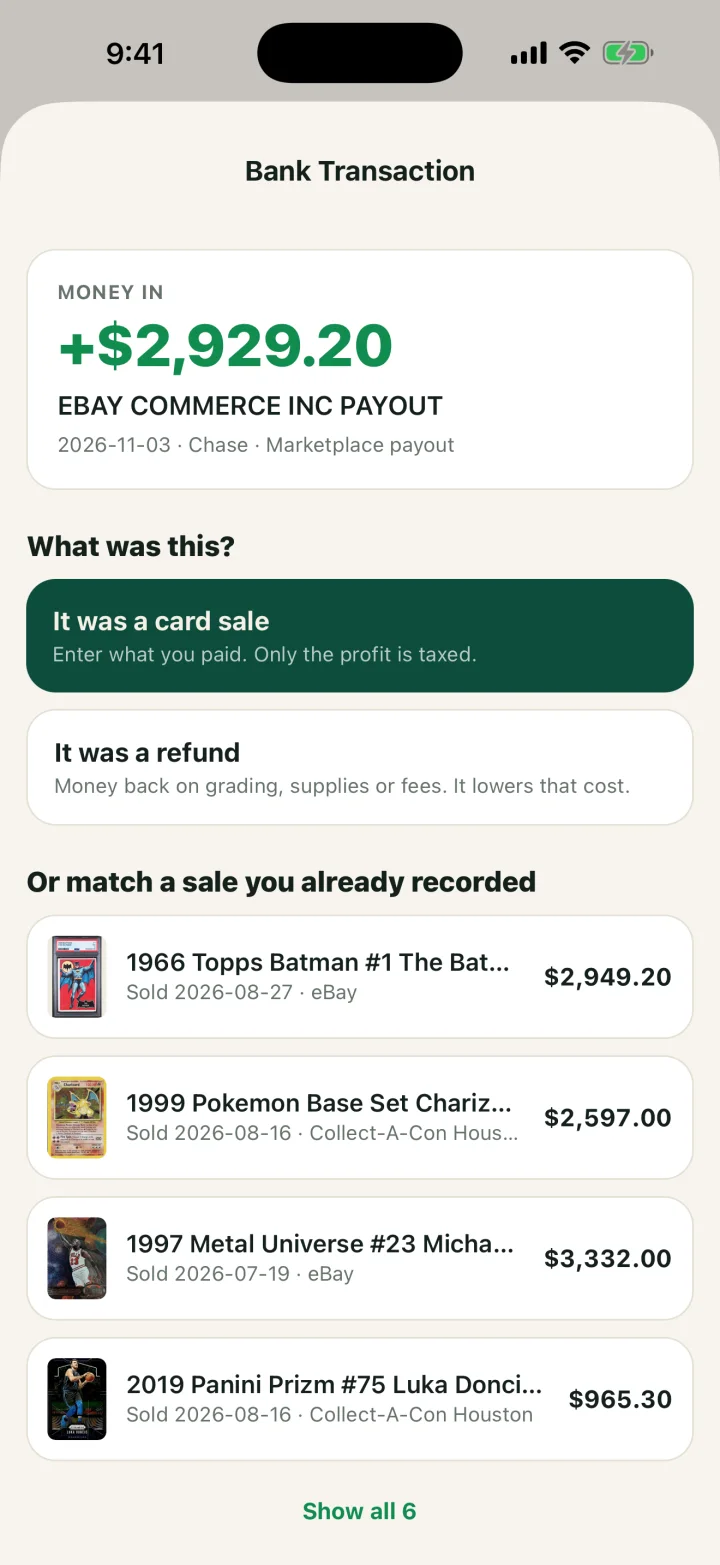
Comped does not prepare or file Form 8300. It keeps the sale record the form is filled in from. The first screen is one recorded sale, with the sale date, the price, what reached the bank, the cost basis and the profit. The second is a bank deposit under review in Comped Pro. You mark it as a card sale or match it to a sale you already recorded.

Related guides
- The Card Vendor's Master Guide to Taxes: how the sale itself is taxed once the form is filed.
- Cost basis for cards bought with cash or by trade at a show: the record on the buying side of a cash deal.
- How to track card show sales: the table record that every form starts from.
- New Jersey card show sales tax: the sales tax due on the same sale.
- Do you have to pay taxes on selling sports cards?: profit, not sale price, and who owes it.
FAQ
Does Form 8300 apply at exactly $10,000?
No. The rule is more than $10,000 in cash, so $10,000 even is not reportable and $10,001 is. The test is the cash received in one transaction or related transactions, not the price of the card.
I am a dealer paying cash for a collection. Do I file Form 8300?
No. The form is filed by the person who receives the cash in a trade or business, not by the person who pays it. If the seller is another dealer, that dealer files and will ask for your ID and taxpayer number. If the seller is a private collector who is not in the business, the IRS examples say that seller does not file.
Is a cashier's check cash for Form 8300?
Yes, if its face amount is $10,000 or less and you received it in a retail sale of a collectible. So are money orders, traveler's checks and bank drafts of $10,000 or less. A cashier's check over $10,000, a personal check and a wire transfer are not cash for this form.
Is Zelle, Venmo or a card reader payment cash?
The IRS says a wire transfer, a credit card and a debit card are not cash for Form 8300. It does not name Zelle, Venmo, PayPal or Cash App. Our reading is that they are not cash either, because none is currency or one of the four named instruments. Those payments are still income, and the apps have their own reporting form.
What if the buyer will not give a Social Security number?
You still have to file. On a paper form the IRS says to write customer refused in item 6. An electronic filer leaves the item blank and notes the refusal in the comments. Keep a note of when you asked, and remember you can decline the sale.
Should I just stay under the threshold?
No. The threshold is a reporting rule, not a tax rule, and the profit is taxed the same whether or not a form is filed. Splitting a payment to avoid the form is structuring, which carries its own penalties for the dealer and the buyer. Take the sale, file the form, report the profit.
The card business is a cash business. Does the IRS really expect this at a show?
Yes. The form applies to any person in a trade or business who receives more than $10,000 in cash. A table at a show is a business location like any other. The 15 days run from the day you took the cash, not from the end of the show.
Do I owe tax on the $12,000 because I filed Form 8300?
No. Form 8300 is an information report and carries no tax. You owe income tax on the profit from the sale: the price minus the card's basis and selling costs. That is the same as for a sale paid by card or check.
SOURCES
- Form 8300, Report of Cash Payments Over $10,000 Received in a Trade or Business (Rev. December 2023), IRS and FinCEN, checked November 2026.
- Instructions for Form 8300 (12/2023), IRS, checked November 2026.
- IRS Form 8300 reference guide, IRS, checked November 2026.
- Form 8300 and reporting cash payments of over $10,000, IRS, checked November 2026.
- Publication 1544, Reporting Cash Payments of Over $10,000, IRS, checked November 2026.
- Report of cash payments over $10,000, motor vehicle dealership Q&As, IRS, checked November 2026.
- Rev. Proc. 2024-40, penalty amounts for returns required to be filed in 2026, IRS, checked November 2026.
- Rev. Proc. 2025-32, penalty amounts for returns required to be filed in 2027, IRS, checked November 2026.
- BSA E-Filing System, FinCEN, checked November 2026.
- Vendors and promoters, New Jersey Division of Taxation, checked November 2026.
This is general information for card sellers, not tax or legal advice for your situation. Rules change and states differ; a CPA who knows your numbers wins every time.