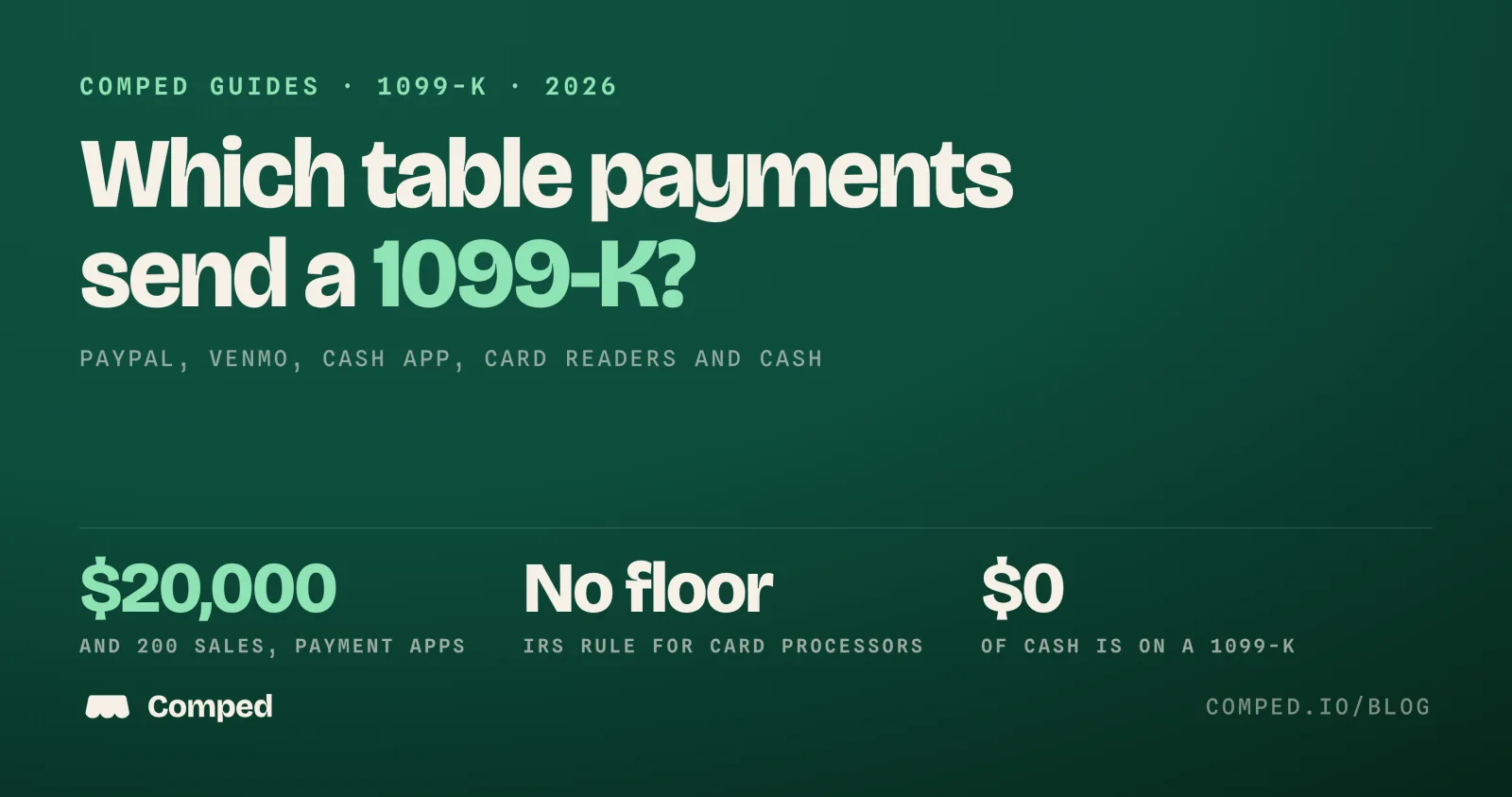
Which payment methods at a show table send a 1099-K?
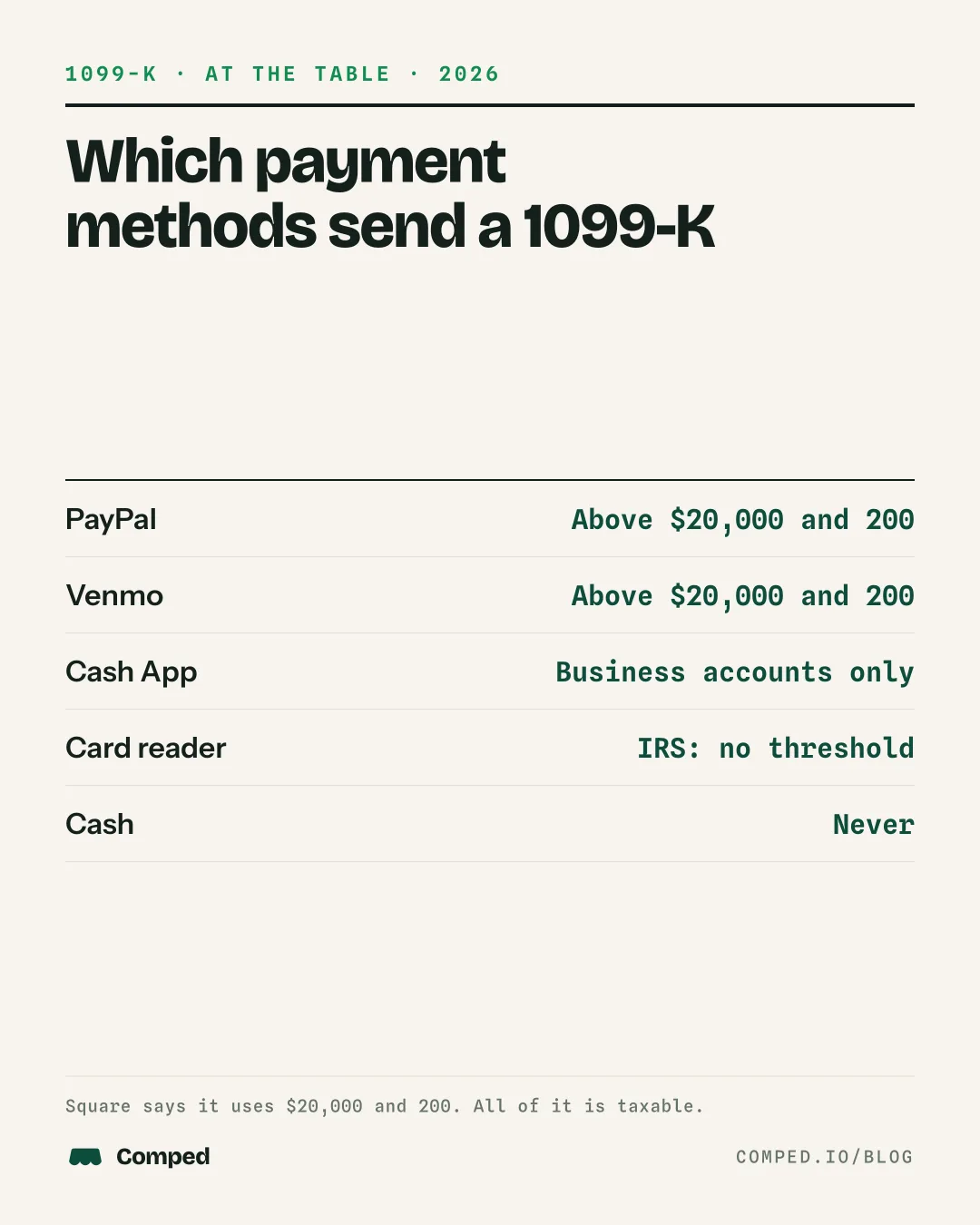
Payment apps report above $20,000 and 200 transactions, the IRS sets no threshold for card processors, though Square says it applies one, and cash and Zelle are never reported on a 1099-K. The table shows what each company's own help page says, next to the IRS rule.
| How the buyer paid | When a 1099-K is sent | What it counts |
|---|---|---|
| PayPal | Above $20,000 and 200 transactions; lower in some states | Payments for goods and services |
| Venmo | Above $20,000 and more than 200 transactions; lower in some states | Payments tagged goods and services; all payments to a business profile |
| Cash App | Business accounts only; above $20,000 and 200 for 2025 | Payments to the business account |
| Card reader (Square) | IRS: no threshold for card processors. Square: more than $20,000 and more than 200 in most states | Card payments, including tax and tips collected by card |
| Zelle | Never; Zelle says it issues no 1099-K | Nothing is reported; you report it |
| Cash | Never | Nothing is reported; you report it |
Each company counts only its own payments. A seller can take $15,000 through each of three apps and receive no form. The whole $45,000 still belongs on the return. The 1099-K guide for card sellers covers eBay, Whatnot and the other marketplaces.
When do PayPal and Venmo send a 1099-K?
When payments for goods and services exceed $20,000 and you have more than 200 transactions in the year. Venmo's tax FAQ gives that test for 2025 and says both parts must be met. Its examples: $18,000 from 300 sales gets no form, and $22,000 from 180 sales gets no form.
The federal test is unchanged for 2026. The IRS FAQs apply $20,000 and 200 to payment apps from 2025 onward.
State rules can lower the line. PayPal's help page, which covers 2025 payments, lists $600 for Vermont, Massachusetts, Virginia and Maryland, and over $1,000 with 4 or more transactions for Illinois. It gives no 2026 figures yet. Vermont's tax department now says $2,000, and Whatnot's 2026 page lists $2,000 for Vermont and Maryland, so those two PayPal figures may change. PayPal uses the primary address on your account on the last day of the prior year. It also sends a form whenever it withheld tax from your payments. The 1099-K threshold by state table tracks the state amounts.
Venmo says forms are issued in January and February for the previous year.
When does Cash App send a 1099-K?
Only to business accounts, above $20,000 and 200 transactions. Cash App's 1099-K page gives that test for 2025 payments, with forms by 2 February 2026. The page lists no state amounts and does not yet cover 2026 payments.
A personal Cash App account gets no 1099-K. Cash App's terms limit personal accounts to non-commercial payments, and its page tells sellers to open a business account. Card sales paid into a personal account are still business income.
Does a card reader send a 1099-K for every dollar?
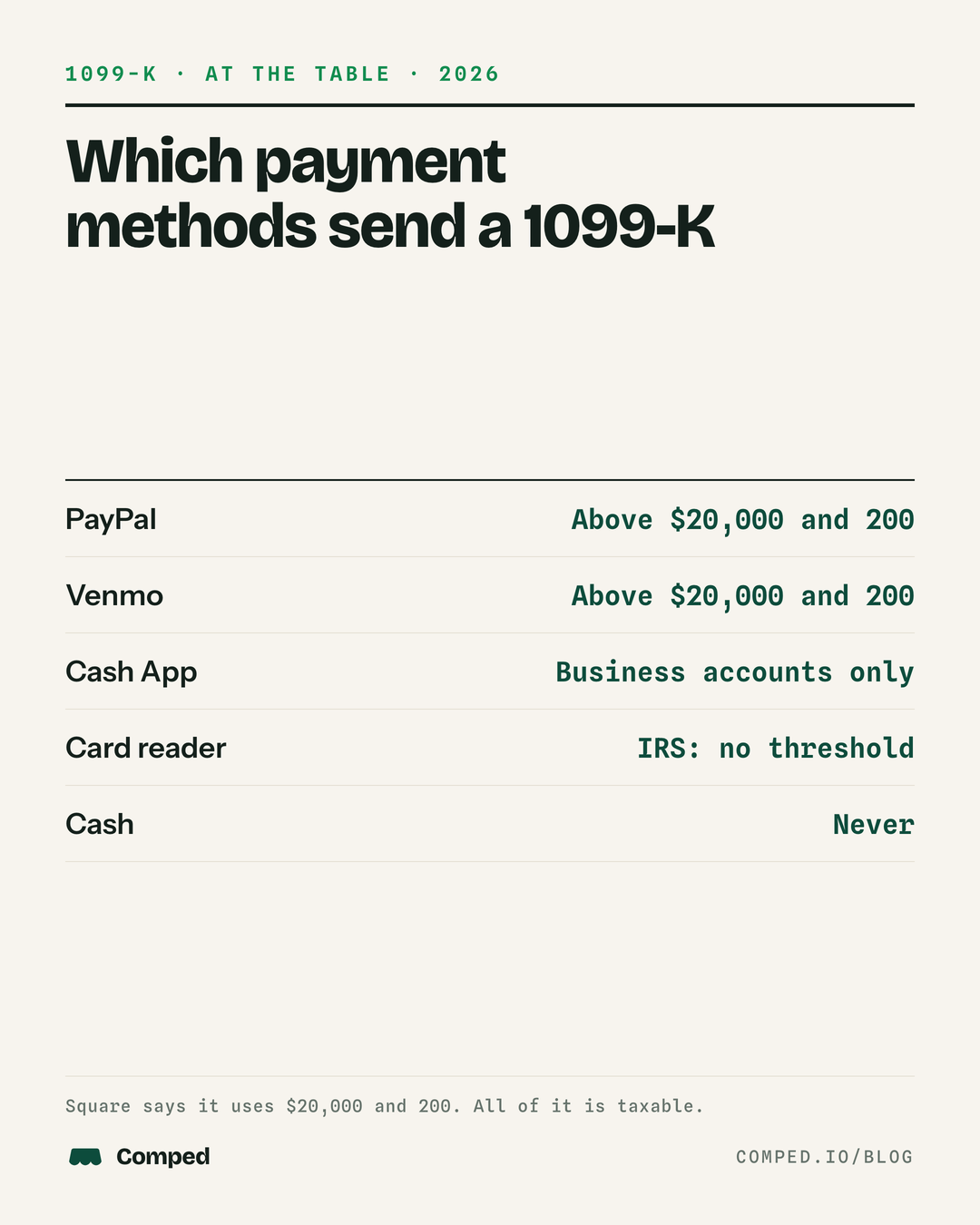
The IRS says card payments have no threshold, and Square's own page says it uses one. Read both, and report every card sale either way.
The IRS page Understanding your Form 1099-K covers customers who pay you directly by credit, debit or gift card. It says your payment card processor sends a form no matter how many payments you got or how much they were for. The IRS FAQs say there is no threshold for payment card transactions.
WHAT SQUARE'S PAGE SAYS
Square's 1099-K page covers 2025 and beyond. In most states, it says, an account qualifies with more than $20,000 in gross sales and more than 200 transactions. It lists lower amounts for some states. Square adds that it may report amounts below these thresholds at its discretion. So a small seller may or may not get a Square form. The income is taxable either way.
Square lists these state amounts for card payments: $600 or more in the District of Columbia, Maryland, Massachusetts, Vermont and Virginia. Missouri is $1,200 or more. Illinois is over $1,000 and more than 3 transactions. Vermont's tax department and Whatnot's 2026 page give $2,000 for Vermont, and Whatnot gives $2,000 for Maryland, so the sources conflict on those two.
Square's gross includes card payments, tax and tips collected on card transactions, and card sales you later refunded. It is not reduced for processing fees. Square says cash sales are not included in the total it reports. Accounts that share a tax ID are added together. Forms appear in the Square Dashboard under Account and Settings, then Tax forms, by 31 January or the next business day.
Other card reader companies publish their own pages. Check the one you use.
What does the number in Box 1a count?
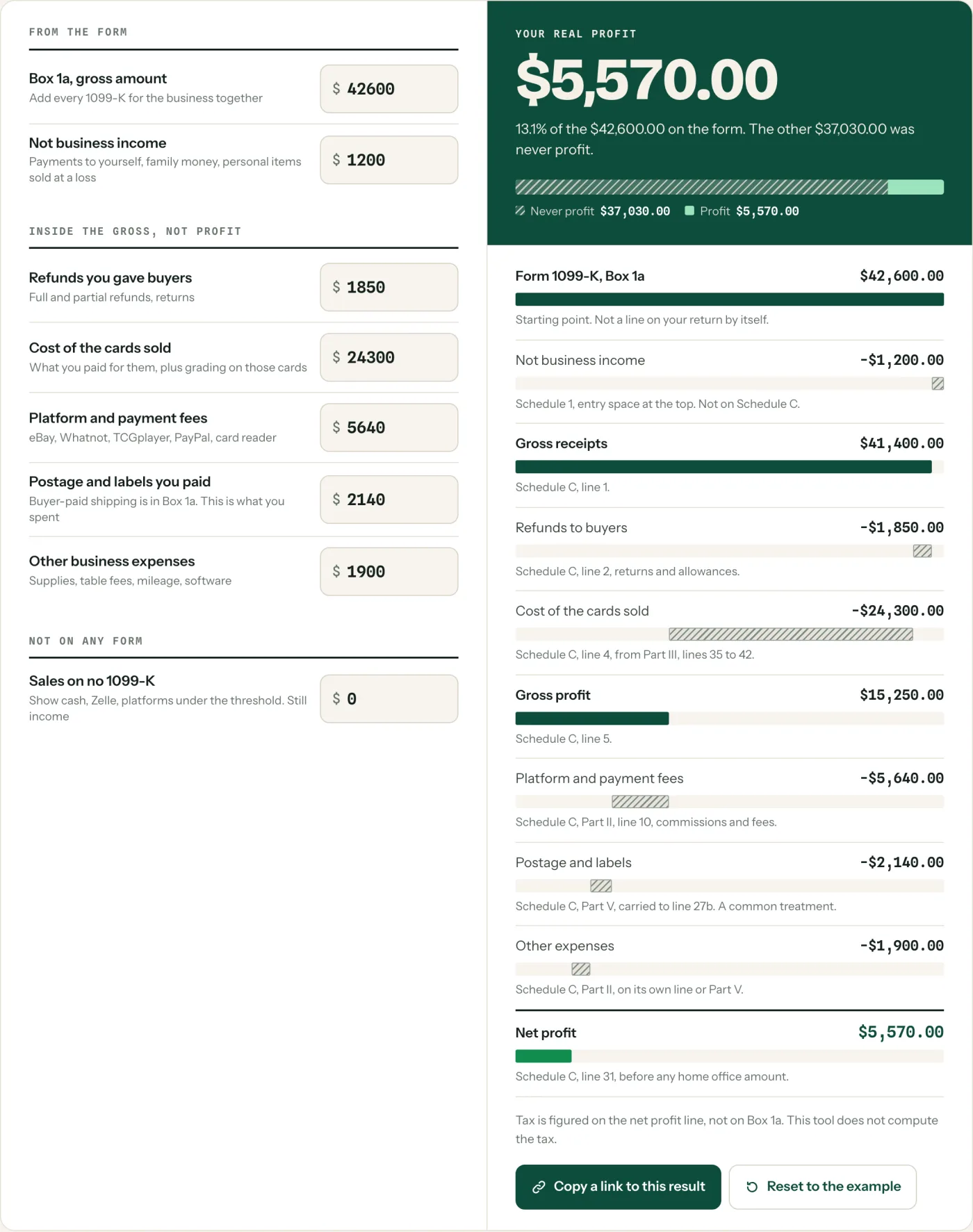
Box 1a is every dollar buyers paid through that company, before anything comes off. The IRS FAQs say the gross amount is not adjusted for fees, credits, refunds, shipping or discounts. You subtract those on your return, along with what the cards cost.
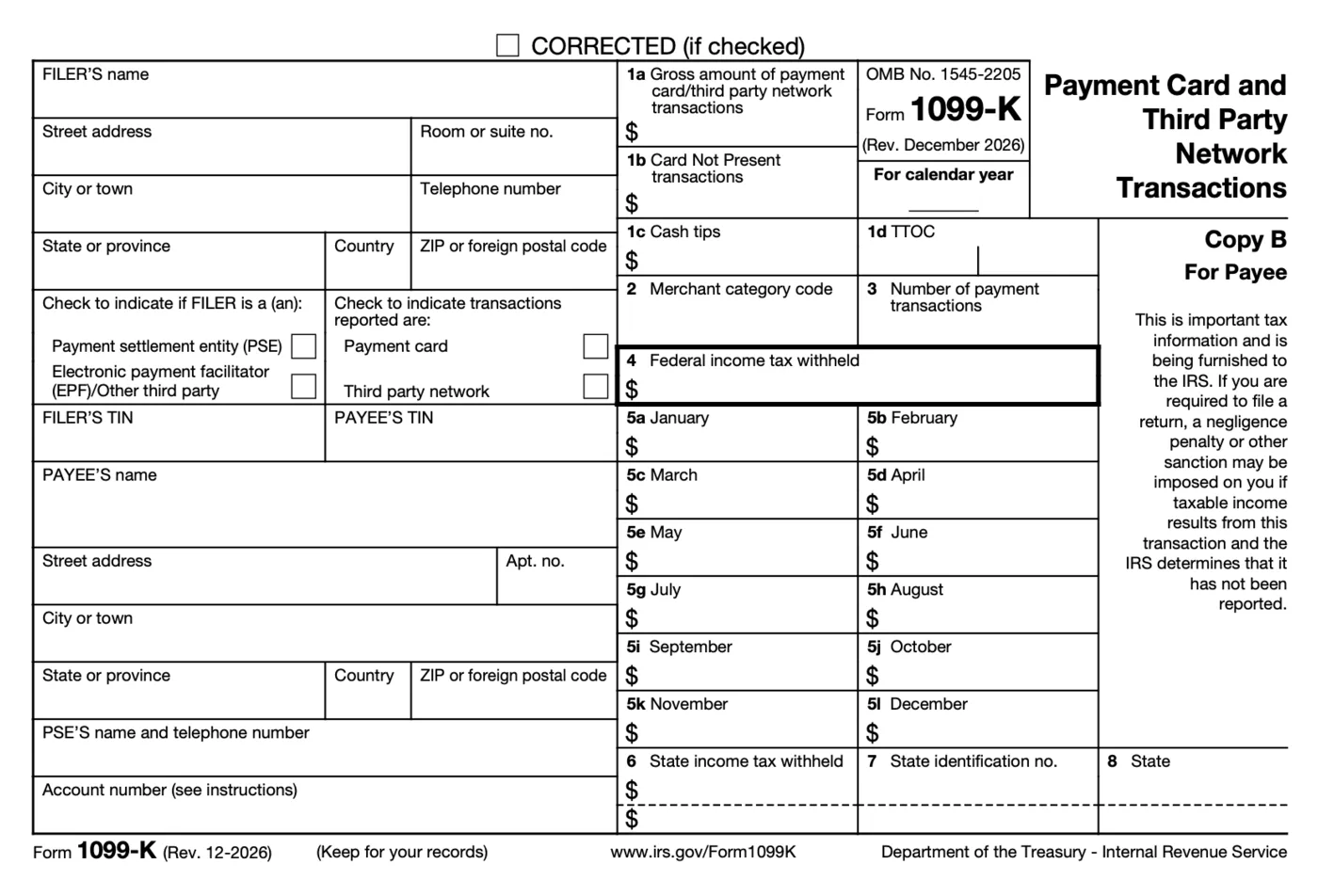
| Box | What it shows | What a card seller does with it |
|---|---|---|
| 1a | Gross payments for the year | Starting point for Schedule C line 1, with every other sale added |
| 1b | Card not present transactions, part of 1a | Nothing separate; it is already in 1a |
| 3 | Number of payment transactions | Compare with your own sale count |
| 4 | Federal income tax withheld | Claim it as a payment on your return; fix the tax ID on the account |
| 5a to 5l | Gross by month | Match show weekends to months when the total looks off |
Sales tax needs care at a table. Square's total includes tax collected on card sales. The Schedule C instructions say sales tax imposed on the buyer, which you collect and pay over to the state, is not part of gross receipts and is not a deductible expense. Tax imposed on you as the seller goes in line 1 if you collected it, and comes off on line 23. Which one applies depends on the state. Keep the year's sales tax total with your reconciliation, and see the state sales tax guide for the collecting side.
The 1099-K reconciliation calculator walks a Box 1a figure down to profit.
What if a buyer pays as friends and family?
The sale is still taxable income. Venmo's FAQ says personal payments between friends and family are excluded from the 1099-K. That exclusion describes the form. It does not change what a card sale is.
Venmo says the sender chooses whether to tag a payment as goods and services. Payments sent to a Venmo business profile are tagged as purchases automatically. Record every sale the same way, whichever tag the buyer used.
The reverse also happens. A form can include personal payments that were never sales, such as a relative paying you back. The section on a form that is wrong covers what the IRS says to do.
Is cash or Zelle at the table reported to anyone?
Not on a 1099-K. No app or processor sees cash, so the only record is yours. Zelle's FAQ says it does not report transactions to the IRS and does not issue 1099-K forms. It adds that reporting taxable payments is your responsibility. Cash and Zelle sales go on your return with everything else. The master tax guide covers where they land on Schedule C.
One cash rule does involve a form. A dealer who receives more than $10,000 in cash for a card files Form 8300 within 15 days. Form 8300 for card dealers explains it, and the card show cash log is a free sheet for recording each cash sale.
What does one show weekend look like?
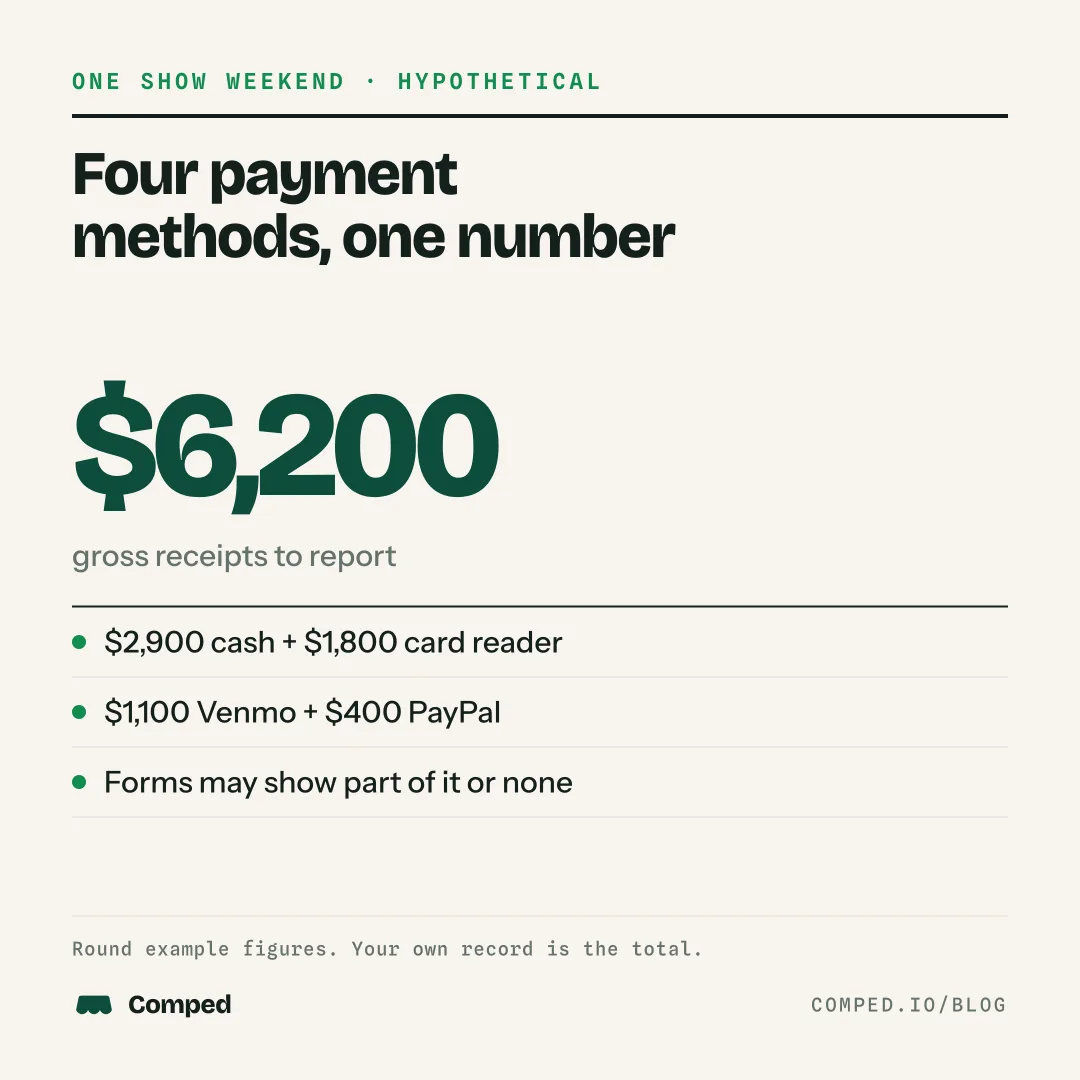
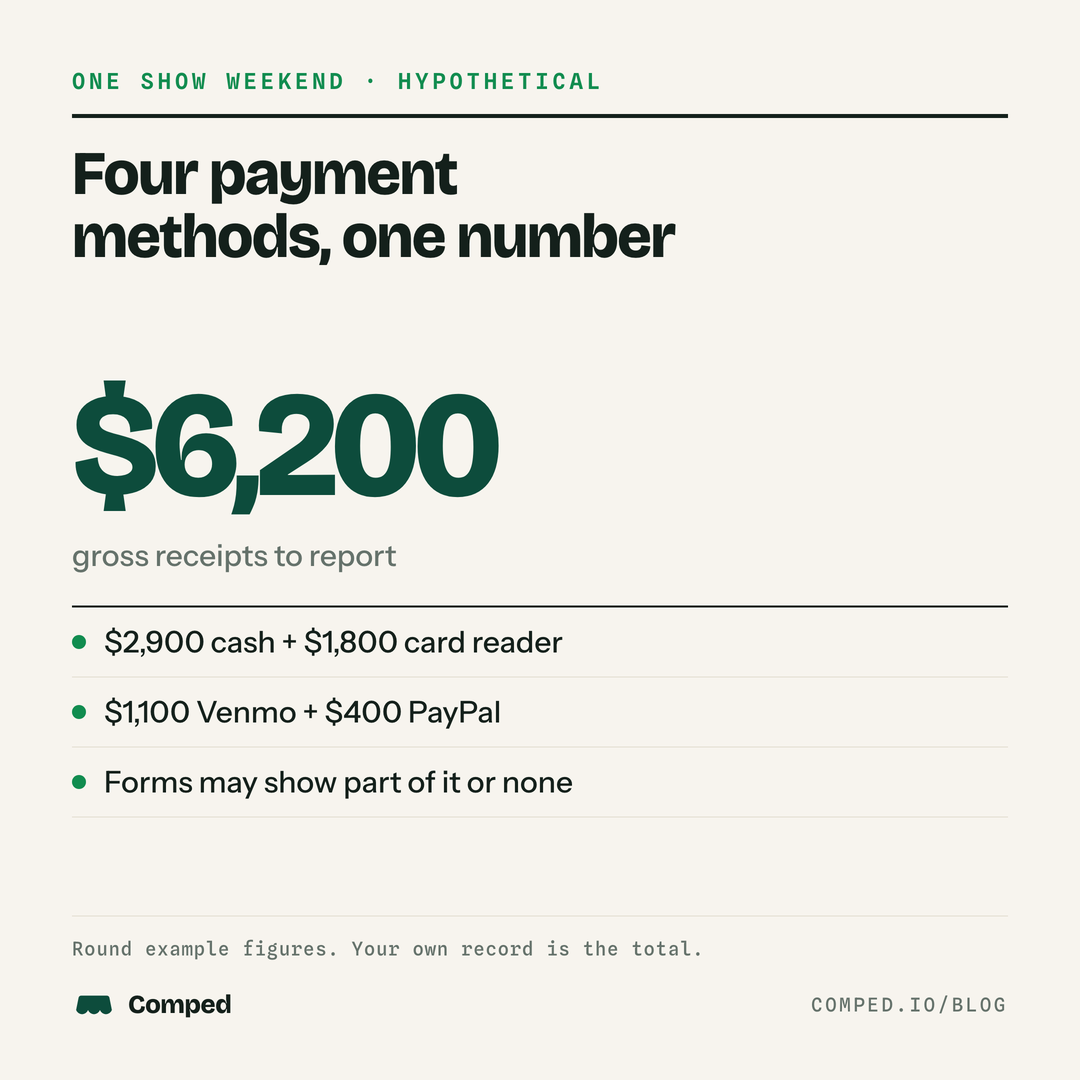
One table usually takes four kinds of payment, and none of the forms will show the total. Only your own record does.
A SHOW WEEKEND, WORKED
Say a vendor sells $6,200 of cards over two days. Round, hypothetical figures.
At year end this vendor may hold one form, several or none. The return starts from $6,200 for this weekend regardless. Comped records each sale at the table with the card, price, venue and date, so the year's total does not depend on which forms arrive. How to track card show sales covers the habit in detail.
How do I get from the forms to Schedule C line 1?
Add every channel from your own records, then check each form against its channel. Do it in this order.
- List every way you were paid in the year: each app, the card reader, Zelle, checks and cash.
- Total each one from your sales record. Download each app's yearly report to check it.
- Where a 1099-K arrived, compare Box 1a with your total for that channel.
- Mark anything in Box 1a that was not a sale, such as personal payments.
- Count each sale once. A marketplace that pays you through PayPal can put the same money on two forms.
- Add the channels. That sum is gross receipts for Schedule C line 1.
- Keep the page that shows the math with your return.
A FULL YEAR, WORKED
Say a part-time dealer gets one 1099-K for 2026, from Venmo, showing $23,800 in Box 1a. It includes $1,200 a relative sent for a shared trip, tagged as goods and services by mistake. Hypothetical figures.
The forms show $23,800. The business took in $73,700. The $1,200 is handled the way the next section describes. Cost of the cards, fees and expenses then come off on their own lines, and tax is figured on the profit.
| Common mistake | What it does |
|---|---|
| Reporting only the 1099-K amount | In the example it leaves $51,100 of sales off the return |
| Reporting bank deposits as sales | Deposits are after fees, so sales are understated; fees then get deducted a second time |
| Counting a marketplace payout and the PayPal form for it | The same sale is taxed twice |
| Leaving a 1099-K off because it holds personal money | The IRS has the form and sees no matching entry |
| No record of cash | Nothing supports the cash figure if the return is questioned |
What if the 1099-K is wrong or includes personal payments?
Ask the company for a corrected form, and file on time whether or not it comes. The IRS page What to do with Form 1099-K says to request the correction from the issuer. It says not to contact the IRS, which cannot correct the form.
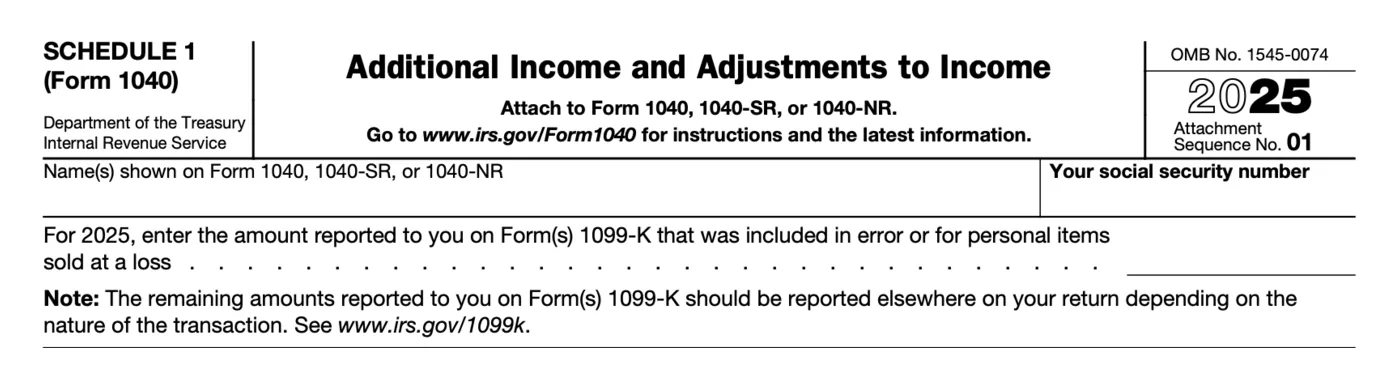
If no corrected form arrives, the IRS says to report the amount included in error in the entry space at the top of Schedule 1 (Form 1040). The business part still goes on Schedule C.
Box 4 matters too. PayPal says it issues a form to anyone it withheld tax from. Withholding at 24% usually means the account has no valid tax ID. Add or fix the tax ID in the app, and claim the withheld amount on your return.
What if I already filed and left sales off?
File an amended return. The IRS page on amended returns says to use Form 1040-X when your income, deductions or tax liability changed. Most can be filed electronically.
A left-off 1099-K tends to surface by itself. Tax Topic 652 says the IRS compares the forms payers file with what you reported. A mismatch can bring a CP2000 notice, which proposes a change and gives 30 days to respond. The notice starts from the gross on the form. Your cost and fee records are what bring it down to profit.
Cash, Zelle and below-threshold app sales produce no form. They are income all the same, and the fix is the same amended return. Sold cards with no receipts covers rebuilding the cost side.
What do the terms mean?
- Third party settlement organization: a payment app or marketplace that moves money between buyer and seller. The $20,000 and 200 test applies to these.
- Payment card processor: the company behind a card reader. The IRS says no threshold applies to card payments.
- Goods and services: the tag an app puts on a payment for a sale. Only these count toward the app's 1099-K.
- Box 1a: the gross amount on the form, before fees, refunds or cost.
- Backup withholding: tax a payer holds back, at 24%, when it has no valid tax ID for you.
How this looks in the Comped app
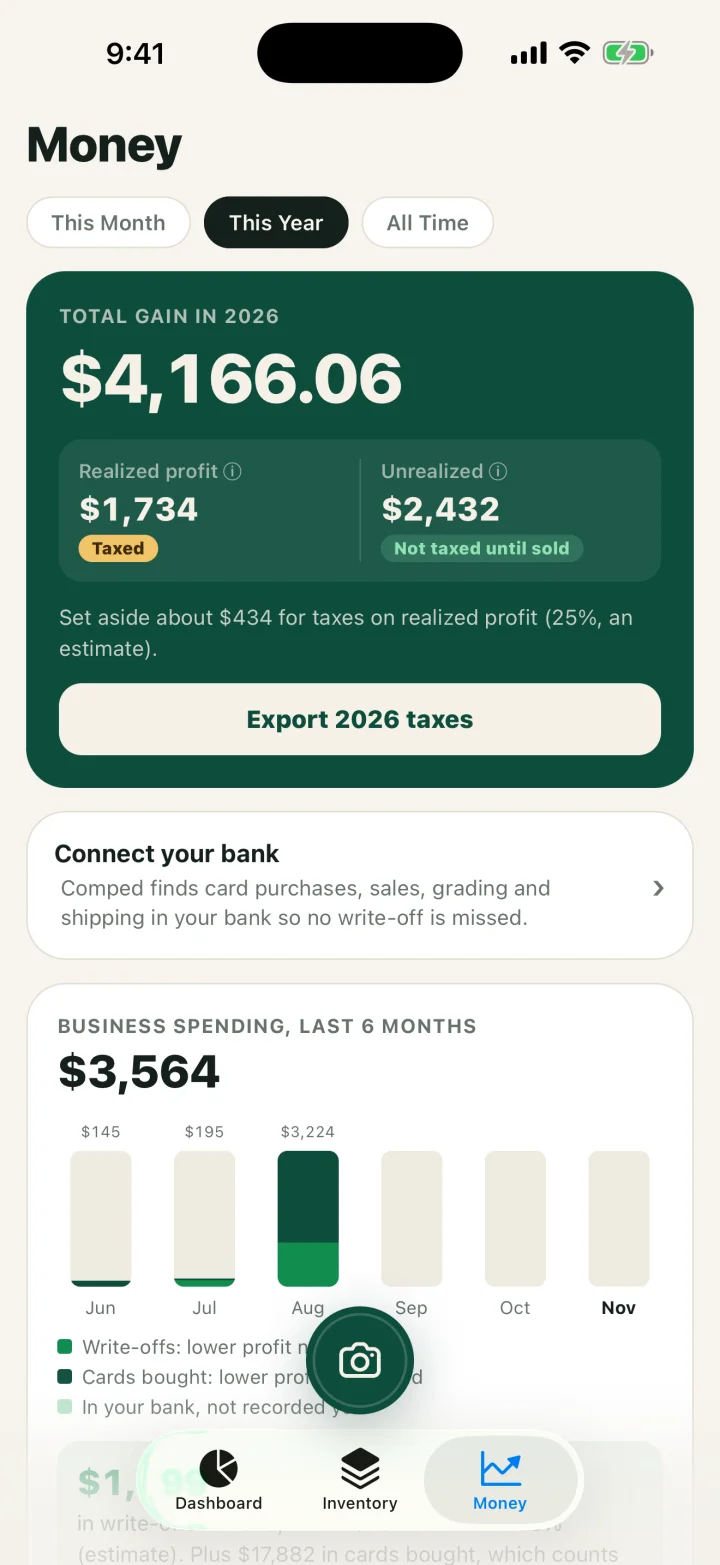
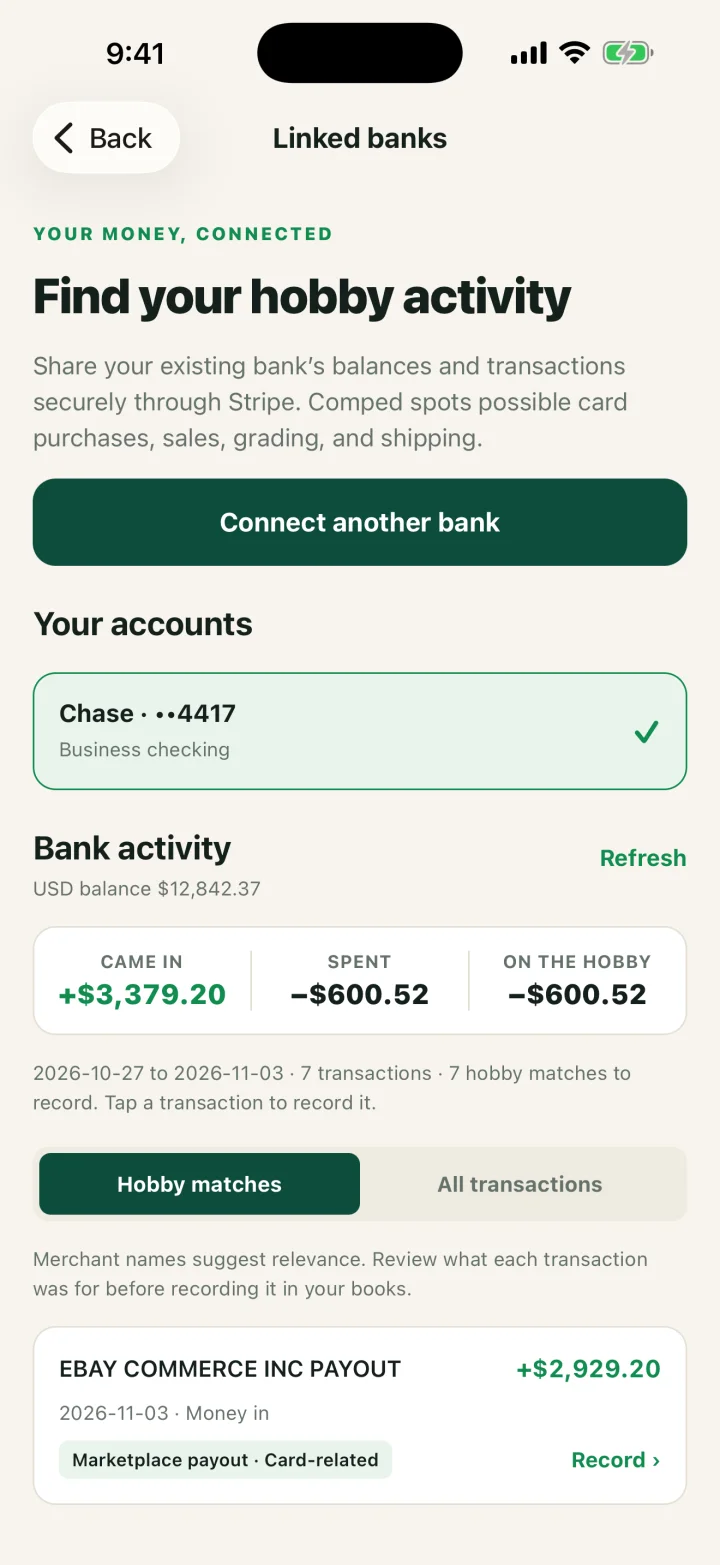
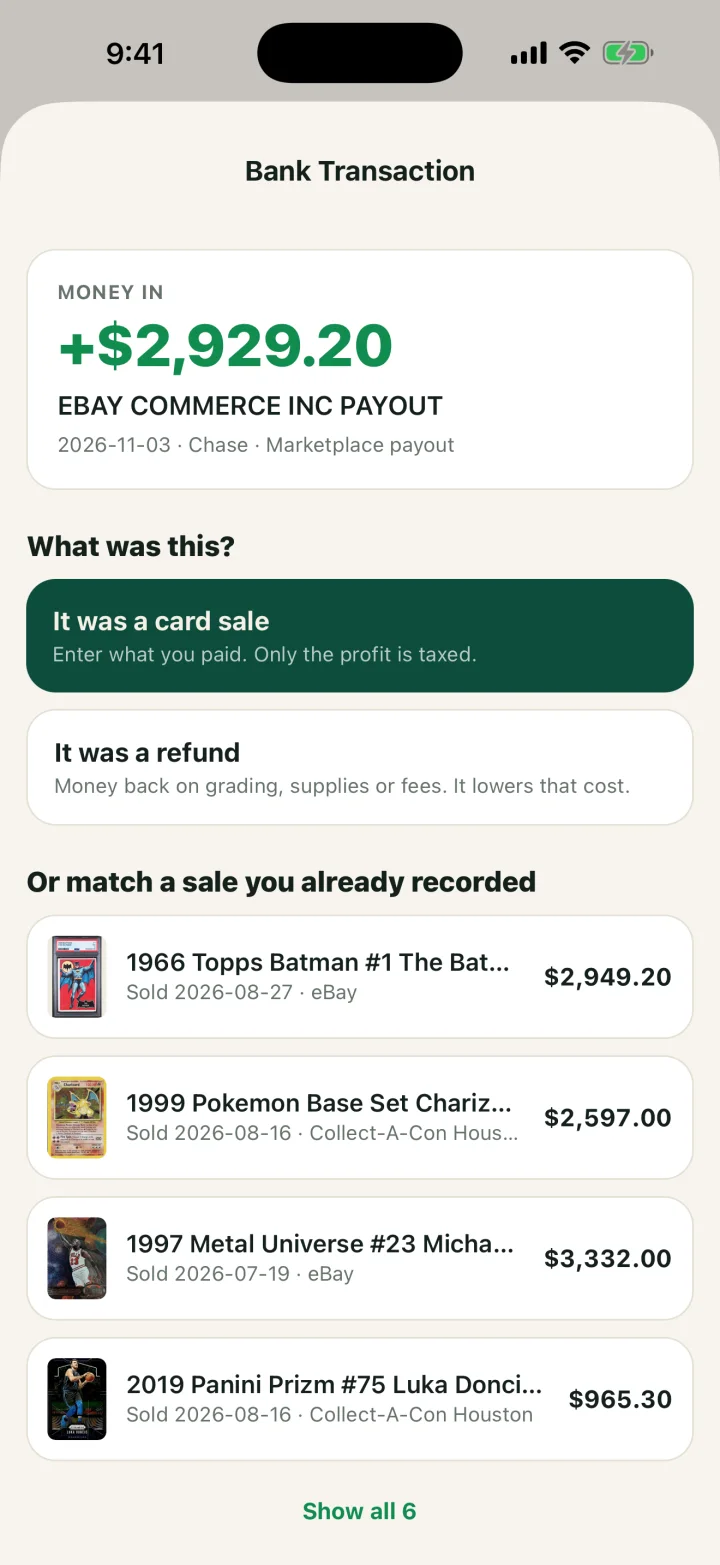
The first screen is the Money tab for the year, with realized profit and the tax set-aside. The other two are from the bank link on Comped Pro. The app flags deposits that look card related, and you mark each one as a card sale or a refund, or match it to a sale you already recorded.
Related guides
- The Card Vendor's Master Guide to Taxes: where every kind of payment lands on Schedule C.
- The 1099-K for card sellers in 2026: the marketplaces, next to the payment apps.
- Form 8300 for card dealers: the form for cash payments over $10,000.
- 1099-K vs your real profit calculator: turn a form's gross into taxable profit.
FAQ
Does Venmo send a 1099-K for card sales?
Yes, when goods and services payments exceed $20,000 and you have more than 200 transactions in the year. Venmo says some states have lower thresholds. Friends and family payments are excluded from the form, but a card sale is taxable however it was tagged.
Does Square report my sales to the IRS?
Square says that in most states it issues a 1099-K above $20,000 in gross sales and 200 transactions, with lower amounts in some states. It also says it may report below those amounts. The IRS says card processors have no threshold, so do not count on getting no form.
Does Zelle send a 1099-K?
No. Zelle says it does not report transactions to the IRS and does not issue 1099-K forms. It also says taxable payments are yours to report, so a card sale paid by Zelle goes on your return like cash.
Do I owe tax if I never got a 1099?
Yes. The IRS says all income, no matter the amount, is taxable unless the tax law says it is not. A 1099-K threshold decides what a company files, not what you owe.
The card business is a cash business. Is cash reported?
Cash is not reported on a 1099-K, and it is still taxable. You report it from your own records. A cash payment over $10,000 for a card also requires Form 8300 within 15 days.
Why is my 1099-K more than I made?
Box 1a is gross. The IRS says it is not reduced for fees, refunds, shipping or discounts, and Square says its total includes tax and tips collected by card. You subtract refunds, fees, expenses and what the cards cost on your return.
Does Cash App send a 1099-K for a personal account?
No. Cash App's page says the 1099-K goes to business accounts. Card sales paid into a personal account are still business income and go on your return.
Should I just stay under the threshold?
No. The threshold is a reporting rule, not a tax rule. Spreading sales across apps changes which forms are filed and does not change what you owe.
SOURCES
- Understanding your Form 1099-K, IRS, checked November 2026.
- Form 1099-K FAQs, general information, IRS, checked November 2026.
- IRS issues FAQs on Form 1099-K threshold under the One Big Beautiful Bill, IRS, checked November 2026.
- What to do with Form 1099-K, IRS, checked November 2026.
- Form 1099-K (Rev. December 2026), IRS, checked November 2026.
- Instructions for Schedule C (Form 1040), 2025, line 23, IRS, checked November 2026.
- File an amended return, IRS, checked November 2026.
- Topic no. 652, Notice of underreported income, CP2000, IRS, checked November 2026.
- Manage your Form 1099-K, Square, checked November 2026.
- Venmo tax FAQ, Venmo, checked November 2026.
- Current Form 1099-K reporting thresholds, 2025 update, PayPal, checked November 2026.
- Tax reporting for Cash App and Form 1099-K FAQs, Cash App, checked November 2026.
- Does Zelle report how much money I receive to the IRS?, Zelle, checked November 2026.
This is general information for card sellers, not tax or legal advice for your situation. Rules change and states differ; a CPA who knows your numbers wins every time.