What counts as support
Support is a document that shows who was paid, how much, when, and for what. The IRS records page lists what documents for purchases should show. They are the payee, the amount paid, proof of payment, the date, and a description of the item. It adds that a combination of documents may be needed to cover all of those.
That last line is the opening for a seller with no receipts. One document rarely does it all. A statement shows the payment. An order page or a message shows the card. Together they do the job a receipt would have done.
Publication 583 lists the usual documents for inventory: canceled checks, cash register tape receipts, credit card sales slips and invoices. The master tax guide covers where that cost lands on Schedule C. The post on cost basis for cash buys and trades covers the receipt to write at the table.
Which cost rule applies to your card
Before you hunt for paper, know which number you are trying to prove. It depends on how you got the card. The rules below are from Publication 551, Basis of Assets, except where marked as our reading.
| How you got the card | The number to prove | What proves it |
|---|---|---|
| Bought it | What you paid. Publication 551 says cost includes sales tax and freight | Payment record plus something that names the card |
| Bought in a lot or collection | The lot price, split across the cards. Publication 551 says to allocate a lump sum among the assets | The lot's payment record and your written split |
| Pulled from a pack or box | The pack or box cost, split across what you kept and sold. This is our reading; no IRS ruling is specific to cards | The box purchase record and your split |
| Got it in a trade | The fair market value of the card you received, per Tax Topic 420 | A note of both cards and sold prices from that date |
| Received as a gift | For a gain, the giver's basis. If the card was worth less than that when given, a loss is figured from its value on that day | The giver's records, or anything showing what the giver paid |
| Inherited | Fair market value on the date of death | An appraisal, estate records, or sold prices from that date |
| Childhood collection | The original cost, if you can show it | Often nothing; see the sections on cash buys and estimates |
The inherited row matters most for old collections. A card inherited from a parent does not carry the parent's 1960s cost. Its basis is the value at death, and sold prices from that month can support it. Do you have to pay taxes on selling sports cards? covers how a collector's sale is taxed.
Evidence, strongest first
Work from the records made at the time, by someone else, down to the ones you write today. The ranking is our reading of the IRS list of what a purchase document should show.
| Record | Shows payee | Shows amount and date | Names the card | Strength |
|---|---|---|---|---|
| Marketplace order page or emailed receipt | Yes | Yes | Yes | Strong |
| Dealer invoice or signed show receipt | Yes | Yes | Yes | Strong |
| Card or bank statement line | Yes | Yes | No | Half; pair it |
| Payment app history | Yes | Yes | Sometimes, in the memo | Half; pair it |
| Grading invoice | Grader only | Fee and date | Yes | Strong for the fee; shows you owned the card |
| Texts and direct messages | Sometimes | Sometimes | Yes | Ties a payment to a card |
| Dated phone photo | No | Date only | Yes | Shows possession |
| Note written today from memory | Your word | Your word | Your word | Weak alone |
Bank and card statements
A statement can prove a payment when you have no canceled check or receipt. Publication 583 says account statements from a financial institution are acceptable if they are highly legible and show set details. Download them as PDFs for every year you bought inventory.
| If you paid by | The statement must show |
|---|---|
| Check | Check number, amount, payee's name, date the check posted |
| Electronic funds transfer | Amount transferred, payee's name, date the transfer posted |
| Credit card | Amount charged, payee's name, transaction date |
A statement has a limit, and Publication 583 states it. Proof of payment alone does not establish that you are entitled to a deduction. You should also keep documents that show what the cost was for. A $400 charge to a card shop proves $400 left your account. It does not say which card you bought.
A payment app transfer funded from your bank shows on the bank statement as well. Pair each line with something that names the card.
Marketplace purchase history
Marketplace purchase history is the strongest record most sellers still have. An order page shows the seller, the date, the item title and the price paid. In our reading that covers the elements the IRS lists, in one place.
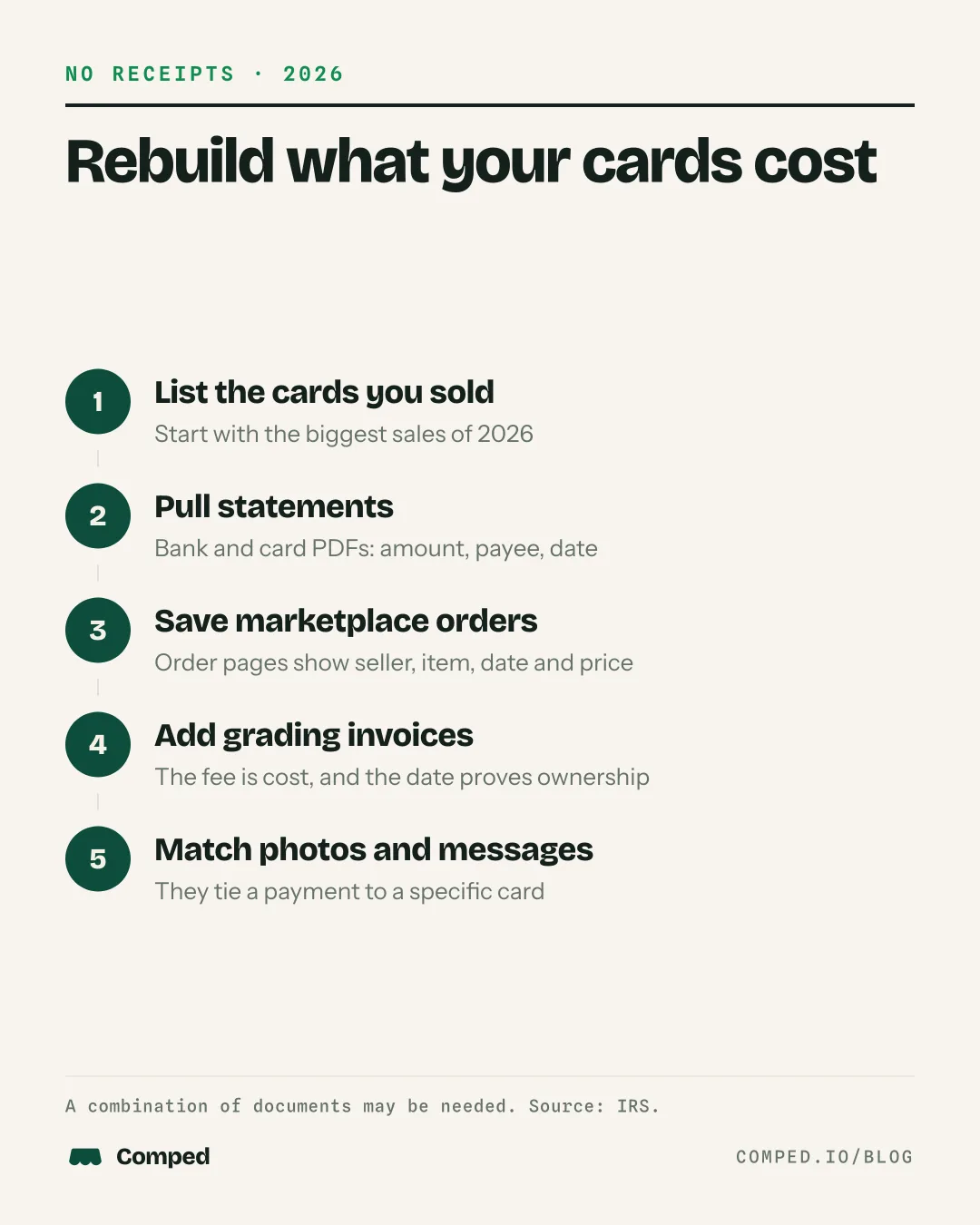
Save each order as a PDF or screenshot now, so the record sits in your own files. Search your email for order confirmations and payment receipts from the same years. Then match each order to the card you sold. A cert number or a clear item title makes the match.
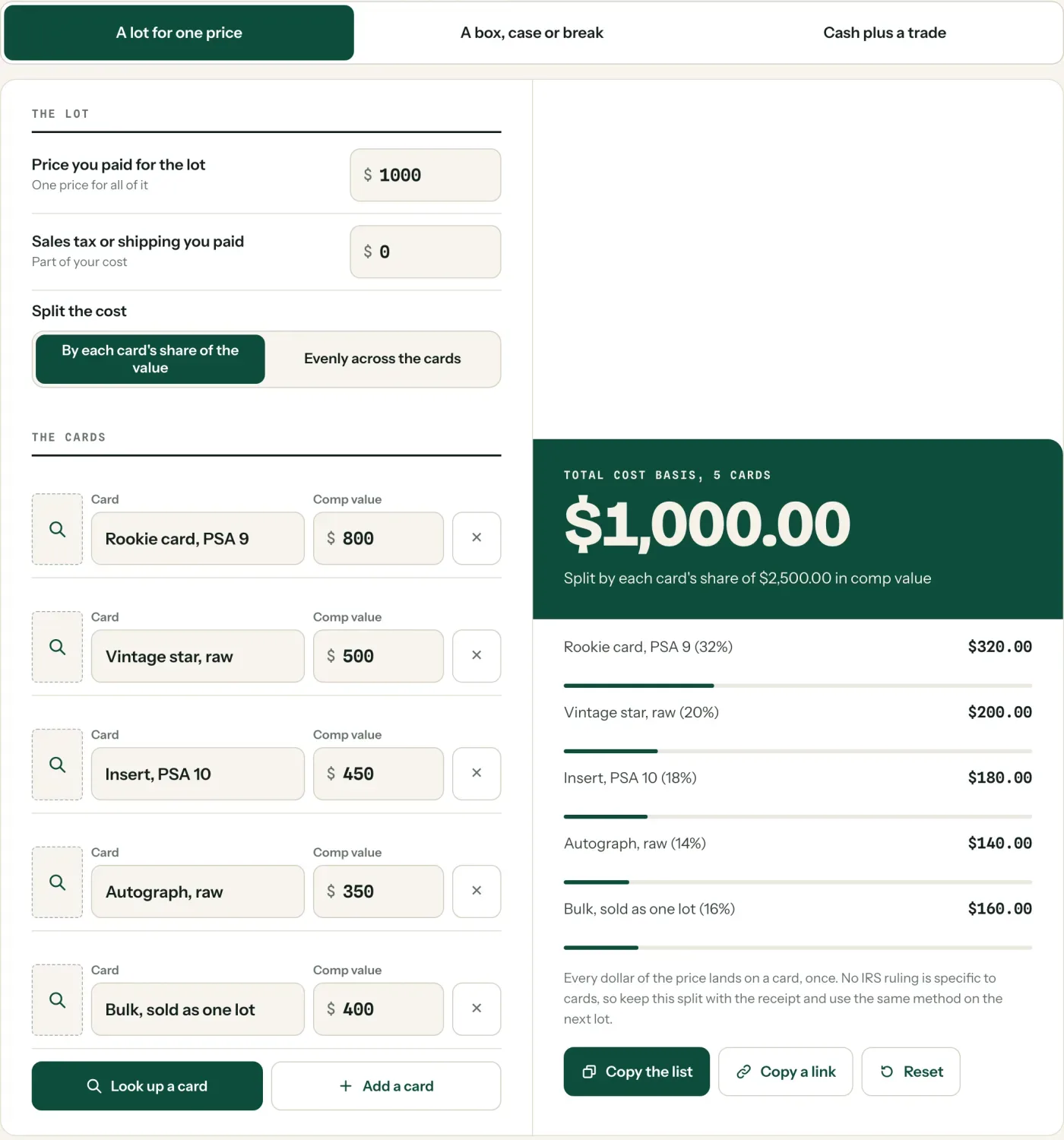
Sales tax you paid on the buy is part of the card's cost. If a lot was bought as one order, split the price across the cards. The card cost basis calculator does that split.
Grading submissions
A grading submission proves two things: the fee, and that you owned the card on that date. The invoice lists each card and the fee charged, and the fee is part of that card's cost. Our post on grading fees explains why.
The submission date also narrows the search. If a card went to the grader in March 2023, you bought it before then. That tells you which statements and messages to read.
Photos and messages
Photos and messages supply the description and the date that a statement lacks. A text that says "$350 for the Charizard, sent" next to a $350 transfer the same day ties the payment to the card. A phone photo of the card carries the date you had it.
On their own they are weak on price. A photo shows a card, not what you paid. Use them to connect a payment to a card, not to replace the payment record.
Cash buys with nothing on paper
A cash buy with no receipt has the least support, so collect what does exist. An ATM withdrawal the day of the show is a start. So are the show's date and location, a message with the seller, and a photo taken at the table.
Then write down what you remember: the seller, the date, the card, the price. Date the note today and say it was written from memory. The IRS burden of proof page asks for adequate records or sufficient evidence that will support your own statement. A note is your statement. The withdrawal and the message are the evidence around it.
If you know the seller, ask. A dealer you bought from may have an invoice copy or a sales log entry. The IRS page on reconstructing records is written for disasters, but its method is the same one: get copies of invoices from suppliers, pull card and bank statements, and use photos.
Do not write a receipt today and date it in the past. A rebuilt record says what it is and when it was made.
Can I estimate what I paid?
An estimate needs something under it. The IRS manual for its own examiners draws the line in two passages, and both are worth reading before you put a guessed number on a return.
Internal Revenue Manual 4.10.7.4.2 says close approximations of items not fully supported by documentary proof can frequently be established through reliable secondary sources and collateral evidence. It also says those instructions are not intended to relieve taxpayers of the burden of proof, and that the examiner must be sure there is a basis for each allowance.
Section 4.10.7.3.2 of the same manual covers your own word. It says there are times when records do not exist and oral testimony may be the only evidence available. Uncontradicted statements that are not improbable or unreasonable should not be disregarded. It adds that testimony need not be accepted without further inquiry.
In our reading, that makes three kinds of numbers. A cost tied to a payment record is supported. A cost tied to secondary evidence, such as a withdrawal, a message and a dated photo, is an approximation an examiner can weigh. A round number with nothing near it has no basis for an examiner to allow. What a card sells for today is not evidence of what you paid for it.
What the IRS can do when basis is unsupported
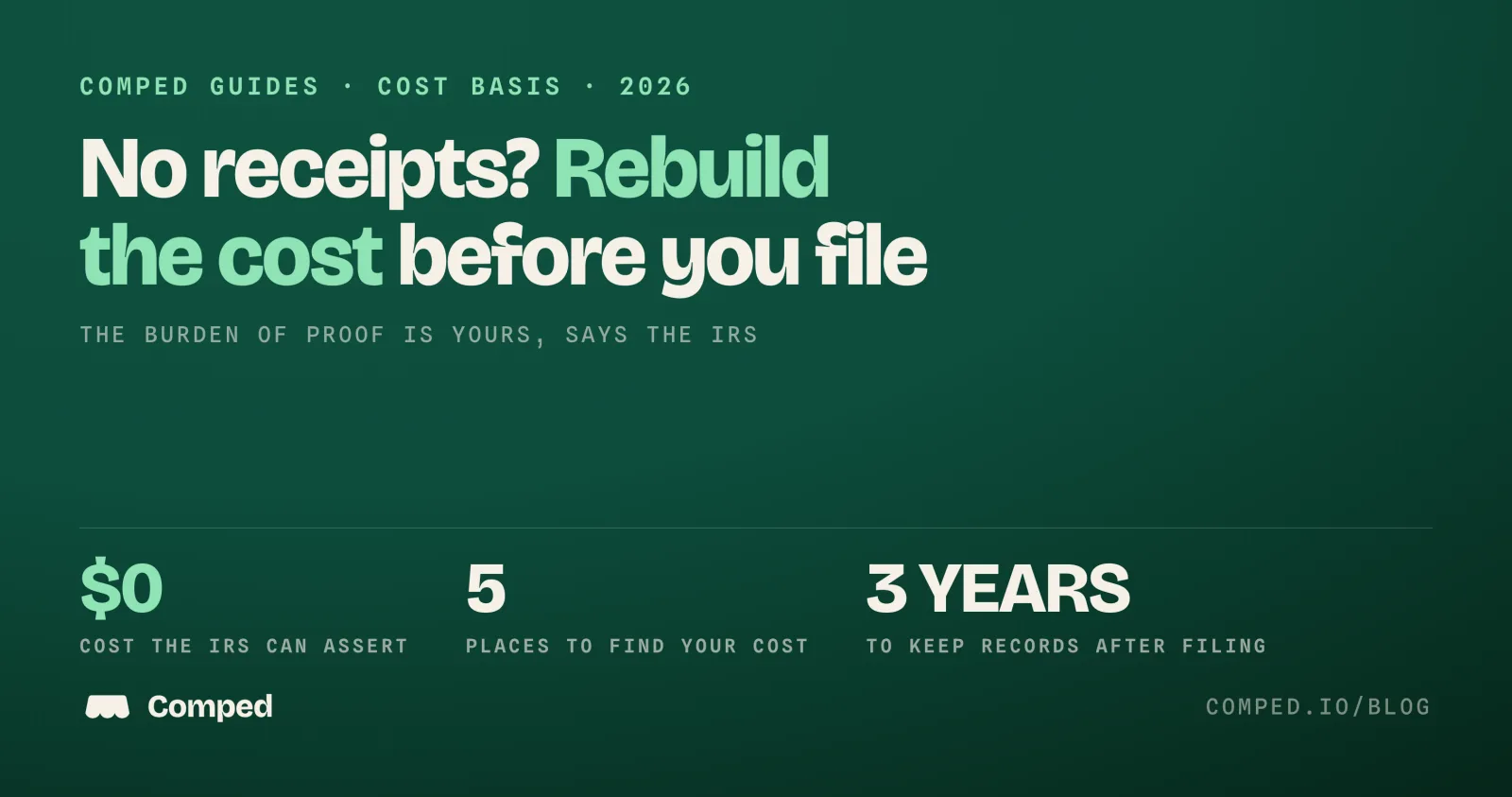
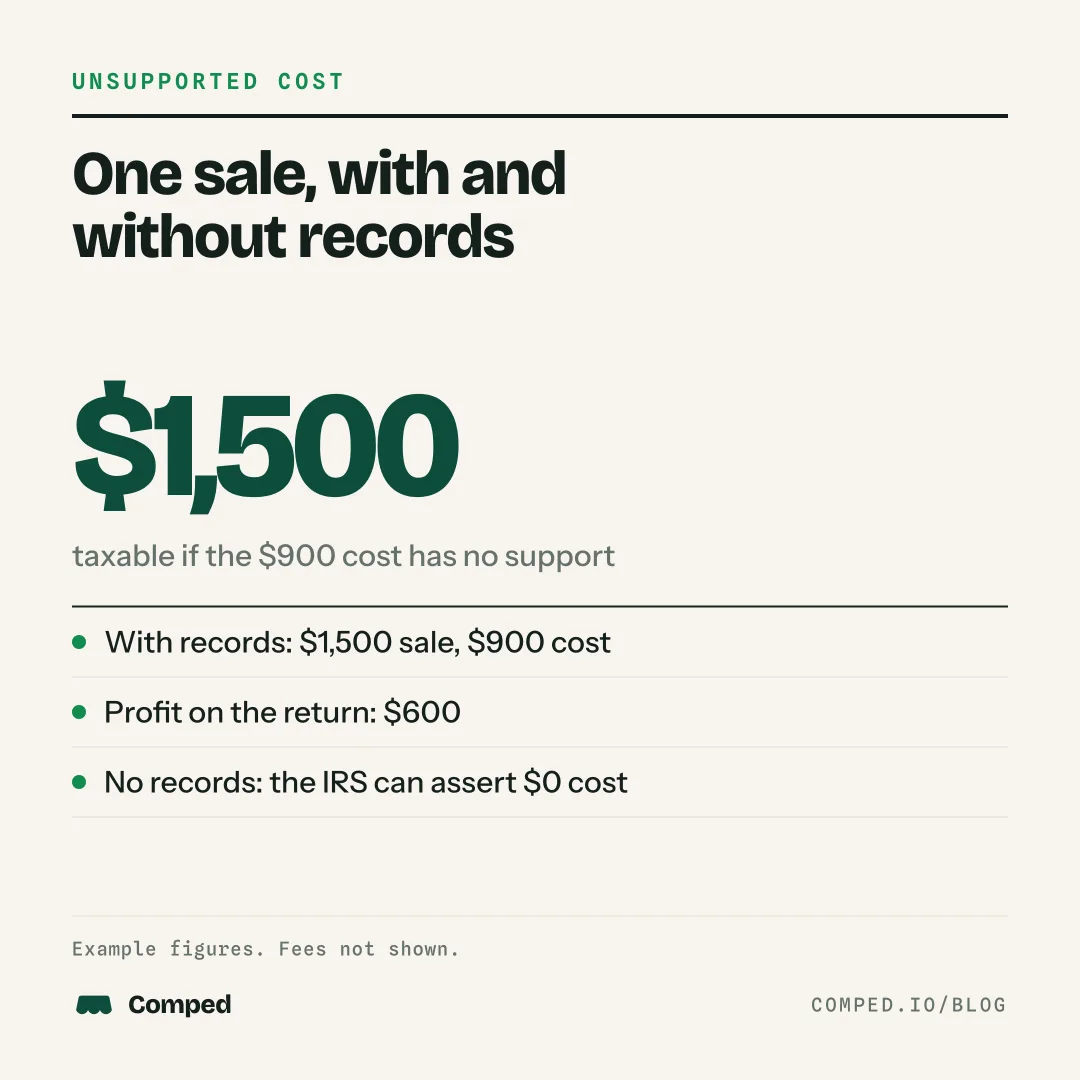
The IRS can assert zero basis, and then the whole sale price is taxable. A card bought for $900 and sold for $1,500 has $600 of profit with support. Without it, the IRS can treat all $1,500 as income. The 1099-K already reports the $1,500, because it shows gross with nothing subtracted.
The burden sits with you. The IRS page says the responsibility to prove entries, deductions and statements on your return is the burden of proof. It says you generally must have documentary evidence, such as receipts, canceled checks or bills.
Other penalties stack on a wrong return. The accuracy-related penalty is 20% of the underpaid tax tied to negligence or a substantial understatement. The better position is a cost you can show, even if it took a weekend of statements to build.
That does not mean reporting $0 to be safe. A cost you really paid and can support belongs on the return. The point is to claim what the file behind it can carry.
The rebuild worksheet
Work one card at a time, starting with the biggest sales. List what sold in 2026, then fill a row for each card. The example cards and amounts below are made up to show the layout.
| Card sold | Proof of payment | What names the card | Cost supported |
|---|---|---|---|
| Slab bought on a marketplace | Order page and card statement | Order page item title and cert | $900 |
| Raw card bought by app transfer | App statement line, $350 | Text with the seller, same day | $350 |
| Same raw card, graded | Grading invoice | Invoice line for the card | $25 |
| Show buy, cash | ATM withdrawal that morning | Table photo, note from memory | $200, weakest |
| Card with nothing found | None | None | $0 can be asserted |
Keep the worksheet with the documents behind each row. The card inventory spreadsheet has the columns. Bring the file to your CPA, who decides what goes on the return.
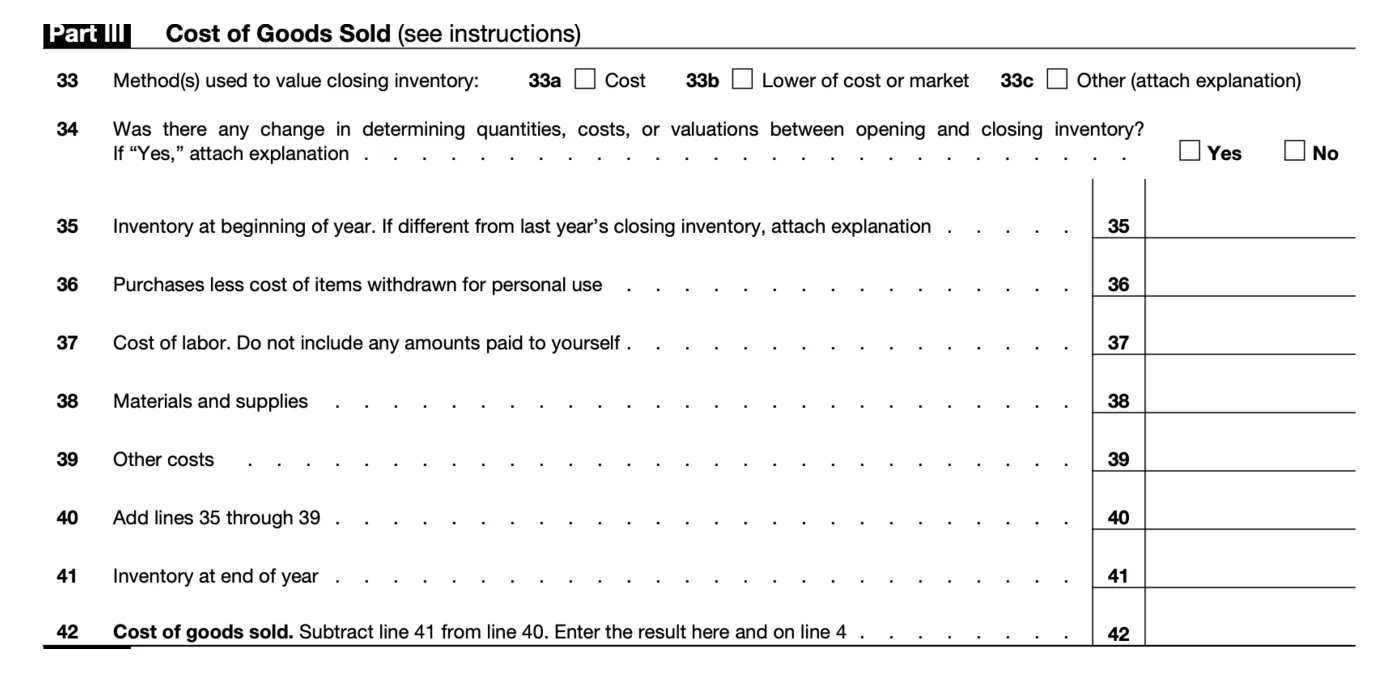
For a dealer, the total feeds Part III of Schedule C. Purchases go on line 36, and cost of goods sold on line 42 carries to line 4. A collector selling investment cards uses the same cost as basis on Form 8949.
A rebuilt year, worked
Here is what a weekend of rebuilding is worth. Say a seller sold 40 cards for $18,000 in 2026 and kept no receipts. All figures are examples.
$18,000 OF SALES, REBUILT
Say the search turns up the records below.
With no file, the IRS can tax $18,000. With the strong records alone it is $7,100, before fees and expenses. The cash buys are the part a CPA should look at, since they rest on the weakest evidence. A few cards in the 40 had nothing behind them, and their cost stays at $0.
What if I already filed?
It depends on which way the return was wrong. If you reported the full sale price with no cost because you had no receipts, you may have overpaid. The IRS page on amended returns says to file Form 1040-X when income or deductions changed. A refund claim generally must be filed within 3 years of the original return, or 2 years of paying the tax, whichever is later.
If you claimed a cost with nothing behind it, build the file now. Do the rebuild above for that year. If the supported cost comes out lower than what you claimed, talk to a CPA about amending. If it holds up, keep the file with that year's return.
Clean records from today
From today, make the record when you buy. For every card that means the seller, the date, the item and the price, plus a photo. Comped records the card, grade, cert, price, venue, date and your photo when you scan a buy. The cost is on file before the card sells.
Electronic records are fine. Publication 583 says the requirements for paper books apply to electronic ones as well. Keep records 3 years after you file the return they support. Make it 6 years if income was under-reported by more than 25%, per the IRS records page. A card show cash log covers the cash side at the table.
How this looks in the Comped app
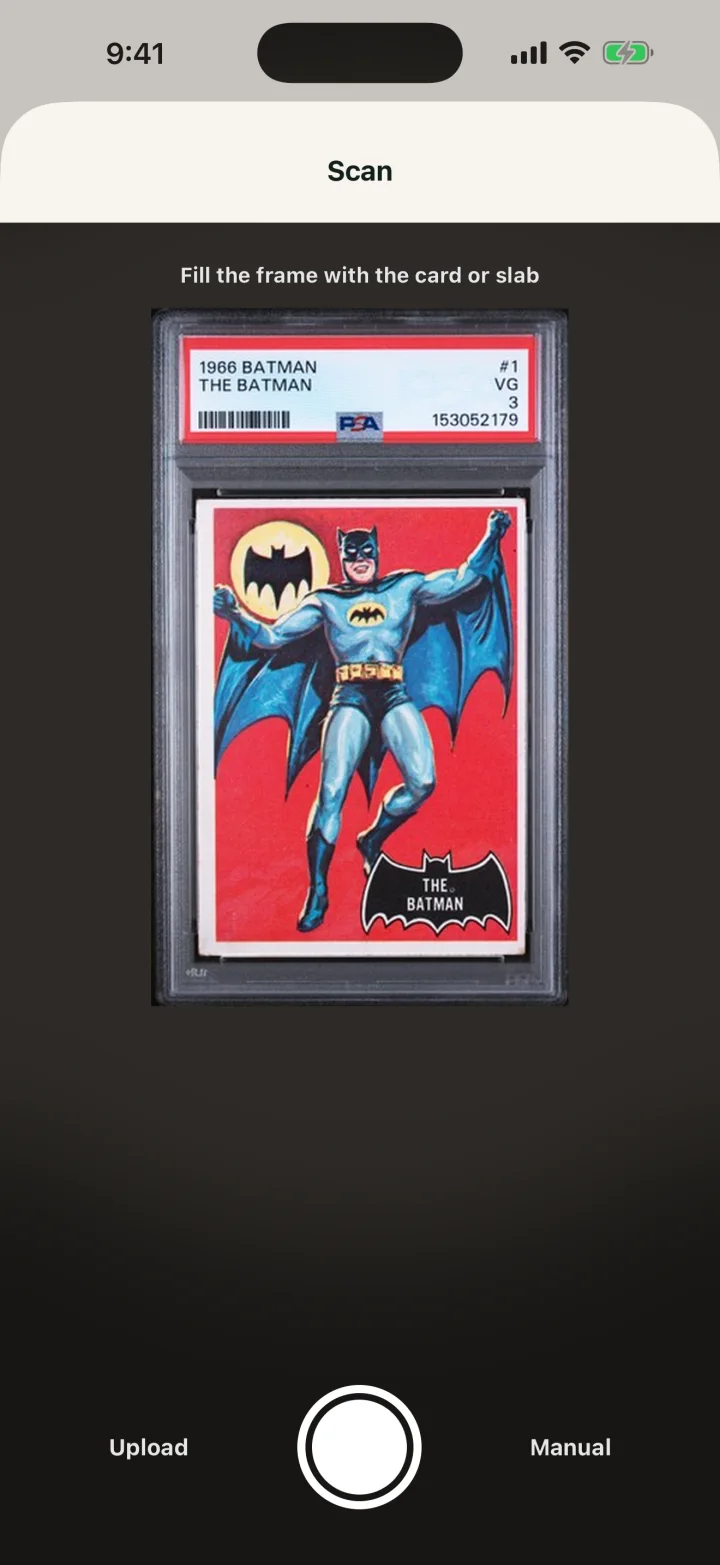
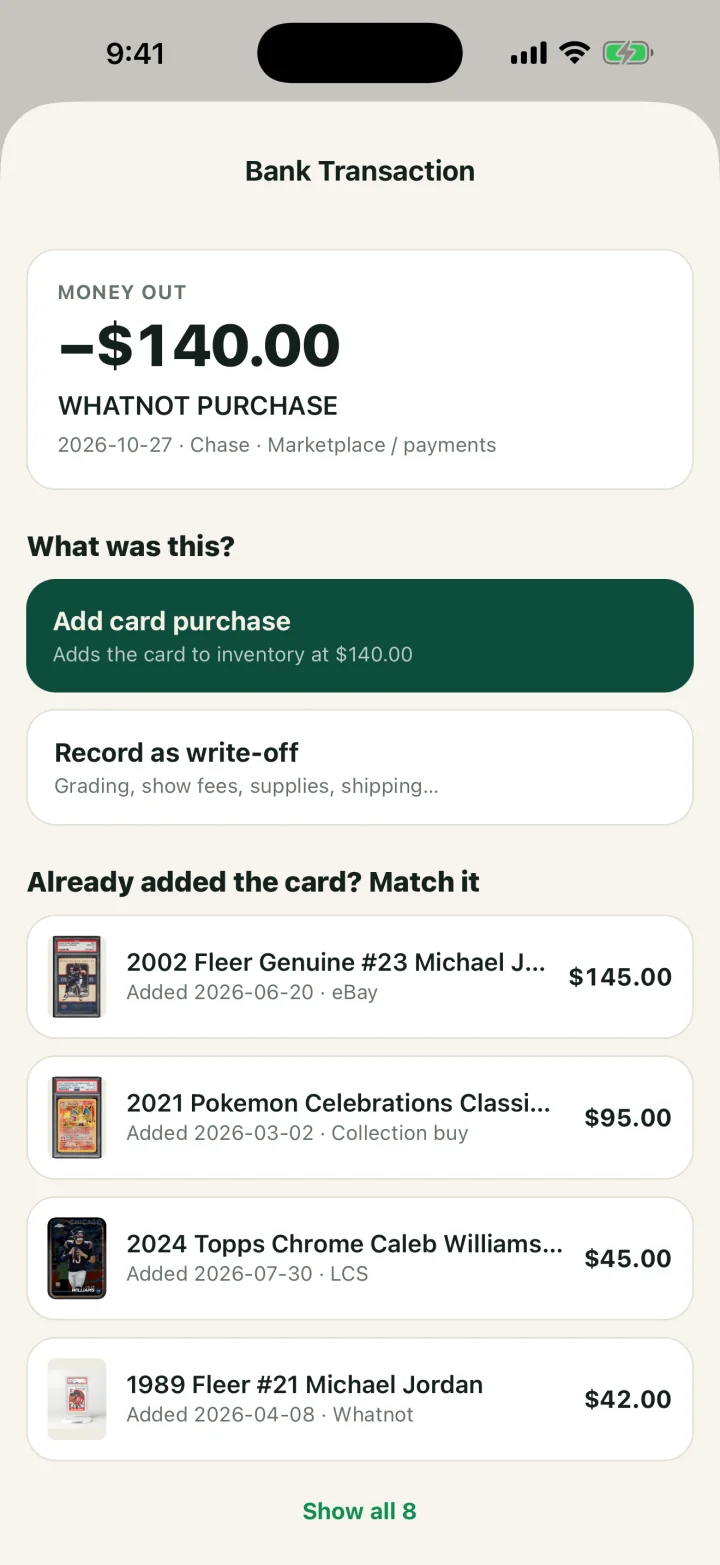
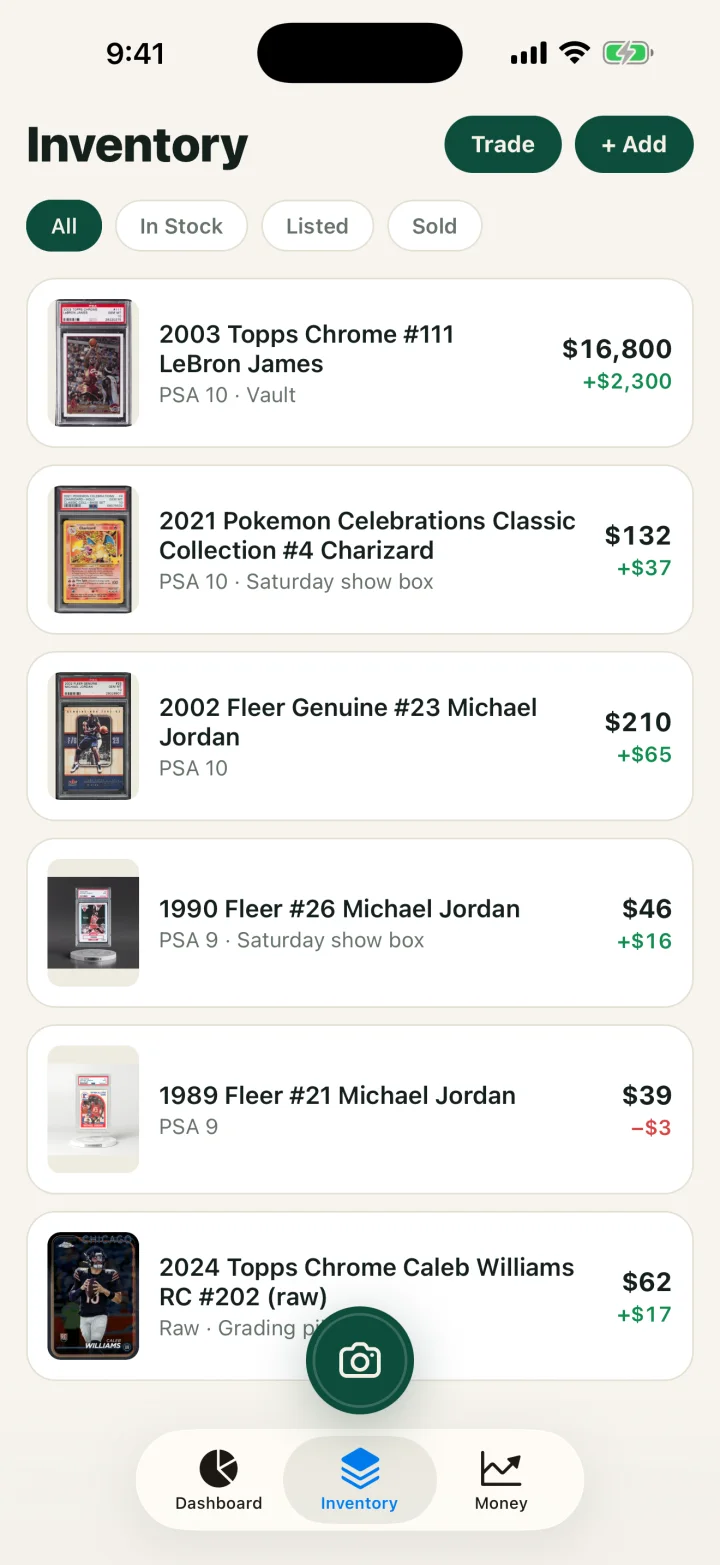
The first screen is the scanner, which starts a buy record from the card or slab. The second is from the bank link on Comped Pro: a payment that looks card related, which you turn into a card purchase or match to a card already added. The third is Inventory, where every card carries its cost.
Related guides
- The Card Vendor's Master Guide to Taxes: where cost of goods sold goes on Schedule C.
- Cost basis for cards bought with cash or by trade: the receipt to write at the table.
- Are PSA grading fees tax deductible?: the fee is part of the card's cost.
- Hobby or business: selling cards: records are the first IRS factor.
FAQ
What if I bought the cards 20 years ago with no receipt?
Basis is the original cost if you can show it. Look for old statements, order emails and anything dated from that time, then write down what you know. If nothing supports a cost, the IRS can assert zero basis and tax the whole sale.
Is a bank statement enough to prove what a card cost?
It proves the payment. Publication 583 accepts account statements that show the amount, the payee and the date. It also says proof of payment alone is not enough. Pair the statement with an order page, invoice or message that names the card.
Can I estimate what I paid?
An estimate with nothing behind it is the weakest position, and the IRS can reject it. The IRS examiner manual says close approximations can be established through reliable secondary sources, and that the burden of proof stays with you. Tie every figure to a document where one exists, and label notes written from memory.
What is my cost basis in cards I inherited?
Publication 551 says the basis of inherited property is generally its fair market value on the date of death. It is not what the person who died paid. An appraisal or sold prices from that date support the figure.
What is my basis in cards my dad gave me?
For a gift, Publication 551 says your basis for figuring a gain is the same as the giver's adjusted basis. You need to know what the giver paid. If the card was worth less than that when given, a loss is figured from the value on that day.
Is it profit or the whole sale that is taxed?
Profit, when you can prove cost. Tax is owed on the sale price minus what the card cost and your selling costs. Without support for the cost, the IRS can tax the full sale price.
I got a 1099-K for more than I made. What do I do?
The 1099-K reports gross payments and does not subtract fees, refunds, shipping or what the cards cost. You report the gross and subtract those on your return. That is why rebuilt cost records matter most in a year a 1099-K arrives.
How long do I keep card purchase records?
Keep them 3 years after filing the return that reports the sale, or 6 years if income was under-reported by more than 25%. A card bought in 2023 and sold in 2026 needs its 2023 record until at least 2030.
SOURCES
- Burden of proof, IRS, checked November 2026.
- Publication 583 (12/2024), Starting a Business and Keeping Records, IRS, checked November 2026.
- Publication 551 (12/2025), Basis of Assets, IRS, checked November 2026.
- Internal Revenue Manual 4.10.7, Issue Resolution, sections 4.10.7.3.2 and 4.10.7.4.2, IRS, checked November 2026.
- What kind of records should I keep, IRS, checked November 2026.
- How long should I keep records?, IRS, checked November 2026.
- Reconstructing records after a natural disaster or casualty loss, IRS, checked November 2026.
- Form 1099-K FAQs, general information, IRS, checked November 2026.
- Accuracy-related penalty, IRS, checked November 2026.
- File an amended return, IRS, checked November 2026.
This is general information for card sellers, not tax or legal advice for your situation. Rules change and states differ; a CPA who knows your numbers wins every time.