The answer for each kind of seller
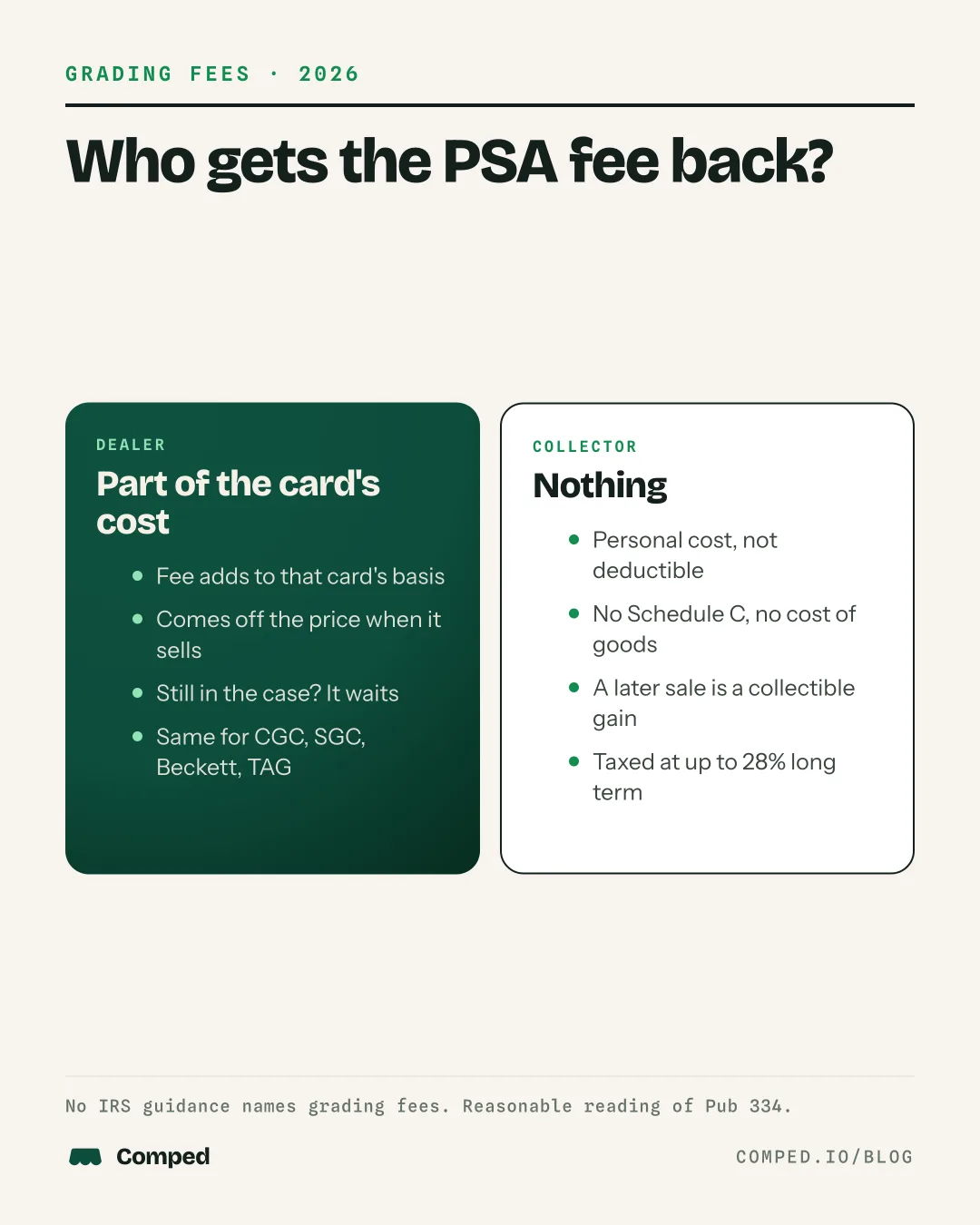
The answer depends on which kind of seller you are, and the master guide to write-offs covers how the IRS sorts you. A dealer treats the fee as a direct cost of the card. A hobby seller folds it into cost of goods sold. A collector has no deduction, only a higher basis if the card is sold later.
No IRS publication, ruling or form instruction mentions grading fees. What exists is the inventory rule in Publication 334. A card bought for resale is not an expense when you buy it; it is a cost you recover when it sells. A fee that turns a raw card into a slabbed card is part of what that card cost you. That is our reading, and it is the one used below.
| Who you are | What the grading fee is | When you get it back |
|---|---|---|
| Dealer, Schedule C | A direct cost of that card | When the card sells, against the sale price |
| Hobby seller, Schedule 1 | Part of cost of goods sold | When the card sells; no other expenses allowed |
| Collector who sells a card later, not as a business | Our reading: added to the card's basis | When the card sells, as a smaller capital gain |
| Collector who never sells | A personal cost | Never |
The hobby row matters because hobby expenses cannot be deducted at all, a rule the July 2025 law made permanent. The IRS page on hobby income says they can no longer be deducted. Cost of goods sold is not an expense in that sense, so the fee survives inside the card's cost. Our guide to hobby or business covers which row you are in.
The collector row rests on Publication 551. It says the cost of property includes charges such as sales tax, freight, and installation and testing. It also says basis rises by items properly added to a capital account. Grading is not on either list, so treat this row as our reading and confirm it with a CPA before a large sale.
The worked example
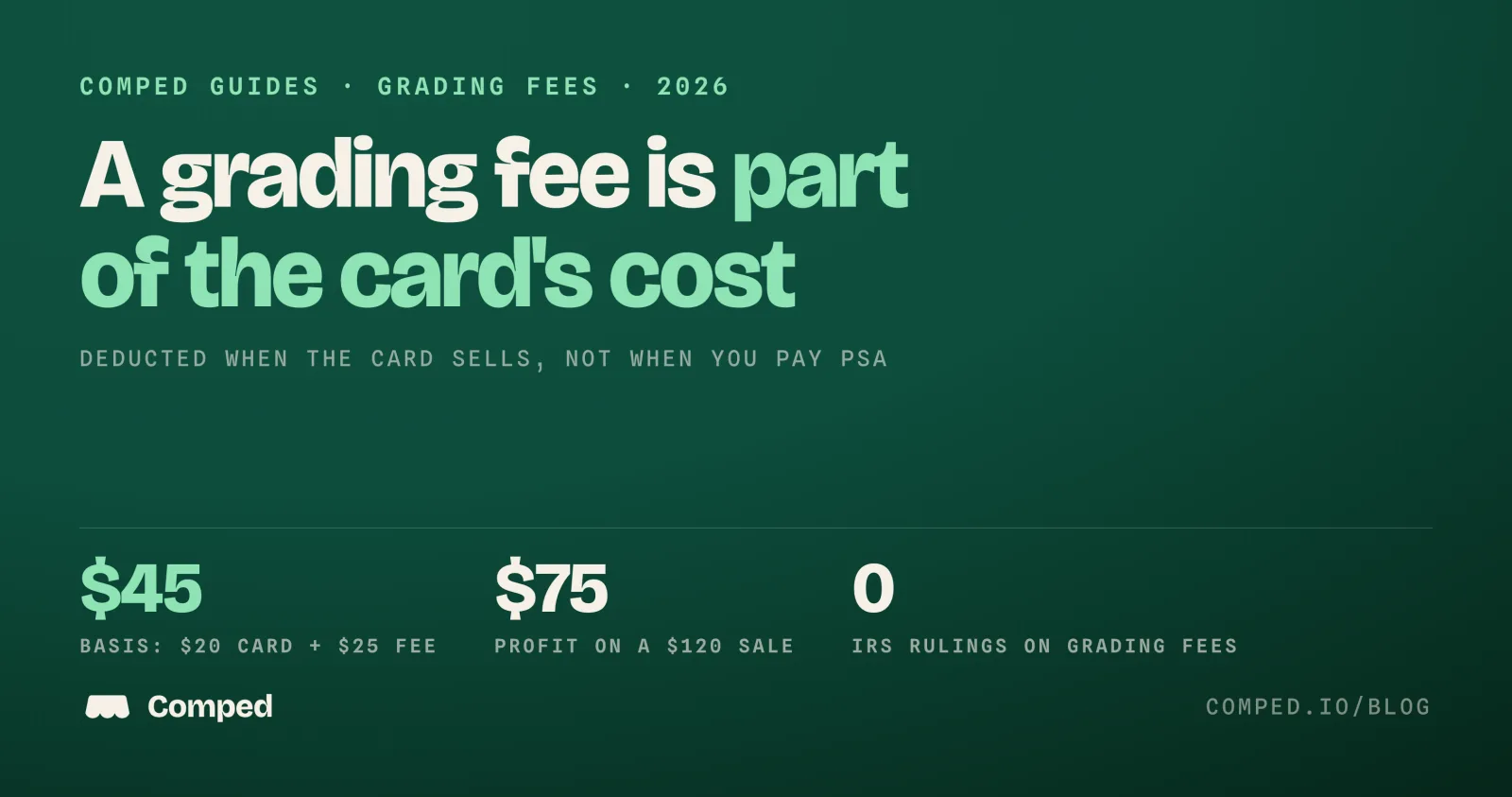
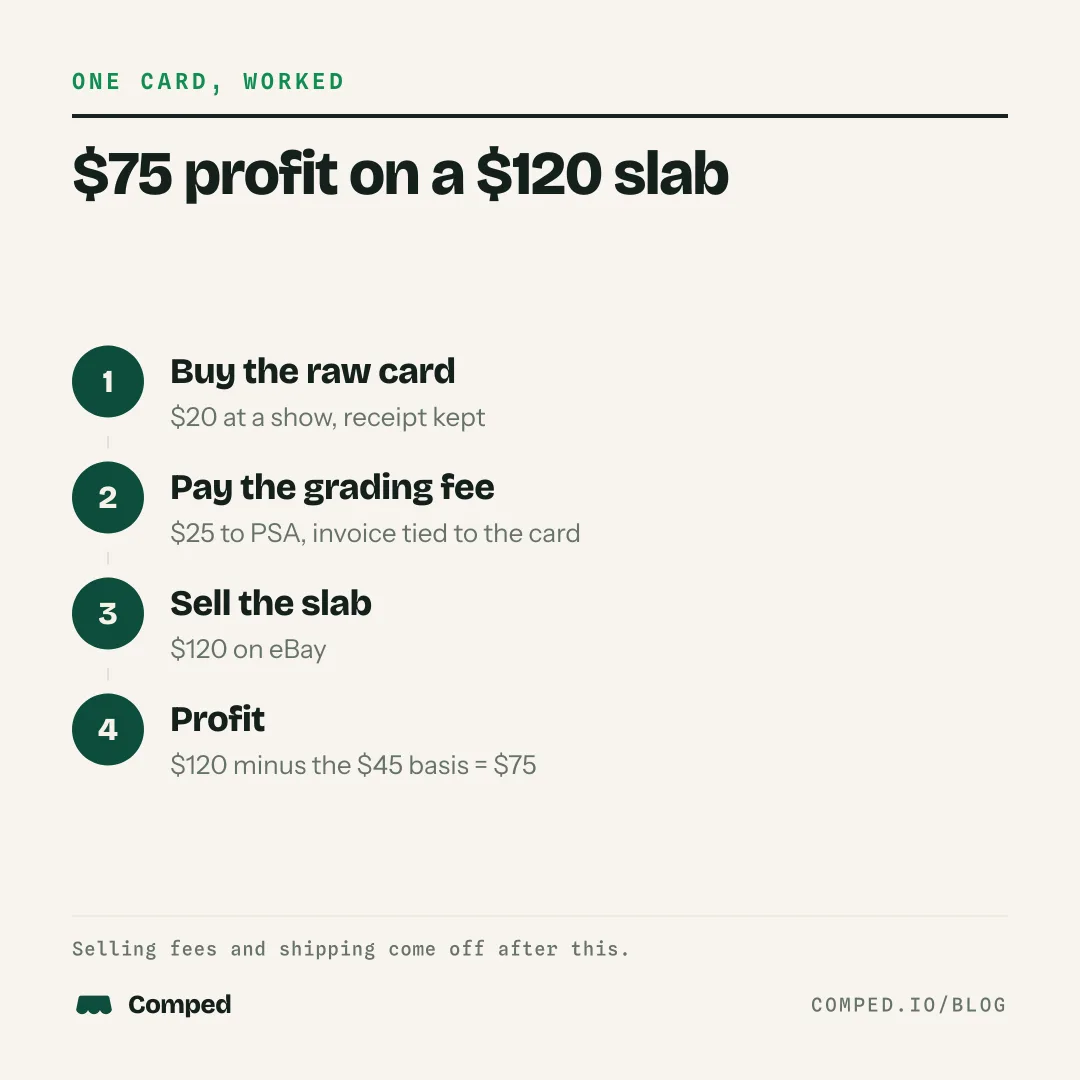
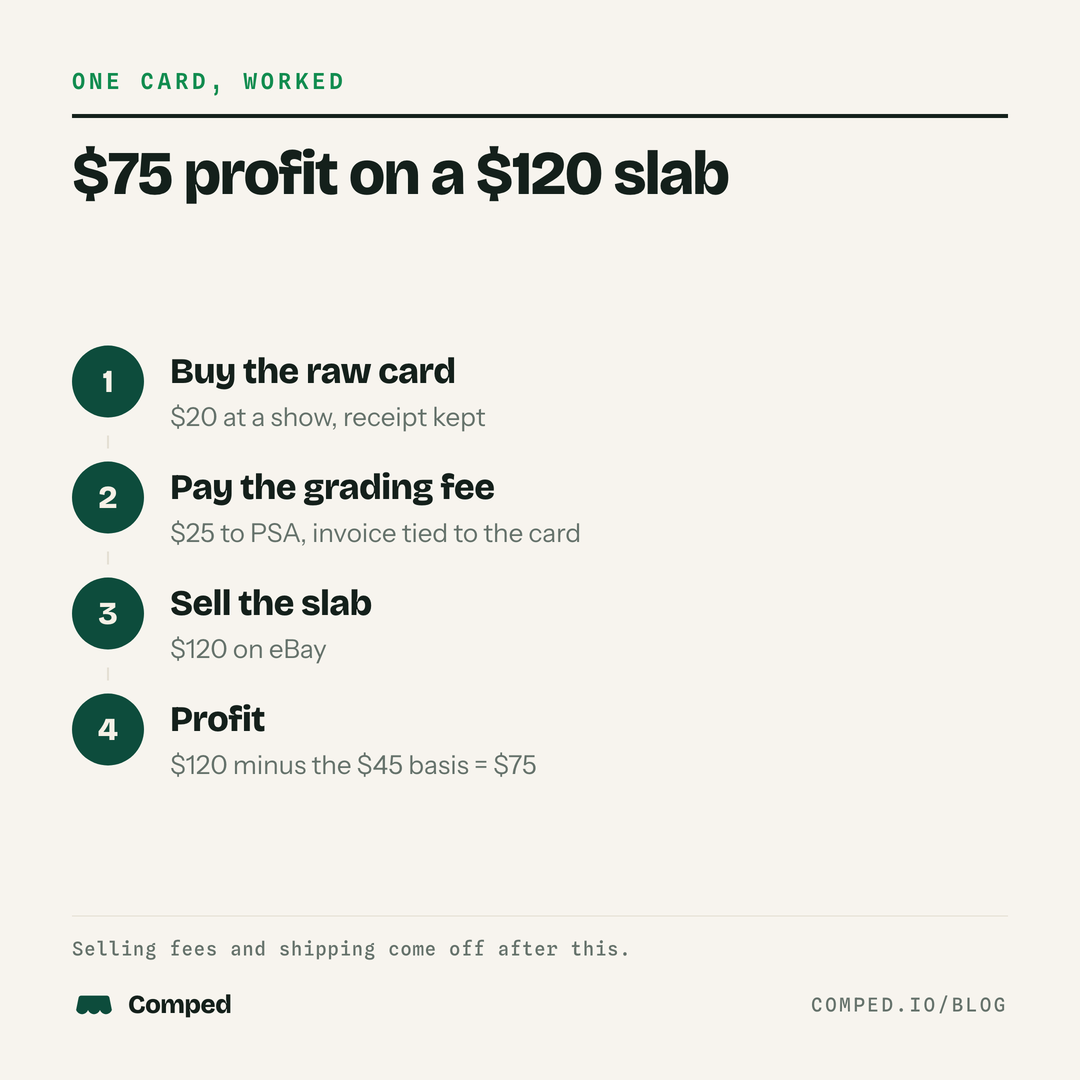
Say you buy a raw card for $20, pay $25 to grade it, and sell the slab for $120. Your basis in the card is $45, and your profit is $75. The grading fee never appears as its own line; it lowers the profit on the card it was spent on. These numbers are an example, not a price list.
Selling costs come off next. If, say, eBay took $16 and the label cost $5, the taxable profit is $54, not $75. Our post on taxes on selling sports cards covers the rest of the subtractions.
A REAL DEAL, WORKED
Say a raw card, one PSA submission, and a sale on eBay. Every figure is an example.
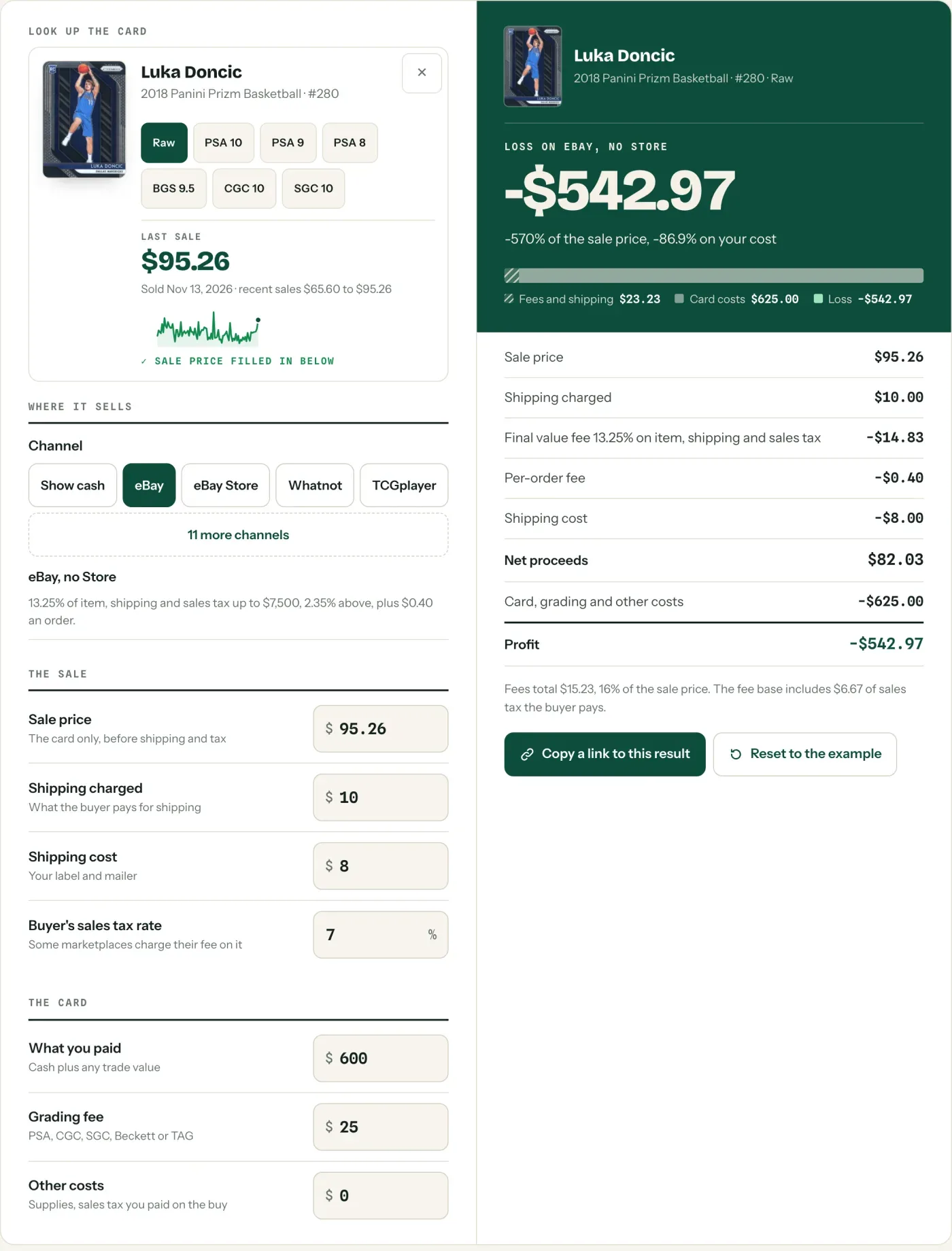
To run your own card, the card profit calculator has a grading fee field beside the purchase price. It subtracts both, plus the fees for the channel you pick.
Sold this year or still in the case
If the graded card sold in 2026, its $45 cost comes off 2026 income. If the slab is still in your case on 31 December 2026, the $25 fee waits and comes off in the year it sells. That is the inventory rule, and it is the part vendors get wrong by writing off every PSA invoice in the year it was paid.
Publication 334 lets a reseller with average gross receipts of $31 million or less (for 2025; $32 million for 2026) skip formal inventory accounting. Cards become non-incidental materials and supplies. The publication says those costs are deducted in the year the items are "first used or consumed in your operations". It adds that inventory is used or consumed "in the year you provide the inventory to your customers". The trigger is the sale, not the payment.
Forum answers often say an expense is claimed in the year paid. That is true of a table fee or a tank of gas. It is not how the publication treats the cost of goods you hold for sale. So if you graded 23 cards and sold 17, the fees on the 17 come off this year and the fees on the other 6 wait.
THE OTHER METHOD
Publication 334 also lets a small reseller follow the method used in its own books and records. Some dealers rely on that to deduct fees as paid. Whether your books support it is a question for a CPA. Whichever method you use, use it every year and never count a fee twice.
Where the fee goes on Schedule C
For a dealer the fee belongs in Part III of Schedule C, the cost of goods sold section, not in the expense lines of Part II. The instructions name no line for grading. Our reading is line 36 with the card's purchase price, or line 39, other costs. Pick one and keep it the same every year.
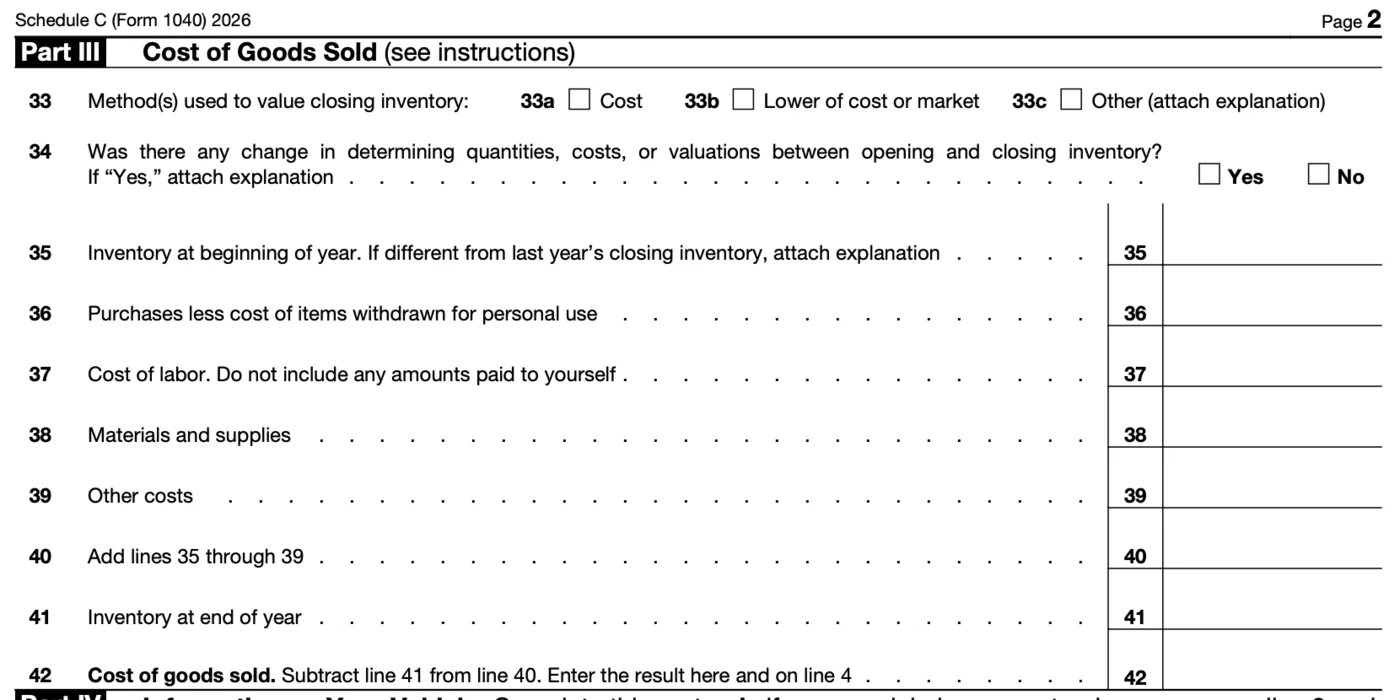
Line 41 is what makes the timing work. The cost of every card still unsold at year end, grading included, sits on line 41 and is subtracted back out. Line 42 is what is left, the cost of the cards that sold, and it carries to line 4 on page 1. A year-end inventory count gives you the line 41 number.
A hobby seller has no Schedule C. Income goes on Schedule 1 (Form 1040), line 8, and the card's cost, fee included, is the only thing that comes off.
Bulk submissions, shipping, upcharges and memberships
A bulk submission is one invoice for many cards, so split it per card. Say 20 cards at $25 each, plus $40 to ship them to PSA and $30 for the return: $570 in all, or $28.50 per card. Each card's basis rises by $28.50.
Shipping to and from the grader travels with the card the same way. Publication 334 counts freight in on merchandise you buy for sale as part of cost of goods sold. We read grader shipping as the same kind of cost. Some dealers book it as a shipping expense instead; either way, count it once.
If some cards sell this year and some do not, only the sold cards' share comes off this year. A per-card split, written down once and used every year, is a reasonable method. The card cost basis calculator splits one invoice evenly across the cards or by each card's share of the value.
| Charge | Our reading for a dealer |
|---|---|
| Grading fee per card | Added to that card's cost |
| An extra charge the grader adds after grading one card | Added to that card's cost |
| Shipping and insurance to and from the grader | Split across the cards in the box |
| A card sent back ungraded with the fee kept | Still a cost of that card |
| A regrade, crossover or reholder fee | Added to the same card's cost again |
| A grader membership or yearly club fee | A business expense in the year paid, since it is tied to no card |
| Card savers, sleeves and boxes for the submission | Supplies, a business expense |
CGC, SGC, Beckett, TAG and regrades
The grader does not change the answer. A CGC, SGC, Beckett or TAG fee is the same kind of cost as a PSA fee. It is money spent on one card to make it sell for more. Treat every grader's invoice the same way, by card, recovered at sale.
A second fee on the same card stacks on the first. Say a card cost $20, graded for $25, then crossed over to another grader for $30. Its basis is $75. A card that comes back with a low grade keeps its full cost too, and the loss shows up when it sells.
Cards graded for your own collection
Grading a card you intend to keep is a personal cost, and personal costs are not deductible. Running it through the business does not change that. If a card leaves inventory for your own collection, its cost, grading included, comes out of purchases on Schedule C line 36.
A later sale of a personal card is an investor's sale, not a business sale. A long-term gain is a collectible gain, taxed at up to 28% under Topic 409. On our reading the grading fee is part of that card's basis, so it shrinks the gain. A loss on a card held for personal use is not deductible. The master tax guide covers that split.
Common mistakes and what they cost
The costly mistakes are all about timing and counting. Each example below uses a seller who sets aside 25% of profit for tax, an example rate.
| Mistake | Example | What it costs |
|---|---|---|
| Writing off the whole invoice in the year paid | 100 cards graded for $2,500 in December 2026, none sold by year end | 2026 profit is understated by $2,500, about $625 of tax pushed to the wrong year |
| Counting the fee twice | $25 in the card's cost and $25 again as an expense | $25 too much deducted on every card, with no record to defend it |
| A hobby seller listing fees as expenses | $600 of fees claimed as hobby expenses | Not allowed. The fees count only inside the cost of cards that sold |
| Running personal cards through the business | 10 keepers in a 50 card order at $25 | $250 of personal cost deducted that should not be |
| Skipping the fee entirely | Profit figured as $120 less $20 | Tax paid on $25 of profit that never existed |
An understated year can carry the 20% accuracy-related penalty on the tax that was underpaid, plus interest. The last row runs the other way: it is the seller overpaying.
Fees you already deducted when you paid
If you deducted grading fees in the year you paid them, do not deduct them again when those cards sell. That is the first fix, and it needs nothing filed. Mark those cards so their cost carries only the purchase price.
Going forward, choose one method and stay on it. Publication 334 says a change in how you account for inventory is made on Form 3115, Application for Change in Accounting Method. Whether a past return should be amended depends on the amounts and the years. Bring a CPA the invoices and the list of which cards sold in which year.
The record
The record is the submission invoice tied to the card. Publication 583 lists invoices and account statements among the documents that prove a cost. A PSA invoice with the card's line item and cert number does both jobs. Keep it with the card's purchase receipt, which our post on cost basis for cash and trade buys explains. In Comped you can edit a card's cost to include its grading fee, so the fee comes off when that card is marked sold.
Keep the records 3 years after the return that reports the sale, 6 years if income was under-reported by more than 25%.
If a marketplace sends a 1099-K, Box 1a shows the gross sale price. The card's cost, grading included, is one of the things you subtract on the return. The 1099-K reconciliation calculator walks from the form's total to your real profit.
Run your own deal through the card sale tax calculator to see the tax to set aside.
How this looks in the Comped app
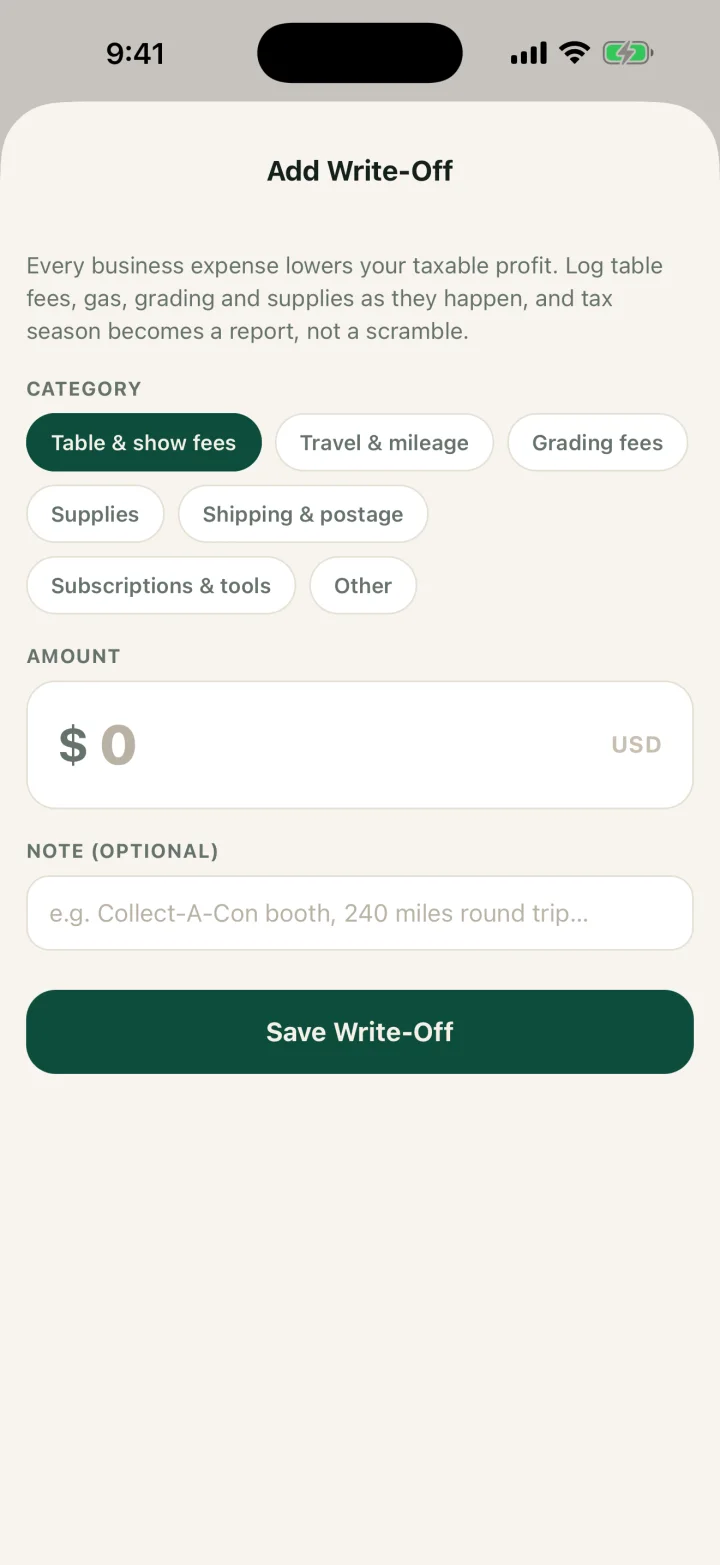
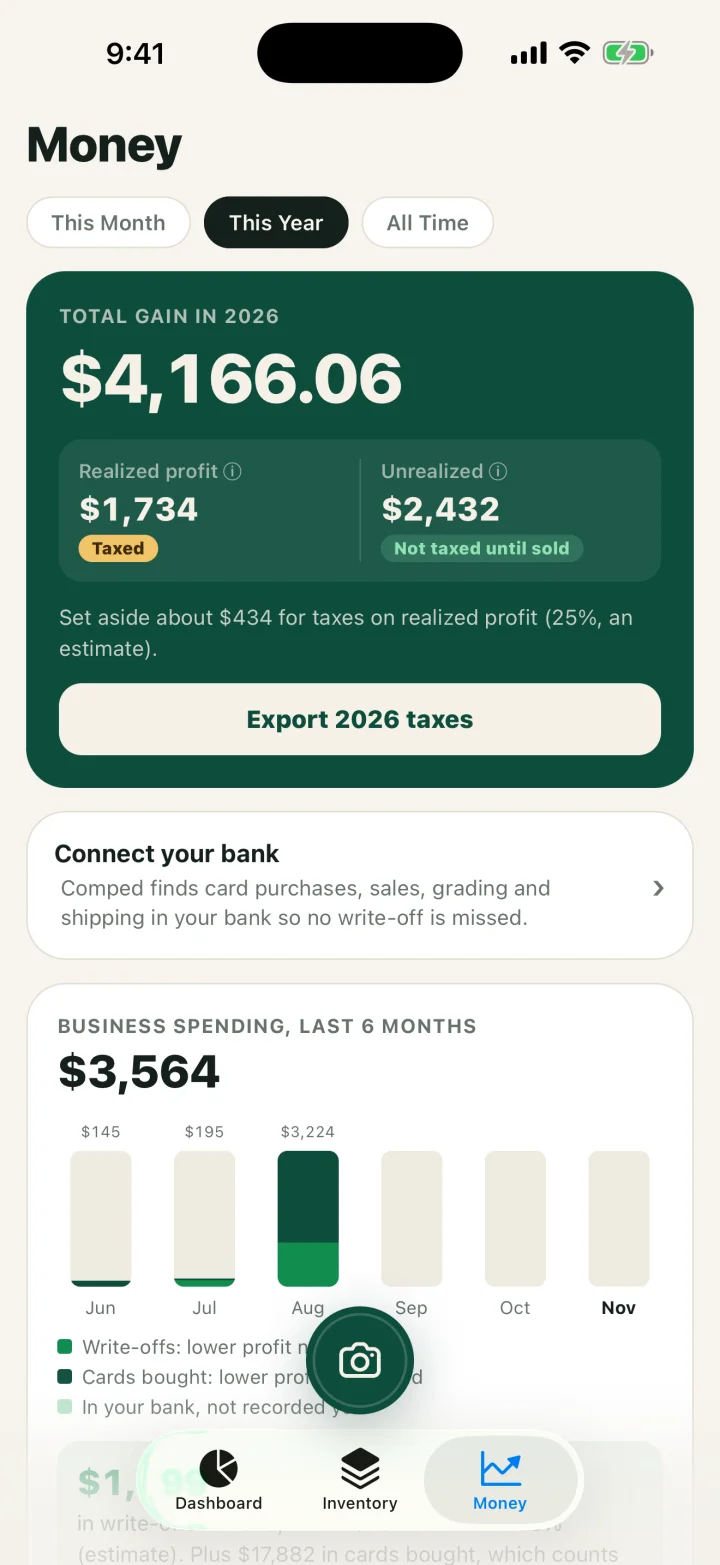
The Add Write-Off screen has a Grading fees category for fees you expense, and an amount logged there counts in the month it was paid. To follow the per-card method on this page, add the fee to the card's cost instead and skip the write-off, so it is not counted twice. A sale's Transaction screen then shows the cost basis coming off the price, and the Money tab totals realized profit for the year with an Export taxes button.

Related guides
- The Card Vendor's Master Guide to Write-Offs: every deduction a card business has, with the record that proves each one.
- Cost basis for cards bought with cash or by trade at a show: the receipt that proves what the card cost.
- Do you have to pay taxes on selling sports cards?: every step from sale price to tax owed.
- Selling Pokemon cards and taxes: the same rules for the Pokemon side of the table.
- Year-end card inventory count: how to get the number for the slabs still in your case.
FAQ
Are grading fees part of basis or an expense?
Part of the card's cost, recovered when that card sells. No IRS guidance names grading fees, so this is our reading of the inventory rules in Publication 334. Treating the fee as a same-year expense for a card still in your case is the mistake to avoid.
Can I deduct the PSA fee in the year I paid it?
Only for cards that sold in that year. For a card still unsold on 31 December 2026, the fee waits with the card and comes off in the year of the sale. The money comes back either way; the only question is which year.
I graded 23 cards and sold 17. Can I deduct the fees on all 23?
On our reading, only the 17. The fees on the 6 unsold cards stay in their cost and come off when each one sells. Publication 334 ties the deduction to the year you provide the inventory to a customer.
What category is PSA grading on Schedule C?
Cost of goods sold, in Part III, not an expense line in Part II. The instructions name no line for grading. Our reading is line 36 with purchases or line 39 as other costs, used the same way every year.
Is shipping to PSA a separate expense?
We read it as part of the cost of the cards in the box, split per card, like freight on merchandise you buy for sale. Some dealers book it as a shipping expense instead. Either approach works only if the amount is counted once.
Do grading fees lower capital gains for a collector?
On our reading, yes. The fee is added to the card's basis, so the gain on a later sale is smaller. A collector gets no deduction before the sale, and a loss on a personal card is not deductible.
What if the card graded lower than I hoped and sold at a loss?
A dealer still recovers the full cost, the grading fee included, and the loss lowers the year's business profit. The fee does not disappear because the grade did. Keep the invoice either way.
Do I need the PSA invoice or is the charge on my bank statement enough?
Keep both. The statement proves the amount was paid; the invoice ties the amount to specific cards and their cert numbers. Publication 583 lists both invoices and account statements as supporting documents.
SOURCES
- Publication 334 (2025), Tax Guide for Small Business, IRS, checked November 2026.
- Schedule C (Form 1040) 2026, Profit or Loss From Business, IRS, checked November 2026.
- Instructions for Schedule C (Form 1040) (2025), IRS, checked November 2026.
- Publication 551 (12/2025), Basis of Assets, IRS, checked November 2026.
- Tips for taxpayers who make money from a hobby, IRS, checked November 2026.
- Topic no. 409, Capital gains and losses, IRS, checked November 2026.
- Publication 583, Starting a Business and Keeping Records, IRS, checked November 2026.
- How long should I keep records?, IRS, checked November 2026.
This is general information for card sellers, not tax or legal advice for your situation. Rules change and states differ; a CPA who knows your numbers wins every time.