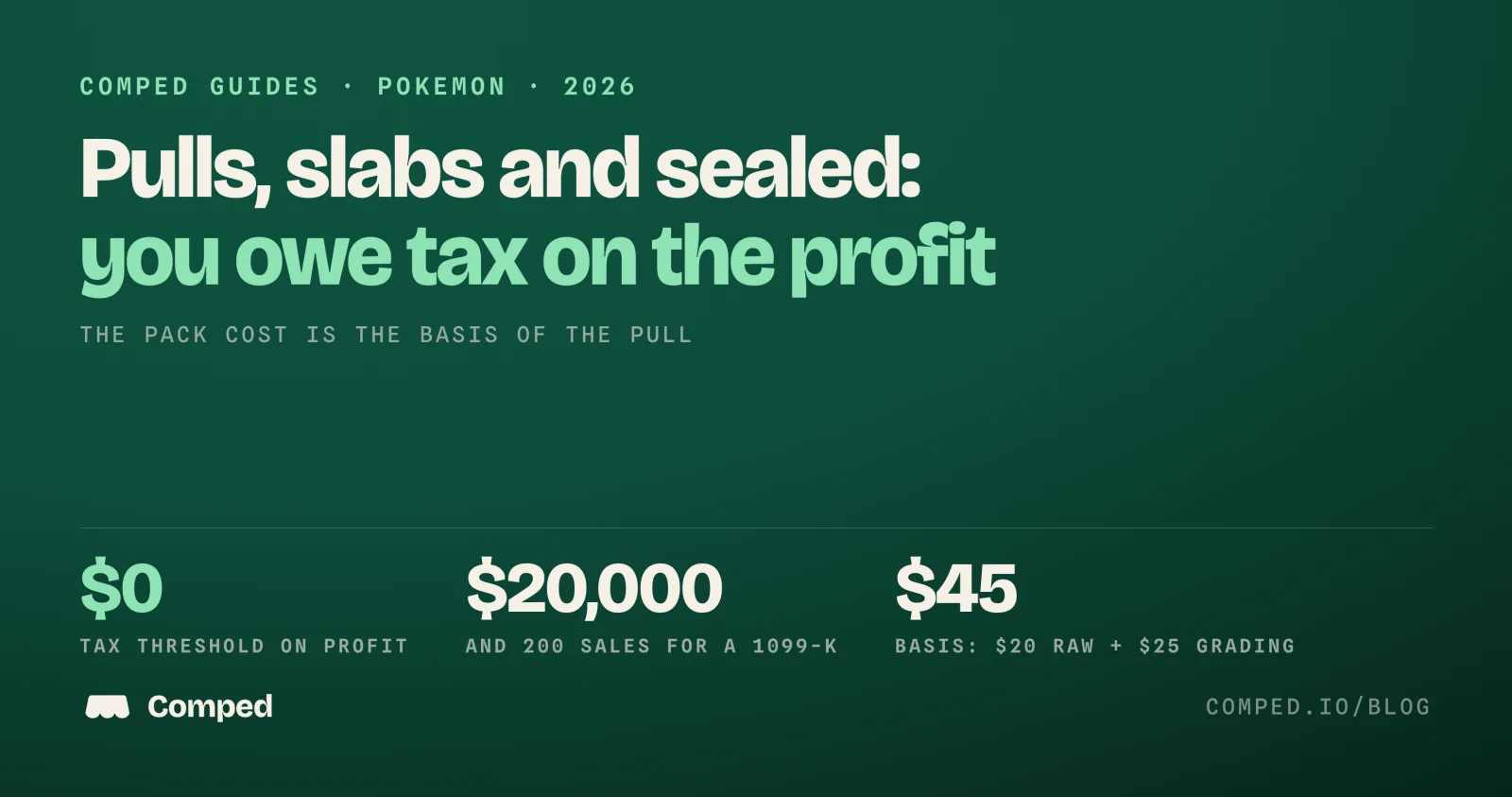
What part of a Pokemon card sale is taxed?
The profit, which is the sale price minus the card's cost basis and the costs of selling it. The IRS 1099-K FAQs say the form's gross figure is not adjusted for fees, refunds, shipping or discounts. You subtract those on your return.
A card bought at a show has an easy basis: what you paid. Pokemon is harder because so much of what sells was pulled, broken or graded, and each changes the basis. The master tax guide covers inventory methods and cost of goods sold in depth. The card profit calculator shows one sale after platform fees.
Are you a collector, a hobby seller or a dealer?
The IRS decides from your conduct, and the answer sets the form, the rate and what you may subtract. Its hobby-or-business factors look at your books, your time, whether you depend on the income, and your profit history. A profit in 3 of 5 consecutive years presumes a business under section 183(d). Hobby or business: selling cards and the IRS factors walks through each one.
| Collector selling personal cards | Hobby seller | Dealer | |
|---|---|---|---|
| Looks like | Selling cards you bought to keep | Buying and selling now and then, no profit motive | Buying to resell, regularly, for profit |
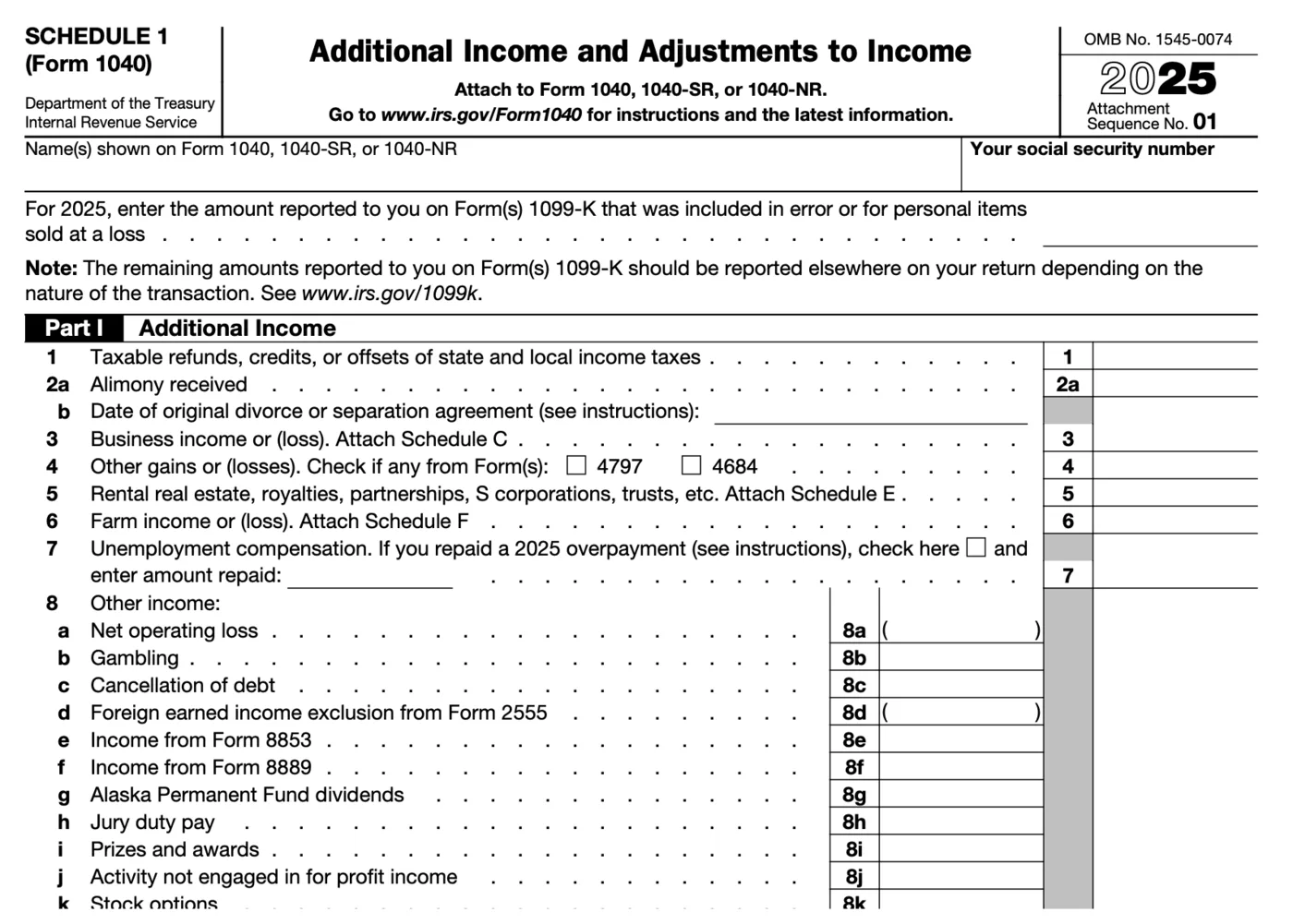
| Where it goes | Form 8949 and Schedule D | Schedule 1, other income (line 8j on the 2025 form) | Schedule C, then Schedule SE |
| Rate | Held over a year: your rate, capped at 28%. A year or less: your ordinary rate | Your ordinary rate | Your ordinary rate plus 15.3% self-employment tax on net earnings of $400 or more |
| What comes off | The card's basis | Cost of goods sold only | Cost of goods sold and every ordinary business expense |
| A loss | Not deductible on personal cards | Not deductible | Counts, subject to limits, and carries to Schedule 1, line 3 |
Hobby is the expensive answer. Cost of goods still comes off, but every other expense is a miscellaneous itemized deduction that cannot be deducted, permanently, since the July 2025 law. No fees, no postage, no table rent.
The 28% figure is a ceiling, not a flat rate. Tax Topic 409 says collectible gains are taxed at a maximum of 28%. Trading cards are not on the statute's list; they are treated as collectibles in practice. Our reading: a seller in a lower bracket pays the lower rate, and card profit stacks on top of your wages either way.
What is the cost basis for a card pulled from a pack?
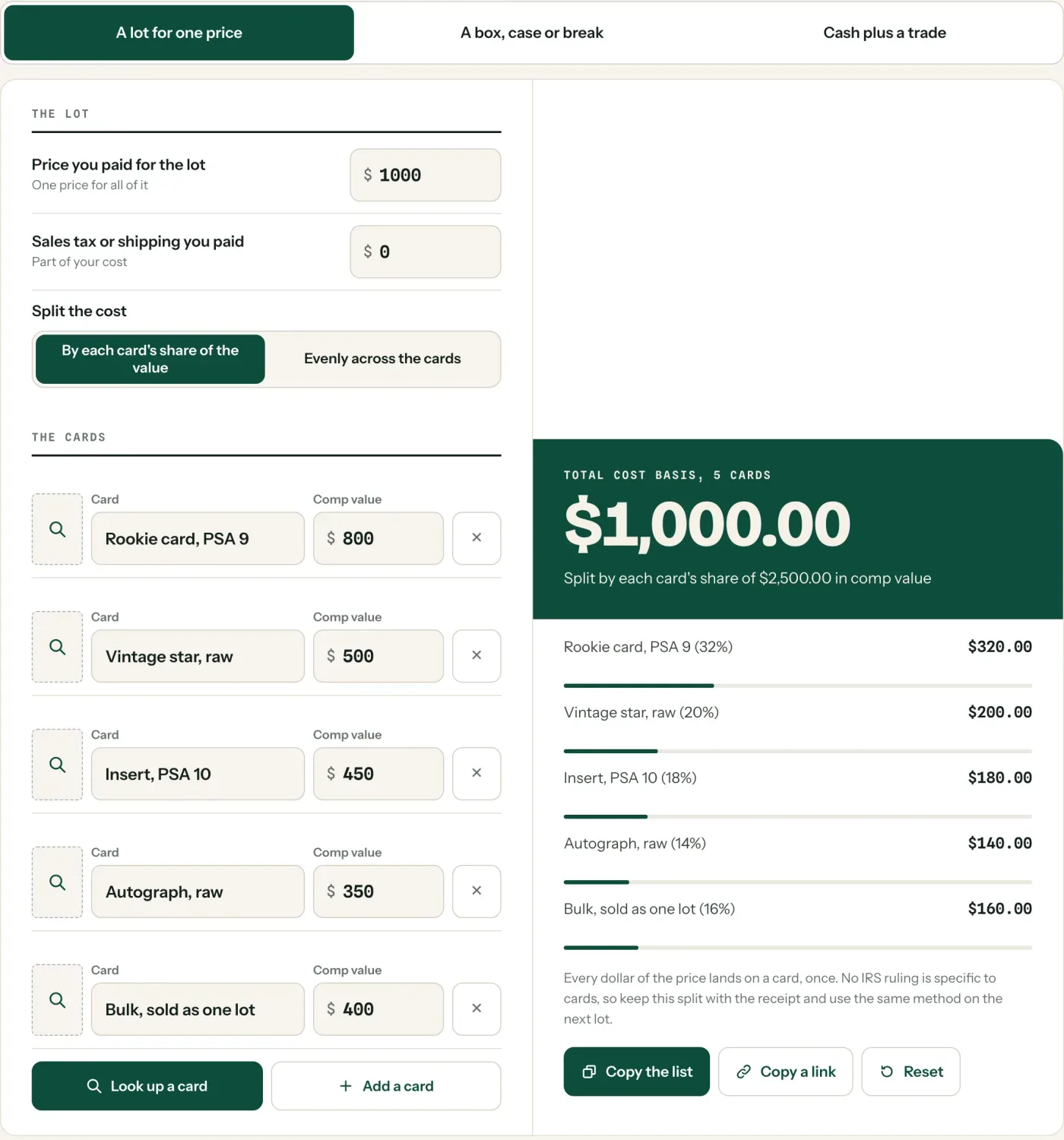
Its share of what the pack or box cost. There is no IRS ruling specific to pulled cards. Publication 551 gives the general rule for a lump-sum purchase: allocate the amount you pay among the assets you receive. Our reading is that a booster box is that kind of purchase. Split the box cost across what you keep and what you sell, use the same method every time, and keep the box receipt.
Say you bought a booster box for $150, pulled one chase card and sold it for $200, then sold the rest as bulk for $50. If everything sells in the same year, the whole $150 comes off and the profit is $100 before fees.
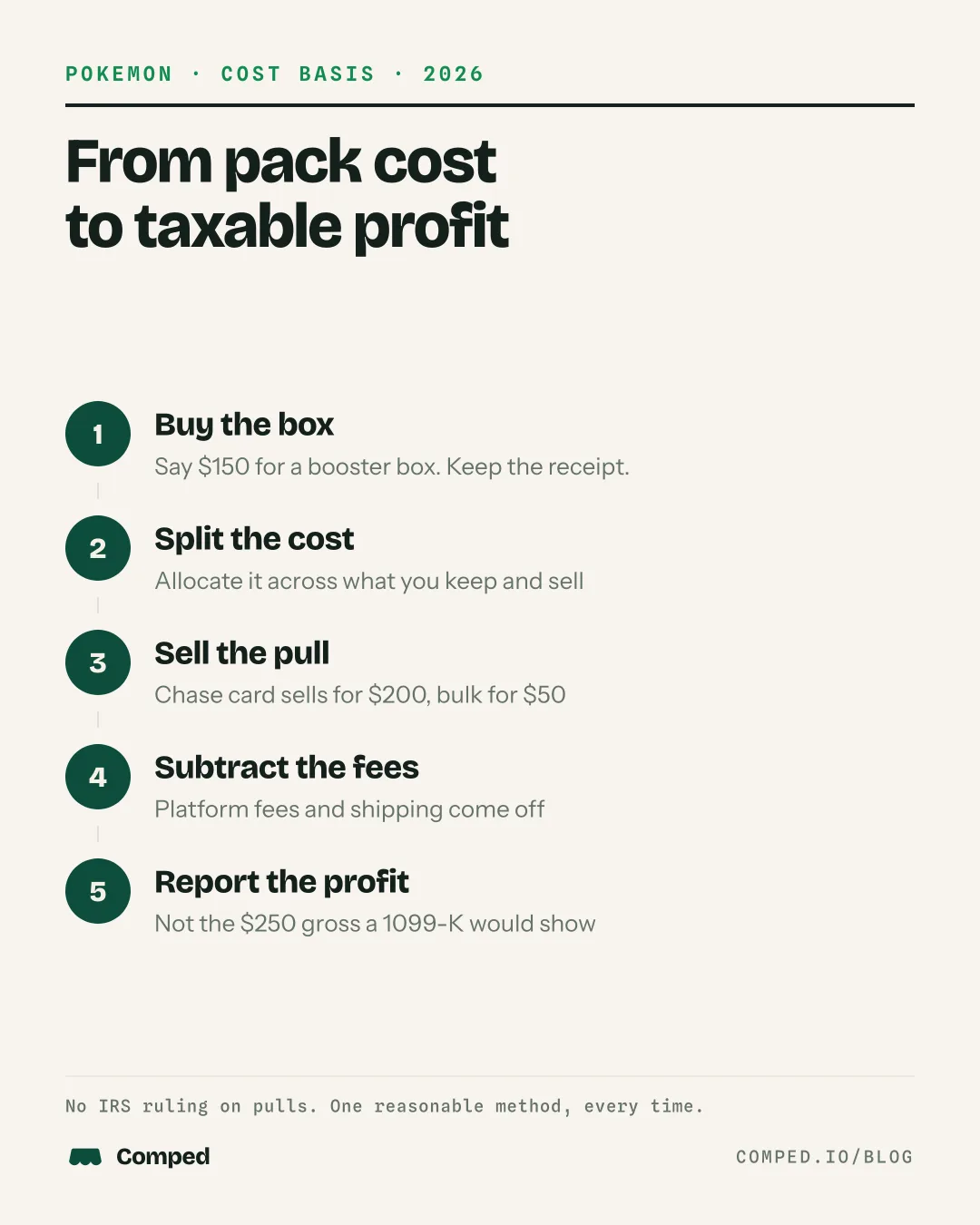
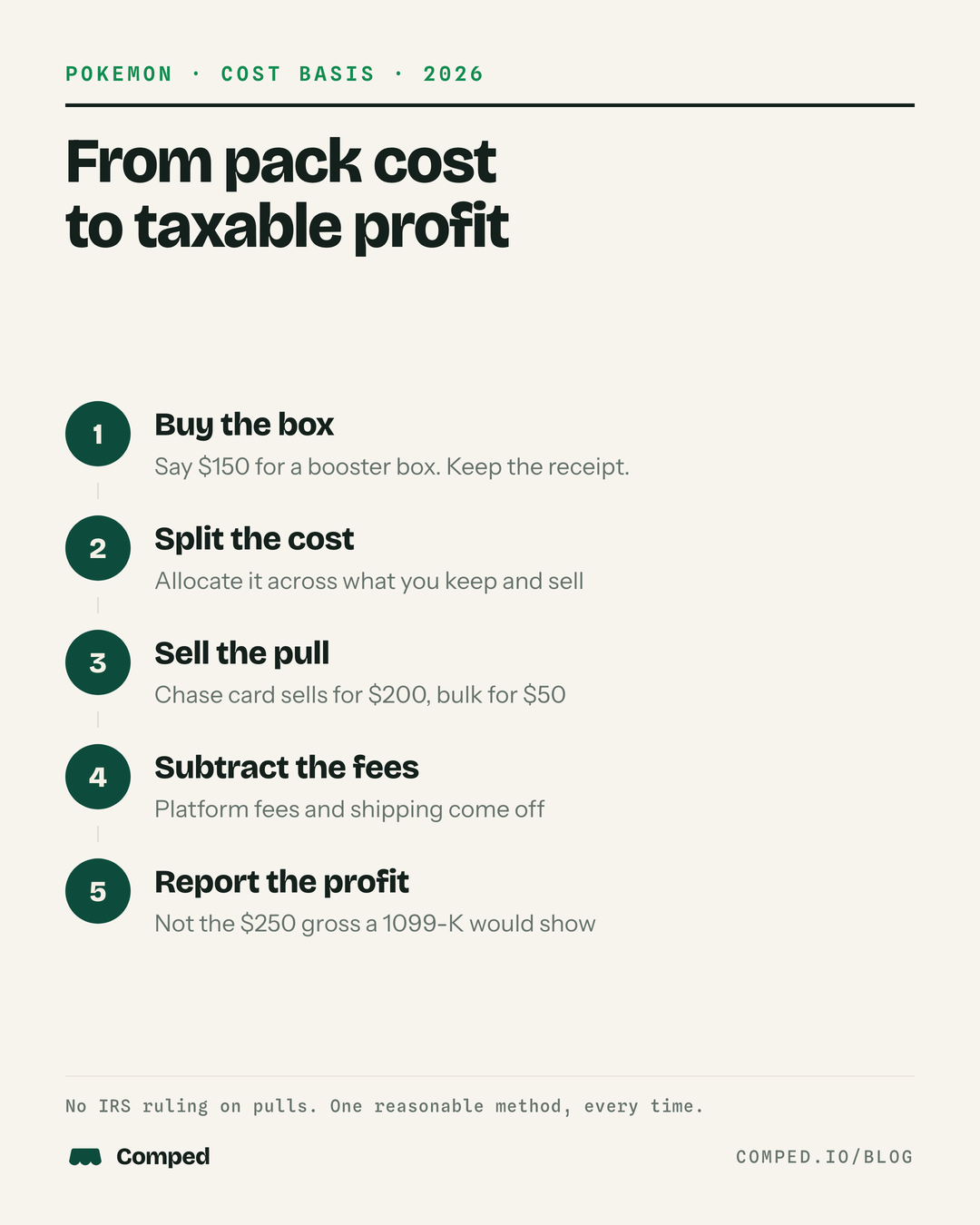
Allocation matters when you keep some of the box, or when the cards sell in different years. The kept cards take their share of the cost with them, because binder cards are no longer inventory. Schedule C line 36 is "purchases less cost of items withdrawn for personal use" for that reason.
AN EXAMPLE BOX, WITH ONE CARD KEPT
Example figures. A $150 booster box gives a chase card worth $200, a second hit worth $50 that goes in your binder, and bulk worth $50. Split by each card's share of the $300 total value.
The binder card's $25 comes out of purchases and waits. If you sell that card later, $25 is its basis. Putting the whole $150 on the two cards you sold would overstate this year's cost by $25. Splitting by value and splitting evenly per pack are both defensible. Loading the full cost onto one hit is harder to defend once cards sell in different years.
Do sealed product and box breaks count?
Yes, both are sales. A sealed box bought to resell is inventory, and the profit when it sells is ordinary income on Schedule C. A box bought for $150 and sold for $220 made $70 before fees, whether it sat a week or a year.
Sales tax you paid at the store or on a Pokemon Center order is part of that box's cost. So is shipping you paid to receive it. A dealer with a resale certificate buys inventory without sales tax and charges it at the table instead; the state sales tax guide covers who must register.
A break is the same thing in more pieces. The spot payments are your gross receipts and the box you opened is your cost of goods sold. Postage to spot buyers is a selling expense. On Whatnot or eBay the platform's fees come off too, and the platform collects sales tax where it is required to. A spot buyer who later sells uses what the spot cost as the basis of what it delivered, allocated like a box.
Does grading change the math?
It raises the basis. No IRS guidance exists on grading fees, so this is interpretation. For a dealer, the PSA, CGC, SGC, Beckett or TAG fee is a direct cost of that card, recovered when the card sells. Say you bought a raw card for $20, paid $25 to grade it, and sold the slab for $120. The basis is $45 and the profit is $75.
For a hobby seller, the fee is part of cost of goods in the same way. For a collector who never sells as a business, it is a personal cost and gives nothing. Are PSA grading fees tax deductible? goes through the dealer, hobby and collector cases.
What about childhood cards, gifts and kids who sell?
The basis follows how the card reached you. Cards you bought years ago carry what you paid then. If you cannot show it, document what you can, because the IRS can assert a zero basis and tax the whole sale. Sold cards with no receipts? shows how to rebuild a record from statements and order pages.
| How you got the card | Your basis | Source |
|---|---|---|
| Bought as a single | Price paid, plus sales tax and shipping you paid | Publication 551 |
| Pulled from a pack or box | Its share of the pack or box cost | Our reading of Publication 551 |
| Received as a gift | Generally the giver's basis | Publication 551 |
| Inherited | Generally the fair market value on the date of death | Publication 551 |
| Received in a trade | Its fair market value on the day of the trade | Tax Topic 420 |
A gift has one twist. When the card was worth less than the giver paid, Publication 551 uses that lower value to measure a loss. Birthday packs from a parent are a gift, so the parent's receipt is the record.
A child who sells follows the same rules. Publication 501, written for 2025 returns, says a dependent must file when net earnings from self-employment are at least $400. That is profit, not sales.
Do trades count as sales?
Yes. Under Tax Topic 420, the fair market value of the card you receive is income that year. That value becomes the new card's basis. A trade with no cash is still a sale.
AN EXAMPLE TRADE
Example figures. You trade a slab that cost you $60 for a card worth $100, then sell that card for $130.
The card trade calculator works a trade with cards and cash on both sides. Cost basis for cards bought with cash or by trade covers the receipt to write. Comped's Trade screen shows the cost basis of the cards you receive and the gain or loss on the cards going out.
Does it matter if you sell on eBay, TCGplayer, Whatnot or at a show?
The tax is the same everywhere; the paperwork is not. Online, the platform documents your gross and may file a 1099-K. At a local show, nobody documents anything unless you do.
| Channel | 1099-K for 2026 sales | Who sends it | Sales tax | Your record |
|---|---|---|---|---|
| eBay | More than $20,000 and more than 200 transactions | eBay; download in Seller Hub, Payments, Taxes | eBay collects and remits in 46 states plus DC | Order history, fee statements |
| TCGplayer | Same federal test; its page is written for 2025 sales | TCGplayer; totals include shipping, fees and refunds; accounts under one SSN or ITIN are combined | Collected where required | Order history |
| Whatnot | Same federal test | Stripe, only if you cash out through Stripe; PayPal-only sellers get no Whatnot form | Collected where required | Payout history |
| PayPal or Venmo | Same federal test; its page covers 2025 payments | PayPal | Yours | Activity statement |
| Card reader at your table | The IRS says card payments have no threshold. Square's page says above $20,000 and 200 in most states | The reader's company | Yours to register, collect and remit | Reader reports |
| Cash at a show | None | Nobody | Yours to register, collect and remit | Only what you write down |
On card readers, the two sources differ. The IRS says payment card transactions have no reporting threshold. Square's help page says it issues a form above $20,000 and 200 transactions in most states, and may report lower amounts at its discretion. Report every card sale whether or not a form comes.
Some states make platforms file at a lower figure, sent to the state. For 2026 sales, state sources give $600 in Massachusetts, Virginia, Montana and the District of Columbia. Arkansas is $2,500, and Illinois is more than $1,000 with 4 or more transactions. Platforms report a $1,000 New Jersey threshold. Vermont and Maryland are in conflict: Whatnot's 2026 list says $2,000 for both and Vermont's tax page agrees, while Stripe and Square still list $600. California and North Carolina use the federal test for a card seller. Every row and its source is in 1099-K thresholds by state.
Forms for 2026 sales are due to sellers by Monday, February 1, 2027, because January 31 falls on a Sunday. Whatnot's own page says January 31, 2027. Platform by platform: the TCGplayer 1099-K, does Whatnot send a 1099? and the 1099-K guide for card sellers.
What if I would get a form even though I didn't make money?
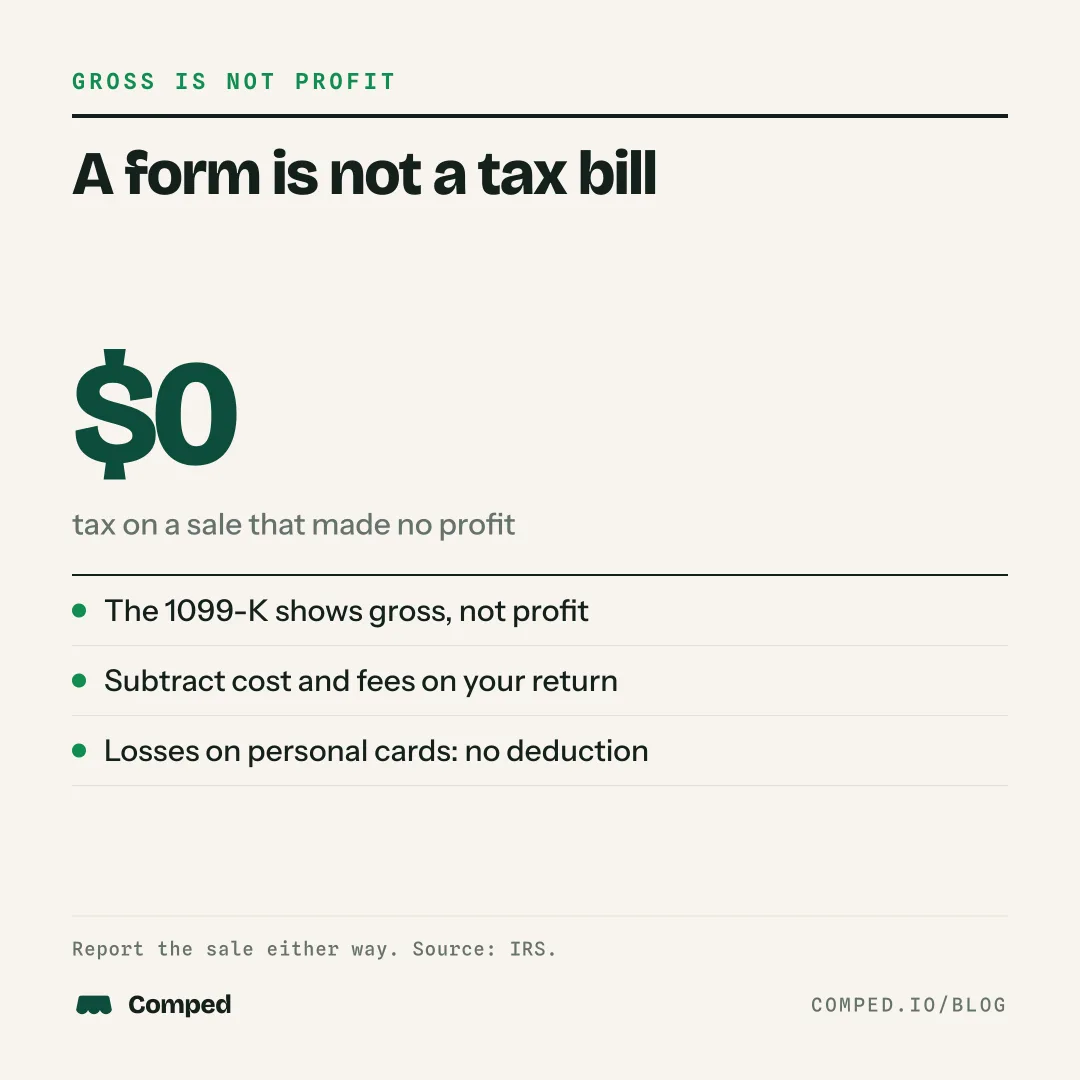
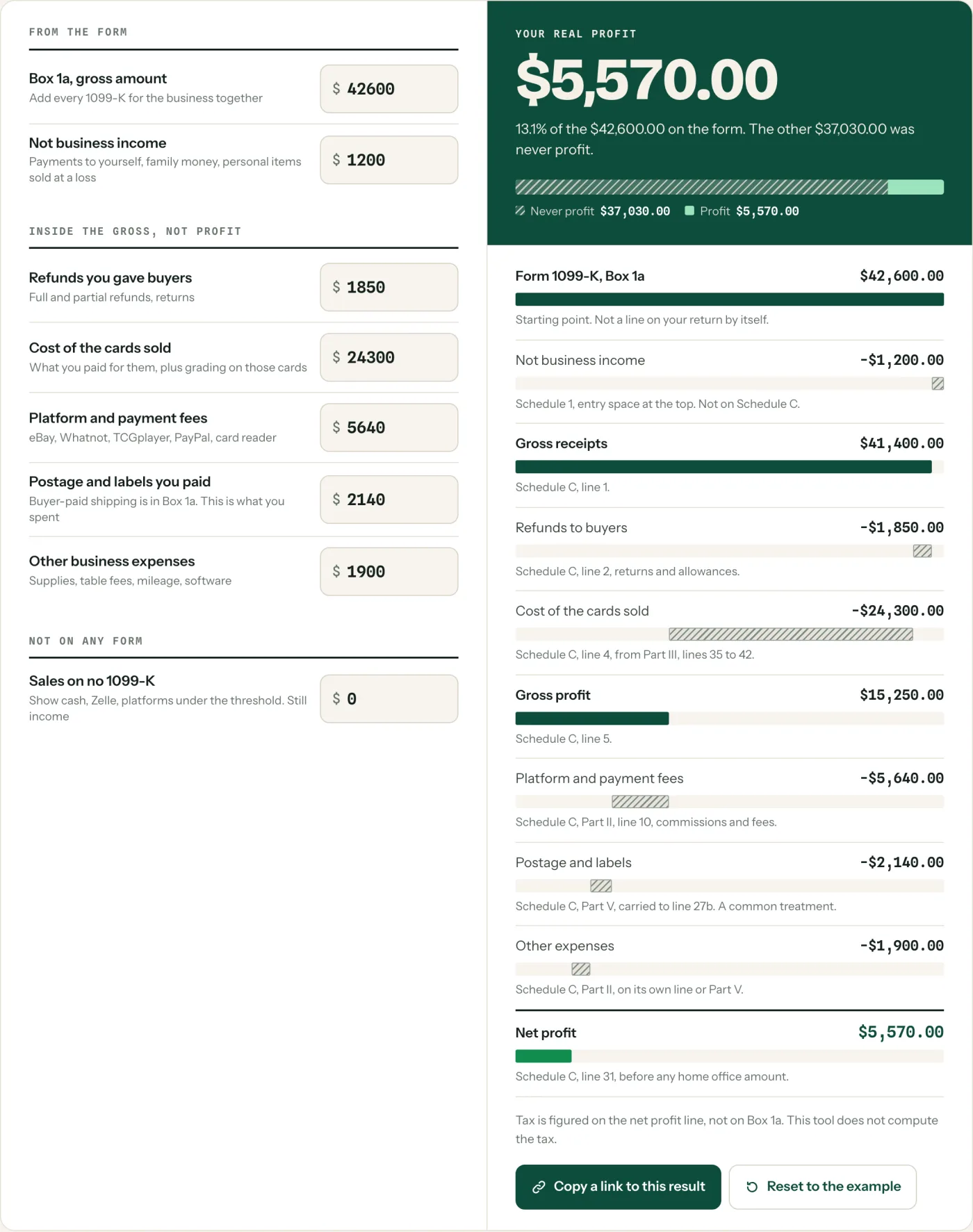
Report the sales anyway and show the costs; the form is not a tax bill. A 1099-K reports gross payments in Box 1a. A seller who moved $22,000 of product across 250 orders for $21,000 of cost has a form and almost no profit. On Schedule C the gross goes on line 1, the cost of goods on lines 35 to 42, and only the small result is taxed.
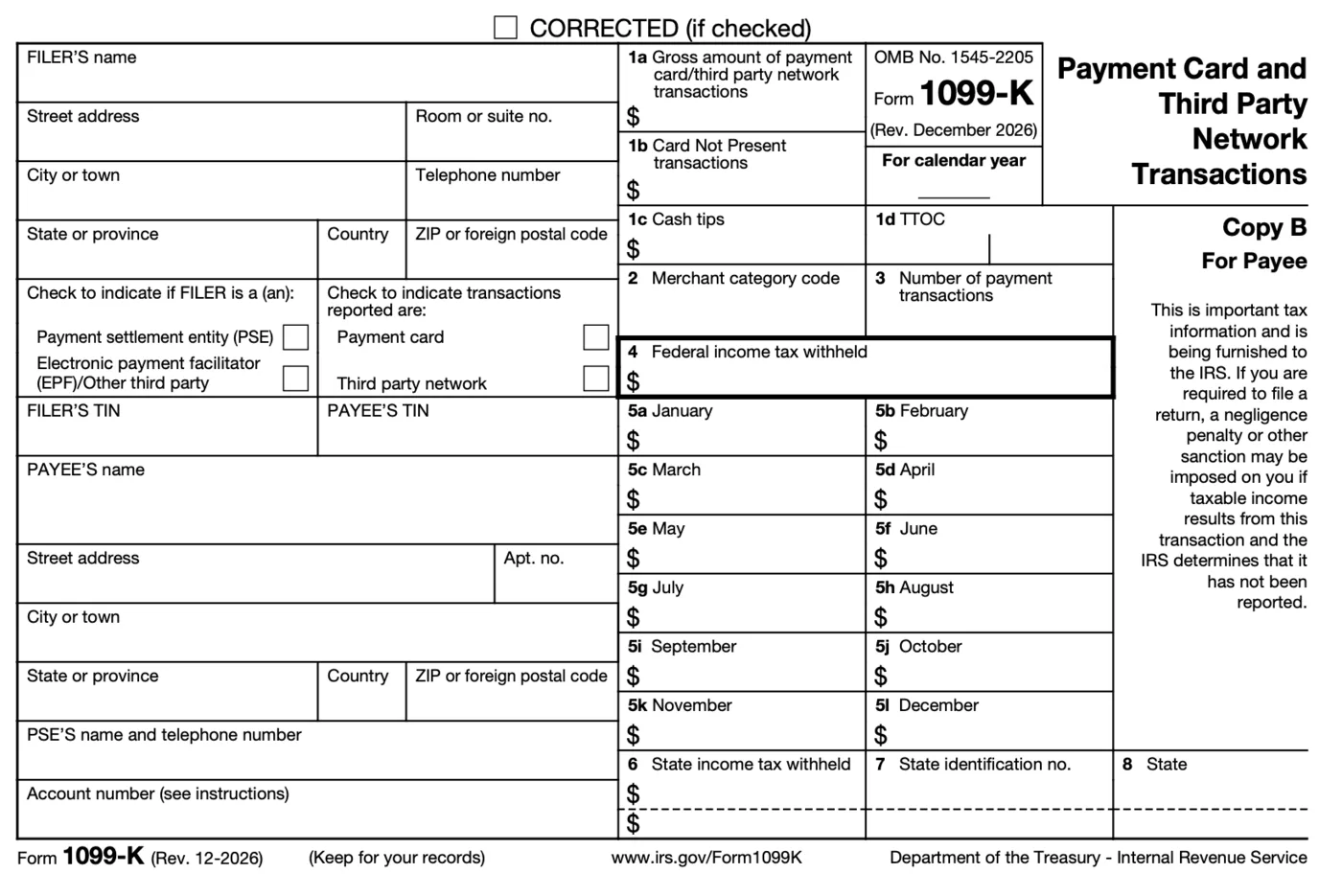
If the cards were personal and sold below cost, the loss is not deductible, but no tax is due either. The IRS says to report the form's amount in the entry space at the top of Schedule 1, or on Form 8949, so it nets to zero. If you sold some personal cards at a gain and some at a loss, report the two groups separately. Keep the form with your records.
How do you report it?
A dealer reports on Schedule C and pays self-employment tax through Schedule SE.
- Add the gross from every channel, forms or not, and enter it on Schedule C line 1.
- Enter refunds you gave buyers on line 2.
- Work out cost of goods sold in Part III, lines 35 to 42, and carry it to line 4. Cards moved to your own collection come out on line 36.
- Enter platform fees, postage, supplies, table fees and mileage in Part II.
- Carry the net profit on line 31 to Schedule 1 and to Schedule SE.
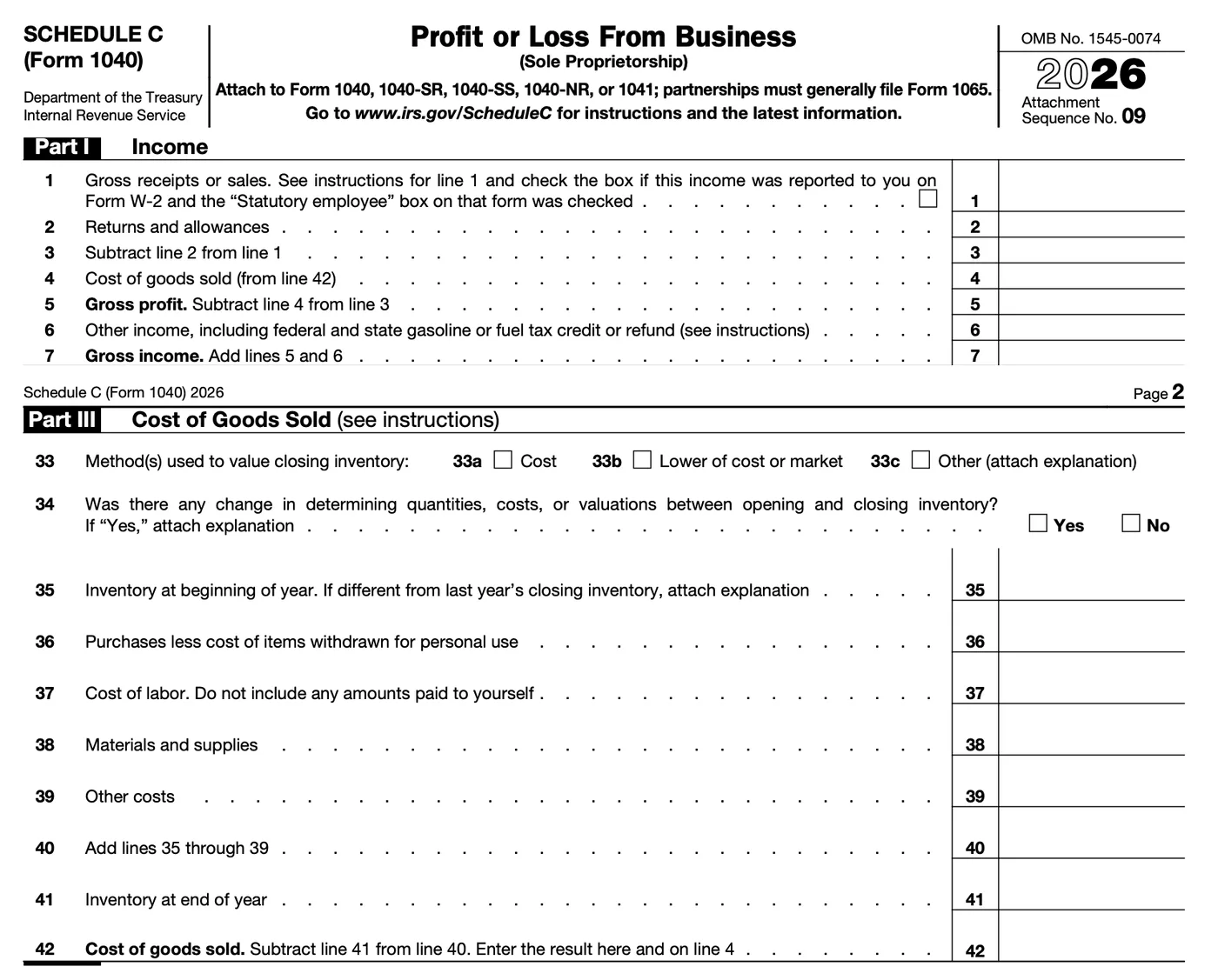
Small resellers may skip formal inventory accounting and deduct a card's cost in the year it sells, under the rule described in Publication 334. Your Whatnot annual statement, line by line on Schedule C shows where each platform figure lands.
A collector reports each card on Form 8949 and Schedule D with its date acquired, date sold, proceeds and basis. A hobby seller reports sales minus cost of goods on Schedule 1, in the other income lines.
A dealer expecting to owe $1,000 or more for 2026 pays estimated taxes quarterly: April 15, June 15, September 15, 2026 and January 15, 2027. Quarterly estimated taxes for card sellers has the safe harbor math. The card sale tax calculator shows what to set aside from one deal.
Which mistakes cost Pokemon sellers the most?
Most come from treating the form, not the profit, as the thing that is taxed.
| Mistake | What it costs |
|---|---|
| Reading the 1099-K threshold as a tax threshold | Unreported income. The accuracy-related penalty is 20% of the underpayment. Late payment adds 0.5% a month |
| Entering bank deposits instead of the Box 1a gross | Your return shows less than the form the IRS already has. Enter the gross, then subtract fees and refunds on their own lines |
| No record of what the box or the single cost | The IRS can assert a zero basis and tax the whole sale |
| Leaving binder cards in cost of goods sold | Overstated cost this year. Their share comes out on Schedule C line 36 |
| Deducting fees, postage and supplies as a hobby | Not allowed. Only cost of goods comes off hobby sales |
| Skipping trades because no cash moved | Missed income now and a wrong basis on the card you got |
| Claiming a loss on personal cards | Disallowed. Personal losses do not offset other income |
What if you already filed it wrong?
File an amended return on Form 1040-X. Tax Topic 308 says to amend when your income, deductions or tax liability change, and the form can be filed electronically. That covers a year with sales left off, and a year taxed on gross without cost subtracted.
A refund claim must generally be filed within 3 years of the original return or 2 years of paying the tax, whichever is later. If a 1099-K itself is wrong, the IRS says to ask the platform for a corrected form. The IRS cannot correct it for you.
Which records do you need?
The box receipt, the grading invoice and a note of every show buy. Publication 583 lists what substantiates a purchase: canceled checks, register tapes, account statements, card slips, invoices and petty cash slips. At a show, that is a written receipt with the seller's name, the date, the card and the price.
For Pokemon, add three things. Keep the order confirmation for every sealed purchase. Note which cards from each box went to the binder. Save the comp you used to value each trade. Keep records 3 years, 6 years if you under-reported income by more than 25%, and indefinitely for any year you did not file.
What do these terms mean?
| Term | Plain meaning |
|---|---|
| Cost basis | What a card cost you: price, sales tax and shipping paid, its share of a box, and grading |
| Cost of goods sold | The total basis of the cards you sold this year. Schedule C, Part III |
| Gross, or Box 1a | Everything buyers paid, before fees, refunds and shipping |
| Fair market value | What the card would sell for that day. Recent sales of the same card and grade show it |
How this looks in the Comped app
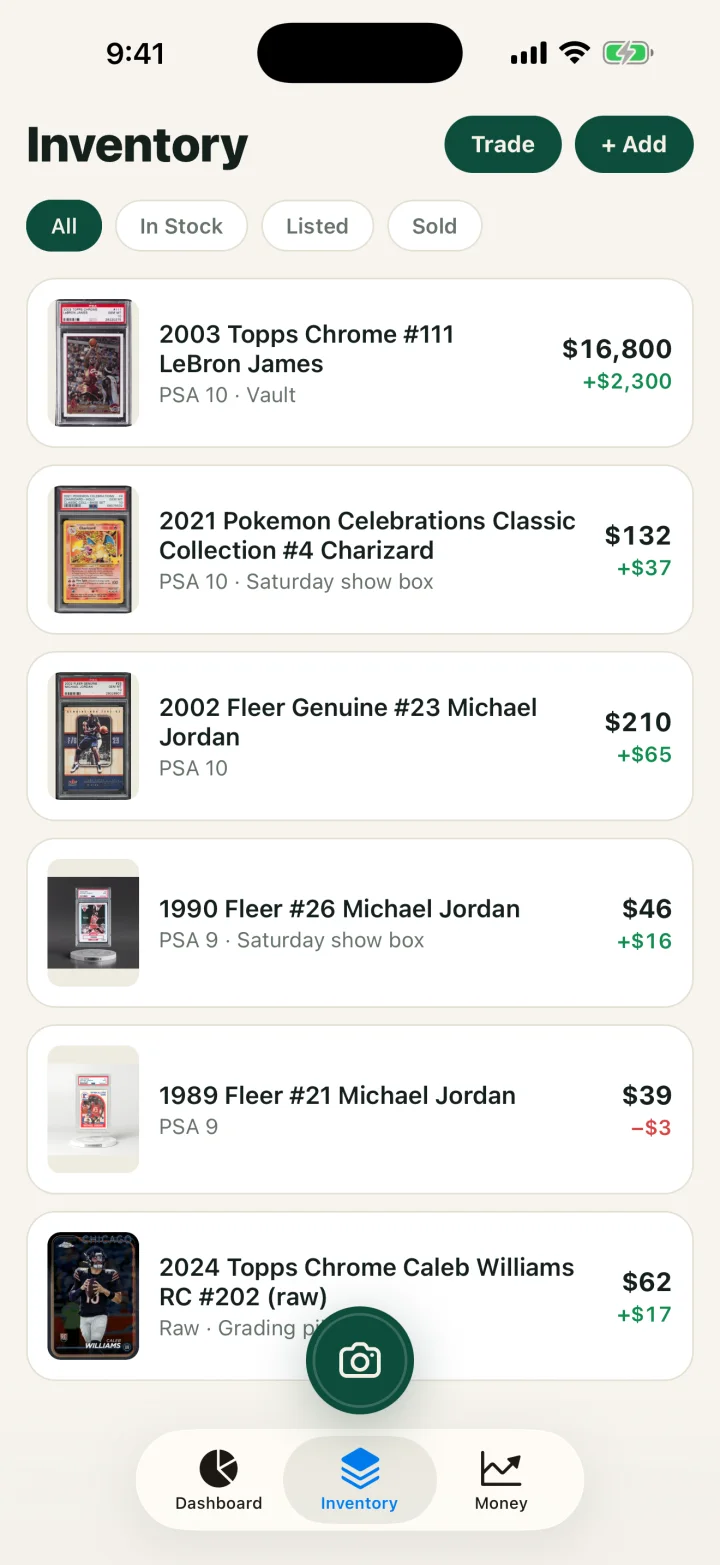
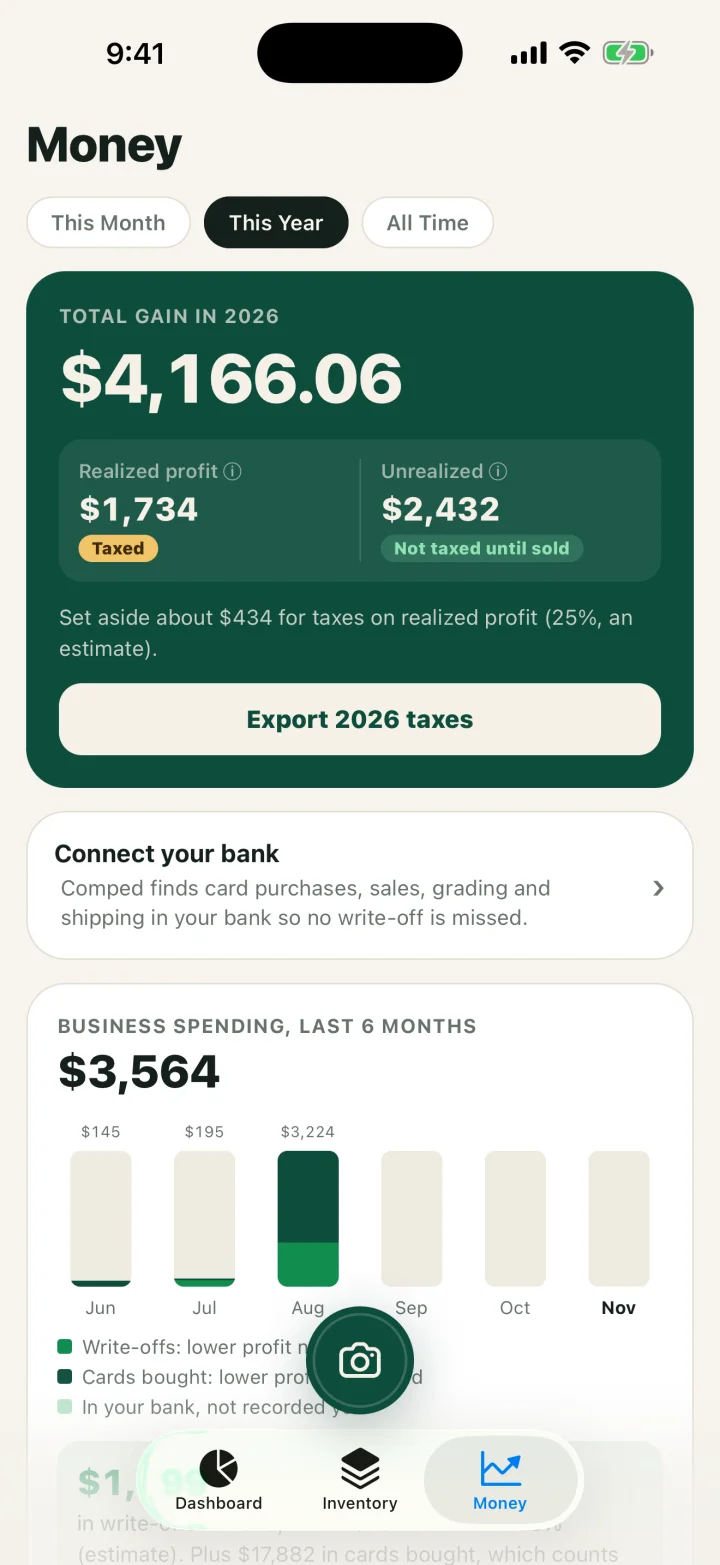
Inventory lists each card with its current value and gain, and filters by In Stock, Listed and Sold. A sale's page shows price, fees, shipping, cost basis and true profit. The Money tab totals realized profit for the year, estimates a 25% set-aside, and exports the year as a CSV with every sale, card bought and write-off.

Related guides
- The Card Vendor's Master Guide to Taxes: inventory methods and the full worked deal.
- Do you have to pay taxes on selling sports cards?: the dealer, investor and collector rules in full.
- The TCGplayer 1099-K for 2026 sales: what the form includes and where to get it.
- Hobby or business: selling cards and the IRS factors: how the IRS decides.
- Are PSA grading fees tax deductible?: how the fee enters basis.
- 1099-K thresholds by state: every lower state figure with its source.
FAQ
Do I have to report Pokemon card sales if I never got a 1099-K?
Yes. The $20,000 and 200 transaction test decides whether a platform sends a form, not whether you owe tax. Profit is taxable from the first dollar, and cash sales count the same as eBay sales.
Will I be taxed at my job's bracket?
Mostly, yes. Card profit is added on top of your wages and taxed at the rate that income reaches. Personal cards held more than a year are capped at 28%, and a dealer also pays 15.3% self-employment tax on net earnings of $400 or more.
What is the cost basis for a card pulled from a pack?
Its share of the pack or box cost. There is no IRS ruling for pulled cards. Allocate the cost across what you keep and sell with a method you can defend, used consistently, and keep the box receipt.
Do I split the pack cost across every card or put it all on the hit?
Split it, by value or evenly, and use the same method each time. Putting the whole cost on one card gives the same total only when every card sells in the same year. Cards you keep take their share of the cost out of this year's deduction.
I would get a form even though I didn't make money. What do I do?
Report the gross the form shows and subtract your cost of goods and fees, so the return shows the real result. A 1099-K reports payments, not profit. If the cards were personal and sold at a loss, the IRS lets you report the amount and zero it out.
Does TCGplayer or Whatnot send a 1099?
Both use the federal test of more than $20,000 and more than 200 transactions, or a lower state figure. TCGplayer's total includes shipping, fees and refunds. Whatnot's form comes through Stripe, only for sellers who cash out through Stripe.
Is selling my childhood collection taxable?
Yes, if the cards sell for more than they cost you. The gain is long-term capital gain capped at 28% when held more than a year. A sale below cost is a personal loss with no deduction, and with no receipts the IRS can assert a zero basis.
Do trades count as sales?
Yes. The value of the card you receive is treated as what you were paid for the card you gave. That value is also the new card's basis when you sell it later.
SOURCES
- Form 1099-K FAQs, general information, IRS, checked November 2026.
- What to do with Form 1099-K, IRS, checked November 2026.
- Understanding your Form 1099-K, IRS, checked November 2026.
- How to tell the difference between a hobby and a business, IRS, checked November 2026.
- Tips for taxpayers who make money from a hobby, IRS, checked November 2026.
- Tax Topic 409, Capital gains and losses, IRS, checked November 2026.
- Tax Topic 420, Bartering income, IRS, checked November 2026.
- Tax Topic 308, Amended returns, IRS, checked November 2026.
- Publication 551, Basis of assets (Rev. December 2025), IRS, checked November 2026.
- Publication 501, Dependents, standard deduction and filing information (2025), IRS, checked November 2026.
- Publication 334, Tax guide for small business, IRS, checked November 2026.
- Publication 583, Starting a business and keeping records, IRS, checked November 2026.
- Schedule C (Form 1040) 2026, IRS, checked November 2026.
- 1099-K FAQ, TCGplayer, checked November 2026.
- 2026 Form 1099-K for U.S. sellers, Whatnot, checked November 2026.
- eBay and Form 1099-K, eBay, checked November 2026.
- Form 1099-K overview, Square, checked November 2026.
This is general information for card sellers, not tax or legal advice for your situation. Rules change and states differ; a CPA who knows your numbers wins every time.