Which Whatnot reports do I use for taxes?
Use the annual Seller Statement, with the Ledger and your 1099-K beside it. Whatnot's help page on Seller Statements names the statements, Form 1099 and the Ledger as the source of truth for tax and reporting. It says the figures in Seller Analytics are estimates.
| Report | What Whatnot says it shows | Where it is |
|---|---|---|
| Annual and monthly Seller Statements | Income, fees, costs and payouts for the period | Seller Hub, Financials, Statements |
| Ledger | Every transaction that changes your balance, as a net amount. CSV export in ranges of up to 31 days | Seller Hub on the web, Finances, Ledger |
| Weekly Orders report | Completed orders with sale price, commission, processing fee and seller-paid shipping. Not an official document | Seller Hub, Financials, Statements |
| Form 1099-K | Gross payments, for sellers above the threshold who cash out through Stripe | Seller Hub |
Whatnot issues an annual statement each January for the prior year. Its 1099-K page says 2026 statements go to all sellers before 31 January 2027, whether or not a 1099-K is due. Does Whatnot send a 1099? covers who gets the form.
What do I download, and in what order?
Start with the annual statement and work down to detail only where a number needs explaining.
- In January, open Seller Hub on the web, then Financials, then Statements. Download the annual statement for 2026.
- Download the twelve monthly statements. Their lines should add up to the annual one.
- If a 1099-K was issued, download it from Seller Hub and note Box 1a.
- For any month that looks wrong, export the Ledger. Whatnot limits an export to 31 days, so a full year takes twelve files.
- For order-level detail, download the Weekly Orders reports. Whatnot says they are not official documents, so use them to explain a number, not to replace the statement.
- Pull what your cards cost from your own records. Whatnot does not have it.
- Fill in the table in the next section, one statement line at a time.
The Ledger shows net amounts. Whatnot's Ledger page says it does not break out the fees inside each sale. To see the fees on one order, select its Order ID on the web.
Where does each statement line go on Schedule C?
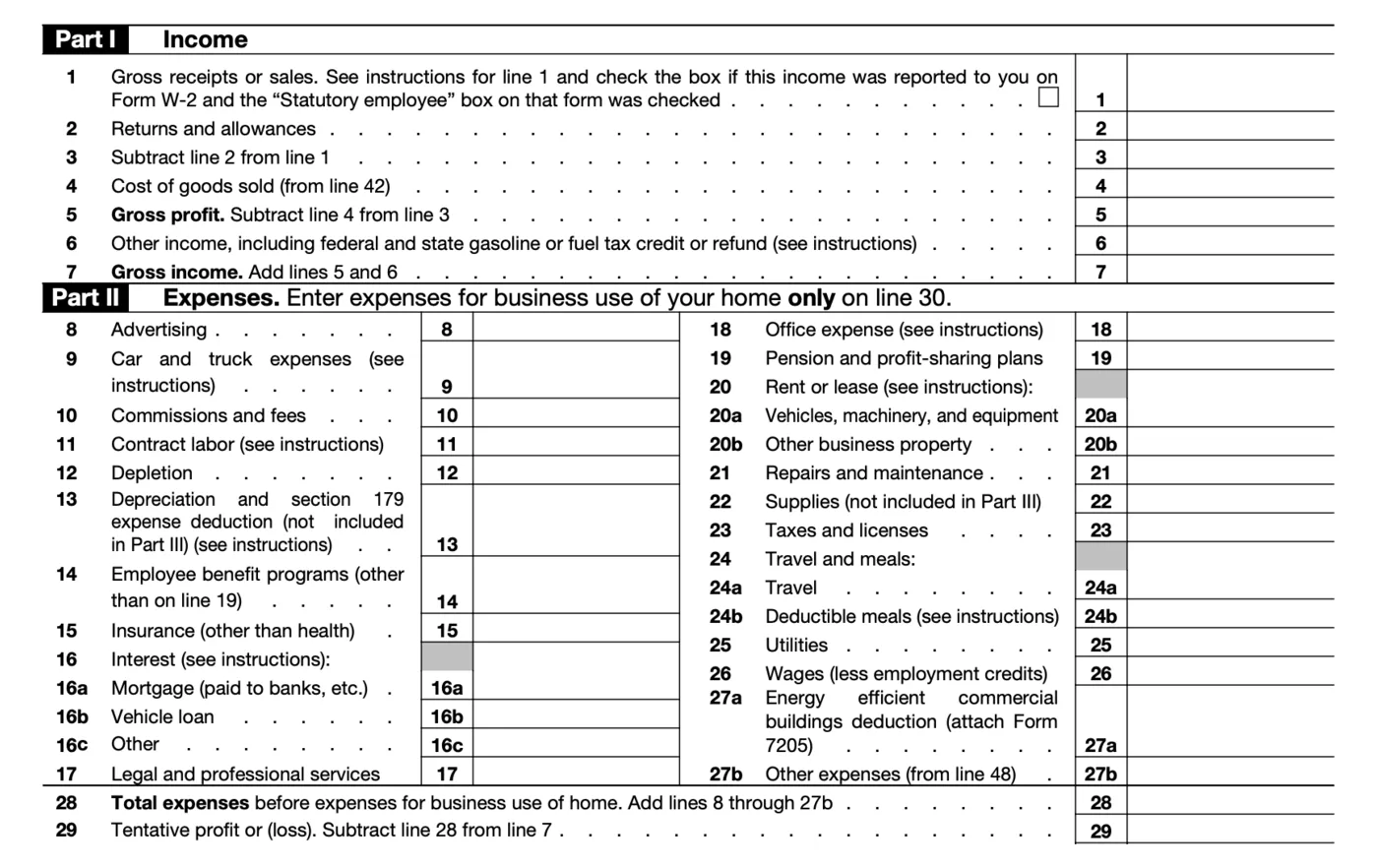
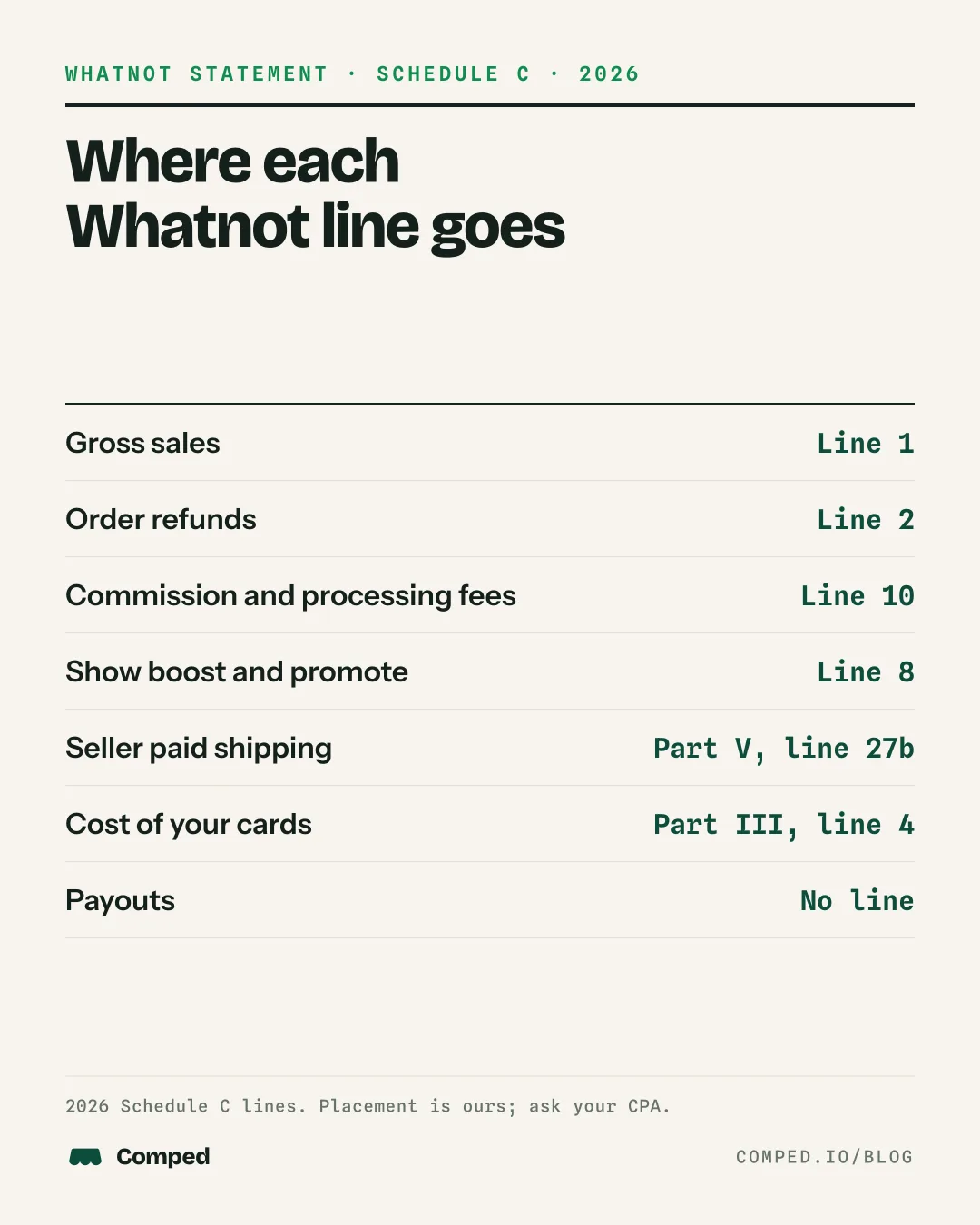
Sales go in Part I, fees and costs go in Part II, and balances and payouts go nowhere. The statement names below are Whatnot's. The line numbers are from the 2026 Schedule C. The match between the two is ours. Whatnot does not say where its lines go on a return, and the IRS has not published a mapping.
| Whatnot statement line | What Whatnot says it is | Schedule C line (our placement) |
|---|---|---|
| Gross sales | Sales income, net of coupons | Line 1, gross receipts or sales |
| Tips | Tips received | Line 1, with sales |
| Affiliate rewards, Seller referral bonus, New seller cash match | Bonuses and rewards | Line 6, other income |
| Order refunds | Billbacks for refunded orders | Line 2, returns and allowances |
| Commission fees | Platform commissions on sales | Line 10, commissions and fees |
| Payment processing fees | Processor fees | Line 10, commissions and fees |
| Sales and use tax on fees and commissions | Tax charged on Whatnot's fees | Line 10, with the fees it was charged on |
| Show boost and promote | Spending on Promote Tools | Line 8, advertising |
| Seller paid shipping and handling; Shipping surcharges and fees | Reduced or free shipping you paid for, including giveaway shipping, and label adjustments | Part V as shipping, total to line 27b (a common treatment) |
| Giveaway refund credit; Other adjustments | Credits, reimbursements and other charges | Not placed here. Read each Ledger entry and ask a CPA |
| Opening balance, Payouts, Closing funds | Money held and money withdrawn | None |
Four placements are judgment calls, because the IRS has no line named for them. Tips are placed with sales. Bonuses and rewards are placed on line 6. The tax on fees is placed with the fees. Shipping is listed in Part V, a common treatment. The Schedule C instructions say line 18, office expense, includes postage, so some preparers put shipping there. Pick one place, use it every year, and have a CPA confirm the table for your return.
The fee lines rest on the instructions. They tell a dealer in property to enter on line 10 the commissions and fees paid to facilitate a sale. They say line 6 is for business income not reported elsewhere in Part I. Line 1 asks you to check any Forms 1099 you received for income that belongs on it. Line 2 takes returns and allowances as a positive number.
WHAT CHANGED ON THE FORM
Other expenses from Part V, line 48, now carry to line 27b. Line 27a is the energy efficient commercial buildings deduction. Older guides that send other expenses to line 27a describe an earlier form.
Whatnot is rarely a seller's only channel. Sales on eBay, at shows and on Whatnot are one card business with one Schedule C. Add the channels on each line. The Schedule C business code for card sellers covers the top of the form.
What does the statement leave out?
The cost of your cards, and every expense Whatnot never saw. Cost of goods sold is usually the largest number on a card seller's return, and no line of the statement holds it.
Cost of goods sold is figured in Part III of Schedule C, lines 35 to 42. Line 36 is purchases less the cost of items withdrawn for personal use. Line 42 is the result, and it carries to line 4. The master tax guide covers the inventory methods a small seller may use.
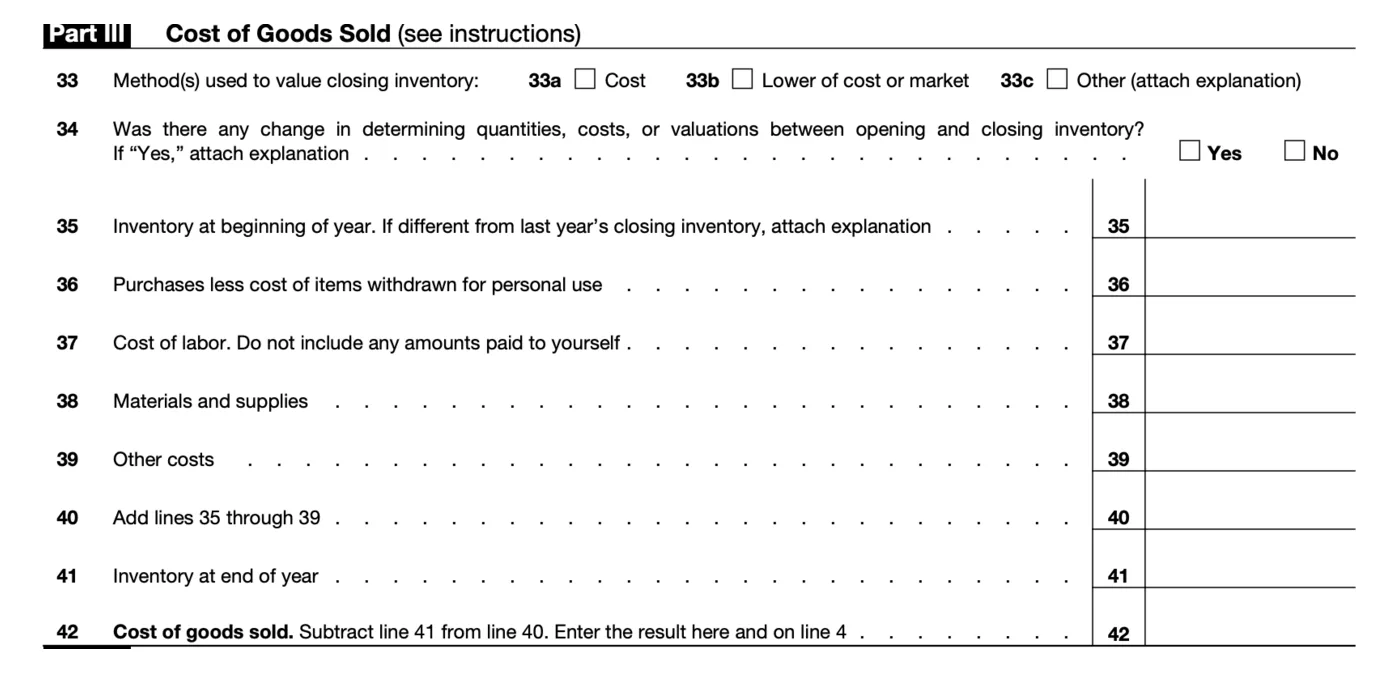
Whatnot's Weekly Orders report has SKU and Cost of Goods columns. Whatnot says they are filled only if you entered them when you created the listing. If you did not, the cost has to come from your own records. Comped tracks the cost of each card from the day you record the buy, so the Part III number is ready when the statement arrives.
The statement also has no line for supplies, grading, mileage to the post office or a home office. Those are yours to add. The master guide to write-offs lists them, and the grading fee guide covers where grading goes. For cards with no purchase record, see sold cards with no receipts.
Where do giveaways go?
The shipping is on the statement, and the card's cost is not. Whatnot's statement page says Seller paid shipping and handling includes giveaway shipping cost. That amount follows the shipping row in the table above.
What the given-away card cost you is a separate number, and no IRS page addresses stream giveaways. In our reading it is a business cost you take once. Either it stays in cost of goods sold with the rest of your purchases, or you take it out of purchases and list it as promotion. Taking it in both places deducts the same card twice. Ask a CPA which treatment fits your books, and keep a list of what you gave away.
What does a full statement look like on the form?
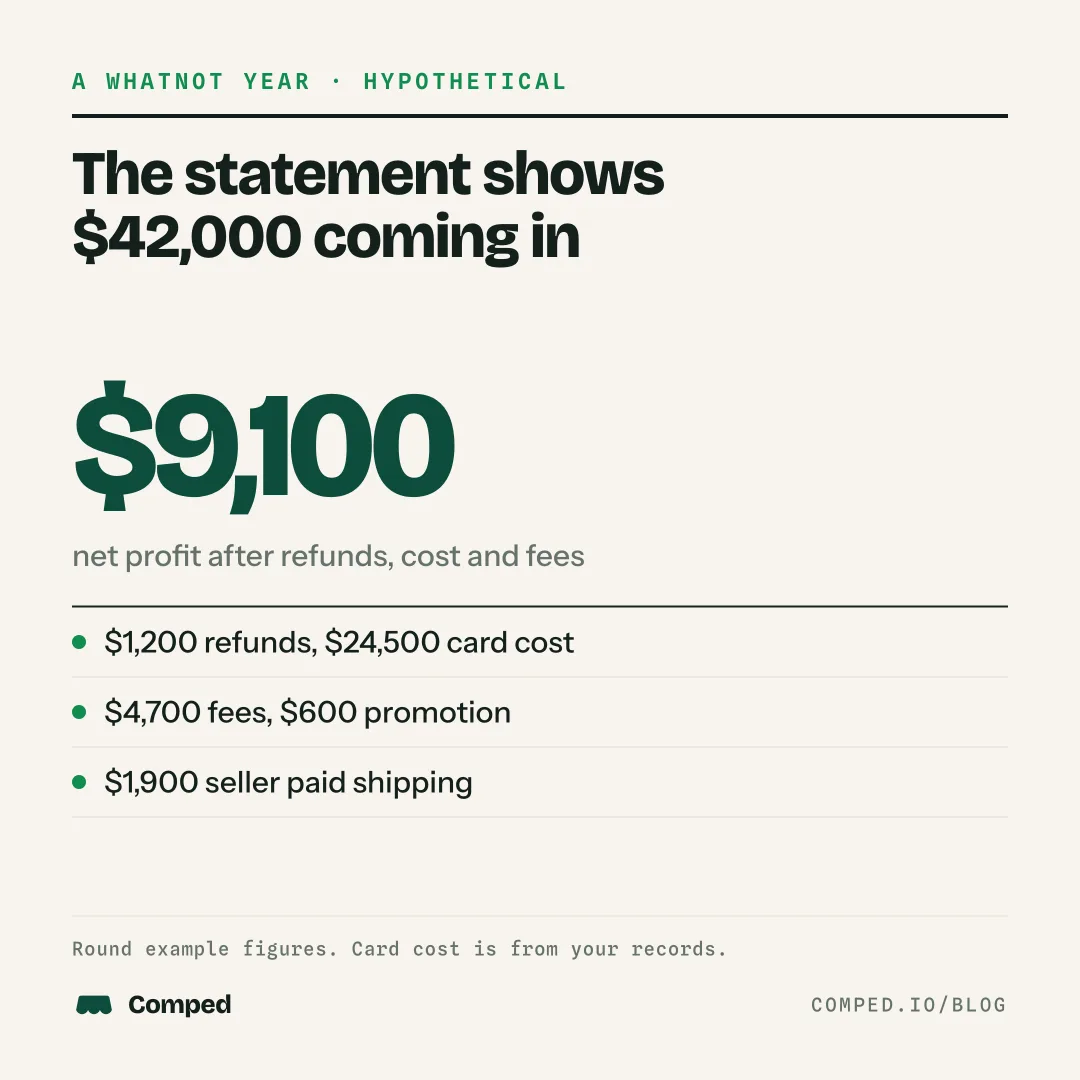
Here is one year, carried from the statement to the lines. The card cost comes from the seller's own records.
A WHATNOT YEAR, WORKED
Say a seller's 2026 annual statement shows the figures below. Round, hypothetical figures.
The statement shows $42,000 coming in. The seller is taxed on $9,100, less the expenses Whatnot never saw. Net profit lands on line 31, then on Schedule 1 (Form 1040), line 3, and Schedule SE, line 2. The card sale tax calculator estimates the tax on it, and quarterly estimated taxes for card sellers covers paying it during the year.
What are the common mistakes, and what do they cost?
The costly ones all come from starting with the wrong number. In the worked year, refunds, promotion, fees and shipping total $8,400, so payouts would be about $33,600 if the balance started and ended at zero.
| Mistake | What happens in the worked year |
|---|---|
| Reporting payouts as sales, then deducting fees | Line 1 shows $33,600 in place of $42,000, and the $8,400 comes off twice. Income is understated by $8,400 |
| Reporting Gross sales and no card cost | Tax is figured on $33,600 in place of $9,100 |
| Using Seller Analytics figures | Whatnot calls them estimates that may not match the statement or the 1099 |
| Putting other expenses on line 27a | That line is now a different deduction; the total belongs on line 27b |
| Deducting a giveaway card as promotion and leaving it in cost of goods | The card's cost is deducted twice |
| Skipping the statement because no 1099-K came | All $42,000 of sales goes unreported; Whatnot's page says every seller must report earnings either way |
What if the 1099-K does not match the statement?
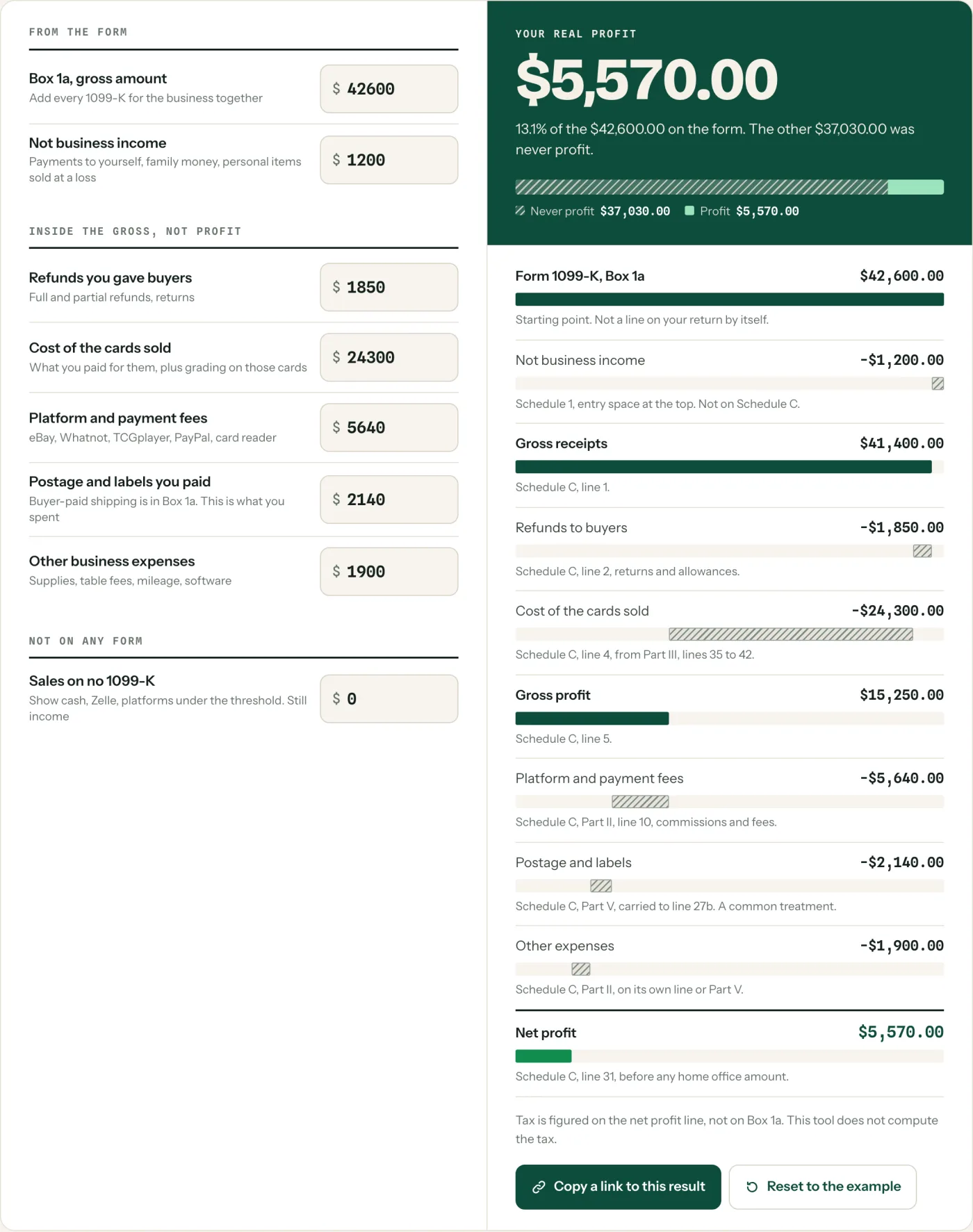
Expect a difference, and reconcile it on paper before you file. The IRS FAQs say Box 1a is gross and is not adjusted for fees, credits, refunds, shipping or discounts. Whatnot's statement defines Gross sales as net of coupons. The two numbers are built differently.
The IRS receives the 1099-K, so line 1 should not come in below it without an explanation in your records. If Box 1a is higher than your statement's sales, find the items that make up the gap and subtract them on their own lines.
| What you see | What to do |
|---|---|
| Box 1a is higher than Gross sales plus Tips | Use the Ledger and order receipts to list what makes up the gap. Report Box 1a on line 1 and subtract each item on the line that fits |
| Box 1a includes money that was never yours | Ask for a corrected form. The IRS says to file on time either way |
| You have two Whatnot accounts under one tax ID | Whatnot says Stripe combines them on one 1099-K. Add both statements |
| A PayPal 1099-K also shows Whatnot cash-outs | Whatnot says sellers who used both may get a PayPal form. Count each sale once |
| No 1099-K at all | Report from the statement. Sellers paid only through PayPal get no Whatnot form |
| The form shows your name, not your LLC | Whatnot says a single-member LLC's form goes to the owner's name and Social Security number by default. It is the same Schedule C |
The 1099-K reconciliation calculator lays the subtraction out line by line.
Which year does a late December sale belong to, and what are the dates?
Whatnot's statements count a transaction by its Completed date, not the date the buyer paid. Its Ledger page says a transaction created in one month and completed in another appears in the statement for the completion month.
That can push a 31 December sale into the next year's statement. Your return follows your accounting method, not Whatnot's cutoff. If the statement and your own sales log disagree at year end, list the orders that crossed over and keep the list with your return. The year-end inventory count is the other job for that week.
| Date | What happens |
|---|---|
| From mid-November 2026 | Whatnot emails sellers who meet the threshold to add or correct a tax ID and choose paperless delivery |
| 31 December 2026 | Year end. Count unsold cards and note orders not yet completed |
| 15 January 2027 | Fourth estimated tax payment for 2026 is due to the IRS |
| January 2027 | Annual statement for 2026 appears in Seller Hub |
| By 31 January 2027 | Whatnot's date for 2026 Forms 1099-K in Seller Hub |
What if I already filed using payouts or the wrong lines?
If the income or the profit on the return was wrong, amend it. The IRS page on amended returns says to file Form 1040-X when income, deductions or tax liability changed. A refund claim generally must be filed within 3 years of the original return, or 2 years of paying the tax, whichever is later.
Rebuild the year from that year's annual statement first. If only the placement was off and the net profit was right, such as shipping on line 18 in place of Part V, the tax did not change. Use one placement from now on.
If a 1099-K was filed and your line 1 came in under Box 1a, the IRS may send a notice proposing a change. The IRS page What to do with Form 1099-K explains how the form should be reported.
How this looks in the Comped app
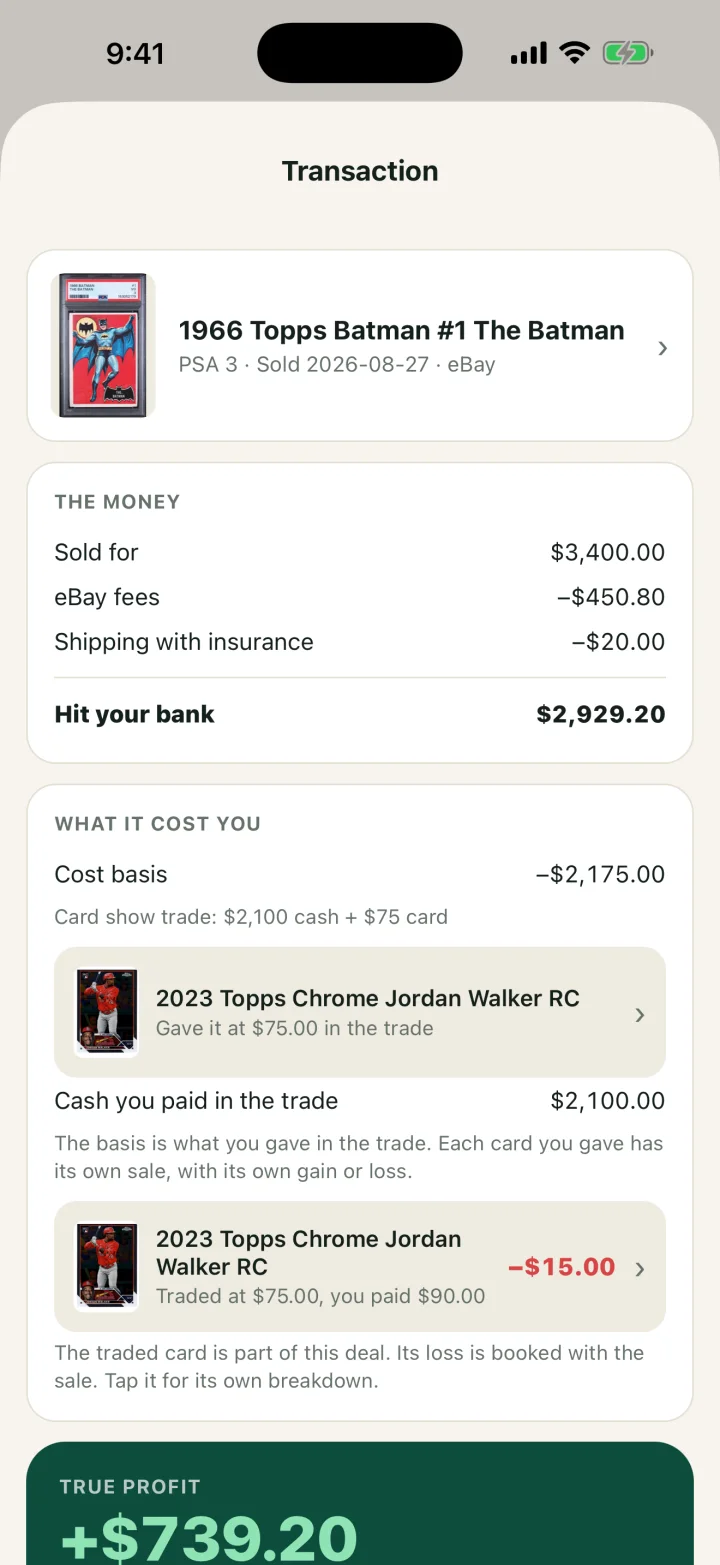
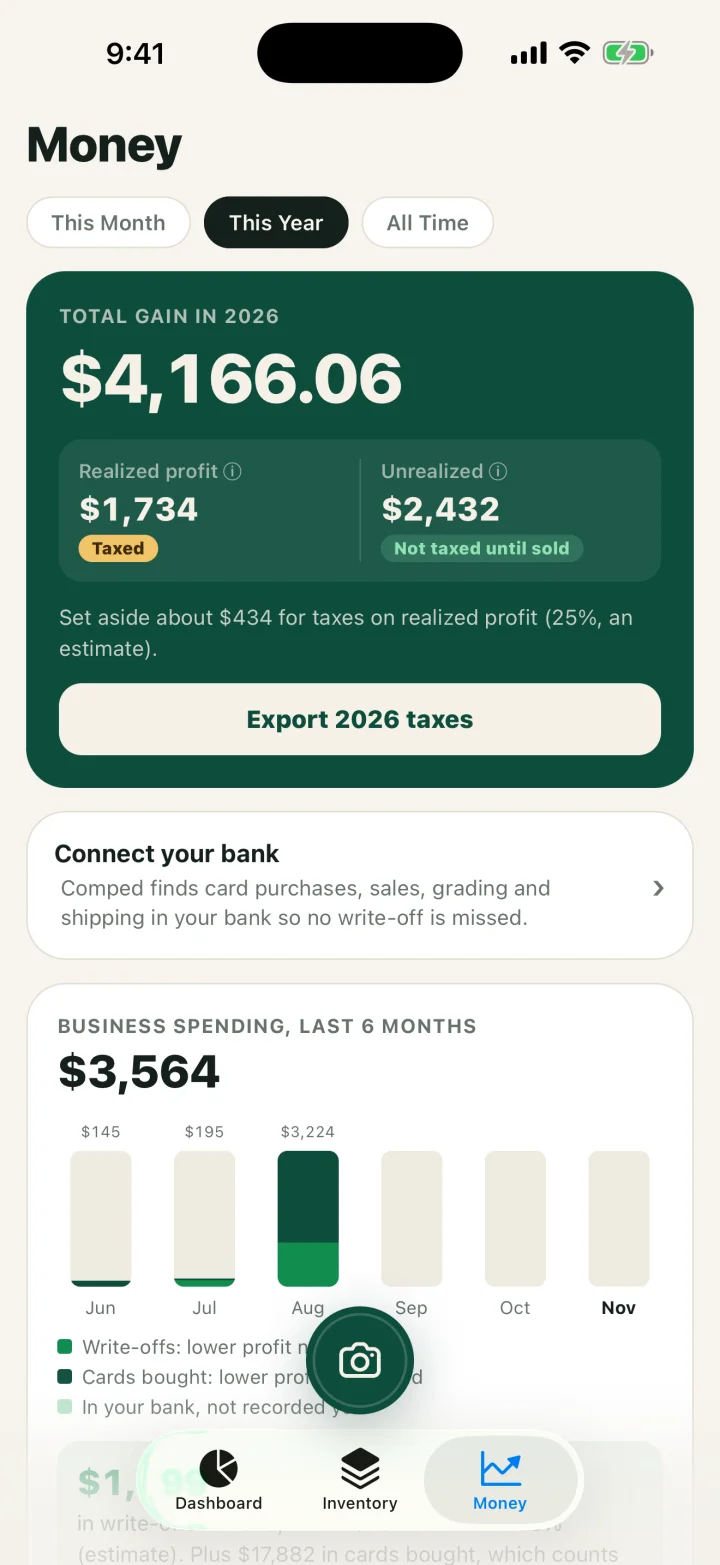
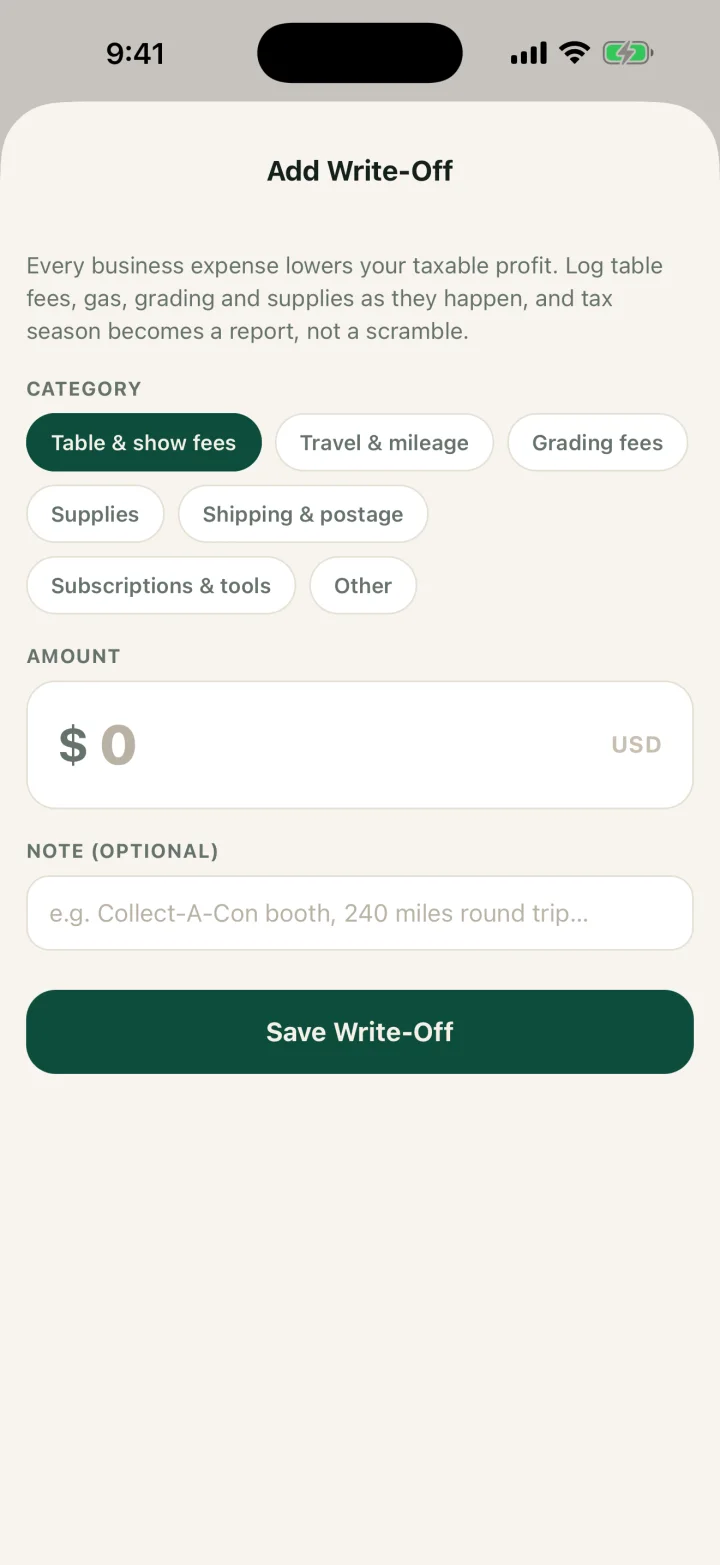
The first screen is one sale: price, fees, shipping, what hit the bank, cost and true profit. The second is the Money tab, where Export taxes produces a CSV for the year with a Schedule C style summary, every sale, every card bought and every write-off. The third is the write-off form for the costs Whatnot never sees.
Related guides
- The Card Vendor's Master Guide to Taxes: the whole Schedule C for a card seller.
- Does Whatnot send a 1099?: who gets the form and who issues it.
- The Schedule C business code for card sellers: the six-digit code for line B.
- 1099-K vs your real profit calculator: reconcile Box 1a to your statement.
FAQ
Where do Whatnot fees go on Schedule C?
Commission fees and Payment processing fees go on line 10, commissions and fees. Show boost and promote spending is advertising, line 8. Seller-paid shipping has no named line. A common treatment is to list it in Part V, which totals to line 27b.
Do Whatnot payouts count as income?
No. A payout is your own balance moving to your bank. Income is the sales and tips the statement shows under Earnings, and it counts whether or not you withdrew it.
Is it profit or the whole sale that is taxed?
Profit. Gross sales go on line 1, then refunds, the cost of the cards and your expenses come off on their own lines. The statement gives you the fees and shipping, and your records give you the cost.
Does the Whatnot statement show my cost of goods?
No. The annual statement lists income, fees, costs charged by Whatnot and payouts. The Weekly Orders report has a Cost of Goods column, filled only if you entered a cost when you created the listing.
Why does my Whatnot 1099-K not match my payouts?
The 1099-K reports gross payments before fees, refunds and shipping. Payouts are what was left after Whatnot took those out, and they also depend on when you withdrew. Report the gross and subtract each cost on its own line.
Are Whatnot giveaways a write-off?
Giveaway shipping is on the statement inside Seller paid shipping and handling. The cost of the card you gave away is not on the statement, and no IRS page covers it. In our reading it is deducted once, either in cost of goods sold or as promotion, never both.
When is the Whatnot annual statement available?
Whatnot issues the annual statement each January for the prior year. Its 1099-K page says 2026 statements go to all sellers before January 31, 2027.
Do I owe tax if I never got a 1099?
Yes. The IRS says all income is taxable unless the tax law says it is not, whatever the amount. The statement gives you the same figures a form would, so use it.
SOURCES
- Seller Statements, Whatnot, checked November 2026.
- Understand your Ledger or Transactions page, Whatnot, checked November 2026.
- Seller Weekly Orders Report, Whatnot, checked November 2026.
- 2026 Form 1099-K for U.S. sellers, Whatnot, checked November 2026.
- Schedule C (Form 1040), 2026, IRS, checked November 2026.
- Instructions for Schedule C (Form 1040), 2025, IRS, checked November 2026.
- Form 1099-K FAQs, general information, IRS, checked November 2026.
- What to do with Form 1099-K, IRS, checked November 2026.
- File an amended return, IRS, checked November 2026.
This is general information for card sellers, not tax or legal advice for your situation. Rules change and states differ; a CPA who knows your numbers wins every time.