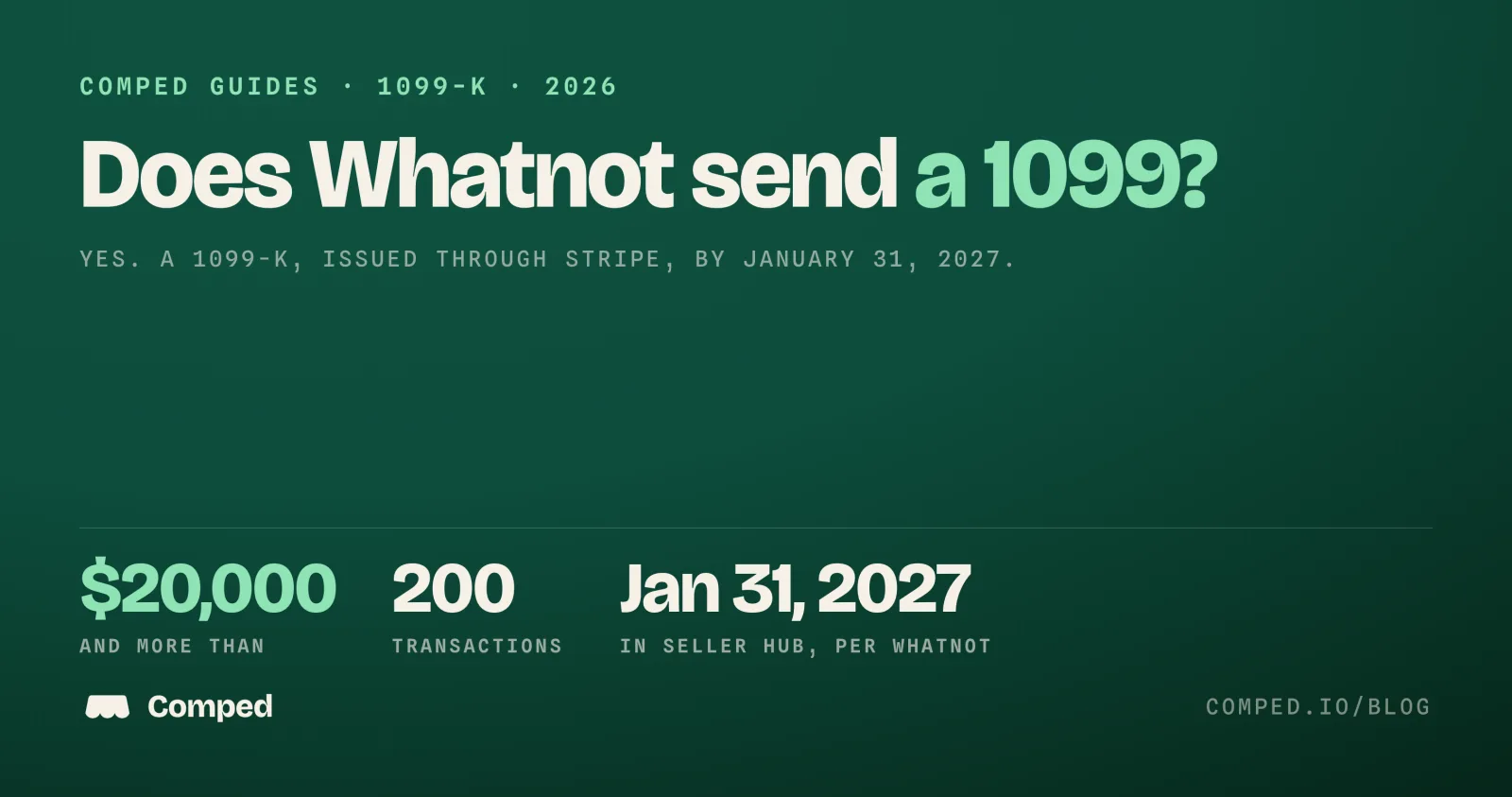
Which 1099 does Whatnot send?
Whatnot sends Form 1099-K, the form for payments processed by a marketplace or payment app. It reports the gross amount buyers paid you through Whatnot in the calendar year. A copy goes to the IRS.
Whatnot does not prepare the form itself. Its 1099-K page for US sellers says forms are issued through Stripe, to sellers who cash out through Stripe. The same page says you cannot opt out: above the threshold, the form is filed. The master tax guide covers what you do with the form once it arrives.
What is the Whatnot 1099-K threshold?
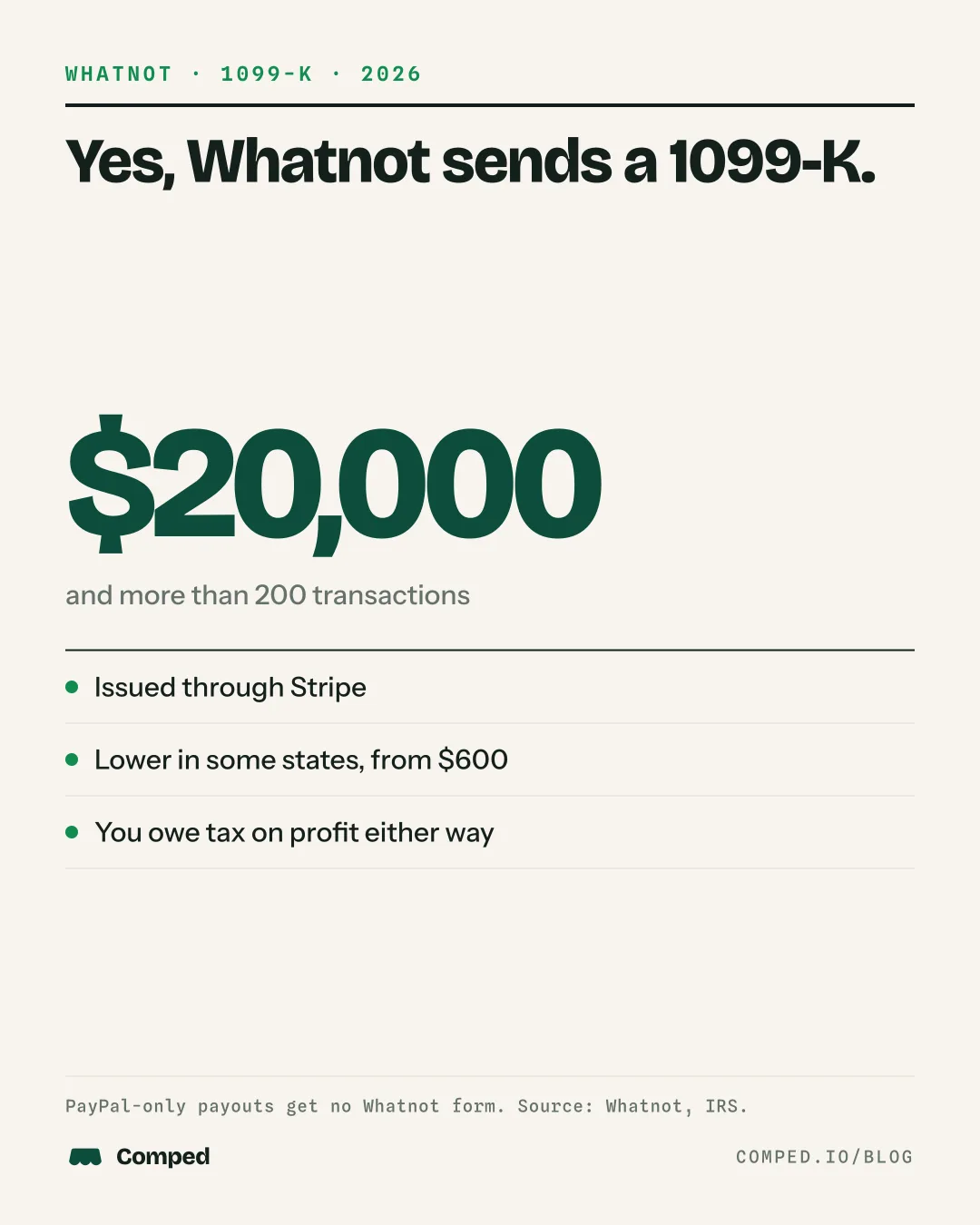
The federal threshold is more than $20,000 in gross payments and more than 200 transactions in the year. Both must be met. The IRS confirmed that the July 2025 law restored this test for 2025 and later years. The $600 rule and the $5,000 and $2,500 phase-in amounts are cancelled.
The test is the same for 2026 sales. Whatnot's page now covers 2026 and says 1099-Ks will be available in Seller Hub by January 31, 2027. The page refused an automated request on November 13, 2026. Its text was read that day through Whatnot's public help center feed.
| Sales year | Federal test, per Whatnot's page |
|---|---|
| 2023 and earlier | $20,000 and 200 transactions |
| 2024 | Temporarily lowered to $5,000 |
| 2025 | Back to $20,000 and 200 transactions |
| 2026 | Still $20,000 and 200 transactions |
That table answers a common question: a seller who got a form for 2024 and none since did nothing wrong. The IRS also says a platform may send a form below the threshold. So the threshold tells you when a form must come, not when one cannot. The 1099-K guide for card sellers compares Whatnot with eBay, PayPal and Cash App.
Which states have a lower Whatnot threshold?
Whatnot's 2026 page lists seven states and DC that may have lower amounts. A seller based in one of them gets a form above the state amount. Whatnot says that form is reported only to the state.
| State on Whatnot's 2026 list | Amount | What the state's own source says |
|---|---|---|
| Massachusetts, Virginia, DC | $600 | $600, on a state page |
| Illinois | $1,000 and 4 transactions | More than $1,000 and 4 or more transactions |
| New Jersey | $1,000 | Platforms report this figure; no state 1099-K page found |
| Maryland | $2,000 | Statute points to the federal 1099-MISC threshold, $2,000 for 2026. The Comptroller states no amount |
| Vermont | $2,000 | $2,000, on the state tax department's page |
| Arkansas | $2,500 | $2,500, a general 1099 rule |
The right-hand column comes from the state-by-state 1099-K threshold report, which links each state source. Whatnot's 2025 table also listed California, Montana and North Carolina at $600. The 2026 list leaves them out. Stripe, which issues the forms, still lists Maryland, Vermont and Montana at $600 on its own state table, opened November 13, 2026. For those three states the sources conflict, so a seller between $600 and $2,000 may or may not get a form.
Who gets no form from Whatnot?
Two groups. Sellers under the federal threshold, in a state with no lower amount, are not required to get one. Sellers paid out only through PayPal get no Whatnot form either, per Whatnot's page, because the form comes from Stripe.
PayPal counts on its own. If your PayPal payments pass PayPal's threshold, PayPal may send its own 1099-K. The PayPal, Venmo and card reader guide covers that form.
You have a connected Stripe account if you have ever cashed out through Stripe, Whatnot says. A PayPal-only seller who sets one up can receive a Whatnot form that reports all of the year's Whatnot earnings.
What if I have two accounts, an LLC, or a transferred account?
Whatnot's page answers all three. The answers decide whose name and tax ID the IRS sees.
| Your situation | What Whatnot's page says |
|---|---|
| Two or more Whatnot accounts under one tax ID | Stripe combines the earnings and issues one 1099-K |
| Stripe account set up as a single-member LLC | The form is issued to the owner's name and SSN, unless the LLC elected corporate tax treatment and gave an EIN |
| Account transferred to someone else during the year | The form goes to the name and tax ID on the Stripe account at year end. It cannot be split between owners |
| No SSN or EIN on file | A valid SSN or EIN is required to sell on Whatnot in the US |
Two accounts that are each under $20,000 can pass the test together. If you bought or sold an account mid-year, Whatnot's own advice is to talk to a tax professional, because one person gets the form for sales two people made.
Is it profit or the whole sale on the form?
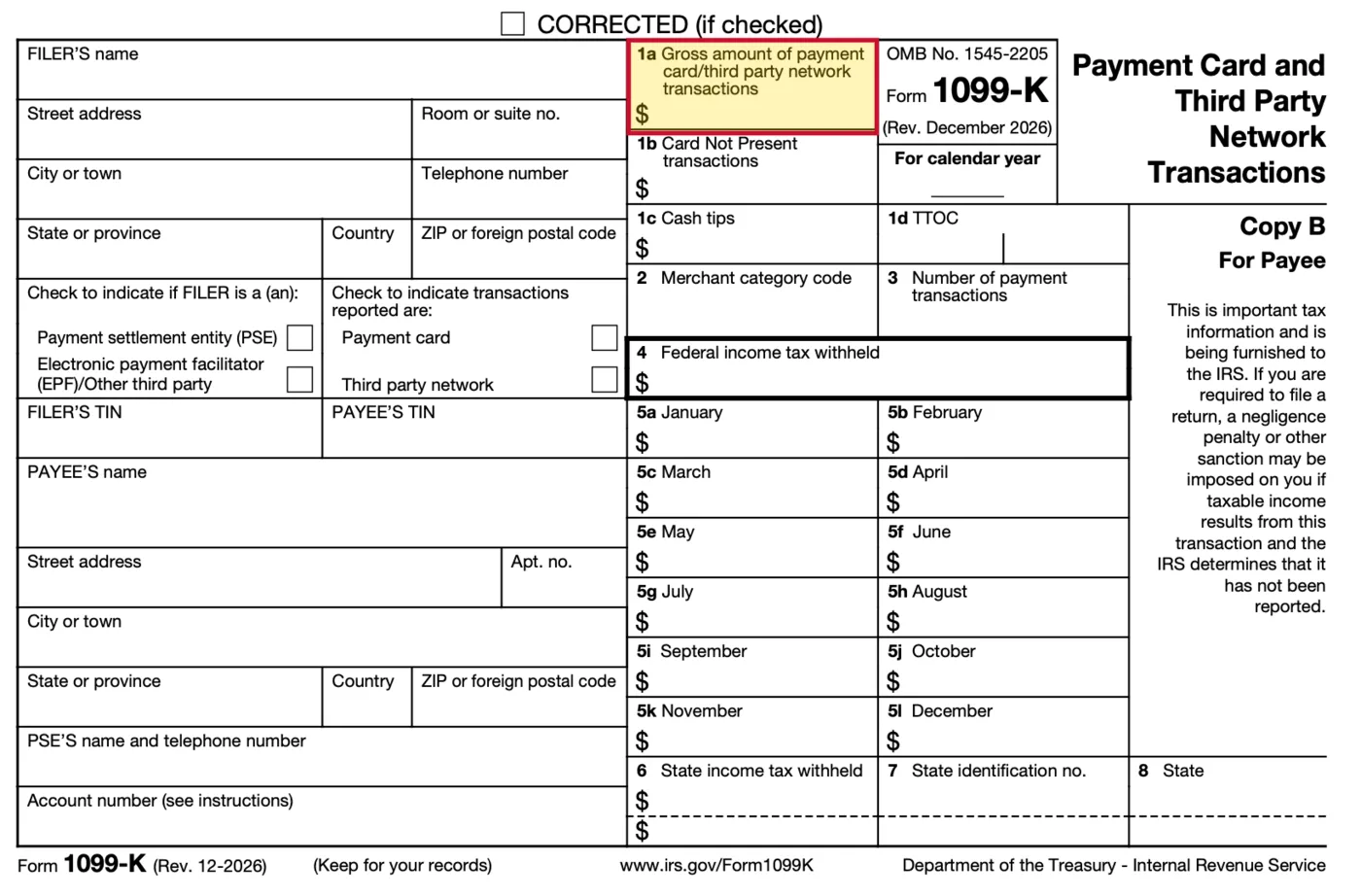
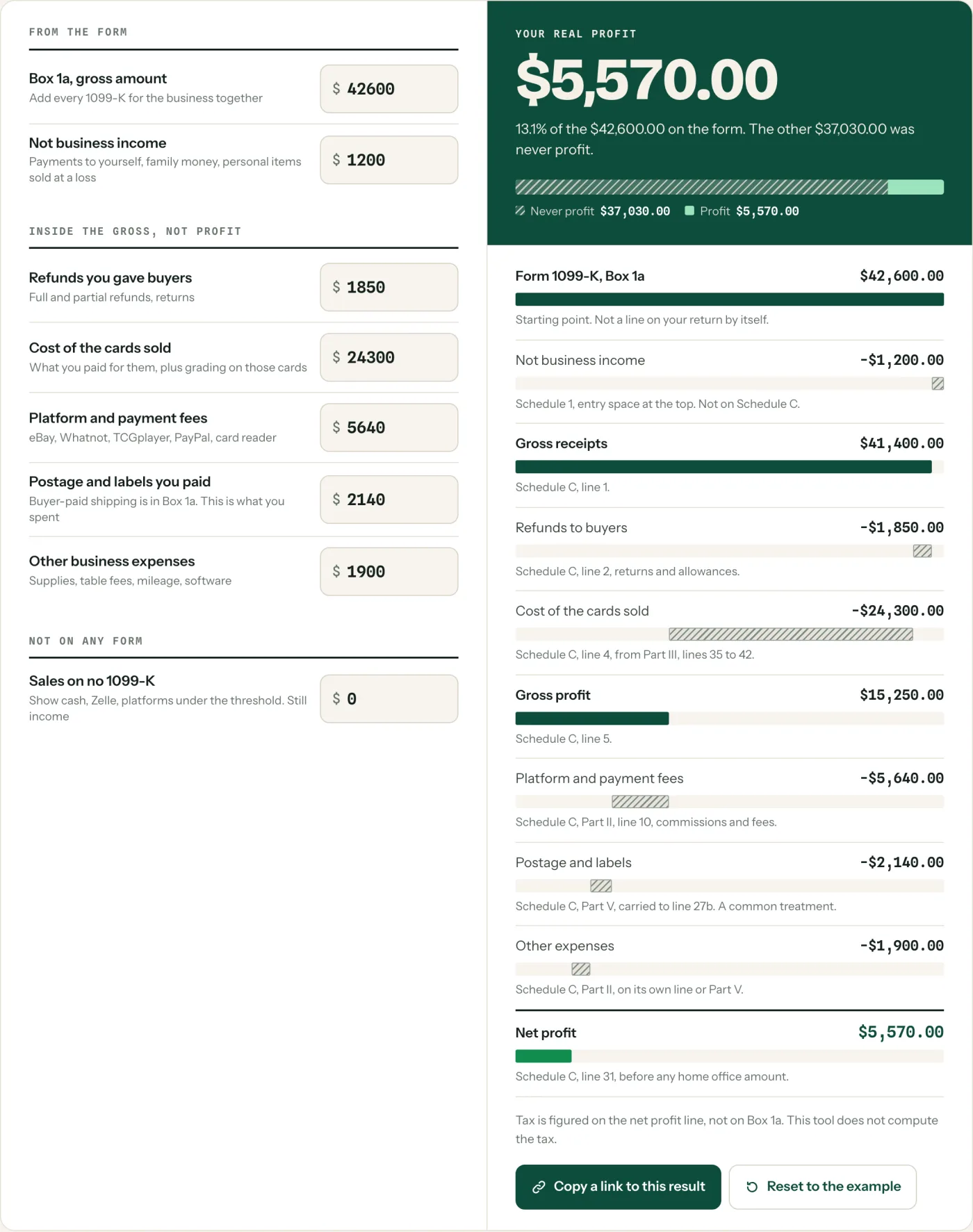
The whole sale. The IRS says Box 1a is gross and "doesn't include adjustments for fees, credits, refunds, shipping, cash equivalents or discounts." It also does not know what you paid for the card.
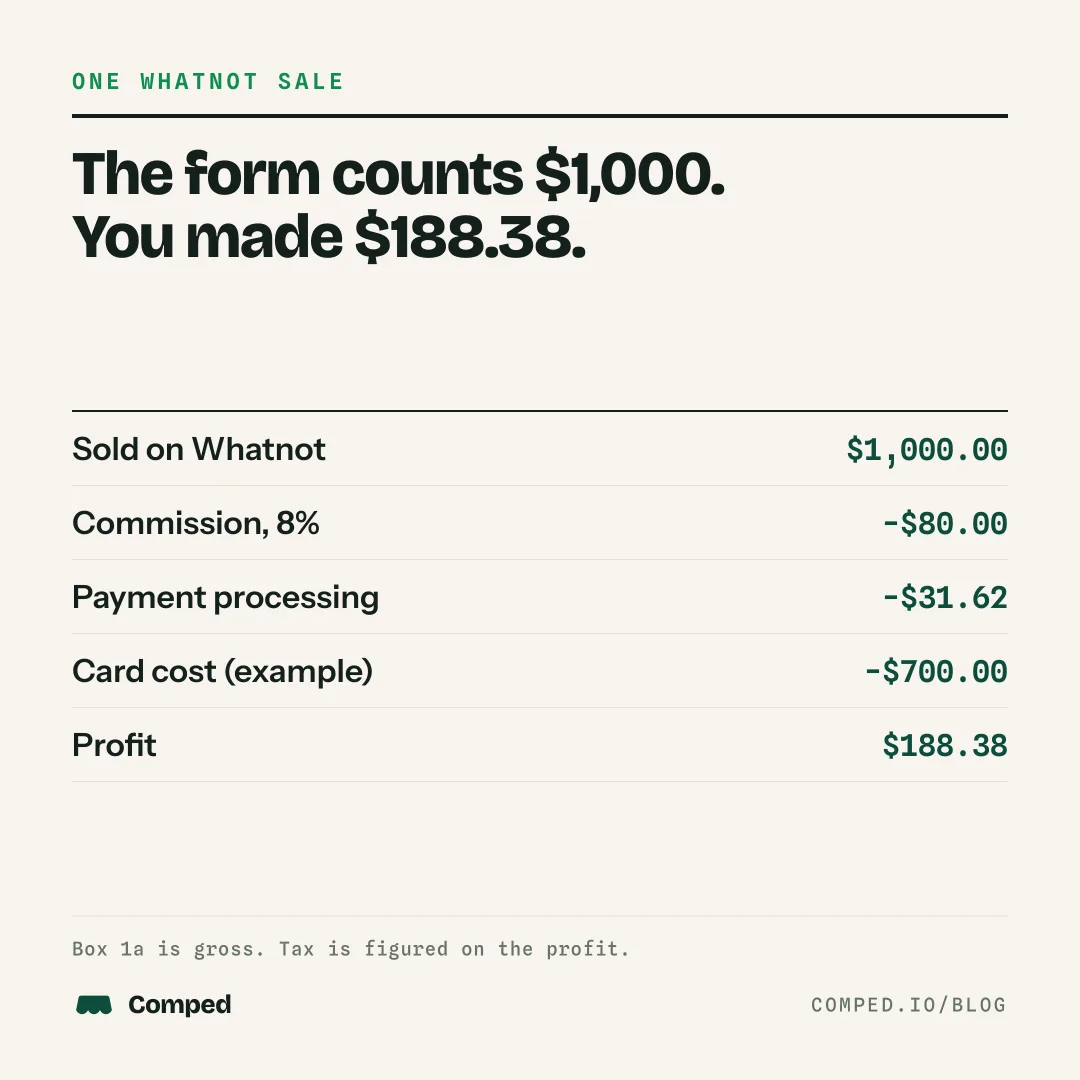
You subtract those on your return. Here is one Whatnot sale, with fees from the platform fee report and an example cost of $700.
ONE WHATNOT SALE, WORKED
A $1,000 card, standard 8% commission, 2.9% plus $0.30 processing on the order including 7% buyer sales tax.
The sale counts toward the form at its gross price. The taxable number is $188.38. Across a year, the 1099-K reconciliation calculator does this for the whole form and shows the Schedule C line for each step.
Whatnot's page says its 1099-K "will report all 2026 Whatnot earnings" and does not list what that includes. Its Seller Statements page lists earnings lines beyond sales: tips, affiliate rewards, seller referral bonuses and cash match promotions. Whether each of those is inside Box 1a is not stated. Compare the form with your annual statement line by line.
How do breaks, grading and giveaways change the math?
They change the cost side, which Whatnot never sees. The form reports what buyers paid. What the cards cost you is yours to prove.
- Breaks: buyers pay for spots, and the box or case is your cost. Splitting the box cost across what you sell and what you keep is the reasonable method; no IRS ruling covers cards. The cost basis calculator splits a box or a break.
- Grading: for a dealer, the fee is part of the cost of that card and is recovered when the card sells. That is our reading; no IRS guidance exists.
- Cards you keep: a hit moved to your personal collection comes out of purchases. It is not a cost of the cards you sold.
- Giveaways: Whatnot's statement has its own line for seller-paid shipping, including giveaway shipping cost. Take the figure from the statement.
- Refunded orders: the statement lists them as billbacks. The form's gross is not reduced for refunds, so subtract them on Schedule C line 2.
Comped records the cost of each card when you buy it, so the last line of that math is already on file when the form comes.
What do I do when the Whatnot 1099-K arrives?
Match it to your annual Seller Statement before you use it. Whatnot emails a link to the copy in Seller Hub, and issues an annual statement each January to every seller with activity.
- Check the name and tax ID. A single-member LLC should expect the owner's SSN.
- Open the annual statement under Statements, in the Financials section of Seller Hub.
- Compare Box 1a with the statement's earnings. Whatnot says to rely on Seller Statements, the form and the Ledger, not Seller Analytics, which shows estimates.
- If you also cashed out through PayPal, check whether PayPal sent a form for the same sales.
- Subtract refunds, commission, processing and shipping from the statement, then the cost of the cards from your own records.
- If the form is wrong, ask for a correction and file on time. The IRS says it cannot correct a 1099-K.
The Whatnot seller statement guide maps every statement line to Schedule C.
Do I owe tax if I never got a 1099 from Whatnot?
Yes. Tax is owed on profit whether or not a form arrives. There is no income threshold below which card profit is tax free. The $400 figure people quote is the point where self-employment tax applies.
A REPORTING RULE, NOT A TAX RULE
The $20,000 and 200 test decides whether Whatnot sends a form. It does not decide whether the income is taxable. A seller with $8,000 of Whatnot sales and no form reports the same way as one with a form.
Without a form, the annual Seller Statement is your source for the gross. Whatnot issues one to every seller with activity, form or no form. Take gross sales, refunds and fees from it, add the cost of the cards, and report on the same lines.
What if I sell on Whatnot and other platforms?
Each platform counts on its own. A seller with $15,000 on Whatnot and $15,000 on eBay is under the federal threshold on both and may get no form from either. All $30,000 is still gross receipts on one Schedule C.
The reverse also happens. A seller over the threshold on both gets two forms. Add the Box 1a amounts together, then subtract refunds, fees, shipping and the cost of the cards once.
Whatnot plus PayPal needs more care. Whatnot's page says its form reports all of the year's Whatnot earnings. It adds that a seller who cashed out through both Stripe and PayPal may also get a PayPal form reporting those payments. Our reading: the same sales can appear on both forms. Report each sale once, and keep both forms with the statement that shows the overlap.
What are the dates for the 2026 form?
Whatnot says 2026 forms will be in Seller Hub by January 31, 2027. That day is a Sunday, and the IRS due date for the seller's copy is Monday, February 1, 2027, under the weekend rule in Publication 1099.
| Date | What happens |
|---|---|
| Mid-November 2026 | Whatnot emails Stripe sellers over the threshold to add or correct a tax ID and opt into paperless delivery |
| December 31, 2026 | Last day of sales on the 2026 form |
| January 2027 | Annual Seller Statement for 2026 issued to every seller with activity |
| January 15, 2027 | Fourth estimated tax payment for 2026, per IRS Form 1040-ES |
| January 31, 2027 | Whatnot's date for 1099-Ks in Seller Hub, by email link or by mail, depending on your setting |
| April 15, 2027 | 2026 return due, per the IRS |
A year of steady shows usually means tax is due before April. The quarterly estimated tax guide covers the four payments.
How this looks in the Comped app
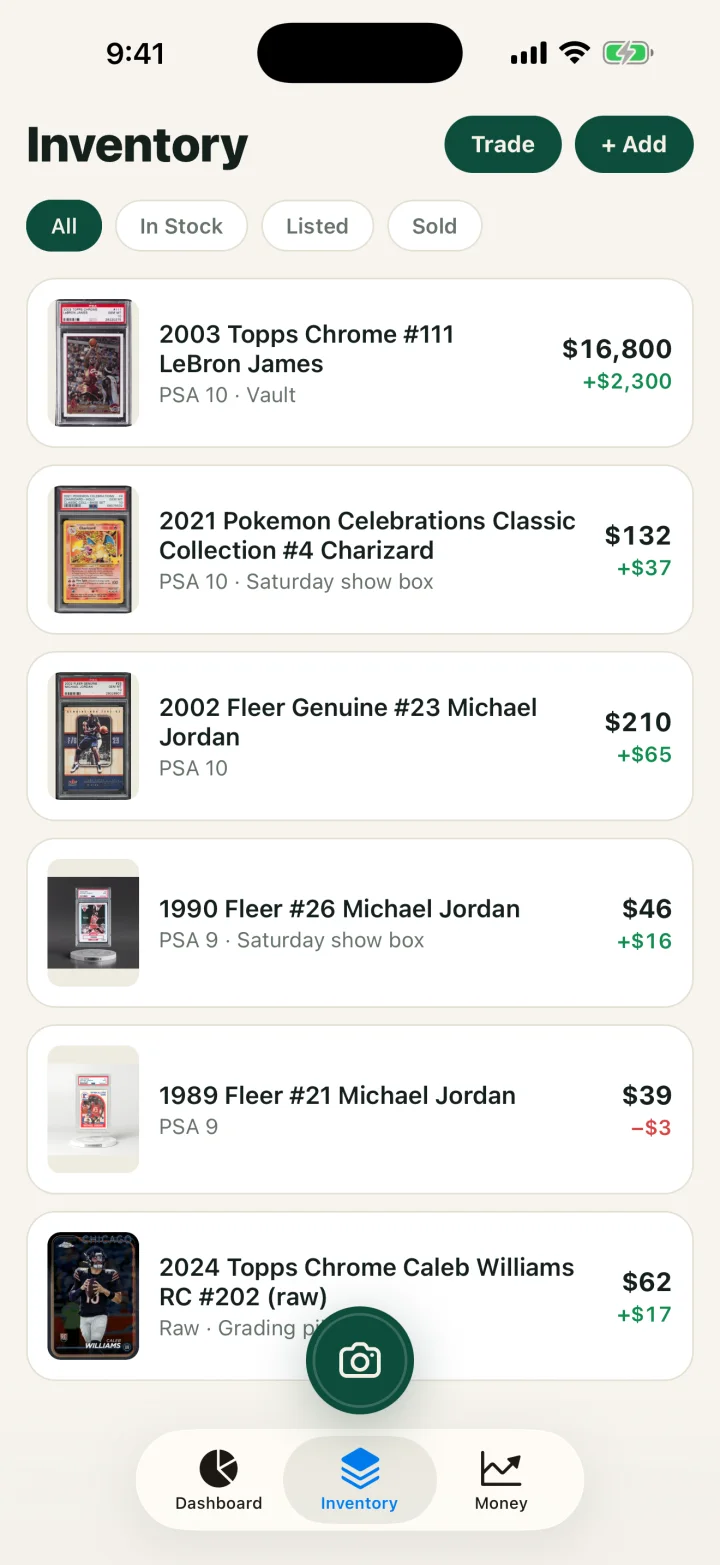
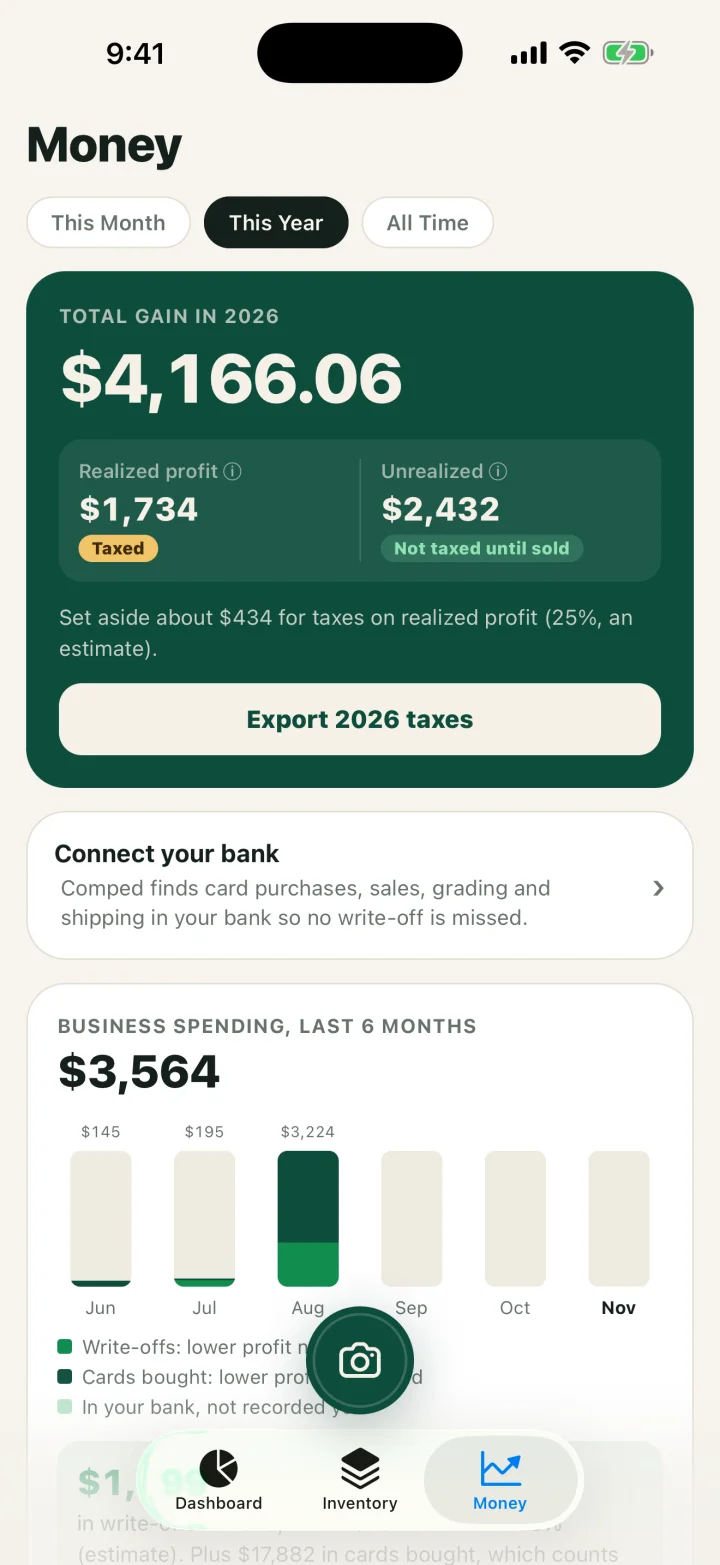
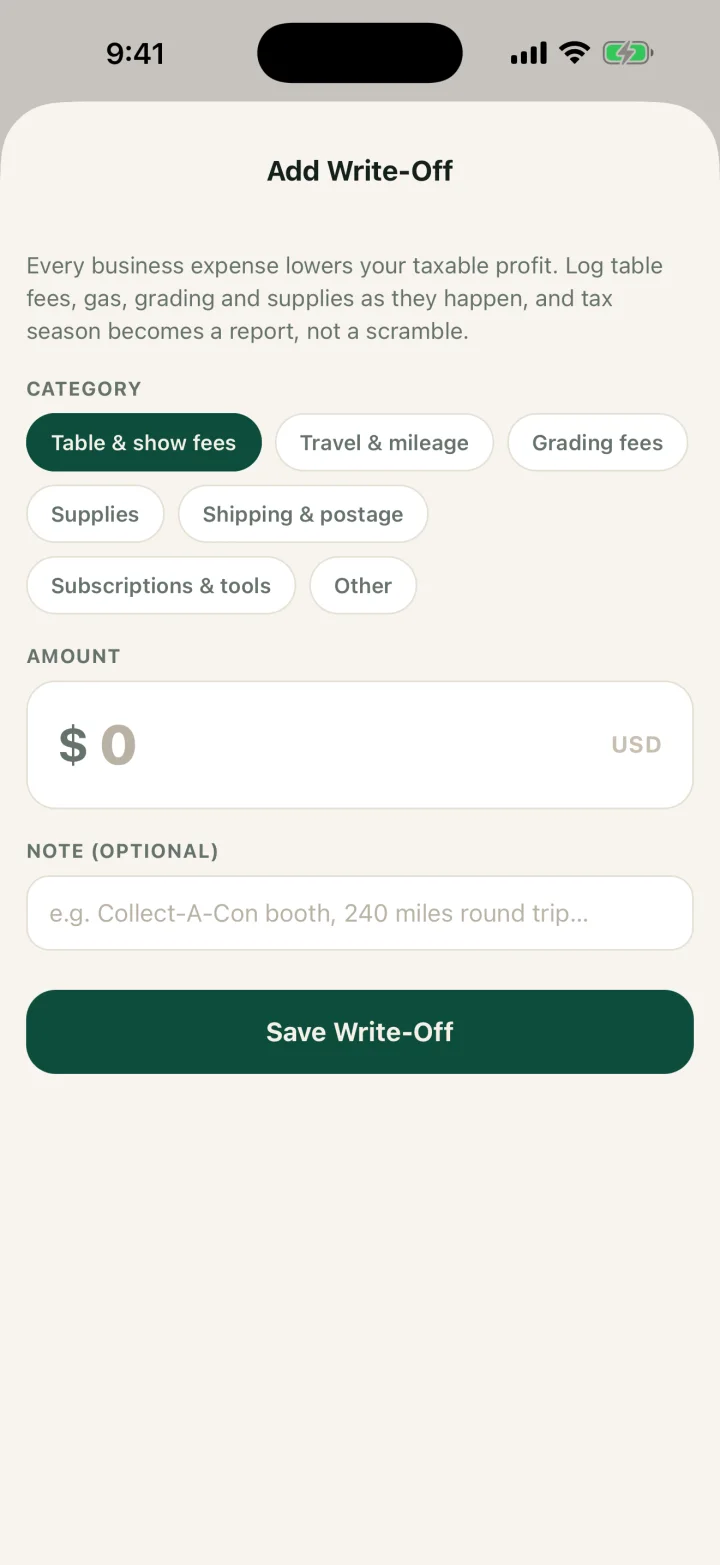
Inventory lists each card with its cost behind it, so a card sold on a stream already has its cost. The Money tab totals realized profit for the year, shows a 25% set-aside estimate and exports the year as a CSV. Add Write-Off records grading, supplies and shipping by category.
Related guides
- The Card Vendor's Master Guide to Taxes: how card profit is taxed, start to finish.
- The 1099-K for card sellers in 2026: every platform's threshold side by side.
- Whatnot seller statement to Schedule C: where each Whatnot number goes.
- 1099-K thresholds by state: the state sources behind the table above.
FAQ
Does Whatnot send a 1099?
Yes, a Form 1099-K, issued through Stripe. It goes to sellers who cash out through Stripe and pass $20,000 and 200 transactions in the year, or a lower amount in certain states.
How much can I sell on Whatnot before I get a 1099?
More than $20,000 and more than 200 transactions under the federal test. Whatnot's 2026 page lists lower amounts in seven states and DC, from $600 to $2,500. A platform may also send a form below the threshold.
Does Whatnot report my sales to the IRS?
Above the threshold, yes. Whatnot's page says that when you receive a 1099-K the IRS has been informed of your payment activity, and that you cannot opt out. Below the threshold no form is filed, and you still report the income yourself.
Do I owe tax if I never got a 1099?
Yes. The form is a report to the IRS, not the thing that makes income taxable. Profit from selling cards is reported whether or not a form arrives.
I would get a form even though I didn't make money. What then?
Report the gross and then subtract refunds, fees, shipping and the cost of the cards. If the costs are larger, a business shows a loss on Schedule C. The form alone does not create tax.
I cash out through PayPal. Will Whatnot send me a form?
Whatnot's page says sellers paid only through PayPal get no Whatnot form. PayPal may send its own 1099-K if your PayPal payments pass its threshold.
What if I have multiple Whatnot accounts?
Whatnot's page says that if the accounts share the same taxpayer identification number, Stripe combines the earnings and issues one 1099-K. Two accounts that are each under the threshold can pass it together.
When does the Whatnot 1099-K arrive?
Whatnot says it will issue 2026 forms in Seller Hub by January 31, 2027. Delivery is electronic or by mail, depending on the preference you set.
SOURCES
- 2026 Form 1099-K for U.S. Sellers, Whatnot Help Center, checked November 2026.
- Seller Statements, Whatnot Help Center, checked November 2026.
- IRS issues FAQs on Form 1099-K threshold under the One, Big, Beautiful Bill, Internal Revenue Service, checked November 2026.
- Understanding your Form 1099-K, Internal Revenue Service, checked November 2026.
- Form 1099-K FAQs: General information, Internal Revenue Service, checked November 2026.
- Form 1099-K FAQs: Third party filers of Form 1099-K, Internal Revenue Service, checked November 2026.
- What to do with Form 1099-K, Internal Revenue Service, checked November 2026.
- Form 1099-K (Rev. December 2026), Internal Revenue Service, checked November 2026.
- Publication 1099 (2026), Internal Revenue Service, checked November 2026.
- Form 1040-ES, Estimated Tax for Individuals, 2026, Internal Revenue Service, checked October 2026.
- When to file, Internal Revenue Service, checked November 2026.
- 1099-K form state requirements, Stripe, checked November 2026.
- Current Form 1099-K reporting thresholds, 2025 update, PayPal, checked November 2026.
This is general information for card sellers, not tax or legal advice for your situation. Rules change and states differ; a CPA who knows your numbers wins every time.