Who must pay
You must pay estimated tax if you expect to owe $1,000 or more when you file, after withholding and credits. The IRS estimated taxes page applies that test to individuals, including sole proprietors.
The payment covers more than income tax. It also covers self-employment tax, which is 15.3% on net earnings of $400 or more. A seller with a day job adds card profit on top of wages, and the job's withholding was not sized for it. The master tax guide covers how card profit lands on Schedule C.
The test runs on profit, not sales. A seller with $40,000 of sales and $34,000 of card cost, fees and show costs has $6,000 of profit to figure tax on. Those figures are an example.
The same IRS page lists one clean exemption. You owe no estimated tax for 2026 if you had no tax liability for 2025. That means your total tax was zero or you did not have to file. You must also have been a U.S. citizen or resident for the whole year, and your 2025 tax year must have covered 12 months.
No form from a marketplace changes any of this. The 1099-K threshold decides who gets a form, not who owes tax, as reporting eBay sales under $20,000 explains.
The safe harbors
You avoid the underpayment penalty by paying the smaller of two amounts through withholding and estimated payments. The first is 90% of the tax on your 2026 return. The second is 100% of the tax shown on your 2025 return. Both come from the worksheet in Form 1040-ES.
The second number rises for higher incomes. Publication 505 says to use 110% if your 2025 adjusted gross income was more than $150,000. The line is $75,000 if you are married filing separately for 2026. The 2025 return must cover all 12 months to count.
The prior-year number is the one a card seller can know in advance. A good show season in 2026 does not change it.
| Safe harbor for 2026 | What you pay in during 2026 | Known in advance? |
|---|---|---|
| Current year | 90% of the tax on your 2026 return | No, it depends on the year you have |
| Prior year | 100% of the tax shown on your 2025 return | Yes |
| Prior year, 2025 AGI over $150,000 | 110% of the tax shown on your 2025 return | Yes |
| Small balance | You owe less than $1,000 after withholding and credits | No |
The 2026 due dates
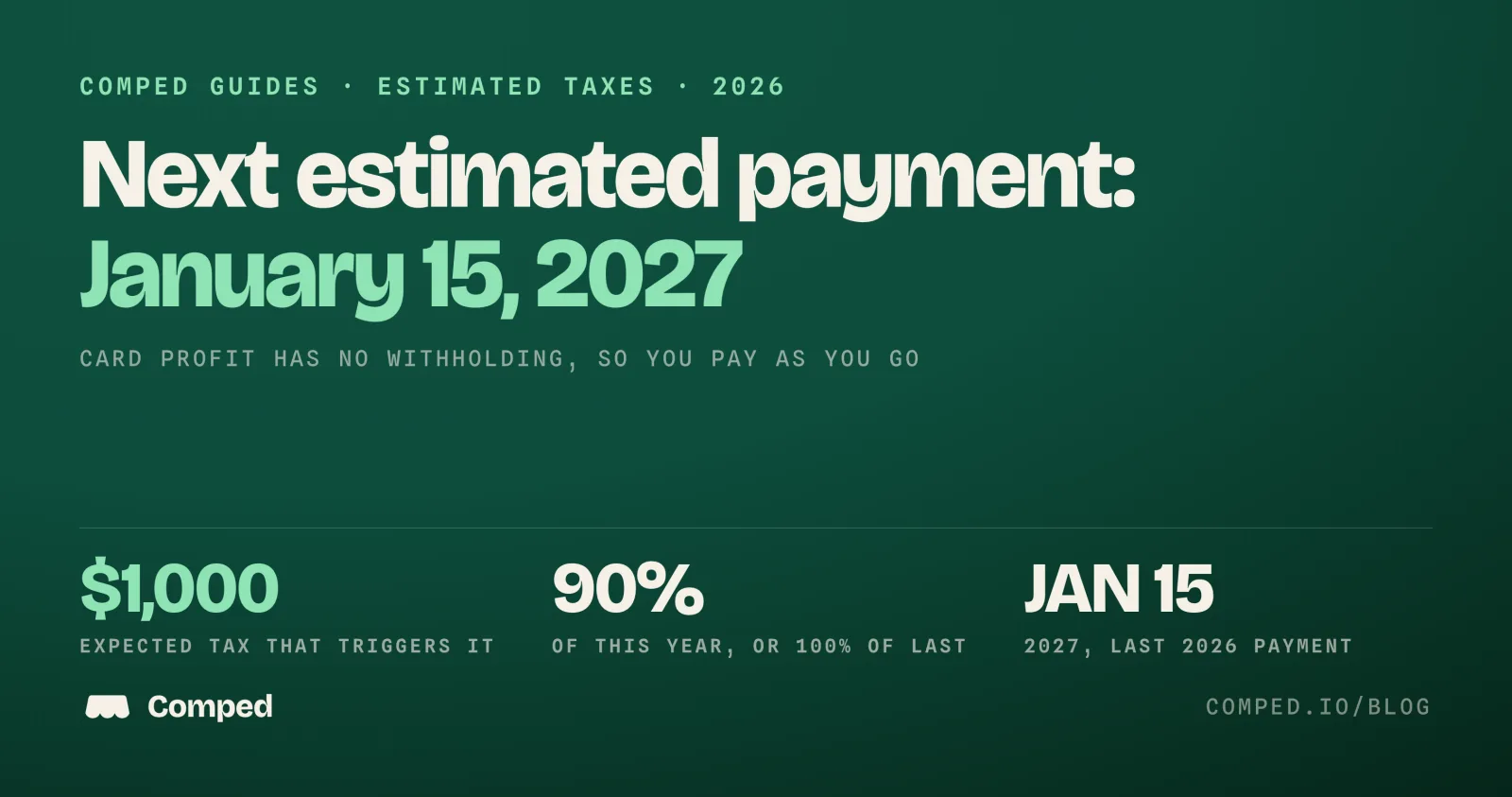
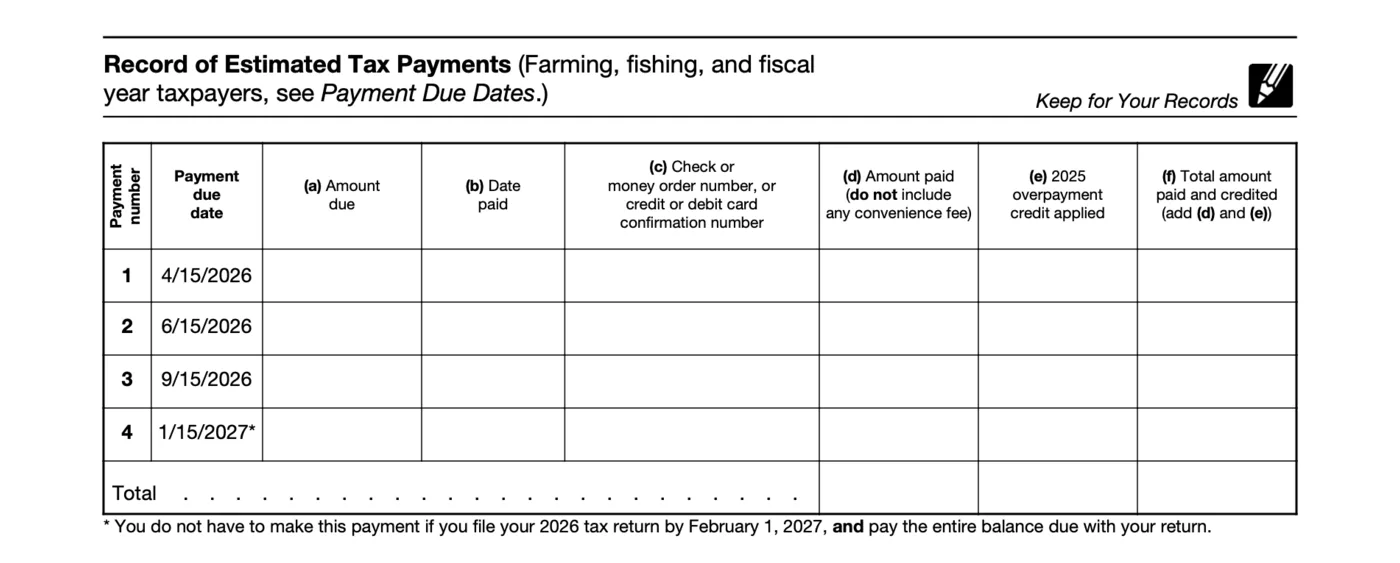
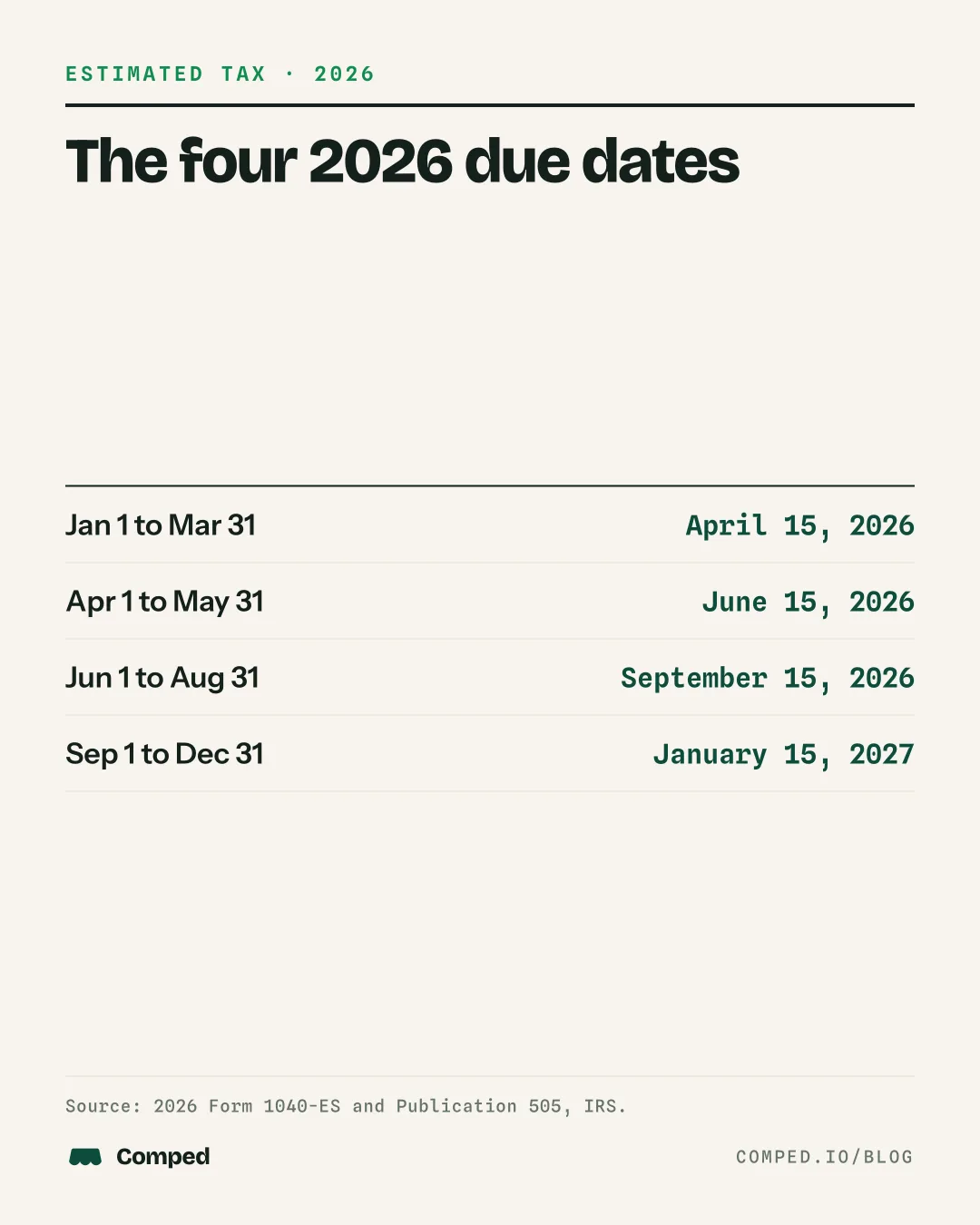
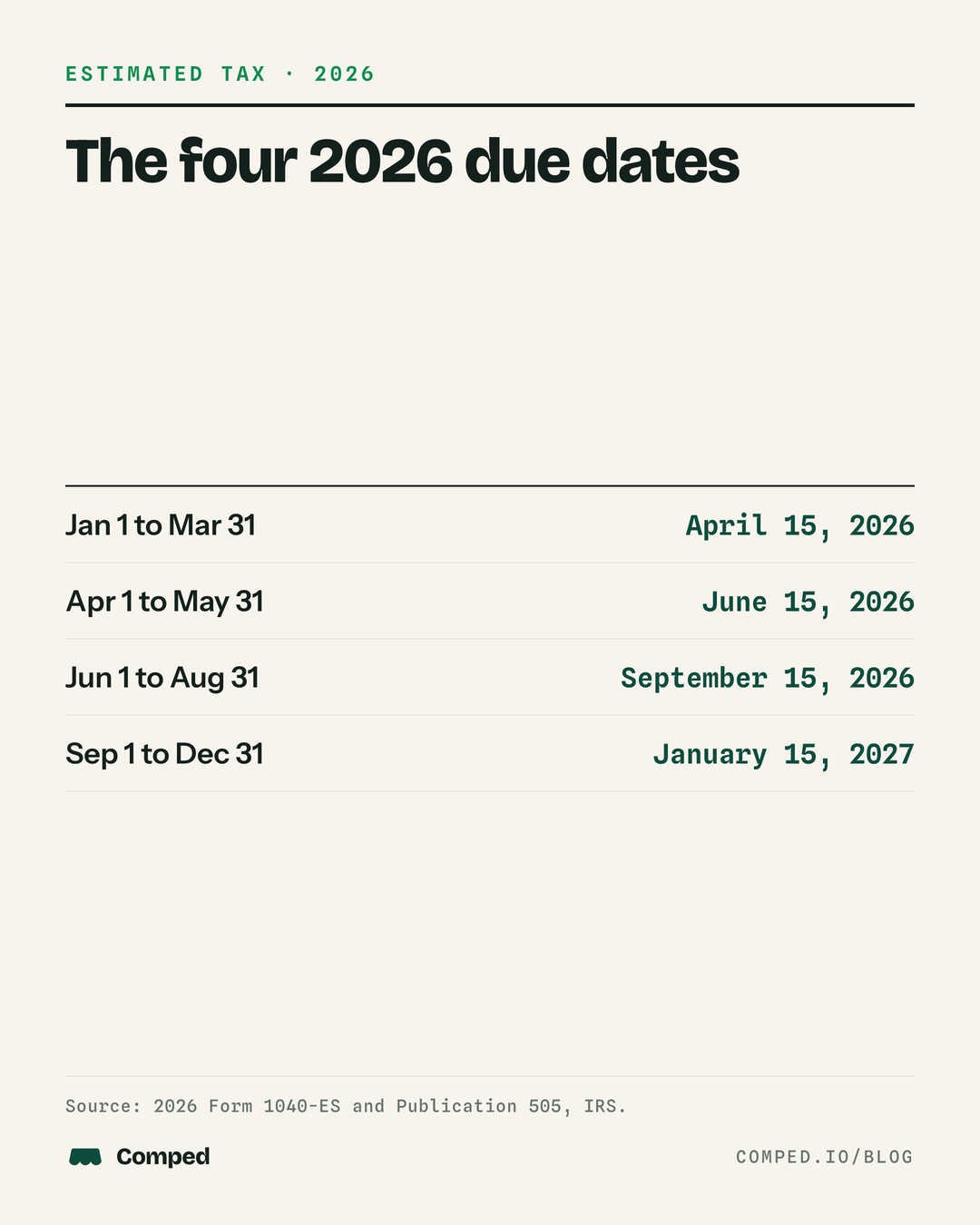
The four payments for 2026 are due April 15, June 15 and September 15, 2026, and January 15, 2027. Three are behind you. The periods are not equal quarters, and Publication 505 lists them this way.
| Income received in 2026 | Payment due | Status on November 13, 2026 |
|---|---|---|
| January 1 to March 31 | April 15, 2026 | Past |
| April 1 to May 31 | June 15, 2026 | Past |
| June 1 to August 31 | September 15, 2026 | Past |
| September 1 to December 31 | January 15, 2027 | Next |
The 2026 Form 1040-ES gives one way to skip the January payment. File your 2026 return by February 1, 2027, pay the entire balance with it, and the January payment is not required. A due date that falls on a weekend or legal holiday moves to the next business day. January 15, 2027 is a Friday, so it does not move.
Which approach fits which seller
The right approach depends on whether you have a job with withholding and how even your card profit is. Each row below uses a rule from Form 1040-ES or Publication 505. The match to a seller type is our reading.
| Your situation | Approach | Why |
|---|---|---|
| Day job, steady and modest card profit | Raise withholding with a new Form W-4 | The form says more withholding can replace estimated payments |
| You paid tax for 2025 and cannot predict 2026 | Prior-year safe harbor, four equal payments | The amount is known on day one and a big year does not change it |
| Most of your shows are in the fall | Annualized income installment method | Payments follow the income; needs Schedule AI at filing |
| First year with profit, and 2025 total tax was zero | No estimated tax is required for 2026 | The no-liability exception; the tax is still due with the return, so set money aside |
| Profit this year is lower than last year | Pay 90% of this year's expected tax | It is the smaller of the two amounts |
Sizing a payment when show income is lumpy
A seller with uneven income has two ways to size a payment, and both are in Publication 505. The first is the regular method: take the required annual payment, subtract expected withholding, and pay the rest in four equal installments. With the prior-year safe harbor, that is last year's tax divided across the four dates.
The second is the annualized income installment method. It figures each payment from the income you actually had through the end of that period. A quiet spring and a big fall produce small early payments and a larger January one. If you use it, Publication 505 says you must file Form 2210 with Schedule AI with your return.
Two more lines in Publication 505 matter to a show vendor. You do not have to make a payment until you have income on which you will owe tax. And when income changes during the year, you refigure and pay the difference by the next due date.
You can also pay more often than four times. The IRS says weekly, biweekly or monthly payments are fine, as long as enough is paid in by the end of each period.
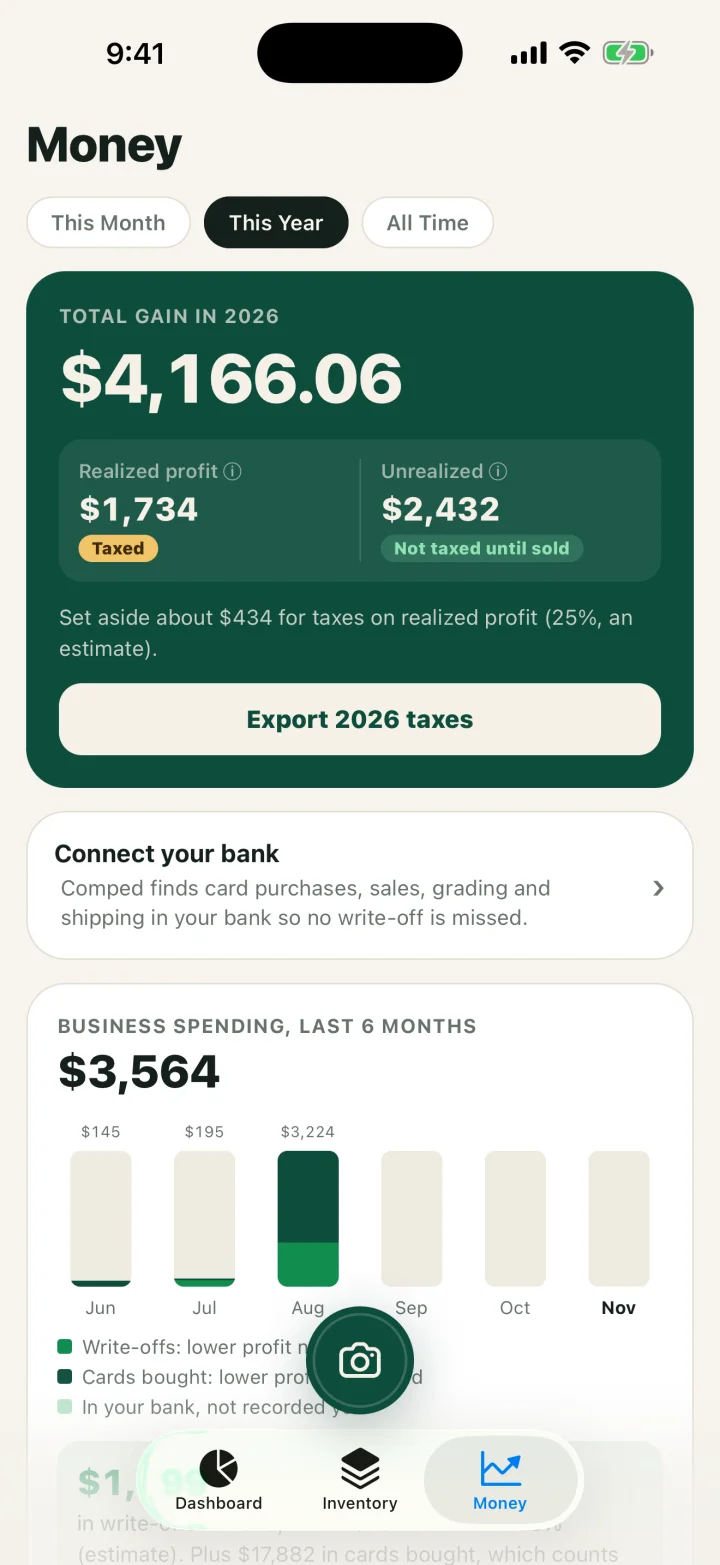
Either method needs the same input: profit for the period, not sales. That is sales minus what the cards cost, fees, table fees and mileage. Comped keeps a running tax set-aside as you record each buy, sale and expense, at a rate you set, 25% unless you change it. A written log does the same job, and how to track card show sales covers one.
Two ways to size it, worked
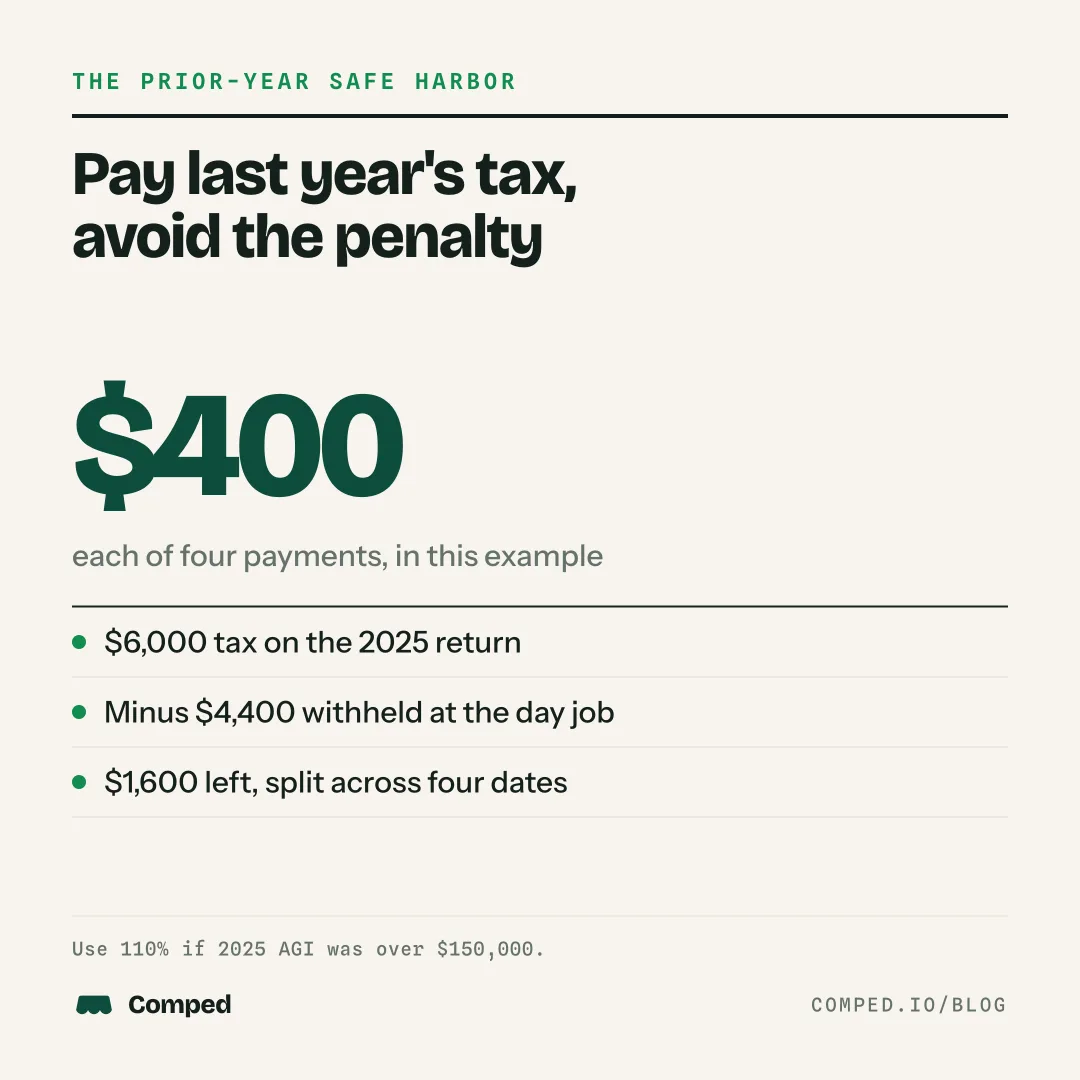
Say a part-time dealer has a day job. The total tax on the 2025 return was $6,000, and the job will withhold $4,400 during 2026. The dealer did most of the year's shows in the fall.
THE PRIOR-YEAR SAFE HARBOR
Say 2025 AGI was under $150,000, so the multiplier is 100%.
Paid on time, those four payments avoid the penalty whatever the fall shows earn. Any tax above $6,000 is due with the return, with no penalty for underpaying. Publication 505 treats withholding as paid in four equal parts on the due dates, which is why the job's $4,400 counts toward every period.
PAYING AS THE INCOME ARRIVES
Say the same dealer had no card profit before September, then cleared $6,000 at fall shows.
The 25% is a set-aside, not a tax rate. Your real figure depends on your bracket and the 15.3% self-employment tax. Schedule AI does the exact math at filing. The card sale tax calculator gives a closer estimate for your own numbers.
The 1040-ES worksheet, line by line
The worksheet turns expected income into a required payment in fifteen lines, and a card seller uses about ten of them. Here is the same dealer on the 2026 form. Say the dealer is single, expects $55,000 of wages and $12,000 of card profit, and takes the standard deduction. Every figure is an example.
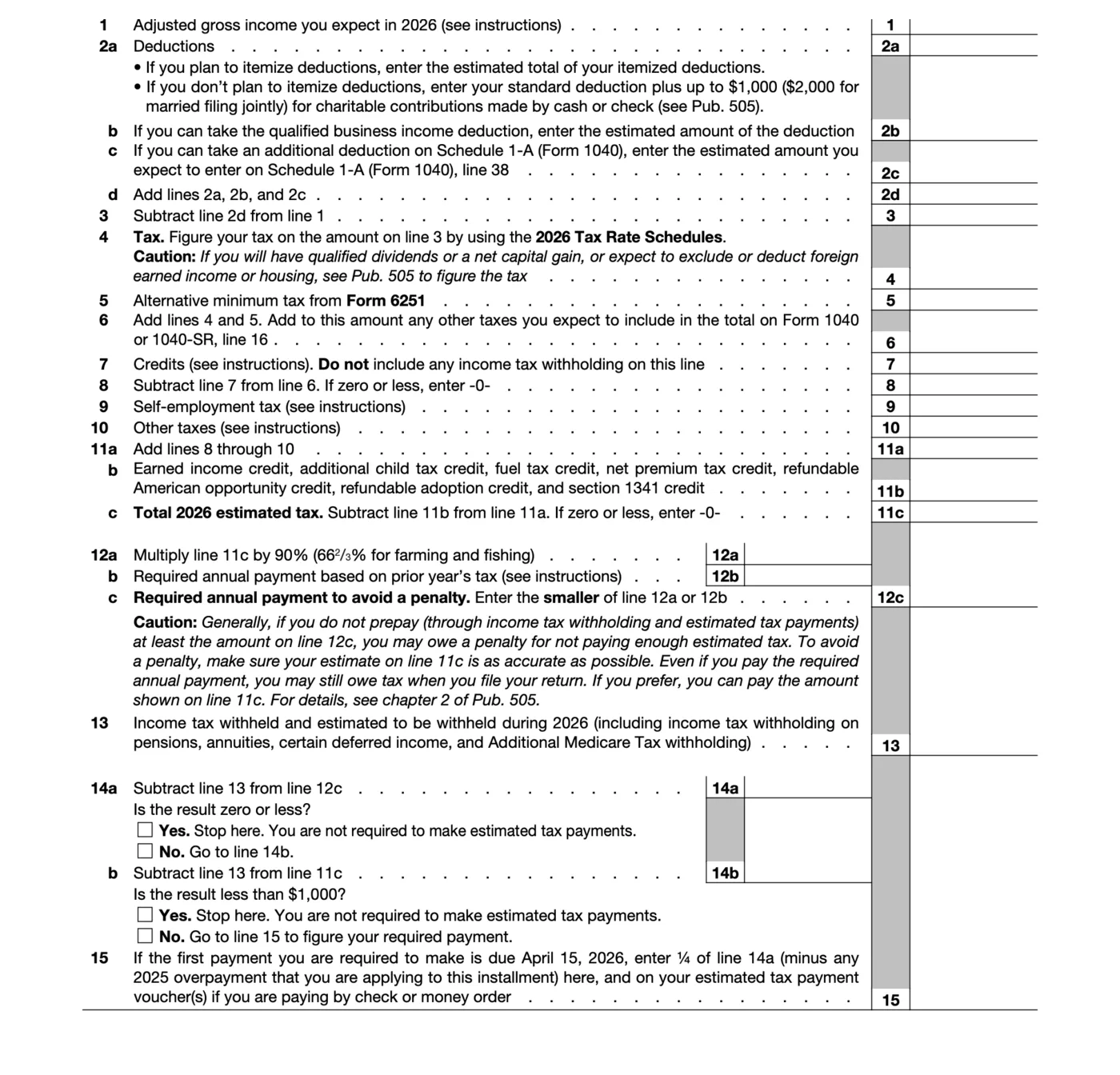
Self-employment tax comes first, on the form's own side worksheet. Card profit of $12,000 times 92.35% is $11,082. Medicare at 2.9% is $321. Social Security at 12.4% is $1,374, since wages plus profit sit under the $184,500 limit. The total is $1,696, and half of it, $848, is deducted from income.
| Line | What it asks | Example |
|---|---|---|
| 1 | Adjusted gross income: $55,000 wages plus $12,000 profit, less $848 | $66,152 |
| 2a | Standard deduction, single, 2026 | $16,100 |
| 2b | Qualified business income deduction, left out here | $0 |
| 3 | Line 1 minus deductions | $50,052 |
| 4 | Tax from the 2026 rate schedule: $1,240 plus 12% of the amount over $12,400 | $5,758 |
| 9 | Self-employment tax | $1,696 |
| 11c | Total 2026 estimated tax | $7,454 |
| 12a | 90% of line 11c | $6,709 |
| 12b | 100% of the tax on the 2025 return | $6,000 |
| 12c | Required annual payment, the smaller of 12a and 12b | $6,000 |
| 13 | Withholding expected in 2026 | $4,400 |
| 14a | Line 12c minus line 13 | $1,600 |
| 14b | Line 11c minus line 13; under $1,000 would mean no payments | $3,054 |
| 15 | One quarter of line 14a, the amount of each payment | $400 |
The dealer pays $400 four times and owes about $1,454 with the return: $7,454 less $4,400 withheld and $1,600 paid. No penalty applies, because the prior-year amount was met.
The example also shows what the card profit costs. By the same rate schedule, tax on the wages alone would be $4,420. The $12,000 of profit adds $3,034, about 25% of it. Line 2b would lower that for a seller who qualifies for the deduction. Your own percentage moves with your bracket, so run your numbers.
Form 1040-ES and the voucher
Form 1040-ES is a worksheet plus four payment vouchers for paying by check, and you do not file the worksheet. It walks from expected income to expected tax, then compares 90% of that with the prior-year amount. If the balance after withholding is under $1,000, the worksheet tells you to stop. No payments are required.
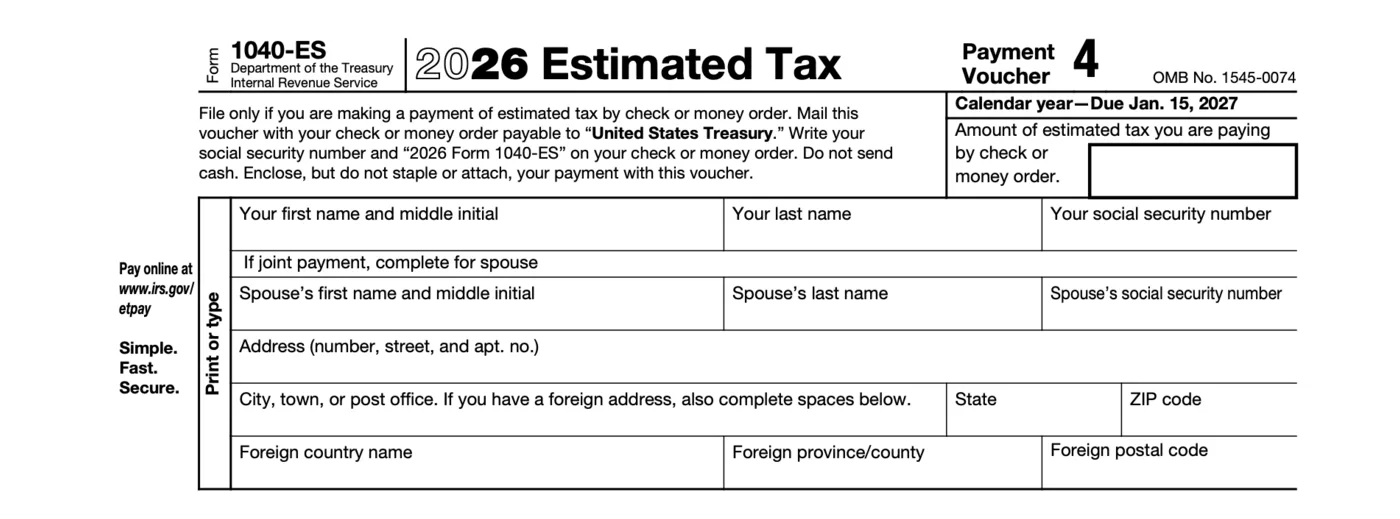
The voucher's own instructions are short. Make the check payable to United States Treasury. Write your Social Security number and "2026 Form 1040-ES" on it. Do not send cash, and do not staple the check to the voucher.
Sellers with wages have another route. The IRS says you can avoid estimated payments by asking your employer to withhold more, using a new Form W-4. That suits a seller whose card profit is steady and modest.
How to pay
Paying from a bank account online is free, and the form lists three ways to pay electronically.
| Method | Fee, per the 2026 Form 1040-ES | Notes |
|---|---|---|
| IRS Online Account | No fees | Pay from checking or savings and see your balance and payment history |
| IRS Direct Pay | No fees | Bank account payment with no registration |
| EFTPS | No fees | Requires enrollment first |
| Debit or credit card | Processing fees apply | The fee goes to the payment processor, not the IRS |
| Check or money order | None stated | Mail it with the voucher for that due date |
IRS Direct Pay takes an estimated payment from a checking or savings account. The IRS page lists three points. It is free and secure, it needs no sign-in, and you can change or cancel within 2 days of the scheduled payment. The January 15, 2027 payment is for tax year 2026, so apply it to 2026 when you pay.
Save the confirmation for each payment. You enter the total of your 2026 estimated payments on your return, and the confirmations are your record. An IRS online account also shows your payment history.
A missed or short payment
A missed payment draws a penalty for that period, and paying sooner makes it smaller. The IRS bases the penalty on the amount underpaid, how long it stayed underpaid, and its published interest rates. It is figured separately for each payment period. You can owe it for an early period even if you are due a refund when you file.
So a seller who skipped April, June and September should not wait for January. Pay now for the periods already past, then pay the January amount on time. If your income arrived late in the year, the IRS says Schedule AI of Form 2210 may reduce the penalty.
The rate is the IRS underpayment rate, set each quarter. The IRS interest rate page lists 7% for January to March 2026, 6% for April to June, and 7% for each of the last two quarters.
ONE MISSED PAYMENT, ROUGHLY
Say the $400 due April 15, 2026 was paid on November 13, 2026. This is simple interest at the IRS rates, as an illustration. Form 2210 computes the real figure.
The amount is small on a small payment and grows with the size and the delay. The IRS penalty page says it charges interest on penalties until the balance is paid.
The same page says the penalty generally cannot be waived for reasonable cause. It may be removed or reduced when the underpayment came from a casualty or local disaster. The same goes for a taxpayer who retired after reaching age 62 or became disabled in the past 2 years and had reasonable cause.
Common mistakes
| Mistake | What it does |
|---|---|
| Figuring the payment on sales | Overpays by the tax on your card cost and expenses |
| Leaving out self-employment tax | In the worksheet example it is $1,696 of the $3,034 the profit adds |
| Planning to catch up in January | The penalty is figured per period, so earlier periods stay short |
| Applying the January 15, 2027 payment to 2027 | The 2026 return shows too little paid |
| Skipping payments because no 1099-K came | The tax is owed either way, and so is the penalty |
| No record of what was paid | The return needs the total of the year's payments |
State estimated tax
Many states with an income tax have their own estimated payments, with their own forms, thresholds and dates. Everything on this page is federal. Check your state revenue department's site before the January date.
The 2027 dates
The IRS has not published the 2027 Form 1040-ES as of November 13, 2026. The IRS form page still shows the 2026 form as current. This page does not state 2027 due dates until that form is out. The January 15, 2027 payment belongs to tax year 2026.
How this looks in the Comped app
The Money tab shows realized profit for the month, the year or all time, with a set-aside estimate under it. Unrealized gain on cards you still hold is shown separately and is not taxed until they sell. The sale screen shows the profit on one card after fees, shipping and cost, which is the number an estimate is built from.

Related guides
- The Card Vendor's Master Guide to Taxes: Schedule C, self-employment tax and the full year in one place.
- Hobby or business: selling cards: which sellers owe self-employment tax at all.
- Reporting eBay sales under $20,000: tax is owed with or without a 1099-K.
- The 2026 card vendor tax sheet: the year's rates and dates on one page.
FAQ
Do I have to pay quarterly taxes if I only sell cards on weekends?
Yes, if you expect to owe $1,000 or more for the year after withholding and credits. The test is the amount of tax, not the hours. A weekend seller with a day job can also raise withholding at work with a new Form W-4 and skip the separate payments.
When is the next estimated tax payment due?
January 15, 2027. It is the fourth payment for tax year 2026 and covers income from September 1 to December 31, 2026. You can skip it if you file your 2026 return by February 1, 2027, and pay the whole balance with it.
How much should I pay each quarter?
Enough that withholding plus estimated payments reach 90% of your 2026 tax or 100% of the tax on your 2025 return, whichever is smaller. Use 110% if your 2025 AGI was over $150,000. The regular method splits the amount into four equal payments.
Is estimated tax based on my sales or my profit?
Profit. Sales come first, then the cost of the cards, fees and expenses come off, and tax is figured on what is left. Self-employment tax of 15.3% applies to that profit on top of income tax.
My show income is uneven. Do I still pay four equal amounts?
No. The annualized income installment method in Publication 505 sizes each payment from the income you had through that period. You then file Form 2210 with Schedule AI with your return. You can also pay more often than quarterly.
Does the withholding from my job count?
Yes. Withholding counts toward both safe harbors, and Publication 505 treats it as paid evenly across the four due dates. A seller with a job can also raise withholding with a new Form W-4 to cover the card profit.
I missed the earlier 2026 payments. What now?
Pay as soon as you can, since the penalty is figured separately for each period and grows with time. Then make the January 15, 2027 payment on time. If most of your profit came late in the year, Schedule AI may reduce the penalty.
How big is the underpayment penalty?
It works like interest on the amount you were short, for the days you were short. The IRS underpayment rate was 7% for three quarters of 2026 and 6% for the second quarter. Form 2210 figures the exact amount, or the IRS figures it and sends a bill.
SOURCES
- 2026 Form 1040-ES, Estimated Tax for Individuals, IRS, checked November 2026.
- About Form 1040-ES, IRS, checked November 2026.
- Estimated taxes, IRS, checked November 2026.
- Publication 505 (2026), Tax Withholding and Estimated Tax, IRS, checked November 2026.
- Direct Pay with bank account, IRS, checked November 2026.
- Underpayment of estimated tax by individuals penalty, IRS, checked November 2026.
- Quarterly interest rates, IRS, checked November 2026.
- Self-employment tax, IRS, checked November 2026.
This is general information for card sellers, not tax or legal advice for your situation. Rules change and states differ; a CPA who knows your numbers wins every time.