FROM THE FORM
INSIDE THE GROSS, NOT PROFIT
NOT ON ANY FORM
YOUR REAL PROFIT
$5,570.00
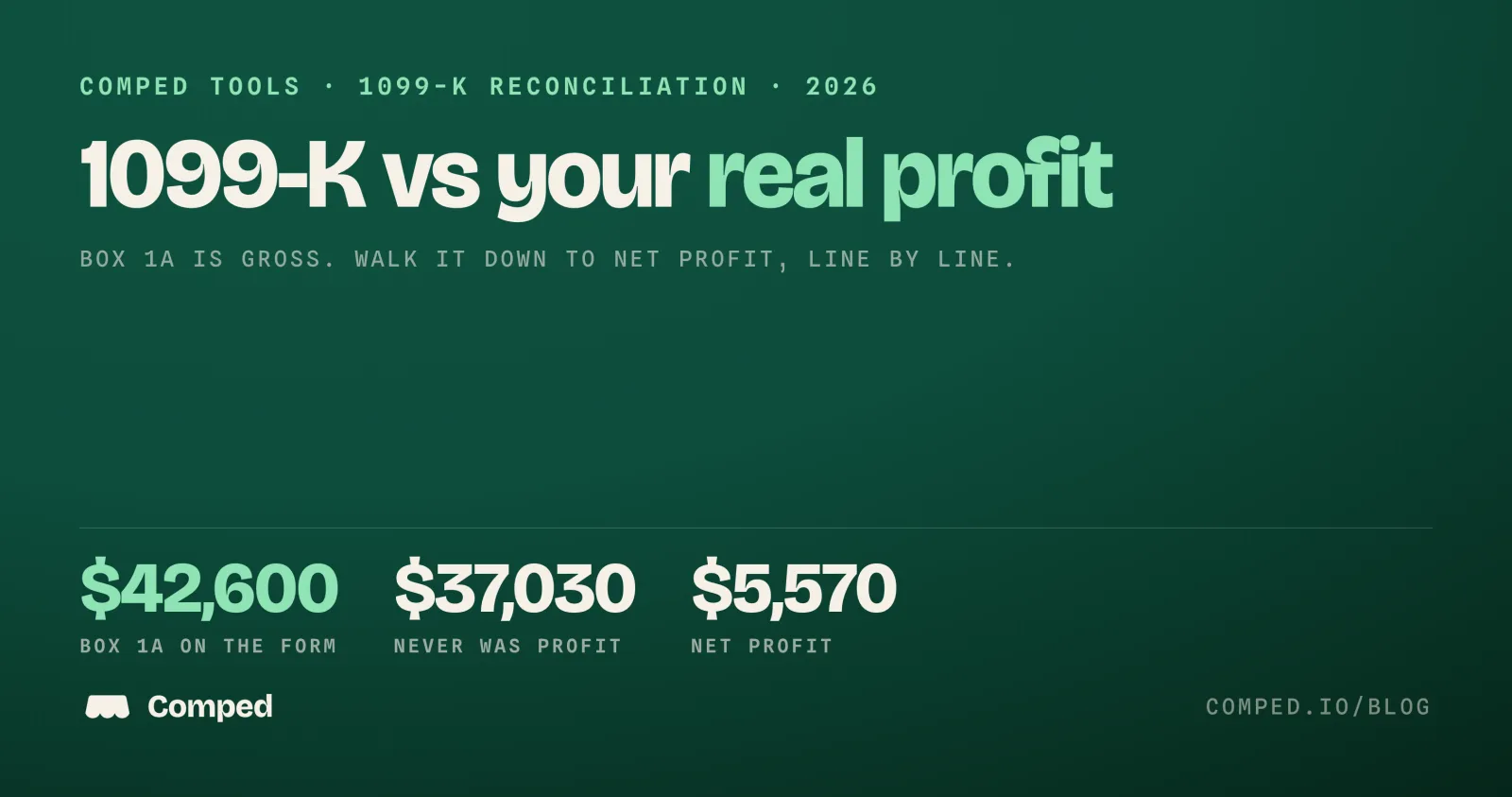
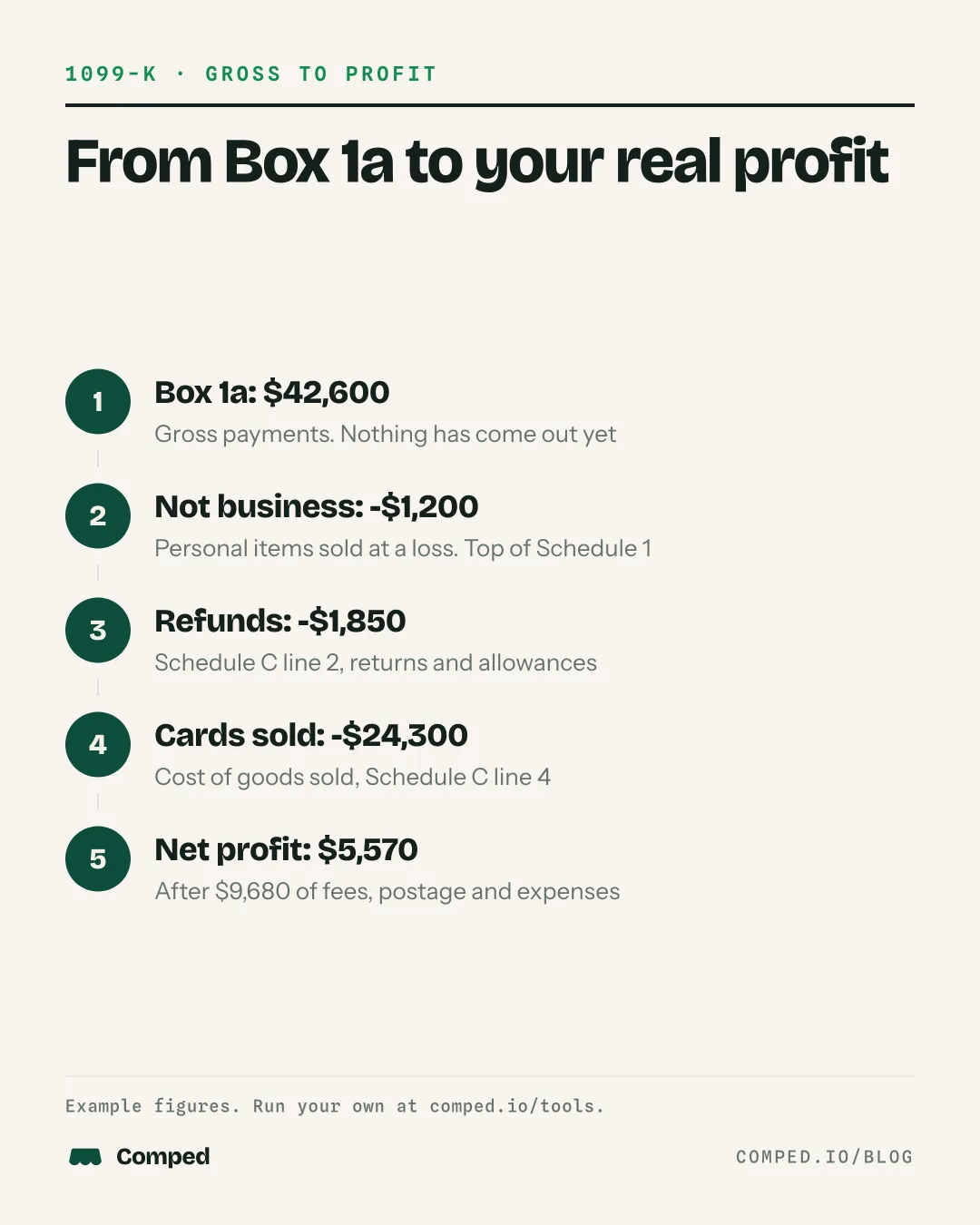
13.1% of the $42,600.00 on the form. The other $37,030.00 was never profit.
Starting point. Not a line on your return by itself.
Schedule 1, entry space at the top. Not on Schedule C.
Schedule C, line 1, with the rest of your receipts.
Schedule C, line 1.
Schedule C, line 2, returns and allowances.
Schedule C, line 4, from Part III, lines 35 to 42.
Schedule C, line 5.
Schedule C, Part II, line 10, commissions and fees.
Schedule C, Part V, carried to line 27b. A common treatment.
Schedule C, Part II, on its own line or Part V.
Schedule C, line 31, before any home office amount.
Tax is figured on the net profit line, not on Box 1a. This tool does not compute the tax.
Comped does this at the table
Comped records what each card cost when you buy it, and the price and fees when you sell it, so the totals this calculator asks for already exist in January. The record you make at the table is the tax record.
Why is my 1099-K higher than my income?
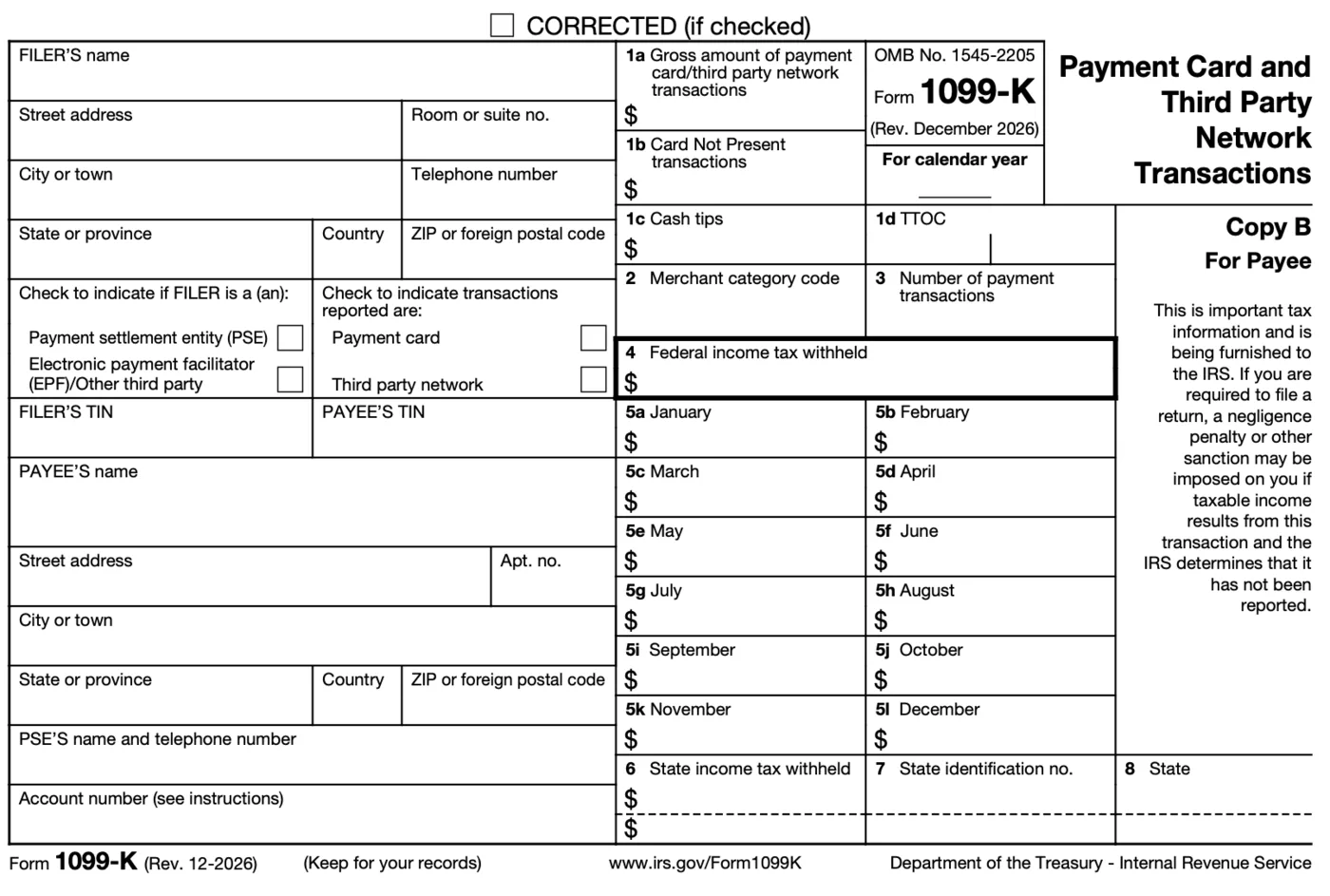
Box 1a reports every dollar buyers paid through the platform, before anything came out. The IRS 1099-K FAQ is direct about it. The gross amount "doesn't include adjustments for fees, credits, refunds, shipping, cash equivalents or discounts." The same page says the form does not account for what you paid for the items you sold.
So a card seller's form counts the sale you refunded. It counts the $5 of shipping the buyer paid that went straight to a label. It counts the fee the platform kept before your payout. It also counts the full price of a card you bought for nearly as much. None of that is profit. The 1099-K guide for card sellers covers who gets a form; this page handles the arithmetic once you have one.
Platforms differ on the edges. eBay's 1099-K page says its gross leaves out sales tax and canceled transactions but includes no adjustment for credits, discounts, fees or refunds. TCGplayer says its amounts include shipping, fees and refunds. Use each platform's detailed report to find your own figures.
What the other boxes on the form tell you
Three other boxes help you check the gross. The instructions printed on the form explain each one.
| Box | What it shows | How to use it |
|---|---|---|
| 1a | Gross amount of all payments for the year | The starting number in the calculator |
| 3 | Number of payment transactions, "not including refund transactions" | Compare with the order count in the platform's report |
| 4 | Backup withholding, if the platform withheld tax | The form says to include it on your return as tax withheld |
| 5a to 5l | The gross for each month, January to December | Match each month to the platform's monthly report to find a gap |
The form's instructions also say each transaction is counted "on the date of the transaction." A card sold on December 30 is on that year's form even if the payout reached your bank in January.
How to reconcile a 1099-K, step by step
- Collect every 1099-K for the year and add up Box 1a for the business. Forms reach sellers by January 31. For 2026 forms the IRS due date is Monday, February 1, 2027.
- Download each platform's detailed report for the same year. On eBay it is in Seller Hub under Payments, then Taxes. The Whatnot seller statement guide covers Whatnot.
- Check that each report's gross matches Box 1a and the monthly boxes. If it does not, ask the filer named at the top left of the form.
- Mark anything that was not a business sale: personal items, money from family, transfers between your own accounts.
- Total the refunds, the platform fees and the postage you paid from the same reports.
- Work out the cost of the cards you sold from your own records. No platform has this number.
- Add the sales that are on no form: show cash, Zelle, a platform under the threshold.
- Type the totals in above, then save the link and the reports with your tax records.
Where each amount goes on Schedule C
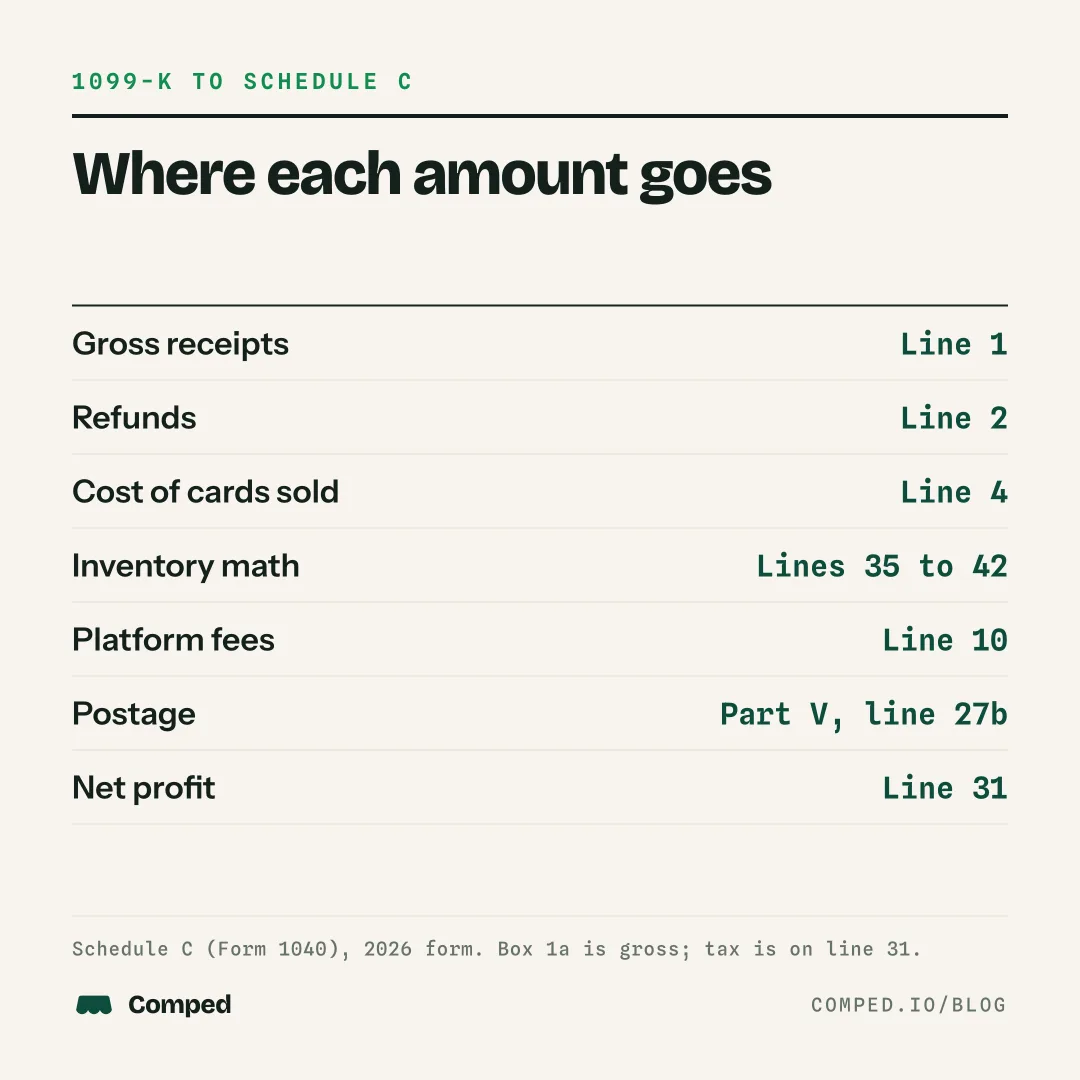
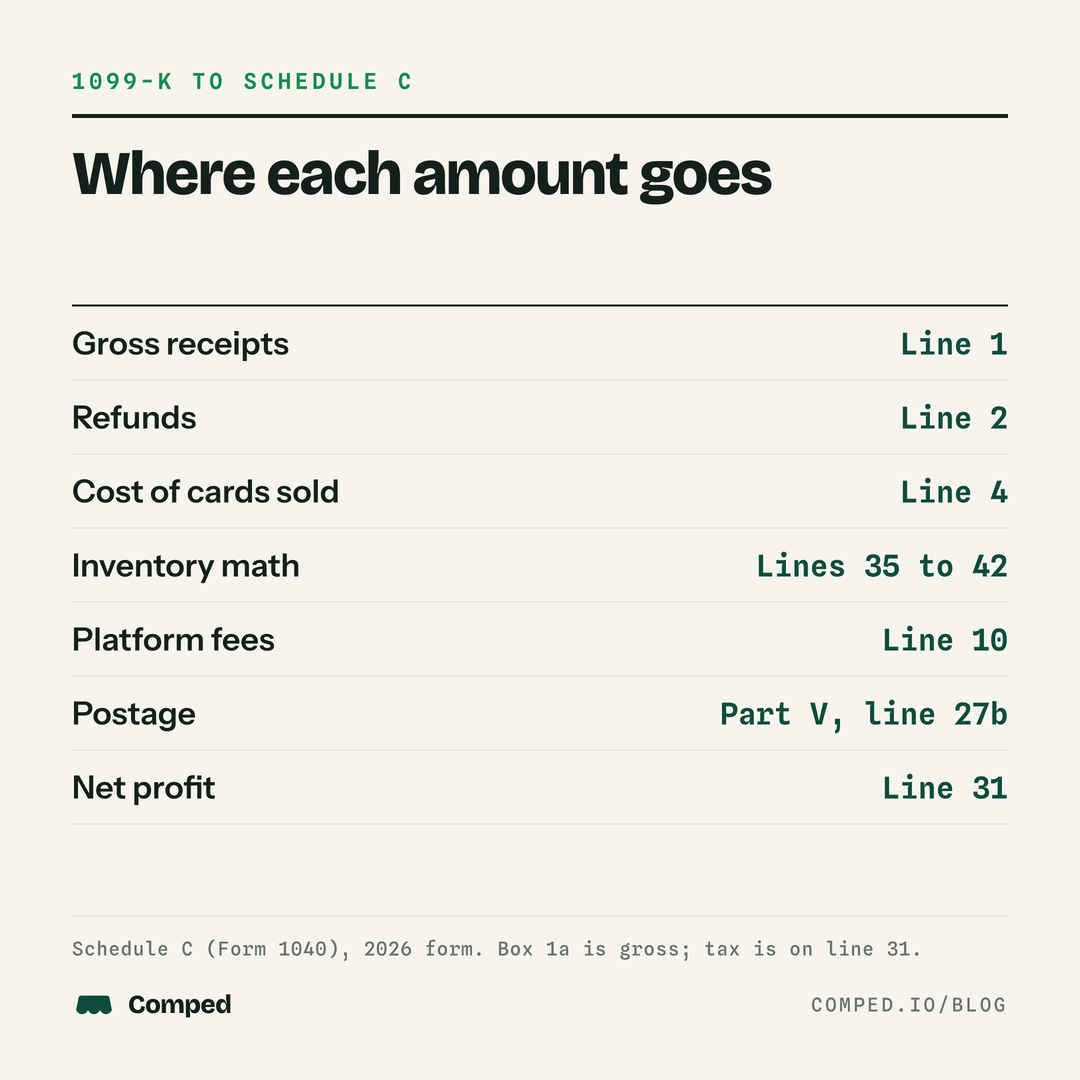
The calculator runs in the same order as Schedule C. Each row lands on a line your preparer or software will ask for. Line numbers below are from the 2026 Schedule C and the Schedule C instructions posted on irs.gov.
| What it is | Where it goes | Example |
|---|---|---|
| Box 1a, all business 1099-K forms | Starting point | $42,600 |
| Amounts that are not business income | Schedule 1, entry space at the top | -$1,200 |
| Gross receipts, including sales on no form | Schedule C, line 1 | $41,400 |
| Refunds to buyers | Schedule C, line 2, returns and allowances | -$1,850 |
| Cost of the cards sold | Schedule C, line 4, figured in Part III, lines 35 to 42 | -$24,300 |
| Gross profit | Schedule C, line 5 | $15,250 |
| Platform and payment fees | Part II, line 10, commissions and fees | -$5,640 |
| Postage and labels | Part V, carried to line 27b (a common treatment) | -$2,140 |
| Other expenses | Part II, by type, or Part V carried to line 27b | -$1,900 |
| Net profit | Schedule C, line 31 | $5,570 |
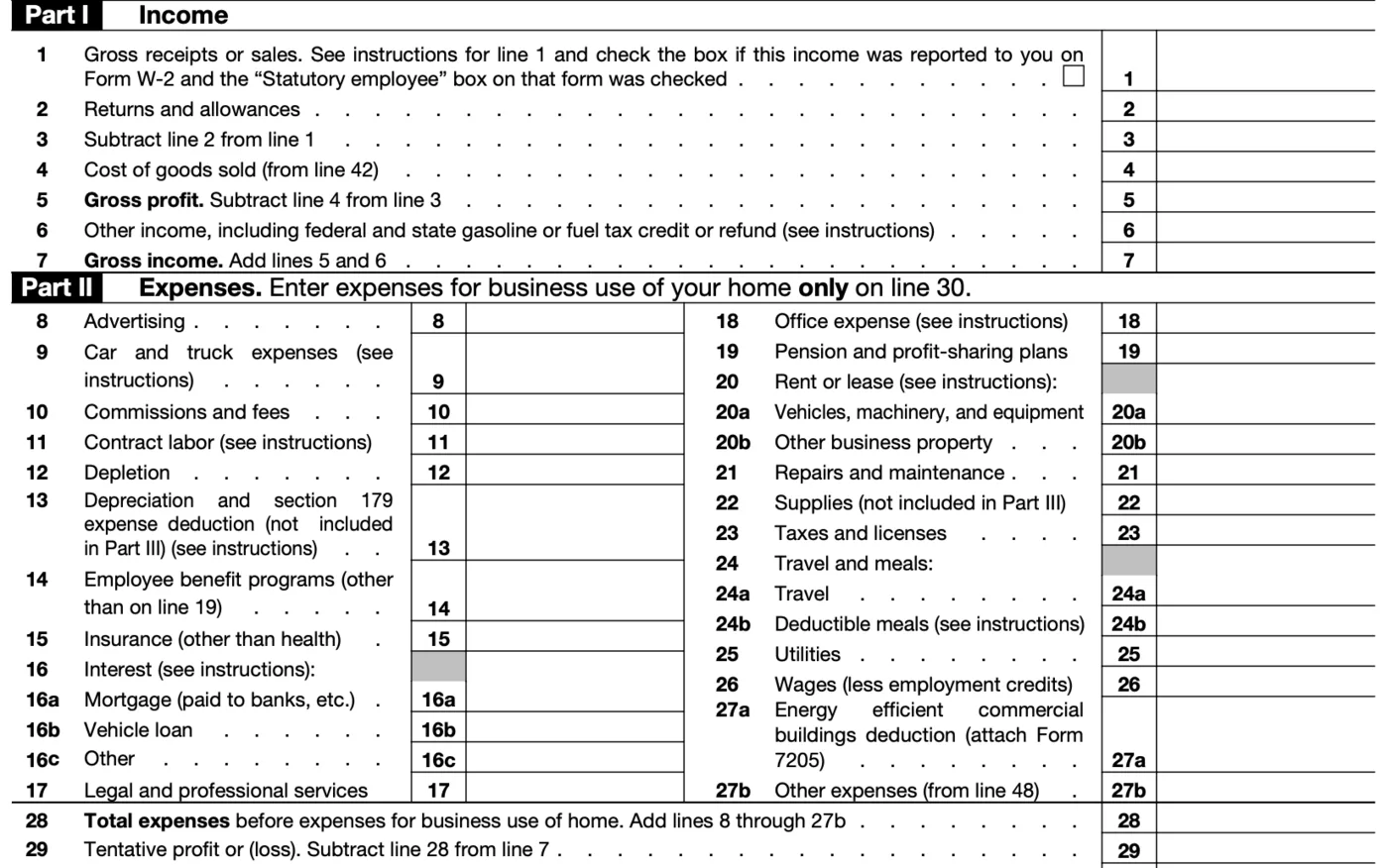
Line 1 is gross receipts for the whole business, so it also takes sales that appear on no form: cash at a show, Zelle, a platform where you stayed under the threshold. The IRS page on what to do with Form 1099-K says to use your books and records to report all gross receipts. Type those sales in the last field and the calculator adds them to line 1.
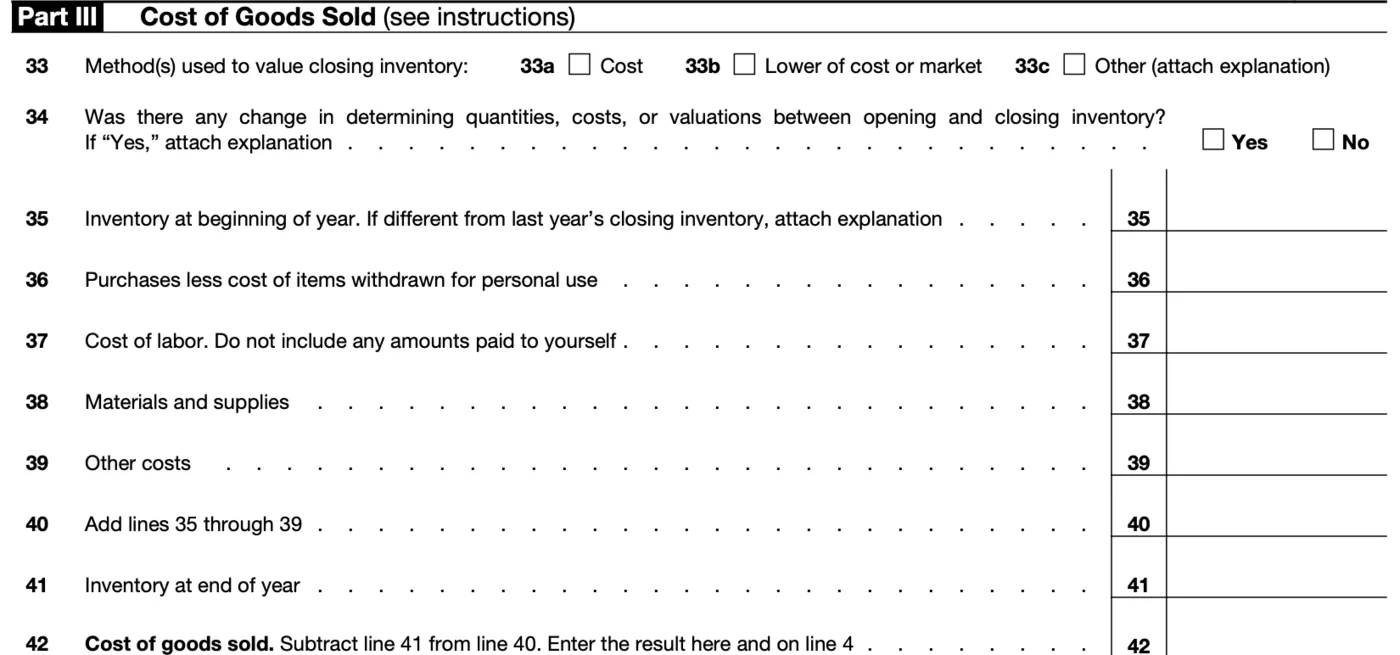
Line 2 is for refunds. The instructions define a sales return as "a cash or credit refund you gave to customers" and tell you to enter it as a positive number. Line 4 is cost of goods sold, carried from line 42 of Part III. Part III starts with inventory at the beginning of the year on line 35. Purchases, less cards withdrawn for personal use, go on line 36 and other costs on line 39. Inventory at the end of the year, line 41, comes off. The year-end inventory count guide covers the two inventory numbers.
Fees go on line 10. The instructions tell a dealer in property to enter there "the commissions and fees you paid to facilitate the sale of that property." The IRS names no line for postage on cards you sold. This calculator lists it in Part V, which carries to line 27b. That is a common treatment, not an IRS rule. The instructions also mention "office supplies and postage" under line 18, so some preparers use that line. Either way it is deducted once. Pick one place and keep it the same each year.
What goes in the "not business income" field?
Money on the form that was never a business sale. The IRS lists personal payments from family or friends, such as gifts or reimbursements, and personal items sold at a loss. A transfer between your own accounts that a payment app counted as a payment belongs here too.
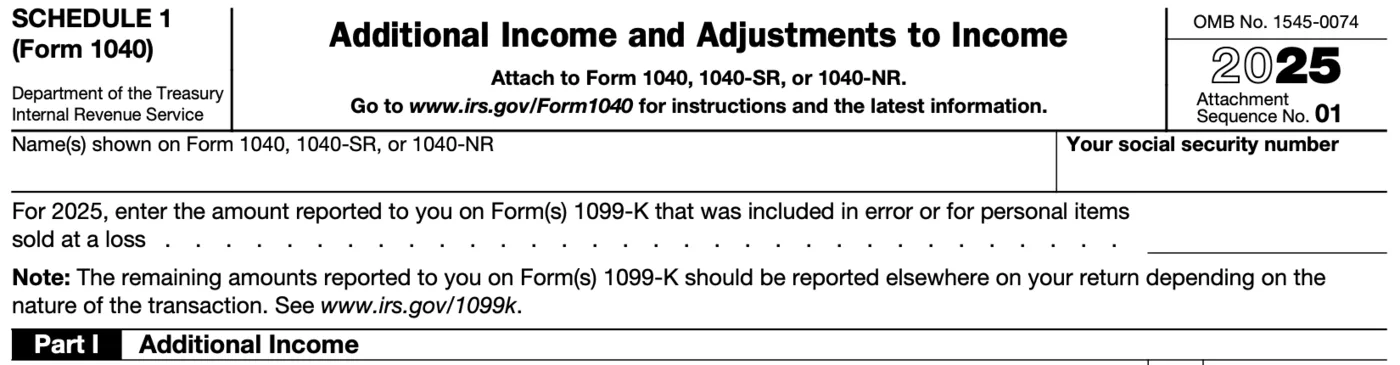
The IRS tells you to ask the issuer for a corrected form first, and not to wait on it to file. Its page adds: "Don't contact the IRS. We can't correct your Form 1099-K." If no corrected form comes, the 2025 Schedule 1 has an entry space at the top. It is for 1099-K amounts "included in error or for personal items sold at a loss." That amount stays off Schedule C.
A personal card sold for more than you paid is different: that gain is taxable and goes on Form 8949 and Schedule D. The IRS says to report a mix of gains and losses separately. Whether your selling is a business at all is covered in hobby or business.
Sales tax inside the gross
Sales tax a marketplace collected from the buyer is not your income, even when a form's gross includes it. Publication 334 warns that a 1099-K "may include items that are not included in your receipts (such as sales tax)." It also says tax you must collect from the buyer and turn over to the state is generally not income.
eBay says its gross already leaves sales tax out. If another platform's report shows tax inside the gross, the calculator has no field for it. Our reading is to keep that tax out of line 1 and keep the report that shows it. It is not a deduction either: the Schedule C instructions bar deducting sales tax imposed on the buyer. Ask your preparer how to show the gap from the form.
The example, worked
The default numbers are an illustration, not a real seller. A part-time dealer gets 1099-K forms from two platforms that add up to $42,600. Inside that total is $1,200 from selling a personal couch and a monitor at a loss through the same payment account.
A YEAR OF ONLINE SALES, WORKED
Two 1099-K forms, one Schedule C.
The form says $42,600. The profit is $5,570, or 13.1% of the form. To see the tax on a profit figure, use the card sale tax calculator.
The largest step is the cost of the cards. It is also the one the platform cannot give you. If you do not know what a card cost, the guide to card sales with no receipts explains what counts as proof. The cost basis calculator splits a lot or a box across the cards in it.
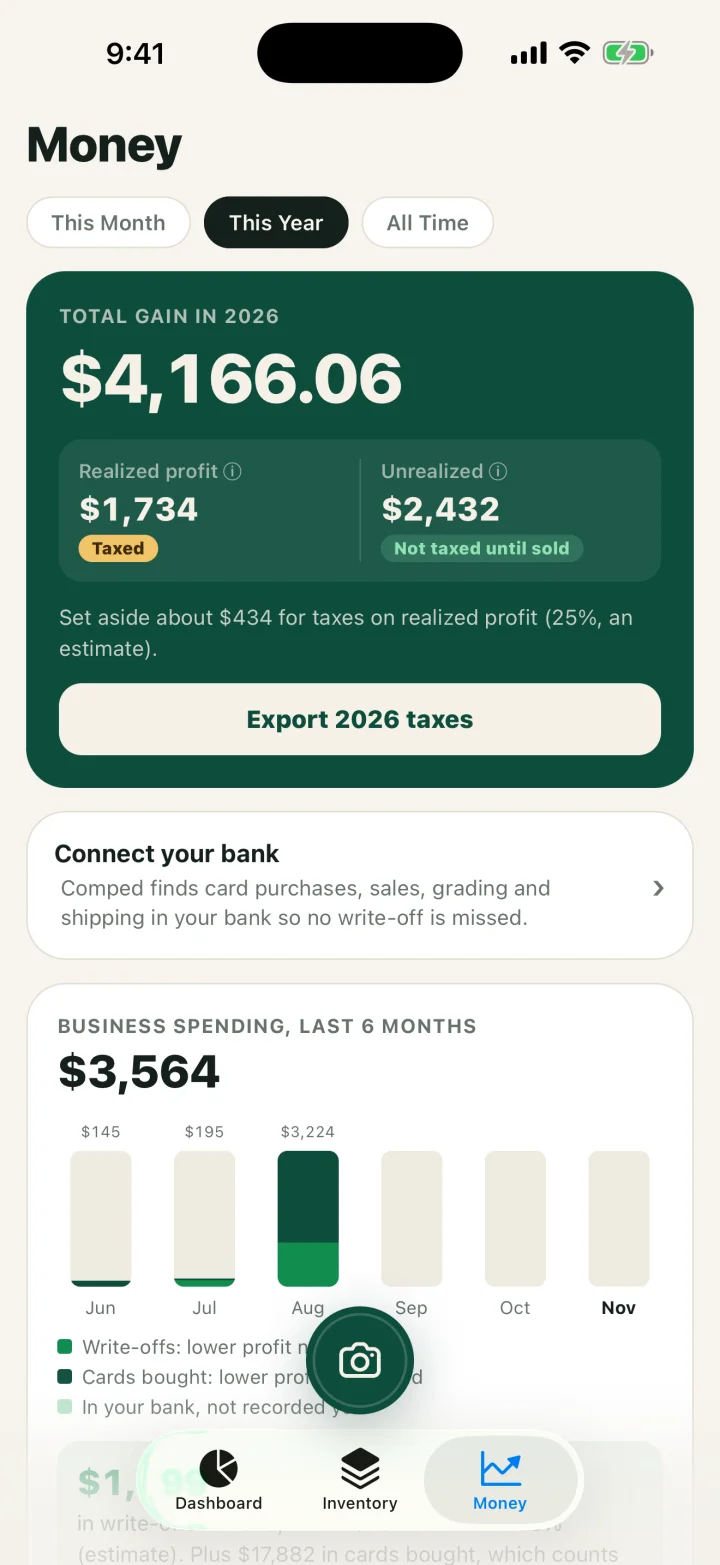
The Money tab in the Comped app keeps the year's running total. Its Export taxes button makes a CSV with a Schedule C style summary, then every sale, card bought and write-off.
Common mistakes and what they cost
The dollar figures use the example above.
- Reporting Box 1a as income. Tax is figured on $42,600 instead of $5,570.
- Deducting everything you bought instead of the cards you sold. Line 4 is the cost of cards sold. Cards still in the case on December 31 are inventory on line 41, not this year's deduction.
- Taking fees off twice. If line 1 is your payouts after fees and line 10 also has the $5,640, profit is understated by $5,640.
- Deducting the shipping buyers paid. The deduction is the $2,140 of postage you bought, not the shipping charges inside the gross.
- Leaving off sales with no form. Show cash and Zelle sales belong on line 1 with the rest.
- Putting personal items on Schedule C. A loss goes at the top of Schedule 1, and a gain goes on Form 8949.
A form can also fail to arrive. The federal test for a marketplace is more than $20,000 and more than 200 transactions, and some states set lower 1099-K thresholds. The threshold is a reporting rule, not an exemption, so sales under $20,000 are still reported.
Related guides
- The Card Vendor's Master Guide to Taxes: the full picture this tool is one piece of.
- The 1099-K for card sellers in 2026: which platforms send the form and when.
- 1099-K thresholds by state: why a form can arrive well under $20,000.
- Whatnot seller statement to Schedule C: finding these numbers in one platform's reports.
- Card profit calculator: the fees on one sale, on 16 channels.
FAQ
Why is my 1099-K higher than my income?
Box 1a is the gross amount buyers paid. The IRS says it is not adjusted for fees, credits, refunds, shipping or discounts, and it does not reflect what you paid for the items. Your income is what is left after those come out on Schedule C.
Do I owe taxes on everything shown on my 1099-K?
No. Tax is figured on net profit, not on Box 1a. Report the gross receipts, then subtract refunds, the cost of the cards sold, fees, postage and other business expenses on Schedule C. In the example on this page, $42,600 on the form comes down to $5,570 of profit.
Does a 1099-K include shipping and fees?
Yes. Shipping the buyer paid and the fees the platform kept are both inside the gross. You deduct the postage you paid and the fees as business expenses. eBay says its form leaves out sales tax and canceled transactions.
Where does cost of goods sold go when I have a 1099-K?
On Schedule C, line 4. The number is figured in Part III, lines 35 to 42: beginning inventory, purchases, other costs, less ending inventory. The 1099-K never shows it, so it has to come from your own records.
Does line 1 have to match my 1099-K?
Line 1 is all gross receipts of the business. It should cover the business part of your forms plus any sales that were on no form. If it is lower than Box 1a because some of the form was personal, the top of Schedule 1 is where that difference is shown.
What if my 1099-K is wrong?
Ask the filer named on the form for a corrected one. The IRS says it cannot correct the form and tells you to file on time even if the corrected form does not come. Keep the platform reports that show the right amount.
I would get a form even though I didn't make money. Do I still report it?
Yes. Report the gross receipts and then the costs. If the costs are larger, Schedule C shows a loss. Leaving the form off the return is what creates a mismatch, because the IRS has a copy.
Does this calculator work out my tax?
No. It stops at net profit. Tax depends on your other income, filing status and state. The card sale tax calculator on this site estimates the federal tax on a profit figure.
SOURCES
- Form 1099-K FAQs: General information, Internal Revenue Service, checked November 13, 2026.
- What to do with Form 1099-K, Internal Revenue Service, checked November 13, 2026.
- Form 1099-K (Rev. December 2026), with Instructions for Payee, Internal Revenue Service, checked November 13, 2026.
- Schedule C (Form 1040), Profit or Loss From Business, 2026, Internal Revenue Service, checked November 13, 2026.
- Instructions for Schedule C (2025), Internal Revenue Service, checked November 13, 2026.
- Schedule 1 (Form 1040), Additional Income and Adjustments to Income, 2025, Internal Revenue Service, checked November 13, 2026.
- Publication 334, Tax Guide for Small Business (for 2025 returns), Internal Revenue Service, checked November 13, 2026.
- Form 1099-K, eBay Customer Service, checked November 2026.
- 1099-K FAQ, TCGplayer Help Center, checked November 2026.
This is general information for card sellers, not tax or legal advice for your situation. Rules change and states differ; a CPA who knows your numbers wins every time.