Who has to register in New Jersey
Anyone who makes retail sales in New Jersey, including sales at flea markets, craft shows or trade shows, is doing business in the state. That is the Division of Taxation's own wording in its promoter and vendor FAQ. It covers a Pennsylvania dealer at one Edison show just as it covers a Cherry Hill shop.
There is no carve-out for occasional sellers. New Jersey law requires all vendors, even seasonal businesses and one-time vendors, to register. The FAQ adds: "There are no special provisions for temporary vendors."
| Who you are | Register on NJ-REG? | What the Division says |
|---|---|---|
| New Jersey dealer with a shop | Already registered | Bulletin ANJ-15 tells a seller with a permanent shop to get a duplicate certificate for a flea market table |
| New Jersey seller who only does shows | Yes | The rules apply whether you sell from shops, at flea markets, at craft shows, by mail or from home |
| Out-of-state dealer at a New Jersey show | Yes | A business from another state coming in for a trade or craft show must register and collect |
| Seller who does one show a year | Yes | Registration is required even if sales are only made occasionally. Mark the business seasonal |
| Hobby seller with a table of priced cards | Yes, in our reading | Only a casual sale is left alone, and the Division's examples are yard sales and classified ads |
| Out-of-state dealer who only buys at the show | No | May buy for resale on form ST-3NR if registered in another state |
A casual sale is an isolated sale of an item you obtained for your own use, by someone not regularly in the business of selling. Our reading is that a table of cards bought to resell is not that. If unsure, ask the Division at taxrevops@treas.nj.gov before the show.
Hobby or business for income tax is a separate question, answered in our guide to taxes on selling sports cards. The state by state guide covers other states.
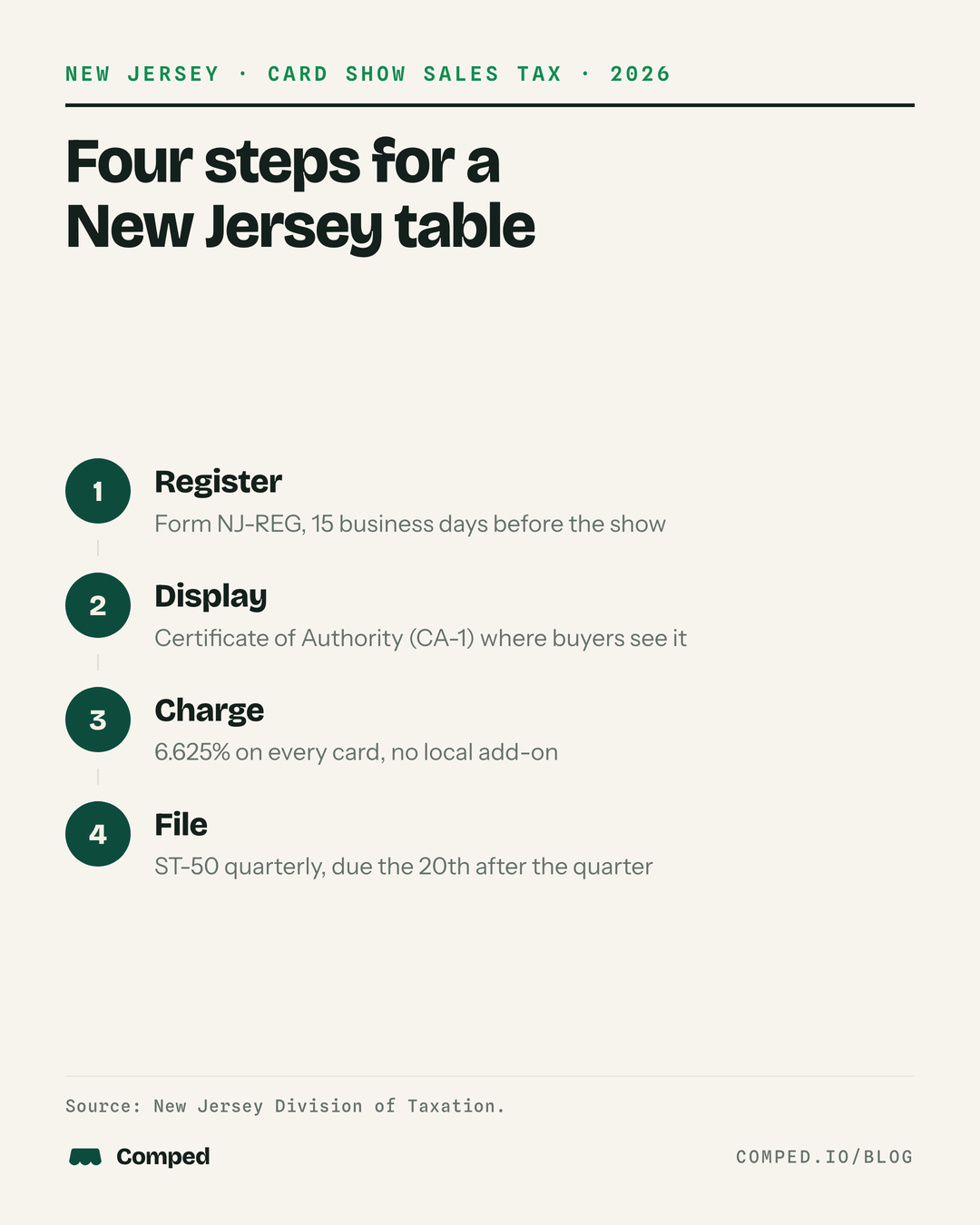
How to register: form NJ-REG
Register with form NJ-REG, the Business Registration Application, at least 15 business days before the show. You file it with the Division of Revenue and Enterprise Services, through its online business registration. The paper form is pages 10 to 12 of the registration packet.
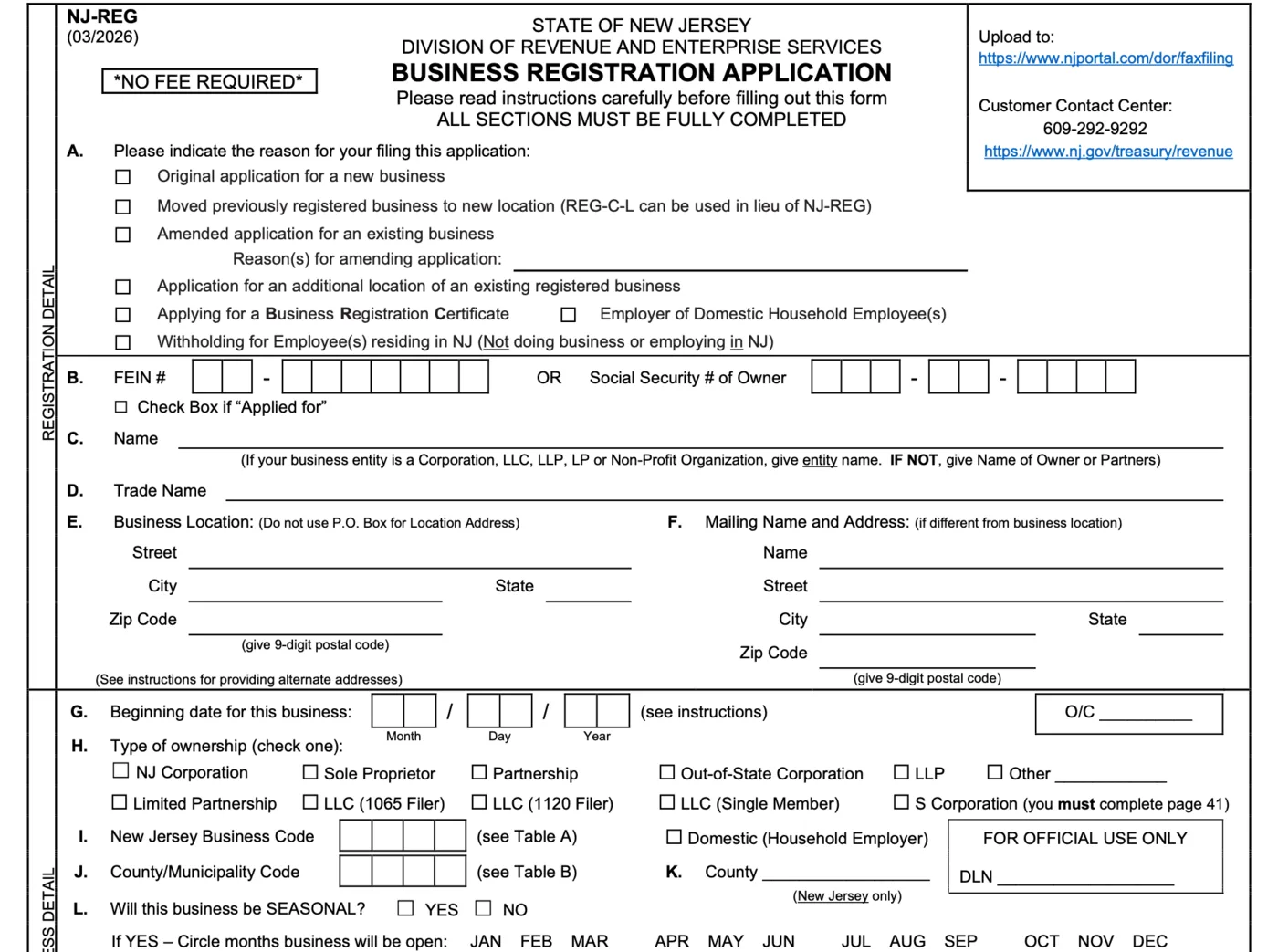
It costs nothing. The form prints "NO FEE REQUIRED" at the top. Forming an LLC or corporation is a separate filing with a $100 fee, and a sole proprietor skips it.
These are the lines that matter for a show vendor.
| Line on NJ-REG | What a show vendor enters |
|---|---|
| A, reason for filing | Original application for a new business |
| B, FEIN or Social Security number of owner | A sole proprietor can use the owner's Social Security number or an FEIN, per the state's Starting a Business guide |
| C and D, name and trade name | Your own name if you are not an entity, then the name on your banner |
| E, business location | A street address. The form says not to use a P.O. box |
| H, type of ownership | Sole Proprietor, LLC (Single Member) or the box that fits |
| I, New Jersey Business Code | A four digit code from Table A in the packet |
| L and M, seasonal | Yes if you sell only in certain months, then circle those months |
| Question 11a | Yes, you will collect New Jersey Sales Tax, and the exact date of your first sale |
| Question 11b | Yes if you will buy inventory tax free. The state then issues resale certificates (ST-3) |
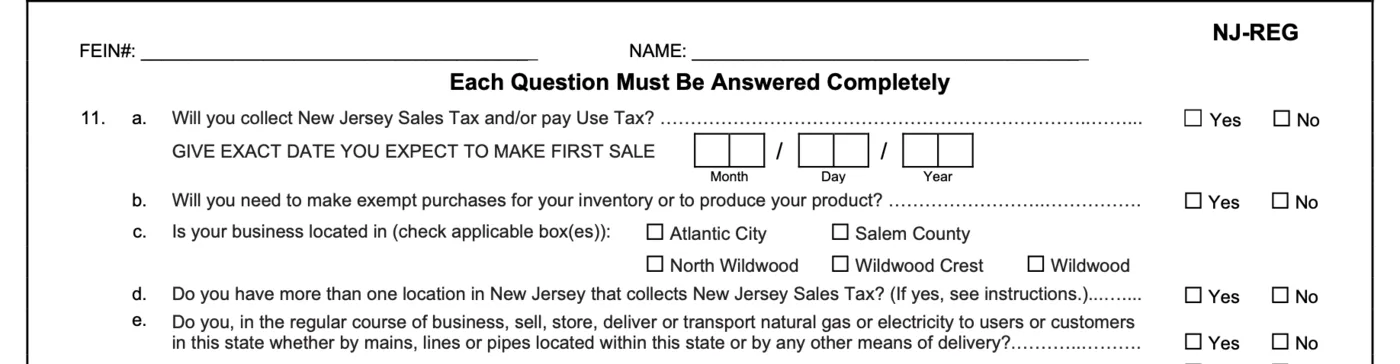
Answering yes to Question 11a is what produces your Certificate of Authority, form CA-1. The FAQ says it is sent to you, or can be printed at the end of the online registration. A Business Registration Certificate can be printed one to two business days after you apply.
State pages differ on the lead time. The FAQ, bulletin ANJ-11 and the form's instructions say 15 business days. The Division's "Who is a Vendor?" page says 15 days. Use 15 business days, which is three working weeks.
NJ-REG registers the business, not one event. There is no per-show notice for the vendor, so the same certificate goes to every later New Jersey show. That differs from Pennsylvania's 30 day notice and New York's 20 day lead.
What to display at the table
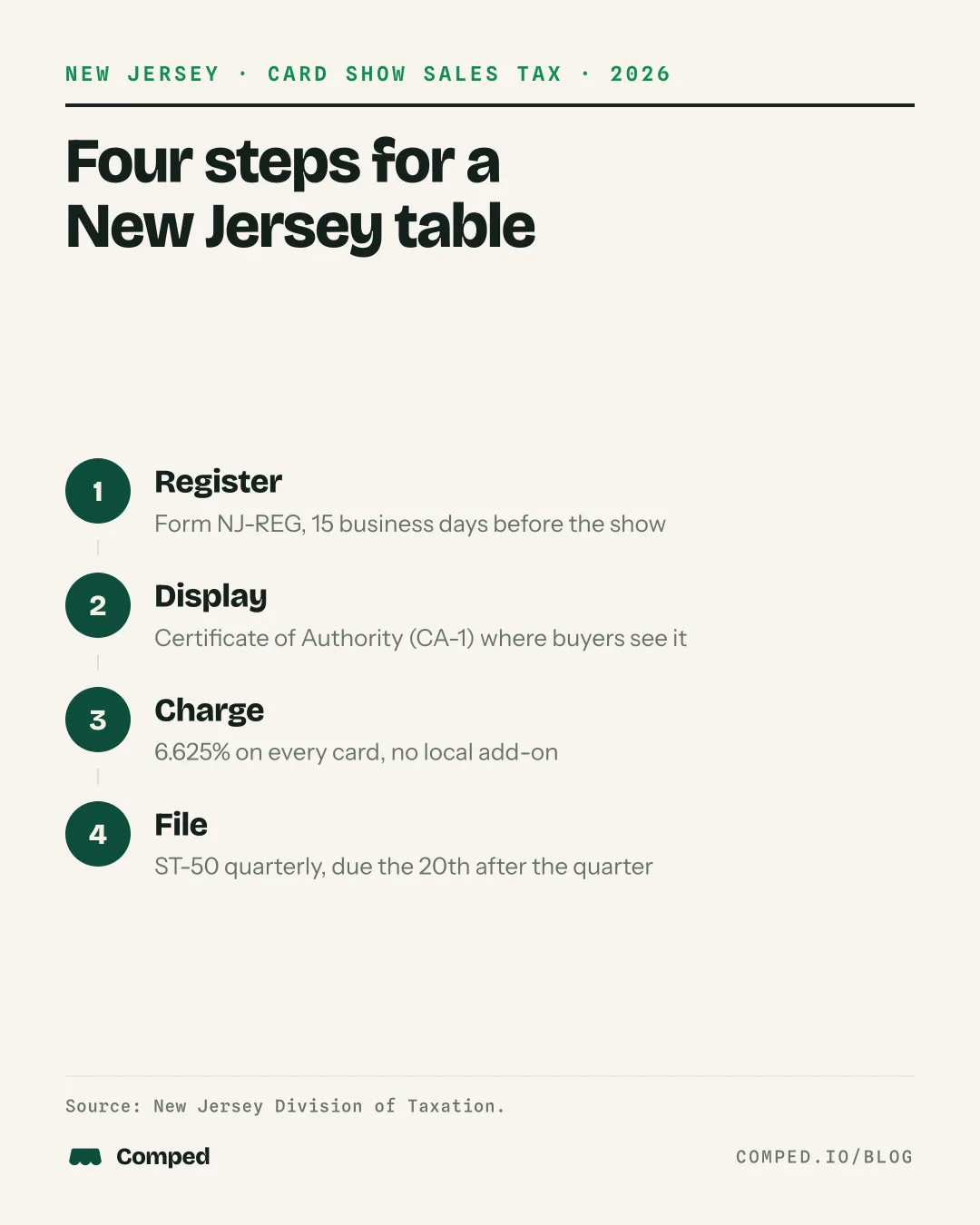
Your Certificate of Authority (form CA-1) must be displayed where your customers can see it at all times. Print it and stand it on the table or tape it to a showcase. Bulletin ANJ-15 says it belongs at the table, stand or vehicle you sell from.
Bring the Business Registration Certificate too. The "Who is a Vendor?" page says you must display both certificates at any event where you sell. The Certificate of Authority cannot be transferred to another seller.
What rate to charge
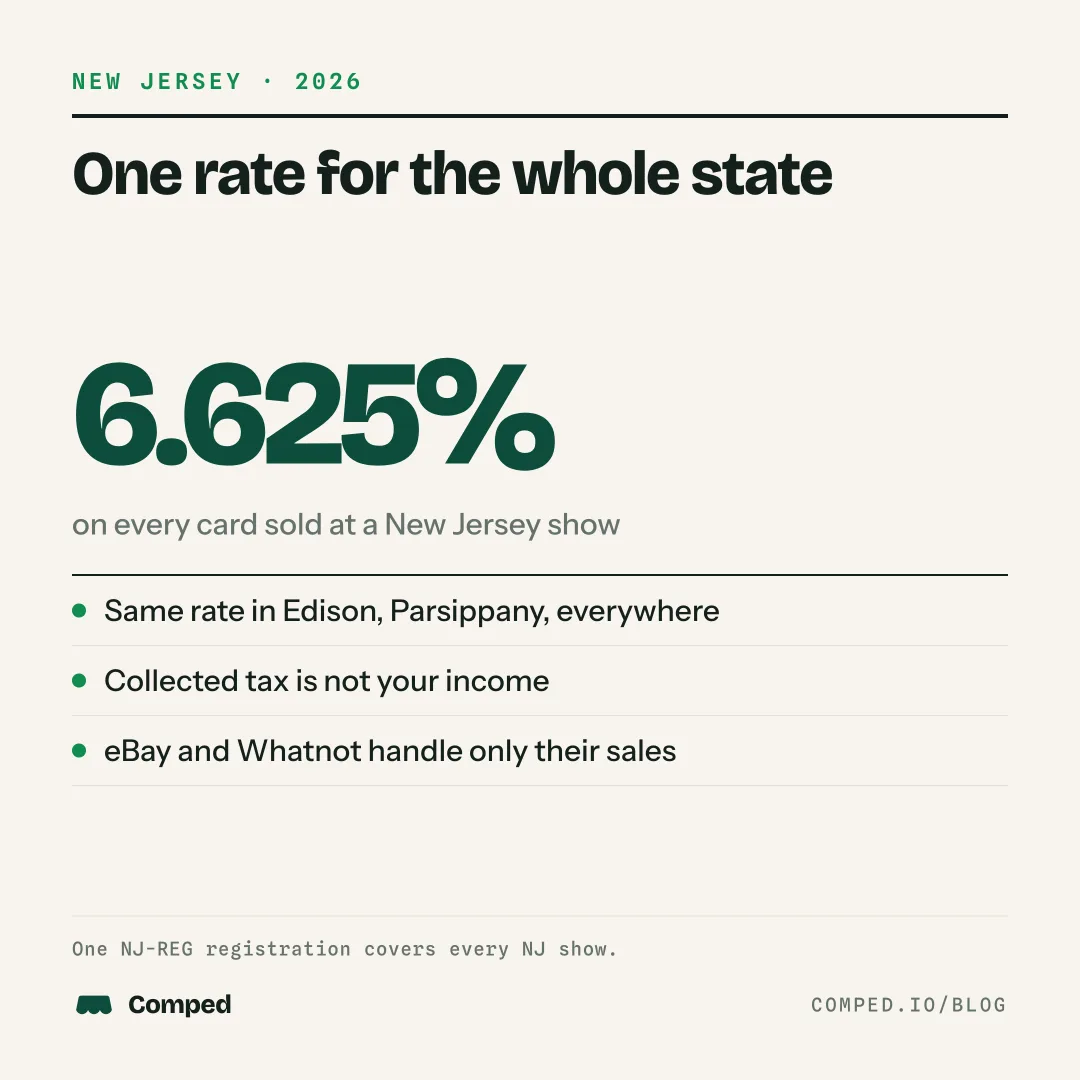
Charge 6.625% on every card, slab, box and supply you sell at the table. That is the statewide Sales Tax rate for 2026. The only local sales taxes the Division names are on certain items in Atlantic City and Cape May County.
New Jersey taxes most tangible personal property unless a law exempts it. We found no exemption for trading cards, so a PSA 10 is taxed like a raw card.
The Division's rule for calculating the tax is to multiply by 0.06625 and work to the third decimal. Round up at half a cent or more. As an example, a $150.00 card is $150.00 x 0.06625 = $9.9375, so you collect $9.94. The state's bracket schedule, form ST-75, is the alternative.
The tax must be shown separately. The New Jersey Sales Tax Guide (S&U-4) says Sales Tax must be separately stated on any sales slip, invoice or receipt.
Two half rates exist. In our reading neither fits a visiting dealer, because the guide ties both to the seller's own place of business.
| Where the show is | What the Division's guide says | Rate at a visiting dealer's table |
|---|---|---|
| Anywhere in New Jersey | Statewide Sales and Use Tax rate | 6.625% |
| Inside an Urban Enterprise Zone | 3.3125% only for a certified zone business, on orders placed in person at its place of business in the zone | 6.625% |
| Salem County | Half rate only from a place of business the seller regularly operates there for retail sales | 6.625% |
| Wildwood, Wildwood Crest, North Wildwood | The 2% tourism tax covers lodging, restaurant food and drink, and admissions | 6.625% |
Atlantic City's luxury tax covers certain rentals, sales and services that the guide does not list. Ask the Division before a show there.
| New Jersey item | Rule for show vendors | Figure |
|---|---|---|
| Sales tax rate | Statewide rate on card sales | 6.625% |
| Registration form | NJ-REG, Business Registration Application, online or paper | No fee |
| Deadline | Before the show, business days | 15 |
| Certificate to display | Certificate of Authority, visible to customers at all times | CA-1 |
| Return | Quarterly, due the 20th of the month after the quarter, zero returns required | ST-50 |
| Monthly payment | Only if you collected more than $30,000 of tax last year and more than $500 that month | ST-51 |
| Late filing penalty | Per month of the tax due, up to 25%. The state may add $100 a month | 5% |
| Interest for 2026 | Prime rate plus 3%, compounded annually | 10.00% |
| Resale certificate | For any buyer registered in New Jersey, which includes you | ST-3 |
| Promoter's vendor list | Sent to the Division before the event, in weeks | 3 |
| Records | Sales records and certificates kept for inspection, in years | 4 |
| 1099-K floor | Platforms report a New Jersey threshold below the federal $20,000 | $1,000 |
The timeline, counted back from show day
Start a month out. The dates below are an example for a show on Saturday, March 13, 2027. Count your own 15 business days, skipping weekends and state holidays.
| When | What you do | Example date |
|---|---|---|
| A month before | Gather your Social Security number or FEIN, a street address and your business code. Form any LLC first | Mid February 2027 |
| 3 weeks before | The promoter's vendor list is due at the Division. Send the promoter your legal name, trade name, tax ID and contact details | February 20, 2027 |
| 15 business days before | Last day to file NJ-REG, by our count | Monday, February 22, 2027 |
| 1 to 2 business days after filing | Print the Business Registration Certificate. Print or wait for the CA-1 | Late February 2027 |
| The week before | Pack both certificates, blank ST-3 forms and a cash log | March 8 to 12, 2027 |
| Show day | Display the CA-1. Charge 6.625%, stated separately. Keep a record of each sale | March 13, 2027 |
| 20th after the quarter | File the ST-50 and pay through the New Jersey Tax Portal | April 20, 2027 |
| Every quarter after | File the ST-50 again, at zero if you had no New Jersey sales | July 20, 2027 |
The card show vendor checklist has the rest of what to pack.
How to file after the show: the ST-50
You file quarterly. The Sales and Use Tax Quarterly Return, form ST-50, is due on or before the 20th of the month after the quarter. That means April 20, July 20, October 20 and January 20. A due date on a weekend or legal holiday moves to the next business day.
Filing is online only. The Division's filing page says to file all Sales and Use Tax returns through the New Jersey Tax Portal. You pay there by e-check, electronic funds transfer or credit card.
A quarter with no sales still needs a return. The page says you must file for each quarter even if no tax is due or no sales were made.
Seasonal registration narrows this. The FAQ says a seasonal business files only for the periods it listed on its registration. That is why lines L and M matter for a vendor with a short show season.
Have four totals ready: gross receipts, receipts not subject to tax, taxable receipts and the Sales Tax due. Count every sale made in the quarter, even one not yet paid for.
Monthly payments apply to very few card vendors. You make one only if you collected more than $30,000 of Sales Tax in the prior calendar year. Even then, it is due only for a month with more than $500 of tax. The portal calls it a Monthly Voucher, and bulletin ANJ-11 calls it form ST-51. $30,000 of tax is about $452,830 of taxable sales.
After a one-off show, returns keep coming due until you end the registration. Bulletin ANJ-13 gives the steps. File a final quarterly return, submit form REG-C-L and send back the certificates.
Comped records each table sale with its price, venue and date, so the quarter's gross sales total is ready when you fill in the ST-50.
Penalties
A late return can cost 5% of the tax due for each month or part of a month, up to 25%. The Division's penalties page says it may also charge $100 for each month the return is late.
Paying late has its own penalty, which may be 5% of the tax due. Interest runs on top at the prime rate plus 3%, compounded annually. Technical Bulletin TB-21(R) sets that rate at 10.00% for 2026. A bill sent to the state's collection agency adds a 9.85% fee.
AN EXAMPLE LATE RETURN, WORKED
An example: $265.00 of tax from one show, filed and paid two months late, at the most the page allows.
Selling without registering can be dealt with on the spot. The "Who is a Vendor?" page says Division staff can make onsite jeopardy assessments of a vendor's operation. The state may seize all available assets to satisfy one. The page names vendors at non-fixed locations who do not register, file or remit.
The Division's pages name no fixed dollar fine for an unregistered table, so we give none. The state may waive part or all of a penalty for reasonable cause. It cannot waive interest.
Buying inventory with a resale certificate
Yes, you can buy inventory tax free once you are registered. Give the selling dealer a completed Resale Certificate, form ST-3, and no Sales Tax is due on that purchase. You then charge 6.625% when the card sells at retail.
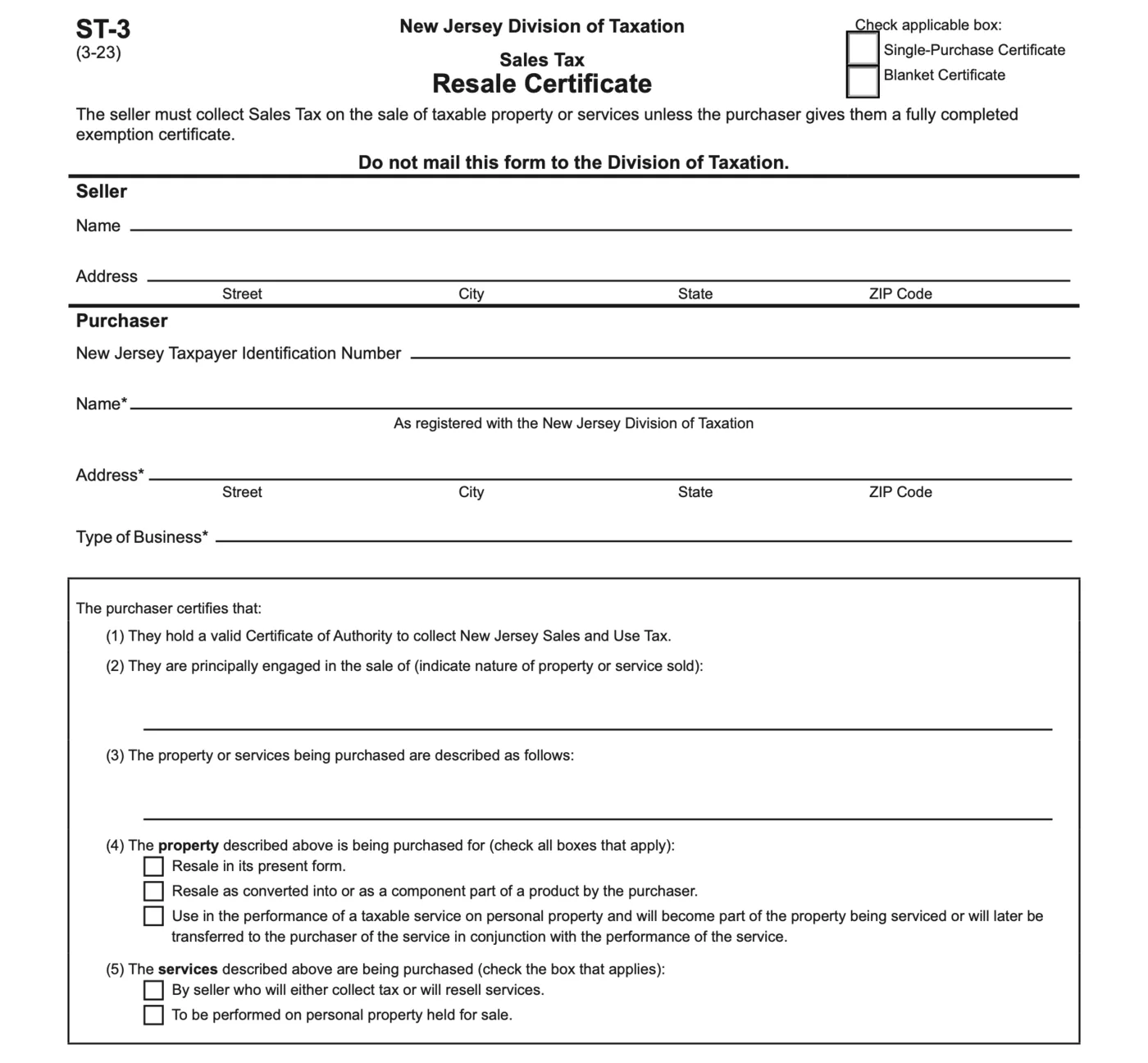
Write your New Jersey taxpayer ID, name, address and type of business. Describe what you are buying, tick "Resale in its present form" and sign.
At your own table it runs the other way. Take a fully completed ST-3 from a dealer buying for resale, within 90 days of the sale. Keep it four years. With no certificate, you collect the tax.
Out-of-state dealers get this wrong. Form ST-3NR says it is only for out-of-state sellers not required to be registered in New Jersey. A dealer with a table at the show must register, so that dealer uses the ST-3. The ST-3NR fits a dealer registered in another state who only buys and carries the cards away.
Most dealer-to-dealer buys at a show are cash with no paperwork. If the other dealer charged you tax, that tax is part of your cost of the card. The cost basis guide covers the receipt that proves a cash buy.
eBay and Whatnot versus your table
eBay has collected and remitted New Jersey sales tax on your eBay sales since May 1, 2019. eBay's marketplace tax page, checked November 13, 2026, says no action is required on your part and that sellers cannot opt out. Whatnot collects where the law requires it.
The Division's remote sellers page agrees: the marketplace facilitator collects and remits on all marketplace transactions.
None of that reaches your table. An in-person sale at a show is yours to tax, collect and remit. The FAQ adds that once you have nexus, your own retail sales delivered to New Jersey are taxable too.
THE RULE MOST VENDORS GET WRONG
Selling online does not make your table legal. eBay and Whatnot collect New Jersey tax on their own sales only. The 15 business day registration clock, the CA-1 at the table and the quarterly ST-50 are all yours the moment you sell face to face.
What the promoter handles
The promoter reports you to the state but does not collect your tax. The Division's promoter page says a promoter or event organizer must send it a list of all vendors at least three weeks before the event. Vendors who sign up later are reported before the event.
For each vendor the list gives the legal and trade name, address, tax ID number, contact details and the items for sale.
The Division checks each name against its registrations. A compliant vendor hears nothing. An unregistered one may be contacted first. If that fails, the Division tells the promoter its staff will visit the show.
A promoter who never asks for your tax ID is a sign of a loose show, not an exemption.
The $1,000 New Jersey 1099-K floor
Platforms report a $1,000 New Jersey threshold. Whatnot's 2026 Form 1099-K page, checked November 13, 2026, lists New Jersey at $1,000. We found no Division page that names a 1099-K figure.
The federal test is more than $20,000 and more than 200 transactions per platform, per the IRS FAQs. The state 1099-K threshold table lists every state.
A 1099-K is a reporting rule, not a tax rule, and you owe income tax on profit either way. The 1099-K guide covers how each platform reports.
A show weekend, worked
Here is an example: a $4,000 weekend at a New Jersey table, at the 2026 rate. You charge 6.625% on each sale and state the tax separately from the price.
AN EXAMPLE $4,000 WEEKEND IN NEW JERSEY, WORKED
Two days at a table, $4,000.00 in card sales, every sale taxed at 6.625%.
The $265.00 was never your money. The Sales Tax Guide says sellers hold collected tax in trust for the state. Profit is the $4,000.00 less the cost of the cards and your show expenses, which the card show profit calculator works out.
If one buyer pays more than $10,000 in cash for a card, Form 8300 is a separate federal duty on top of this.
Common mistakes, and fixing a missed show
Most New Jersey problems come from five habits.
- Registering the week of the show. The lead time is 15 business days.
- Treating one show as exempt. The FAQ says there are no special provisions for temporary vendors.
- Skipping the ST-50 in a quarter with no shows. A zero return is still due, and a late one may cost $100 a month.
- Using form ST-3NR while holding a table. A registered vendor uses the ST-3.
- Quoting one price with no tax line. The tax must be separately stated on the receipt.
The Division publishes no step list for a vendor who already sold without registering, so this is our reading. File NJ-REG now and give the true date of your first sale. File an ST-50 for each quarter since that date and pay the tax on those sales.
Expect interest and the late penalties above, and ask for abatement if you have reasonable cause. The tax now comes out of your margin, and a CPA can tell you how to approach the Division.
Four edge cases come up at tables.
- Cash. Cash sales are taxed like card sales. Under the Division's 2026 rounding guidance, a seller who rounds a cash total to the nickel still remits the full tax on the price.
- Trades. For income tax a trade is a sale at the value of what you receive, and the card trade calculator does that math. We found no Division page on Sales Tax for a card trade, so ask.
- Out-of-state buyers. A card handed over at a New Jersey table is taxed wherever the buyer lives. ANJ-11 says items shipped out of state are generally not taxed.
- Out-of-state dealers. The FAQ says a sole proprietor with New Jersey income files form NJ-1040NR when total income tops $10,000 single or $20,000 married.
A dealer who works several states registers in each. The 2026 card show sales tax index compares them.
New Jersey's recurring shows
New Jersey's regular card shows include the shows at the New Jersey Convention and Expo Center in Edison and the Parsippany shows. The Collector Roadshow is our own show. The same CA-1, the same 6.625% and the same ST-50 cover all of them.
How this looks in the Comped app
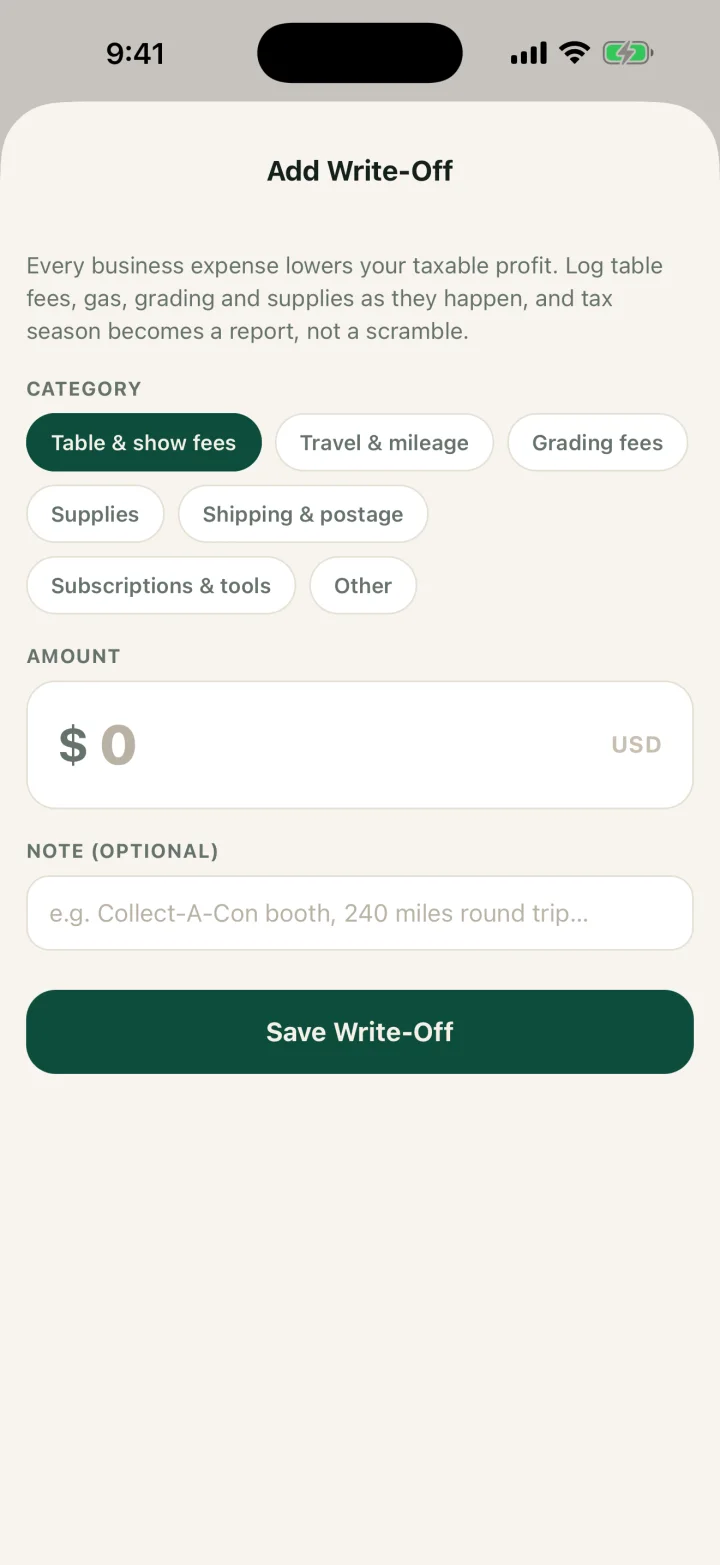
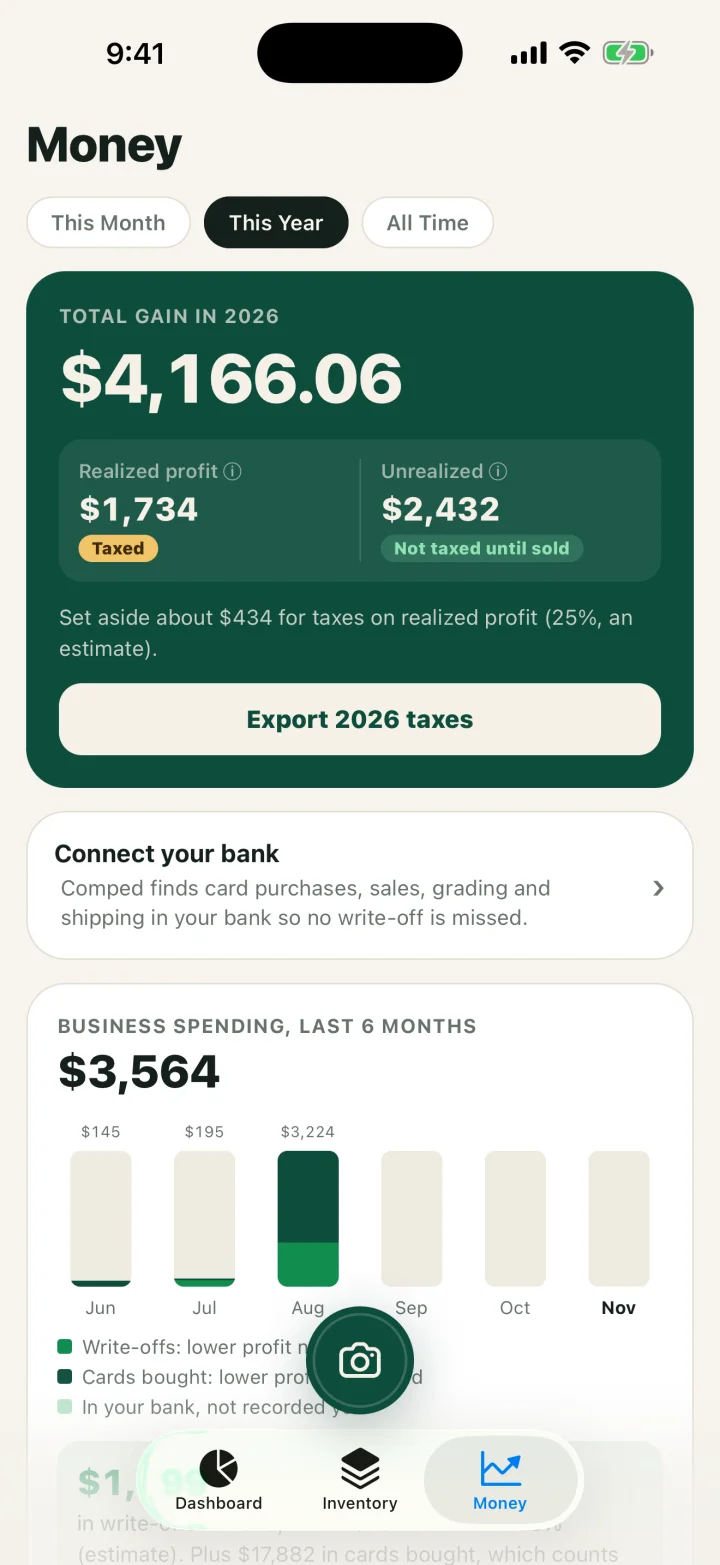
The ST-50 starts from your gross sales for the quarter. In Comped, each sale is its own record with the price, the date and where it sold. The table fee goes in as a write-off, and the Money tab exports the year. The app does not calculate or file sales tax.

Related guides
- State by State: Sales Tax and Show Permits for Card Vendors: every state's permit, rate and rules in one place.
- New York card show sales tax for vendors (2026): the 20 day rule and the $500 per day penalty across the river.
- Pennsylvania card show sales tax for vendors (2026): the Transient Vendor Certificate and the 30 day notice.
- Form 8300 for card dealers: what happens when someone pays $10,000 cash for a card.
FAQ
Do I need a permit to sell at a single card show in New Jersey?
Yes. New Jersey requires all vendors, even one-time vendors, to register on form NJ-REG at least 15 business days before the show. The Division of Taxation says there are no special provisions for temporary vendors. The Certificate of Authority you receive also covers every later New Jersey show.
How much does a New Jersey Certificate of Authority cost?
Nothing. Form NJ-REG is printed with the words NO FEE REQUIRED, and the Certificate of Authority comes from that registration. Forming an LLC or corporation is a separate filing with a $100 fee, which a sole proprietor does not need.
How long does it take to get the certificate?
The state asks for the registration at least 15 business days before your first sale. Its vendor FAQ says the Certificate of Authority is sent to you or can be printed at the end of the online registration. A Business Registration Certificate can be printed one to two business days after you apply.
Do I charge sales tax on cash?
Yes. The 6.625% applies to every retail sale at the table whether the buyer pays cash, card or an app. The tax is figured on the price you actually charge. If you round a cash total to the nearest nickel, you still remit the full tax on the price.
Do I have to file an ST-50 if I had no sales?
Yes. The Division says you must file a return for each quarter even if no tax is due or no sales were made. A seasonal business files only for the periods it listed on its registration. To stop the returns for good, you end the registration with form REG-C-L.
Does the promoter collect it for me?
No. In New Jersey the vendor registers, collects and remits. The promoter must send the Division a list of all vendors at least three weeks before the event, with each vendor's tax ID number. The Division uses that list to check who is registered.
I am an out-of-state dealer. Do I use form ST-3 or ST-3NR?
If you have a table at the show, you are required to register in New Jersey, so you use form ST-3. Form ST-3NR is only for out-of-state sellers who are not registered and not required to register in New Jersey. That fits a dealer who comes only to buy.
Does eBay handle all of my sales tax?
eBay collects and remits New Jersey sales tax on sales made through eBay, and has since May 1, 2019. It handles nothing about your in-person sales. Your table is your own registration, your own collection and your own quarterly ST-50.
SOURCES
- Promoter, Event Organizer, and Vendor Frequently Asked Questions, New Jersey Division of Taxation, checked November 13, 2026.
- Who is a Vendor?, New Jersey Division of Taxation, checked November 13, 2026.
- Promoters and Event Organizer Responsibilities, New Jersey Division of Taxation, checked November 13, 2026.
- Form NJ-REG, Business Registration Application and instructions (03/2026), New Jersey Division of Revenue and Enterprise Services, checked November 13, 2026.
- Getting Registered, New Jersey Division of Revenue and Enterprise Services, checked November 13, 2026.
- Arts and Crafts Businesses and New Jersey Sales Tax (ANJ-11, Rev. 5/25), New Jersey Division of Taxation, checked November 13, 2026.
- Flea Markets and New Jersey Sales Tax (ANJ-15, Rev. 10/17), New Jersey Division of Taxation, checked November 13, 2026.
- New Jersey Sales Tax Guide (S&U-4, Rev. 07/22), New Jersey Division of Taxation, checked November 13, 2026.
- Urban Enterprise Zone, New Jersey Division of Taxation, checked November 13, 2026.
- New Jersey Tax Guide: Starting a Business in New Jersey, New Jersey Division of Taxation, checked November 13, 2026.
- Filing and Remitting Sales and Use Tax, New Jersey Division of Taxation, checked November 13, 2026.
- Calculating the Tax, New Jersey Division of Taxation, checked November 13, 2026.
- Cash Transaction Rounding Guidance Due to Penny Supply Changes, New Jersey Division of Taxation, checked November 13, 2026.
- Penalties, Interest, and Collection Fees, New Jersey Division of Taxation, checked November 13, 2026.
- Technical Bulletin TB-21(R), Interest Rate Assessed on Tax Balances for 2026, New Jersey Division of Taxation, checked November 13, 2026.
- Abatement of Penalty, New Jersey Division of Taxation, checked November 13, 2026.
- Form ST-3, Resale Certificate (3-23), New Jersey Division of Taxation, checked November 13, 2026.
- Form ST-3NR, Resale Certificate for Non-New Jersey Sellers (3-17), New Jersey Division of Taxation, checked November 13, 2026.
- Ending Your Tax Registration in New Jersey (ANJ-13, Rev. 10/17), New Jersey Division of Taxation, checked November 13, 2026.
- Remote Sellers, New Jersey Division of Taxation, checked November 13, 2026.
- Taxes and import charges, eBay, checked November 13, 2026.
- 2026 Form 1099-K for U.S. Sellers, Whatnot, checked November 13, 2026.
- IRS issues FAQs on Form 1099-K threshold, IRS, checked November 13, 2026.
This is general information for card sellers, not tax or legal advice for your situation. Rules change and states differ; a CPA who knows your numbers wins every time.