Who needs a license, and which one
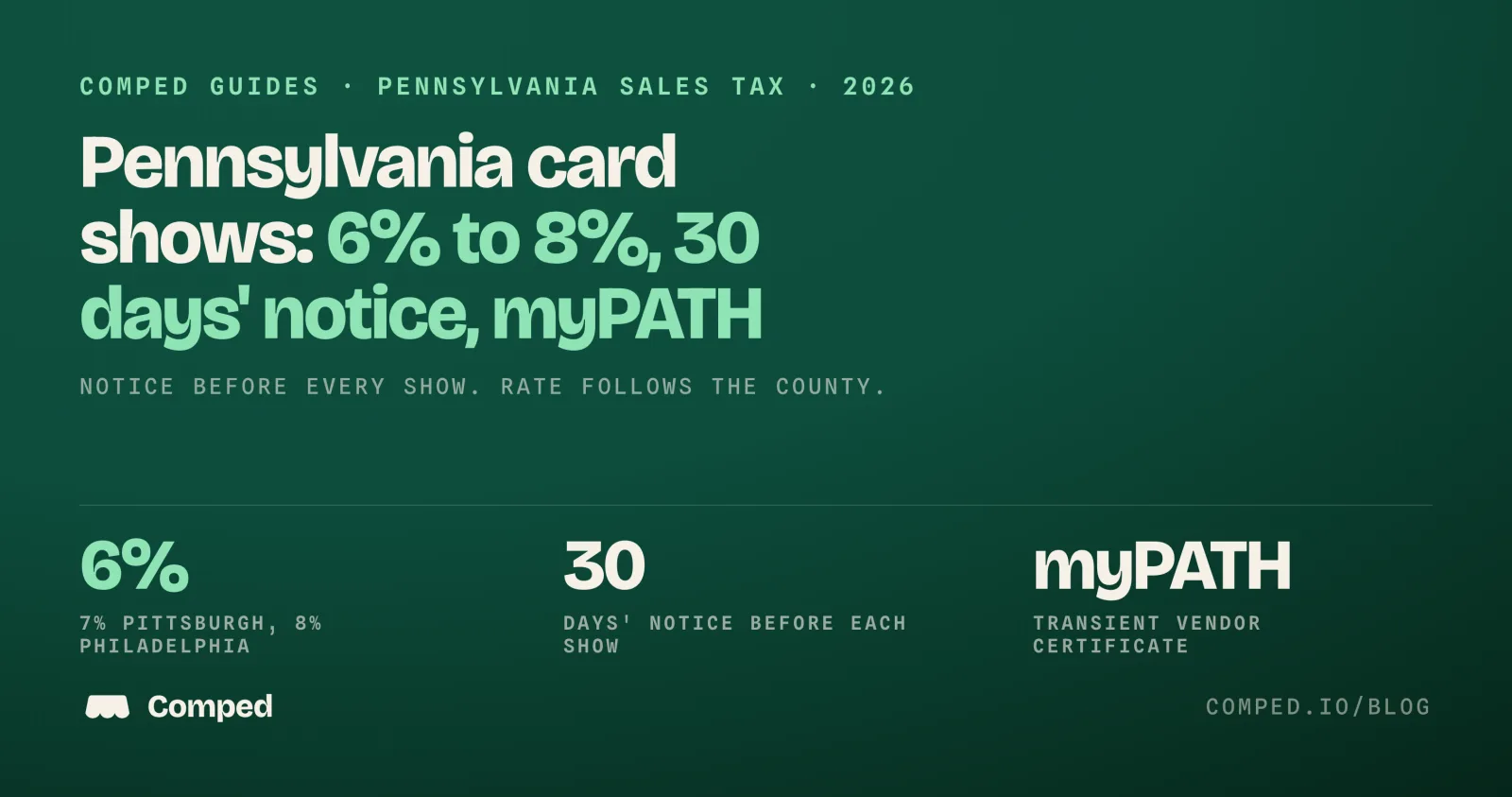
Everyone selling cards at a Pennsylvania show needs a sales tax license, and the kind depends on where your business is based. The Department of Revenue's sales, use and hotel occupancy tax page lists the license types. A business with a Pennsylvania location gets the regular Sales, Use and Hotel Occupancy Tax License. A non-Pennsylvania sole proprietorship or partnership with no permanent location in the state gets a Transient Vendor Certificate.
The statute draws the same line. Section 201(t) of the Tax Reform Code defines a transient vendor as a person who brings taxable goods into Pennsylvania to sell at retail. That person keeps no office, warehouse, "residence from which business is conducted" or other place of business in the state. A Pennsylvania dealer who works from home has that residence, so the regular license applies.
| Who you are | What you hold | 30 day notice and bond? |
|---|---|---|
| Pennsylvania dealer with a shop | Sales, Use and Hotel Occupancy Tax License | No |
| Pennsylvania seller with no shop, working from home | The same license. Our reading of section 201(t): a home you run the business from is a place of business | No |
| Out-of-state sole proprietor or partnership | Transient Vendor Certificate | Yes, both |
| Out-of-state seller who already holds a Pennsylvania sales tax license | That license. The Department says no certificate is needed | Ask the Department |
| Out-of-state LLC or corporation | The Department limits the certificate to sole proprietorships and general partnerships. Confirm the license type with the Department | Ask the Department |
| Anyone selling at one show only | Whichever row above fits. There is no one-show exception | As above |
| Hobby seller thinning a collection | A license. A table beside licensed vendors is not an isolated sale | As above |
The Department's help center backs the one-show row. Its answer "Do I need a Transient Vendor Certificate?" uses a New York seller who works one Pennsylvania show a year. She needs the certificate. Its license chooser limits the certificate to sole proprietorships and general partnerships.
The hobby row is a regulation. The isolated sales rule exempts a one-off private sale. It then removes any sale made on the same premises "in competition with vendors required to collect tax". The Department's yard sale answer says the same about flea markets.
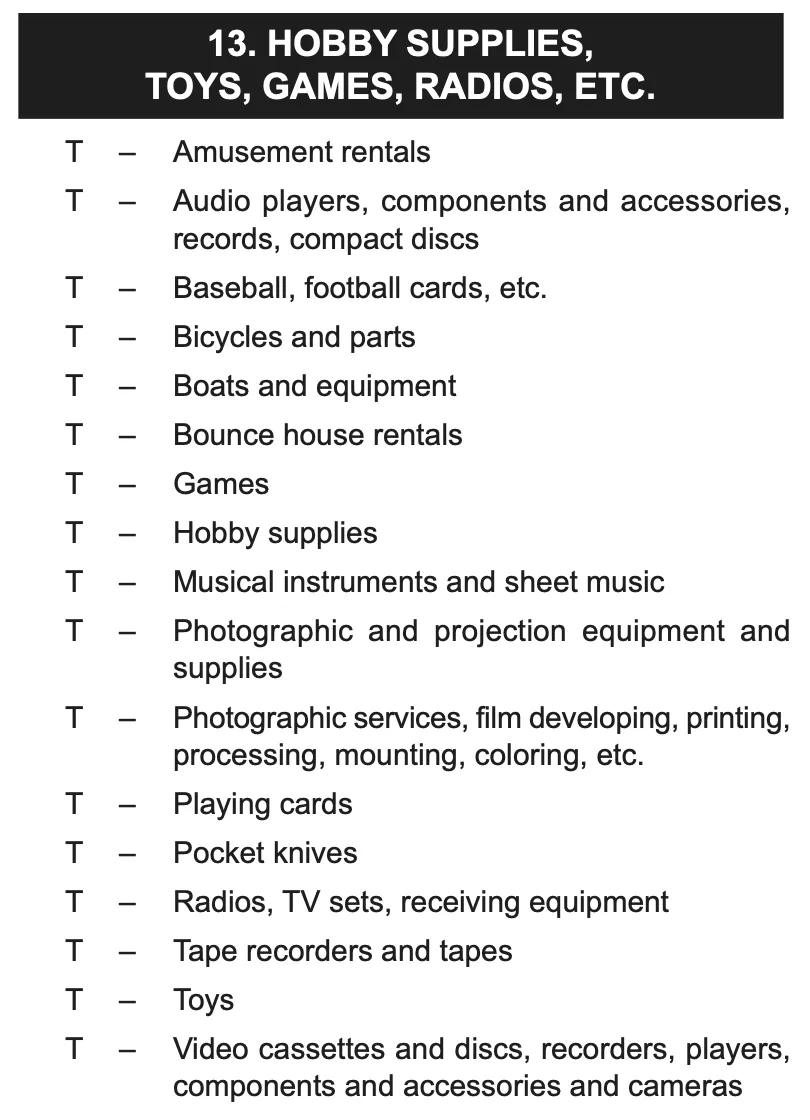
Cards are taxable. The Department's Retailer's Information guide marks "Baseball, football cards, etc." as taxable, and it lists no exemption for slabs.
Hobby or business for income tax is a separate question, covered in our guide to taxes on selling sports cards. The state by state sales tax guide covers every state's table rules.
How to register and the 30 day notice
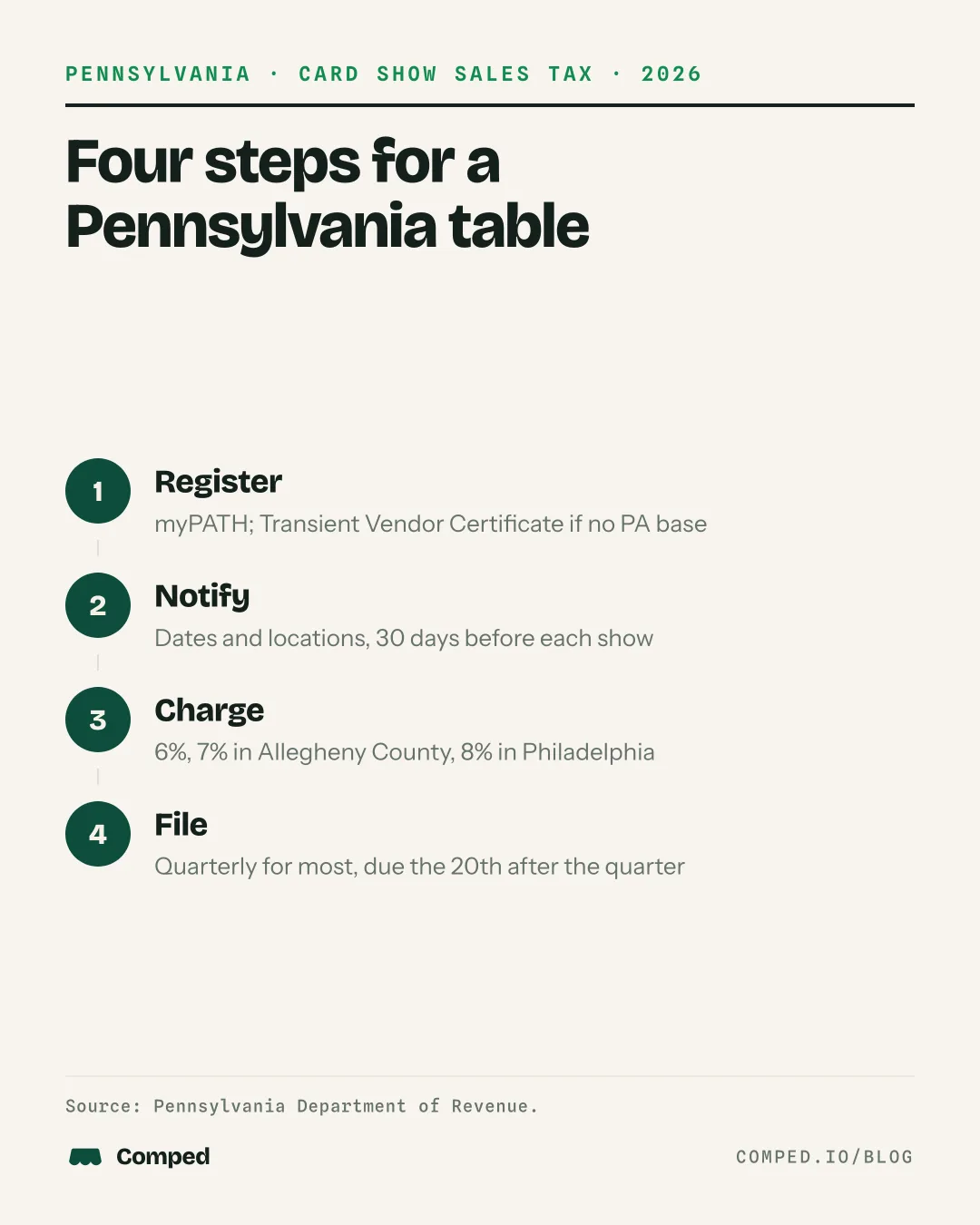
Register online through myPATH, using the Pennsylvania Online Business Tax Registration. One application covers the regular license and the Transient Vendor Certificate. The Department's registration answer gives the steps.
- Open mypath.pa.gov. A new business needs no username or password.
- In the Registration panel, select "Pennsylvania Online Business Tax Registration."
- Select "Business Tax Registration," then Next.
- Enter the business details and choose the license. The Department's list includes "transient vendor certification."
- Select Submit. A saved draft is kept for 30 days.
Lead time is short. The same answer says the license details arrive by email, and by mail within 7 to 10 business days. Older guides name a paper form, PA-100. The Department pages we opened today name only the online registration.
Then comes the notice. The Department's page says that thirty days prior to entering Pennsylvania to conduct business, the certificate holder must notify it of the dates and locations. The notice goes in writing or through the myPATH registration. Email notices to ra-btftregisfax@pa.gov.
The statute itself says only "prior to entering". The notice regulation lists what to send: where you will sell and the approximate dates. Add the county, municipality and street address if known. You may send a year of show dates with your annual application.
No neighbor asks for this. New Jersey wants 15 business days before your first show. New York wants 20 days, once. Pennsylvania wants notice of every show.
Cost, the $500 bond and renewal
Registration is free, and the only money the law asks for up front is a $500 bond from transient vendors. 61 Pa. Code 34.1 says "There is no registration fee" for the sales tax license.
Section 248.1 of the Tax Reform Code makes a transient vendor post a $500 bond as surety. 61 Pa. Code 39.4 lets the Department take a letter of credit or cash instead.
The Department may reduce or drop the bond in two cases. One is 12 months of compliance, reviewed at renewal. The other helps a card show vendor on day one: you give the license number of a promoter who has notified the Department of the show. Ask your promoter for the Promoter License number when you book the table.
The Department's web page does not mention the bond, so the registration will show whether it applies to you. A bond is returned when you surrender the certificate in good standing.
A Transient Vendor Certificate is annual. Under 61 Pa. Code 39.3 certificates expire on the last day of January, and a first certificate runs to the second January after issue. The regular license lasts five years and renews on its own when your returns are current.
What to display at the table
Display the certificate at your table for the whole show. The regulation requires it to be prominently displayed while you sell. Section 248 of the statute adds that you show it on demand to Department employees or any law enforcement officer.
A regular license holder with no shop displays the license on the stand.
The Department can also inspect your records at the table. Section 248.2 names sales receipts and inventory or price lists. A filled-in card show cash log covers the first of those.
What rate to charge, by show city
Charge 6% on every card, slab and box, plus 1% at a show in Allegheny County and 2% inside Philadelphia. Those are the only local sales taxes on the Department's page.
The rate follows the show, not your home address. 61 Pa. Code 60.16 applies the local tax when "the sale originates in a taxable county." A New Jersey dealer at a Pittsburgh table charges 7%.
| Show city | County | 2026 rate |
|---|---|---|
| Oaks, home of the Philly Show | Montgomery | 6% |
| Valley Forge area, King of Prussia | Montgomery | 6% |
| Allentown | Lehigh | 6% |
| Harrisburg | Dauphin | 6% |
| Pittsburgh, and anywhere else in the county | Allegheny | 7% |
| Philadelphia, inside the city limits | Philadelphia | 8% |
The counties come from the U.S. Census Bureau's geocoder, checked November 13, 2026. The Philly Show is held in Oaks, in Montgomery County, so its rate is 6% and not the city's 8%.
Tax is figured on the price you actually charge. 61 Pa. Code 33.2 excludes an on-the-spot cash discount from the taxable price when the receipt shows it. The 2026 card show sales tax index compares every state.
| Pennsylvania item | Rule for show vendors | Figure |
|---|---|---|
| State sales tax rate | Most of the state, including Oaks, Allentown, Harrisburg, Valley Forge | 6% |
| Allegheny County | State rate plus 1% local, Pittsburgh shows | 7% |
| Philadelphia | State rate plus 2% local, inside the city only | 8% |
| Registration | Pennsylvania Online Business Tax Registration, no fee | myPATH |
| License, no PA location | Transient Vendor Certificate, renewed each January | TVC |
| Bond | Transient vendors only. The Department may reduce or waive it | $500 |
| Notice | Days before each show, dates and locations to the Department | 30 |
| Return | Quarterly for new licensees, due the 20th after the quarter | PA-3 |
| On-time discount | 1% of tax collected, capped per quarterly return | $75 |
| Late return | 5% of the tax per month, to a maximum of | 25% |
| Resale certificate | Pennsylvania Exemption Certificate, with your License ID | REV-1220 |
| Remote seller nexus | Pennsylvania sales in the previous calendar year, over | $100,000 |
The timeline, counted back from show day
Start six weeks out, because the 30 day notice sets the pace. The dates are an example for a show on Saturday, March 13, 2027. The return dates come from the Department's 2027 due date schedule (REV-819).
| When | What you do | Example date |
|---|---|---|
| 6 weeks before | Register on myPATH. Ask the promoter for the Promoter License number | Late January 2027 |
| 30 days before | Send the notice of the show's dates and location | By February 11, 2027 |
| 1 week before | Print the certificate. Pack REV-1220 copies and a cash log | March 6, 2027 |
| Show day | Display the certificate. Charge the county's rate. Record every sale | March 13, 2027 |
| 20th after the quarter | File the PA-3 on myPATH and pay | April 20, 2027 |
| Every later quarter | File a zero PA-3 if you had no Pennsylvania sales | July 20 and October 20, 2027 |
| January | Renew a Transient Vendor Certificate before it expires | By January 31 |
The card show vendor checklist has the rest of what to pack.
The PA-3 return after the show, and zero returns
You report the show on the PA-3, the Sales, Use and Hotel Occupancy Tax Return, filed in myPATH. There is no separate event return. The Retailer's Information guide warns that PA-3 forms cannot be downloaded, so file online or by TeleFile at 1-800-748-8299.
New licensees file quarterly, under 61 Pa. Code 34.3. The 2026 REV-819 puts the last 2026 quarter's return on January 20, 2027.
Frequency changes with volume. The Retailer's Information guide sets the bands. Under $600 of tax a quarter but over $300 a year files quarterly. Over $600 a quarter files monthly. $300 or less a year files twice a year. At 6%, $600 of tax is $10,000 of sales.
File every period, even with nothing to report. The Department's page says returns are to be filed whether or not taxable transactions occur. In myPATH, open the Sales and Use Tax account and select "File Now". Answer No to the question about Pennsylvania sales, then submit.
The Department describes Line 1 as total gross sales and Line 2 as net taxable sales. A return filed and paid on time earns a discount of 1% of the tax collected, up to $75 a quarter. myPATH figures it for you.
Comped records each table sale with its price, venue and date, so the period's gross sales by venue are totaled before you open the return.
Penalties, fines and seizure
The law punishes four things: no certificate at the table, selling on a suspended certificate, selling with no license, and late returns. All section numbers below are from the Tax Reform Code.
| What happened | What the law allows | Section |
|---|---|---|
| A transient vendor cannot show a valid certificate on demand | Seizure without a warrant of the goods and the vehicle that carried them | 248.3 |
| Getting seized goods back | Show a valid certificate, or register and post the $500 bond within 15 days | 248.3 |
| No notice, false information, tax not collected, or return not filed | Suspension or revocation of the certificate | 248.2 |
| Selling while the certificate is suspended or revoked | Third degree misdemeanor, fine up to $2,500 for each offense | 248.4 |
| Selling from a place of business with no valid license | Summary offense, fine of $300 to $1,500. Each day is a separate violation | 208 |
| Return filed late | 5% of the tax per month, up to 25%, at least $2, plus interest | 266 |
| Willfully failing to collect, remit or file | Misdemeanor, fine up to $1,000, up to one year in prison, or both | 268 |
| Willful evasion | A penalty of half the tax evaded | 267 |
Section 248.3 calls seized property contraband. The regulations give the Department 30 days to file a forfeiture complaint or return the goods.
Section 208 is written for sellers with a place of business in the state. Our reading is that it reaches transient vendors too, since section 248.5 treats them like in-state vendors.
Buying inventory with a resale certificate (REV-1220)
Yes, a licensed dealer buys inventory tax free by giving the seller a Pennsylvania Exemption Certificate, form REV-1220. Check block 3, "Property will be resold under License ID," and enter your eight digit license number. Tick "blanket" at the top if you buy from that dealer often.
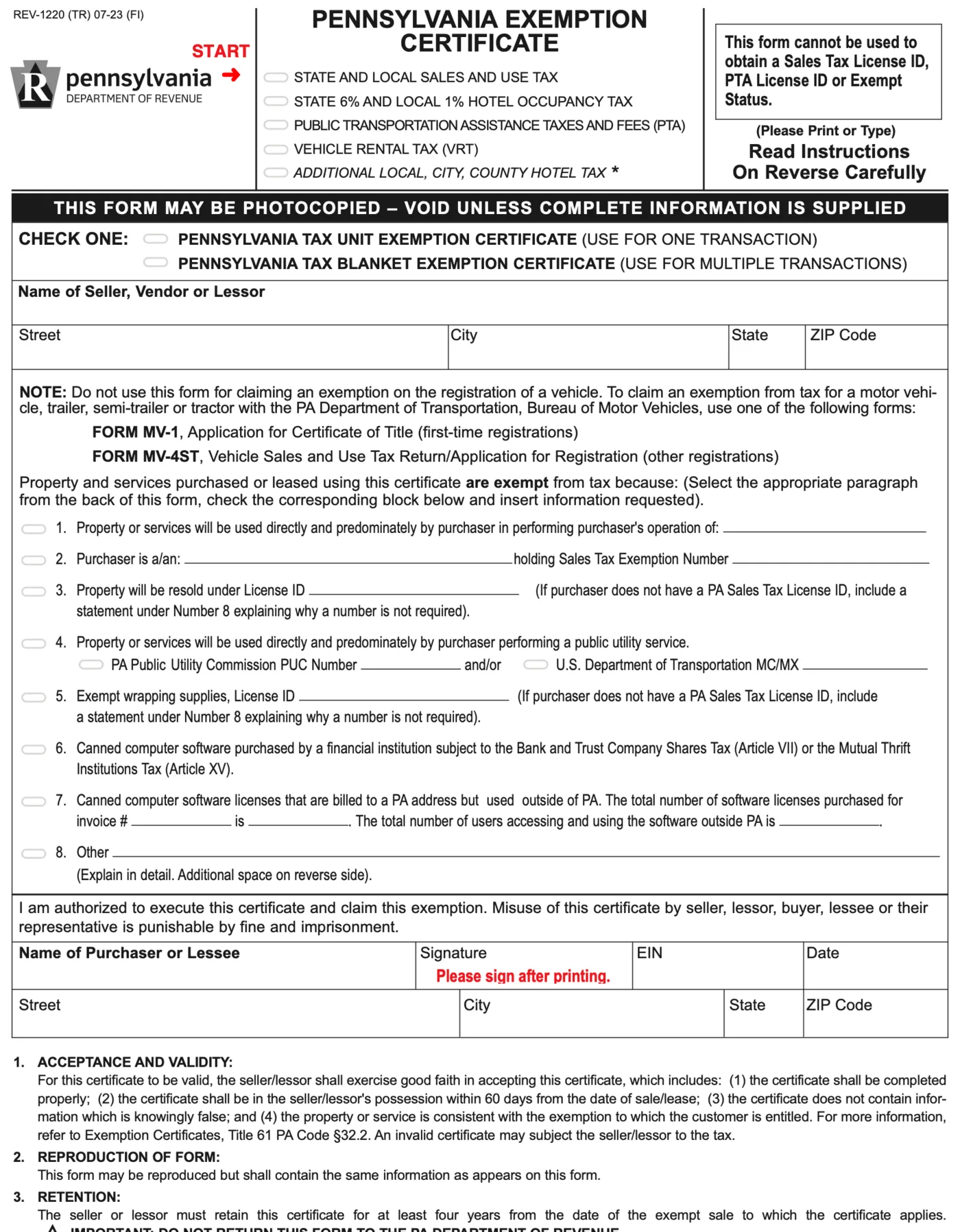
The seller must hold the certificate within 60 days of the sale and keep it at least four years. Nobody sends it to the Department. A buyer with no Pennsylvania license number explains why under block 8. Supplies you use yourself are taxed.
You take certificates too. When another dealer buys from your table for resale, collect a completed REV-1220 or charge the tax.
If you paid Pennsylvania tax on a card and then resold it, the state has a fix. The Department's PA-3 credit answer allows a Taxes Paid/Purchases Resold credit on Line 11. Keep the receipt for three years. Tax you never claim back is part of the card's cost, which the cost basis guide covers.
eBay and Whatnot versus your table
eBay has collected and remitted Pennsylvania sales tax on eBay sales since July 1, 2019, and Whatnot collects where required. You file nothing for those sales. eBay's marketplace tax page lists Pennsylvania with that date, checked November 13, 2026.
The table is yours. Section 208 excuses a marketplace seller from the license only if the seller makes no sales outside the marketplace. One card sold face to face at a Pennsylvania show ends that excuse.
Remote sales are a separate test. The Department's online retailers page sets economic presence at more than $100,000 of Pennsylvania sales in the previous calendar year. Sales a marketplace already taxed do not count toward it.
THE RULE MOST VENDORS GET WRONG
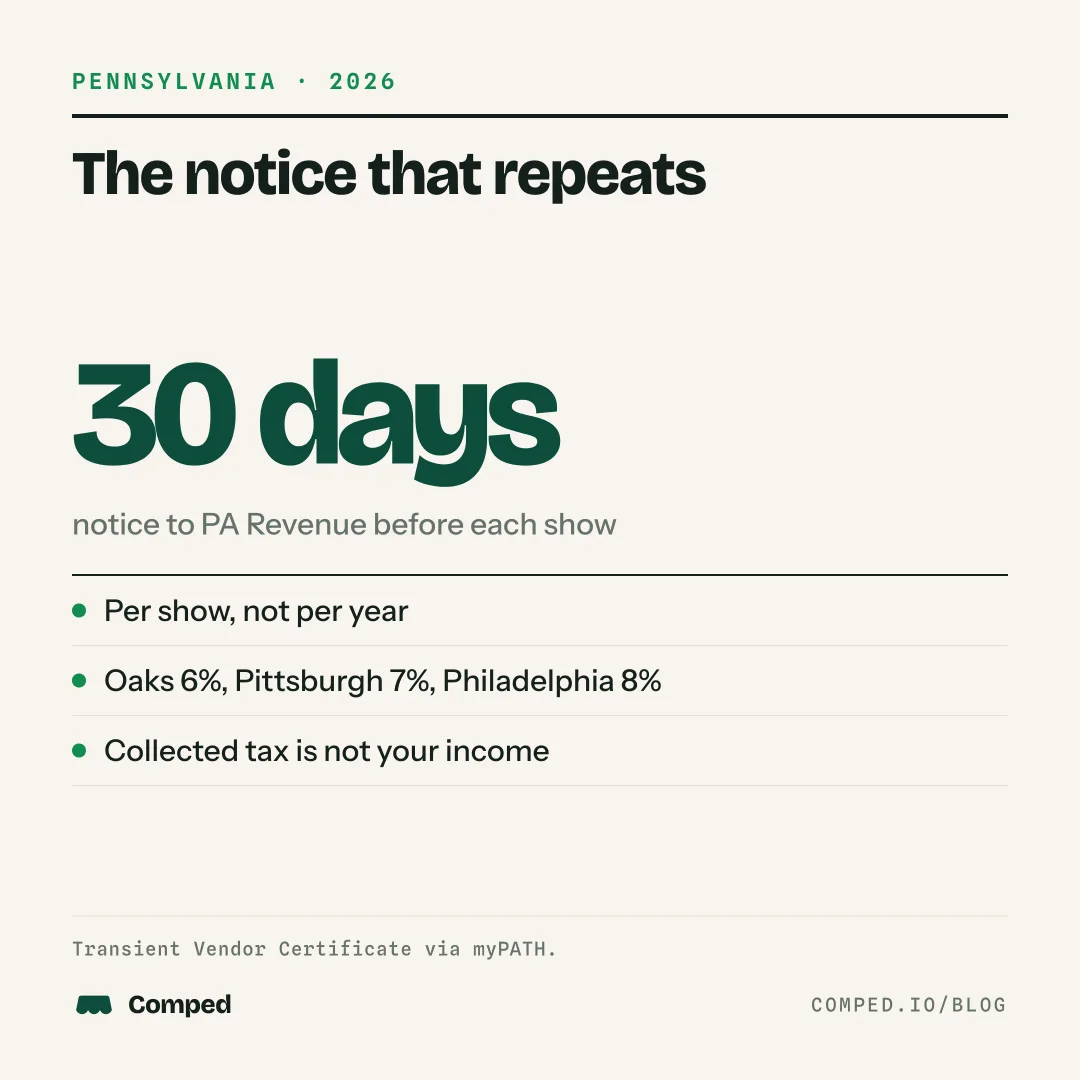
The 30 day notice is per show, not per year. A Transient Vendor Certificate holder tells the Department of Revenue the dates and locations before entering Pennsylvania to sell, every time. Failing to notify is a ground for suspending the certificate. Booking a table three weeks out is already late.
What the promoter handles: the Promoter License
The promoter is licensed too, but never collects or pays your tax. The statute's definition of a show names a "coin show, stamp show, comic book show, hobby show" and any similar event with more than one vendor. The Department's own definition of a promoter adds "card" to that list.
Section 248.6 sets the promoter's duties, which the Department sums up in three lines. The promoter applies each year, at least 30 days before the first show, and the license is issued without charge. No vendor may display or sell unless licensed. Under section 271.1 the promoter records each vendor's name, address and license number, and keeps the list three years.
A promoter who lets an unlicensed vendor sell can lose the license and be refused a new one for up to six months. The promoter files no returns, so your collection and your PA-3 stay yours.
Pennsylvania's 1099-K floor
Pennsylvania has no lower 1099-K threshold of its own, so the federal rule applies. Platforms file a 1099-K when your gross payments exceed $20,000 and your transactions exceed 200 in the year, per platform. The IRS FAQs issued after the July 2025 law set that out.
Pennsylvania is not on Whatnot's 2026 list of states with lower thresholds, checked November 13, 2026. Our 1099-K threshold by state table shows the states that are. You owe income tax on profit whether or not a form arrives, as the 1099-K guide explains.
A show weekend, worked
Here is an example: a $4,000 weekend at a Pittsburgh table, at Allegheny County's 2026 rate of 7%. The same weekend in Oaks would collect $240.00 at 6%, and inside Philadelphia $320.00 at 8%.
AN EXAMPLE $4,000 WEEKEND IN PITTSBURGH
Two days at a table in Allegheny County, $4,000.00 in card sales, every sale taxed at 7%, return filed on time.
The $280.00 was never your money. Collected sales tax is held for the state, not income. Profit is the $4,000.00 less the cost of the cards and your show expenses, which the card show profit calculator works out. A buyer who pays more than $10,000 in cash for one card triggers Form 8300, a separate federal duty.
Common mistakes, and fixing a missed show
Most Pennsylvania problems come from five habits.
- Treating the notice as a yearly task. It is due before each trip.
- Charging 8% at the Philly Show, or your home state's rate. Oaks is 6%.
- Skipping the PA-3 in a quarter with no Pennsylvania show.
- Leaving the certificate at home. That is the trigger for seizure.
- Letting the certificate lapse on January 31.
If you already sold at a Pennsylvania show with no license, the state publishes one route back. Its Voluntary Disclosure Program offers a limited lookback and penalty relief. You do not qualify if you are or were registered, or if the Department has already contacted you. You can apply without giving your name, and the office replies in 1 to 2 business days.
That page warns applicants not to register, file or pay outside the program first. Our reading: choose the route before you open myPATH. If you are registered and missed a return, file it now and pay the tax, additions and interest.
Four edge cases come up at tables.
- Cash. Cash sales are taxed like any other sale and belong in your gross sales.
- Trades. Section 201(g) deducts the value of property "actually taken in trade" from the taxable price. A $500 card sold for $300 cash plus a $200 card is taxed on $300. That is an example. The card trade calculator does the income tax side.
- Selling before the license arrives. The Department's answer on waiting for a license says to carry a copy of the registration. It does not mention transient vendors.
- Several states. A table in each state means a registration in each state.
Pennsylvania's recurring shows
Pennsylvania's regular card shows include the Philly Show in Oaks, the Pittsburgh shows, and the shows in Allentown, Harrisburg and Valley Forge. One certificate covers the year, but each show needs its own notice.
How this looks in the Comped app
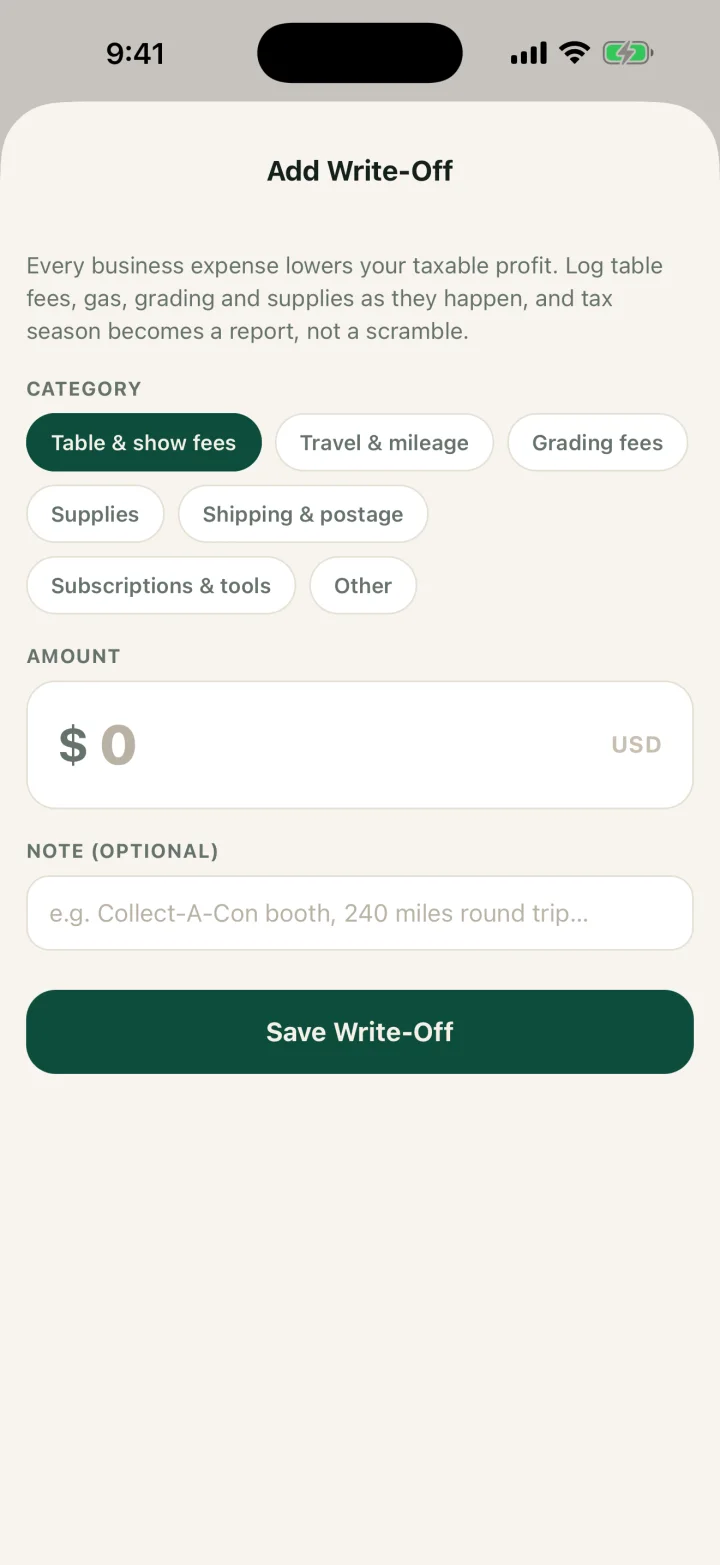
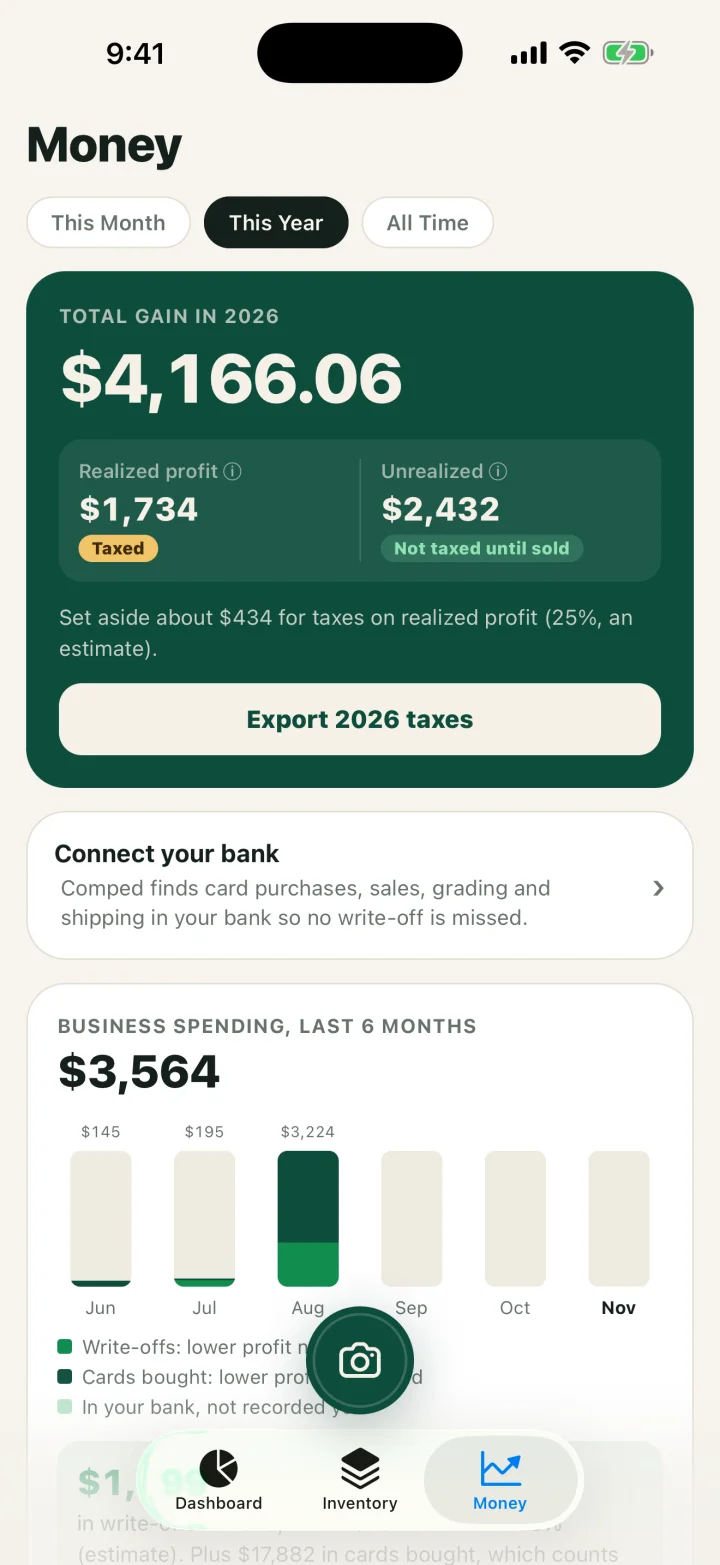
The PA-3 asks for your sales for the period, and that number comes from your sale records. In Comped, each sale is its own record with the price, the date and where it sold. Table fees go in as a write-off, and the Money tab exports the year. The app does not calculate or file sales tax.

Related guides
- State by State: Sales Tax and Show Permits for Card Vendors: every state's permit, rate and rules in one place.
- New Jersey card show sales tax (2026): one 6.625% rate and a 15 business day registration clock.
- New York card show sales tax (2026): the 20 day rule and the $500 per day penalty.
- Form 8300 for card dealers: what happens when someone pays $10,000 cash for a card.
FAQ
Do I need a permit to sell at a single card show in Pennsylvania?
Yes. Pennsylvania has no one-show exception. An out-of-state sole proprietor or partnership registers on myPATH for a Transient Vendor Certificate and gives 30 days' notice of the show. A seller based in Pennsylvania registers for the regular sales tax license.
How much does a Pennsylvania Transient Vendor Certificate cost?
Registration carries no fee. The Tax Reform Code requires a transient vendor to post a $500 bond, and the regulation accepts a letter of credit or cash instead. The Department may reduce or waive it after 12 months of compliance, or when you supply the license number of a promoter who reported the show.
How do I give Pennsylvania the 30 day notice?
Tell the Department of Revenue the dates and locations in writing, or enter them in the Pennsylvania Online Business Tax Registration on myPATH. The Department's page gives the email address ra-btftregisfax@pa.gov for notices. Include the venue, town and county, and send it at least 30 days before you enter the state to sell.
Is the Philly Show taxed at 8%?
No. The Philly Show is held in Oaks, which is in Montgomery County, so the rate is the 6% state rate. The 8% rate applies only to sales inside the city of Philadelphia. Pittsburgh shows are 7% because Allegheny County adds 1%.
Does the promoter collect it for me?
No. A Pennsylvania promoter holds a Promoter License, checks that each vendor is licensed and keeps a list of vendors and license numbers for three years. The promoter files no returns. You collect at the table and you file the PA-3.
Do I charge sales tax on cash and on trades?
Yes on cash. The 6%, 7% or 8% applies to every retail sale whether the buyer pays cash, card or an app. On a trade, the statute deducts the value of the card you take in from the taxable price, so tax applies to the cash difference.
I only sold at one show this year. Do I still file returns?
Yes. Pennsylvania says returns are to be filed whether or not taxable transactions occur in a period. New licensees file the PA-3 quarterly, so a quarter with no Pennsylvania show still gets a zero return in myPATH. The due date is the 20th after the quarter ends.
Can I buy inventory tax-free with a resale certificate?
Yes, once you are licensed. Give the selling dealer a completed REV-1220 with block 3 checked and your License ID, and no tax is due on that purchase. If you paid Pennsylvania tax on a card you later resold, the PA-3 allows a credit for it on Line 11.
SOURCES
- Sales, Use and Hotel Occupancy Tax, Pennsylvania Department of Revenue, checked November 13, 2026.
- Tax Reform Code of 1971, sections 201, 208, 217, 227, 248 to 248.6, 266 to 268 and 271.1 (72 P.S. 7201 onward), Pennsylvania General Assembly, checked November 13, 2026.
- 61 Pa. Code Chapter 39, Transient Vendors (sections 39.1 to 39.12), Pennsylvania Code, checked November 13, 2026.
- 61 Pa. Code 32.4, Isolated sales; 33.2, Purchase price; 34.1, Registration; 34.3, Tax returns; 60.16, Local tax, Pennsylvania Code, checked November 13, 2026.
- Retailer's Information (REV-717, revision 02-26), Pennsylvania Department of Revenue, checked November 13, 2026.
- 2026 Sales, Use and Hotel Occupancy Tax Returns, Tax Periods and Administrative Due Dates (REV-819) and the 2027 schedule, Pennsylvania Department of Revenue, checked November 13, 2026.
- Pennsylvania Exemption Certificate (REV-1220, revision 07-23), Pennsylvania Department of Revenue, checked November 13, 2026.
- Pennsylvania Department of Revenue help center answers: Do I need a Transient Vendor Certificate?, How do I determine which Sales Tax license to apply for?, How do I register for business taxes?, What is a Promoter?, What are the Promoter's responsibilities?, Do I need a sales tax license when I host a yard sale?, Sales and Use Tax return on myPATH, vendor discount, PA-3 credit and selling before the license arrives, checked November 13, 2026.
- Online Retailers Selling Goods and Services to Pennsylvania Customers, Pennsylvania Department of Revenue, checked November 13, 2026.
- Apply for the Voluntary Disclosure Program, Pennsylvania Department of Revenue, checked November 13, 2026.
- Census Geocoder, U.S. Census Bureau, for the county of each show city, checked November 13, 2026.
- Taxes and import charges, eBay, checked November 13, 2026.
- 2026 Form 1099-K for U.S. Sellers, Whatnot, checked November 13, 2026.
- IRS issues FAQs on Form 1099-K threshold, IRS, checked November 13, 2026.
This is general information for card sellers, not tax or legal advice for your situation. Rules change and states differ; a CPA who knows your numbers wins every time.