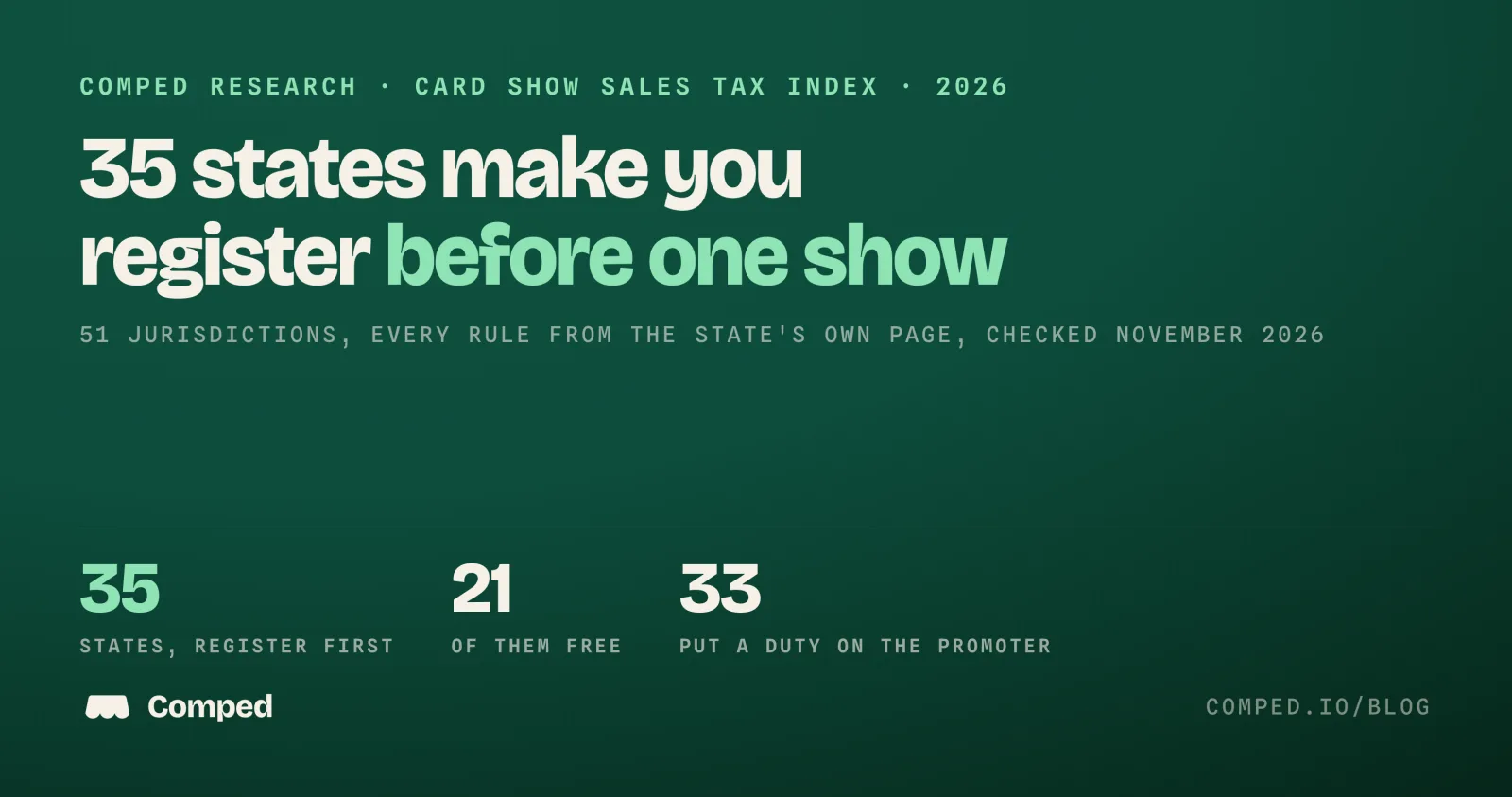
Key findings
- 35 of the 46 states with a sales tax require a card show vendor to register with the state before a single show. In the other 11 an occasional vendor can sell at one show without registering first: KS, KY, MI, SC, SD, VA take a return after the event, AR, MS, NV, OK run the tax through the promoter, and in RI the promoter issues a temporary permit at the show. Each route has limits, such as a number of shows a year or the kind of event, and tax is still owed on every sale. 5 jurisdictions have no state sales tax at all: AK, DE, MT, NH, OR.
- Trading cards are taxable in every state that has a sales tax. No state exempts sports cards or Pokemon cards, graded or raw. Coin and bullion exemptions do not reach them.
- Registering is free in 21 of the 35 states that require it. States that charge: AZ $12, CO $8, CT $100, HI $20, IN $25, OH $50, WI $20, WV $30. 6 states do not print a fee on the page a vendor would use (MO, ND, NJ, NY, PA, WY).
- 7 states set a deadline before the show. ND 30 days, PA 30 days, MO 21 days, NY 20 days, NJ 15 business days, LA 14 days, VT 1 business days. The longest is North Dakota at 30 days.
- In 33 states the promoter has a legal duty too: a vendor list, a report after the show, a licence, or liability for unregistered vendors. In 4 of them the promoter collects the vendors' tax outright. AR, AZ, CA, CO, DC, IA, ID, IL, KS, KY, LA, MA, MD, MN, MS, NC, ND, NE, NJ, NV, NY, OH, OK, PA, RI, SC, SD, TN, TX, UT, VT, WA, WI.
- No state lets a regular show dealer use the occasional-sale exemption. Several write it out explicitly for shows and flea markets. A table at a show is a retail business for that weekend.
- The median state sales tax rate is 6%, from Colorado at 2.9% to California at 7.25%, before local add-ons.
- eBay and Whatnot collect for the seller in 46 of 46 sales tax states under marketplace facilitator laws. The table at the show is the vendor's own job in all of them.
- 19 states still count transactions for remote-seller nexus; the rest use dollars alone, most often $100,000 (27 states).
- 42 of 51 jurisdictions tax card profit as income on top of the federal return. AK, FL, NH, NV, SD, TN, TX, WA, WY do not.
Every jurisdiction at a glance
Each state name links to the full entry in the state guide, with the forms, the rules in the state's own words and the sources.
| State | State rate | Permit for a show | Cost | Notice before show | Promoter duty | Marketplaces collect | Top income rate |
|---|---|---|---|---|---|---|---|
| Alabama | 4% | yes | free | no | yes | 5% | |
| Alaska | none | none | |||||
| Arizona | 5.6% | yes | $12 | yes | yes | 2.5% | |
| Arkansas | 6.5% | no, through the promoter | yes | yes | 3.7% | ||
| California | 7.25% | yes | free | yes | yes | 13.3% | |
| Colorado | 2.9% | yes | $8 | yes | yes | 4.4% | |
| Connecticut | 6.35% | yes | $100 | no | yes | 6.99% | |
| Delaware | none | 6.6% | |||||
| District of Columbia | 6% | yes | free | yes | yes | 10.75% | |
| Florida | 6% | yes | free | no | yes | none | |
| Georgia | 4% | yes | free | no | yes | 5.19% | |
| Hawaii | 4% | yes | $20 | no | yes | 11% | |
| Idaho | 6% | yes | free | yes | yes | 5.3% | |
| Illinois | 6.25% | yes | free | yes | yes | 4.95% | |
| Indiana | 7% | yes | $25 | no | yes | 2.95% | |
| Iowa | 6% | yes | free | yes | yes | 3.8% | |
| Kansas | 6.5% | no, return after the event | yes | yes | 5.58% | ||
| Kentucky | 6% | no, return after the event | yes | yes | 3.5% | ||
| Louisiana | 5% | yes | free | 14 days | yes | yes | 3% |
| Maine | 5.5% | yes | free | no | yes | 7.15% | |
| Maryland | 6% | yes | free | yes | yes | 6.5% | |
| Massachusetts | 6.25% | yes | free | yes | yes | 5% | |
| Michigan | 6% | no, return after the event | no | yes | 4.25% | ||
| Minnesota | 6.875% | yes | free | yes | yes | 9.85% | |
| Mississippi | 7% | no, through the promoter | yes | yes | 4% | ||
| Missouri | 4.225% | yes | not stated | 21 days | no | yes | 4.7% |
| Montana | none | 5.65% | |||||
| Nebraska | 5.5% | yes | free | yes | yes | 4.55% | |
| Nevada | 6.85% | no, through the promoter | yes | yes | none | ||
| New Hampshire | none | none | |||||
| New Jersey | 6.625% | yes | not stated | 15 business days | yes | yes | 10.75% |
| New Mexico | 4.875% | yes | free | no | yes | 5.9% | |
| New York | 4% | yes | not stated | 20 days | yes | yes | 10.9% |
| North Carolina | 4.75% | yes | free | yes | yes | 3.99% | |
| North Dakota | 5% | yes | not stated | 30 days | yes | yes | 2.5% |
| Ohio | 5.75% | yes | $50 | yes | yes | 2.75% | |
| Oklahoma | 4.5% | no, through the promoter | yes | yes | 4.5% | ||
| Oregon | none | 9.9% | |||||
| Pennsylvania | 6% | yes | not stated | 30 days | yes | yes | 3.07% |
| Rhode Island | 7% | no, permit issued at the show | yes | yes | 5.99% | ||
| South Carolina | 6% | no, return after the event | yes | yes | 5.21% | ||
| South Dakota | 4.2% | no, return after the event | yes | yes | none | ||
| Tennessee | 7% | yes | free | yes | yes | none | |
| Texas | 6.25% | yes | free | yes | yes | none | |
| Utah | 4.85% | yes | free | yes | yes | 4.45% | |
| Vermont | 6% | yes | free | 1 business days | yes | yes | 8.75% |
| Virginia | 5.3% | no, return after the event | no | yes | 5.75% | ||
| Washington | 6.5% | yes | free | yes | yes | none | |
| West Virginia | 6% | yes | $30 | no | yes | 4.58% | |
| Wisconsin | 5% | yes | $20 | yes | yes | 7.65% | |
| Wyoming | 4% | yes | not stated | no | yes | none |
How to read the table
Read one row left to right, and it answers the questions in the order a vendor meets them. The state rate is the floor, the permit column says whether paperwork comes before the show, and the promoter column says who else is watching.
- "Yes" under Permit for a show means the state wants a registration in hand before the first taxable sale, even at one show. It does not say how long that takes. The Notice column does, where the state prints a deadline.
- "No" under Permit for a show means an occasional vendor can sell at one show without registering first. It never means no tax. Each of those 11 states has a limit, listed in the next section.
- A blank under Notice means the state page gives no deadline. It does not mean same-day approval. Several states mail the certificate days after an online application.
- "Free" under Cost is the state fee only. A city business licence, a bond or a promoter's own charge can still apply.
- The state rate is not the rate at the table. Most states add county or city tax. North Carolina's state rate is 4.75%, and a Charlotte table charges 8.25% from July 1, 2026.
- "Yes" under Promoter duty is why a promoter asks for your tax number. It rarely means the promoter pays your tax.
- "Yes" under Marketplaces collect covers eBay and Whatnot orders only. It never covers a table.
The index answers "what does this state want before I set up". It does not replace the state's own page, and each state name links to the entry that cites it.
The 11 states where one show needs no registration first
In 11 of the 46 states with a sales tax, an occasional vendor can sell at one show without registering with the state first. Sales tax is still owed on every sale in all 11. They differ only in how the tax reaches the state, and each route has a limit.
Six states take a return after the event. In four the promoter collects the vendors' tax and remits it. In one the promoter issues a permit at the show.
| State | Route | How an occasional vendor pays | The limit |
|---|---|---|---|
| Kansas | Return after the event | Form CTE-50, the Special Event Sales Tax Remittance Return, from the event packet | Four or fewer Kansas events a year |
| Kentucky | Return after the event | Form 30A006, the Temporary Vendor Sales and Use Tax Return | Not regularly engaged in selling at retail, and no permanent place of business |
| Michigan | Return after the event | Form 5089, the Concessionaire's Sales Tax Return | One or two Michigan events a year |
| South Carolina | Return after the event | Form FC-1, the Special Event Return, with the Form FS-152 affidavit, within five days | One special event in 24 months, at a show that charges admission |
| South Dakota | Return after the event | The special event return the organizer hands out, due the 20th of the next month | Ordinary special events; the Sturgis Rally and the State Fair need a temporary license |
| Virginia | Return after the event | Form ST-50, the Temporary Sales Tax Certificate/Return, due the 20th of the next month | Fewer than three Virginia shows a year |
| Arkansas | Through the promoter | Tax and a daily sales report handed to the promoter, who is registered with the state | A special event with a registered promoter, and a vendor with no Arkansas permit |
| Mississippi | Through the promoter | Tax handed to the promoter, who reports it, under the Department's promoted event rule | A flea market, antique mall or promoted event |
| Nevada | Through the promoter | A One-Time Sales Tax Return and the tax handed to the promoter | Up to two Nevada events in 12 months |
| Oklahoma | Through the promoter | A sales tax report and the tax handed to the promoter under its special event permit | A special event with a promoter permit, and a vendor with no Oklahoma permit |
| Rhode Island | Permit issued at the show | A Temporary Sales Permit issued by the promoter, with the tax paid to the promoter at close, under the Division's promoter checklist | A show run by a promoter who holds a Promoter Permit |
Go past the limit and the state's regular registration applies. None of the 11 is a place to sell tax free. Mississippi and Rhode Island are coded with medium confidence, because the state texts are not fully consistent.
Georgia is counted among the 35, with a caveat. A Georgia-based dealer must register for one show. An out-of-state seller whose only Georgia presence is shows, for 5 days or less in 12 months, may skip registration and remit on Form FS-32, as the Georgia page explains.
Tennessee is counted among the 35 too. Its exception is narrow: a seller at one or two temporary events a year with no ongoing retail business. A card dealer who also sells online or from a shop registers for the event.
The map
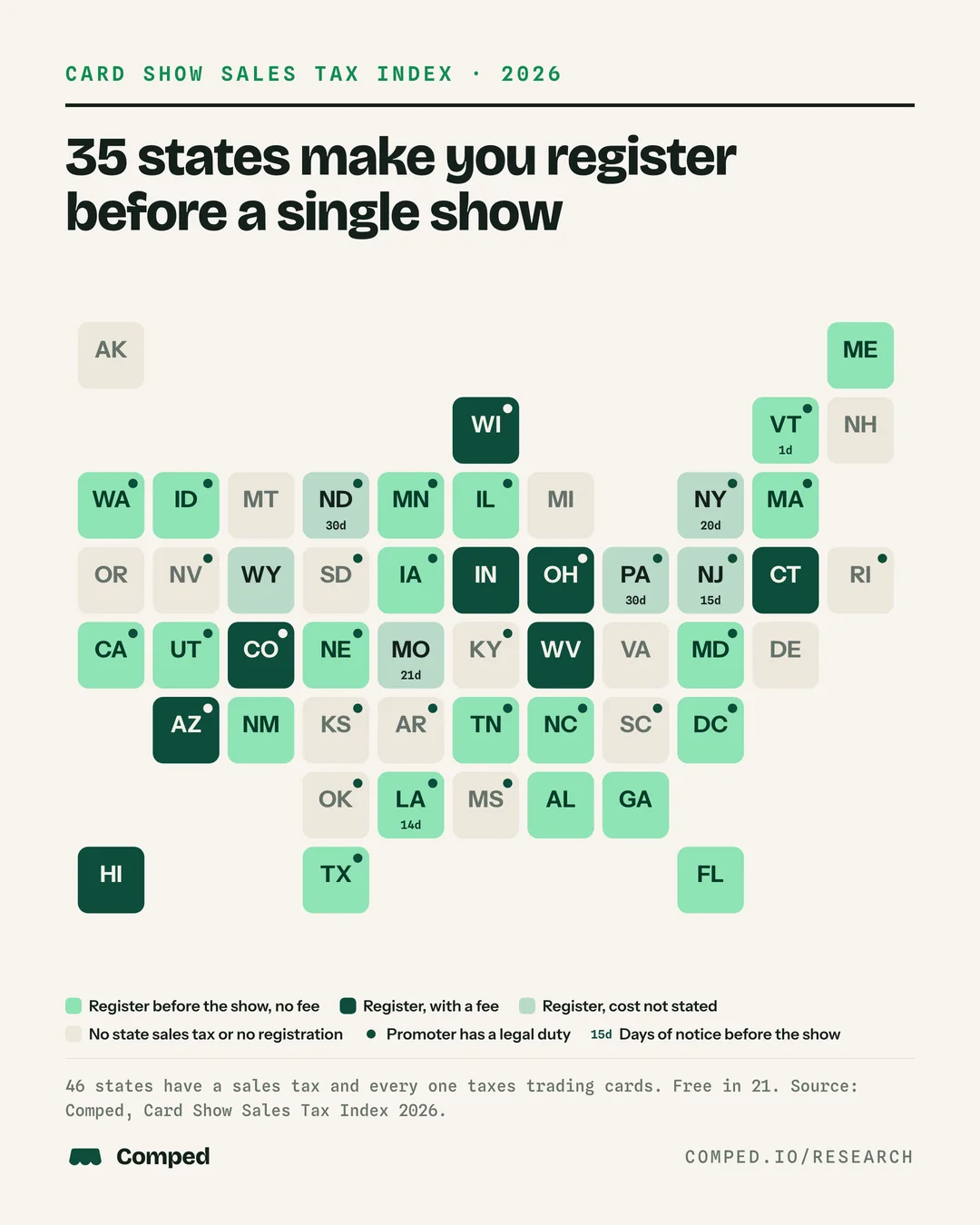
One square per jurisdiction, coloured by what a vendor must do before a show. A dot marks states where the promoter has a duty of their own. A number is the notice the state wants before the show, in days.
What changed on November 13, 2026
On November 13, 2026, every state was re-verified against its own sources. The count of states that require registration before one show went from 43 to 35 of 46. Eight states moved, and no state's tax on cards changed.
The rule for coding a state is now written down. A state counts as "register first" unless the state's own text lets an occasional vendor sell at one show without registering beforehand. Earlier versions counted an after-event return or a promoter's permit as a registration. Neither is one, so those states left the count.
- Return after the event, 6 states. Kansas (four or fewer events a year, Form CTE-50), Kentucky (not regularly engaged in retail and no permanent place of business, Form 30A006), Michigan (one or two events a year, Form 5089), South Carolina (one admission-charging special event in 24 months, Forms FC-1 and FS-152), South Dakota (the organizer's special event return) and Virginia (fewer than three shows a year, Form ST-50).
- Through the promoter, 4 states. Arkansas, Mississippi, Nevada (up to two events in 12 months) and Oklahoma. The promoter collects the vendors' tax and remits it.
- Permit issued at the show, 1 state. Rhode Island, where the promoter issues a Temporary Sales Permit under the Division's promoter checklist.
- Free registration, recounted. Registering is free in 21 of the 35 states that require it.
- Georgia and Tennessee, unchanged. Both stay in the 35. Georgia's exception covers only an out-of-state seller at shows, on Form FS-32. Tennessee's covers only a seller at one or two temporary events a year with no ongoing retail business.
- North Carolina, rate range corrected. Total rates run from 6.75% to 8.25%, not 7.5%. Mecklenburg County added 1% on July 1, 2026. The state rate in the table, 4.75%, did not change.
- Massachusetts, transient vendor note corrected. A person operating under a written agreement with a licensed promoter is outside the transient vendor definition. The coding did not change.
Not changed: 7 states set a deadline before the show, 33 put a duty on the promoter, and 5 jurisdictions have no state sales tax. Earlier versions of this page said 43, and for part of November 13 it said 42. Please cite 35 of 46 with its checked date.
Method and definitions
Each jurisdiction's entry was researched against its department of revenue or taxation website in September and October 2026, with the source pages listed in the state by state guide. Every state was re-verified on November 13, 2026, with the forms, statutes and regulations opened. The structured fields in this index were then coded from those entries by an editor, with the sentence that supports each judgment kept alongside it in the dataset. Trading cards means sports cards, Pokemon and other trading card game cards, raw or graded, sold at retail by a person who sets up at shows with some regularity.
- Permit for a show: the state requires a vendor to hold a sales tax registration, licence or permit (standard, temporary or transient) before making taxable sales at a show, even one show. "No" means the state's own text lets an occasional vendor sell at one show without registering beforehand.
- Cost: the state fee for that registration. Free means the state charges nothing; local business licences and bonds are noted in the guide but not counted here.
- Notice before the show: a deadline the state publishes for registering or notifying the department before an event, in calendar days unless marked business days.
- Promoter duty: the state puts an obligation on the show promoter, such as keeping or filing a list of vendors, holding a promoter licence, verifying vendor certificates, or liability for an unregistered vendor's tax.
- Marketplaces collect: the state has a marketplace facilitator law, so eBay and Whatnot collect and remit on marketplace orders. In-person sales are never covered by those laws.
- State rate: the state-level general sales tax rate, before county and city additions. Combined rates at a given venue are higher in most states.
- Top income rate: the state's highest individual income tax rate, which is what card profit is taxed at after the federal return. None means the state does not tax wage or business income.
Limits: the index records what state pages say, not how often they are enforced. Local permits, home-rule cities and tribal jurisdictions are out of scope. Rates and forms change; the checked date is on every entry and the dataset is re-checked twice a year.
One coding rule matters more than the others. A state counts as "register first" unless the state's own text lets an occasional vendor sell at one show without registering beforehand. A return filed after the event, tax paid through the promoter, and a permit the promoter issues at the show all count as "no". The quoted state text for each is in the dataset.
A state stays "yes" when its easier route covers only a narrow group. Georgia's covers out-of-state sellers only, and Tennessee's covers a seller with no ongoing retail business. Mississippi and Rhode Island are coded "no" with medium confidence, because the state texts are not fully consistent. Where a state page is silent on a point, the field is left blank and not guessed.
How a vendor uses the index
Use it three weeks before a show in a state you have not sold in. The steps below take about ten minutes.
- Find the state's row. If Permit says yes, open the state's entry and register today. If it says no, check the limit in the table of 11 states above.
- Check Notice. Where a number appears, count back from the show's first day. North Dakota and Pennsylvania ask for 30 days.
- Check Promoter duty. If yes, have your tax number ready before you ask for a table.
- Look up the venue's combined rate on the state revenue site. The table shows the state rate only.
- Write the return's due date in your calendar, and plan for zero returns if you registered for one show.
The card show vendor tax checklist carries on from there, through records at the table and the return afterward. The card show profit calculator shows whether a distant show covers its table, travel and hotel.
CITE THIS
Free to quote and reuse with credit to Comped and a link to this page (CC BY 4.0). Suggested citation:
Comped. "Card Show Sales Tax Index 2026." https://www.comped.io/research/card-show-sales-tax-index-2026. Checked November 13, 2026.
Related guides
- State by State: Sales Tax and Show Permits for Card Vendors: the full entry for every jurisdiction, with forms and sources.
- New Jersey, New York and Pennsylvania card show sales tax: the three busiest show states in depth.
- Virginia, North Carolina, Georgia, Michigan and Massachusetts: five more state pages, each with its form.
- Texas, California, Florida, Ohio and Illinois: the other state pages.
- 1099-K threshold by state 2026: the companion dataset for platform reporting.
- Form 8300 for card dealers: the other rule that applies at the table.
- The Card Vendor's Master Guide to Taxes: income tax on the profit, after the sales tax is handled.
FAQ
Can I quote these numbers?
Yes. The findings, the table and the map are free to quote and reuse with credit to Comped and a link to this page. The dataset is published under CC BY 4.0 as CSV and JSON.
Do I need a permit to sell at a single card show?
In 35 of the 46 states with a sales tax, yes, if you are a dealer and not someone clearing out a personal collection once. In the other 11 an occasional vendor can sell at one show without registering first, within limits, and still owes the tax. Registration is free in 21 of the 35.
Which states do not require a sales tax permit for one card show?
Eleven states with a sales tax. Kansas, Kentucky, Michigan, South Carolina, South Dakota and Virginia take a return after the event. Arkansas, Mississippi, Nevada and Oklahoma run the tax through the promoter. In Rhode Island the promoter issues a Temporary Sales Permit at the show. Every route has limits, and all 11 still tax the sales.
Which states have no sales tax at a card show?
Alaska, Delaware, Montana, New Hampshire and Oregon have no state sales tax. Every other state and the District of Columbia taxes trading cards sold at a show.
Why did the headline change from 43 to 35?
Every state was re-verified against its own sources on November 13, 2026. A state now counts as "register first" unless its own text lets an occasional vendor sell at one show without registering beforehand. Eight states left the count. They take a return after the event, collect through the promoter, or issue the permit at the show.
Does the promoter handle sales tax for vendors?
Rarely. In 33 states the promoter has a duty of their own: a vendor list, a licence, checking certificates, or liability for an unregistered vendor. That is why promoters ask for your number. In four, Arkansas, Mississippi, Nevada and Oklahoma, the promoter collects the tax from vendors who have no permit of their own.
Does eBay or Whatnot collecting sales tax cover my show sales?
No. Marketplace facilitator laws cover orders placed through the marketplace. A sale at your table is a retail sale you make yourself, and you collect and remit it under your own registration.
How often is the index updated?
Twice a year, in the fall and the first week of January, plus whenever a state changes a rule that appears here. Each entry carries the date it was checked. The last change was November 13, 2026.
SOURCES
- The state department of revenue and taxation pages listed under each jurisdiction in the state by state guide, checked September and October 2026 and re-verified November 13, 2026.
- Sales Tax License FAQ, Michigan Department of Treasury, and 2026 Form 5089, for Michigan, checked November 13, 2026.
- Form ST-50, Temporary Sales Tax Certificate/Return (Rev. 09/26), Virginia Tax, for Virginia, checked November 13, 2026.
- Special Events, Craft Shows, Trade Shows, Kansas Department of Revenue, and Form CTE-50, checked November 13, 2026.
- 103 KAR 25:060, Temporary vendors and transient merchants, Kentucky, checked November 13, 2026.
- Events and Festivals guide, South Carolina Department of Revenue, checked November 13, 2026.
- Special Events tax fact, South Dakota Department of Revenue, checked November 13, 2026.
- Special Event Sales Tax Info, Arkansas Department of Finance and Administration, checked November 13, 2026.
- Sales Tax Frequently Asked Questions, Mississippi Department of Revenue, with Miss. Admin. Code Title 35, Part IV, 13.05, checked November 13, 2026.
- Guidelines for Promoters and Vendors Participating in One-Time Special Events, Nevada Department of Taxation, checked November 13, 2026.
- Enrolled HB 2289 (2023), amending 68 O.S. 1364.2, Oklahoma Legislature, checked November 13, 2026.
- Show Promoter Checklist, Rhode Island Division of Taxation, checked November 13, 2026.
- Current Sales and Use Tax Rates, North Carolina Department of Revenue, checked November 13, 2026.
- Taxes and import charges, eBay, for the marketplace facilitator coverage, checked October 2026.
- The index dataset (JSON) with the coded fields and the supporting sentence for each, and the CSV.
This is general information for card sellers, not tax or legal advice for your situation. Rules change and states differ; a CPA who knows your numbers wins every time.