Why one show is still taxed
Virginia wrote the answer into a regulation. 23VAC10-210-570 covers people who sell tangible personal property at fairs, flea markets, carnivals and circuses. It says they must hold a certificate of registration, collect the tax and remit it. For an occasional vendor, Form ST-50 in the next section is that certificate and the return in one.
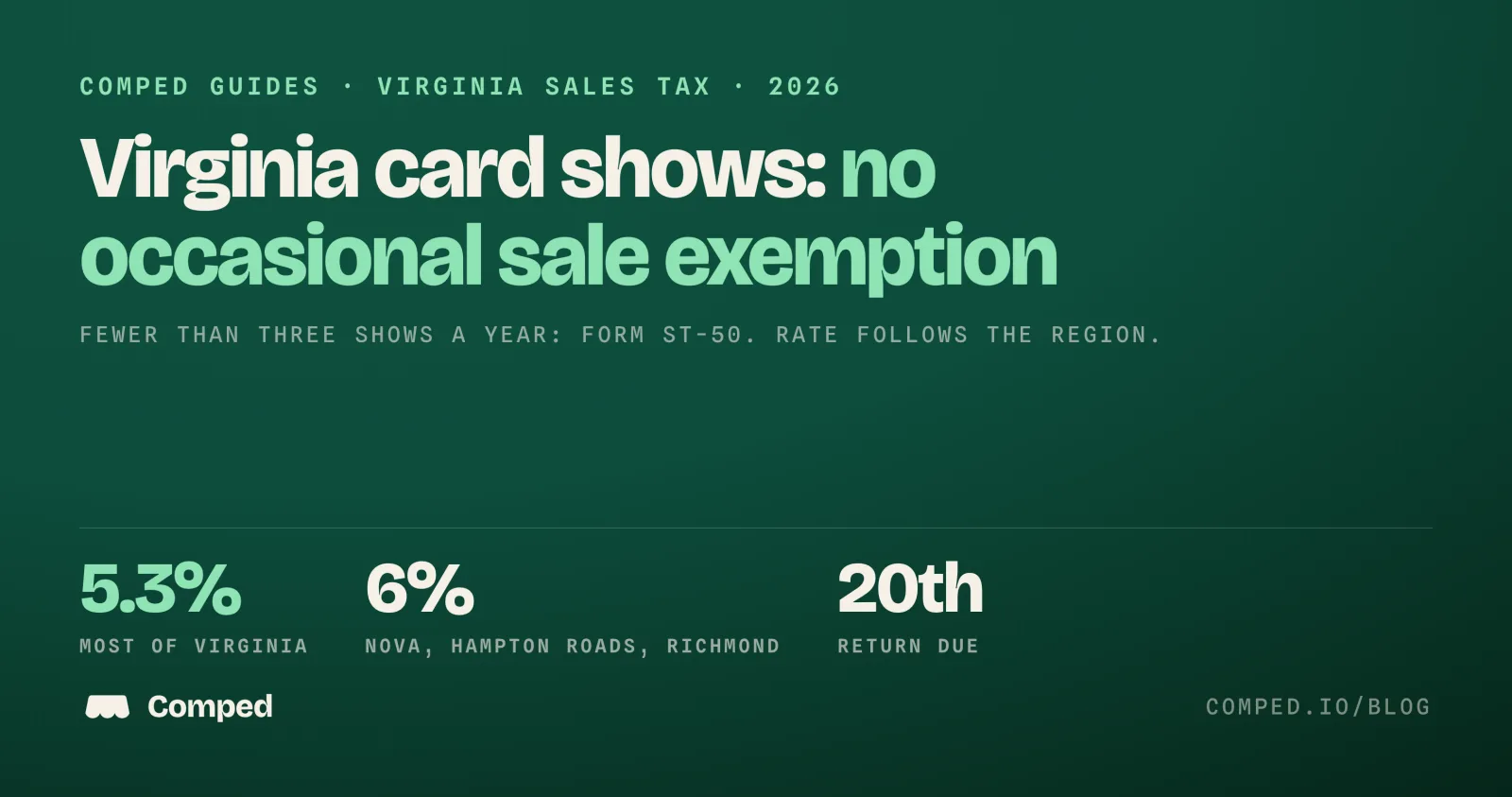
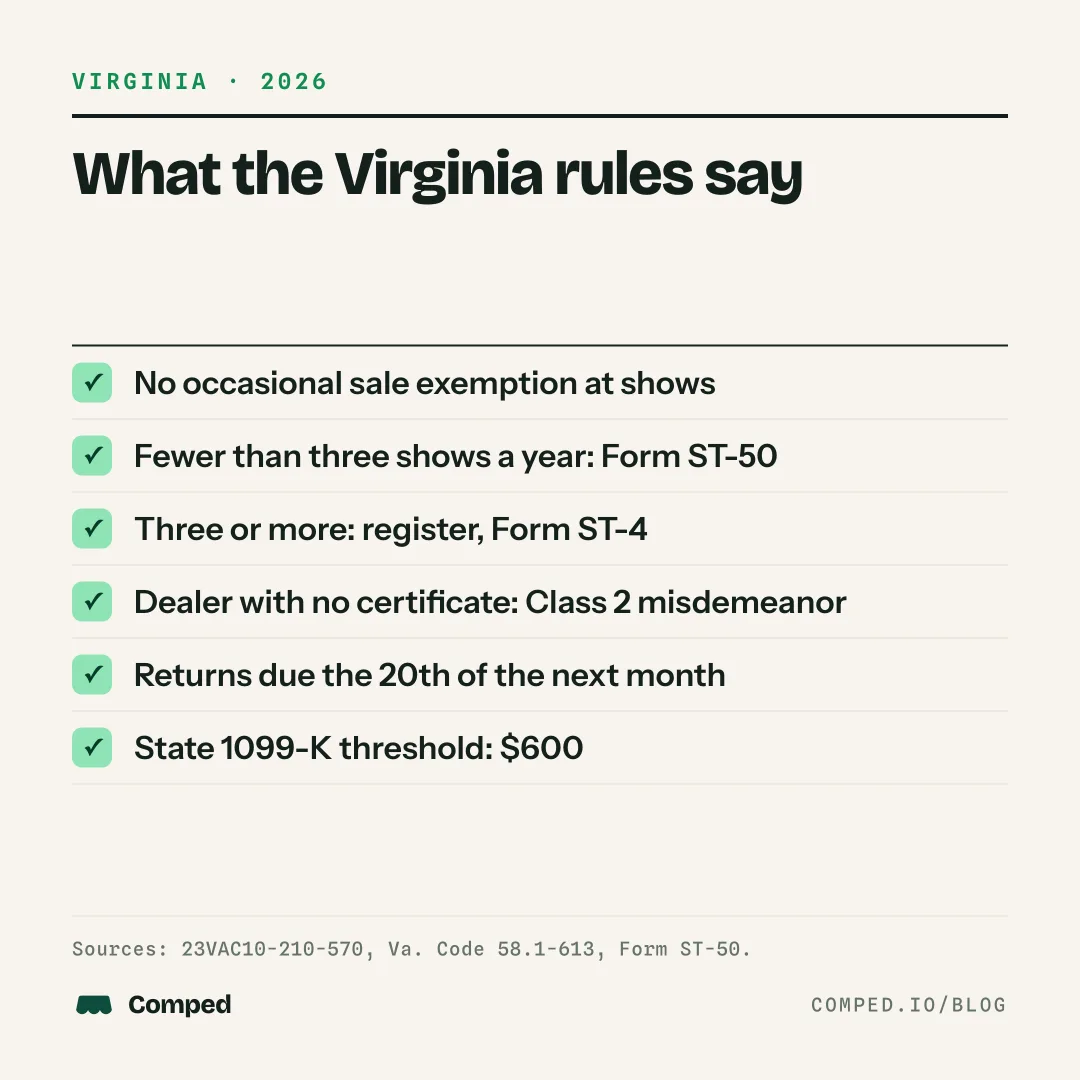
The same rule says the occasional sale exemption does not apply to these sellers. It makes no distinction between profit and nonprofit vendors. The rule does not name card shows. In our reading, a rented table at a card show is the same kind of event selling.
Most states leave a vendor to argue about what "occasional" means. Virginia does not. Trading cards and slabs are taxable tangible personal property here, with no collectibles exemption. The state by state sales tax guide shows how other states handle the same question.
THE RULE MOST VENDORS GET WRONG
Selling without the certificate is more than a late fee in Virginia. Va. Code 58.1-613 makes doing business as a dealer without a valid certificate a Class 2 misdemeanor. Each day of continued business counts as a separate offense.
Form ST-50 for one or two shows a year
Virginia Tax publishes a form for show sellers who are not registered. Form ST-50, the Temporary Sales Tax Certificate/Return, is for shows and events held on or after July 1, 2023. The copy we read is marked Rev. 09/26.
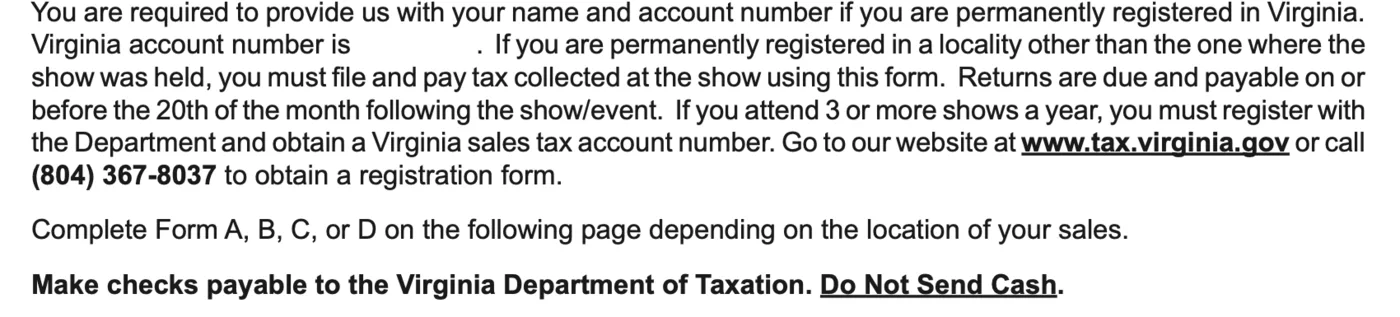
The form draws the line itself. It says: "If you attend 3 or more shows a year, you must register with the Department and obtain a Virginia sales tax account number." A vendor at fewer than three Virginia shows a year files Form ST-50 for each show and does not register first. Call Virginia Tax at the number on the form if your case is unusual.
That puts Virginia among 11 states in our Card Show Sales Tax Index where an occasional vendor can sell at one show without registering first. The other 35 states with a sales tax require registration before a single show. Tax is owed on every sale in all 46.
Returns on Form ST-50 are due on or before the 20th of the month following the show. You mail the form with a check to the Virginia Department of Taxation. The form says not to send cash.
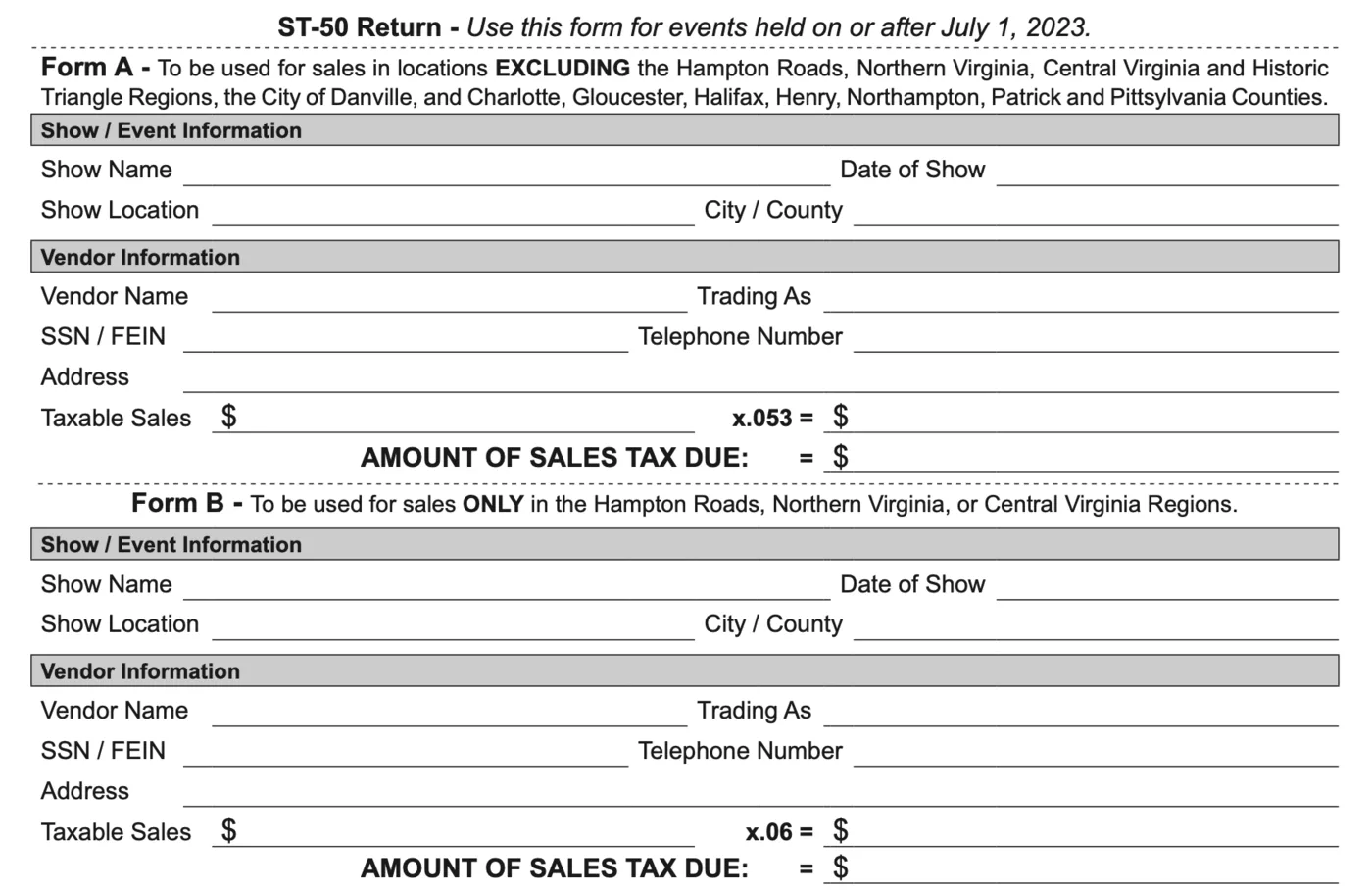
Page 2 holds four short returns, one per rate. Form A is 5.3% for most of Virginia. Form B is 6% for Hampton Roads, Northern Virginia and Central Virginia. Form C is 7% for the Historic Triangle. Form D is 6.3% for Danville and the seven listed counties. Each asks for the show name, date, location, your name, SSN or FEIN, address and taxable sales.
Registered dealers meet this form too. It says a dealer permanently registered in a locality other than the show's must file and pay the show's tax on Form ST-50. That dealer writes the Virginia account number on it.
How to register
Register online with Virginia Tax before the show if you will work three or more Virginia shows in the year. The business registration page says to mail Form R-1 only if you cannot register online. The page lists no fee, and the statute sets none.
Virginia Tax's retail sales and use tax page says what arrives. You receive a 15-digit sales tax account number and a Sales Tax Certificate of Registration, Form ST-4. The page says the certificate must be displayed prominently at your registered location.
Nothing stops a one-show vendor from registering instead of using Form ST-50. Registration brings a return every period, though, even with no sales. For the income tax side of selling, see taxes on selling sports cards.
What rate to charge
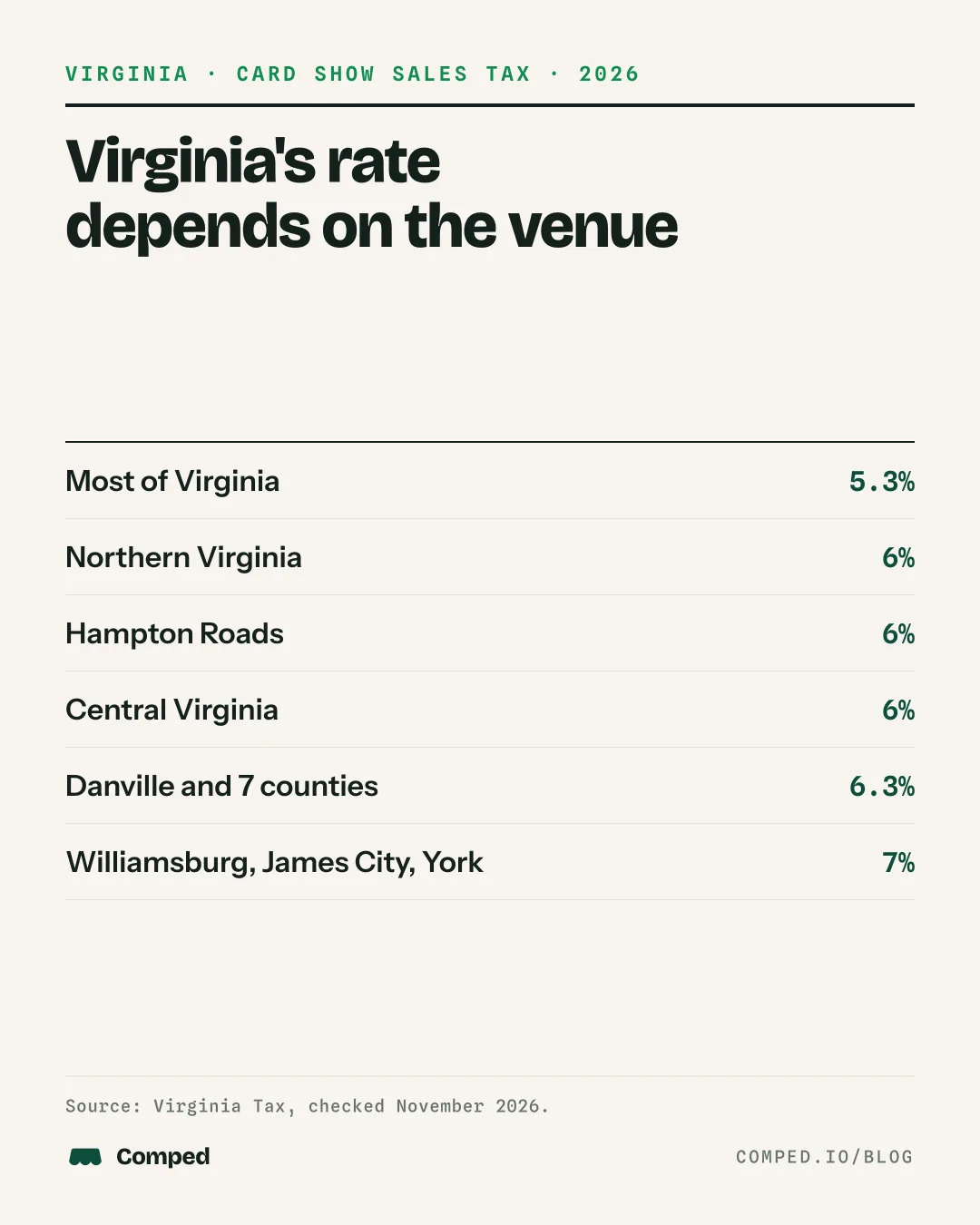
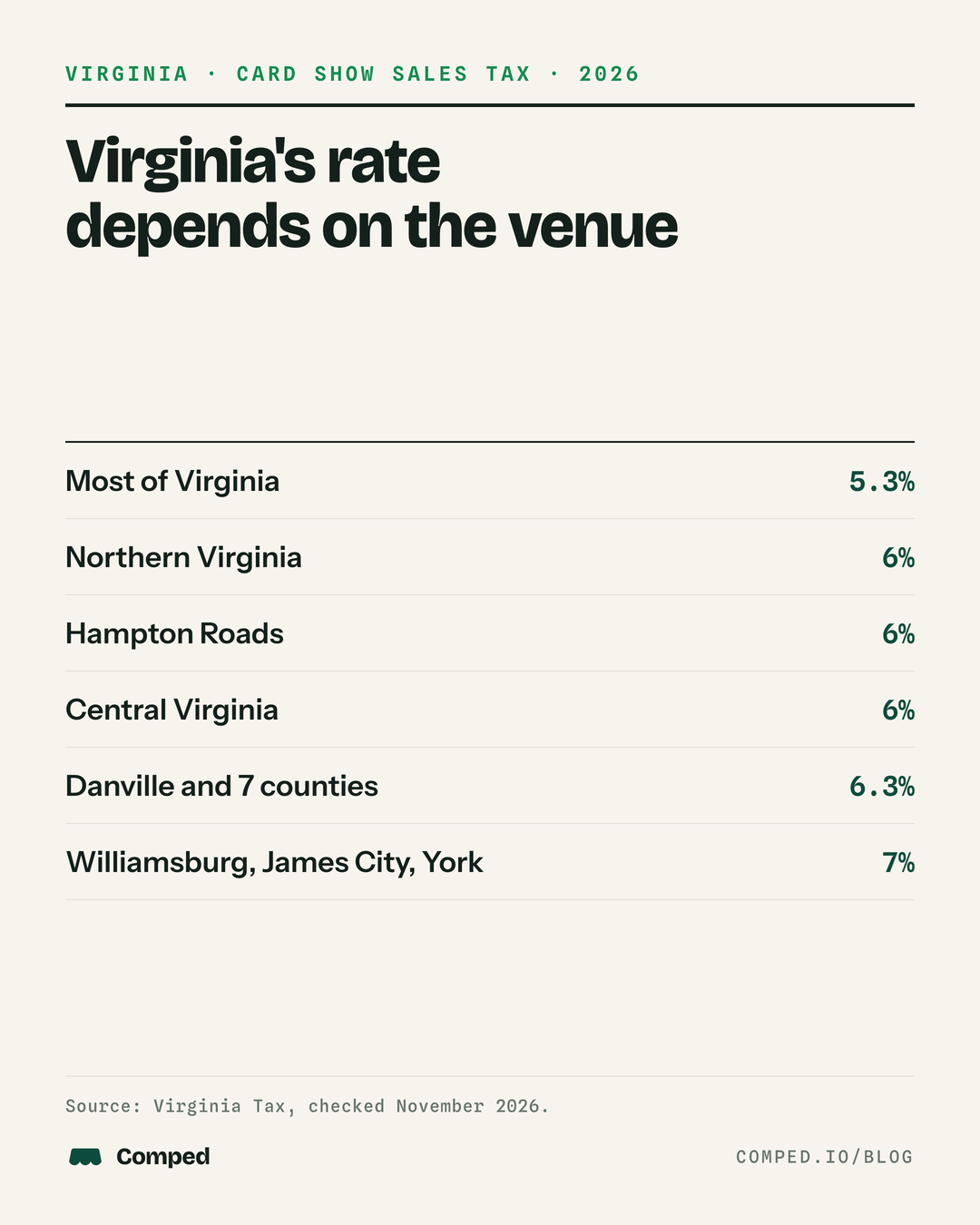
Charge the rate for the locality where the show is held. Virginia Tax lists four general rates and says the rate depends on where the sale was made. There is no separate city rate to add on top.
| Virginia item | Rule for show vendors | Figure |
|---|---|---|
| Most of Virginia | General rate, cards and slabs included | 5.3% |
| Northern Virginia, Hampton Roads, Central Virginia | Fairfax County, Arlington, Virginia Beach, Norfolk, Richmond City, Henrico and the other listed localities | 6% |
| Eight localities | Charlotte, Gloucester, Halifax, Henry, Northampton, Patrick and Pittsylvania counties, and Danville | 6.3% |
| Historic Triangle | James City County, Williamsburg, York County | 7% |
| Temporary certificate and return | For a vendor not registered, per show, due the 20th of the next month | ST-50 |
| Must register | Shows attended in a year, per Form ST-50 | 3 or more |
| Certificate | Sales Tax Certificate of Registration, displayed | ST-4 |
| Registered dealer's return due | After each monthly or quarterly period, even with no sales | 20th |
| Late penalty | Per month, 30% maximum, $10 minimum | 6% |
| Resale certificate | Sales and Use Tax Certificate of Exemption | ST-10 |
| State 1099-K threshold | Payees with a Virginia mailing address | $600 |
Timeline, counted back from show day
Start three weeks out, because Virginia Tax's pages print no processing time for a new registration. The dates below use an example show on Saturday, December 12, 2026. The "weeks before" rows are our suggestion, not a state deadline.
| When | What to do | Where it comes from |
|---|---|---|
| 3 weeks before | Count your Virginia shows for the year. Three or more: register online with Virginia Tax. One or two: plan on Form ST-50. | Form ST-50; our suggestion on timing |
| 1 week before | Find the venue's city or county and its rate. Print Form ST-50 and note which block applies, A, B, C or D. | Form ST-50, page 1 |
| 1 week before | If you will buy inventory from dealers, fill in Form ST-10 with box 1 checked. | Form ST-10 |
| Show day | Charge the venue's rate on every retail sale. Write down each sale as it happens. | Virginia Tax rate lists |
| Night after the show | Total the taxable sales and count the cash against your log. | Our suggestion |
| By January 20, 2027 | Mail Form ST-50 with a check, or file the regular return if registered. | Form ST-50; Virginia Tax |
The card show vendor checklist has a printable version of the packing and paperwork steps. The card show profit calculator shows what the table has to sell to cover its costs.
How to file after the show
Which form you file depends on whether you are registered. An unregistered vendor mails Form ST-50 by the 20th of the month after the show. Fill in the block for the venue's region, multiply taxable sales by the printed rate, and attach a check.
A registered dealer files the regular return. Virginia Tax's page names Form ST-1 and says returns are due the 20th of the month after the filing period closes. Quarterly returns are due April 20, July 20, October 20 and January 20.
Registered dealers file even with nothing to report. Virginia Tax says a return is required every month or quarter "even if no tax is owed". A quarter with no Virginia shows gets a zero return. A late return or payment adds 6% per month, to a maximum of 30%. The $10 minimum applies to a late return even when no tax is owed.
Form ST-50 has no line about a show with no sales, and we found no Virginia Tax page that covers it. Ask Virginia Tax before skipping it. Comped records each table sale with the card, price, venue and date, so the sales behind each return are on record.
What the promoter handles
By default, nothing on your return. Each vendor holds a certificate and remits their own tax. We found no vendor list filing or promoter penalty on Virginia Tax's pages.
The regulation has one exception. Virginia Tax may authorize a sponsor or operator to remit the tax for the people selling at the event. The sponsor must apply to the Department in writing first. Unless your promoter tells you that authorization is in place, the tax is yours to send.
Buying inventory with Form ST-10
Yes. Give the selling dealer Form ST-10, the Sales and Use Tax Certificate of Exemption, with box 1 checked for resale only. The form says it stays in effect until revoked in writing by the Department.
Out-of-state dealers have a published answer. Ruling 10-21 says the Department allowed the resale exemption for an unregistered out-of-state dealer. That dealer used Form ST-10 and referenced its out-of-state registration number on it. The form itself still asks for a Virginia account number, so a supplier may ask questions.
Most dealer to dealer buys at a show are cash with no certificate. Any tax charged on that buy is part of the card's cost, as the cost basis guide explains.
eBay and Whatnot versus your table
Marketplaces collect Virginia tax on their own orders. Virginia Tax's economic nexus page sets the test at more than $100,000 in annual gross retail sales or 200 or more transactions to Virginia customers. A seller whose Virginia sales all go through a facilitator generally does not have to register.
A show table changes that. A sale made face to face in Virginia is your sale, taxed at the venue's rate and remitted by you.
Virginia's $600 1099-K rule
Virginia sets its own 1099-K threshold at $600. Tax Bulletin 20-10 requires third-party settlement organizations to report payments of $600 or more in a taxable year. It applies only to payees with a Virginia mailing address, for transactions on or after January 1, 2020.
The federal test is more than $20,000 and more than 200 transactions. A Virginia seller can get a form far below that. The form reports gross payments, and tax is owed on profit either way. The 1099-K guide covers what to subtract.
A show weekend, worked
Here is a $4,000 weekend at a table in Fairfax County, at the 2026 Northern Virginia rate of 6%.
A $4,000 WEEKEND IN FAIRFAX COUNTY, WORKED
Two days at a table, $4,000.00 in card sales, every sale taxed at 6%.
On Form ST-50 this weekend goes in Form B: taxable sales of $4,000.00 times .06 is $240.00. The same weekend in Roanoke or Charlottesville, at 5.3%, collects $212.00 on Form A. In Williamsburg, at 7%, it collects $280.00 on Form C. The $4,000.00 is your gross for income tax, and the tax collected was never your money.
Common mistakes and what they cost
Most Virginia errors come from the rate and the calendar. Each one below has a printed cost or a printed rule behind it.
- Charging 5.3% at a 6% venue. On the $4,000.00 example weekend that is $28.00 under-collected, and you still owe the full $240.00.
- Missing the 20th. Virginia Tax adds 6% per month to a late return or payment, up to 30%, with a $10 minimum.
- Registering for one show, then forgetting the zero returns. The $10 minimum applies to a late return with no tax owed.
- Staying on Form ST-50 at a third show. The form says three or more shows a year means registering, and selling as a dealer without a certificate is the misdemeanor described above.
- Treating cash differently. The rate applies to every retail sale, and the cash and trade log keeps the cash sales on paper.
If you already sold at a Virginia show and sent nothing, the form's phone number is the place to start. The guide to tracking card show sales covers rebuilding a weekend's total from payment reports and a cash count.
Virginia shows
CSA Shows ran its show in Chantilly for more than 25 years. Its site says the Dulles Expo Center has been sold and that it is working to secure a new location. Check the promoter's page for the venue, then look up that locality's rate. One certificate covers any Virginia venue.
How this looks in the Comped app
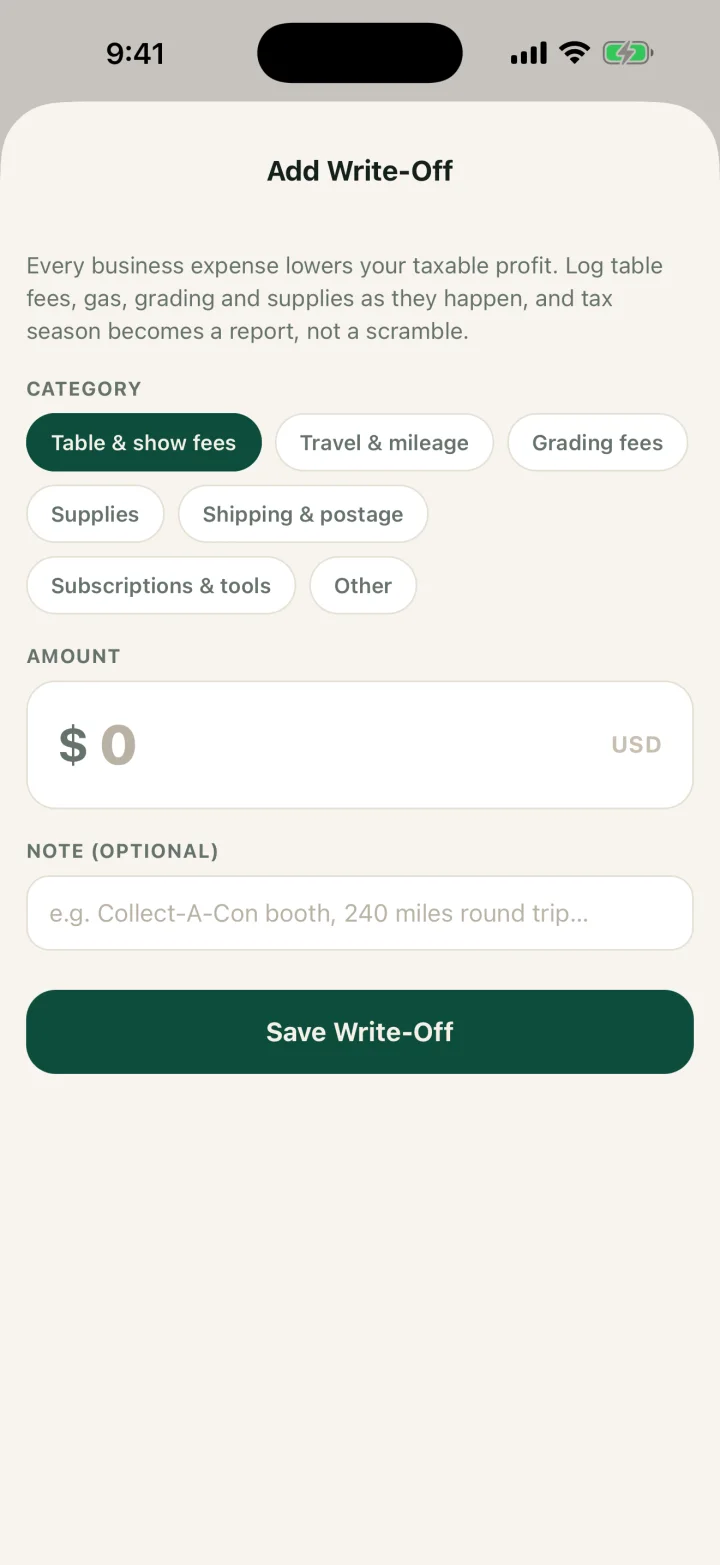
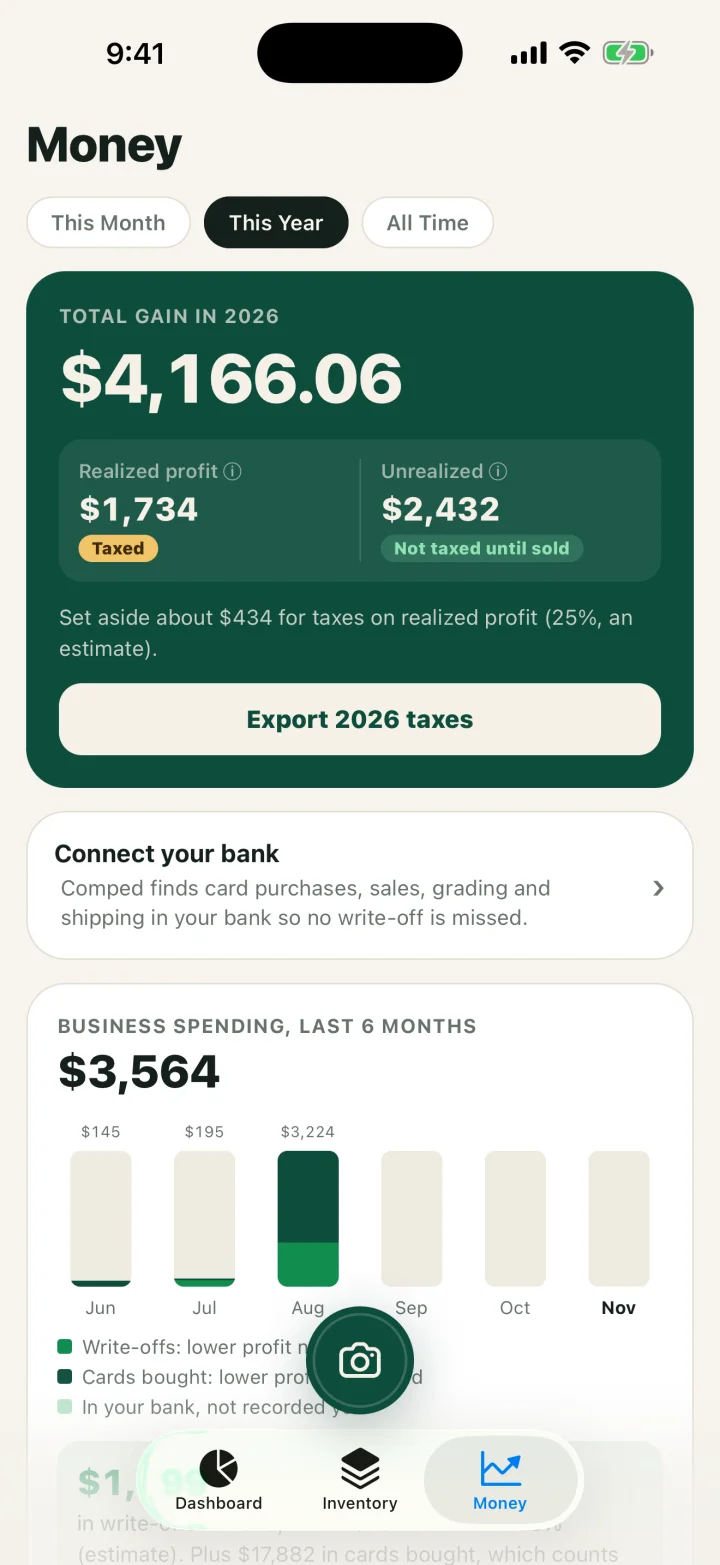
Comped does not compute or file Virginia sales tax. It keeps the sale records a return is built from. The Transaction screen shows one sale with its price, fees and cost. Add Write-Off files the table fee under Table and show fees. The Money tab totals the year and exports it as a CSV.

Related guides
- State by State: Sales Tax and Show Permits for Card Vendors: every state's permit, rate and rules in one place.
- North Carolina card show sales tax (2026): a single event creates physical presence, and the operator keeps a daily vendor list.
- Pennsylvania card show sales tax (2026): a Transient Vendor Certificate and 30 days of notice.
- Card show sales tax index 2026: the 51-state comparison of permits, fees and promoter duties.
FAQ
Do I need a permit to sell at a single card show?
Not a registration, if you sell at fewer than three Virginia shows a year. You collect the tax and file Form ST-50, the Temporary Sales Tax Certificate/Return, after the show. The form says a vendor at 3 or more shows a year must register. The regulation on fairs and flea markets gives show sellers no occasional sale exemption.
Is there a temporary sales tax permit for one show in Virginia?
Virginia Tax publishes Form ST-50, the Temporary Sales Tax Certificate/Return, for shows and events. You fill in the block for the venue's region and mail it with a check. It is due on or before the 20th of the month following the show.
Do I have to file a Virginia return if I had no sales?
A registered dealer does. Virginia Tax says a return is due every month or quarter even if no tax is owed. The $10 minimum penalty applies to a late return with no tax due. Form ST-50 does not address a show with no sales, so ask Virginia Tax.
Do dealers at shows actually collect sales tax?
They are required to. Doing business as a dealer without a valid certificate is a Class 2 misdemeanor under Va. Code 58.1-613, and each day counts separately. Late returns add 6% per month up to 30%.
Does the promoter collect it for me?
Not unless Virginia Tax has authorized it. A sponsor can apply in writing to remit tax for its sellers. Without that authorization, each vendor collects and remits their own tax.
Do I charge sales tax on cash?
Yes. The rate for the venue's locality applies to every retail sale at the table. Cash, card or a payment app makes no difference to the tax.
I travel to shows in other states, do their rules apply to me?
Yes. Each state taxes sales made at a table inside its borders. Virginia taxes anyone selling at its fairs and flea markets, wherever the seller lives. Form ST-50 covers a vendor at fewer than three Virginia shows a year, and a regular dealer registers.
Will I get a 1099-K in Virginia under $20,000?
You can. Virginia requires third-party settlement organizations to report payments of $600 or more to payees with a Virginia mailing address. The form shows gross payments, not profit.
SOURCES
- 23VAC10-210-570, Fairs, flea markets, circuses and carnivals, Virginia Administrative Code, checked November 13, 2026.
- Va. Code 58.1-613, Certificates of registration, Code of Virginia, checked November 13, 2026.
- Form ST-50, Temporary Sales Tax Certificate/Return (Rev. 09/26), Virginia Tax, checked November 13, 2026.
- Retail Sales and Use Tax, Virginia Tax, checked November 13, 2026.
- Register a Business in Virginia, Virginia Tax, checked November 13, 2026.
- Remote Sellers, Marketplace Facilitators and Economic Nexus, Virginia Tax, checked November 13, 2026.
- Form ST-10, Sales and Use Tax Certificate of Exemption, Virginia Tax, checked November 13, 2026.
- Ruling of the Tax Commissioner 10-21, Virginia Tax, checked November 13, 2026.
- Tax Bulletin 20-10, Form 1099-K reporting, Virginia Tax, checked November 13, 2026.
- IRS issues FAQs on Form 1099-K threshold, IRS, checked November 13, 2026.
This is general information for card sellers, not tax or legal advice for your situation. Rules change and states differ; a CPA who knows your numbers wins every time.