Who needs a license in Ohio
Anyone making taxable retail sales in Ohio needs a vendor's license, and a show table is no exception. The Department of Taxation's vendor brochure says making taxable retail sales without one is a criminal offense. The license for selling from a temporary location, such as a fair, an exhibition or a trade show, is the Transient Vendor's License.
Ohio's only carve-out is the casual sale: selling something you bought for your own use. The brochure's example is a table and chairs used at home for five years. Someone who buys goods and resells them weeks later is making retail sales, so a dealer working a show gets no exemption.
| Who you are | License you need for a show |
|---|---|
| Out-of-state dealer at one Ohio show | Transient Vendor's License |
| Ohio seller with no shop, shows only | Transient Vendor's License |
| Ohio shop owner, show in the shop's own county | The county vendor's license already covers it |
| Ohio shop owner, show in another county | Transient Vendor's License as well |
| Collector selling cards bought for personal use, not as a business | None, if it is a true casual sale |
The shop owner rows come straight from Ohio Revised Code 5739.17. A holder of a regular vendor's license may sell at a show in a county where it has a licensed fixed place of business. Everywhere else, the transient license is the one that applies.
Trading cards are taxable tangible personal property in Ohio, slabs included. Hobby or business for income tax is a separate question, covered in our guide to taxes on selling sports cards. The state by state sales tax guide covers every state's table rules.
How to get the Transient Vendor's License
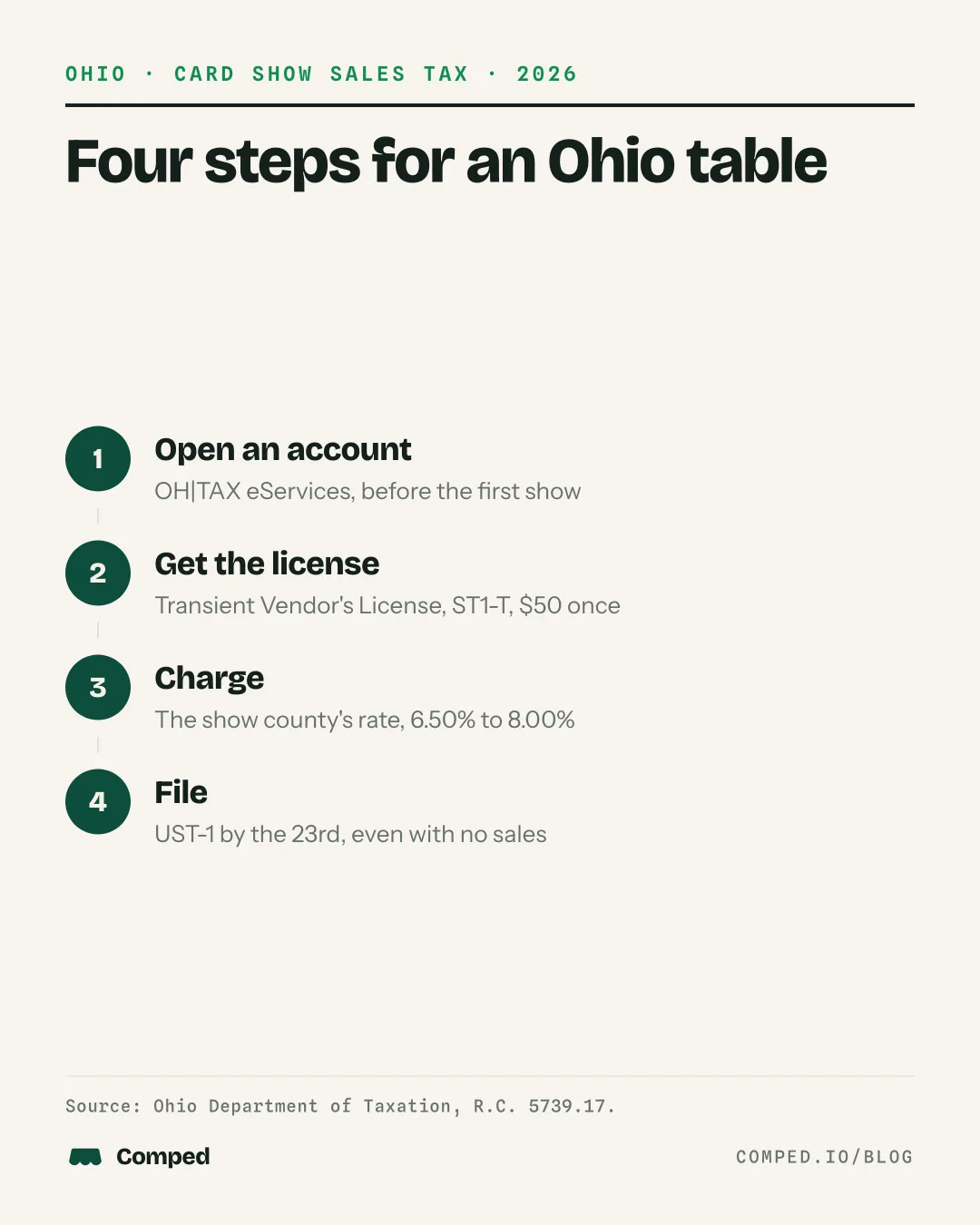
Apply online, and the license can be issued the same day. The state issues this license, not the county auditor. The Department's registration page says a vendor's license can be obtained immediately through OH|Tax eServices, once you have set up an account there.
The Department's own ST 1T page points to the Ohio Business Gateway at gateway.ohio.gov instead, and also says you can obtain the account immediately. Either way, the account you create is the one you file returns from.
The paper route is slow. The same ST 1T page says processing a paper application may take up to six weeks. Mail it to the Ohio Department of Taxation, P.O. Box 182215, Columbus, OH 43218-2215, the address printed on the form. The Department's license line is 888 405 4089.
One license covers the whole state. Under section 5739.17, a transient vendor's license authorizes retail sales in any county where you have no fixed place of business. A Michigan dealer and a Columbus dealer working the same Cleveland show both hold the same license type.
There is no advance notice per show, unlike Pennsylvania's 30 day notice. Section 5739.17 also requires you to display the license, or a copy, in plain view wherever you sell. Print a copy for the table.
The ST 1T application, line by line
Form ST 1T is one page with 11 questions, and the online application asks the same things. The current paper version is Rev. 4/25.
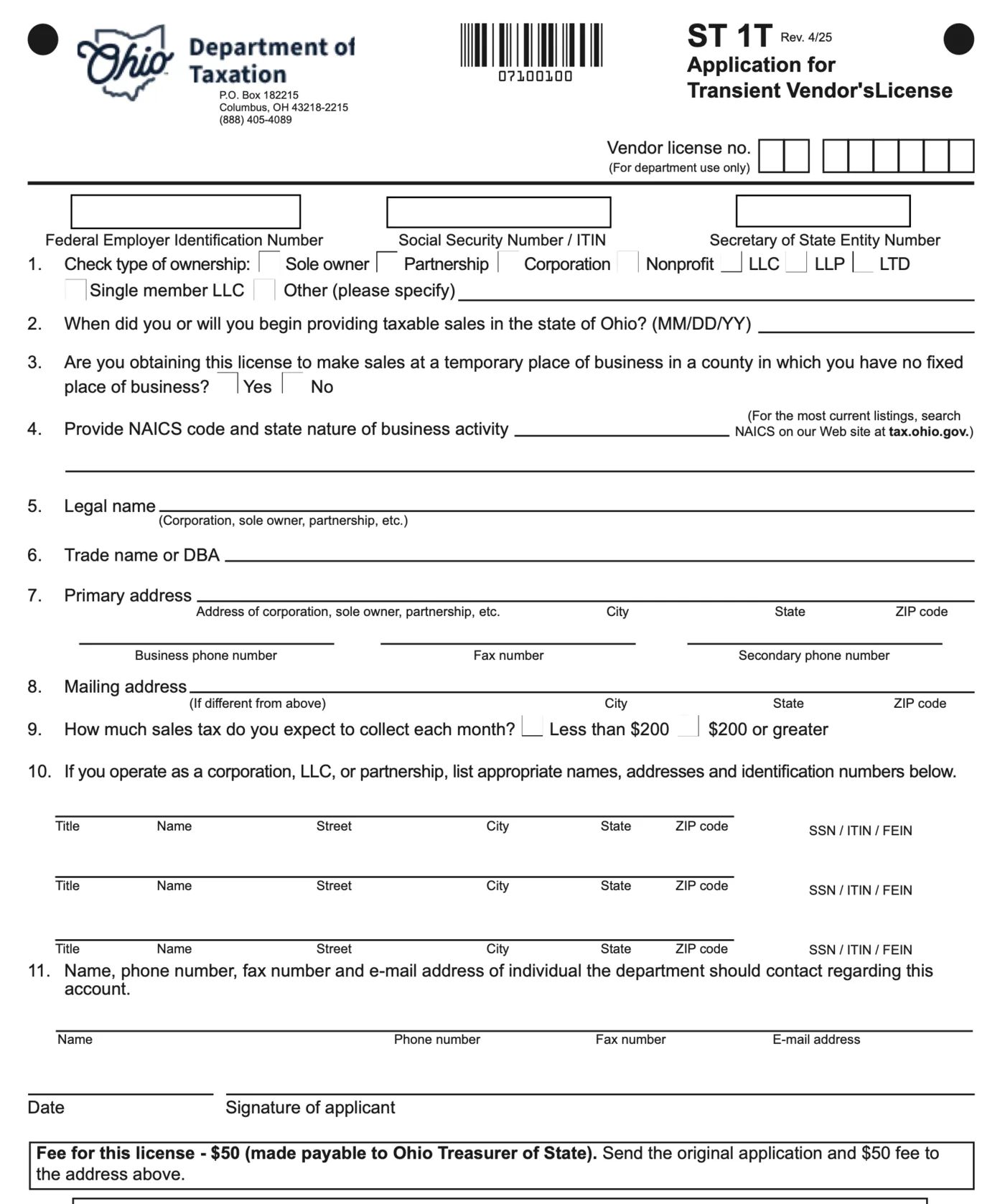
| Line on ST 1T | What a card dealer enters |
|---|---|
| FEIN, or Social Security Number / ITIN | A sole owner with no EIN uses the Social Security number |
| 1. Type of ownership | Sole owner, single member LLC, LLC, partnership and so on |
| 2. When did you or will you begin taxable sales in Ohio | The first day of your first Ohio show |
| 3. Sales at a temporary place of business in a county where you have no fixed place | Yes. This is the question that makes you a transient vendor |
| 4. NAICS code and nature of business | Your code and a plain description, such as trading card sales |
| 5 and 6. Legal name, trade name or DBA | Your own name if you are a sole owner |
| 7 and 8. Primary and mailing address | Your permanent address, in any state |
| 9. Sales tax you expect to collect each month | Less than $200, or $200 or greater |
| 10. Owners or officers | Only for a corporation, LLC or partnership |
| 11. Contact person | Name, phone and email for the account |
| Fee box | $50, payable to Ohio Treasurer of State, on a paper application |
The form does not list NAICS codes. The business code guide for card sellers covers the codes dealers use. Our reading is that question 9 feeds the filing schedule the Department assigns you, since the form gives no other reason for it.
What it costs and whether it renews
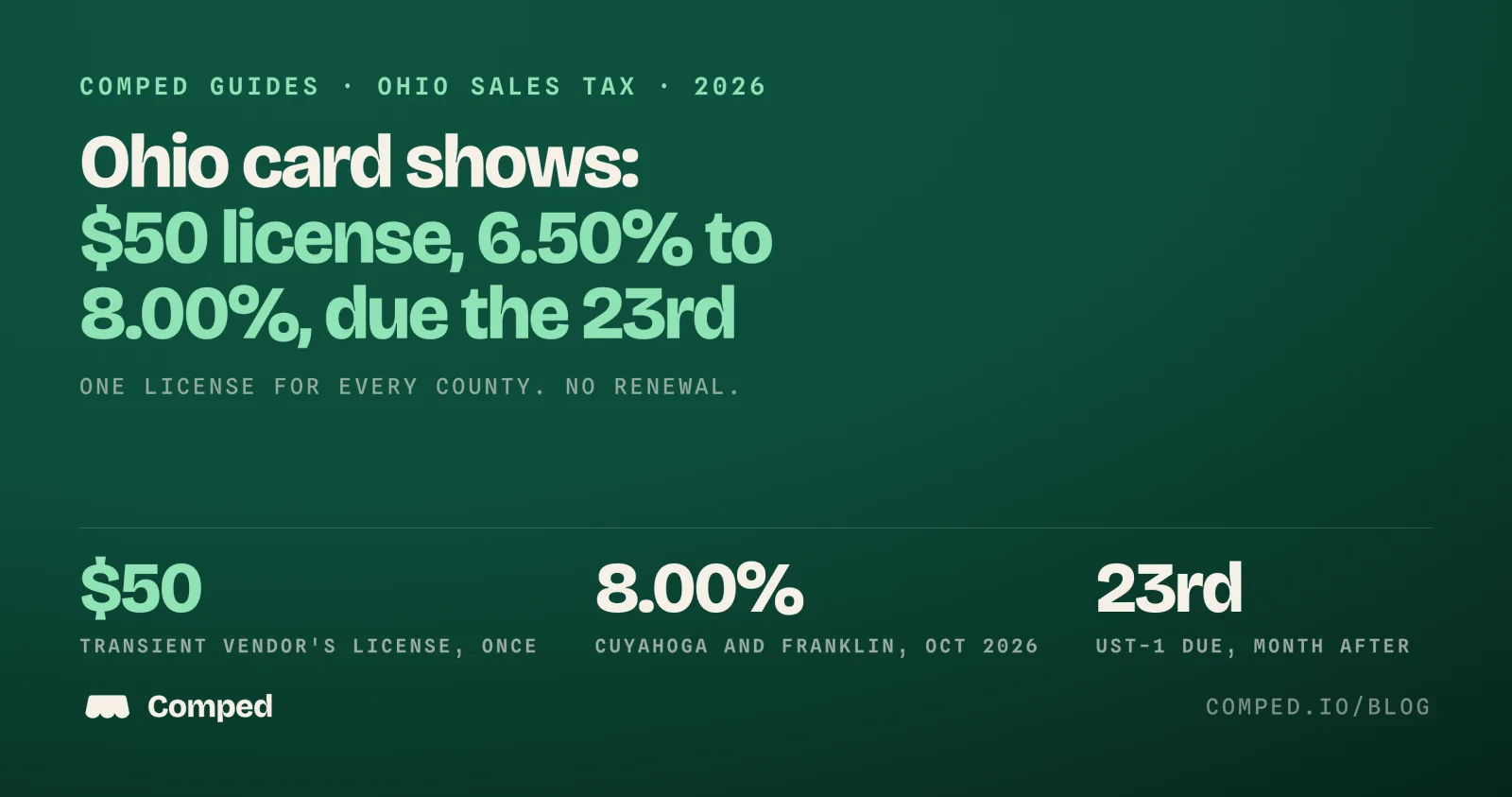
The license costs $50, once. The Department's April 1, 2025 bulletin announced that the fee for a new vendor's license application rose from $25 to $50 effective April 9, 2025, including transient licenses. Section 5739.17, as amended by House Bill 366, sends $25 of each fee to the organized crime commission fund.
Many county auditor pages, the Department's printed brochure and the older Rev. 12/09 form still say $25. That figure is out of date for any application made on or after April 9, 2025.
There is nothing to renew each year. The brochure says a vendor's license remains valid until it is canceled. Returns keep coming due for as long as the license is open, so cancel it if you stop selling in Ohio.
WHAT CHANGED
The Ohio vendor's license fee doubled from $25 to $50 on April 9, 2025. Pages that still quote $25 were written before House Bill 366. The license itself still does not expire.
The timeline, counted from show day
A week is enough if you apply online. The dates in the right column are an example for a show on Saturday, March 13, 2027, for a vendor on a monthly schedule.
| When | What you do | Example date |
|---|---|---|
| 6 weeks before | Last safe day to mail a paper ST 1T | January 30, 2027 |
| 7 days before | Apply online and pay the $50 fee | March 6, 2027 |
| 3 days before | Print the license. Look up the county rate. Pack a cash log | March 10, 2027 |
| Show day | Display the license. Give the promoter your license number. Charge the county rate | March 13, 2027 |
| After the show | Total the show's sales by county | March 14, 2027 |
| 23rd of the next month | File the UST-1 for March and pay | April 23, 2027 |
| Every period after | File a return even with no Ohio sales, until you cancel the license | The 23rd, each period |
The card show vendor checklist has the rest of what to pack.
What rate to charge, by show county
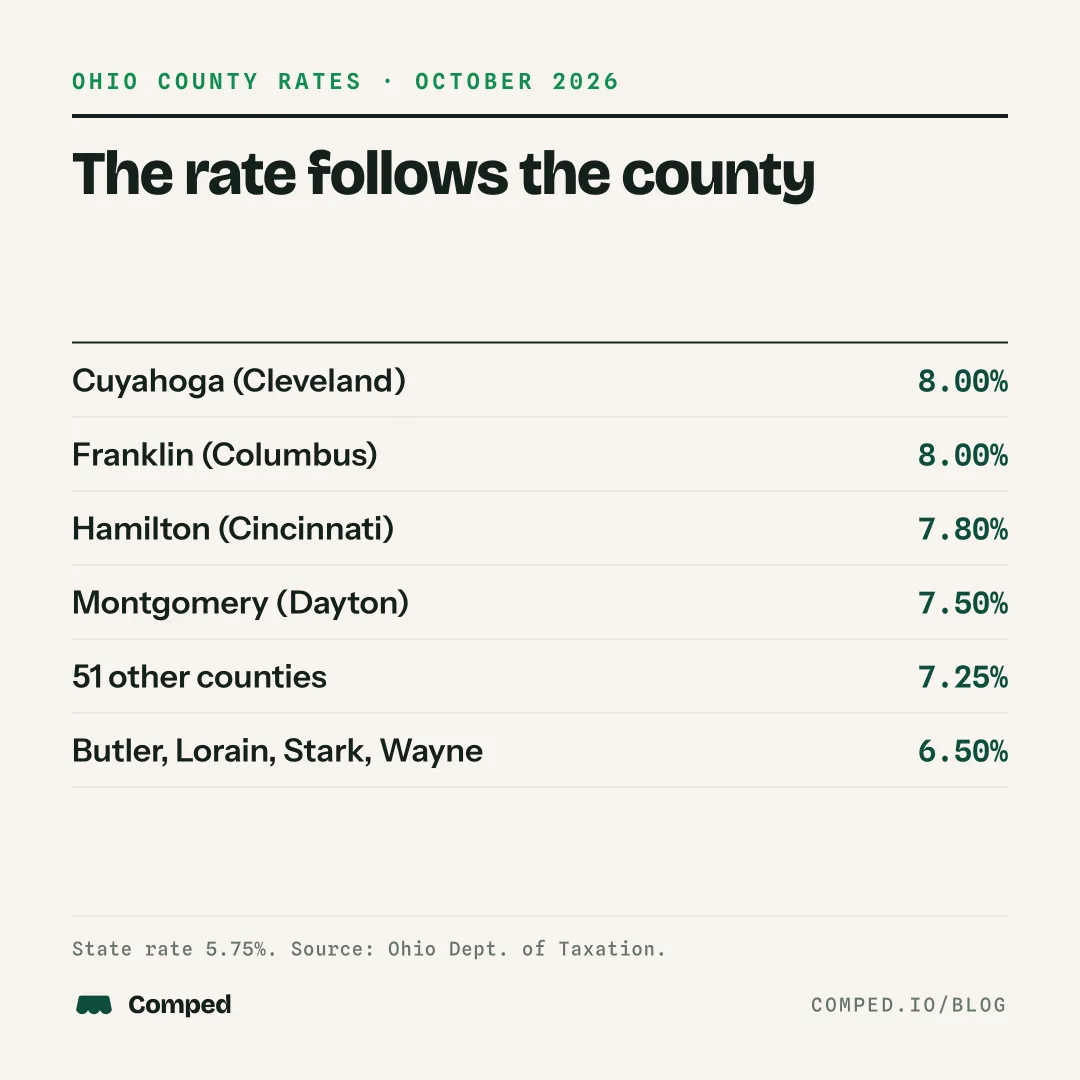
Charge the combined state and county rate where the show is held. The state rate is 5.75% under section 5739.02, and counties and transit authorities add their own share. The Department's October 2026 rate map puts county totals between 6.50% and 8.00%.
Cuyahoga County, home to the Cleveland area shows, and Franklin County, home to Columbus, are the highest at 8.00%. Fifty-one counties sit at 7.25%. Parts of Delaware, Fairfield, Licking and Union counties add a 1.00% transit levy that the county figure leaves out. Look up any venue address in the Department's Finder tool before you set your price tags.
| Ohio item | Rule for show vendors | Figure |
|---|---|---|
| State sales tax rate | Statewide, before county and transit tax | 5.75% |
| Cuyahoga County | Cleveland, Strongsville, Independence, October 2026 | 8.00% |
| Franklin County | Columbus, October 2026 | 8.00% |
| Hamilton County | Cincinnati, October 2026 | 7.80% |
| Lucas County | Toledo, October 2026 | 7.75% |
| Montgomery County | Dayton, October 2026 | 7.50% |
| Mahoning County | Youngstown, October 2026 | 7.50% |
| Summit County | Akron, October 2026 | 6.75% |
| Lowest counties | Butler, Lorain, Stark and Wayne, October 2026 | 6.50% |
| License | Transient Vendor's License, application ST 1T, online or by mail | $50 |
| Renewal | Valid until canceled | None |
| Return | Universal sales tax return, due the 23rd of the following month | UST-1 |
| Late return | Additional charge up to 10% of the tax, or if greater | $50 |
| Selling with no transient license | First offense fine, up to | $500 |
| Promoter records | Vendor names, addresses, license numbers, goods sold | 4 years |
| Remote seller nexus | Ohio sales in the current or prior calendar year, or 200 transactions | $100,000 |
The UST-1 after the show, and zero returns
Monthly is the default, with each return due by the 23rd. Section 5739.12 sets the 23rd of each month for the preceding month and requires electronic filing. The Department can authorize less frequent filing for vendors whose tax does not merit monthly returns. It tells you your schedule by letter after the license is issued.
File every period, even one with no Ohio shows. The brochure says returns are due even if no sales are made or no tax is due. A zero return is the same return with zero sales entered. An out-of-state dealer who works one Ohio show a year still owes a return for every period the license stays open.
Keep each show's sales separate by county, because each county's rate differs. File on time and pay in full and you keep a discount of 0.75% of the tax shown as due, under the same section.
Comped records each table sale with its price, venue and date, so a show's sales total is already added up when you file.
If Ohio was a one-off, cancel the license after your last return. The license has no end date, so the returns keep coming due until you do.
Penalties
Selling at a show without the license is a crime with a fine of $100 to $500 for a first offense. Section 5739.99 adds up to ten days in jail, or both. A repeat offense is $1,000 to $2,500, up to 30 days, or both. The same section lets the state impound the vehicle and goods of a person charged.
Not displaying a transient vendor's license is a minor misdemeanor under the same section. A sheriff or city police officer can enforce it.
A late or missing return has its own cost. Section 5739.12 allows an additional charge of up to $50 or 10% of the tax due for the period, whichever is greater. If the state has to assess tax you never collected or never sent in, section 5739.133 allows a penalty of up to 50% of the amount assessed. Failing to remit tax you collected is a fourth degree felony under section 5739.99.
Buying inventory with a resale certificate
Yes. Give the selling dealer an Ohio exemption certificate marked for resale. The blanket form is STEC B, for an ongoing supplier, and the unit form STEC U covers one purchase. STEC B asks for your name, type of business, address, reason and vendor's license number. No sales tax is due on that purchase, and you charge the county rate when the card sells at retail.
Most show buys between dealers are cash with no certificate. When a dealer buys from you for resale, keep his certificate, since it is your proof for the untaxed sale. If the other dealer charged you tax, that tax is part of your cost of the card. The cost basis guide covers the receipt that proves a cash buy at a show.
eBay and Whatnot versus your table
eBay collects and remits Ohio sales tax on eBay orders, and Whatnot collects where required. eBay's marketplace tax page lists Ohio from September 1, 2019. The Department's registration page says you need not collect on marketplace sales while the facilitator is collecting for you.
The table is yours. Marketplace facilitator laws reach the marketplace's own sales only, so every card sold face to face at an Ohio show is taxed, collected and remitted by you. Separately, a remote seller with more than $100,000 of Ohio sales or 200 Ohio transactions in the current or prior calendar year has nexus under section 5741.01.
What the promoter keeps
The promoter keeps records on you for four years but does not collect your tax. Section 5739.17 covers owners, organizers and promoters of fairs, flea markets, shows and similar events. They must record each transient vendor's name, permanent address, vendor's license number and type of goods sold. The records stay open to the Tax Commissioner for four years.
Expect the promoter to ask for your license number at load-in. The brochure also says tax enforcement agents regularly visit vendor locations, so keep the license where you can show it.
Ohio's 1099-K floor
Ohio has no lower state 1099-K threshold, so the federal rule applies. Platforms file a 1099-K when gross payments exceed $20,000 and transactions exceed 200 in the year, per platform, as the IRS FAQs issued after the July 2025 law set out. Ohio does not appear on Whatnot's list of lower state thresholds for 2026 sales.
A form is a reporting rule, not a tax rule. You owe income tax on profit whether or not a 1099-K arrives, and the state 1099-K threshold table lists every state.
A show weekend, worked
Here is an example: a $4,000 weekend at a Cuyahoga County show, at the October 2026 combined rate of 8.00%. The same weekend in a 7.25% county would collect $290.00.
AN EXAMPLE $4,000 WEEKEND IN CUYAHOGA COUNTY
Two days at a table near Cleveland, $4,000.00 in card sales, every sale taxed at 8.00%.
The tax you collected was never income. It is held for the state and sent in with the return. Your gross sales for income tax are $4,000.00, and profit is that figure less the cost of the cards and your show expenses. Run the numbers in the card show profit calculator. A buyer who pays more than $10,000 in cash for one card triggers Form 8300, a separate federal duty.
Common mistakes, and fixing a missed show
Most Ohio problems come from five habits.
- Paying $25. The fee has been $50 since April 9, 2025, and the Department treats an application as complete only with the correct fee.
- Applying to a county auditor. Auditors issue the regular license for a fixed location. The state issues the transient one.
- Buying a new license for each show. One transient license covers every county and does not expire.
- Going quiet after the show. Returns are due every period until the license is canceled.
- Charging one rate everywhere. The rate follows the county where the show is held.
If you already sold at an Ohio show without a license, our reading is to fix it before the state writes to you. Get the license, report the sales on a return for the period they happened in, and pay the tax. Expect the late charge above. A CPA can tell you whether to ask the Tax Commissioner to remit it, which section 5739.12 allows.
Three edge cases come up at tables. Cash sales are taxed like any other sale. A trade is a sale for income tax, at the value of what you receive, and the card trade calculator does that math. A dealer who works shows in several states needs each state's own permit.
Ohio's recurring shows
The Strongsville Sports Collectors Convention, a vintage show founded in 1978, left Strongsville for 2026. Sports Collectors Digest reported that it ran April 10 to 12, 2026 at the Independence Fieldhouse, sharing the building with the Great Lakes Collectors Convention. Independence and Strongsville are both in Cuyahoga County, so both collect 8.00%.
One transient license covers every Ohio show you work. The 2026 card show sales tax index compares Ohio's rules with every other state.
How this looks in the Comped app
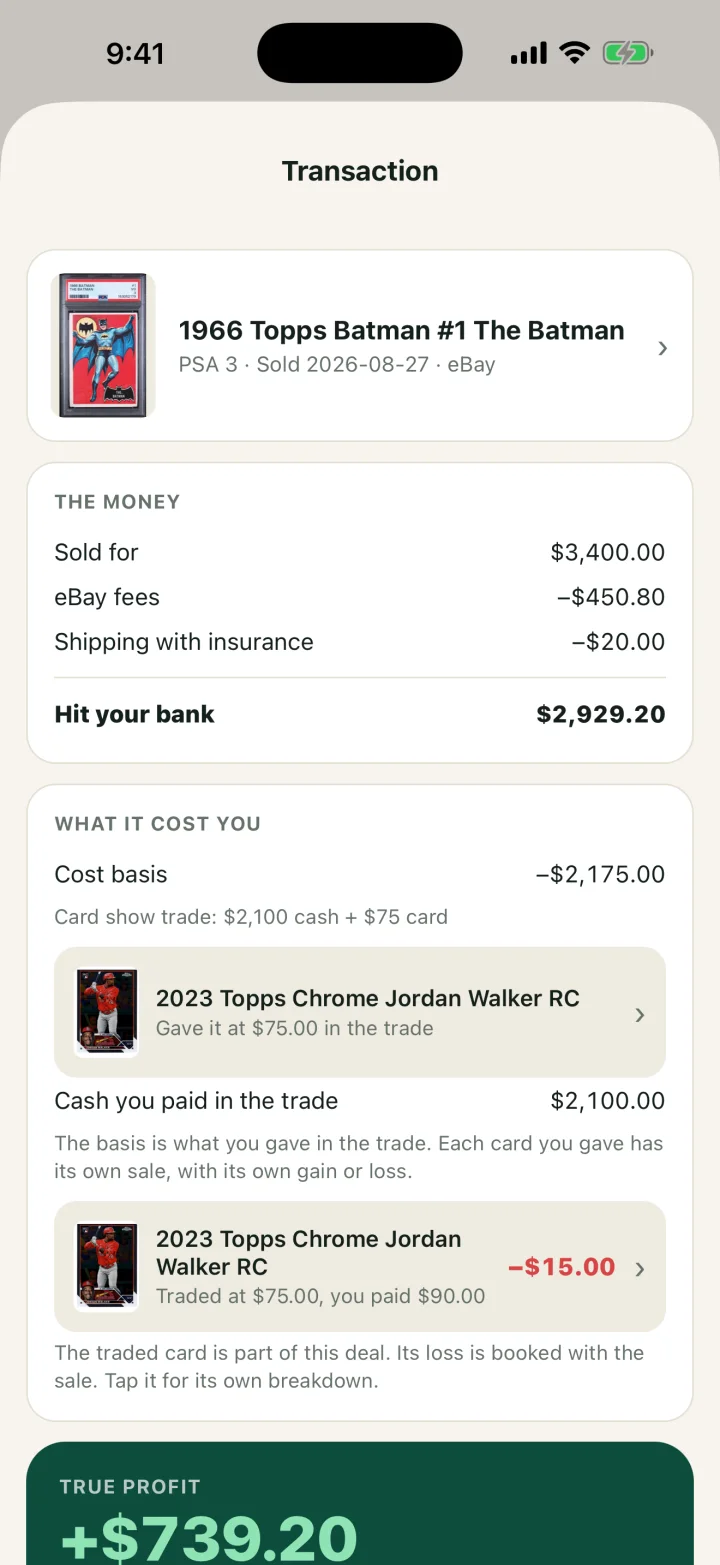
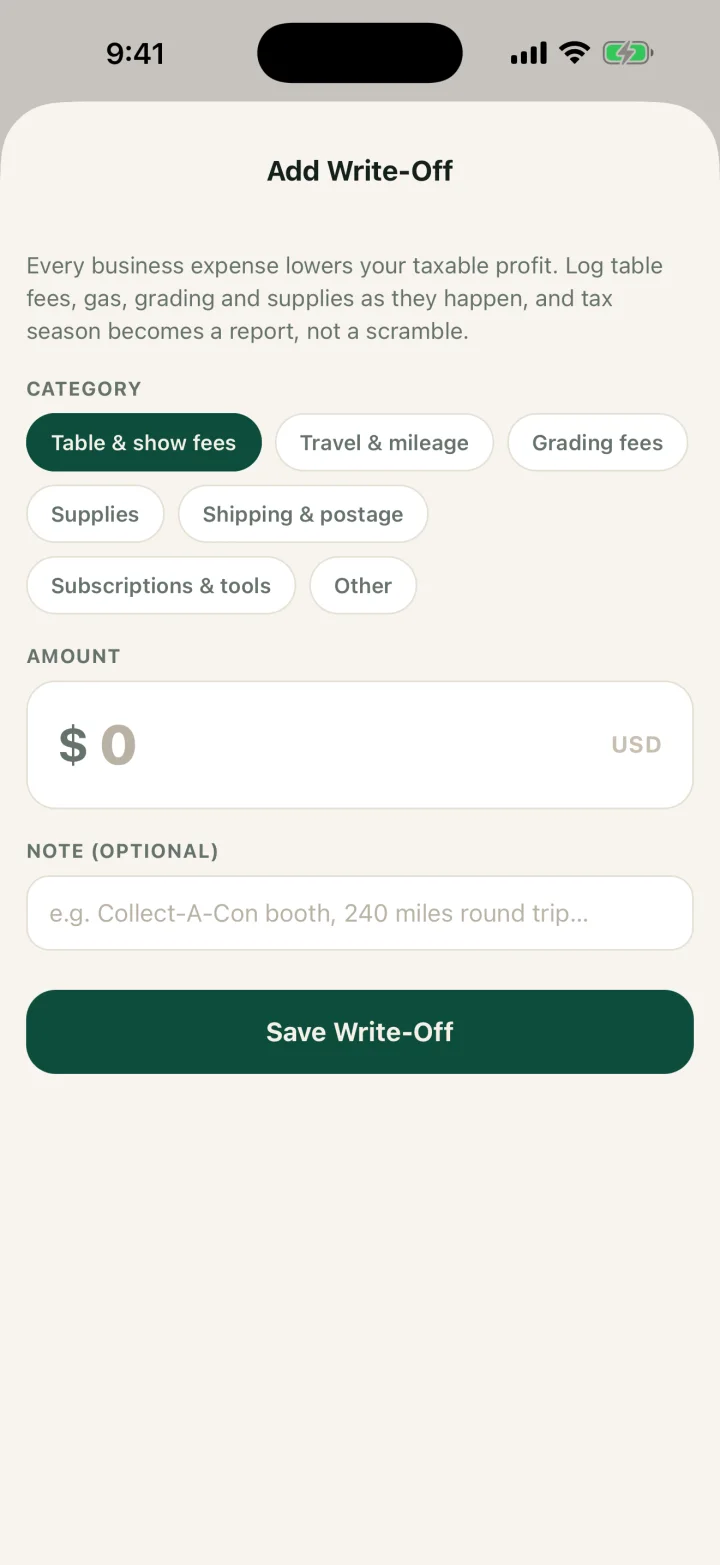
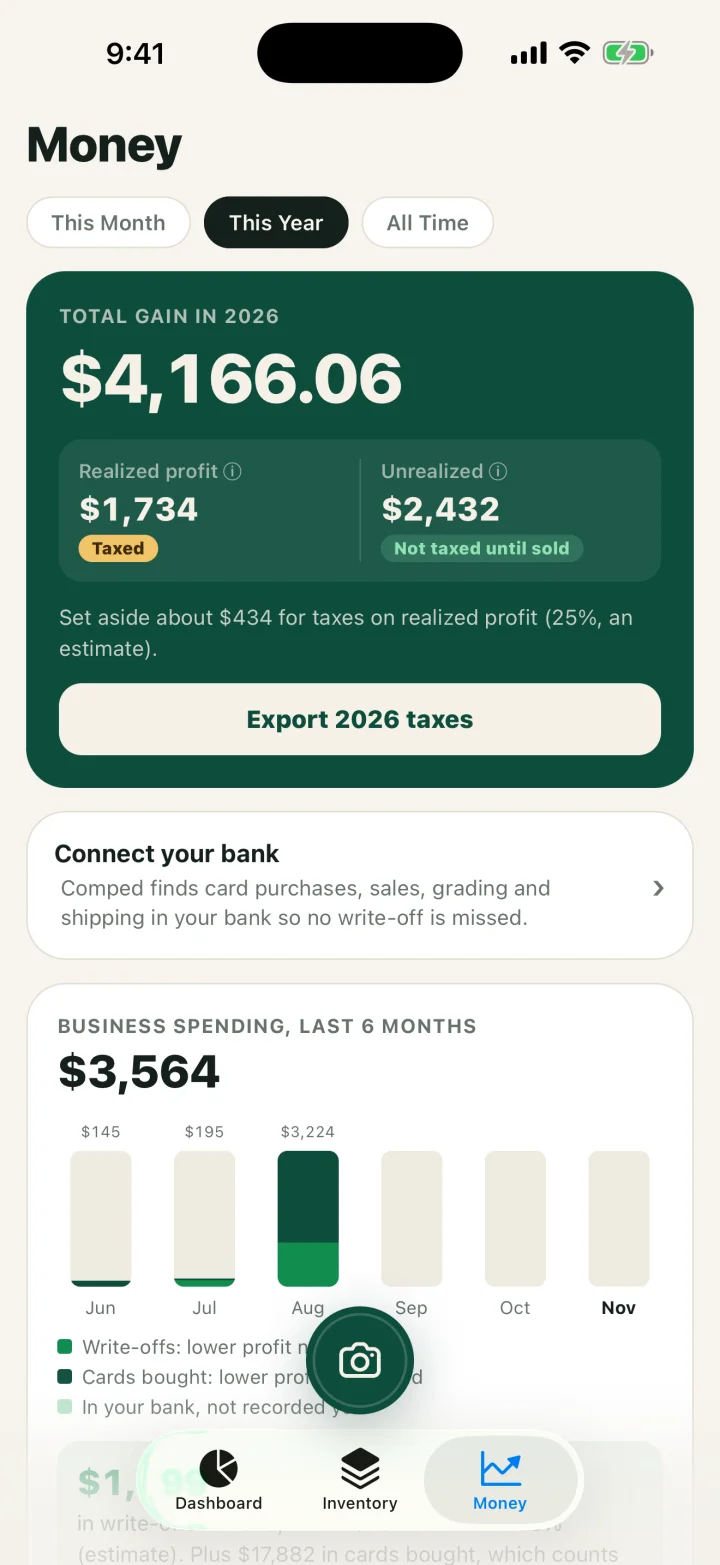
The Ohio return starts from one figure per show, your sales there, and that comes from your sale records. In Comped, each sale is its own record with the price, the date and where it sold. The $50 license and the table fee go in as write-offs, and the Money tab exports the year. The app does not calculate or file sales tax.
Related guides
- State by State: Sales Tax and Show Permits for Card Vendors: every state's permit, rate and rules in one place.
- Pennsylvania card show sales tax (2026): the 30 day notice that repeats for every show.
- Illinois card show sales tax (2026): IDOR-6-SETR and the National in Rosemont.
- New York card show sales tax (2026): the 20 day rule and the $500 per day penalty.
FAQ
Do I need a transient vendor license in Ohio for one card show?
Yes. Ohio requires a vendor's license for any taxable retail sale, and the Transient Vendor's License is the one for shows and other temporary locations. One show is enough to need it. Selling without a license is a criminal offense in Ohio.
How much is a transient vendor license in Ohio?
It is $50, paid once. The fee rose from $25 on April 9, 2025 under House Bill 366. The license does not renew; it stays valid until you cancel it.
How do I apply for an Ohio transient vendor license?
Apply online through OH|Tax eServices or the Ohio Business Gateway, and the license can be issued immediately. The paper application is Form ST 1T, mailed to the Department of Taxation in Columbus with a $50 check. Paper can take up to six weeks. County auditors do not issue this license.
Do I need a new transient vendor license for each show?
No. One Transient Vendor's License covers every Ohio county where you have no fixed place of business, for every show. It stays valid until it is canceled. You do owe a return for every filing period while it is open.
I travel to shows in other states, do their rules apply to me?
Yes. A table at an Ohio show is an Ohio retail sale, and out-of-state dealers need the same Transient Vendor's License as residents. The license covers every county where you have no fixed place of business.
Does the promoter collect it for me?
No. An Ohio promoter records each vendor's name, address, license number and goods sold and keeps those records for four years. The promoter does not collect or remit your tax. You collect at the table and file the return.
Do I charge sales tax on cash?
Yes. The county rate applies to every retail sale at the table whether the buyer pays cash, card or an app. The tax is figured on the price you actually charge.
When is the Ohio sales tax return due?
By the 23rd of the month after the period, on the UST-1, filed electronically. Monthly is the default, and the Department can assign a less frequent schedule. A period with no sales still needs a zero return.
SOURCES
- Ohio Revised Code 5739.17, vendor's license and transient vendor's license, effective April 9, 2025, checked November 13, 2026.
- Application for Transient Vendor's License to Make Taxable Sales (ST 1T), Ohio Department of Taxation, checked November 13, 2026.
- Form ST 1T, Rev. 4/25, Ohio Department of Taxation, copy hosted by the Lucas County Auditor, checked November 13, 2026.
- Vendor's license fee increase effective April 9, 2025, Ohio Department of Taxation bulletin, April 1, 2025, checked November 13, 2026.
- Register for a Vendor's License or Seller's Use Tax Account, Ohio Department of Taxation, checked November 13, 2026.
- Sales and Use Tax Rate Map, October 2026, Ohio Department of Taxation, September 9, 2026, checked November 13, 2026.
- Ohio Revised Code 5739.12, returns, vendor discount and additional charge, checked November 13, 2026.
- Ohio Revised Code 5739.99, penalties, and 5739.31, checked November 13, 2026.
- Ohio Revised Code 5739.133, penalties on assessments, checked November 13, 2026.
- Vendors: Sales Tax Laws in Ohio, Ohio Department of Taxation, checked November 13, 2026.
- Form STEC B, Blanket Exemption Certificate, Rev. 3/15, Ohio Department of Taxation, checked November 13, 2026.
- Ohio Revised Code 5739.02 and 5741.01, rate and substantial nexus, checked November 13, 2026.
- 2026 Form 1099-K for U.S. Sellers, Whatnot, checked November 13, 2026.
- IRS issues FAQs on Form 1099-K threshold, IRS, checked October 2026.
This is general information for card sellers, not tax or legal advice for your situation. Rules change and states differ; a CPA who knows your numbers wins every time.