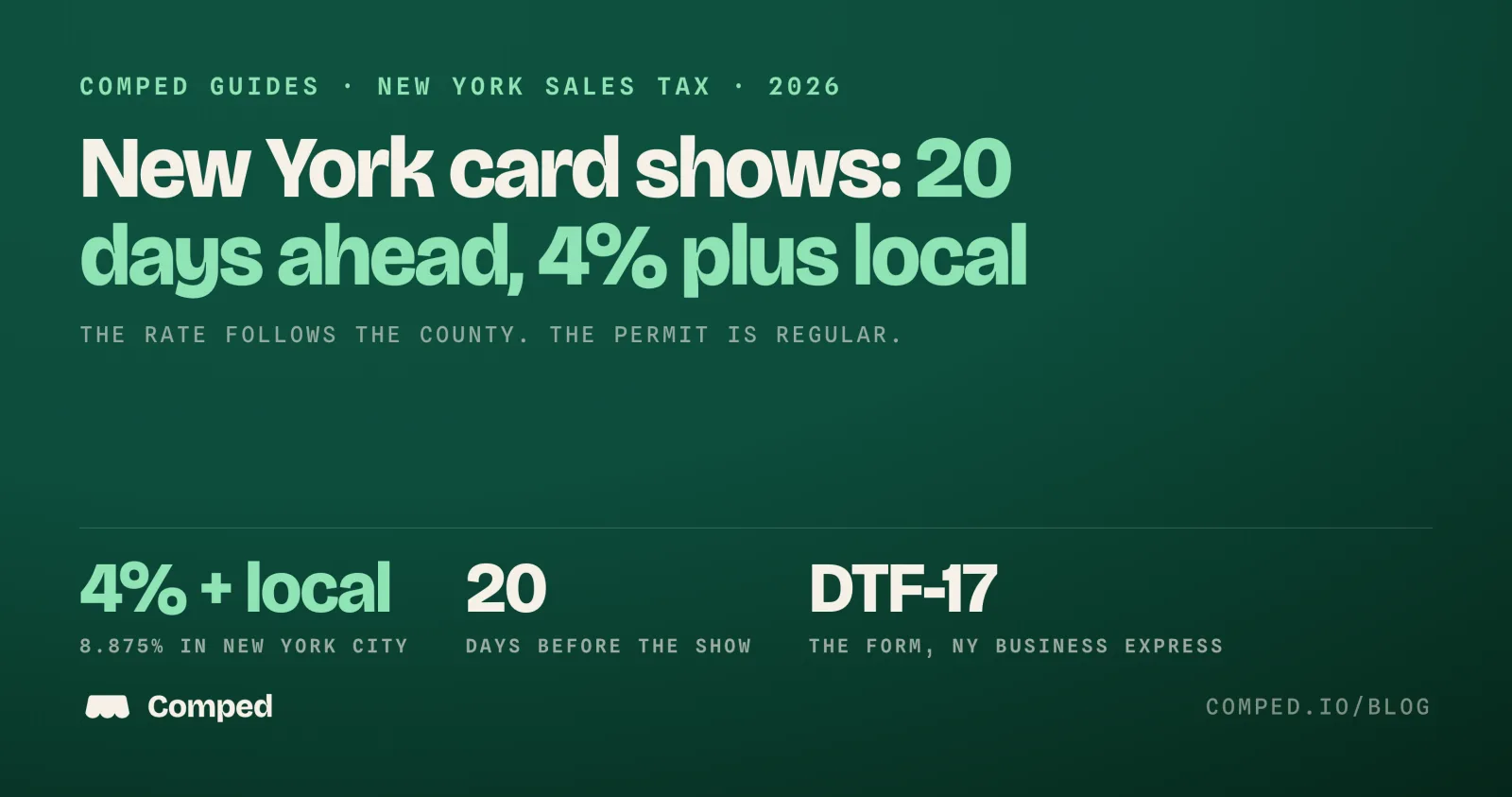
Who has to register in New York
Anyone who sells taxable goods at a New York show must register first, whatever their home state or sales volume. The state's bulletin How to Register for New York State Sales Tax (TB-ST-360) names show vendors directly. They must apply for a regular Certificate of Authority, "even if your sales are only on an isolated or occasional basis."
One show a year is enough. The companion bulletin Do I Need to Register for Sales Tax? (TB-ST-175) says how often you sell does not usually decide it. Its own example is a seller at one craft fair a year, who must register, collect and remit.
| Your situation | Register? | What New York says |
|---|---|---|
| New York dealer with a table at shows | Yes | Regular Certificate of Authority, at least 20 days ahead |
| Out-of-state dealer at a New York show | Yes | Same certificate; the promoter must list your New York number, not another state's |
| One show, once a year | Yes | Isolated or occasional show sales still need the regular certificate |
| Collector selling priced cards from a table | Yes | A show vendor is any person who displays for sale or sells taxable goods at a show |
| New York seller on eBay or Whatnot only | Yes | Register and file returns even though the marketplace collects the tax |
| Promoter running four or more shows a year | Yes, plus a show permit | Permit to Operate a Show, form DTF-723 |
Trading cards are taxable tangible personal property in New York, and graded slabs are taxed like raw cards. Hobby or business for income tax is a separate question, covered in our guide to taxes on selling sports cards. The state by state sales tax guide covers every other state the same way.
How to register: DTF-17, cost and lead time
Apply online through New York Business Express, the home of form DTF-17, at least 20 days before your first sale. The Tax Department's Register as a sales tax vendor page lists what you need. That is a NY.gov Business account, the application checklist and form DTF-17.1, the Business Contact and Responsible Person Questionnaire.
On cost, neither the DTF-17 instructions nor the Business Express listing shows an application fee. The listing gives an average processing time of 5 days. The certificate then comes by mail, and the bulletin says you cannot legally make any taxable sale until you have received it.
A show vendor with no shop enters a home address on the application. The DTF-17 instructions say so for vendors with no permanent place of business.
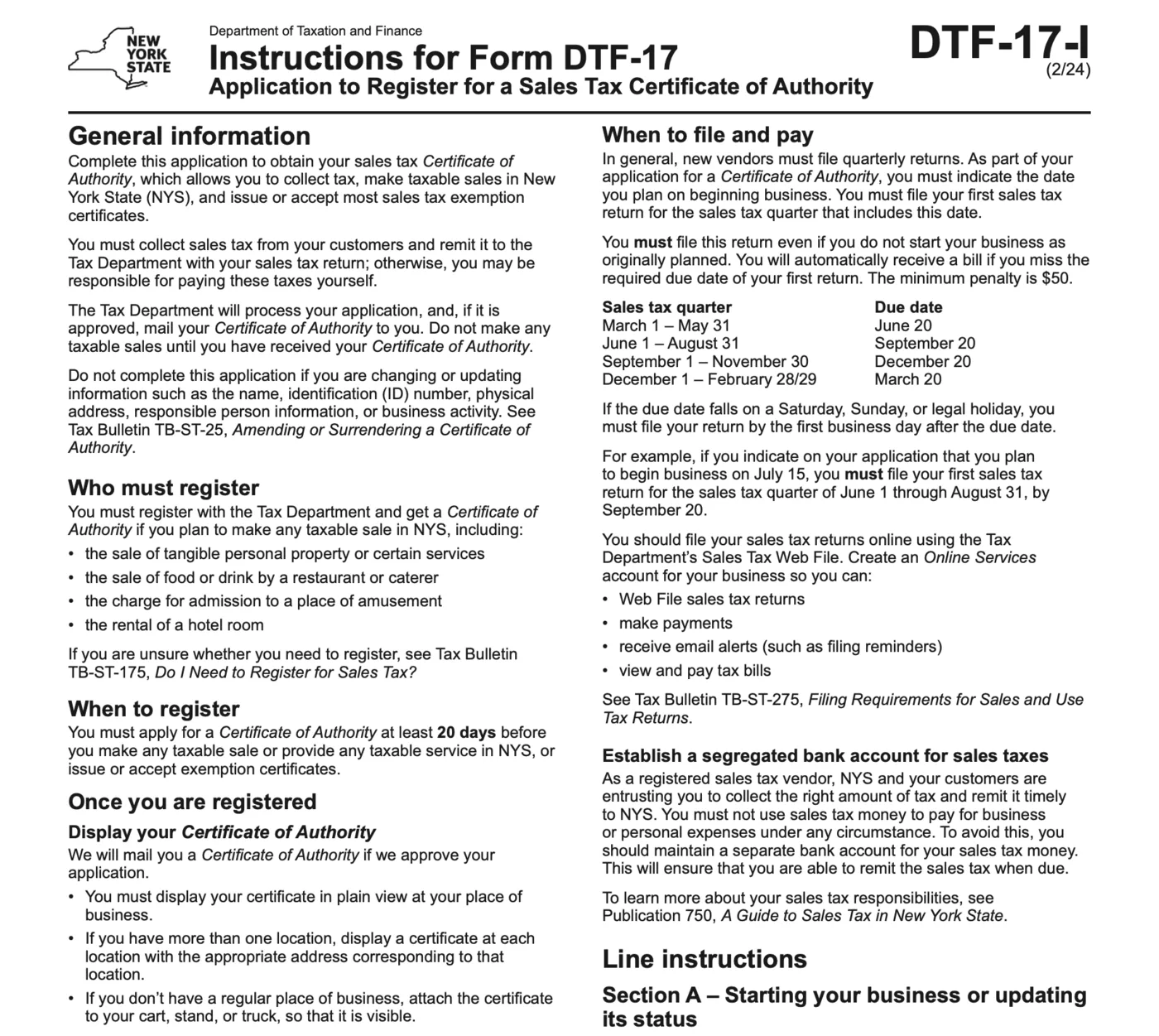
New York issues temporary certificates for businesses that sell in no more than two consecutive sales tax quarters. But "show and entertainment vendors may not apply for a temporary Certificate of Authority." A card show vendor gets the regular certificate or nothing.
The regular certificate is not tied to one show. A 2008 Tax Department memo, TSB-M-08(13)S, says the certificate issued to show vendors has no expiration date. Business Express lists a term of at least three years, renewable at the Department's discretion. Compare New Jersey's 15 business day clock and Pennsylvania's 30 day notice before each show. New York is the one you do once.
Timeline counted back from show day
Start the day you book the table, because the 20 day rule and the mailed certificate leave no room in the final week. The card show vendor checklist has the packing list; this is the tax side.
| When | What to do |
|---|---|
| 30 days or more before | Create a NY.gov Business account, fill in DTF-17.1 and submit DTF-17 on NY Business Express |
| 20 days before | The last day New York allows you to apply |
| After approval | The certificate arrives by mail; no taxable sales until you hold it |
| The week before | Look up the venue address in the state's rate lookup, and create a Tax Department Online Services account for Web File |
| Show day | Display the certificate, give the promoter your legal name, addresses and certificate number, and state the tax separately on any receipt you give |
| The 20th of the next month | The promoter's Report of Show is due; nothing for you to file |
| 20 days after the quarter ends | File the ST-100 and pay the tax you collected |
| Every quarter after | File again, even with no shows and no sales |
What to display at the table
Display the Certificate of Authority in plain view at the table. New York says a vendor with no permanent location can attach it to a truck, cart, wagon, stand or other facility. A card table is the stand. Failing to display it properly carries its own $50 penalty, separate from the penalty for not having one.
The promoter is told to look for it. The show permit instructions (DTF-723-I) say a promoter must make certain every vendor has a valid certificate and displays it at the primary selling location.
What rate to charge, by show city
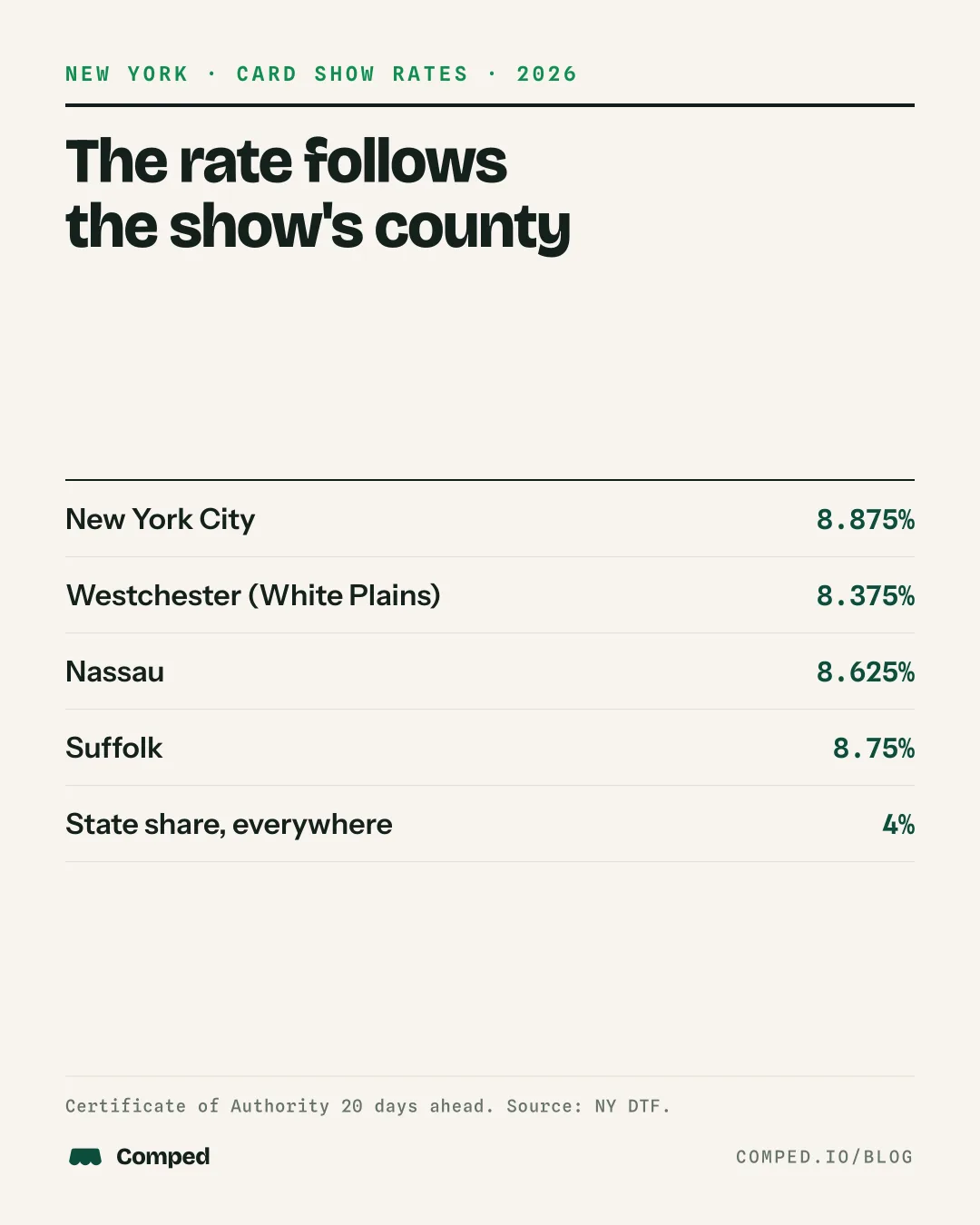
Charge the combined rate for the place where the show is held: 4% New York State tax plus the local rate. The figures below come from Publication 718, effective March 1, 2025, which is the version on the Tax Department's site today. The rate follows the venue, so a Westchester dealer at a Manhattan show charges 8.875% that day, not 8.375%.
| Show location | Jurisdiction on the return | Combined rate |
|---|---|---|
| New York City, all five boroughs | New York City | 8.875% |
| White Plains | White Plains (city), Westchester | 8.375% |
| Yonkers | Yonkers (city), Westchester | 8.875% |
| Nassau County, Long Island | Nassau | 8.625% |
| Suffolk County, Long Island | Suffolk | 8.75% |
| Buffalo | Erie | 8.75% |
| Rochester | Monroe | 8% |
| Syracuse | Onondaga | 8% |
| Albany | Albany | 8% |
| Saratoga Springs | Saratoga Springs (city) | 7% |
Nassau and Suffolk do not share a rate; Publication 718 lists Suffolk at 8.75%. For any other venue, enter the street address in the state's Jurisdiction/Rate Lookup. It returns the rate and the reporting code the return asks for.
How to file the ST-100 after the show
You report the show on form ST-100, the quarterly return, due 20 days after the quarter ends. New York's quarters end on the last day of May, August, November and February. The DTF-17 instructions give the due dates as June 20, September 20, December 20 and March 20. A date on a weekend or legal holiday moves to the next business day.
By our count, the quarter of September 1 to November 30, 2026 is due Monday, December 21, 2026, because December 20 is a Sunday. The next one is due Monday, March 22, 2027. Your first return covers the quarter that includes the start date on your application, even if the show falls through.
Most vendors must use Sales Tax Web File, per bulletin TB-ST-275. The return asks for gross sales, nontaxable sales and taxable sales by jurisdiction. So keep each show's sales total with its venue. Comped records each table sale with its price, venue and date, so a show's gross sales total is ready when you fill in the return.
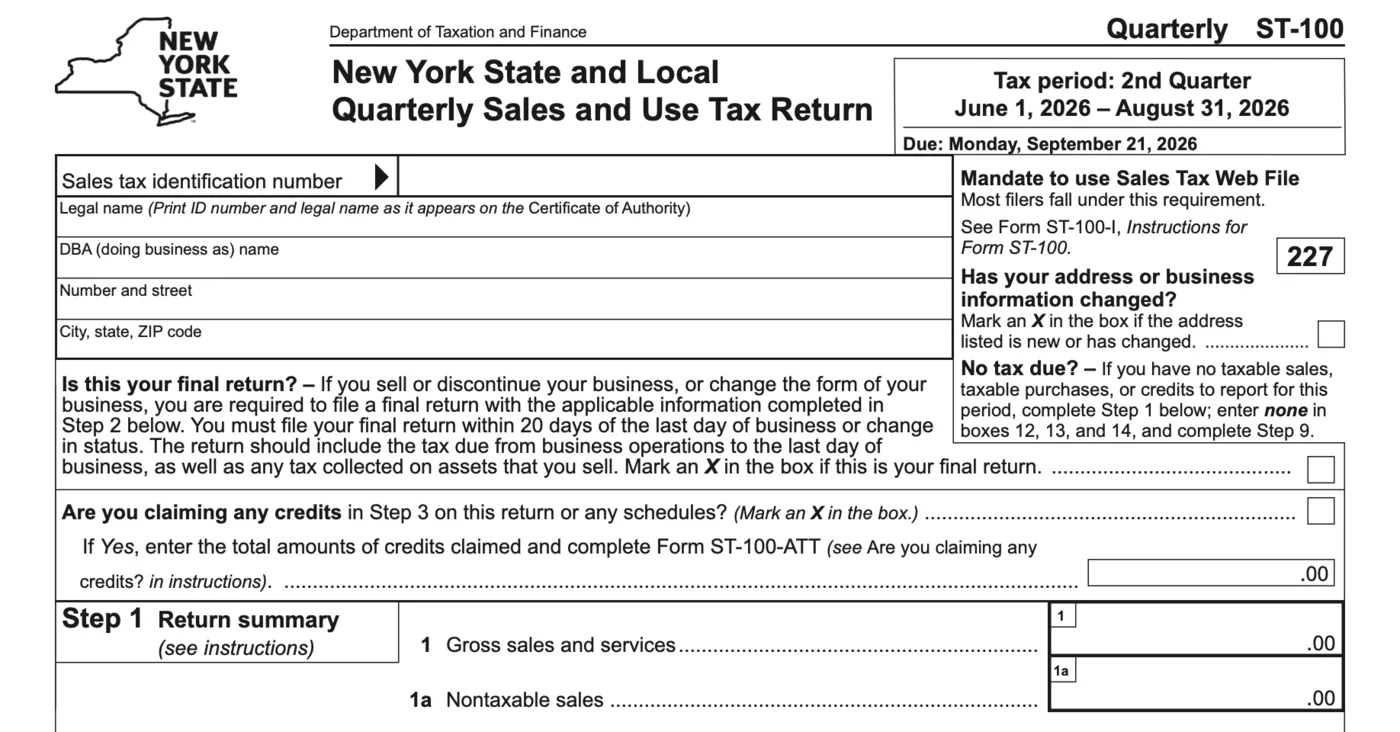
A quarter with no shows still needs a return. The form's "No tax due?" box says to complete Step 1, enter none in boxes 12, 13 and 14, and complete Step 9. Web File handles no-tax-due returns too. Skipping it costs $50.
File on time and pay in full, and you keep a vendor collection credit. The ST-100 instructions set it at 5% of the tax reported, to a $200 maximum. Vendors who owe $3,000 or less in a year may be moved to the annual ST-101, due March 20. If you stop selling in New York, file a final return within 20 days of your last day of business.
Penalties
Selling without a valid Certificate of Authority costs up to $500 for the first day and up to $200 for each day after, to a $10,000 maximum. A two-day show with no certificate can cost $700 before any tax is counted. The figures are in bulletin Sales and Use Tax Penalties (TB-ST-805).
| What went wrong | Civil penalty |
|---|---|
| Selling without a required certificate | Up to $500 the first day, up to $200 each later day, $10,000 maximum |
| Certificate not displayed | $50 |
| Return with no tax due filed late or not filed | $50 |
| Return filed 60 days late or less | 10% of the tax for the first month, 1% for each added month, 30% maximum, $50 minimum |
| Filed on time, tax not paid | 10% of the tax for the first month, 1% for each added month, 30% maximum |
| Promoter lets an unregistered vendor sell | Up to $10,000 for each show |
The tax itself is still owed on top, with interest. The same bulletin lists crimes for willfully failing to collect or remit.
Buying from other dealers: the ST-120
Once you hold a Certificate of Authority you can buy inventory tax free by giving the seller form ST-120, the Resale Certificate. Part 1 of the form has a box for a New York vendor, "show vendor or entertainment vendor," with your sales tax identification number. Mark it blanket to cover repeat buys from the same dealer.
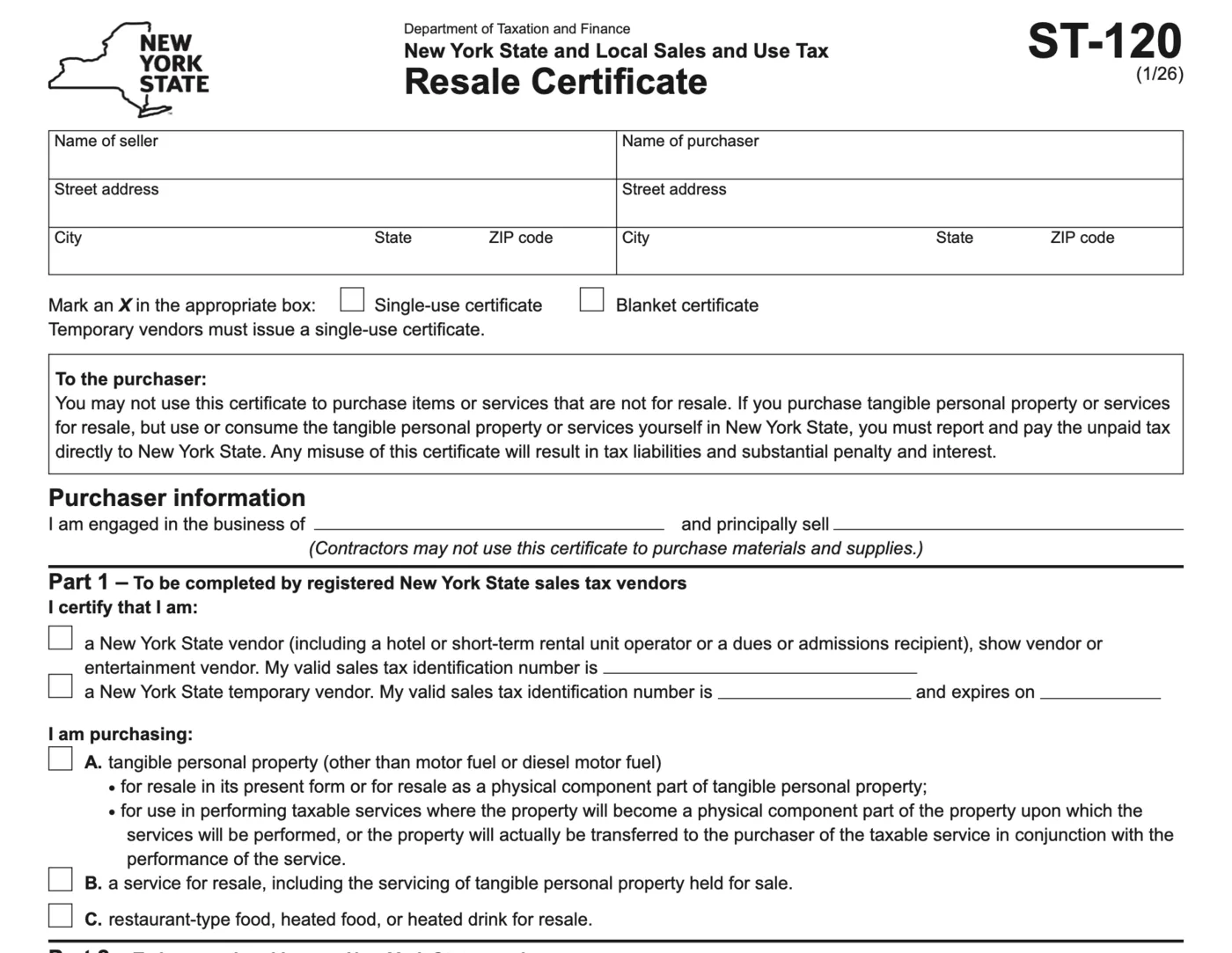
The bulletin on exemption certificates (TB-ST-240) says the buyer must hand it over within 90 days of the sale. The seller accepts it in good faith and keeps it. When you are the seller, a dealer with no certificate pays tax like any other buyer. An out-of-state dealer who is not registered in New York uses Part 2, for cards to be resold from a business outside the state.
Most dealer-to-dealer buys at shows are cash with no certificate. If the other dealer charged you tax, that tax is part of your cost of the card. The written receipt described in the cost basis guide is what proves it.
Cash, trade-ins and other table cases
Cash changes nothing: a cash sale is taxed at the same rate as a card payment and belongs on the same return. Bulletin TB-ST-860 says you must separately state the sales tax on any receipt or invoice you give the customer.
Trade-ins lower the taxable amount. The same bulletin covers a seller who takes a trade-in, reduces the price and plans to resell the item. Tax is then due only on the reduced price. Its example is a car, but the rule is written for any seller. As an example, a buyer takes a $500 card and you credit $200 for a card you will resell. Our reading is that tax applies to $300, which is $24.00 at Albany's 8%.
A card handed over at the table is delivered in New York, whatever state the buyer lives in. The state's rate page says the point where possession transfers decides the tax. A weekend that crosses state lines means two sets of rules, and New York's cover only the New York table.
New York asks you to keep a record of every sale, its amount and its tax for at least three years, per TB-ST-770. Our free card show cash log is one way to do it on paper, and how to track card show sales covers the rest.
What the promoter handles: DTF-727
The promoter reports you; the promoter does not collect for you. A promoter who runs four or more shows in a calendar year needs a Permit to Operate a Show, applied for on form DTF-723. That promoter may allow only registered vendors to sell.
You give the promoter a statement with your legal name, physical and mailing address and Certificate of Authority number. After each show the promoter files form DTF-727, Report of Show, due the 20th of the following month. The DTF-727 instructions say every vendor must give a New York certificate number, "not another state's number."
The table fee itself is a different matter. A 1997 advisory opinion, TSB-A-97(7)S, answered a sports card show promoter. The Department said the fee a vendor pays for space was not subject to sales tax. Advisory opinions are limited to their own facts.
eBay and Whatnot versus your table
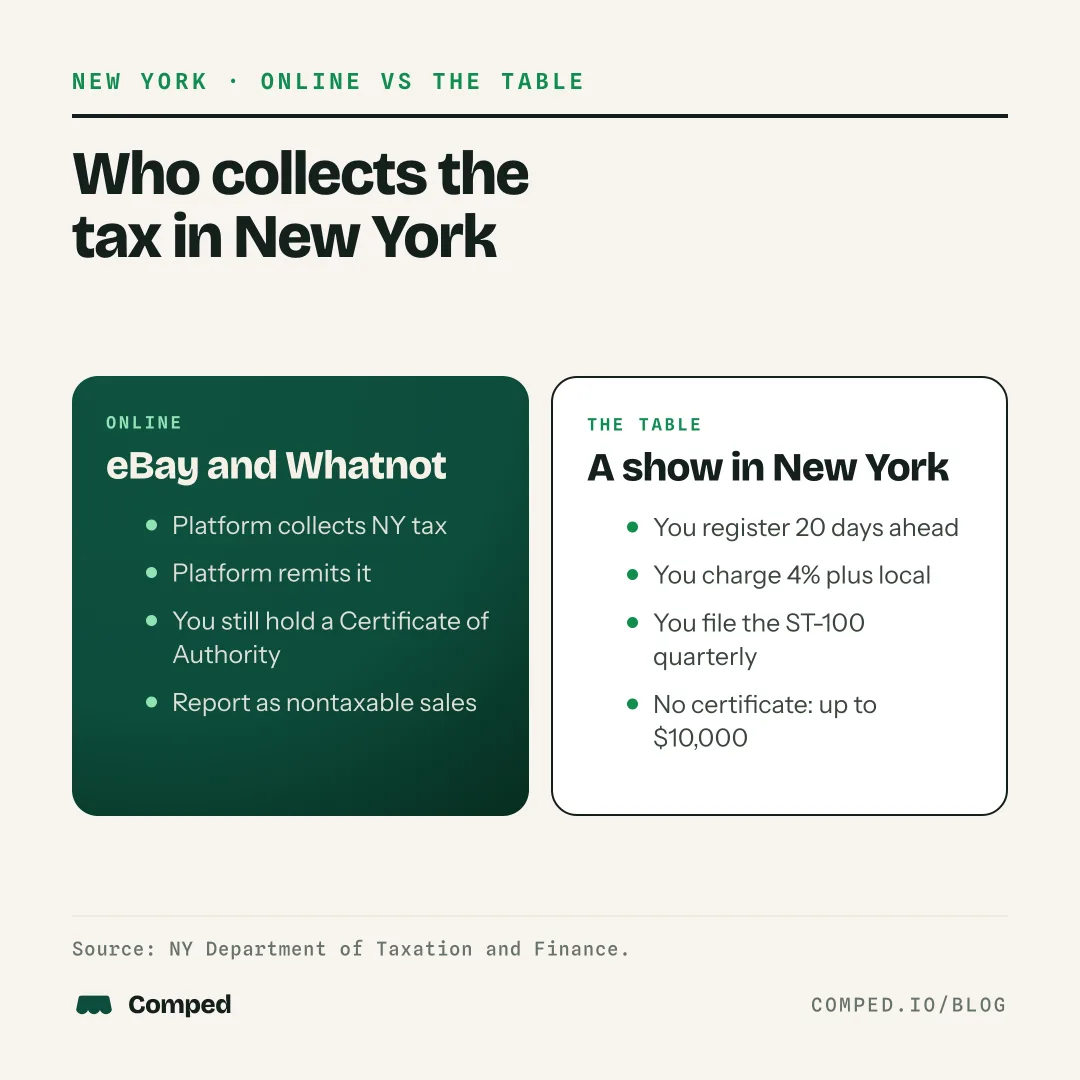
eBay has collected and remitted New York sales tax on eBay sales since June 1, 2019, per its marketplace tax page. Whatnot collects where required. You cannot opt out. But a registered vendor still reports those sales. The state's marketplace guidance says to include them in gross sales and again in nontaxable sales.
The same page answers a New York home seller who sells only through a marketplace: yes, register and file returns anyway. Your table is yours either way. Sales not facilitated by a marketplace are yours to tax, collect and remit, and that is every card that crosses the table.
THE RULE MOST VENDORS GET WRONG
There is no temporary permit for a New York card show. Show vendors must hold a regular Certificate of Authority, applied for at least 20 days before the show. Without one the state can charge up to $500 for the first day and $200 for each day after.
Common mistakes and what they cost
- Applying the week of the show. The law asks for 20 days, and no sale is legal until the mailed certificate arrives.
- Looking for a one-day permit. Show vendors cannot use the temporary certificate at all.
- Charging your home county's rate. A Nassau dealer in Buffalo charges Erie's 8.75%, not 8.625%.
- Skipping the return for a quiet quarter. That is $50 each time, with no tax due.
- Spending the tax. The DTF-17 instructions tell vendors to keep sales tax in a separate bank account.
- Handing the promoter a New Jersey or Pennsylvania number. The Report of Show takes New York numbers only.
- Assuming eBay's collection covers the table. It covers eBay orders only.
If you already sold without a certificate
Register now, before the next show, and report the past sales. New York runs a Voluntary Disclosure and Compliance Program. The Department says eligible taxpayers who owe back taxes and have not filed can avoid monetary penalties and possible criminal charges. They do it by telling the Department what they owe, paying it and agreeing to pay future taxes.
Eligibility has conditions, so read the program page or ask a CPA before you apply. If you are registered and only missed returns, file them now. The late penalties in the table above apply.
New York's 1099-K floor
New York is not on the platforms' lists of lower state 1099-K thresholds, so the federal rule applies. Platforms file a 1099-K when your gross payments exceed $20,000 and your transactions exceed 200 in the year, per platform. The IRS FAQs issued after the July 2025 law set that out. New York is absent from Whatnot's list of lower state thresholds for 2026, and from our state by state 1099-K table.
A form is a reporting rule, not a tax rule. You owe income tax on profit whether or not a 1099-K arrives, and the 1099-K guide covers what each platform reports.
A show weekend, worked
Here is an example: a $4,000 weekend at a table in White Plains, at the city's combined rate of 8.375%. The same weekend in Manhattan would collect $355.00 at 8.875%.
AN EXAMPLE $4,000 WEEKEND IN WHITE PLAINS, WORKED
Two days at a White Plains show, $4,000.00 in card sales, every sale taxed at 8.375%, the only sales of the quarter.
The $335.00 was never your money. Collected sales tax is held for the state and sent in with the return. Your gross sales for income tax are $4,000.00, and profit is that figure less the cost of the cards and your show expenses. The card show profit calculator runs that math for a table. A buyer who pays more than $10,000 in cash for one card triggers Form 8300, a separate federal duty.
New York's recurring shows
New York's regular card shows include the White Plains show at the Westchester County Center, the Long Island shows, and the Buffalo shows. One Certificate of Authority covers all of them; the rate you charge changes with the venue. The 2026 card show sales tax index compares New York with every other state.
How this looks in the Comped app
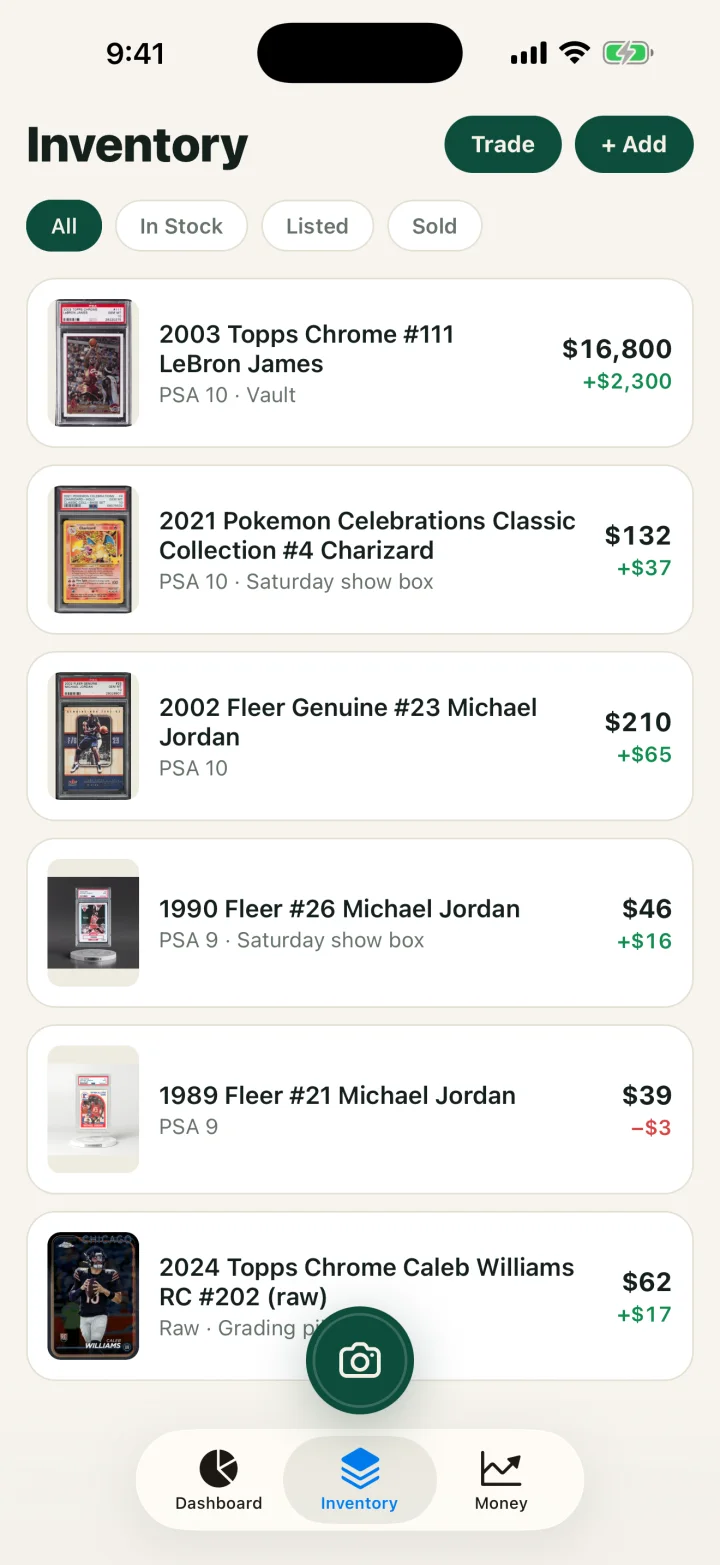
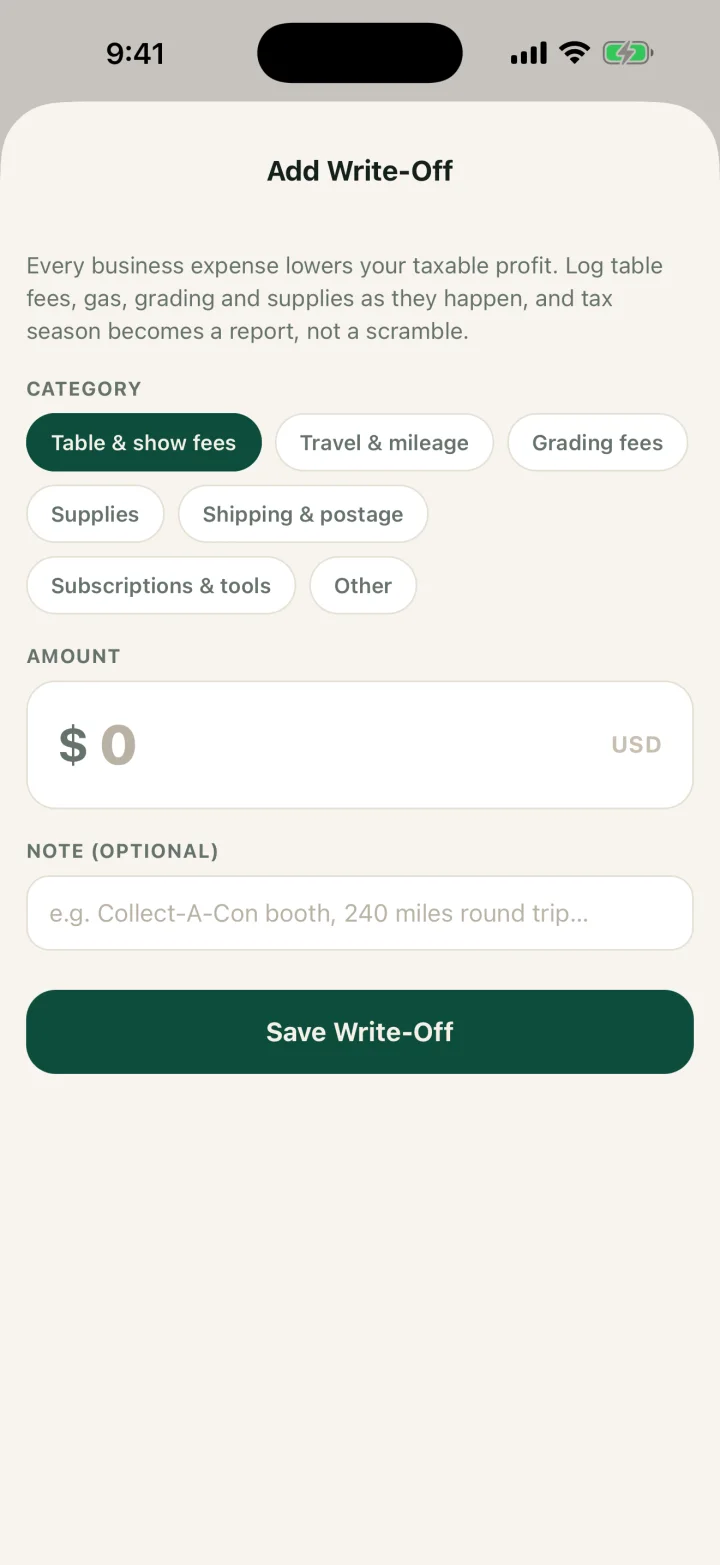
These are real screens from the current iPhone app, with demo data. The app does not compute, record or file sales tax. It keeps the sale and cost records that the return and your income tax both start from.

Related guides
- State by State: Sales Tax and Show Permits for Card Vendors: every state's permit, rate and rules in one place.
- New Jersey card show sales tax (2026): one 6.625% rate and a 15 business day registration clock.
- Pennsylvania card show sales tax (2026): the Transient Vendor Certificate and the 30 day notice before each show.
- How to become a card show vendor: the first table, from booking to load-out.
- Form 8300 for card dealers: what happens when someone pays $10,000 cash for a card.
FAQ
Do I need a permit to sell at a single card show in New York?
Yes. New York requires a regular Certificate of Authority even for isolated or occasional show sales, and show vendors cannot use a temporary certificate. Apply through NY Business Express at least 20 days before the show. The certificate is not tied to one show, so the same one covers later shows.
How much does a New York Certificate of Authority cost and how long does it take?
The state's instructions and its Business Express listing show no application fee. The listing gives an average processing time of 5 days, and the certificate is then mailed. The law asks you to apply at least 20 days before your first sale, and you cannot sell until you hold it.
What sales tax rate do I charge at a card show in New York?
Charge the combined rate where the show is held. Publication 718 lists 8.875% in New York City, 8.375% in White Plains and 8.625% in Nassau. Suffolk and Erie are 8.75%, and Monroe, Onondaga and Albany counties are 8%. Use the state's address lookup for any other venue.
Do I have to file a sales tax return if I had no sales this quarter?
Yes. Once you hold a Certificate of Authority you file every period, even with no sales. On the ST-100 you complete Step 1, enter none in boxes 12, 13 and 14, and sign. A late or missing no-tax-due return costs $50.
Does the promoter collect it for me?
No. The promoter checks that you hold a Certificate of Authority and lists you on the Report of Show, form DTF-727. Collecting the tax at the table and filing the quarterly ST-100 are yours.
Does eBay handle all of my sales tax?
eBay collects and remits New York tax on eBay sales, and has since June 1, 2019. A registered vendor still reports those sales on the return as gross sales and as nontaxable sales. Table sales are yours to tax and remit.
I travel to shows in other states, do their rules apply to me?
Yes. New York's show vendor rule applies to an out-of-state dealer the same as a resident. The promoter's report takes only a New York certificate number. The same logic sends you to New Jersey's and Pennsylvania's rules when you cross their lines.
Can I buy inventory tax-free with a resale certificate?
Yes, once you hold a Certificate of Authority. Give the seller a completed form ST-120 within 90 days of the sale and no tax is due on that purchase. You charge the combined rate when the card sells at retail. If you paid tax on a cash buy with no certificate, that tax is part of your cost of the card.
SOURCES
- How to Register for New York State Sales Tax (TB-ST-360), New York State Department of Taxation and Finance, checked November 13, 2026.
- Do I Need to Register for Sales Tax? (TB-ST-175), New York State Department of Taxation and Finance, checked November 13, 2026.
- Instructions for Form DTF-17 (2/24), New York State Department of Taxation and Finance, checked November 13, 2026.
- Register as a sales tax vendor, New York State Department of Taxation and Finance, checked November 13, 2026.
- Application to Register for a Sales Tax Certificate of Authority, New York Business Express, checked November 13, 2026.
- TSB-M-08(13)S, Certificates of Authority for Show and Entertainment Vendors, New York State Department of Taxation and Finance, checked November 13, 2026.
- Publication 718, Sales and Use Tax Rates by Jurisdiction, effective March 1, 2025, New York State Department of Taxation and Finance, checked November 13, 2026.
- Filing Requirements for Sales and Use Tax Returns (TB-ST-275), New York State Department of Taxation and Finance, checked November 13, 2026.
- Form ST-100 (6/26) and its instructions, New York State Department of Taxation and Finance, checked November 13, 2026.
- Sales and Use Tax Penalties (TB-ST-805), New York State Department of Taxation and Finance, checked November 13, 2026.
- Exemption Certificates for Sales Tax (TB-ST-240) and Form ST-120 (1/26), New York State Department of Taxation and Finance, checked November 13, 2026.
- Taxable Receipt: Discounts, Trade-Ins and Additional Charges (TB-ST-860) and Recordkeeping Requirements for Sales Tax Vendors (TB-ST-770), New York State Department of Taxation and Finance, checked November 13, 2026.
- Instructions for Form DTF-723 (2/19) and Form DTF-727, Report of Show (3/18), New York State Department of Taxation and Finance, checked November 13, 2026.
- Advisory Opinion TSB-A-97(7)S, sports card and memorabilia show, New York State Department of Taxation and Finance, checked November 13, 2026.
- Sales tax requirements for marketplace providers, New York State Department of Taxation and Finance, checked November 13, 2026.
- Voluntary Disclosure and Compliance Program, New York State Department of Taxation and Finance, checked November 13, 2026.
- Taxes and import charges, eBay, checked November 13, 2026.
- 2026 Form 1099-K for U.S. Sellers, Whatnot, checked November 13, 2026.
- IRS issues FAQs on Form 1099-K threshold, IRS, checked November 13, 2026.
This is general information for card sellers, not tax or legal advice for your situation. Rules change and states differ; a CPA who knows your numbers wins every time.