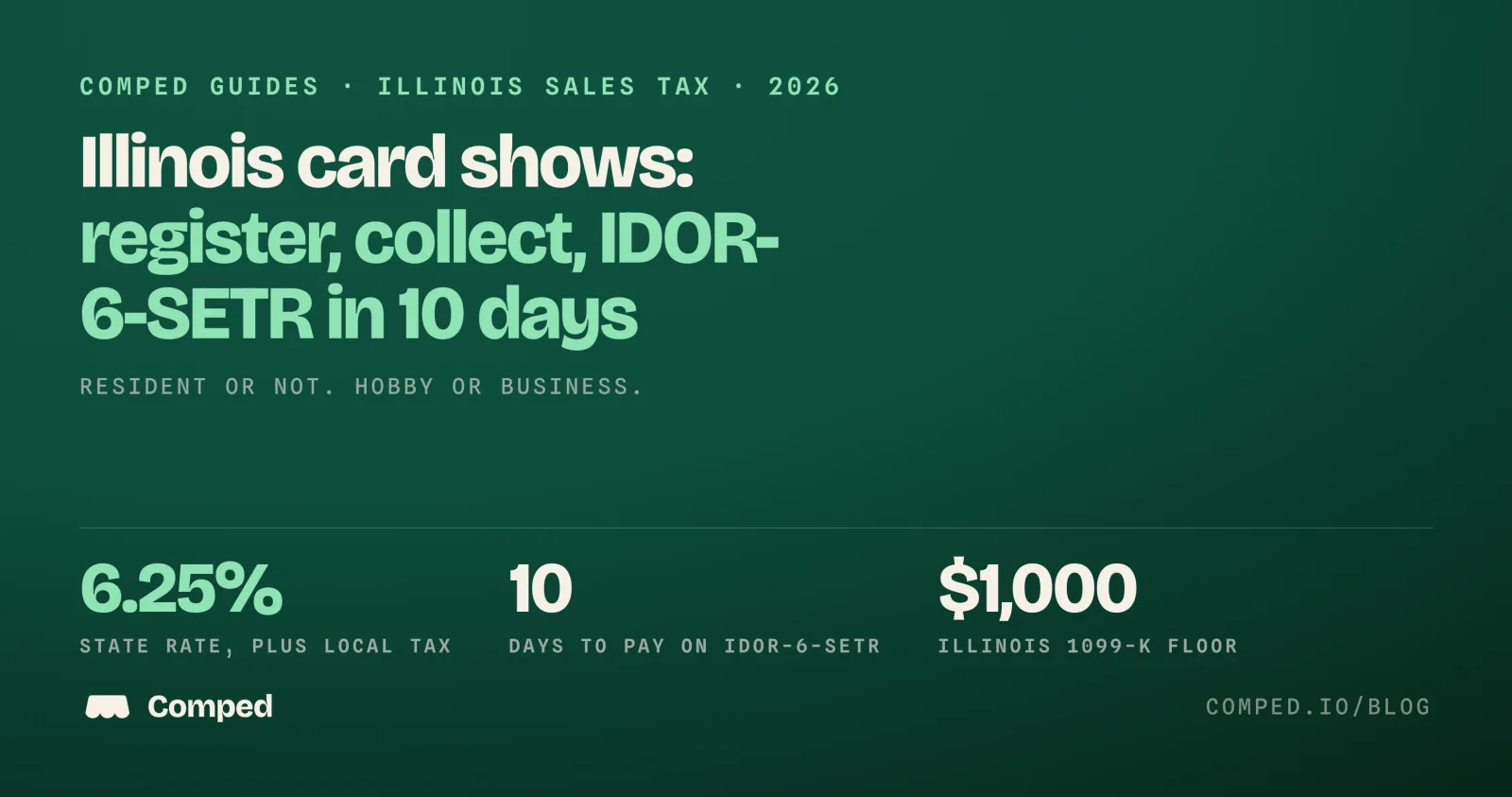
Who has to collect at an Illinois show
Everyone selling at the show. IDOR's page on taxes at fairs, festivals, pop-up events, flea markets and craft shows says that if you sell merchandise there, you are a retailer. You must collect, report and remit Illinois Retailers' Occupation Tax, which is the state's sales tax.
Illinois closes the hobby door in the same paragraph. Whether your sales are a full-time business or a hobby, you are subject to these requirements. A collector thinning a binder at one show collects tax like the dealer next to him.
| Who you are | Register with IDOR? | How the show's tax is paid |
|---|---|---|
| Illinois dealer with a shop or a home business | Yes, and add "changing location" if you travel to events | IDOR-6-SETR for the event, then the receipts on your ST-1 |
| Illinois seller who only does shows | Yes, as a changing location filer | IDOR-6-SETR for the event, then the receipts on your ST-1 |
| Out-of-state dealer at one Illinois show | Yes. IDOR says residents or not | IDOR-6-SETR within 10 days of the close |
| Hobby seller at one show | Yes. Hobby sales are covered | IDOR-6-SETR within 10 days of the close |
| Any seller at an event IDOR has not registered | Yes, directly with IDOR | Form ST-1, since no coupon exists for the event |
Trading cards are taxable general merchandise in Illinois, slabs included. Hobby or business for income tax is a separate question, covered in our guide to taxes on selling sports cards. The state by state sales tax guide covers every state's table rules.
How to register with IDOR
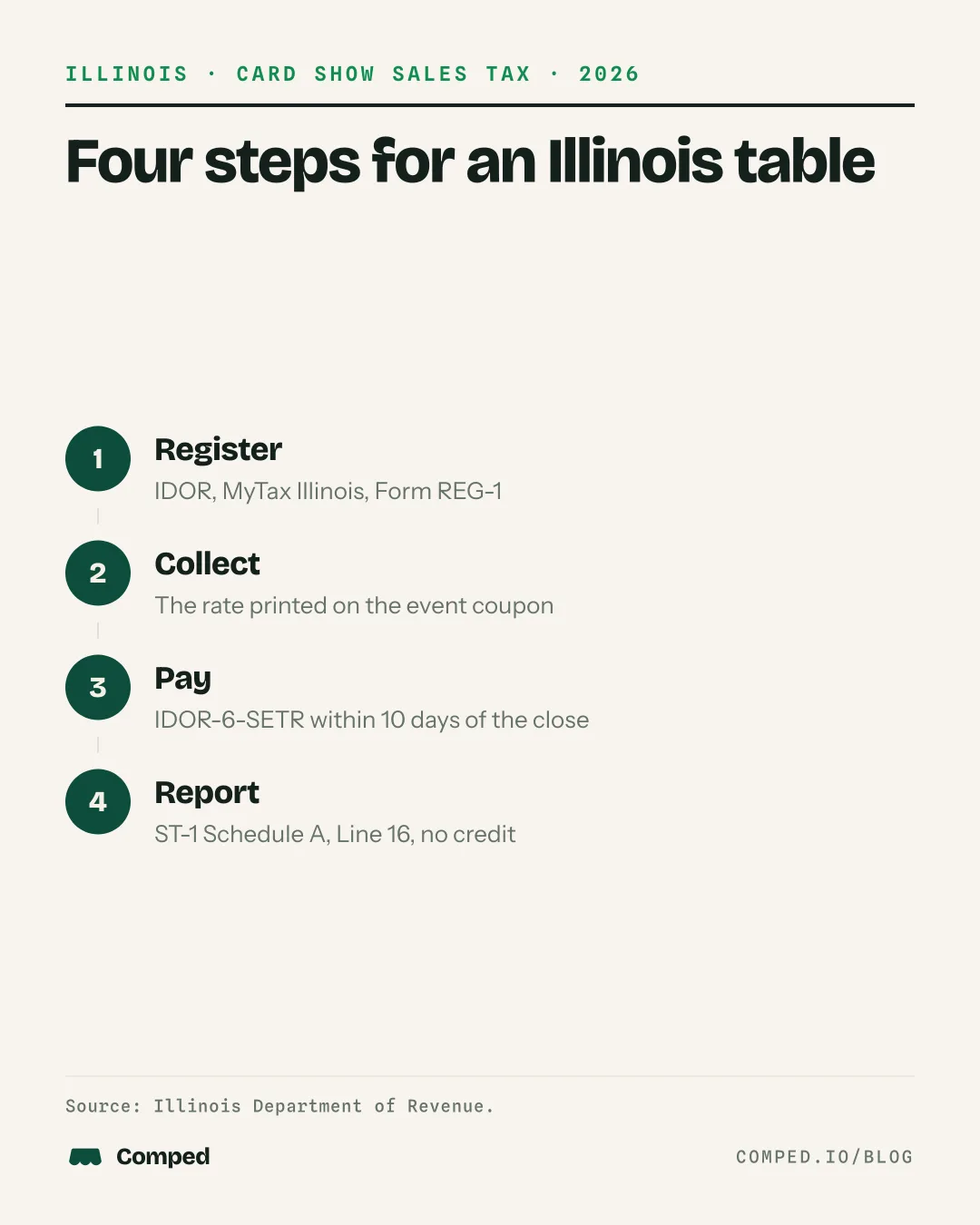
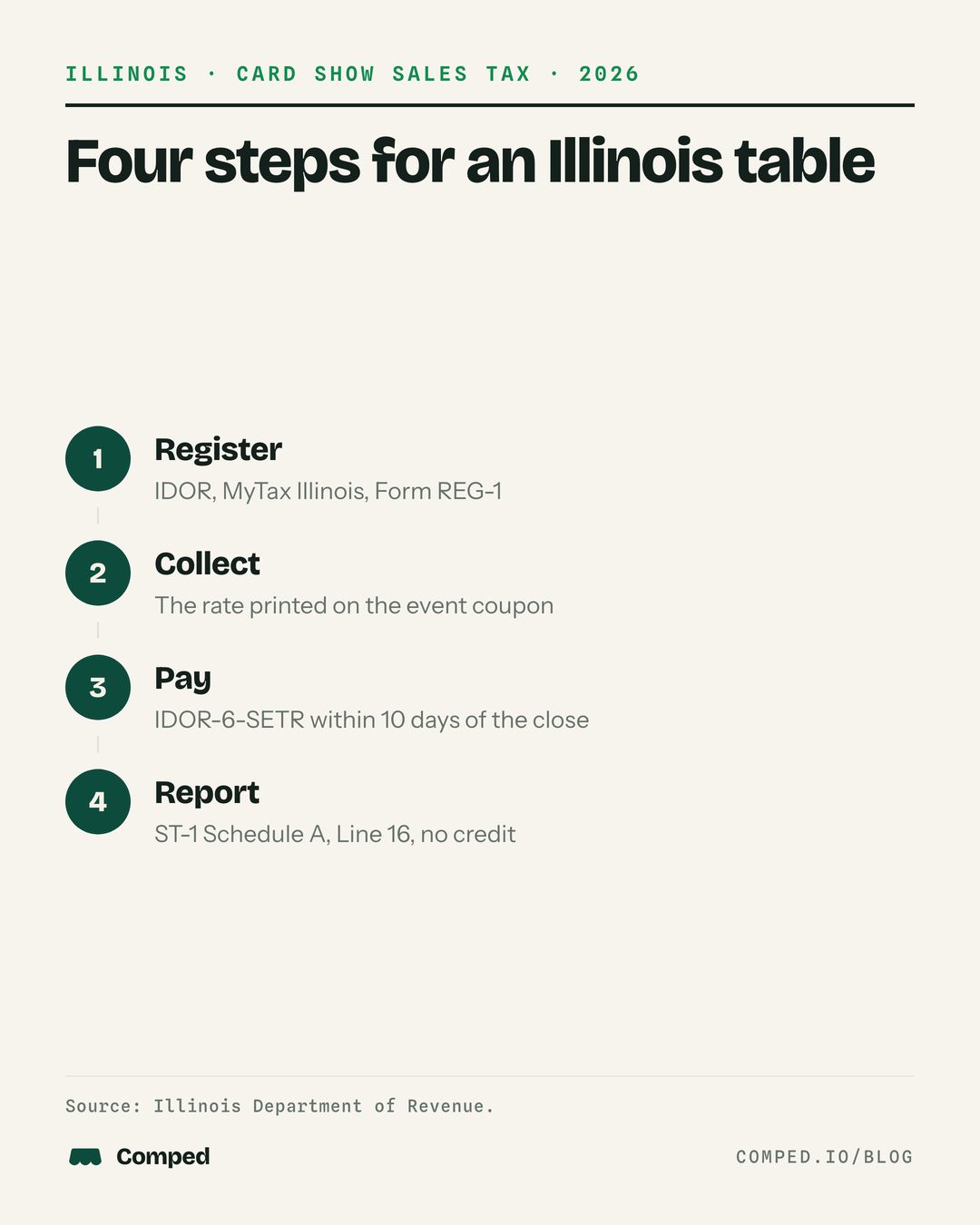
Register online through MyTax Illinois by choosing "Register a New Business (Form REG-1)." IDOR's registration page says online applications take about one to two business days. A mailed paper REG-1 takes four to six weeks. The page lists no fee.
IDOR's answer on registration is blunt. All business and individual taxpayers, Illinois residents or not, must register for each tax they will collect. That holds even if you sell only at special events, and failing to register is a criminal offense.
Pick the right filer type. IDOR says that if you routinely travel to special events, or travel to one or more events each year, you must register as a "changing location" filer. That is every card show dealer without a storefront.
IDOR issues a Certificate of Registration electronically. You print it from your MyTax Illinois account under "View Account Letters." Bring a copy, since the organizer has to report your Illinois account ID.
There is no per-show notice for the vendor. That differs from Pennsylvania's 30 day notice and New York's 20 day registration lead. In Illinois the notice duty sits with the organizer.
What Form IDOR-6-SETR is
Form IDOR-6-SETR is the Special Event Tax Collection Report and Payment Coupon. It is a one page form on which a vendor reports the receipts from one event and pays the tax. The vendor files it, not the organizer.
You cannot download a blank one from IDOR's forms page. IDOR prints each coupon for one registered event, with the event name, address, dates, a location code and the tax rate already filled in. It mails a packet of them to the organizer, who hands one to each vendor.
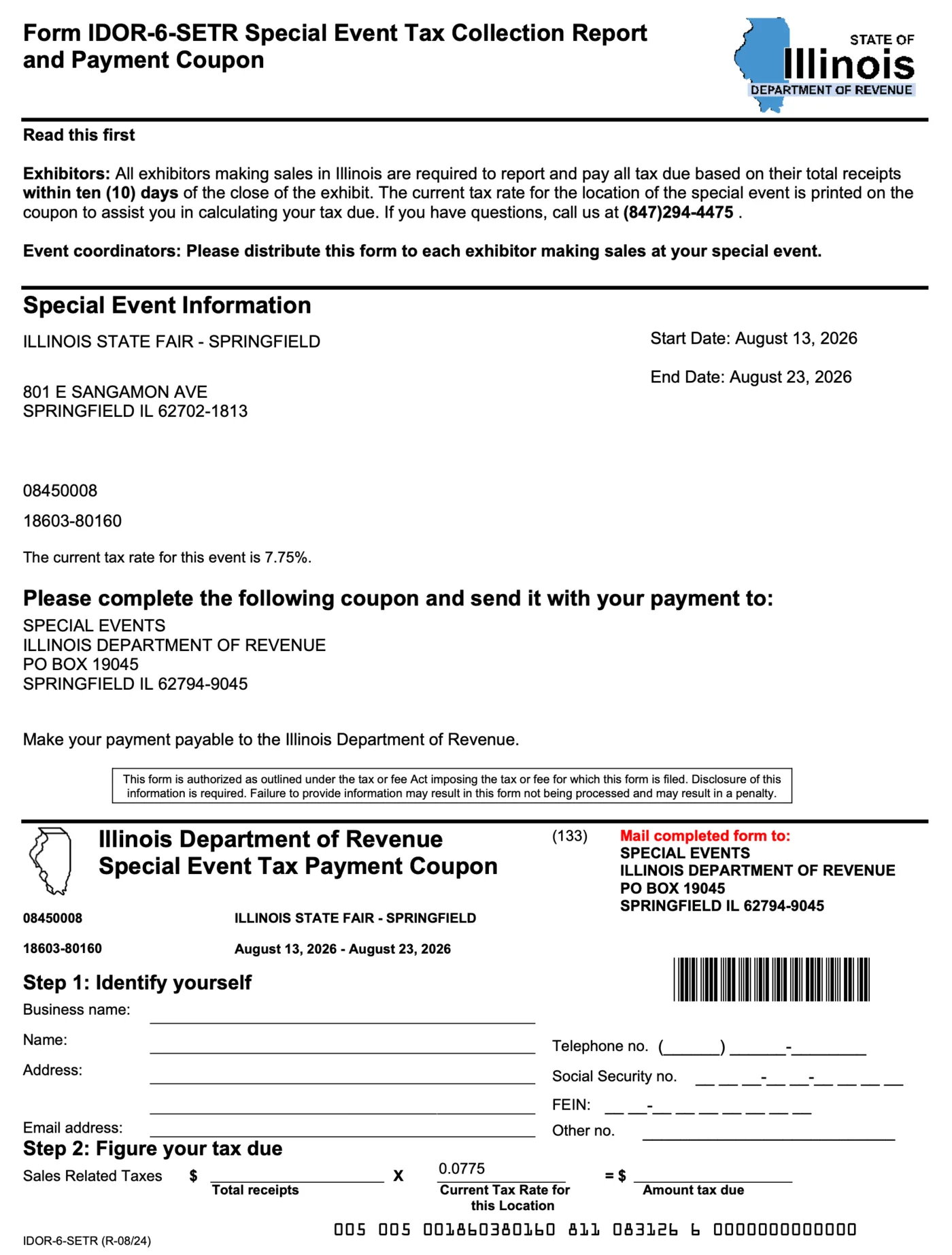
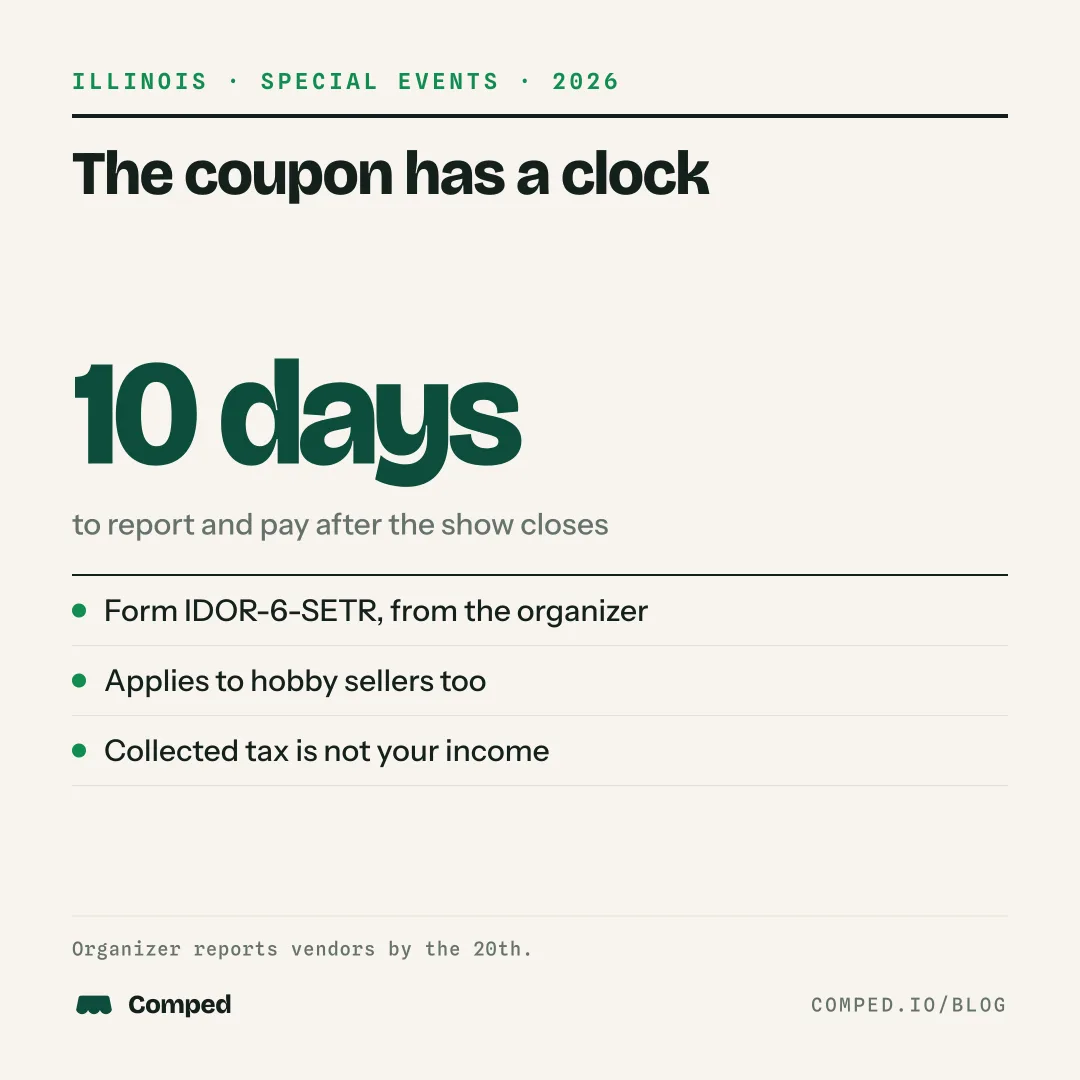
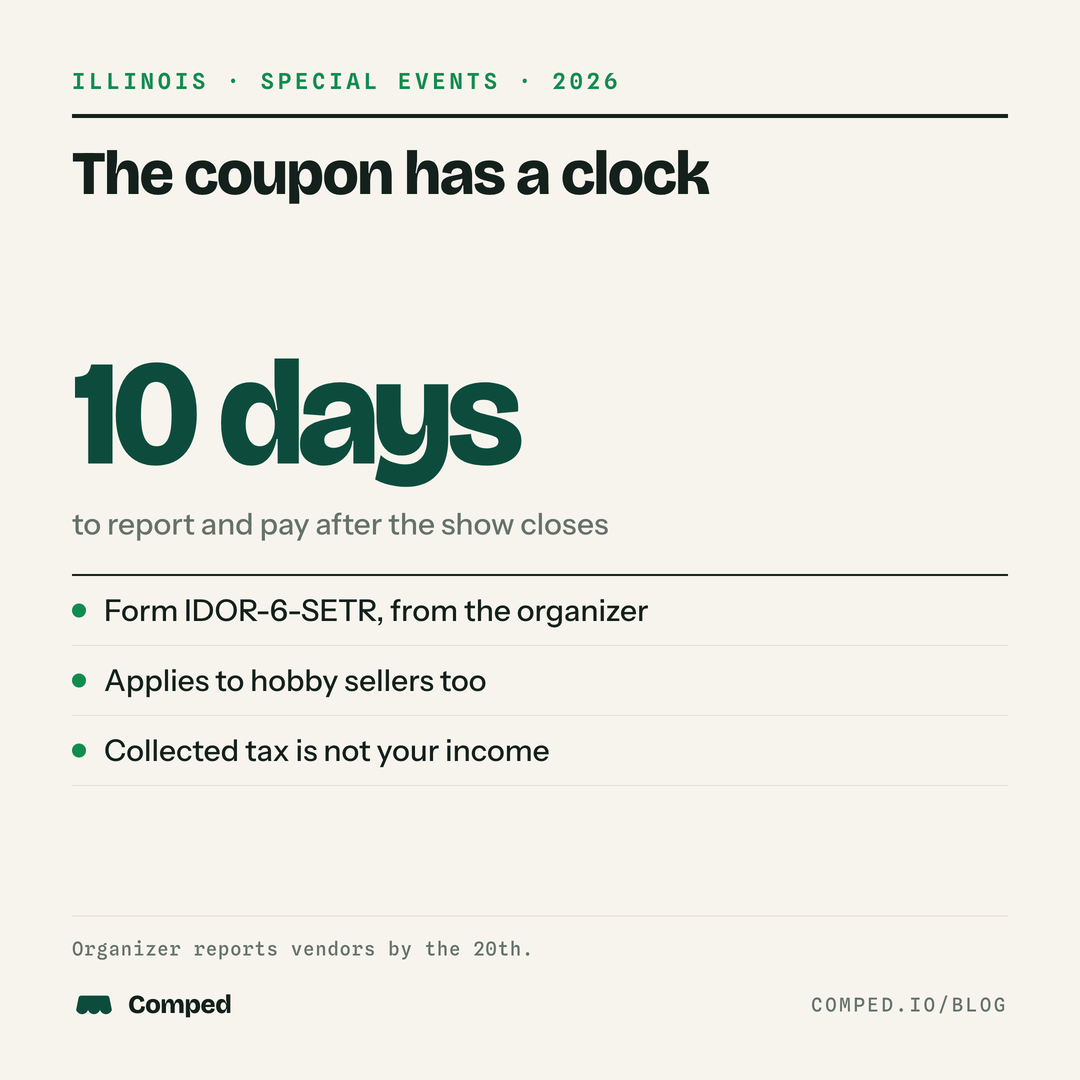
The deadline is printed at the top. All exhibitors making sales in Illinois must report and pay all tax due on their total receipts within ten days of the close of the exhibit.
How to fill in Form IDOR-6-SETR
The coupon has two steps, and the arithmetic is one multiplication. Here is each part of the R-08/24 version.
| Part of the coupon | What goes there |
|---|---|
| Special Event Information | Already printed: event name, address, start and end dates, location code, and "the current tax rate for this event" |
| Step 1, Business name and Name | Your business name if you have one, and your own name |
| Step 1, Address, Email, Telephone | Your permanent address and contact details |
| Step 1, Social Security no. or FEIN | The number your registration is under |
| Step 1, Other no. | Our reading: your Illinois account ID, which the daily version of the form asks for by name |
| Step 2, Total receipts | Your sales at this event, in dollars |
| Step 2, Current Tax Rate for this Location | Already printed as a decimal, for example 0.1025 |
| Step 2, Amount tax due | Total receipts multiplied by the printed rate |
Make the payment payable to the Illinois Department of Revenue. Mail the coupon and payment to Special Events, Illinois Department of Revenue, PO Box 19045, Springfield IL 62794-9045. That address is printed twice on the form.
One point the form leaves open is whether "total receipts" means before or after tax. Our reading is that you enter sales before tax when you added tax on top. If your prices included tax, ask the Special Events Coordinator at 847 294 4475 before you fill it in.
Some large events use a daily version, Form IDOR-6-SETD. It lists gross receipts for each day of the event and prints its own postmark date in place of the ten day rule. It also lets a registered retailer tick a box and pay the amount with the ST-1 or through MyTax Illinois.
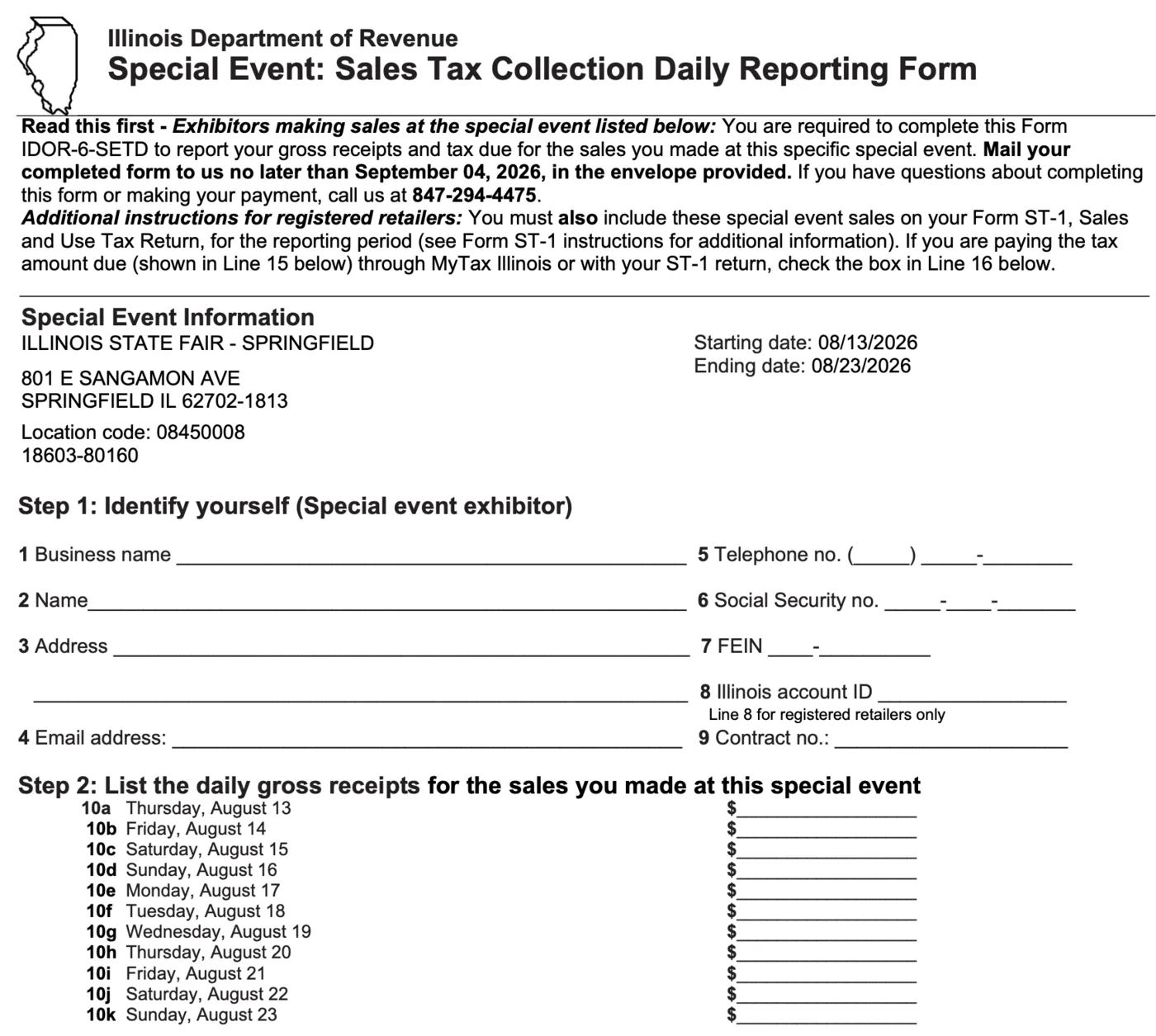
If the organizer gives you no form
You still owe the tax, and how you pay depends on whether IDOR registered the event. IDOR's fairs page gives two routes. If its Special Events Coordinator registered the event, you get a reporting and payment form for it. If not, you register directly with IDOR and report the sales on Form ST-1.
To find out which applies, email Rev.SpecialEvents@illinois.gov or call 847 294 4475 on a weekday. IDOR says that if nobody contacts you at an event, collecting at the proper rate and remitting is still your responsibility. Ask the organizer before the show whether the event is registered.
THE RULE MOST VENDORS GET WRONG
A registered retailer who pays at the event still reports those receipts on the regular return. IDOR says to write the event receipts, including tax, on Line 16 of Schedule A of Form ST-1. Do not show the tax paid at the event as a credit on the front of the return.
What rate to charge, by show city
Charge the combined rate printed on the event's coupon. The state general merchandise rate is 6.25%, per IDOR's rate answer, and local taxes stack on top. IDOR publishes no single list of local rates. It points sellers to the Tax Rate Finder at mytax.illinois.gov for a specific address.
The rates below are ones we could read on an IDOR coupon or an organizer's own page this year. Look up any other address in the Tax Rate Finder before you price.
| Location | Where the figure comes from | Rate |
|---|---|---|
| Illinois, state rate only | IDOR rate answer, general merchandise | 6.25% |
| Rosemont, the National | The National's dealer FAQ, for the 2027 show | 10.25% |
| Chicago, 701 S Dearborn St | IDOR-6-SETR printed for an August 2026 event at that address | 10.25% |
| Springfield, Illinois State Fairgrounds | IDOR-6-SETR printed for the August 2026 fair | 7.75% |
For the National, the organizer does the lookup for you. The National's dealer FAQ tells dealers that the sales tax rate in Illinois is 10.25% and that the forms come in the vendor packet. Check the rate on the coupon itself, since that is the figure IDOR expects.
| Illinois item | Rule for show vendors | Figure |
|---|---|---|
| State sales tax rate | General merchandise, before local tax | 6.25% |
| Registration | MyTax Illinois, Form REG-1, about 1 to 2 business days, no fee listed | REG-1 |
| Paper registration | Mailed Form REG-1, processing time in weeks | 4 to 6 |
| Show payment | Special Event Tax Collection Report and Payment Coupon | IDOR-6-SETR |
| Show deadline | Days after the event closes to report and pay | 10 |
| Regular return | Monthly, quarterly or annual, due the 20th after the period, zero returns required | ST-1 |
| Late filing penalty | The lesser of 2% of the tax or | $250 |
| Organizer notice | Days before the event, to IDOR | 30 |
| Organizer vendor report | Due the 20th of the month after the event; fine up to | $250 |
| Resale certificate | Certificate of Resale, update at least every 3 years | CRT-61 |
| State 1099-K floor | Payments over $1,000 and more than 3 transactions | $1,000 |
| Remote seller nexus | Illinois sales in a 12 month lookback, no transaction count from 2026 | $100,000 |
The timeline, counted from show day
Start two weeks out and you are done ten days after the show closes. The dates in the right column are an example using the 2027 National, which the organizer lists as closing on Sunday, August 1, 2027.
| When | What you do | Example date |
|---|---|---|
| 30 days before | The organizer's notice to IDOR is due. Ask whether the event is registered | Late June 2027 |
| 14 days before | Register on MyTax Illinois as a changing location filer | Mid July 2027 |
| 7 days before | Print your Certificate of Registration. Pack a cash log and CRT-61 copies | Third week of July |
| Show day | Collect the coupon from the organizer. Charge the printed rate on every sale | July 28 to August 1 |
| Close of show | Total your receipts for the event | August 1, 2027 |
| 10 days after close | Mail IDOR-6-SETR and payment to Springfield | By August 11, 2027 |
| 20th of the next month | Monthly filers: ST-1 for August with the event on Schedule A, Line 16 | September 20, 2027 |
| 20th after the quarter | Quarterly filers: the same entry on the third quarter ST-1 | October 20, 2027 |
The card show vendor checklist has the rest of what to pack.
The ST-1 after the show, and zero returns
Once you are registered, Form ST-1 is due every period, show or no show. IDOR's Publication 113 page on Form ST-1 says you must file for each reporting period whether or not there are receipts. With nothing to report, you file a "zero" return.
Returns are due the 20th of the month after the period. IDOR assigns monthly or quarterly filing when you register, and some accounts later qualify to file once a year, due January 20. A due date on a weekend or state holiday moves to the next business day.
For the period that holds a special event, IDOR's fairs page gives the steps:
- Include the event receipts in total receipts on Line 1.
- Write the event receipts, including tax, on Schedule A, Line 16, labelled "special event collections."
- Carry your total deductions to Line 2, then figure tax on what is left on Line 3.
- Leave the event off Form ST-2 if you file one.
- Claim no credit on the front of the return for tax paid at the event.
The effect is that the event's sales are counted once. You paid that tax on the coupon, so the ST-1 backs it out. IDOR will require electronic filing if your annual gross receipts average $20,000 or more.
Comped records each table sale with its price, venue and date, so one show's total receipts are already added up when you fill in the coupon.
Penalties
A late or missing return costs a penalty plus interest, and selling unregistered is a crime on paper. IDOR's fairs page says failing to register is a criminal offense.
IDOR's Publication 103 (September 2025) sets the money penalties. The late filing penalty is the lesser of $250 or 2% of the tax required to be shown on the return. Ignore a notice of nonfiling for 30 days and a second penalty applies: the greater of $250 or 2% of the tax, capped at $5,000.
Late payment has its own penalty. It is 2% of the unpaid tax when you pay 1 to 30 days late and 10% after that. Tax first paid after an audit or investigation starts carries 15%.
Buying inventory with a resale certificate
Yes, a registered dealer can buy cards for resale without paying sales tax. IDOR's resale certificate page says Illinois businesses may buy items tax free to resell, using Form CRT-61 or their own certificate. The seller keeps a copy, and certificates should be updated at least every three years.
At a show this works in both directions. When you buy from another dealer for resale, hand over a completed CRT-61. When a dealer buys from you for resale, keep his certificate with your records, because that sale is your deduction to prove.
Most show buys between dealers are cash with no certificate. If the other dealer charged you tax, that tax is part of your cost of the card. The cost basis guide covers the receipt that proves a cash buy, and a trade is covered there too.
eBay and Whatnot versus your table
eBay collects and remits Illinois sales tax on eBay orders, and Whatnot collects where required. eBay's marketplace tax page lists Illinois from January 1, 2020. From January 1, 2026, IDOR's Bulletin FY 2026-12 makes $100,000 of Illinois sales the only remote seller test; the 200 transaction count no longer applies.
The table is yours. Marketplace facilitator laws reach the marketplace's own sales only, so every card sold face to face at an Illinois show is collected and remitted by you. Cash sales count the same as card sales.
What the organizer reports
The organizer tells IDOR about the event and about you, but does not pay your tax. IDOR requires anyone who promotes, organizes or provides retail selling space at an event to notify it at least 30 days before the start. The notice gives the event name, address, dates and a contact. IDOR then mails the packet of coupons.
After the show, the organizer reports each vendor no later than the 20th of the month after the event. The report lists your business name, the people in the business, your permanent address and your Illinois account ID. Missing it is a business offense with a fine of up to $250.
That report is how IDOR knows who sold. A vendor on the organizer's list with no coupon filed is easy to find.
Illinois's 1099-K floor: $1,000 and 4 sales
Illinois sets its own, much lower 1099-K reporting floor. Under 35 ILCS 5/703A, platforms report Illinois payees to the state when payments exceed $1,000 and the number of transactions exceeds 3. Whatnot's list for 2026 sales shows Illinois at $1,000 and 4 transactions.
The federal floor is $20,000 and more than 200 transactions, per the IRS FAQs. So an Illinois seller with five $300 sales on one platform can get a state form. A form is a reporting rule, not a tax rule, and the state 1099-K threshold table lists every state.
A National weekend, worked
Here is an example: $4,000 of table sales at the National in Rosemont, at the 10.25% rate the organizer gives dealers. Use the rate printed on your coupon if it differs.
AN EXAMPLE $4,000 WEEKEND AT THE NATIONAL
Card sales at a table in Rosemont, $4,000.00 before tax, every sale taxed at 10.25%.
The $410.00 was never your money. Collected sales tax is held for the state, not income. Profit is the $4,000.00 less the cost of the cards and your show expenses, which the card show profit calculator works out. A buyer who pays more than $10,000 in cash for one card triggers Form 8300, a separate federal duty.
Common mistakes, and fixing a missed show
Most Illinois problems come from five habits.
- Skipping registration because the show is a one-off. IDOR requires it even for sellers who only do special events.
- Mailing the coupon with the next ST-1. The coupon has its own clock of ten days from the close.
- Taking a credit on the ST-1 for tax paid at the event. IDOR says to use Schedule A, Line 16 instead.
- Charging the home rate. The rate follows the event's address, so a Bloomington dealer in Springfield charges Springfield's rate.
- Skipping the ST-1 in a month with no shows. A registered account owes a zero return.
If you already sold at an Illinois show without registering or paying, fix it before IDOR writes to you. Register on MyTax Illinois, then contact the Special Events Coordinator at Rev.SpecialEvents@illinois.gov for the event's form and rate. Pay the tax and expect the late penalties above plus interest. A CPA can tell you whether to ask for penalty relief.
Three edge cases come up at tables. Cash sales are taxed like any other sale. A trade is a sale for income tax, at the value of what you receive, and the card trade calculator does that math. A dealer who works shows in several states registers separately in each one, which the 2026 card show sales tax index compares.
Illinois's recurring shows
The biggest is the National Sports Collectors Convention at the Donald E. Stephens Convention Center in Rosemont. The National's site lists the 2027 show for July 28 to August 1, 2027, in Rosemont. Its dealer FAQ says the forms come in the vendor packet and the vendor information goes to the Village of Rosemont after the show.
Every other Illinois show works the same way: register, collect the coupon's rate, pay within 10 days.
How this looks in the Comped app
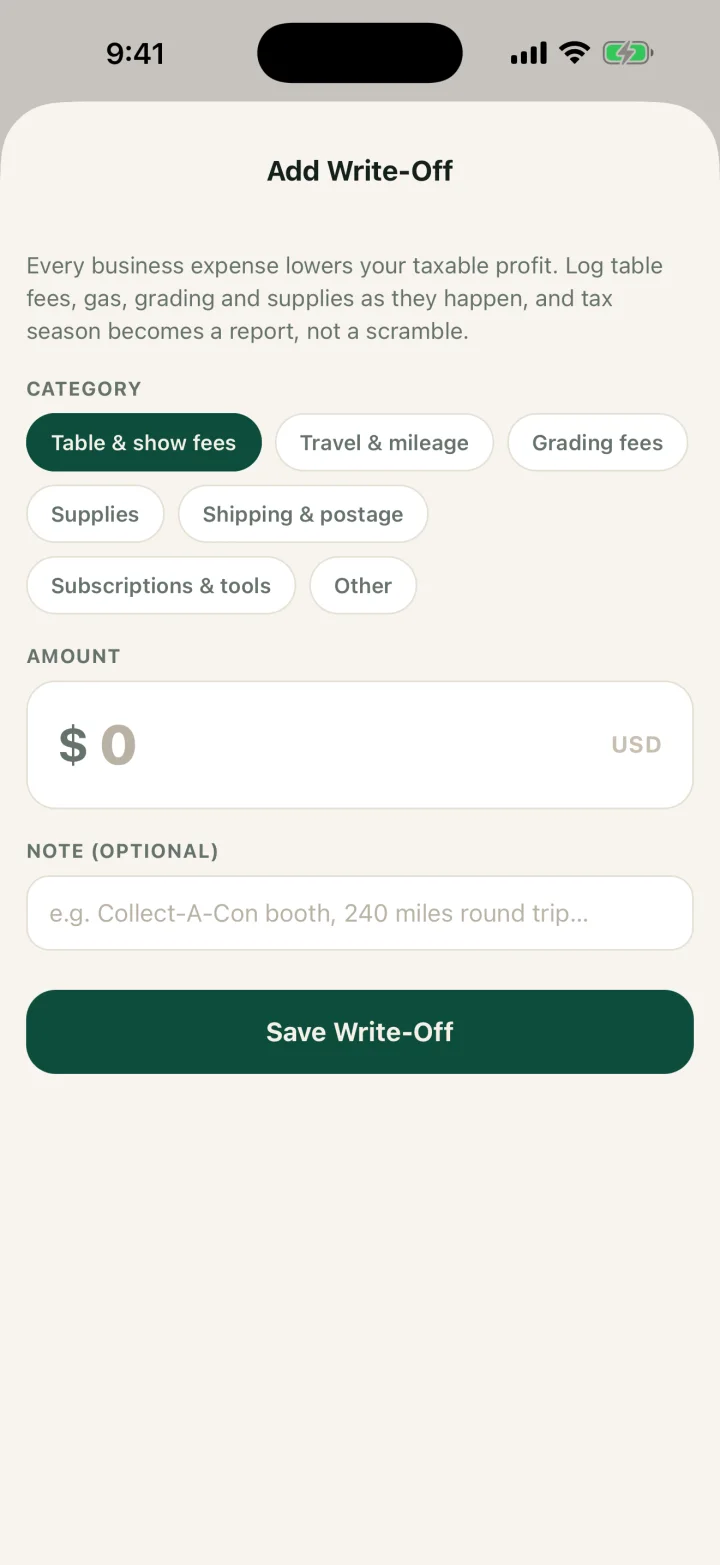
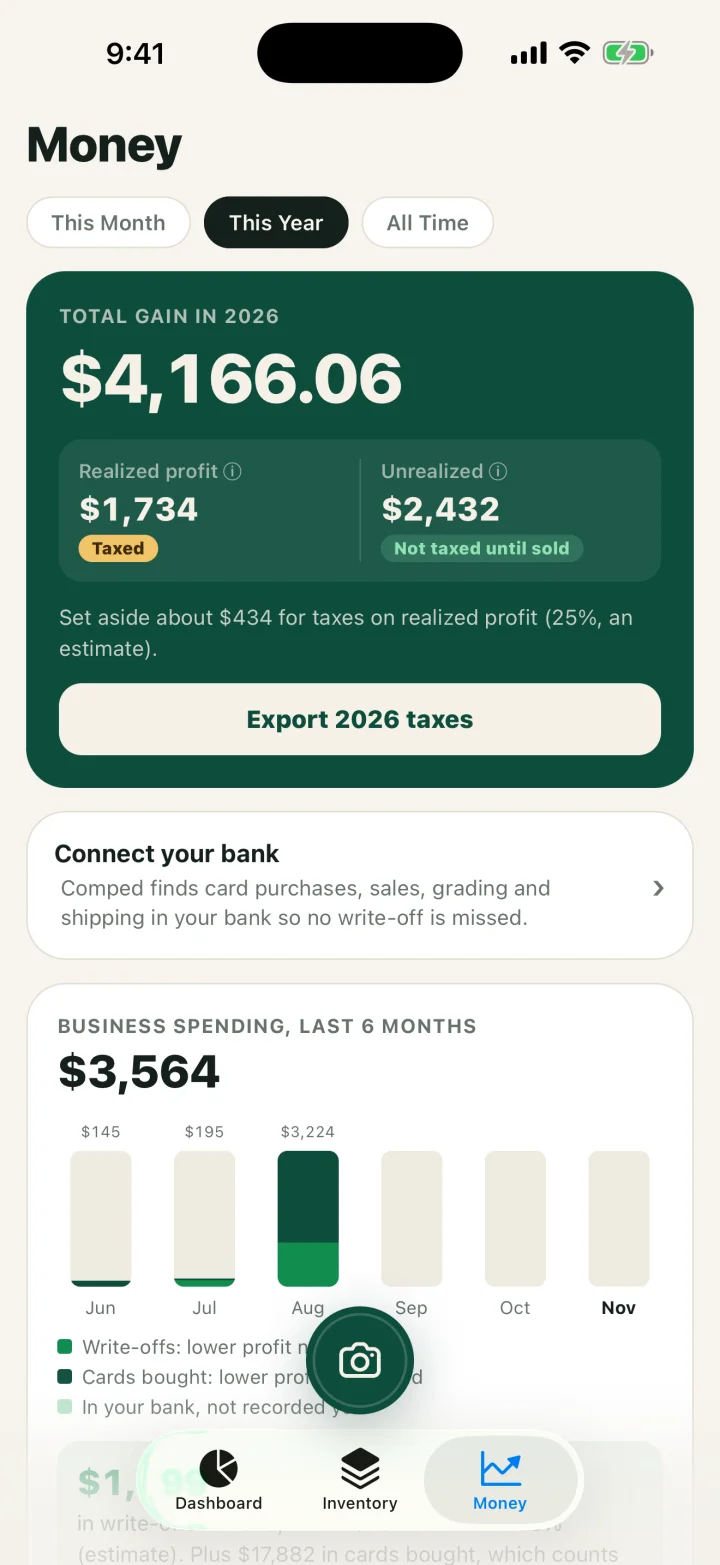
The coupon asks for one number, your total receipts for the event, and that number comes from your sale records. In Comped, each sale is its own record with the price, the date and where it sold. Table and show fees go in as a write-off, and the Money tab exports the year. The app does not calculate or file sales tax.

Related guides
- State by State: Sales Tax and Show Permits for Card Vendors: every state's permit, rate and rules in one place.
- Ohio card show sales tax (2026): the transient vendor license and county rates.
- Pennsylvania card show sales tax (2026): the 30 day notice that repeats for every show.
- The 1099-K for card sellers in 2026: why Illinois sellers see forms at $1,000.
FAQ
Do I have to charge sales tax at a card show in Illinois?
Yes. IDOR says anyone selling at a special event, resident or not, must collect Illinois sales tax. It applies whether the sales are a business or a hobby. You charge the rate printed on the event's coupon.
What is Form IDOR-6-SETR?
It is the Special Event Tax Collection Report and Payment Coupon. IDOR prints it for one event with that event's tax rate, and the organizer hands it to each vendor. You enter total receipts, multiply by the printed rate and pay within 10 days of the close of the event.
Where can I download Form IDOR-6-SETR?
You generally cannot download a blank one, because IDOR prints each coupon for a specific registered event. The organizer gets a packet from IDOR and gives one to each vendor. If you did not receive one, contact the Special Events Coordinator at Rev.SpecialEvents@illinois.gov or 847 294 4475.
Where do I mail IDOR-6-SETR?
The address printed on the form is Special Events, Illinois Department of Revenue, PO Box 19045, Springfield IL 62794-9045. Make the payment payable to the Illinois Department of Revenue. Use the address on your own copy if it differs.
What is special event sales tax in Illinois?
It is ordinary Illinois sales tax collected at a fair, festival, flea market or show. It is paid through the special event coupon instead of waiting for a regular return. Registered retailers also show the event receipts on Line 16 of Schedule A of their ST-1, without claiming the event tax as a credit.
Do I need to register with IDOR for just one show?
IDOR says yes. Its fairs page says all business and individual taxpayers, Illinois residents or not, must register even if they sell only at special events. Online registration through MyTax Illinois takes about one to two business days and the page lists no fee.
Does the promoter collect it for me?
No. The organizer notifies IDOR 30 days before the event, hands out the coupons and reports vendor information by the 20th of the following month. You collect at the table and you send the payment.
Will I get a 1099-K in Illinois at $1,000?
You can. Illinois law has platforms report Illinois payees to the state when payments exceed $1,000 and transactions exceed 3 in the year. The federal floor of $20,000 and 200 transactions does not change that state rule.
SOURCES
- Taxes at fairs, festivals/markets, pop-up events, flea markets and craft shows, Illinois Department of Revenue, checked November 13, 2026.
- Form IDOR-6-SETR (R-08/24) and Form IDOR-6-SETD (R-09/19), Illinois Department of Revenue, 2026 Illinois State Fair copy, checked November 13, 2026.
- Business registration, Illinois Department of Revenue, checked November 13, 2026.
- Publication 113, Registering your Business, Illinois Department of Revenue, checked November 13, 2026.
- Retailers' occupation and use tax rates, Illinois Department of Revenue, checked November 13, 2026.
- Publication 113, Requirements for Retailers who File Form ST-1, Illinois Department of Revenue, checked November 13, 2026.
- Publication 103, Penalties and Interest for Illinois Taxes (September 2025), Illinois Department of Revenue, checked November 13, 2026.
- Certificate of resale, Illinois Department of Revenue, checked November 13, 2026.
- Informational Bulletin FY 2026-12, Illinois Department of Revenue, checked November 13, 2026.
- 35 ILCS 5/703A, third party settlement organization reporting, Illinois General Assembly, checked November 13, 2026.
- FAQ, National Sports Collectors Convention, checked November 13, 2026.
- 2026 Form 1099-K for U.S. Sellers, Whatnot, checked November 13, 2026.
This is general information for card sellers, not tax or legal advice for your situation. Rules change and states differ; a CPA who knows your numbers wins every time.