What the promoter reports about you
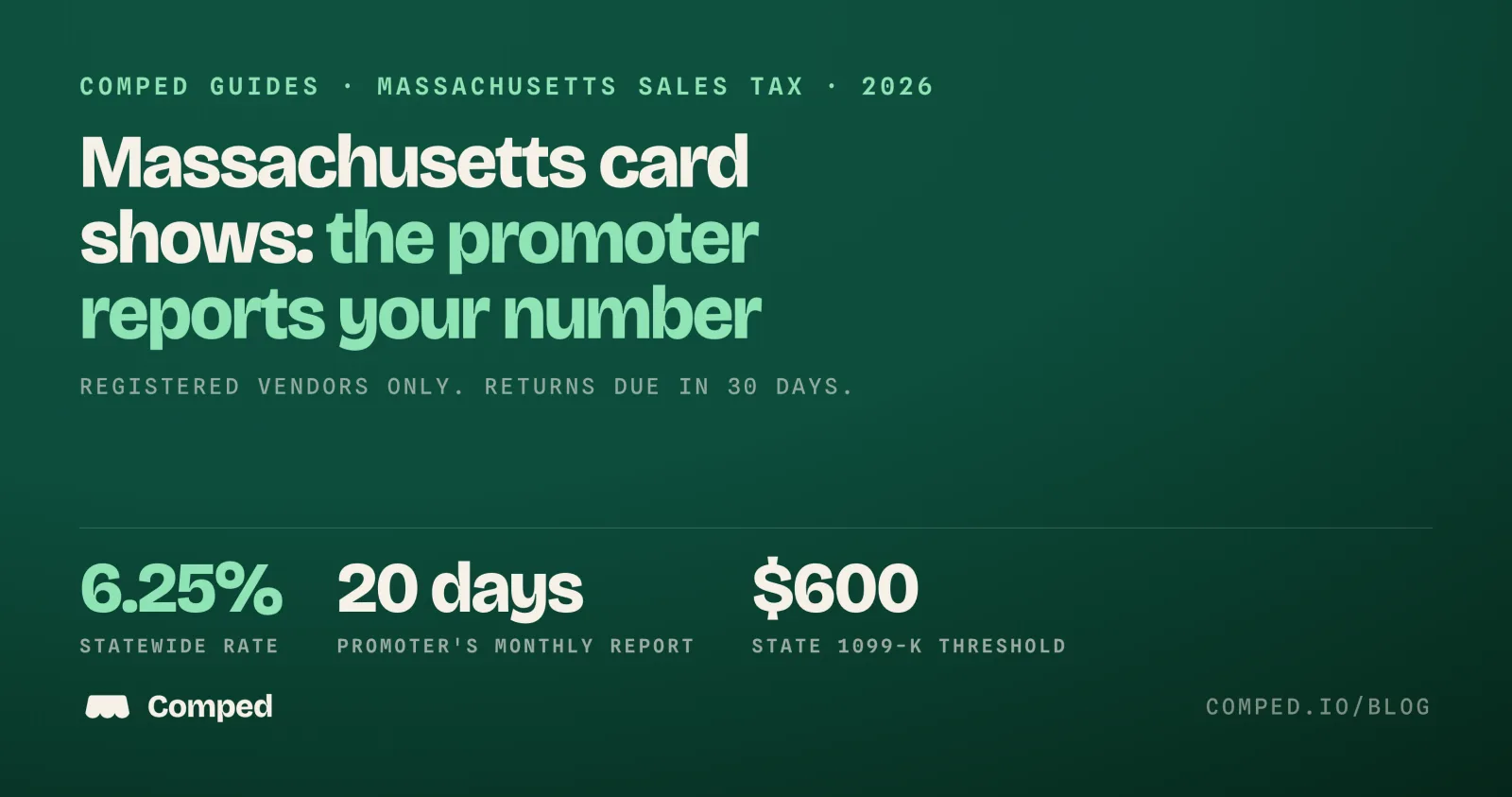
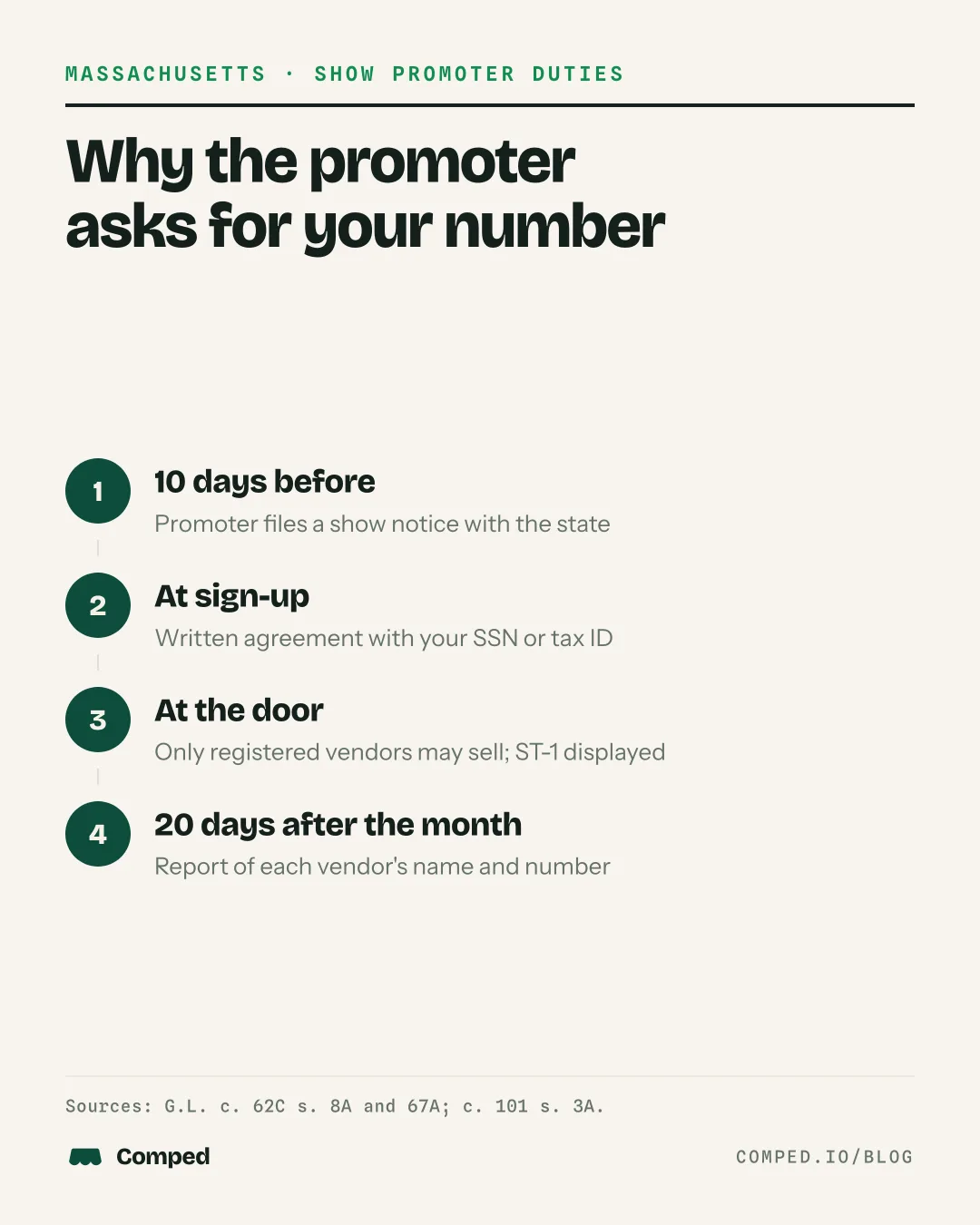
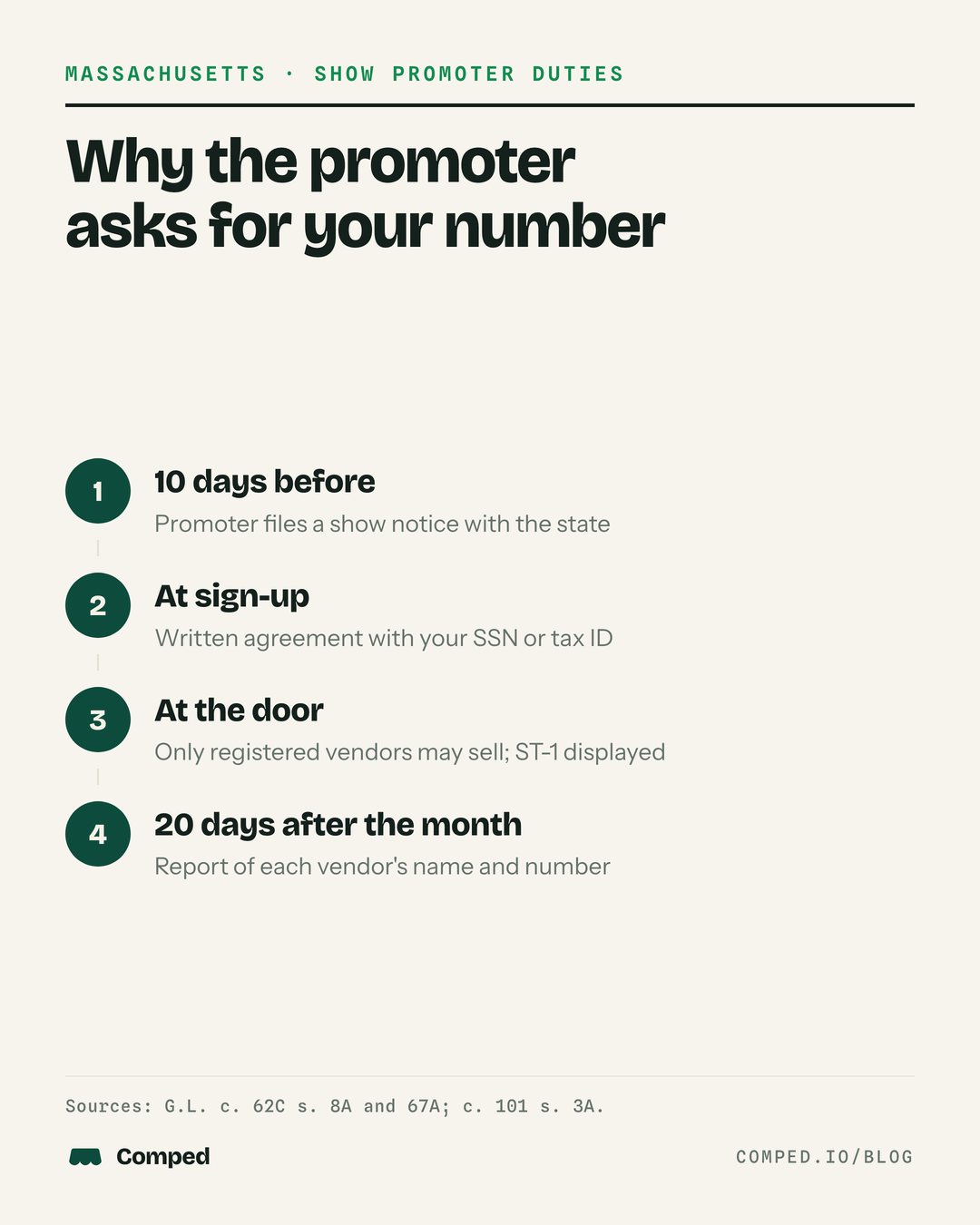
Your name, address and vendor registration number go to the state after every show month. That is G.L. c. 62C, section 8A. Every promoter files a report for each calendar month, listing each show and every person permitted to sell there. The report is due within twenty days after the month ends.
The same section puts a duty on you. Every person who sells taxable goods at a show must give the promoter a statement of name, address and vendor registration number. The promoter keeps those records for three years.
Section 67A covers the front end. The promoter files a notice with the Department at least ten days before the show and receives a registration certificate at no charge. The promoter may not let anyone sell taxable goods at the show unless that person is a registered vendor displaying the certificate.
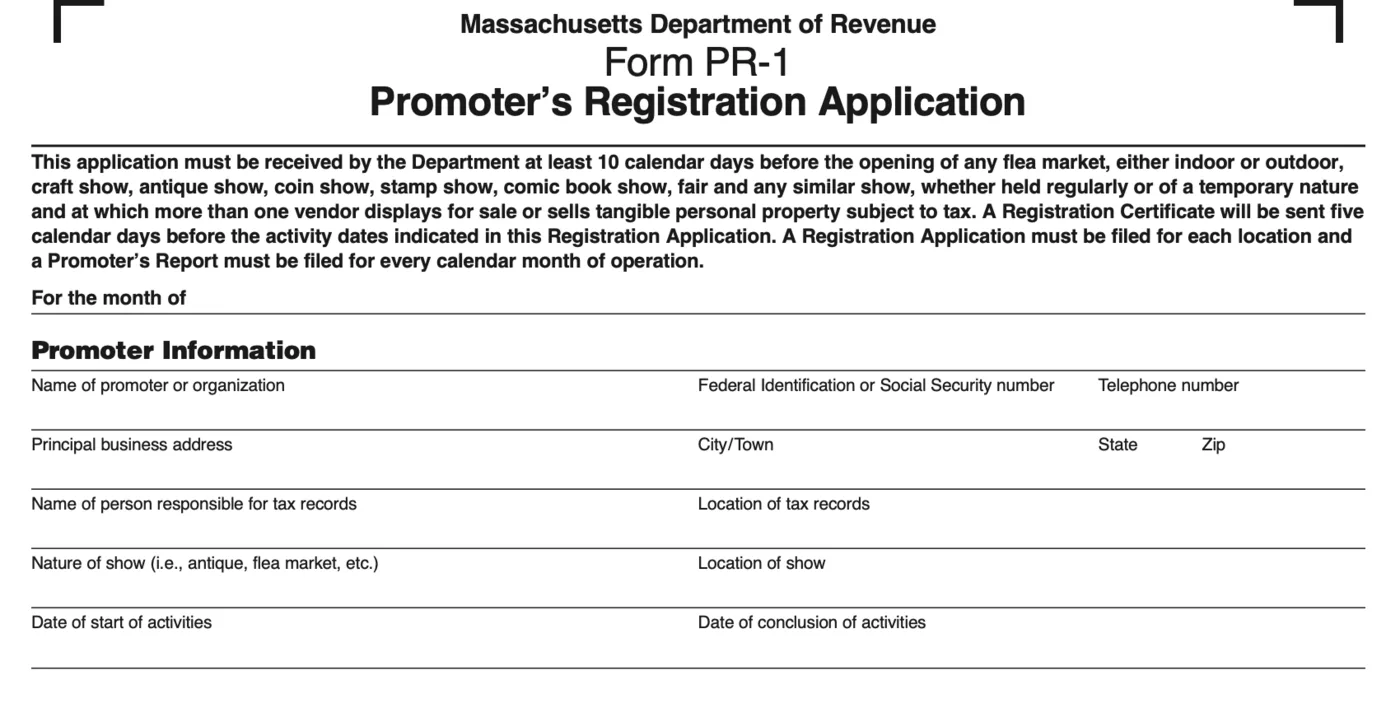
The promoter's form shows the calendar you are working inside. Form PR-1 must reach the Department at least 10 calendar days before the show opens. It says a Registration Certificate will be sent five calendar days before the activity dates. It also says a Promoter's Report must be filed for every calendar month of operation.
The law's definition of a show lists flea markets, coin shows, stamp shows, comic book shows "and any similar show" with more than one vendor. Card shows are not named, and in our reading a card show fits. Other states' promoter rules are compared in the state by state sales tax guide.
THE RULE MOST VENDORS GET WRONG
In most states the tax office never learns who had a table. In Massachusetts it receives a list. A promoter who files no report, or a wilfully false one, can have every registration certificate revoked. The Department can then deny a new one for up to six months. Expect to be asked for your number.
The operating agreement you will sign
A licensed promoter keeps a written operating agreement with each vendor. G.L. c. 101, section 3A says it must document the vendor's identity and location. That includes a social security number or tax identification number and a general description of the merchandise. The promoter keeps it for at least 12 months.
That agreement also settles a second license question. Chapter 101 requires a state transient vendor license, with a $500 deposit or bond, for temporary selling. The chapter's definitions say a transient vendor does not include a person operating under a written agreement with a licensed promoter.
An EIN keeps your social security number off these agreements, as the LLC guide explains.
How to register
Register with the Department of Revenue through MassTaxConnect. The Department's sales and use tax guide says you then receive a Sales and Use Tax Registration Certificate, Form ST-1, for each business location. The form must be displayed where customers can easily see it.
One show is enough to need it. Directive 91-3 says all vendors must register and collect tax on sales of tangible personal property in Massachusetts, "regardless of how often the vendor is in the state". It adds that all sales of inventory a vendor brings to a Massachusetts show are Massachusetts sales subject to sales tax. The directive dates from 1991, and its page carries a note that the current rate is 6.25%.
The guide says out-of-state vendors who meet the vendor definitions generally have the same responsibilities as Massachusetts vendors. We found no temporary or single show registration in the guide. For the income tax side, see taxes on selling sports cards.
The guide exempts casual and isolated sales. It describes them as infrequent and nonrecurring transactions by people who do not regularly make such sales. A dealer who buys cards to resell at shows is not that.
What rate to charge
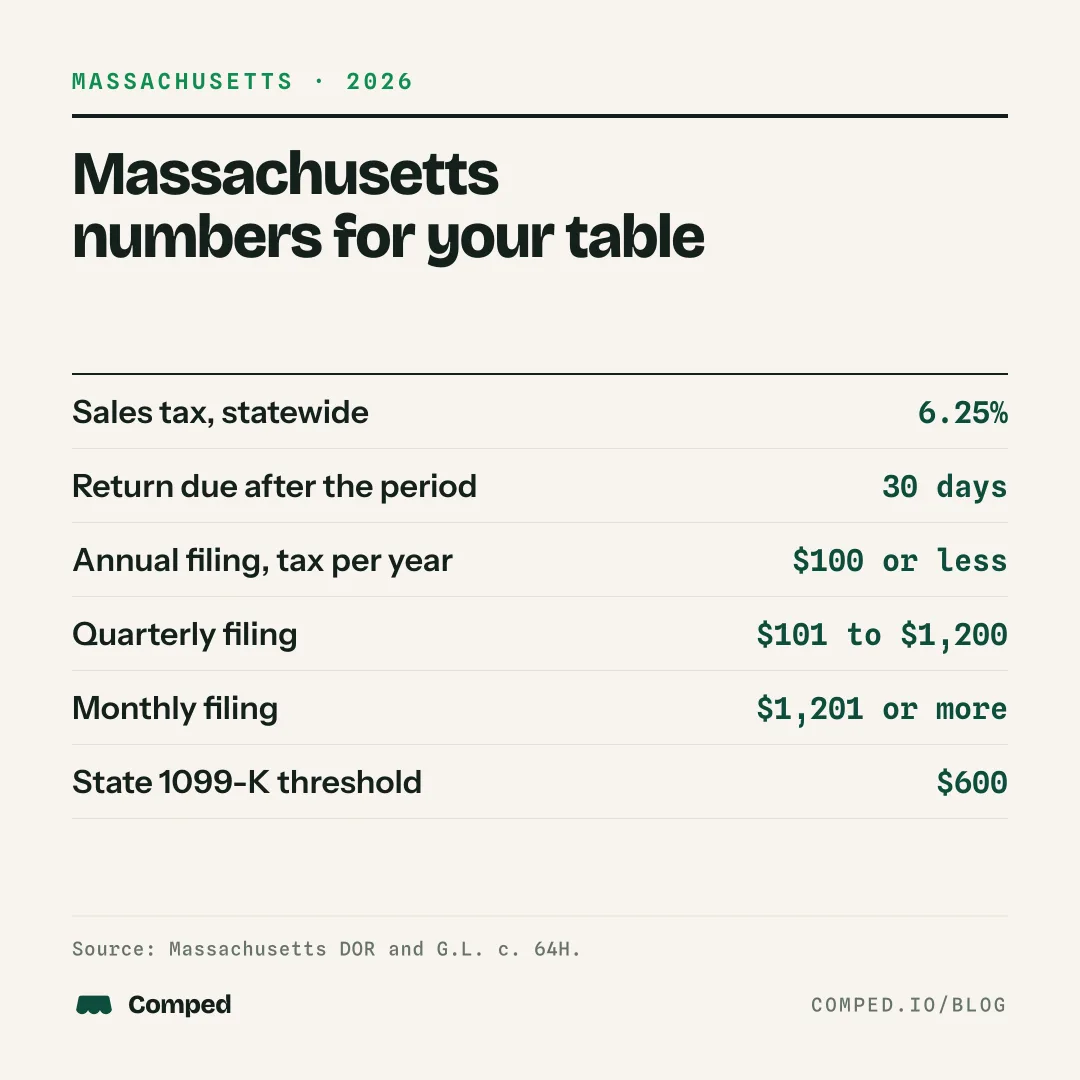
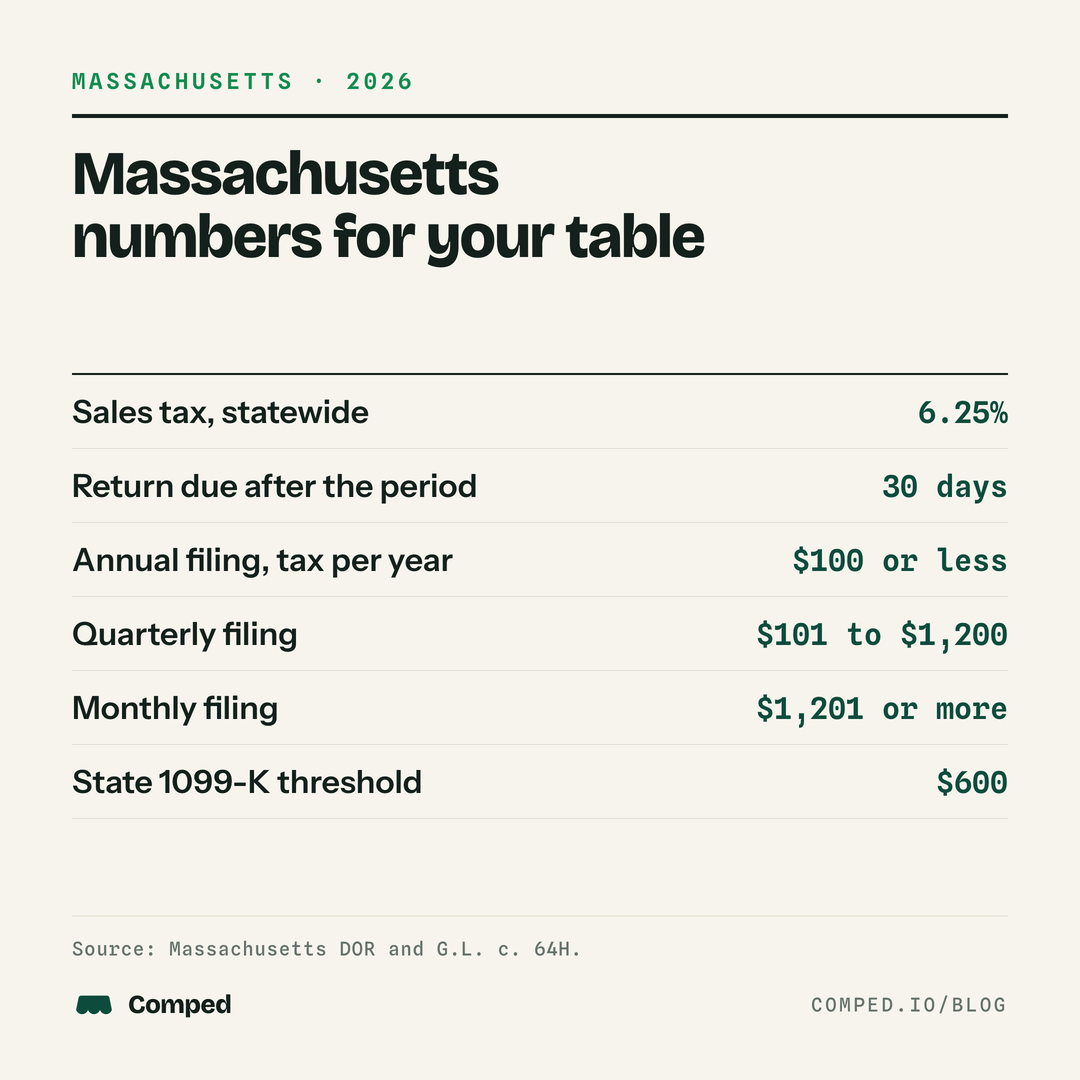
Charge 6.25% at every Massachusetts venue. G.L. c. 64H, section 2 sets the sales tax at 6.25% of gross receipts, and the Department's guide lists that one rate. Trading cards and slabs are taxable tangible personal property.
| Massachusetts item | Rule for show vendors | Figure |
|---|---|---|
| Sales tax rate | Statewide, cards and slabs included | 6.25% |
| Vendor certificate | Sales and Use Tax Registration Certificate, displayed | ST-1 |
| Promoter's notice to the Department | Days before the show opens | 10 |
| Promoter's monthly vendor report | Days after the month ends | 20 |
| Operating agreement | Kept by the promoter, with your SSN or tax ID | 12 months |
| Return due | After the period ends, monthly, quarterly or annual | 30 days |
| Quarterly filing | Tax collected per year | $101 to $1,200 |
| Resale certificate | Sales Tax Resale Certificate | ST-4 |
| State 1099-K threshold | Any number of transactions | $600 |
Timeline, counted back from show day
Have your registration number before the promoter's paperwork is due, which is 10 days before the show. The dates below use an example show on Saturday, December 12, 2026. The first row is our suggestion, since the guide we read prints no processing time.
| When | What to do | Where it comes from |
|---|---|---|
| 3 weeks before | Register through MassTaxConnect so the number exists when the promoter asks. | Our suggestion |
| 10 days before, December 2 | The promoter's Form PR-1 must be with the Department. Expect to have signed the operating agreement by now. | Form PR-1; G.L. c. 62C, s. 67A |
| 5 days before, December 7 | The Department sends the promoter's Registration Certificate. | Form PR-1 |
| Show day | Display Form ST-1. Give the promoter your name, address and registration number. Charge 6.25%. | G.L. c. 62C, s. 8A |
| By January 20, 2027 | The promoter's report for December, listing you, is due. | G.L. c. 62C, s. 8A |
| Within 30 days after your period ends | File your own return in MassTaxConnect, with the December show on it. | Department guide |
For a quarterly filer, the period holding a December show ends December 31, 2026. The card show vendor checklist covers the packing and paperwork steps in print.
How to file after the show
You file your own return for the period the show fell in, and how often depends on the tax you collect in a year. The Department's guide sets three tiers. A vendor collecting $100 or less files annually. From $101 up to $1,200 files quarterly. A vendor collecting $1,201 or more files monthly.
Each return is due on or before the 30th day after the period it covers. That is 30 days after the period ends, not the 30th of the month. Most states in this series use the 20th. You must file for every period, even when no tax is due, and enter 0. The return is filed in MassTaxConnect or on Form ST-9.
At 6.25%, $19,216 of taxable sales in a year collects $1,201 and moves a vendor to monthly filing. Late filing and late payment each cost 1% per month, up to 25%. Comped records each table sale with the card, price, venue and date, so the sales behind each return are on record.
Buying inventory with Form ST-4
Yes, as a registered vendor. Give the selling dealer Form ST-4, the Sales Tax Resale Certificate. The seller keeps it as proof the sale was exempt.
A buyer with no Massachusetts nexus is treated differently. The guide says a Massachusetts business cannot accept a resale certificate from that customer. It can accept a statement on the customer's letterhead, signed under the pains and penalties of perjury, under Directive 89-10.
Tax charged on a cash buy with no certificate is part of the card's cost, as the cost basis guide explains.
eBay and Whatnot versus your table
eBay has collected and remitted Massachusetts sales tax on eBay orders since October 1, 2019, per its marketplace tax page. The Department's guide treats a marketplace as a vendor once its Massachusetts sales exceed $100,000 in a calendar year.
That figure does not help at a show. Every card sold face to face at a Massachusetts table is taxed at 6.25%, collected and remitted by you.
Massachusetts's $600 1099-K rule
Massachusetts sets its own 1099-K threshold at $600. The Department's reporting page requires third-party settlement organizations to report payees with a Massachusetts address at $600 or greater in a calendar year. That applies regardless of the number of transactions.
The federal test is more than $20,000 and more than 200 transactions. A Massachusetts seller can receive a form far below it. The form shows gross payments, and tax is owed on profit either way. The 1099-K guide covers what to subtract.
A show weekend, worked
Here is a $4,000 weekend at a Massachusetts table, at the 2026 rate of 6.25%. The math is the same in every city.
A $4,000 WEEKEND IN MASSACHUSETTS, WORKED
Two days at a table, $4,000.00 in card sales, every sale taxed at 6.25%.
One weekend like this collects more than $100, so annual filing is out. Five of them in a year collect $1,250.00, which means monthly filing. The $250.00 was never your money.
Common mistakes and what they cost
Massachusetts mistakes are visible to the state, because the promoter's report names you. Each item below rests on the statute or the Department's guide.
- Asking for a table with no registration number. The promoter may not permit an unregistered person to sell taxable goods at the show.
- Registering for one show and never filing again. A return is due for every period, with 0 entered when no tax is due.
- Reading "the 30th" as the due date. Returns are due within 30 days after the period ends.
- Filing or paying late. Each costs 1% per month, up to 25%.
- Assuming a show weekend means annual filing. One $4,000.00 weekend collects $250.00, which is already above the $100 annual tier.
Cash sales carry the same 6.25%. The cash and trade log and the guide to tracking card show sales cover the record behind the return.
Massachusetts shows
The Northeast Sports Card Expo lists shows at the Marriott Boston Quincy in Quincy. Whatever the venue, the rate is 6.25%. Have your registration number ready before you ask any Massachusetts promoter for a table.
How this looks in the Comped app
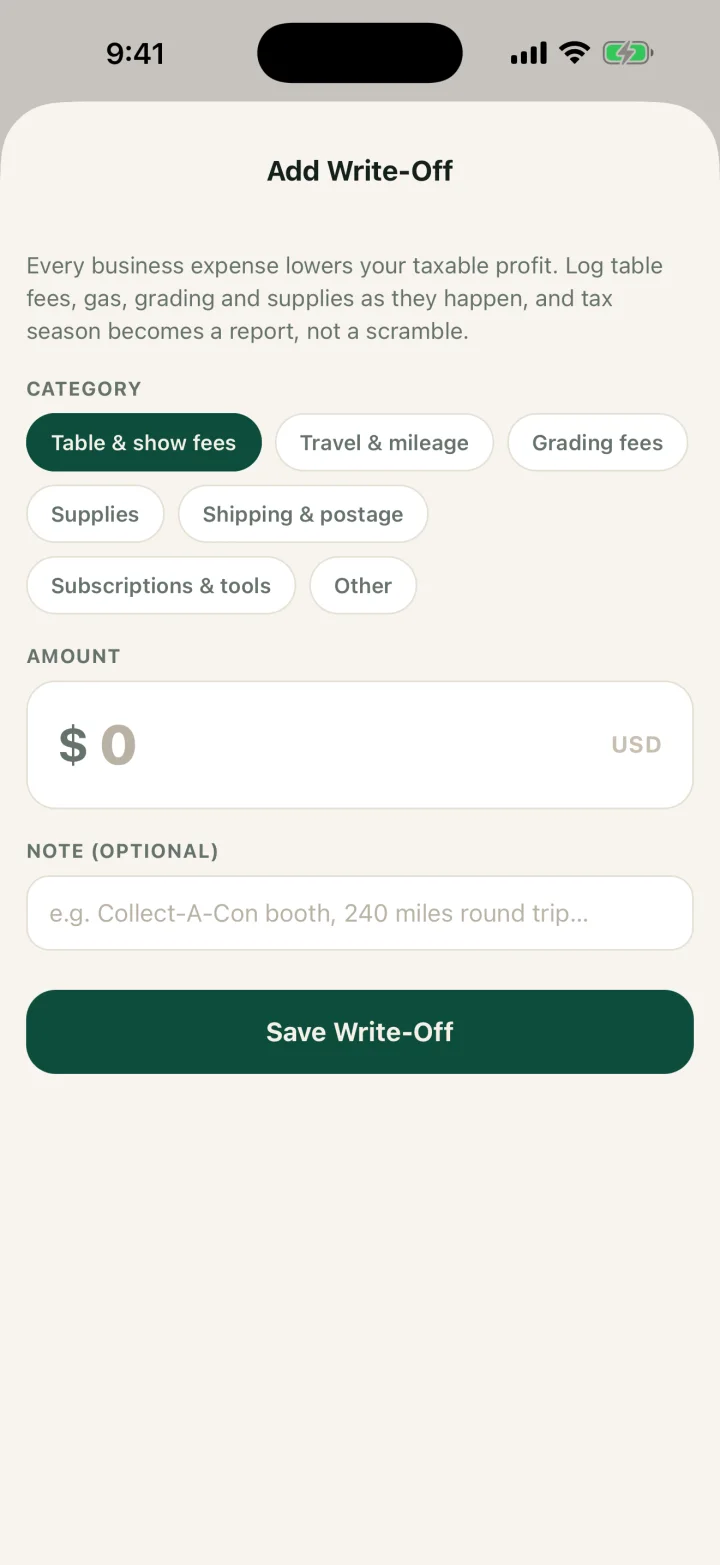
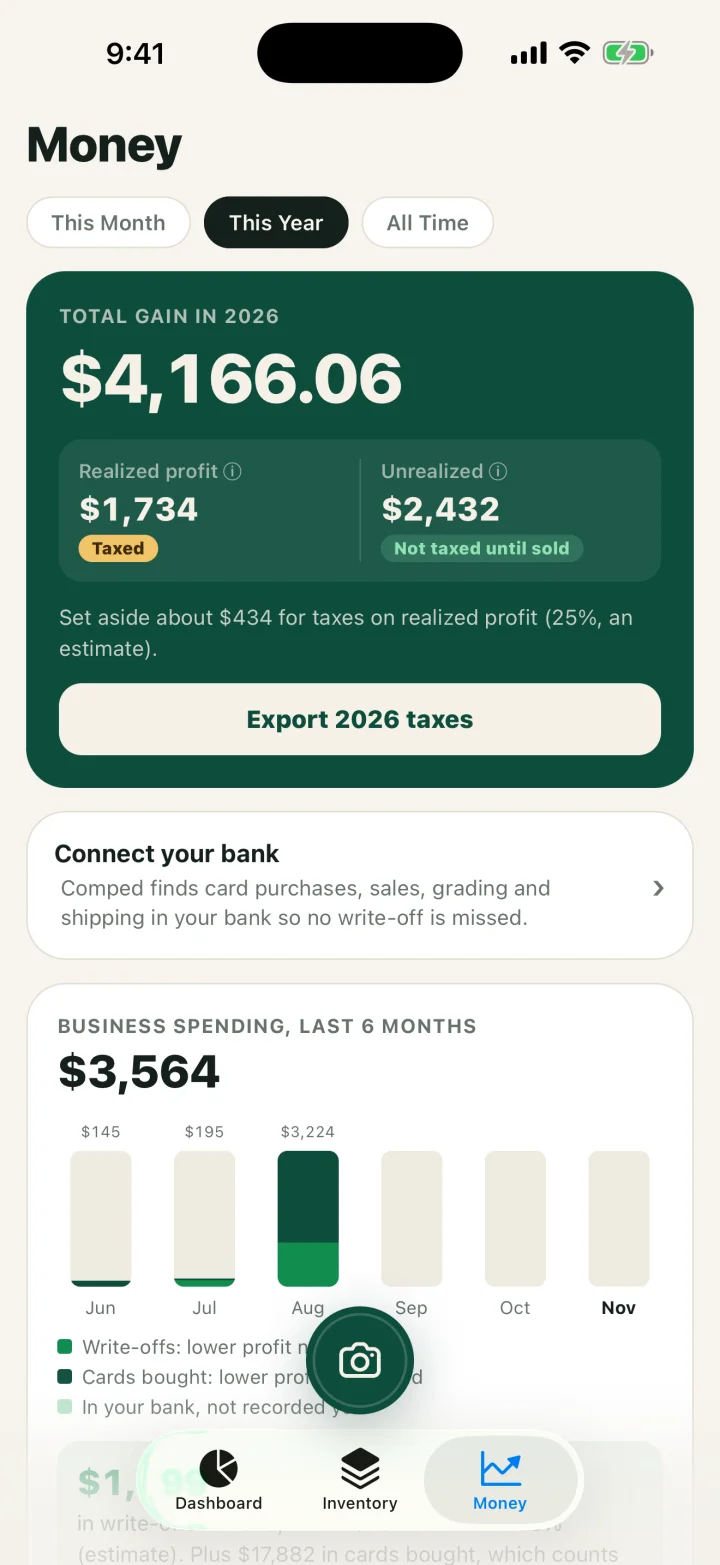
Comped does not compute or file Massachusetts sales tax. It keeps the sale records a return is built from. The Transaction screen shows one sale with its price, fees and cost. Add Write-Off files the table fee under Table and show fees. The Money tab totals the year and exports it as a CSV.

Related guides
- State by State: Sales Tax and Show Permits for Card Vendors: every state's permit, rate and rules in one place.
- New York card show sales tax (2026): the other state where promoters verify certificates and report after each show.
- New Jersey card show sales tax (2026): register 15 business days ahead, one statewide rate.
- Card show sales tax index 2026: the 51-state comparison of permits, fees and promoter duties.
FAQ
Do I need a permit to sell at a single card show?
Yes in Massachusetts, if you sell cards as a dealer. A promoter may not permit anyone to sell taxable goods at a show unless that person is a registered vendor. Only casual and isolated sales by people who do not regularly sell are exempt.
Does the promoter collect it for me?
No. The promoter reports your name, address and registration number to the Department of Revenue each month. You collect the 6.25% and file your own return.
Why does the promoter want my social security number?
A licensed promoter must keep a written operating agreement with each vendor. The law says it includes a social security number or tax identification number and a description of the merchandise. The promoter keeps it for at least 12 months.
Do I need a transient vendor license for a card show?
Not when you operate under a written agreement with a licensed promoter. Chapter 101 excludes that person from the definition of a transient vendor. Selling on your own outside such a show is a different case.
Is there a temporary sales tax permit for one show in Massachusetts?
We found none. Directive 91-3 says all vendors must register and collect tax on Massachusetts sales regardless of how often the vendor is in the state. The Department's guide describes one registration through MassTaxConnect and names no single show version.
Do I have to file a Massachusetts return if I made no sales?
Yes. The Department's guide says a return is required for every period, even when no tax is due, with 0 entered. Late filing and late payment each cost 1% per month, up to 25%.
Do I charge sales tax on cash?
Yes. The 6.25% tax applies to every retail sale at the table. Cash, card or a payment app makes no difference to the tax.
How much can I sell on eBay before I get a 1099 in Massachusetts?
Massachusetts sets the line at $600 in a calendar year for payees with a Massachusetts address. The number of transactions does not matter. The form shows gross payments, not profit.
SOURCES
- G.L. c. 62C, section 8A, promoter reports and records, Massachusetts Legislature, checked November 13, 2026.
- G.L. c. 62C, section 67A, promoter notice and registration certificate, Massachusetts Legislature, checked November 13, 2026.
- G.L. c. 62C, section 1, definitions of promoter and show, Massachusetts Legislature, checked November 13, 2026.
- G.L. c. 101, section 3A, promoter license and operating agreements, Massachusetts Legislature, checked November 13, 2026.
- G.L. c. 101, section 1, definition of transient vendor, Massachusetts Legislature, checked November 13, 2026.
- G.L. c. 64H, section 2, sales tax rate, Massachusetts Legislature, checked November 13, 2026.
- Form PR-1, Promoter's Registration Application (Rev. 6/19), Massachusetts Department of Revenue, read from the Internet Archive copy of September 1, 2025.
- Directive 91-3, Obligation of Trade Show Vendors to Collect Sales and Use Tax, Massachusetts Department of Revenue, read from the Internet Archive copy of August 9, 2026.
- Tradeshow and Flea Market Promoters, Massachusetts Department of Revenue, read from the Internet Archive copy of August 9, 2026 (page updated September 30, 2025).
- Sales and Use Tax guide (updated May 7, 2026), Massachusetts Department of Revenue, read from the Internet Archive copy of October 31, 2026 because mass.gov blocked direct access on November 13, 2026.
- MA reporting requirements for third party settlement organizations (1099-K), Massachusetts Department of Revenue, page updated September 7, 2024, read from the Internet Archive copy of July 19, 2026.
- Taxes and import charges, eBay, checked November 13, 2026.
This is general information for card sellers, not tax or legal advice for your situation. Rules change and states differ; a CPA who knows your numbers wins every time.