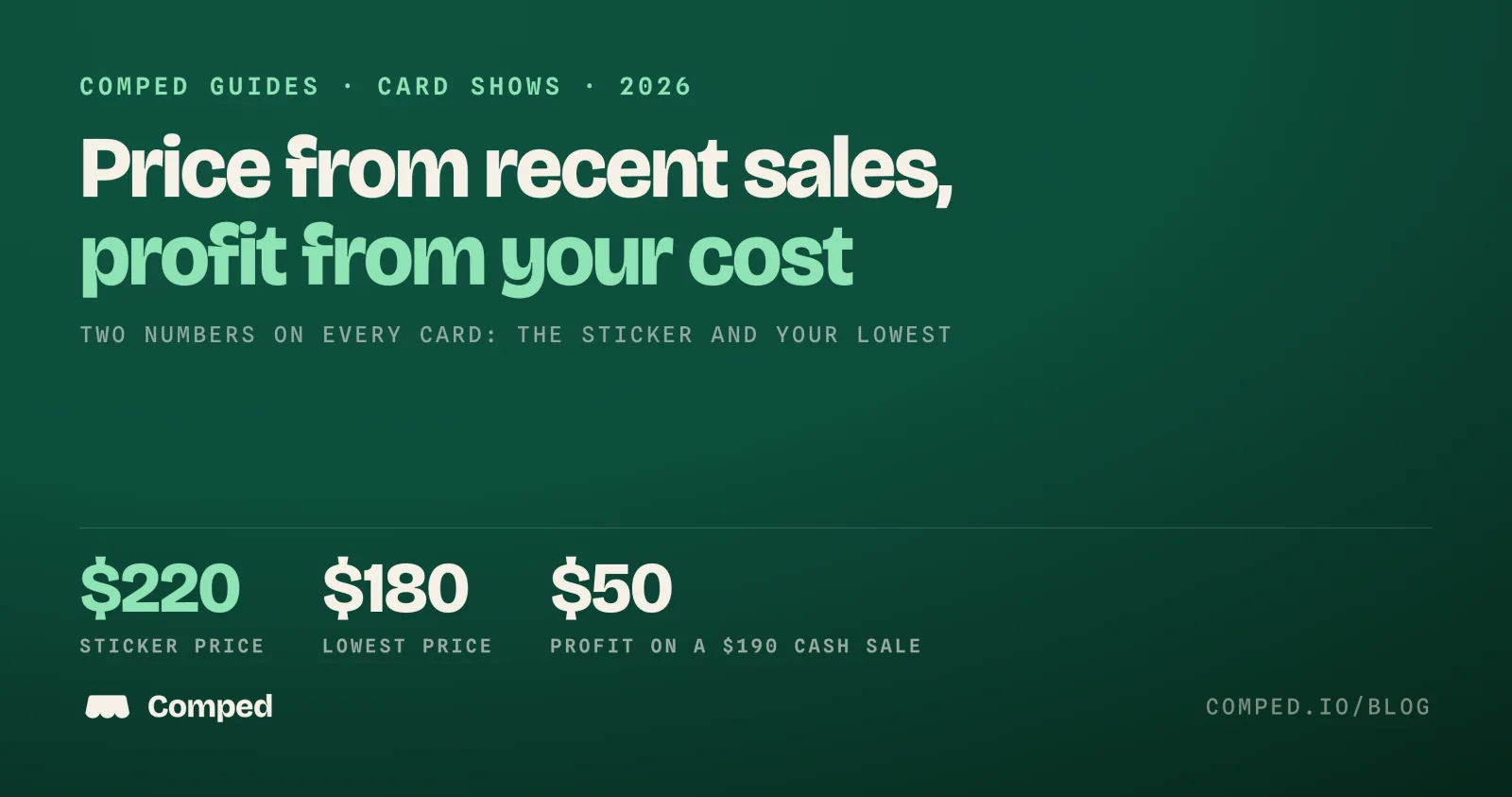
Pricing from recent sales
The price of a card is what the same card sold for lately. Look up sold listings, not asking prices, for the same year, set, card number, parallel and grade. A PSA 9 is a different card from a PSA 10 for pricing, and a raw card is different again.
Use the last several sales, not the single highest one. If the last five sales run from $185 to $215, the card is a $200 card. Drop a sale that sits far from the rest, such as a damaged copy or a mislabeled listing. Check within a few days of the show, because a price from two months ago can be wrong in either direction.
Read each sold listing before you count it. A listing marked best offer accepted shows the asking price, not the price paid. Vinnie Rullo's guide for All Vintage Cards tells sellers to look up the accepted figure.
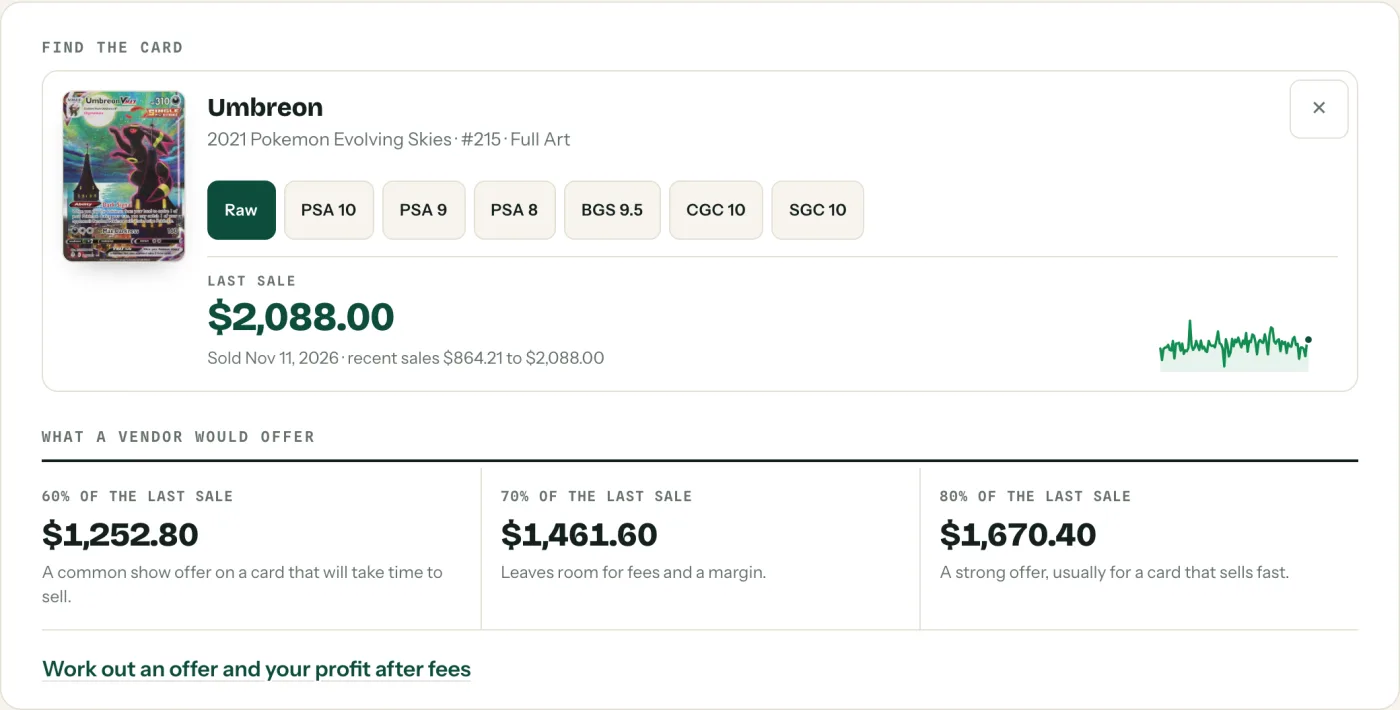
Buyers at your table have the same sold listings on their phones. A sticker far above recent sales does not get a counteroffer; it gets skipped. The master tax guide explains why profit, not the sale price, is the number that matters at year end.
Raw cards and cards with few sales
Price a raw card from sold raw copies in the same condition, not from graded sales. Condition moves a raw price more than anything else. Where sold copies in your condition exist, use them. Where they do not, a published rule of thumb gives a starting point.
| Condition of a raw card | Share of the near mint price |
|---|---|
| Near mint | 100% |
| Lightly played | 70% to 85% |
| Moderately played | 50% to 70% |
| Heavily played | 30% to 50% |
| Damaged | 10% to 30% |
Those ranges come from CardPulse's pricing guide of April 2026, written for trading card game singles. They are one site's estimate, not a rule. Vintage sports cards follow their own scale, so use sold copies.
Some cards have no recent sales at all. Start from the nearest sales you can find: the same card one grade away, or the same player's closest parallel. Then set a wider gap between the sticker and your lowest price, because neither you nor the buyer can prove the number. Say so at the table.
Sticker price and lowest price
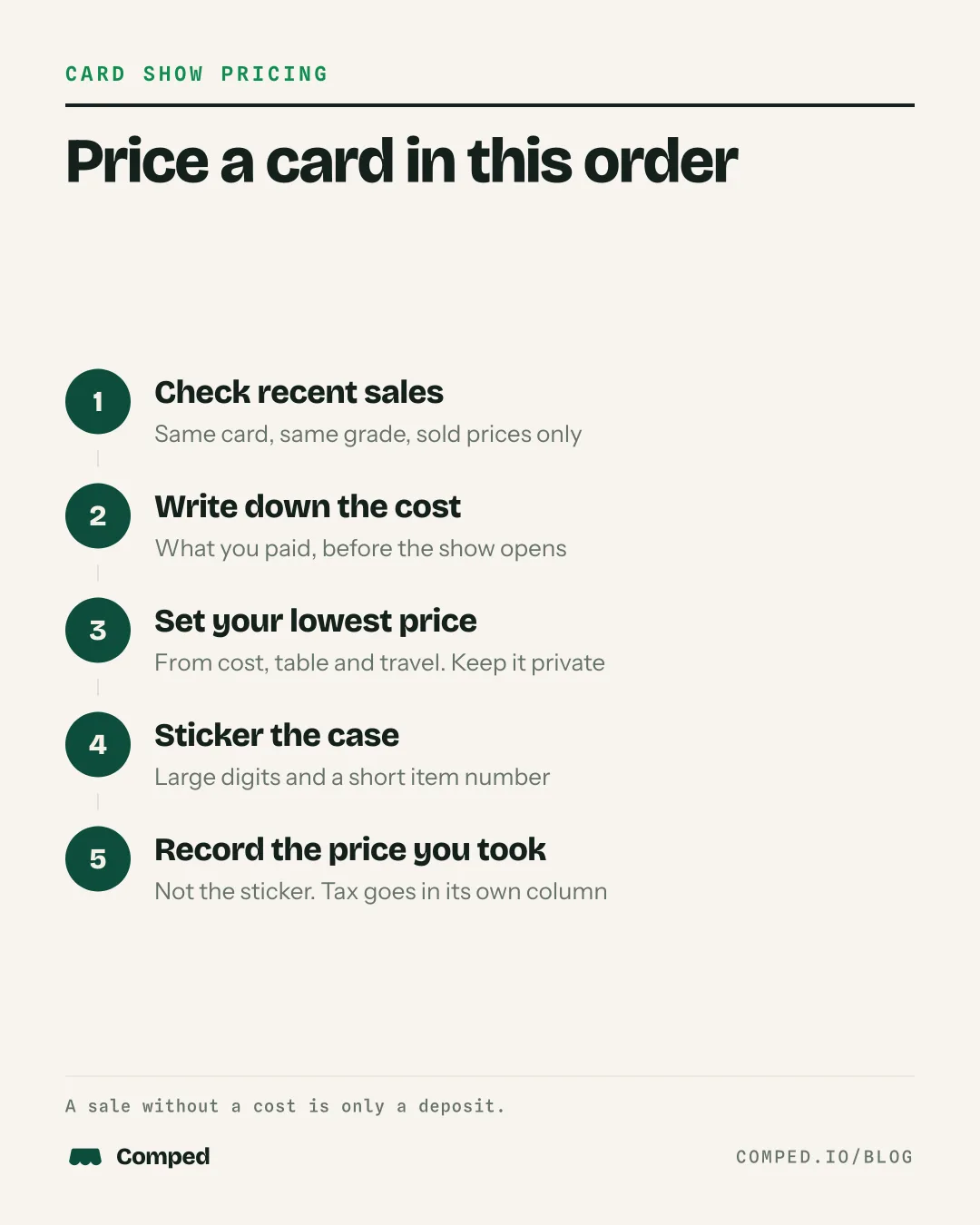
Every card needs two numbers: the price on the sticker and the lowest price you will accept. The sticker is public. The lowest price is yours, and you set it at home, not while a buyer is holding out cash.
Vendors disagree on how far apart the two should be. In a 2025 Elite Fourum thread, one vendor treats the sticker as the best price and does not move. Another marks every card up slightly so buyers have room to offer. A third said that pricing low to avoid haggling backfired, and now prices a bit higher to leave room.
The buyer's side is consistent. Roman Fusco wrote for CoolStuffInc in April 2026 that asking nicely typically won about 10% off. Card Codex tells buyers to open at 80% to 90% of market value. Our reading: a sticker about 10% above your target lands near the target after the usual ask.
| Approach | Sticker on a $200 card | Suits | Risk |
|---|---|---|---|
| Firm price | $200, with a sign that prices are firm | Fast-selling cards and busy tables | Buyers who expect a discount walk on |
| Room to offer | $220, lowest price $180 | Most showcase cards | A buyer who pays sticker without asking has overpaid by show standards |
| Two prices on the sticker | Recent sales $200, your price $190 | Tables that sell on being under market | You have shown your number, so there is little room left |
A dealer on the Collectors Universe forum described the two-price sticker back in 2007. Whichever you pick, set the lowest price from your cost, not from your hopes. It has to cover what you paid, a share of the table and travel, and something for you.
Show price against online price
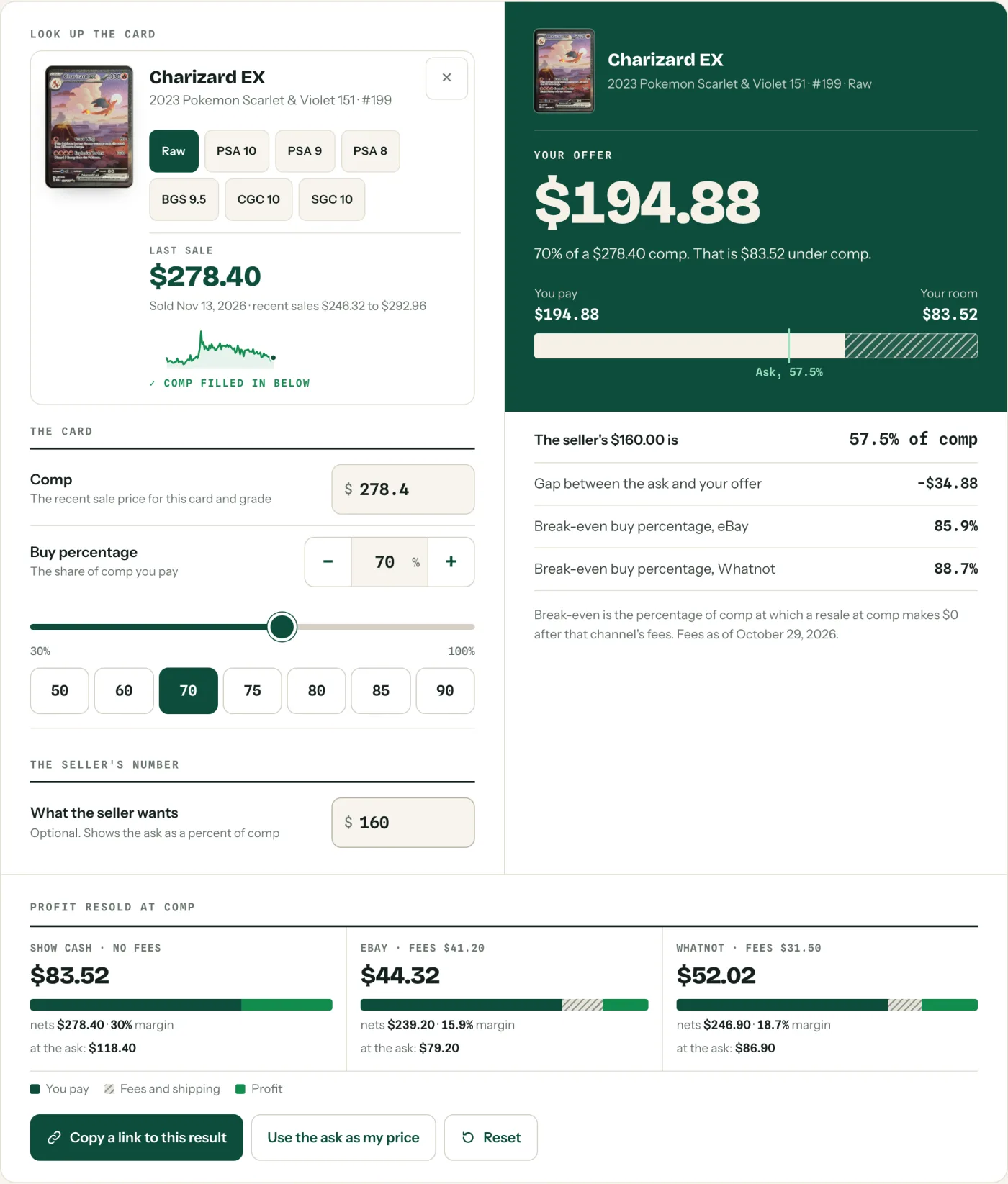
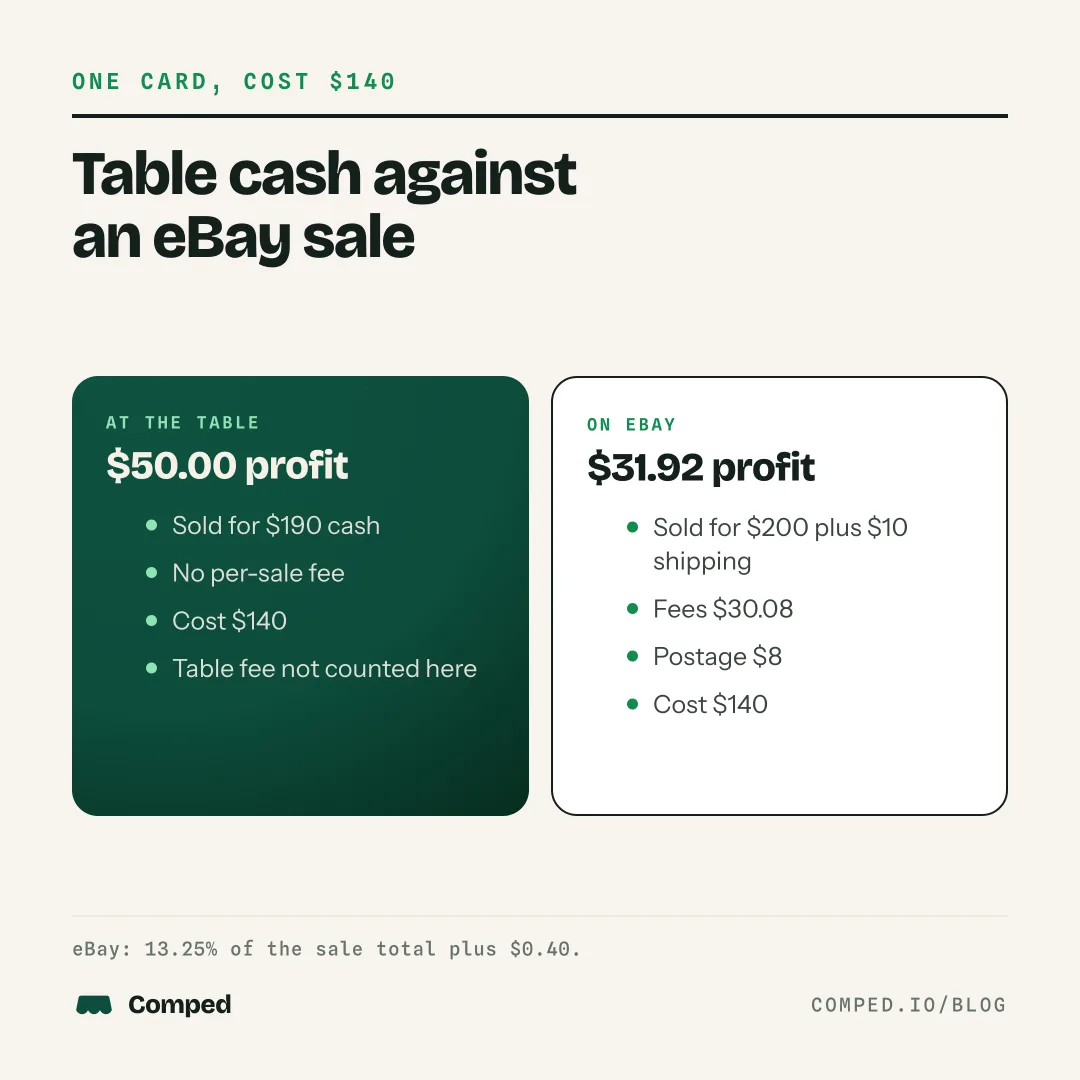
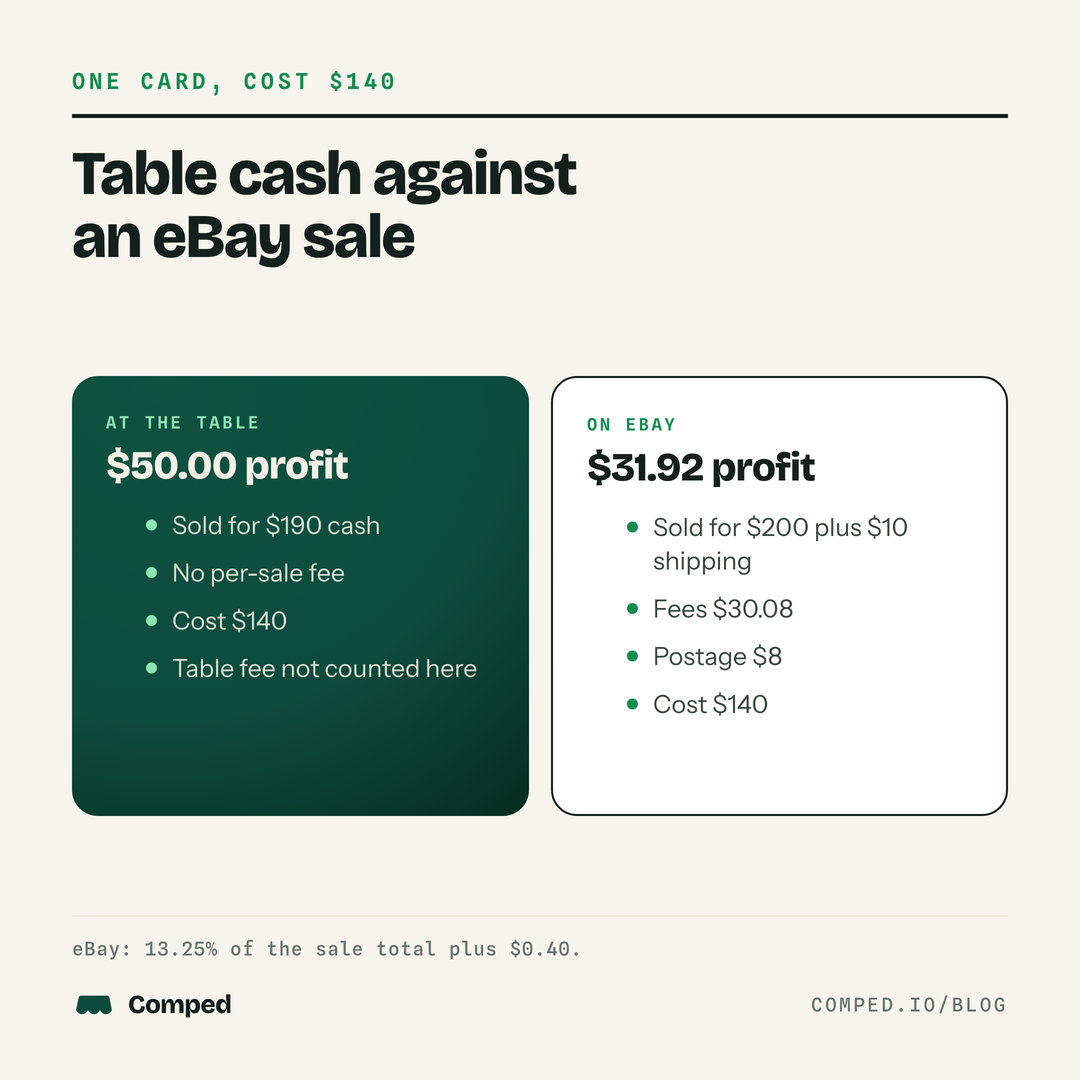
A cash sale at the table can beat a higher sale online, because it has no marketplace fee and no postage. Our platform fee research puts eBay's fee on trading cards at 13.25% of the sale total plus $0.40 per order. The card profit calculator runs the comparison for eBay, Whatnot, TCGplayer and show cash.
ONE CARD, TWO WAYS TO SELL IT
An example: recent sales are near $200 and you paid $140. The sticker says $220 and your lowest price is $180. A buyer offers $190 cash.
The table fee is not in that panel. The card show profit calculator spreads it across the weekend.
Cash is not the only way buyers pay, and the others cost you. The table below takes the same $190.00 sale with $12.59 of New Jersey sales tax, so the buyer sends $202.59. Rates are from our fee research, checked October 29, 2026.
| How the buyer pays | Published rate | Fee on $202.59 | Profit on the $140 card |
|---|---|---|---|
| Cash | None | $0.00 | $50.00 |
| Venmo business profile | 1.9% plus $0.10 | $3.95 | $46.05 |
| Square, tap or dip | 2.6% plus $0.15 | $5.42 | $44.58 |
| PayPal Goods and Services | 2.99% | $6.06 | $43.94 |
The fee is charged on the whole payment, tax included. Set your lowest price knowing which payment you will accept at that number.
Showcase, binder and box prices
Sort inventory into three tiers by value, because each tier is priced and displayed differently. Low-priced cards do much of the selling. One vendor in the Elite Fourum thread sells mostly raw cards, many at $10 and few at $200. A first-time dealer on Hobby Insider sold large volumes of $0.25 to $5 singles and wished they had brought more.
| Tier | Where it sits | How it is priced | What you record |
|---|---|---|---|
| Best cards and slabs | Locked showcase | One sticker each, from that card's recent sales | Each card, with its own cost |
| Mid-priced singles | Binders or rows of top loaders | One sticker each, or a price per page or row | Each card, with its own cost |
| Low-priced cards | Boxes at the end of the table | One sign per box, with a quantity deal | A count per box, at the lot's cost per card |
Quantity deals move boxes. Rob Bertrand's Cardboard Connection guide prices $1, $3 and $5 boxes with deals such as six $1 cards for $5. A poster on The Bench used the same ladder. His dollar box was 6 or 7 for $5, and his 50 cent box was 3 for $1. The price levels in both are years old. The structure still works.
Price stickers
A sticker should show the price in large digits and nothing a buyer has to decode. Put it on the top loader, the one-touch case or the slab sleeve, never on the card or the slab label. A dealer on Hobby Insider puts cards in team bags and stickers the bag, which keeps adhesive off top loaders and slabs.
Add a short item number in small print, such as A14. That number matches a row in your inventory list, where the cost and the lowest price live. The card show inventory sheet has columns for the item number, cost, sticker price and lowest price.
Price everything. Some dealers leave cards unpriced to start a conversation, and one on the Collectors Universe forum said he never stickers a card. Most of the vendors and buyers we read want the opposite. Sports Collectors Digest profiled a dealer in 2013 who brought about 100,000 cards with every card priced. An unpriced card makes the buyer ask, and many will not.
Bulk boxes
Bulk is priced by the box, not by the card. A $1 box, a $5 box and a $10 box each need one sign and no stickers. Sort by price, not by player, so the sign is always true.
Bulk still has a cost, and the cost comes from the lot it arrived in. There is no IRS method specific to cards, so use a reasonable one and keep using it. Say you paid $80 for a lot of 800 commons. Each card carries $0.10 of cost. Sell 45 cards from the $1 box and the day's record is $45.00 of sales against $4.50 of cost.
A quantity deal changes the sale, not the cost. Six cards sold as 6 for $5 are $5.00 of sales against $0.60 of cost. Count the box before the show and after it, or keep a tally sheet beside it. The card cost basis calculator splits a lot or a box price across its cards. The cost basis guide covers collection buys.
Offers, bundles and trades
Answer an offer from your lowest price, which you already set, and not from the moment. If the offer is at or above it, take it. If it is below, name your number once. A dealer told Sports Collectors Digest in 2018: "I'm not running a museum. A reasonable offer never offends." A low offer is not an insult either. Saying no is enough.
A bundle is one sale at one price. If three cards stickered at $60, $40 and $25 leave together for $100, record $100 across the three cards. Splitting it in proportion to the stickers gives $48, $32 and $20. Each card then has its own profit against its own cost.
A trade is priced the same way as a sale. Value your card at the price you would take in cash, and value theirs from recent sales. A trade is also a taxable sale of your card at the value you received, under Tax Topic 420. The card trade calculator works out both sides, with cash either way.
Buying at the table uses the same recent sales, read from the other side. Scott Orgera reported for Sports Illustrated in July 2025 that show dealers often pay around 60 percent of comp. Our guide to card show buy percentages shows the arithmetic behind an offer.
Repricing
Reprice when the facts change, not when you are bored. Three things change during a show. Recent sales move. The same card shows up cheaper two tables over. Or the weekend is ending and you would rather carry home cash than cards.
Change the sticker, not only the spoken price. The next buyer should see the new number without asking. Keep your lowest price where it is unless your reason for it has changed. Your cost has not changed, so a price below cost is a loss you are choosing. If you choose it, record it like any other sale. The loss lowers the year's profit.
Between shows, recheck in batches. One vendor in the Elite Fourum thread prices once and finds the prices hold for the next two to four shows in a short run. Another restickers often when the market is rising, because a stale sticker gives the gain to the buyer. Recheck your best cards before every show and the rest on a schedule.
Sales tax and the sticker
Sales tax is not part of your price, and it is not your money. Trading cards and graded slabs are taxable goods, and in-person table sales are the seller's job to collect on. Decide before the show whether tax is added on top of the sticker, and check your state's rule on tax-included prices.
New Jersey's rate is 6.625%, per the Division of Taxation's vendor page. A $190.00 sale there carries $12.59 of tax, so the buyer pays $202.59. Your sale is $190.00 and your profit is still figured on $190.00. Write the tax in its own column.
An out-the-door price hides the same tax inside the number. Say you agree to $200.00 with tax included, in a state that allows it. At 6.625% the sale is $187.57 and the tax is $12.43. You gave a $2.43 discount from $190.00 without deciding to. The card show sales tax index lists every state's rate and permit.
Recording what each card cost
A sale without a cost is only a deposit. Profit is the sale price minus what the card cost minus selling costs, and tax is owed on the profit. If you cannot show the cost, the IRS can treat it as zero and tax the whole sale.
Write the cost down when you buy, not when you sell. Publication 583 lists the documents that back up the cost of inventory: canceled checks, cash register tape receipts, credit card sales slips and invoices. For a cash buy at a show, that means a written receipt with the seller's name, the date, the item and the price.
Cost includes more than the purchase. No IRS guidance covers grading fees, so this is our reading: a grading fee is part of the card's cost. A $20 raw card with a $25 grading fee has a $45 cost. Comped shows a price from recent sales when you scan a card, stores what you paid, and shows the profit on each sale.
Our guide on how to track card show sales compares paper, a spreadsheet and an app for keeping that record.
Pricing mistakes and what they cost
Most pricing mistakes cost a few dollars a card and repeat all weekend. The figures below use the $200 card from the example above.
| Mistake | What it costs | Fix |
|---|---|---|
| Pricing from asking prices | A sticker above recent sales, and a card that rides home | Sold listings only, several of them |
| No lowest price set at home | A price made up under pressure, often below what you needed | Write the lowest price on the inventory list |
| No record of cost | The $190.00 sale can be taxed as $190.00 of profit, not $50.00 | Record cost at the buy, with a receipt |
| Ignoring the payment fee | $5.42 on a Square payment of $202.59 | Know your lowest price for each payment method |
| Agreeing to a tax-included price | $2.43 on a $200.00 out-the-door price at 6.625% | Quote the price, then add tax |
| Pricing at the table | Missed buyers while you look up sold listings | Sticker everything before you load the car |
If you already sold cards with no cost on record, rebuild what you can from bank statements, payment app history and messages. Our guide to card sales with no receipts covers that.
How this looks in the Comped app
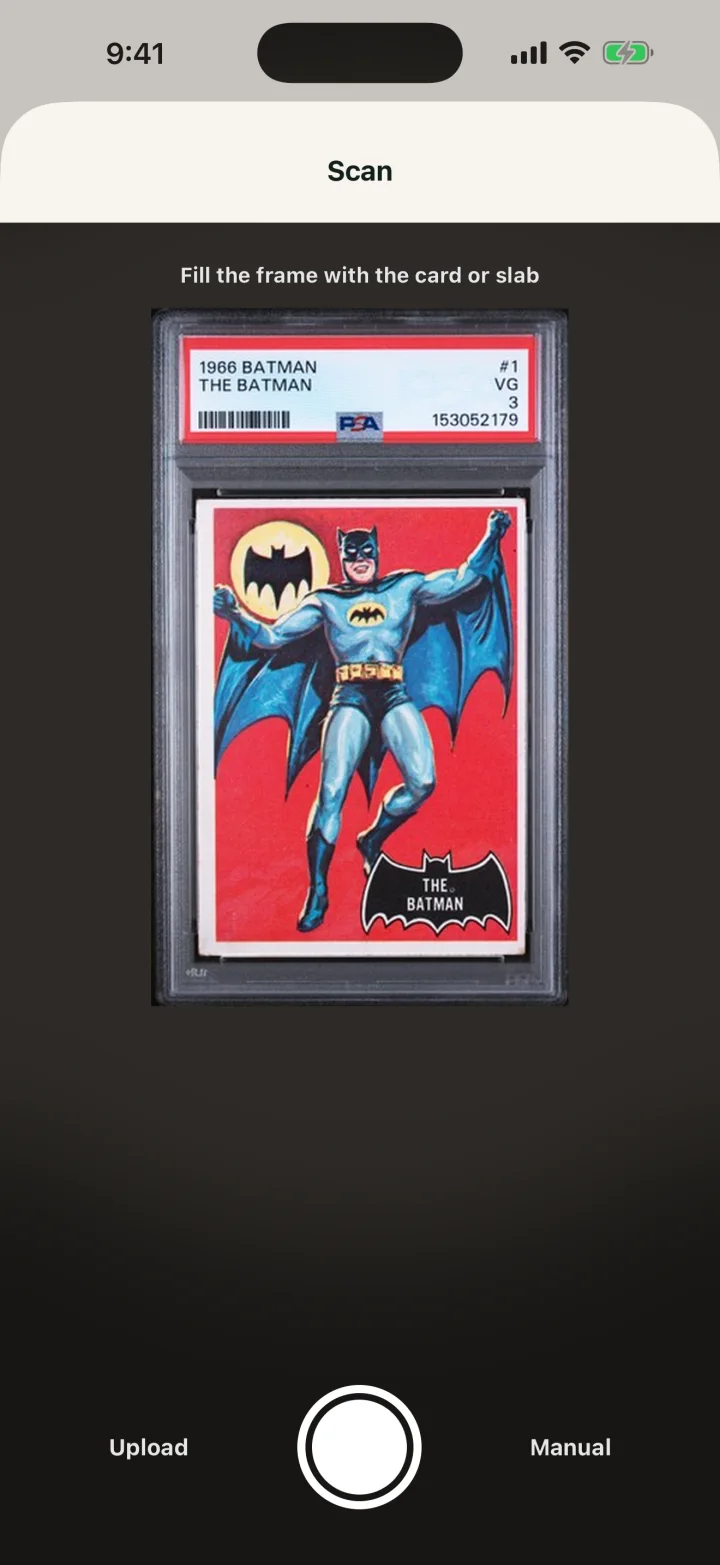
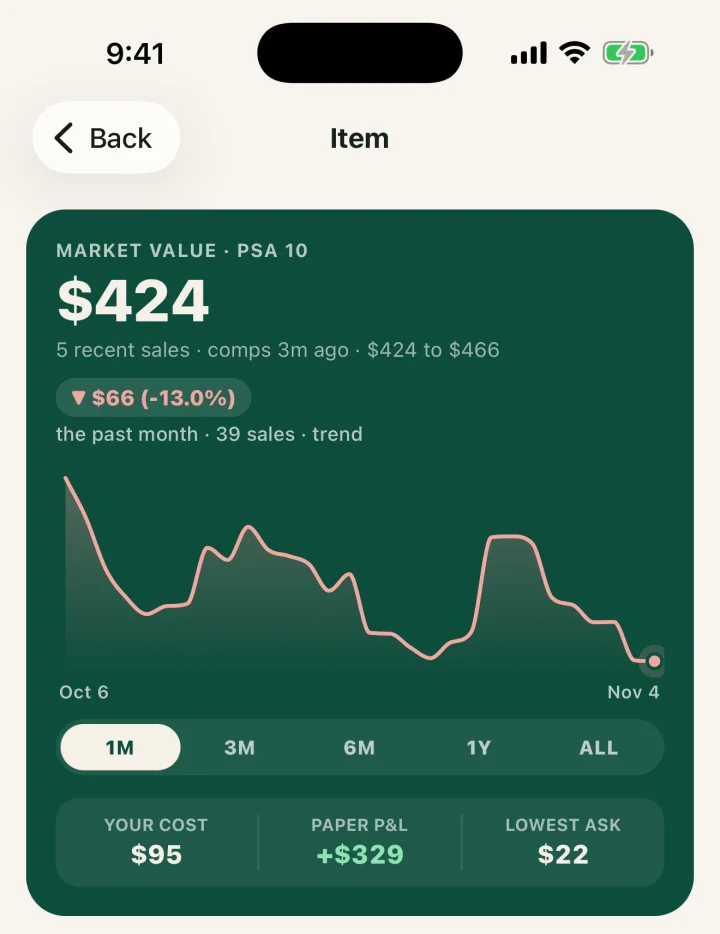
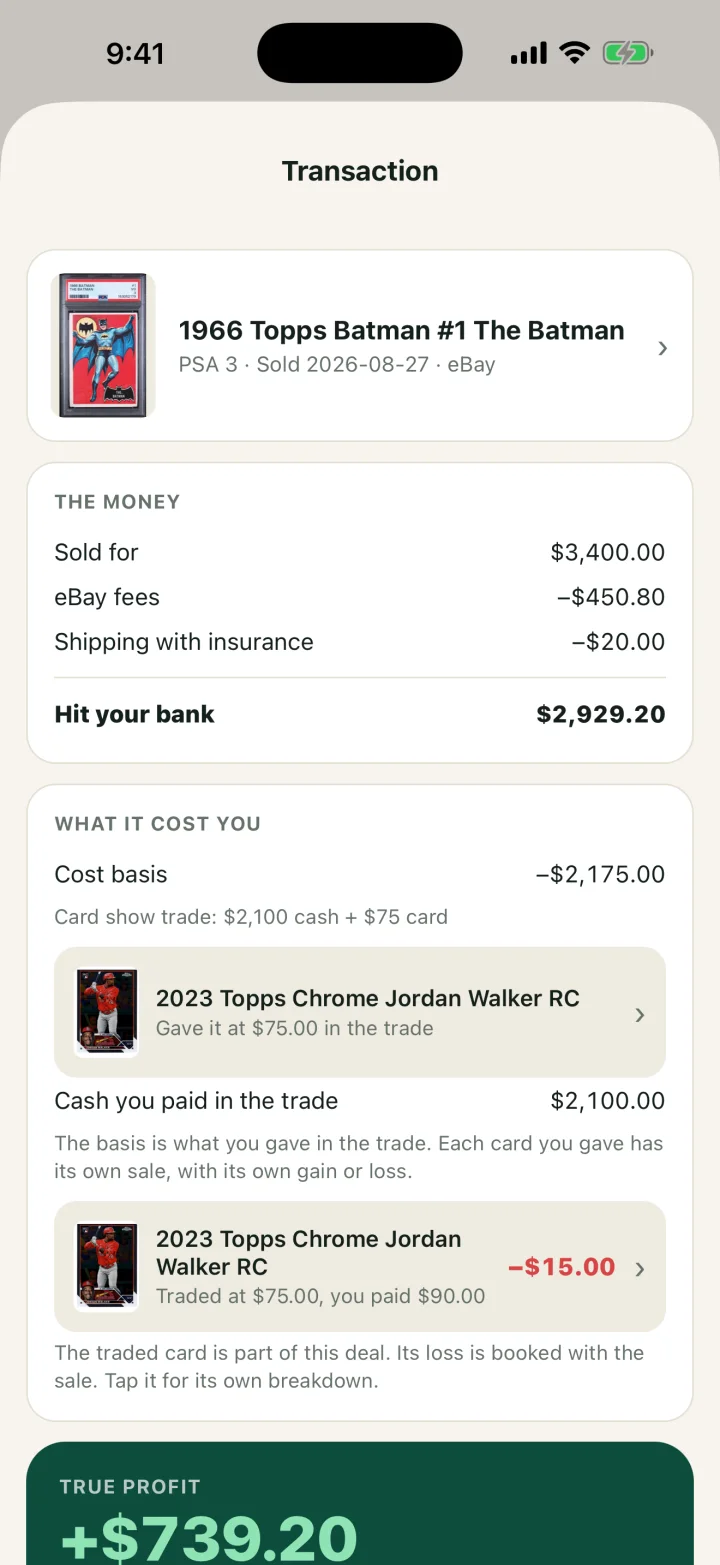
These three screens are the current iPhone app with demo data. The scan screen identifies a card or slab from the camera. The item screen shows a market value from recent sales, your cost and current listings. The transaction screen shows one sale from price to true profit.
Related guides
- The Card Vendor's Master Guide to Taxes: how profit on each sale is taxed, and where cost lands on Schedule C.
- Card show buy percentages: what a card nets after fees, and what that leaves you to pay for it.
- How to track card show sales: three ways to keep the price, the payment and the cost together.
- How to become a card show vendor: the table, the sales tax registration and the first tax year.
- Cost basis for cards bought with cash or by trade: the receipt that proves what a card cost.
FAQ
What is the best way to price cards for a card show?
Use recent sold prices for the same card in the same grade, checked in the days before the show. Set the sticker about 10 percent above the number you want and decide your lowest price at home from what the card cost you. Record the cost before the show so each sale has a profit number.
Should I put price stickers on every card?
Yes for anything in a case, a binder or a row of top loaders. Put the sticker on the top loader, a team bag or the slab sleeve, never on the card or the slab label. Bulk boxes are the exception: one sign per box with one price and any quantity deal.
How much room should I leave to haggle?
About 10 percent is what buyers expect. Buyer guides tell people to open at 80 to 90 percent of market value. One writer found that asking nicely won about 10 percent off. Some vendors price firm at recent sales and say so on a sign. Both work if your lowest price is set before the show.
Should I price lower at a show than on eBay?
You can afford to, because a cash sale has no marketplace fee and no postage. In our example a $190 cash sale leaves $50 on a card that cost $140, and a $200 eBay sale leaves $31.92. Count the table and travel before you call the show cheaper.
What if a card has no recent sales?
Start from the nearest sales, such as the same card one grade away or the closest parallel. Leave a wider gap between the sticker and your lowest price, and tell the buyer the price is an estimate. Recheck before every show, because one new sale can reset the price.
Is it profit or the whole sale that is taxed?
Profit. That is the sale price minus what the card cost minus selling costs. On a $190 sale of a card that cost $140, the profit is $50. Without a record of the $140, the IRS can treat the cost as zero.
Do I charge sales tax on cash?
Yes, where the state taxes the sale. The payment method does not change it. Sales tax is collected from the buyer and owed to the state, so record it apart from the sale price.
How do I price a dollar box for tax purposes?
The sign sets the sale price. The cost per card comes from the lot the bulk arrived in, split by a reasonable method you use every time. A lot of 800 cards bought for $80 carries $0.10 a card. Count what sold and record sales and cost together.
SOURCES
- Publication 583, Starting a Business and Keeping Records (rev. December 2024), IRS, checked November 2026.
- Publication 334, Tax Guide for Small Business, IRS, checked October 2026.
- Recordkeeping, IRS, checked November 2026.
- Topic no. 420, Bartering income, IRS, checked October 2026.
- Selling fees, eBay, checked October 2026.
- Square's fees, Square, checked October 2026.
- Business profile transaction fees, Venmo, checked October 2026.
- Merchant fees, PayPal, checked October 2026.
- Vendors and promoters at flea markets, craft shows and trade shows, New Jersey Division of Taxation, checked November 2026.
- Hobby reporting and vendor threads read November 13, 2026, linked where cited: Sports Illustrated, Sports Collectors Digest, Cardboard Connection, All Vintage Cards, Card Codex, CoolStuffInc, CardPulse, and the Collectors Universe, Elite Fourum, Hobby Insider and The Bench forums.
This is general information for card sellers, not tax or legal advice for your situation. Rules change and states differ; a CPA who knows your numbers wins every time.