What the sheet looks like
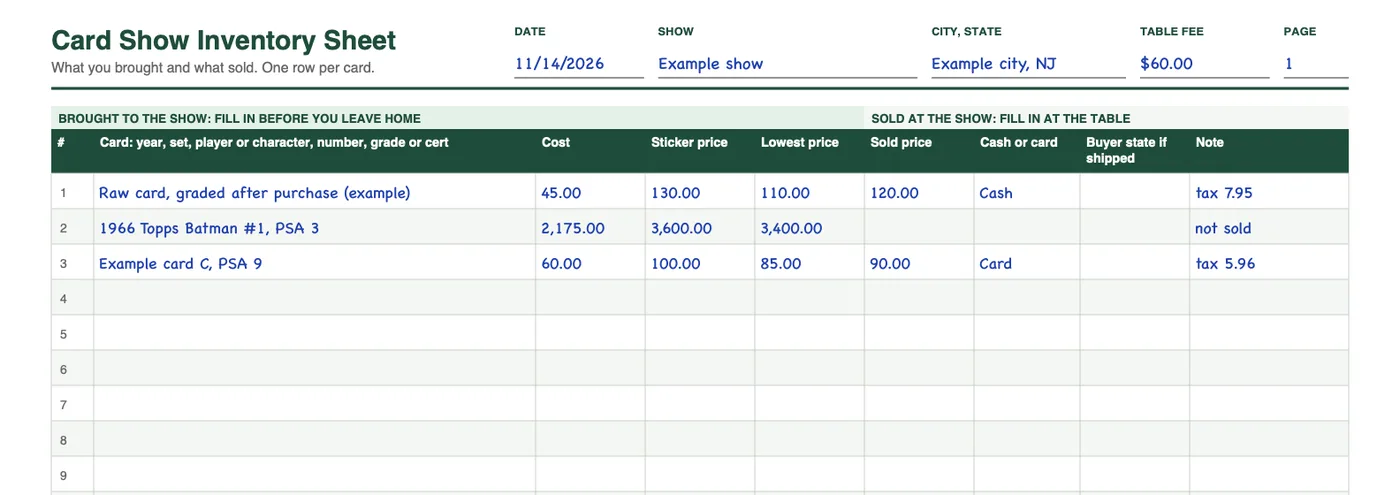
Page 1 is the list of cards you brought, with the sold columns on the right. This is the printed page with three example rows written in. The names, prices and show are examples.
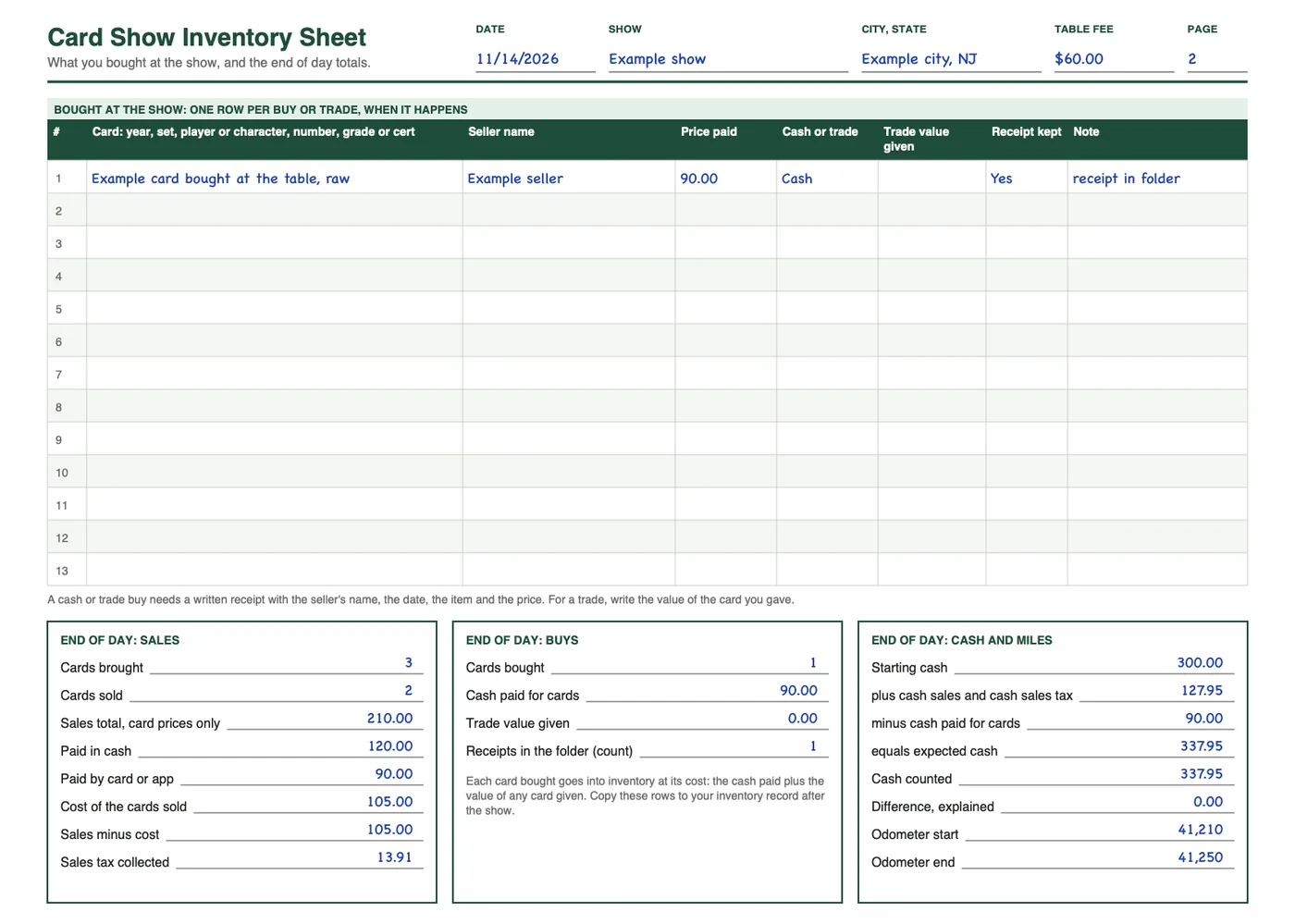
Page 2 has the cards you bought at the show and three boxes of end of day totals. The example carries the same three cards through to the cash count.
What is on the sheet
The sheet has three parts: what you brought, what sold, and what you bought. The header takes the date, the show, the city and state, and the table fee.
| Part | Column | What to write |
|---|---|---|
| Brought | Card | Year, set, player or character, number, and the grade or cert |
| Brought | Cost | What the card cost you, including any grading fee |
| Brought | Sticker price | The price on the card at the table |
| Brought | Lowest price | The least you will take. It stays on the sheet, not on the sticker. |
| Sold | Sold price | What the buyer paid for the card, without sales tax |
| Sold | Cash or card | How the buyer paid |
| Sold | Buyer state if shipped | The state the card goes to, only if you ship it after the show |
| Bought | Seller name | Who sold you the card |
| Bought | Price paid | The cash you handed over |
| Bought | Cash or trade | One word, plus the value of any card you gave |
Fill in the brought columns at home. Fill in the rest at the table, while the buyer or seller is still in front of you. For a busy cash day, the card show cash and trade log gives every deal its own timed row.
How to use it, step by step
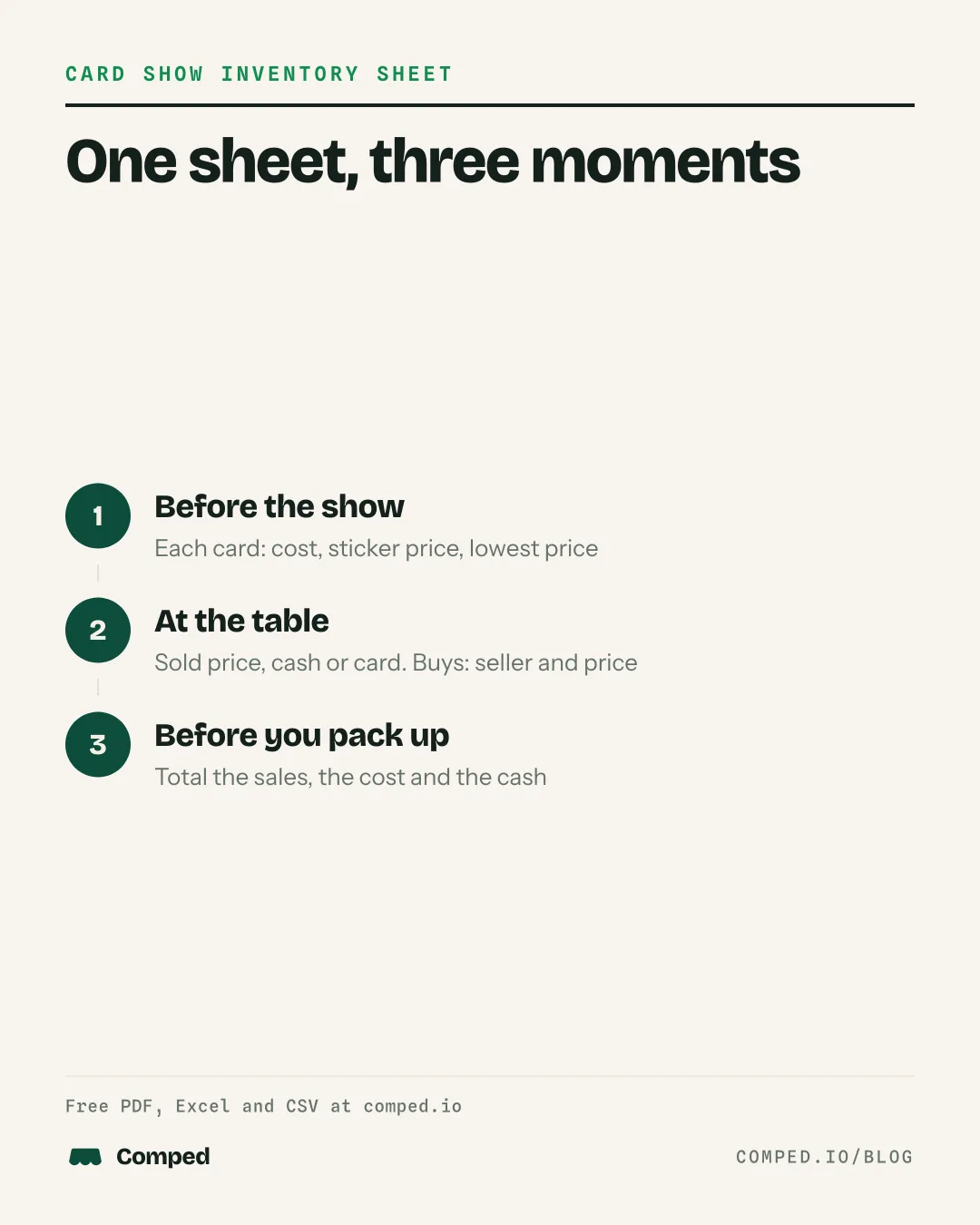
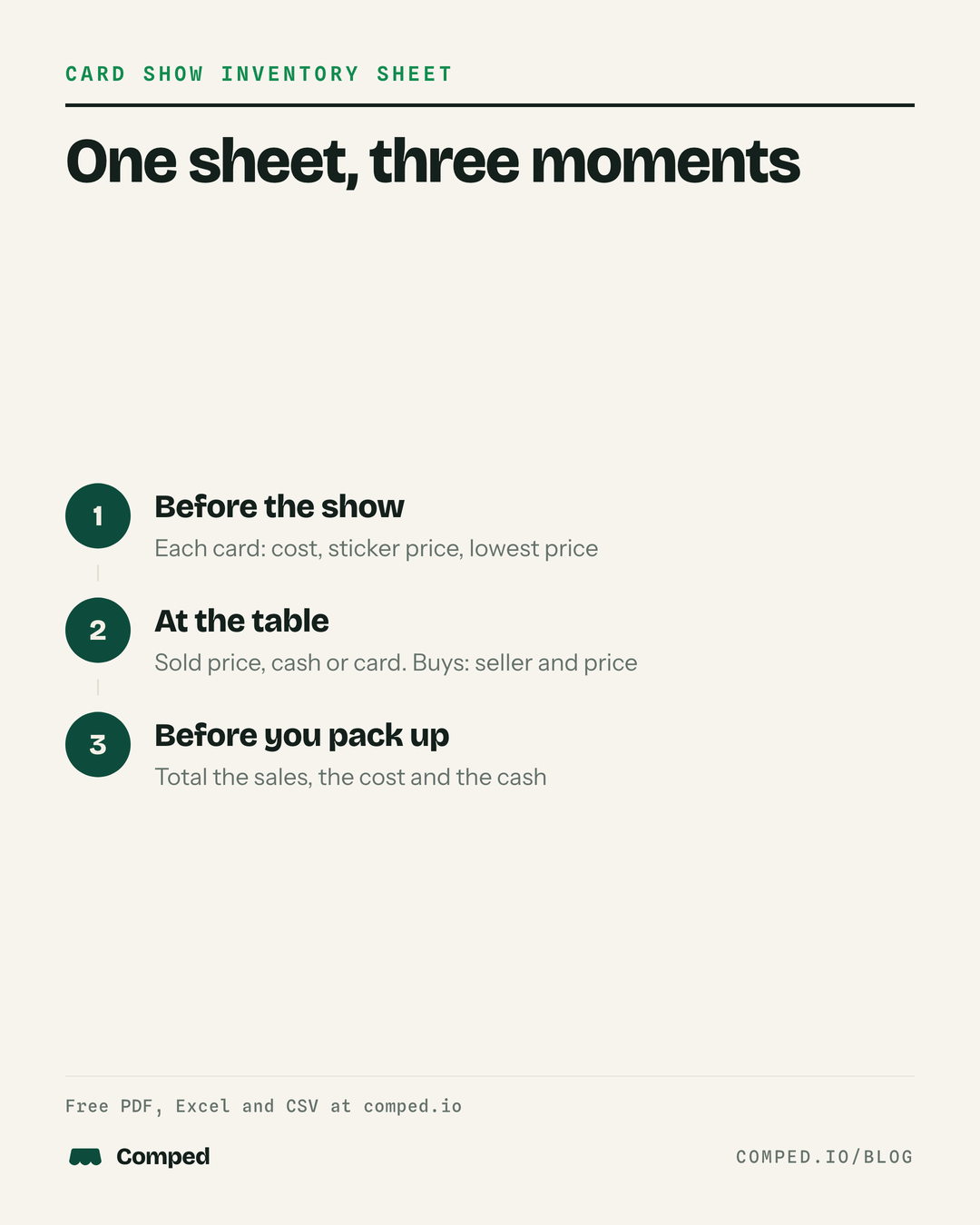
The sheet is filled in three sittings: at home, at the table and at the close.
- The night before, print page 1 once for every 22 cards and page 2 once.
- Write the date, show, city and state, and table fee at the top. Number the pages.
- List each card you are bringing with its cost, sticker price and lowest price. Put the row number on the back of the sticker or the top loader so you can find the row fast.
- Count your starting cash and write it in the cash and miles box. Write the odometer reading before you leave.
- At the table, when a card sells, find its row and write the sold price and cash or card. Note the sales tax beside it.
- When you buy a card, write a row on page 2 while the seller is still there, and get the receipt.
- At the close, add up the three boxes, count the cash and write the odometer again.
- At home, check unsold cards against page 1 and copy the day into your books.
If the table is busy, do not skip the row. Write the row number and the price on anything, even the back of the sheet, and fill in the rest at the next quiet minute.
Cost, sticker price and lowest price
Each card gets three numbers before the show: what it cost, what you ask and the least you will take. The gap between the last two is your room to negotiate. The gap between the lowest price and the cost is the profit you are protecting.
Cost means everything you paid to own the card. For a dealer, a grading fee is part of the card's cost and comes back when the card sells. No IRS guidance speaks to grading fees directly, so treat that as the common reading and confirm it with your preparer. The grading fee guide walks through it.
A card with no cost on the sheet is a card you cannot price a deal on. It is also a problem at tax time, because the cost is the number you subtract from the sale. The cost basis guide covers cards bought with cash, by trade or in a lot.
What sold
When a card sells, write the sold price and cash or card on its row. The sold price is the card only. Sales tax you collect goes in its own box on page 2, because it is owed to the state.
ONE ROW, WORKED
A vendor bought a raw card for $20, paid $25 to grade it, and sells it for $120 cash at a New Jersey show.
Table sales are the seller's own job for sales tax. Marketplaces collect on their own orders, not on yours at a show. In the card show sales tax index, 35 of the 46 states with a sales tax require a vendor to register before a single show.
The buyer state column is for a card you ship after the show. Write the state so the sale can be sorted later. How a shipped sale is taxed depends on the states involved, so ask the state's revenue agency or your preparer.
What you bought at the show
Every buy gets a row with the seller's name, the price and cash or trade. That row and a written receipt are your proof of the card's cost.
IRS Publication 583 lists the documents that support a purchase. For a cash or trade buy at a show, that means a written receipt with the seller's name, the date, the item and the price. The sheet has a Receipt kept column so you can see which ones are missing before you leave.
A trade is barter. Under IRS Tax Topic 420, the fair market value of the card you receive is income in the year you receive it, and that value becomes the new card's cost. Write the value of the card you gave in the Trade value given column.
End of day totals
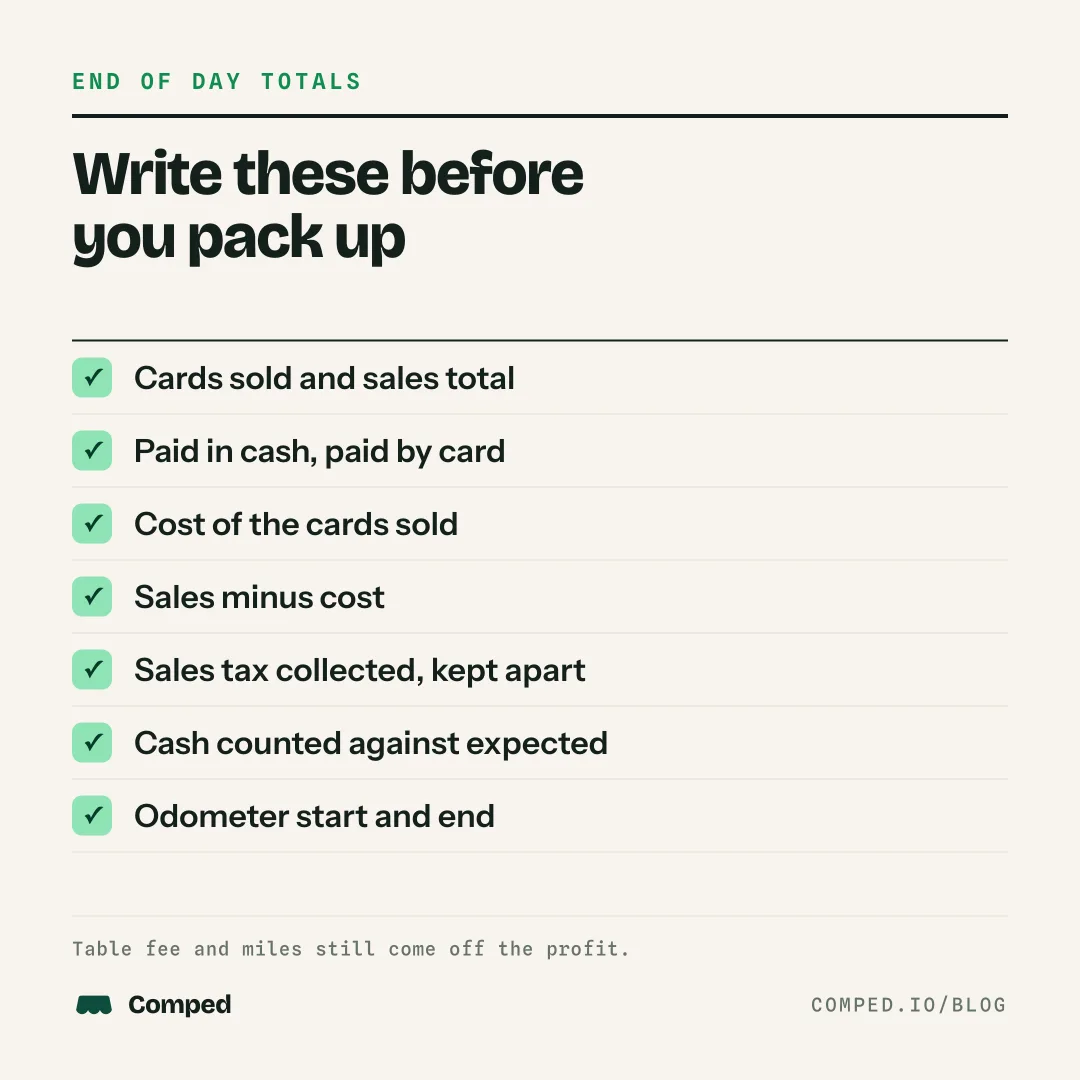
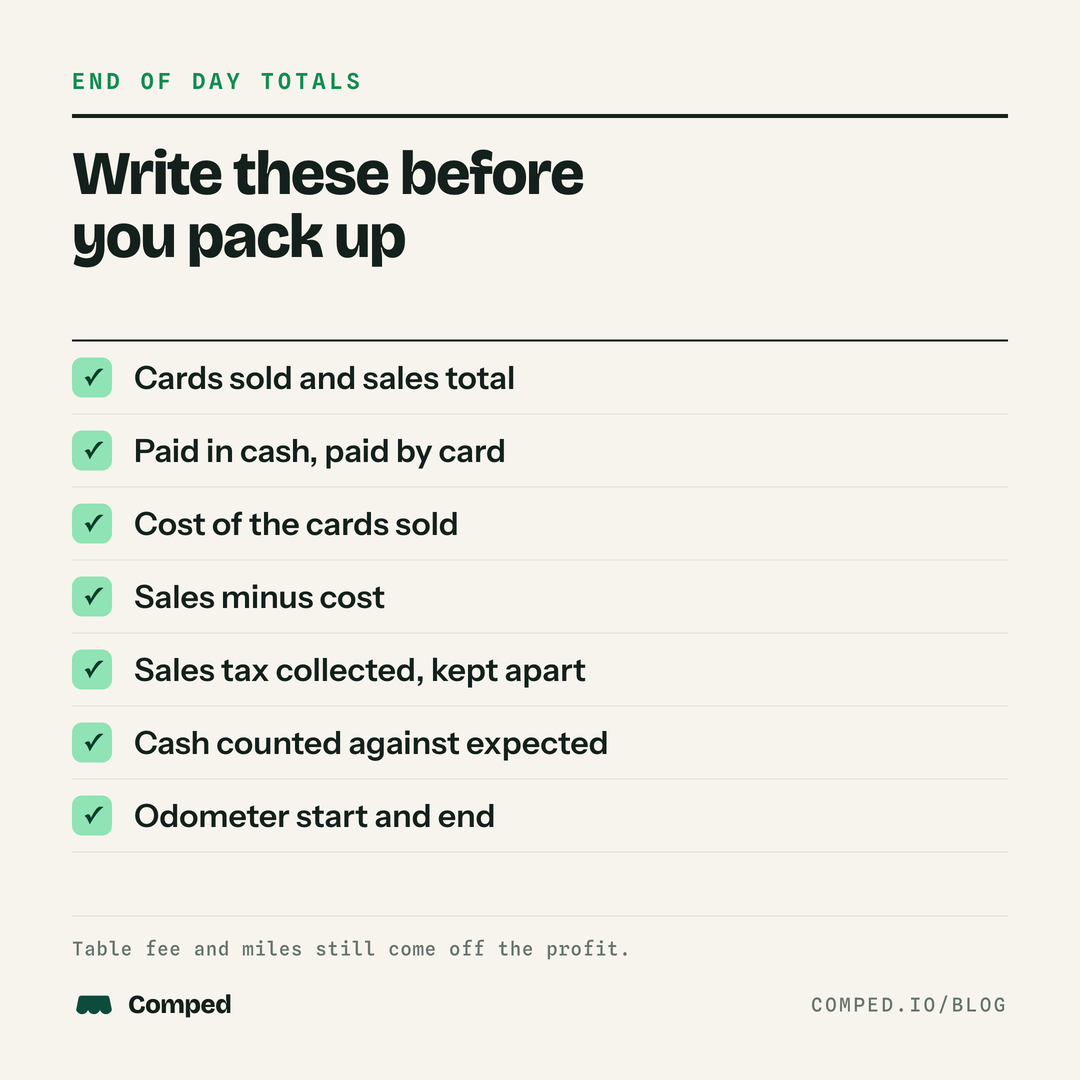
Page 2 ends with three boxes: sales, buys, and cash and miles. Fill them in before you pack up, while the day is still in your head.
| Box | Lines |
|---|---|
| Sales | Cards brought, cards sold, sales total, paid in cash, paid by card or app, cost of the cards sold, sales minus cost, sales tax collected |
| Buys | Cards bought, cash paid for cards, trade value given, receipts in the folder |
| Cash and miles | Starting cash, plus cash sales and cash sales tax, minus cash paid for cards, equals expected cash, cash counted, the difference, odometer start and end |
Sales minus cost is not your profit for the day yet. The table fee, travel and supplies come off too. The standard mileage rate for 2026 is 72.5 cents a mile from January 1 to June 30 and 76 cents from July 1 to December 31, per the IRS mileage rates page. The write-off guide covers the rest.
THE EXAMPLE DAY, ADDED UP
The show in the pictures above: three cards brought, two sold, one bought, at a New Jersey show. The table fee and miles are examples.
The cash count is separate from profit. Starting cash of $300.00, plus $120.00 in cash sales and $7.95 of sales tax taken in cash, minus $90.00 paid for a card, is $337.95 expected in the box. The $90.00 card is not a cost of the day. It is inventory, and its cost comes off when it sells.
Sales tax of $13.91 was collected on the two sales: $7.95 in cash and $5.96 through the card reader. All of it is owed to the state. The card show profit calculator runs the same sum with your own table fee and travel before you book a show.
Comped records each card's cost when you buy it and marks the card sold when you sell it, so sales minus cost is already added.
Where the totals go at tax time
Each total on page 2 feeds one part of a seller's Schedule C. One show's sheet is one slice of the year, so add the sheets together before anything goes on a return.
| Line on the sheet | What it becomes |
|---|---|
| Sales total, card prices only | Part of gross receipts, Schedule C line 1. Cash counts the same as card. |
| Cost of the cards sold | Part of cost of goods sold, Part III, which ends on line 42 and carries to line 4 |
| Cash paid for cards and trade value given | Purchases, line 36. The cards stay in inventory until they sell. |
| Table fee | A business expense in Part II |
| Odometer start and end | Business miles for the standard mileage rate, claimed on line 9, car and truck expenses |
| Sales tax collected | Not your money. Keep it apart and pay it with the state return. |
| Trade value given | Also a sale of the card you gave, at that value |
This is how the lines read to us, from the 2026 Schedule C. Your preparer decides where each expense sits. A hobby seller does not use Schedule C; the hobby or business guide explains the difference.
PDF, Excel or CSV
Use the PDF at the table and the Excel file at home. Paper does not run out of battery, and a row takes five seconds to write.
| File | What is in it | Use it when |
|---|---|---|
| 2 landscape letter pages: 22 card rows, 13 buy rows, 3 totals boxes | You want paper on a clipboard | |
| Excel | 3 sheets: Brought and sold, Bought at the show, End of day. Room for 300 cards. The End of day sheet adds itself up. | You type the day up at home, or bring a laptop or tablet |
| CSV, 2 files | The same columns with no formulas | You are importing into another program |
In the Excel file, type the word Cash in the Cash or card column for cash sales. The Paid in cash total looks for that exact word. The Excel file also has a Sales tax collected column on each row and a Sold price minus cost column that fills itself.
Dollar boxes and bulk
Cards you price by the box do not need a row each. Give the box one row: "Dollar box, 400 cards", the total you paid for them in Cost, and $1 in Sticker price. Keep a tally of cards sold from the box in the Note column, and write the box's sales in Sold price at the close.
The cost of the cards sold from a box is their share of the box's cost. If 400 cards cost $100, each one cost 25 cents, so 60 sold is $15.00 of cost. That is an example; use your own count and cost.
Common mistakes
Five slips cause most of the trouble with a show sheet.
| Mistake | What it costs |
|---|---|
| Leaving Cost blank | You negotiate blind, and at tax time a card with no supported cost can be treated as all profit |
| Writing the sold price with tax included | Sales look higher than they were, and the tax owed to the state is hidden inside them |
| Skipping the row for a card you bought | No record of what it cost, and the cash count will not match |
| Counting the table fee as part of a card's cost | It is an expense of the day, not of one card |
| Not counting the cash before you leave | A shortage found the next morning cannot be traced to a deal |
If you already ran a show without a sheet, rebuild it the same week from payment app history, card reader reports, photos and memory. The guide to card sales with no receipts covers what counts as support.
After the show
The sheet is one day's record. It becomes useful when it reaches your books.
- Staple the buy receipts and the table fee invoice to the sheet.
- Copy each sale and buy into your inventory record, such as the free card inventory and profit spreadsheet.
- Check the unsold cards back in against page 1.
- Set the sales tax collected aside for the state return.
- Keep the sheet for at least 3 years.
The IRS record period is 3 years, 6 years if income was under-reported by more than 25%, and indefinitely if no return was filed. The card show vendor checklist covers the rest of the day, before and after.
How this looks in the Comped app
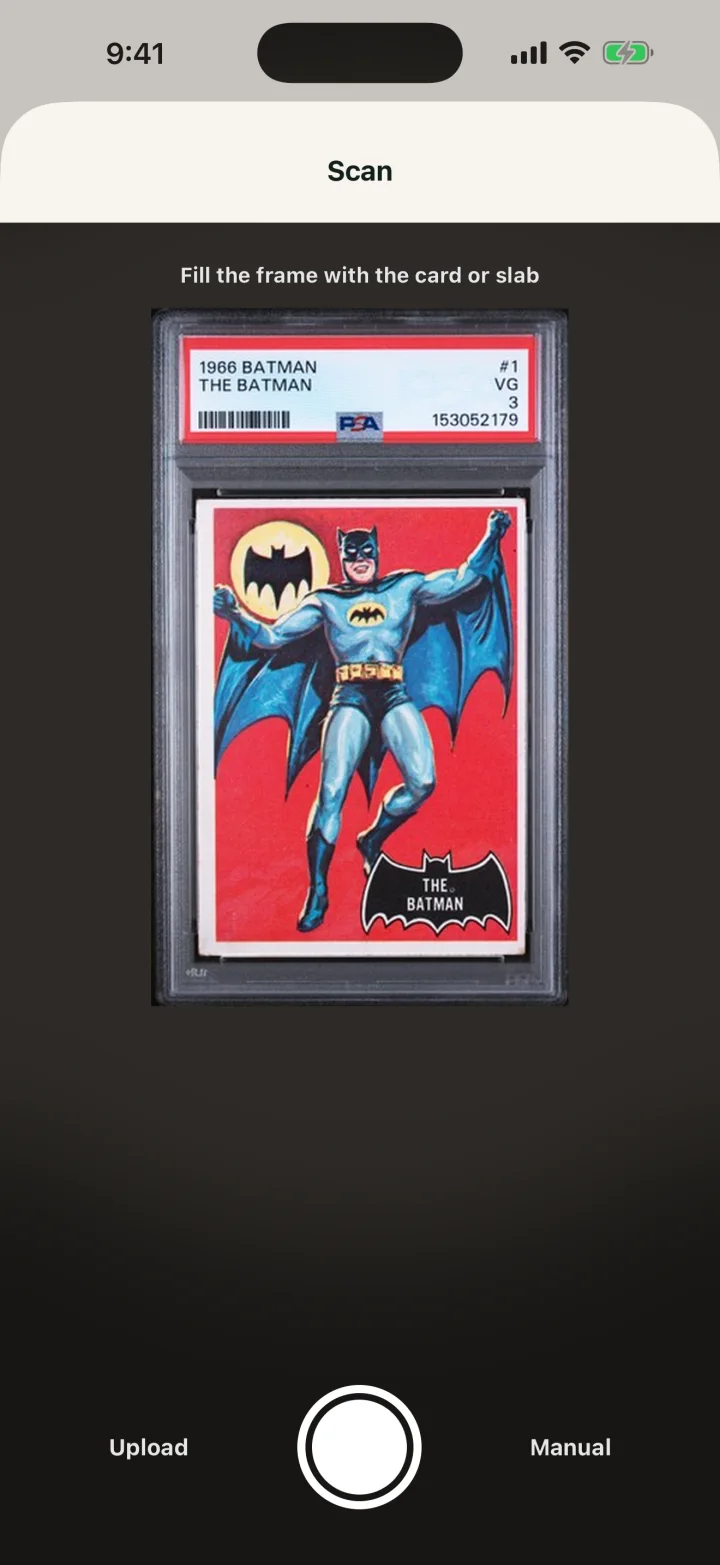
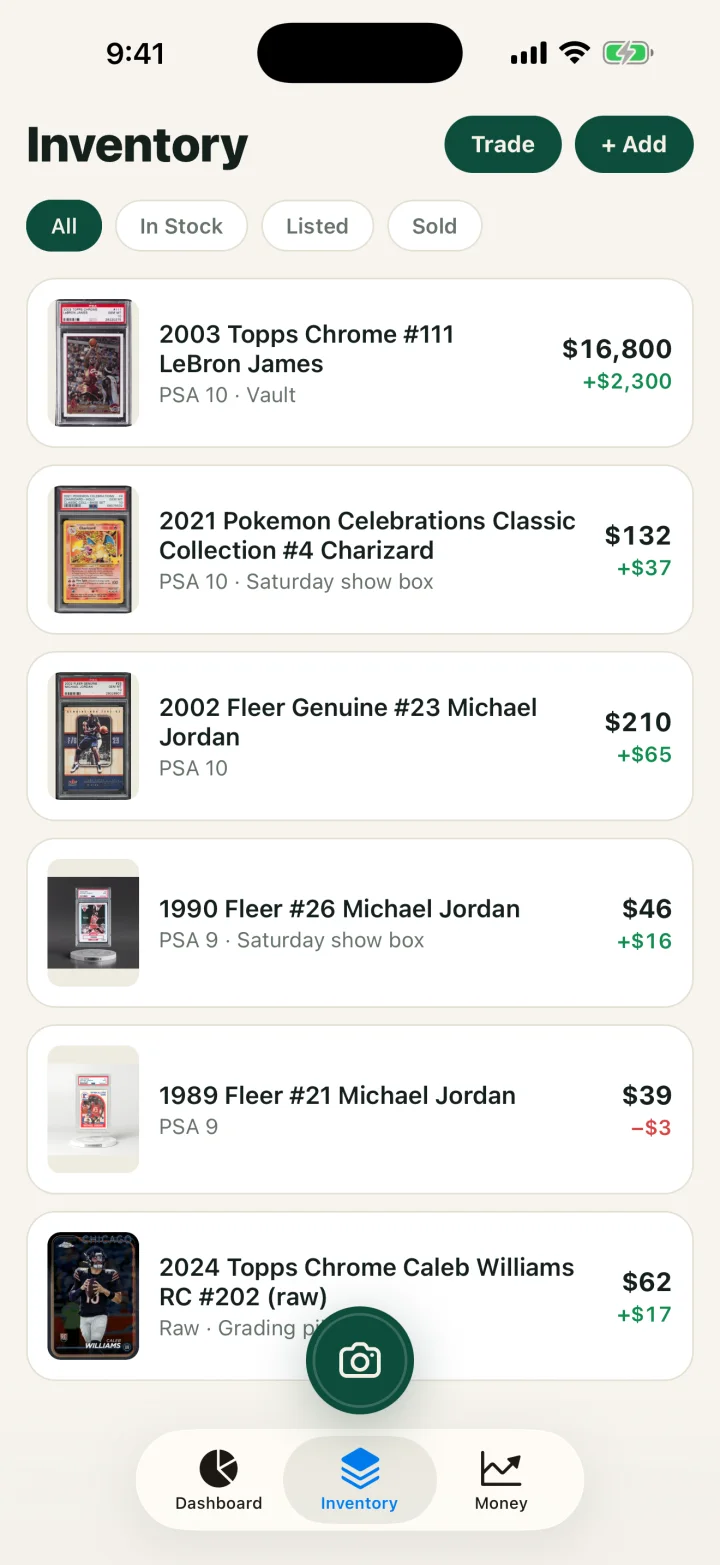
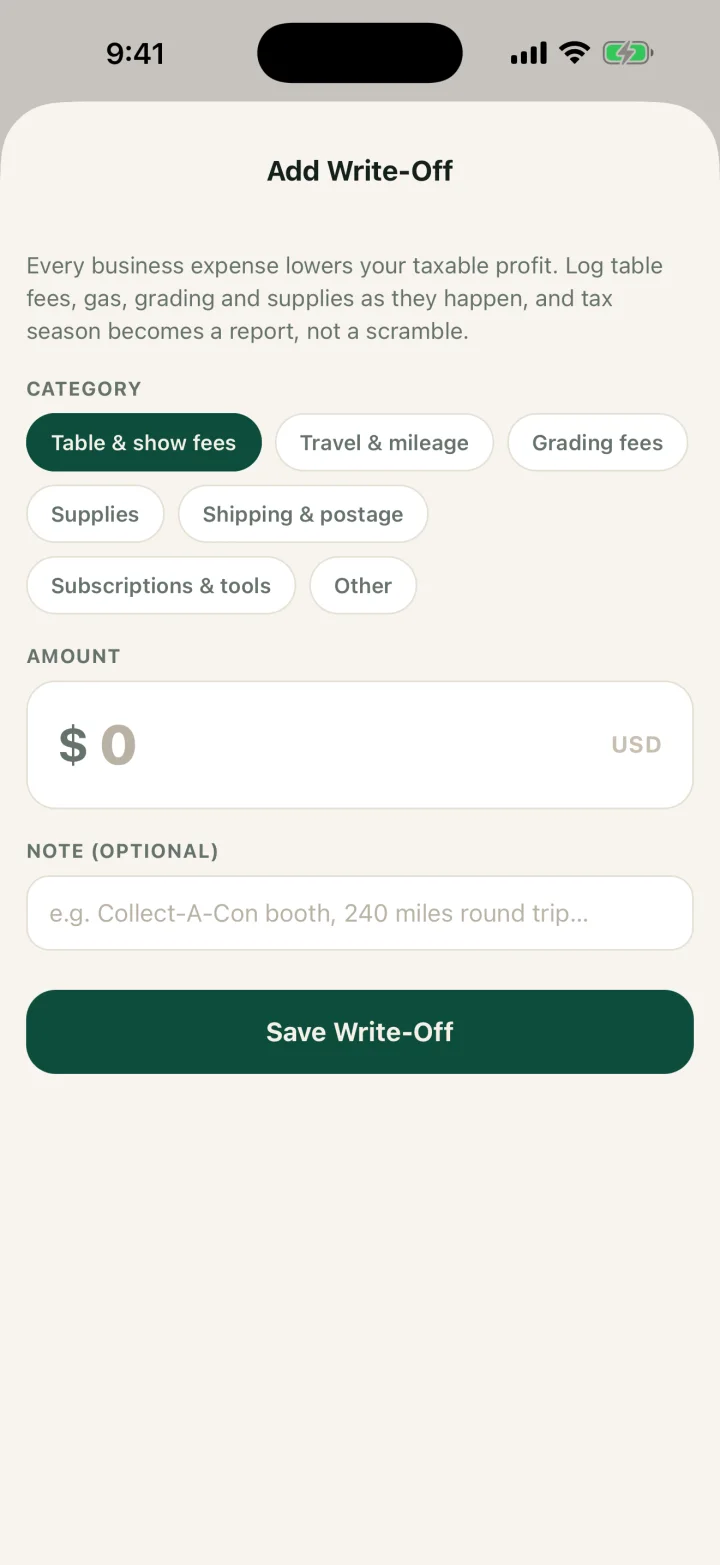
These are captures of the current app with demo data. Scanning a card at the table starts its record. Inventory then lists each card with its value and gain, with filters for In Stock, Listed and Sold. The table fee goes in as a write-off under Table and show fees.
Related guides
- The Card Vendor's Master Guide to Taxes: how the profit on these rows is taxed.
- Card show vendor checklist: what to do before, during and after the show.
- How to track card show sales: the record behind this sheet.
FAQ
What should a card show inventory list include?
The card, its cost, the sticker price and the lowest price you will take. Add the sold price and payment method when it sells. Year, set, player or character, number and grade or cert identify the card.
Is the card show inventory template free?
Yes. The PDF, Excel and CSV files download directly from this page. There is no email form and no account.
Does the spreadsheet work in Google Sheets?
Yes. Upload the Excel file to Google Sheets with File, Import, and the formulas carry over. The CSV files open in any spreadsheet program.
How do I track inventory at a card show without an app?
Print the sheet, list each card with its cost before you leave home, and write the sold price on its row when it sells. Add up the totals and count the cash before you pack up. Type it into your books that week.
Should I list every card or use a quantity?
List every card you price by itself. A dollar box or a bulk bin can be one row with the total cost and a tally of cards sold. Showcase cards and slabs should each have a row.
Do I charge sales tax on cash?
Yes, where the sale is taxable. Sales tax depends on the item and the state where the show is held, not on how the buyer pays. Write it apart from the sold price.
Do trades count as sales?
Yes. A trade is barter, and the fair market value of the card you receive is income. That value becomes the new card's cost on your next inventory sheet.
Why write down a lowest price?
It lets you answer an offer in seconds without doing math in front of the buyer. Set it at home from the card's cost, and keep it on the sheet where only you can see it.
SOURCES
- Publication 583, Starting a Business and Keeping Records, IRS, checked November 2026.
- Topic no. 420, Bartering income, IRS, checked November 2026.
- Standard mileage rates, IRS, checked November 2026.
- Schedule C (Form 1040), 2026, IRS, downloaded November 13, 2026.
- How long should I keep records, IRS, checked November 2026.
- Vendors and promoters, New Jersey Division of Taxation, checked November 2026.
This is general information for card sellers, not tax or legal advice for your situation. Rules change and states differ; a CPA who knows your numbers wins every time.