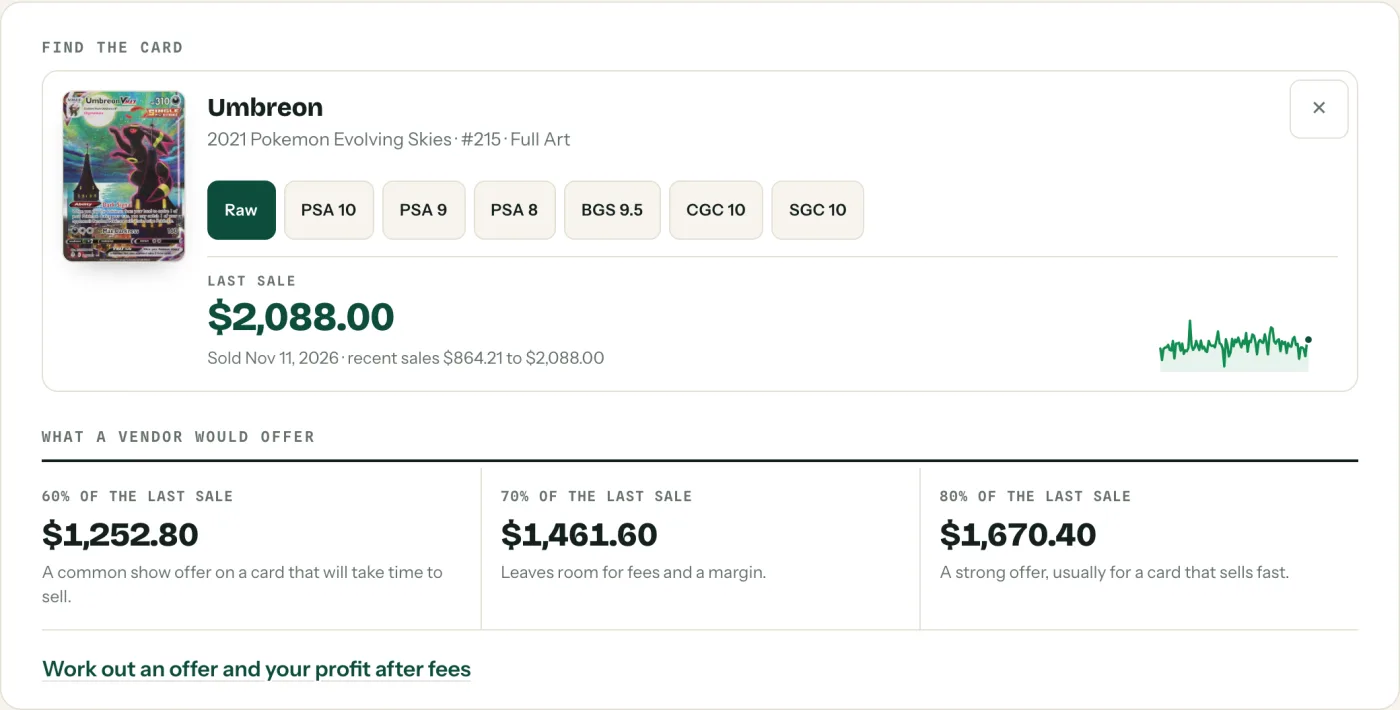
WHAT A VENDOR WOULD OFFER
60% OF THE LAST SALE
$0.00
A common show offer on a card that will take time to sell.
70% OF THE LAST SALE
$0.00
Leaves room for fees and a margin.
80% OF THE LAST SALE
$0.00
A strong offer, usually for a card that sells fast.
COMPED DOES THIS AT THE TABLE
Scan the card or slab with your phone and Comped shows the price from recent sales, then records what you paid or what it sold for. That record is the card's cost for your profit and for your taxes.
What the price is
The number is the most recent sale on record for that card in that grade. It is a sale that closed, not an asking price and not an average. Asking prices tell you what a seller hopes for. A closed sale tells you what a buyer paid.
Under the price you see the range of the latest sales. A tight range means the card trades at a steady price. A wide range means condition, timing or the listing mattered, so look at more than one sale before you make an offer.
How to comp a card
To comp a card, find recent sold prices for the exact same card in the same grade, then judge where your copy sits in that range. "Comp" is short for comparable sale. Seven steps cover it.
- Name the exact card. You need the year, the set, the player or character and the card number printed on the card.
- Match the version. A base card, a silver or refractor parallel, a reverse holo and a 1st Edition are separate markets. A serial number such as 25/99 stamped on the card means a numbered parallel.
- Match the condition. Raw and graded are different prices. For a slab, match the grading company and the grade.
- Use sold prices only. Leave out asking prices and auctions still running.
- Read several sales, not one. The range under the price shows whether the last sale was typical.
- Check the dates. The one year line shows whether the card is rising, falling or flat. In a moving market the newest sales count most.
- Adjust for your copy and your exit. Flaws put a raw card below the range. Fees put what you keep below the comp.
Sold prices versus asking prices
Only a closed sale is a comp. Every other number on a listing page is a guess about a sale that has not happened.
| The number | What it is | Use it as a comp? |
|---|---|---|
| Sold price | What a buyer paid | Yes |
| Asking price on an active listing | What the seller hopes for | No. At best it is a ceiling |
| Current bid on a running auction | Where bidding stands before the close | No. Wait for the final price |
| List price on a sale closed by Best Offer | The price before the buyer's lower offer was accepted | No. Find the accepted amount |
| Price guide or book value | A publisher's estimate | As a cross-check only |
Best Offer sales are the usual trap. eBay's help page for its Product Research tool says the tool covers "the last 3 years of eBay sales data" and shows "the actual price that the item sold for, even if a Best Offer was accepted." Sellers with Seller Hub can use it to check a sale that looks too high.
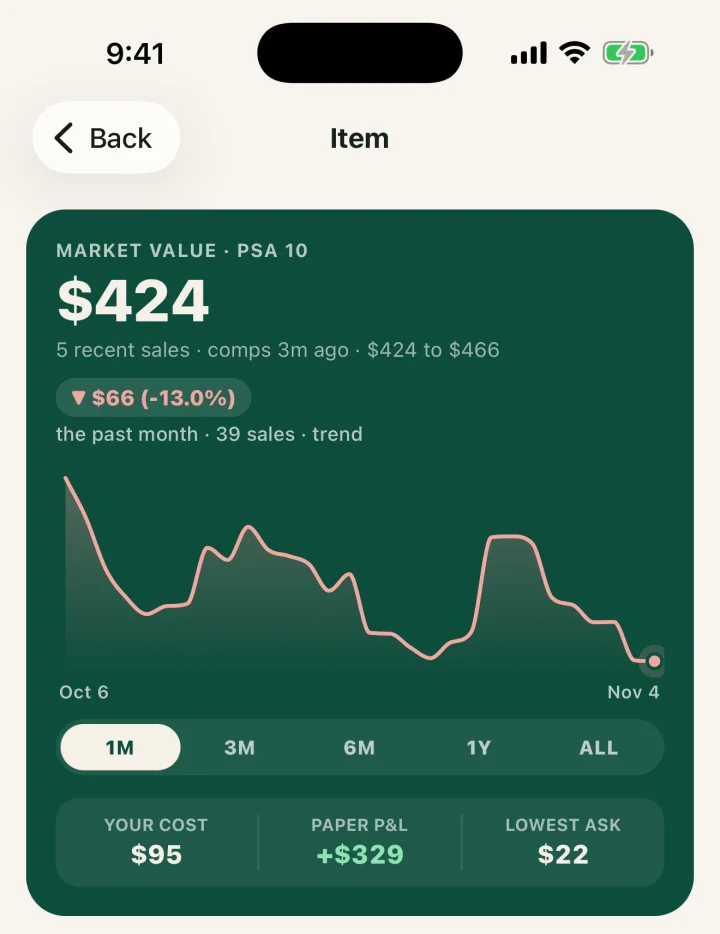
The Comped app keeps the two kinds of number apart on a card's page. Market value from recent sales is on top, with the count and the range. Current listings sit underneath, lowest first.
Raw versus graded
A raw card, a PSA 9 and a PSA 10 of the same card are three different prices. The gap can be small on a common card and several times the raw price on a popular one. Pick the grade that matches the card in front of you. Grading companies are separate markets too, so the lookup lists PSA, BGS, CGC and SGC grades on their own.
For a raw card, the raw price assumes typical condition. Check the corners, the edges, the surface and the centering under good light. Corner wear, a crease or poor centering puts a card below the range. Never price a raw card off a PSA 10 sale. That price belongs to a card that already earned the grade.
Whether to grade is arithmetic. Take the graded price, subtract the grading fee, and compare with the raw price.
IS GRADING WORTH IT? AN EXAMPLE
If the card comes back a grade lower and sells for $40, the same math is $15.00 after the fee, $5.00 less than selling it raw. Look up the lower grades before you submit.
If a grade shows no sales, the card rarely trades in that grade. The next section covers what to do.
When a card has no recent sales
With no recent sale there is no comp, only an estimate, and it is better to say so than to guess. Work outward in this order.
- Check the grades on either side. The PSA 8 and PSA 10 prices bracket a PSA 9.
- Go further back in time, and treat an old sale as a rough guide if the player or the set has moved since.
- Look at the closest relatives: the same card in another parallel, or a similar card of the same player from the same year.
- Use asking prices last, and only as a ceiling.
A card that rarely sells will also take longer to sell. Price that wait into what you pay for it.
Common mistakes when comping
| Mistake | What it costs |
|---|---|
| Pricing from asking prices | Your card sits unsold, or you overpay when buying |
| Comping the wrong version | A base card priced as a parallel, or the reverse |
| Mixing grades or grading companies | A PSA 10 price put on a PSA 9 or a raw card |
| Trusting one sale | In the capture above the last sale is $2,088.00 and the recent range starts at $864.21 |
| Using old sales in a moving market | You pay last season's price |
| Reading the list price on a Best Offer sale | The comp is higher than what the buyer paid |
| Counting lots, reprints and damaged copies | Search results mix them in with the card you want |
| Forgetting fees | A $1,000 comp nets $858.50 on eBay in our fee study |
From a comp to a number you can use
A comp is what a buyer paid, not what you should pay or what you will keep. A vendor buying a card pays a share of its recent sale price, because the vendor still has to sell it, cover fees and wait. The three offers under the price show that math. The buy percentage calculator shows the profit left after eBay or Whatnot fees at any percentage, and the guide to buy percentages explains why offers land where they do.
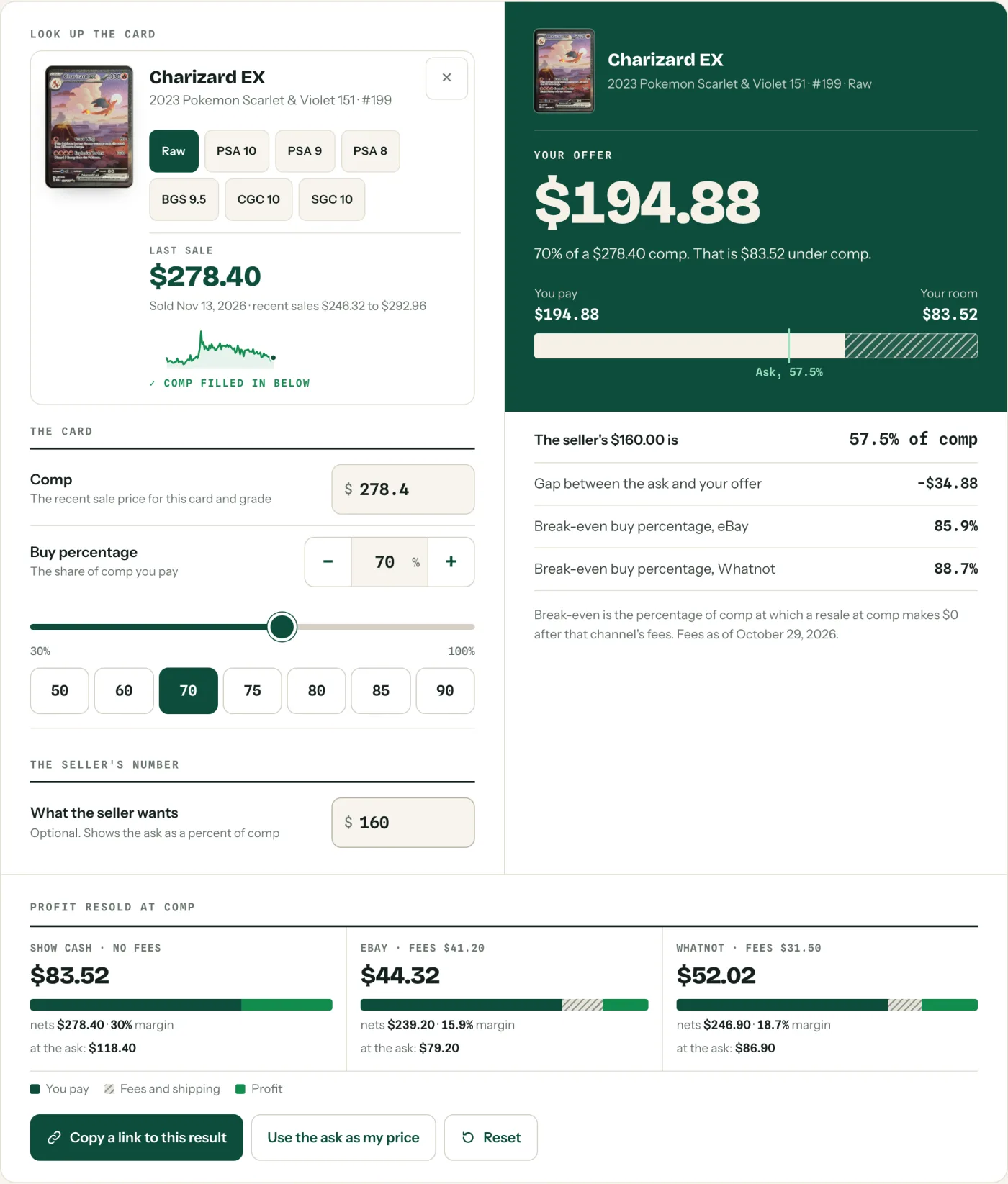
If you are trading, price both sides the same way and use the card trade calculator to see who owes cash. If you are selling, the card profit calculator shows what the same card nets on each platform and for cash at a show. For sticker prices on a table, see how to price cards for a card show.
Why the price you paid matters as much
The sale price is half of the profit. The other half is what you paid, and that is the number sellers lose. You owe tax on profit, so a card with no record of its cost can be taxed as if it cost nothing. Write the cost down when you buy. The cost basis guide covers cash buys and trades, and the free inventory spreadsheet gives each card a row.
Terms used on this page
- Comp: a comparable sale, meaning a recent sold price for the same card in the same grade.
- Raw: a card that has not been graded.
- Slab: a card sealed in a grading company's case with its grade on the label.
- Parallel: a version of a card with a different finish, color or print run than the base card.
- Best Offer: an eBay listing where the seller can accept less than the list price.
Related tools and guides
- Card show buy percentage calculator: turn the last sale into an offer.
- Card profit calculator: what the card nets on each platform.
- How to price cards for a card show: sticker prices and lowest prices.
- Card cost basis calculator: the cost per card when you buy a lot or a box.
- The card vendor's master guide to taxes: what happens after the sale.
FAQ
Is the card price lookup free?
Yes. There is no sign-up and no limit on ordinary use. It works on a phone, so you can check a card at a show table.
Does it cover Pokemon cards as well as sports cards?
Yes. Search a Pokemon card by name and card number, or a sports card by year, set and player. Both show raw and graded prices.
What does comp mean for cards?
A comp is a comparable sale: a recent sold price for the same card in the same grade. To comp a card is to look those sales up before you buy, sell or trade. Asking prices are not comps.
Is the price an average?
No. It is the most recent sale on record for that card and grade. The range under it shows the spread of the latest sales so you can see whether that sale was typical.
Should I use asking prices if there are no recent sales?
Only as a ceiling. Check the grades on either side first, then older sales, then the same card in another parallel. An asking price shows what a seller hopes for, and a listing that has not sold has not found a buyer at that price.
Why does a grade show no sales?
Some cards rarely trade in a given grade. When no recent sale is on record the tool says so instead of guessing. Check the grades on either side.
How much should a dealer offer me for my card?
It depends on the card and the dealer. A dealer pays less than the last sale because the dealer has fees, time and risk before the card sells again. The buy percentage calculator shows the math at any percentage.
Can I look up a slab by its cert number?
Not on this page. The Comped app reads the slab when you scan it and prices that exact card and grade.
SOURCES
- Researching with Product Research, eBay Customer Service, checked November 13, 2026.
- Card sale fees by platform, Comped research, data as of October 29, 2026, for the $858.50 eBay net on a $1,000 card.