What a card dealer's books need
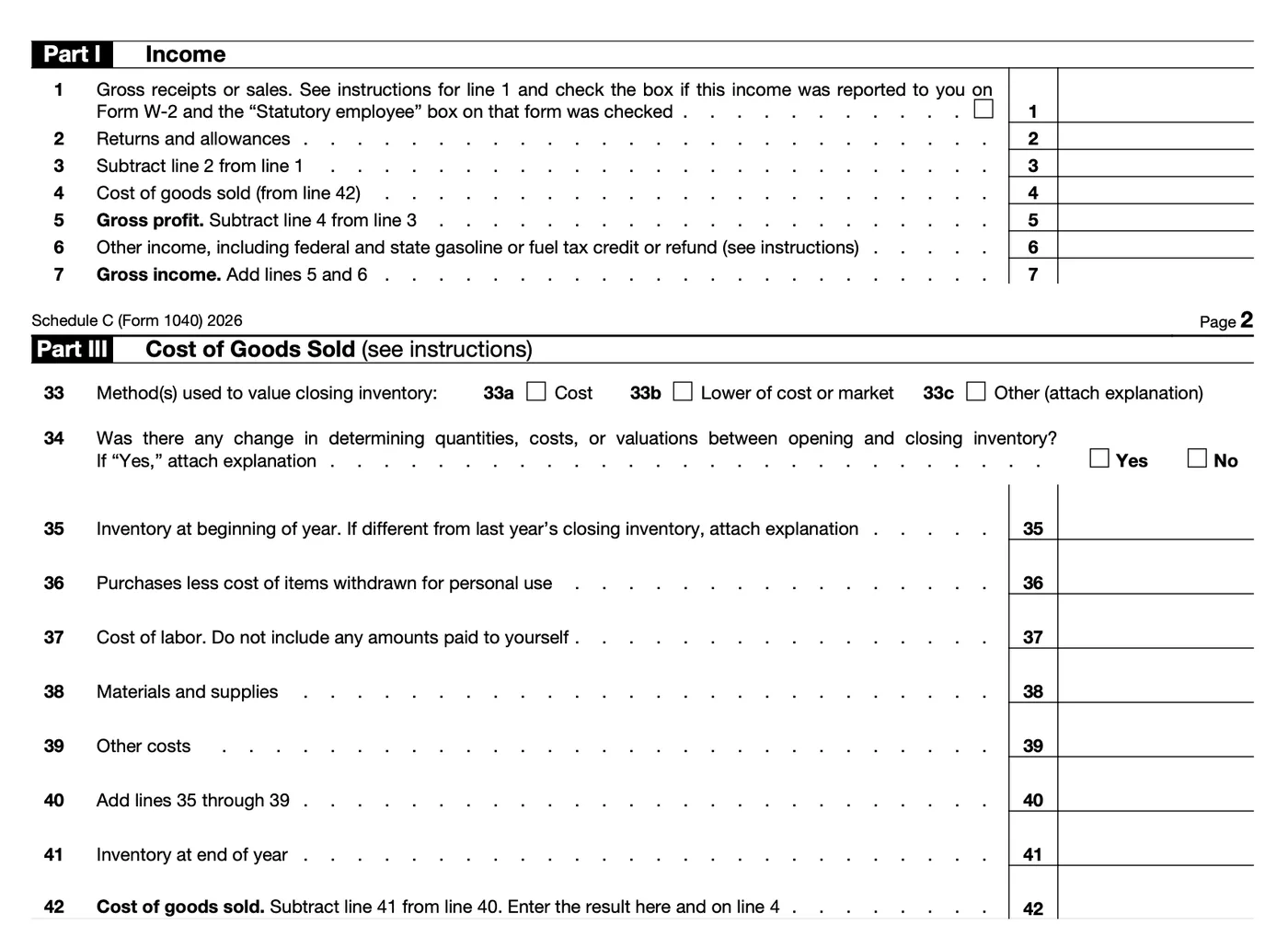
A card dealer's books need a cost for every card sold, not only a list of sales. Dealers report on Schedule C, where sales go on line 1 and cost of goods sold is worked out on lines 35 to 42. The master tax guide walks through the form.
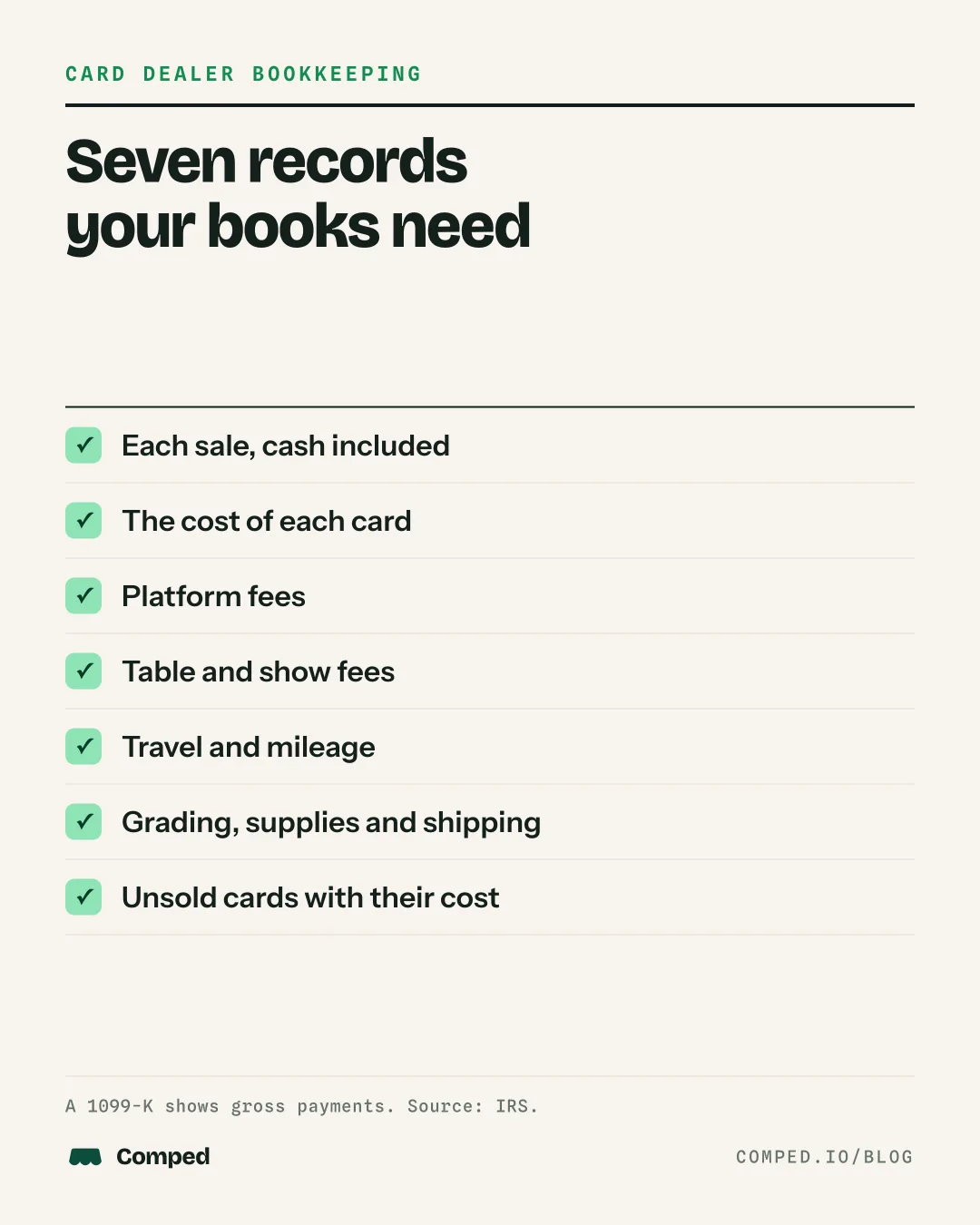
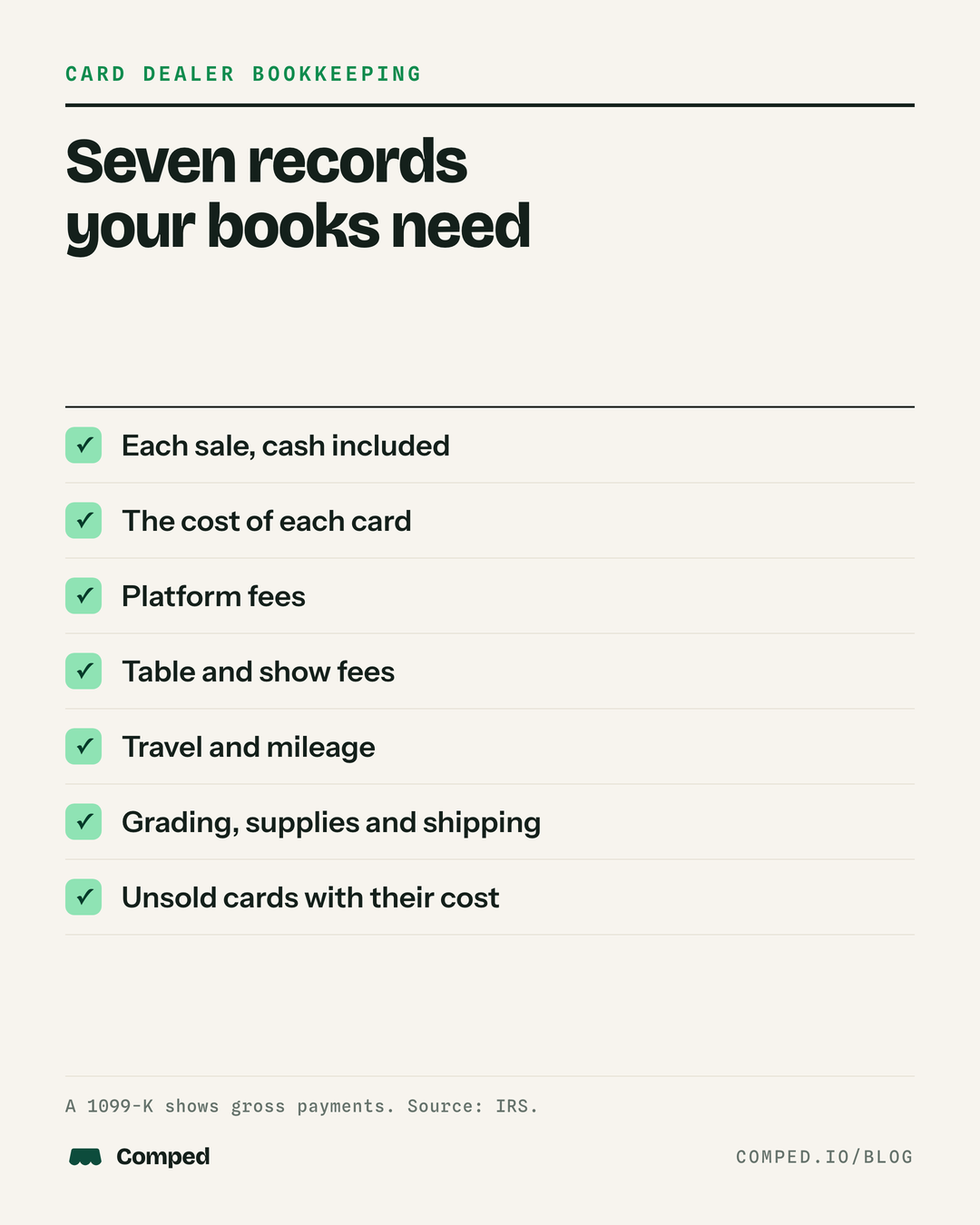
| Record | Why the books need it | Where on Schedule C | Where Comped keeps it |
|---|---|---|---|
| Each sale | Income, including cash that no platform reports | Line 1 | The sale record: card, price, venue, date |
| Cost of each card sold | Subtracted from the sale to reach profit | Part III, to line 4 | The buy record and the Inventory tab |
| Platform fees | A 1099-K does not subtract them | Part II | The fees line on each sale page |
| Table and show fees | A business expense | Part II | Write-offs, table and show fees |
| Travel and mileage | A business expense when logged | Part II, lines 9 and 24a | Write-offs, travel and mileage |
| Grading, supplies, shipping | Costs of the cards and of selling them | Part II or Part III | Write-offs, one category each |
| Unsold cards | Their cost is not deducted until they sell | Part III | The Inventory tab, each card with its cost |
The IRS says a 1099-K shows gross payments. Fees, refunds, shipping and the cost of the cards come off on the return, from your records. The 1099-K reconciliation calculator shows the gap between the form and real profit.
Books made at the table
In Comped, the record you make at the table is also the tax record. Scan the card, enter the price, and the buy is on the books with its date, venue and photo.
That is the hard part of bookkeeping for card sellers. A cash buy from a walk-up seller produces no invoice and no bank line. IRS Publication 583 lists the documents that support a purchase, and for a cash buy that means a written record made at the time.
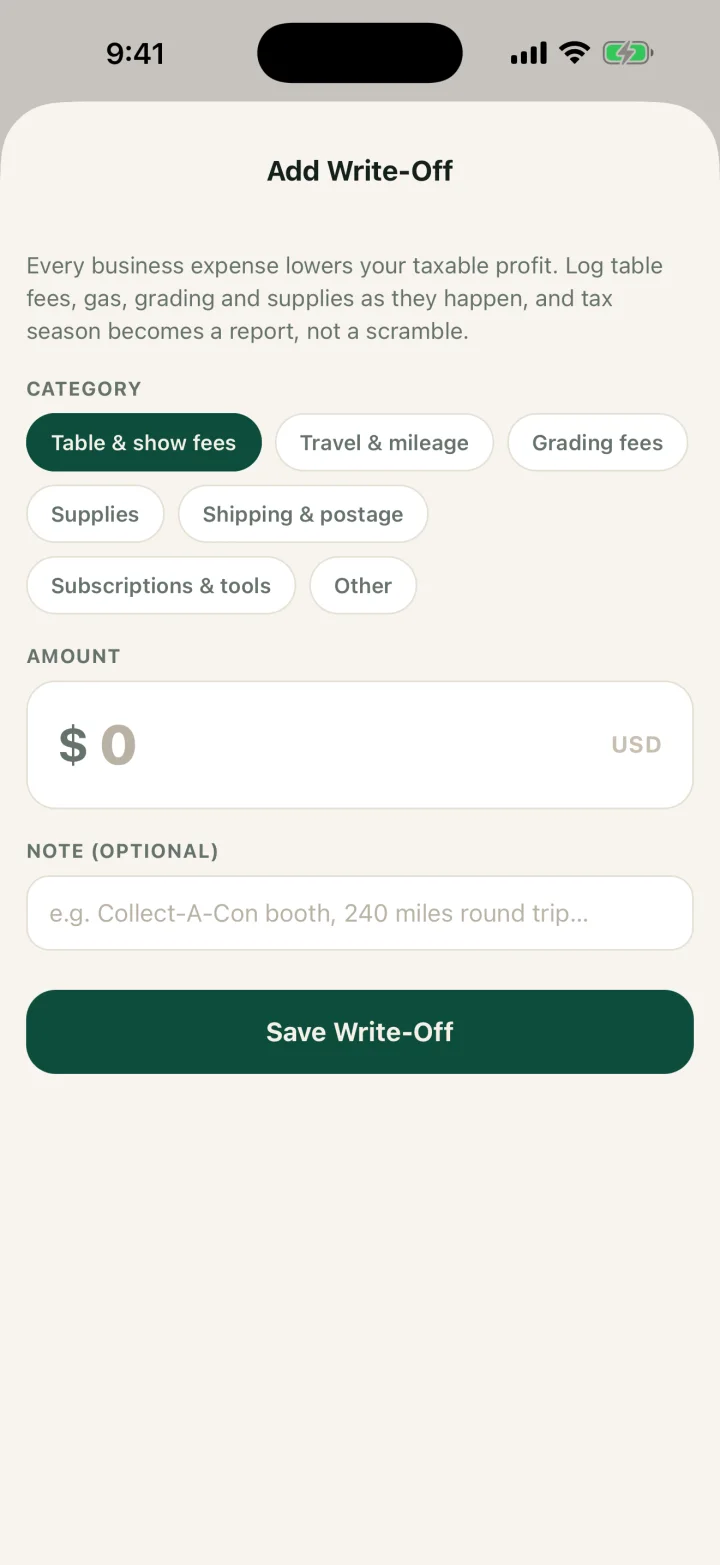
Expenses go in the same day. A write-off takes a category, an amount and a note, and the category is what sorts it in the year-end file.
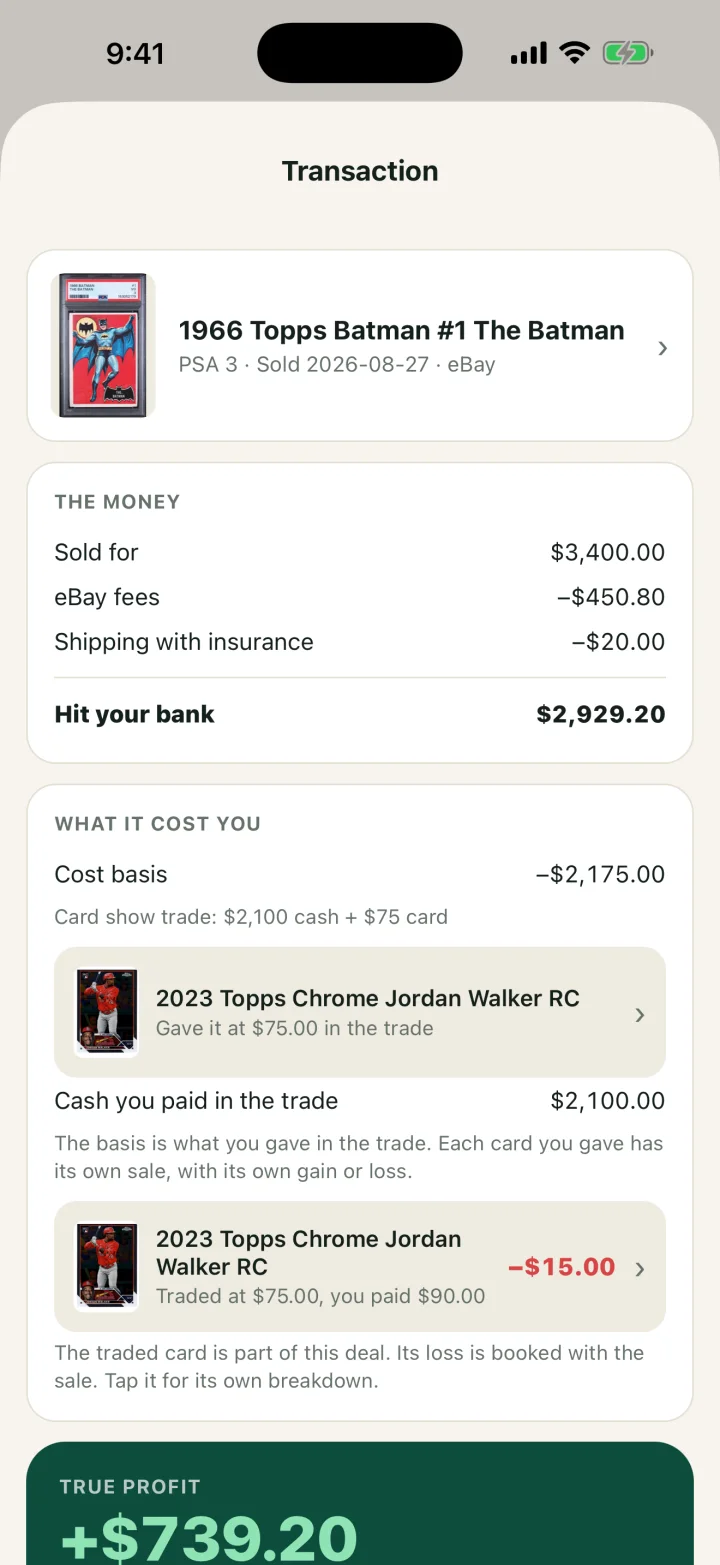
One sale through the books
One sale touches four of those records: the price, the fees, the shipping and the card's cost. Comped puts them on one page. In the demo sale below, $3,400 came in, $470.80 went to fees and shipping, and the card's basis was $2,175, which was $2,100 cash plus a card traded at $75.
Small costs change the answer as much as large ones. The example below uses round numbers.
AN EXAMPLE CARD, WORKED
A raw card bought for cash at a show, sent for grading, then sold.
Books that hold only the $120 sale overstate the profit by $45. The IRS has no guidance specific to grading fees. The guide on whether grading fees are deductible gives our reading of how a dealer treats them.
Spreadsheet, accounting software or Comped
All three can hold a card dealer's books. They differ in where the entry gets made and who types it.
| Spreadsheet | Accounting software built on a bank feed | Comped | |
|---|---|---|---|
| Starting point | A blank row | A bank transaction | A card, scanned or typed in |
| Cash buy at a show | Typed in later | Entered by hand, no bank line exists | Recorded when you buy |
| Cost per card | A column you maintain | Depends on the product's inventory setup | Saved with each card |
| Trades | Two rows you link yourself | Entered by hand | One Trade screen entry |
| Card prices | Looked up elsewhere | Looked up elsewhere | Market value from recent sales in the app |
| Invoices, payroll, sales tax | Built by you | Varies by product | Not included |
| Works on | Any computer or phone | Varies by product | iPhone only |
| Price | Free | Varies by product | Free, or Pro at $16.99 a month |
A spreadsheet is a fair choice for a small card business. The free card inventory and profit spreadsheet has the columns already built, and it takes Pokemon cards as well as sports cards. A dealer with employees, invoices or sales tax returns to file needs full accounting software, with or without Comped beside it.
The bank link
Pro links a bank account through Stripe and reads balances and transactions. Comped totals what came in and what was spent, and lists the transactions that look card related as hobby matches.
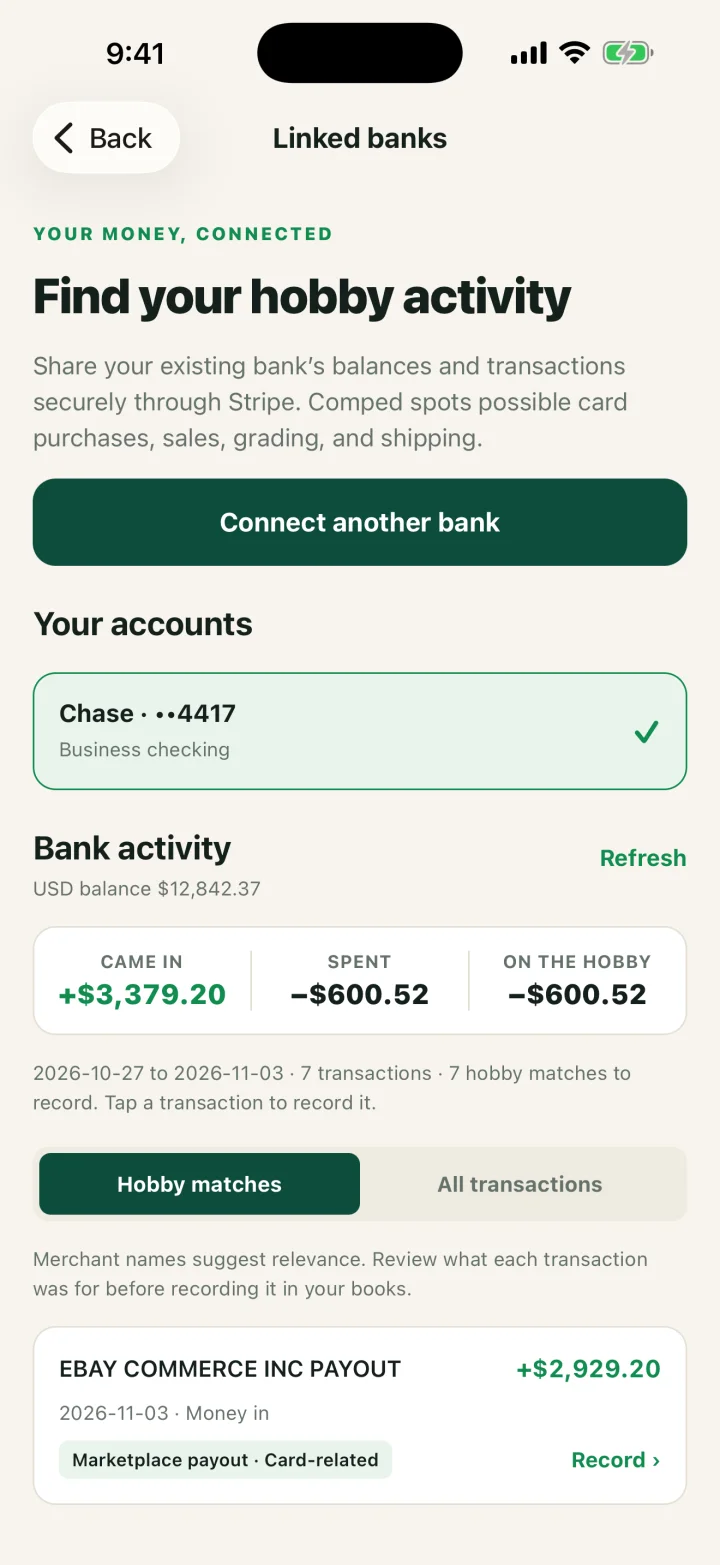
Each match is a question, not an entry. For a deposit you choose card sale or refund, or match it to a sale already recorded. For a payment you choose card purchase or write-off, or match it to a card already in inventory. Nothing reaches the books until you choose.
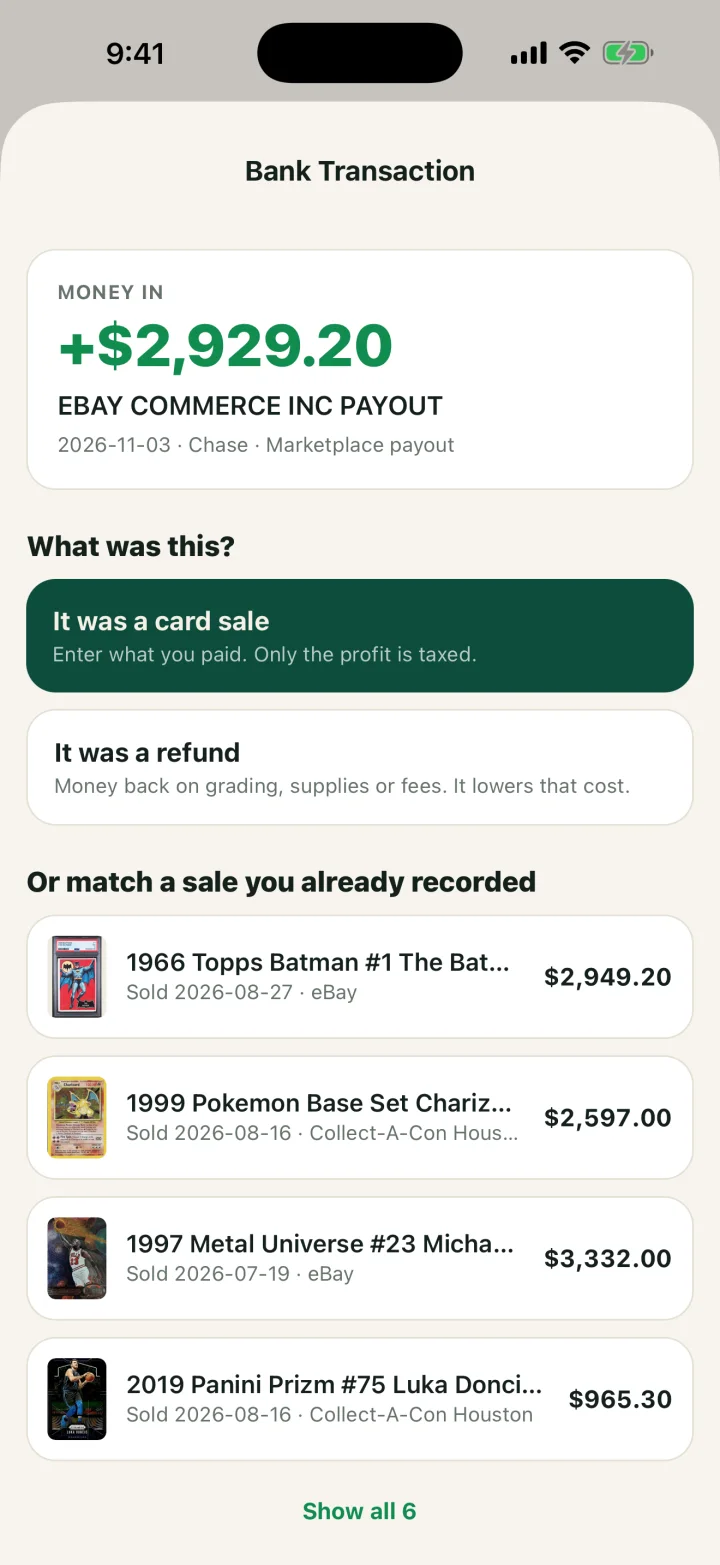
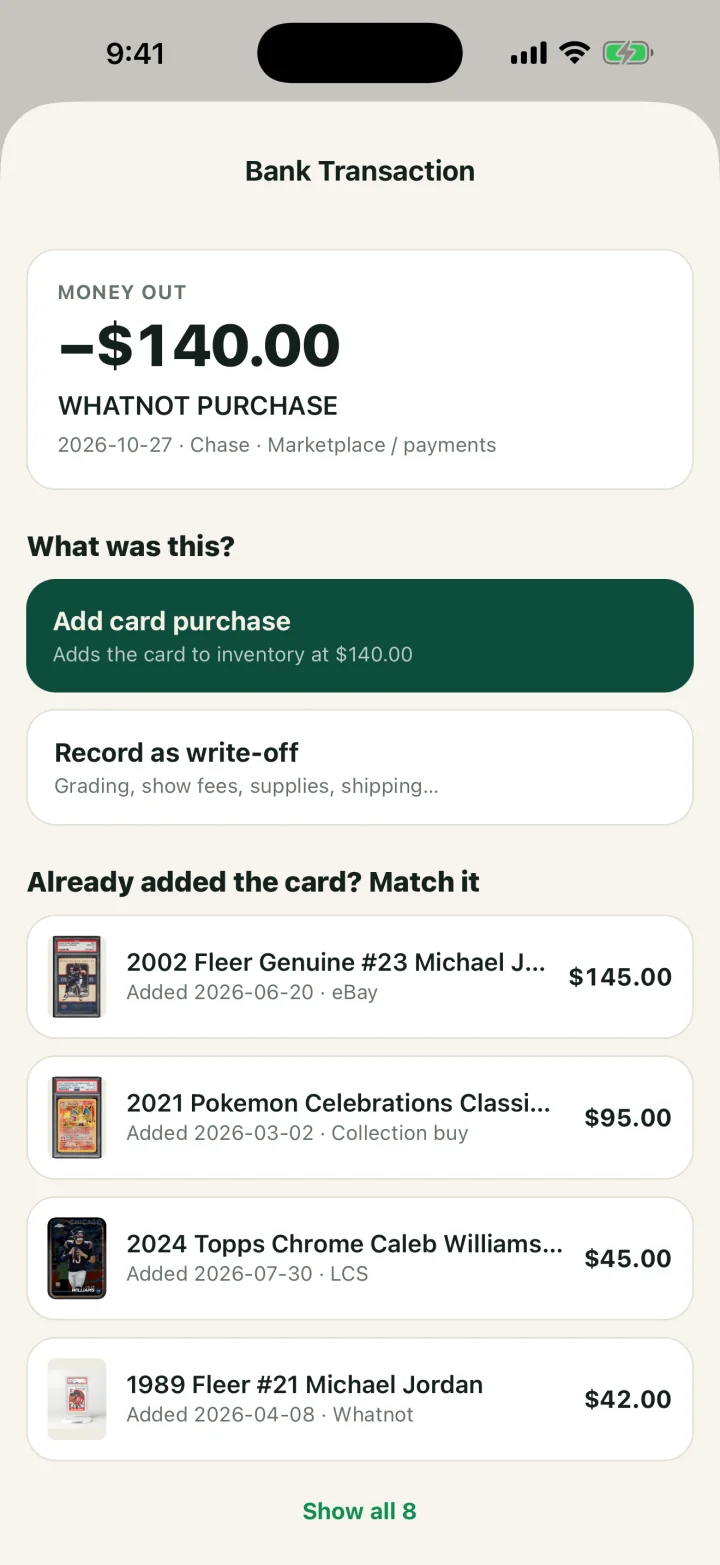
A merchant name only suggests a match, so read each one. IRS Publication 583 says to keep the business account separate from your personal checking account, which also makes this list shorter.
The year-end file and a weekly routine
The year-end file is one CSV from the Export taxes button on the Money tab. It opens with a summary laid out like Schedule C: gross receipts, cost of goods sold, platform and selling fees, gross profit, each write-off category and net profit. Below that it lists every sale, every card bought and every write-off for the year. Cards still in inventory and their unrealized gain are listed apart, outside profit.
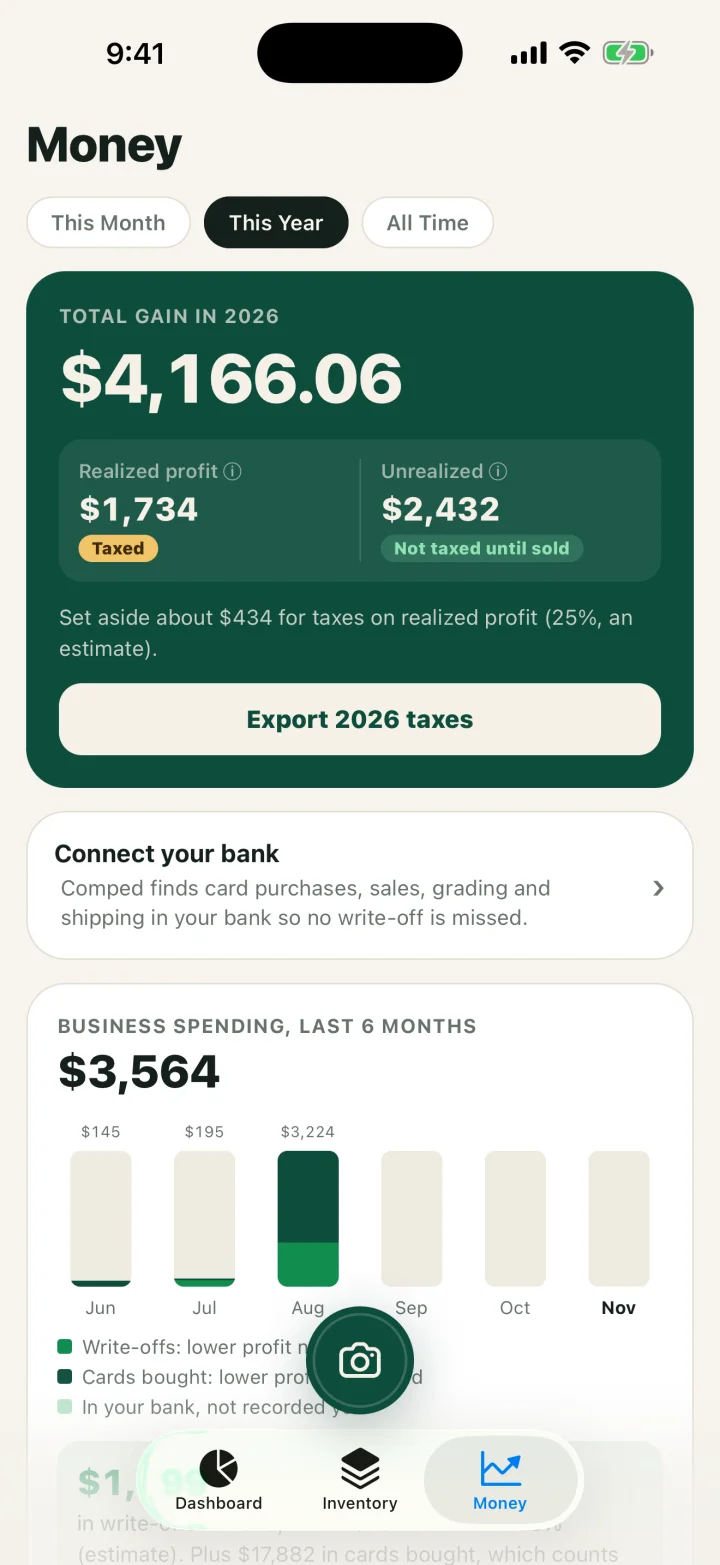
The file is only as good as the entries. Ten minutes a week keeps it honest:
- Record any deal you did not enter at the table, cash buys first.
- Add the fee and shipping amounts to that week's online sales.
- Log write-offs: table fees, grading, postage, and mileage as a dollar amount.
- On Pro, clear the bank matches.
- Read the set-aside figure and move that cash. The guide to quarterly estimated taxes has the 2026 due dates.
What it does not do
Comped keeps a card seller's records. It is not a full accounting system.
- It does not file or prepare an income tax return.
- It does not compute or file sales tax, and it has no field for sales tax collected.
- It has no general ledger, invoices, payroll or balance sheet.
- It does not calculate platform fees or mileage. You enter both as amounts.
- It has no team accounts, no Android app and no web version.
- It does not take card payments.
- It is not tax advice. The set-aside, 25% of realized profit, is a savings habit and not a tax calculation.
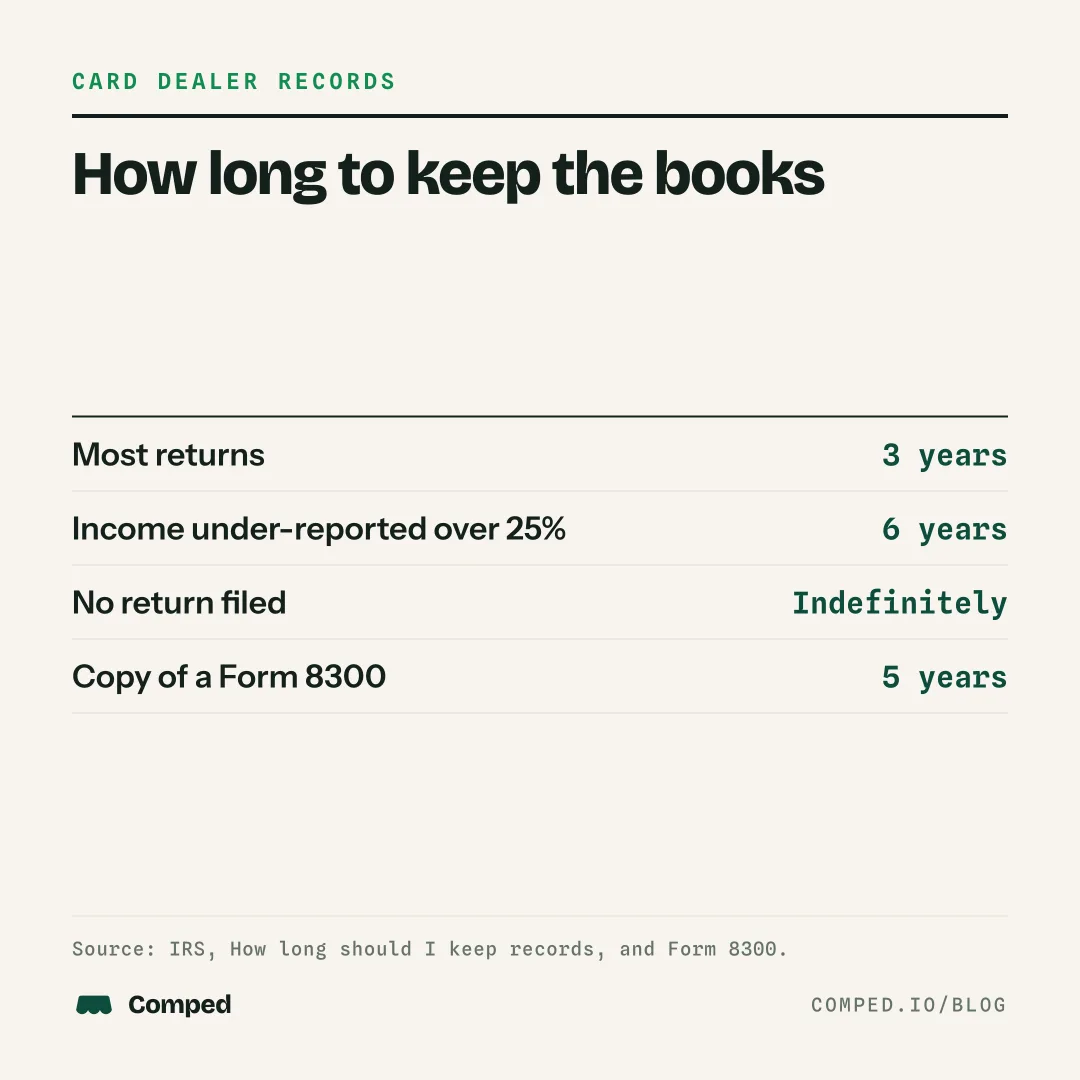
Keep the records after the return is filed. The IRS says to keep them 3 years in most cases, 6 years if income was under-reported by more than 25%, and indefinitely if no return was filed. A copy of a Form 8300 is kept 5 years, as the Form 8300 guide for card dealers explains.
Related guides
- The card vendor's master guide to taxes: Schedule C, inventory methods and estimated payments.
- The card vendor's master guide to write-offs: what counts and what record supports it.
- Card show cash and trade log: a printable page for cash deals.
FAQ
What accounting software works for a sports card business?
Any software that keeps a cost for each card works. Accounting software built on a bank feed starts from bank transactions, so cash deals at shows are typed in by hand. Comped starts from the card and records the deal when it happens.
Is a spreadsheet enough for a Pokemon card business?
Yes, if it is kept up. It needs a row per card with the cost, the sale price, the fees and the date. The free spreadsheet on comped.io has those columns.
What type of inventory tracking should I be using?
One line per card with what you paid and the date, kept from the day you buy it. At year end, the cost of the cards you sold is your cost of goods, and the cost of the cards you still hold is your closing inventory.
How do I work out the cost of inventory I have no records for?
Use the original cost if you know it, and write down what you can to support it. Where nothing supports a cost, the IRS can treat it as zero. Start recording from today so the gap does not grow.
Do I need a separate bank account for my card business?
IRS Publication 583 says to keep your business account separate from your personal checking account. Separate accounts make every deposit and payment easier to explain, and they shorten the list of bank transactions to sort.
Do I need bookkeeping if I never got a 1099?
Yes. Tax is owed on profit whether or not a form arrives. The books are how you know the profit.
Does Comped replace my accountant?
No. Comped holds the records, shows profit with a tax set-aside and exports the year as a CSV. A preparer or your own filing software prepares the return.
How long should a card dealer keep records?
The IRS says 3 years in most cases. It is 6 years if income was under-reported by more than 25%, and indefinitely if no return was filed.
SOURCES AND SCOPE
Features described from the Comped iPhone app, version 1.2.2, November 13, 2026. Screens show demo data. Prices are in US dollars. The worked card is an example, not a sale. Form lines are from Schedule C (Form 1040), 2026. Tax rules are from the IRS Form 1099-K FAQs, Publication 583, Publication 334 and the IRS record retention page, checked November 2026. Read our sources and editorial standards.
This is general information for card sellers, not tax or legal advice for your situation. Rules change and states differ; a CPA who knows your numbers wins every time.