How this was checked
Everything below comes from each product's own website or App Store page, read on November 13, 2026. We did not test the apps. "Not mentioned" means the words were not on the pages we read, not that the feature is missing.
One gap: cardladder.com would not load for our check, so Card Ladder's row comes from its App Store page alone. Comped is our app. Its limits are in the tables too.
We also read the articles that rank for "CollX vs Ludex" and "Card Ladder alternative". Most are written by a company selling its own scanner or grader, several give no prices, and the figures they give for free limits do not always match the apps' own pages. That is why every number here links to the page it came from.
What each one says it does
All three identify or look up a card and show what it sells for. They differ in what happens next: CollX sells inside its own marketplace, Ludex sends a listing to eBay, and Card Ladder shows sales history.
| Job for a seller | CollX | Ludex | Card Ladder |
|---|---|---|---|
| Identify a card | Photo scan against "our database of every known card" | Photo scan, including variations and parallels | Search card values for verified cards. Its description does not mention a camera scan. Its release notes mention adding a graded card by scanning it with the camera. |
| Price it | An average value "based on all recent transactions from marketplaces" | "Real-time prices based on actual sales" | Value estimates, daily sales recaps, and on PRO, all-time sales history from every marketplace |
| Track what you hold | Collection and total collection value over time | Collections, binders and portfolio value | On PRO, add cards to a collection and track its value |
| Sell | Buy and sell on the CollX marketplace, with multi-card deals | "List-It" builds an eBay listing from a scan, US only | Not mentioned on its page. The page says you can buy cards from several marketplaces. |
| Export | On Pro, the collection as a CSV spreadsheet with pricing | Not mentioned on its site | Not mentioned on its page |
| Purchase price | Not in the description. Release notes for version 4.0.5 mention setting a purchase price and date. | Not mentioned on its site | Not mentioned on its page |
CollX's site also promotes a separate product, Card Dealer Pro, for "bulk scanning and inventory of cards, as well as multi-channel selling". We did not review that product here.
Price and platforms
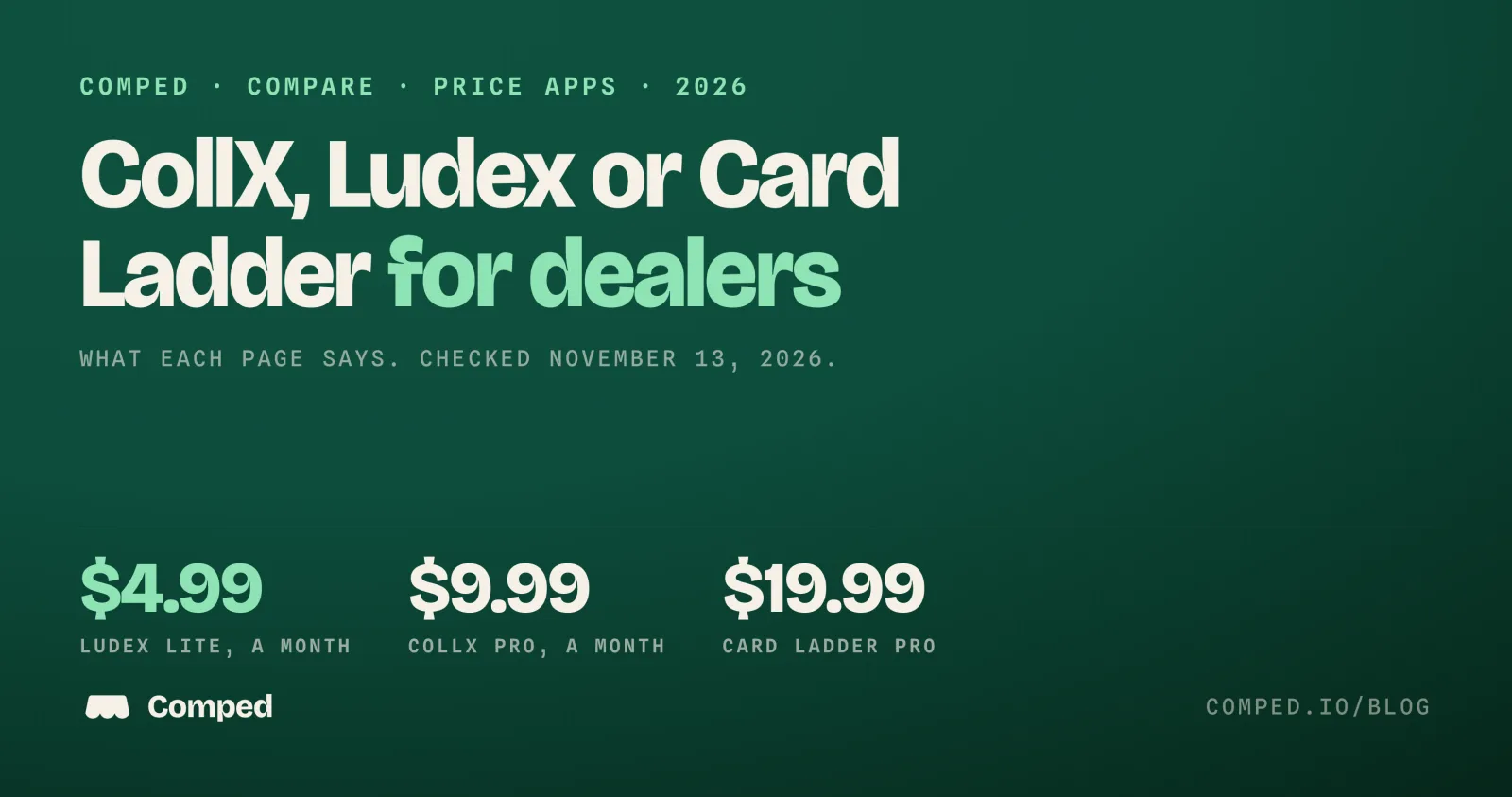
Ludex has the lowest paid tier at $4.99 a month, CollX Pro is $9.99, and Card Ladder PRO is $19.99. All three are free to download.
| App | Free plan on its page | Paid plans on its page | Platforms on its page |
|---|---|---|---|
| CollX | Free download. Collections under 500 items. | Pro $9.99 a month or $99.99 a year. Gold $24.99 a month or $249.00 a year. | iPhone, iPad and Android |
| Ludex | Unlimited scans, 60 saved cards, 5 eBay listings a month | Lite $4.99 a month or $44.99 a year. Standard $9.99 a month or $89.99 a year. Pro $24.99 a month or $239.99 a year. | iPhone on the App Store, plus a Google Play link on its site |
| Card Ladder | Card values, daily sales recaps, the Card Ladder Index | PRO $19.99 a month or $199.99 a year | iPhone on the App Store. Its website did not load for our check. |
| Comped | 5 card scans a week and every record | Pro $16.99 a month or $99 a year | iPhone only. No Android, no web app. |
Sources: CollX Pro and the CollX App Store page, the Ludex membership page, and the Card Ladder App Store page, all checked November 13, 2026. Ludex's eBay listing caps are 50 a month on Lite and Standard and 250 on Pro.
What a year costs
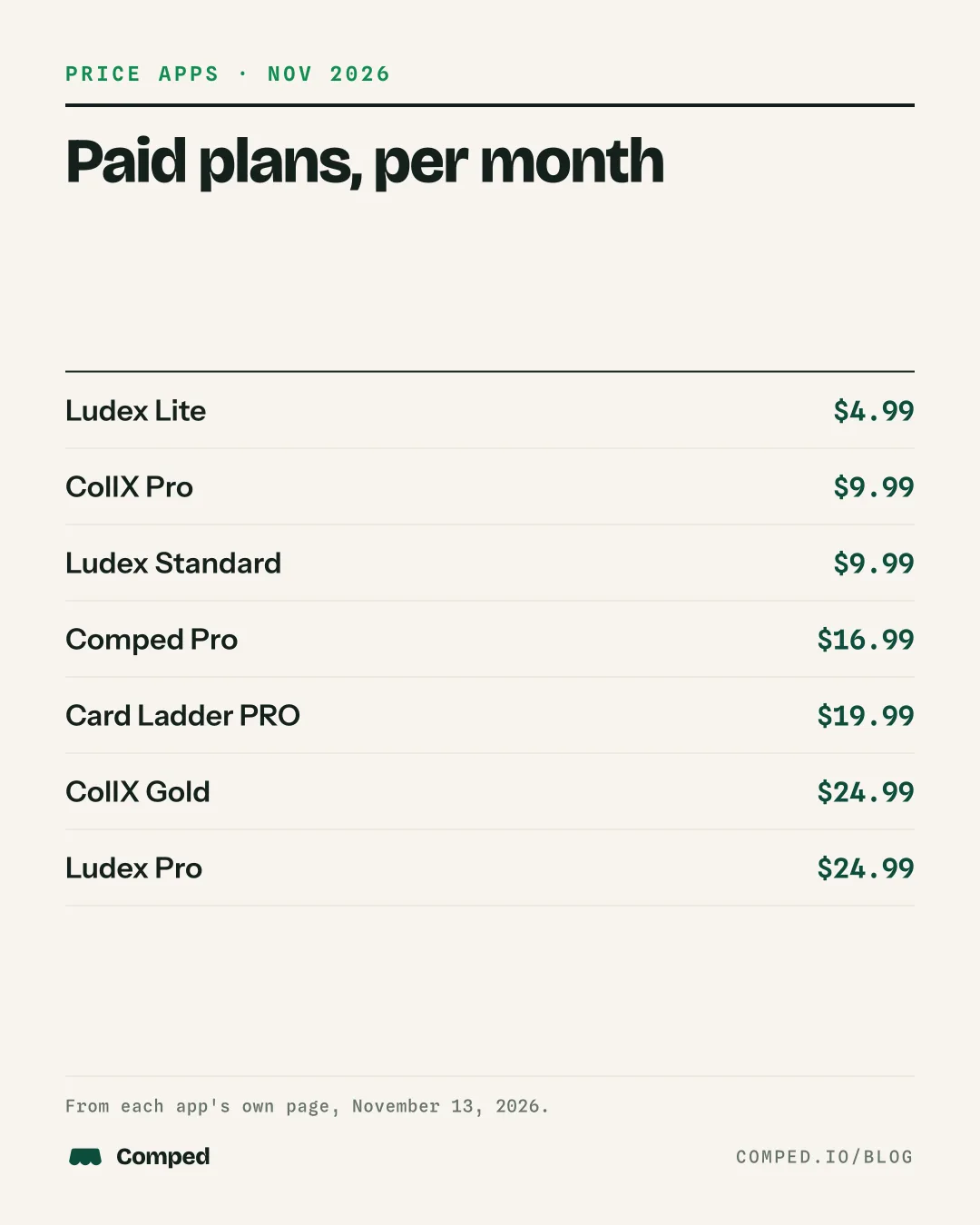
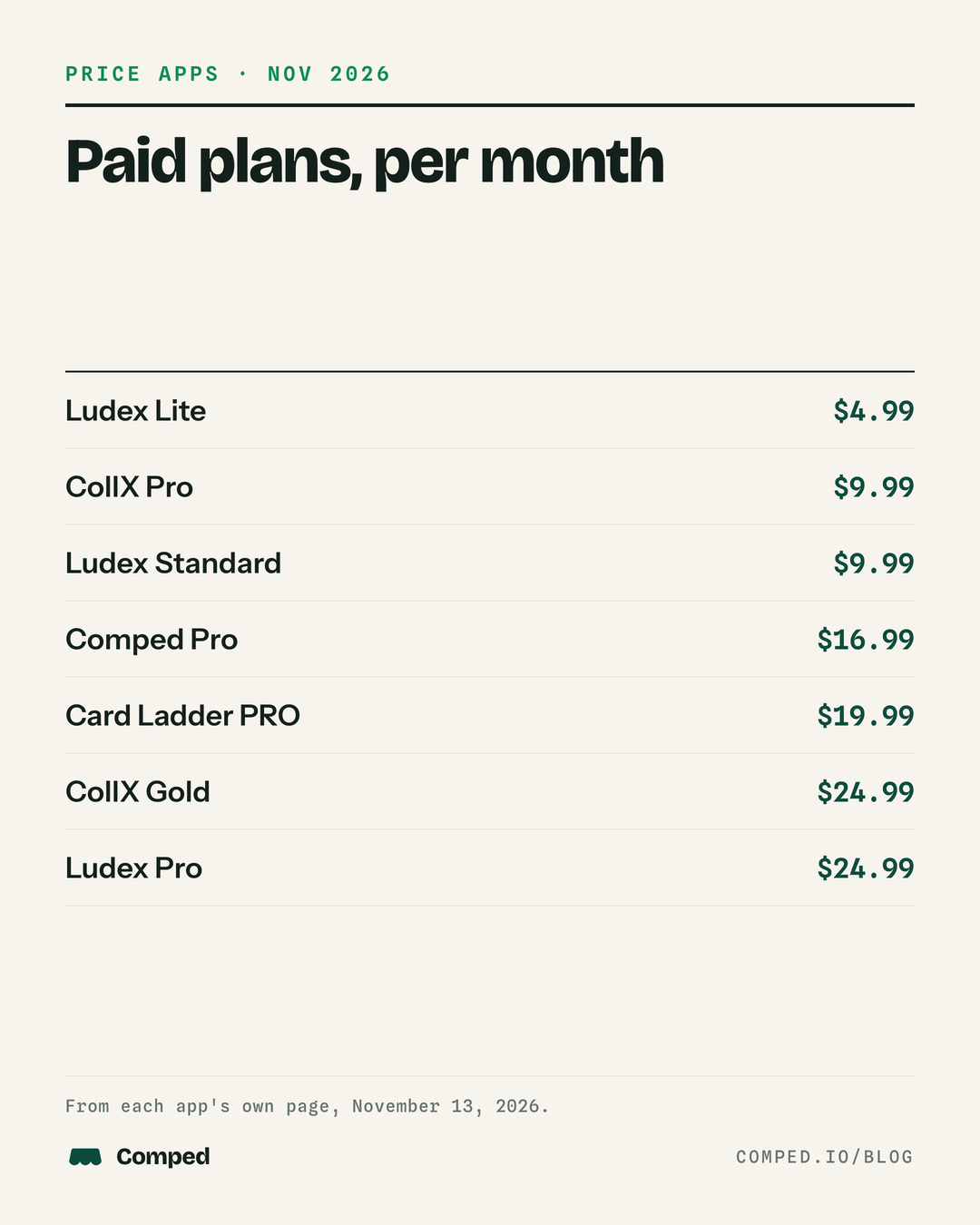
Paid yearly, the plans run from $44.99 to $249.00. Paying monthly for 12 months costs about 20% to 33% more on the three price apps.
| Plan | Yearly price on its page | 12 months paid monthly |
|---|---|---|
| Ludex Lite | $44.99 | $59.88 |
| Ludex Standard | $89.99 | $119.88 |
| Comped Pro | $99.00 | $203.88 |
| CollX Pro | $99.99 | $119.88 |
| Card Ladder PRO | $199.99 | $239.88 |
| Ludex Pro | $239.99 | $299.88 |
| CollX Gold | $249.00 | $299.88 |
The yearly prices are from each page, checked November 13, 2026. The right column is our arithmetic: the monthly price times 12.
Check the free plan first. Ludex's free plan lists unlimited scans but saves 60 cards. CollX's free collection holds under 500 items. Card Ladder's page says you can browse for free and lists no free limit. Count your stock against those limits: a show box of 300 cards is past Ludex's 60 saved cards on day one.
What none of them say they do
None of the three pages mentions bookkeeping. We looked for six things a seller needs at tax time and found none of them described as a feature.
| What a dealer needs | CollX | Ludex | Card Ladder | Comped |
|---|---|---|---|---|
| Profit on a sale after cost and fees | Not mentioned | Not mentioned | Not mentioned | Yes |
| Cost of each card, kept until it sells | Not mentioned in the description | Not mentioned | Not mentioned | Yes |
| Expenses such as table fees and grading | Not mentioned | Not mentioned | Not mentioned | Yes, as write-offs |
| Mileage | Not mentioned | Not mentioned | Not mentioned | Yes, as a write-off |
| 1099-K or a tax report | Not mentioned | Not mentioned | Not mentioned | A tax set-aside and "Export taxes", a CSV for the year. Does not file. |
| Sales tax | Not mentioned | Not mentioned | Not mentioned | Not a feature |
| Sell or list the card for you | Yes, its own marketplace | Yes, an eBay listing | Not mentioned | No. It records the sale. |
| Android | Yes | Yes | Not on the pages we could load | No |
A few exceptions, for completeness. CollX's release notes mention a purchase price and date on a card, and seller profit on its marketplace orders. One developer reply on its App Store page says withdrawals can be blocked while tax verification finishes. Ludex's membership page carries the line "Maximize your profit potential". None of those pages describes a profit or tax record as a feature.
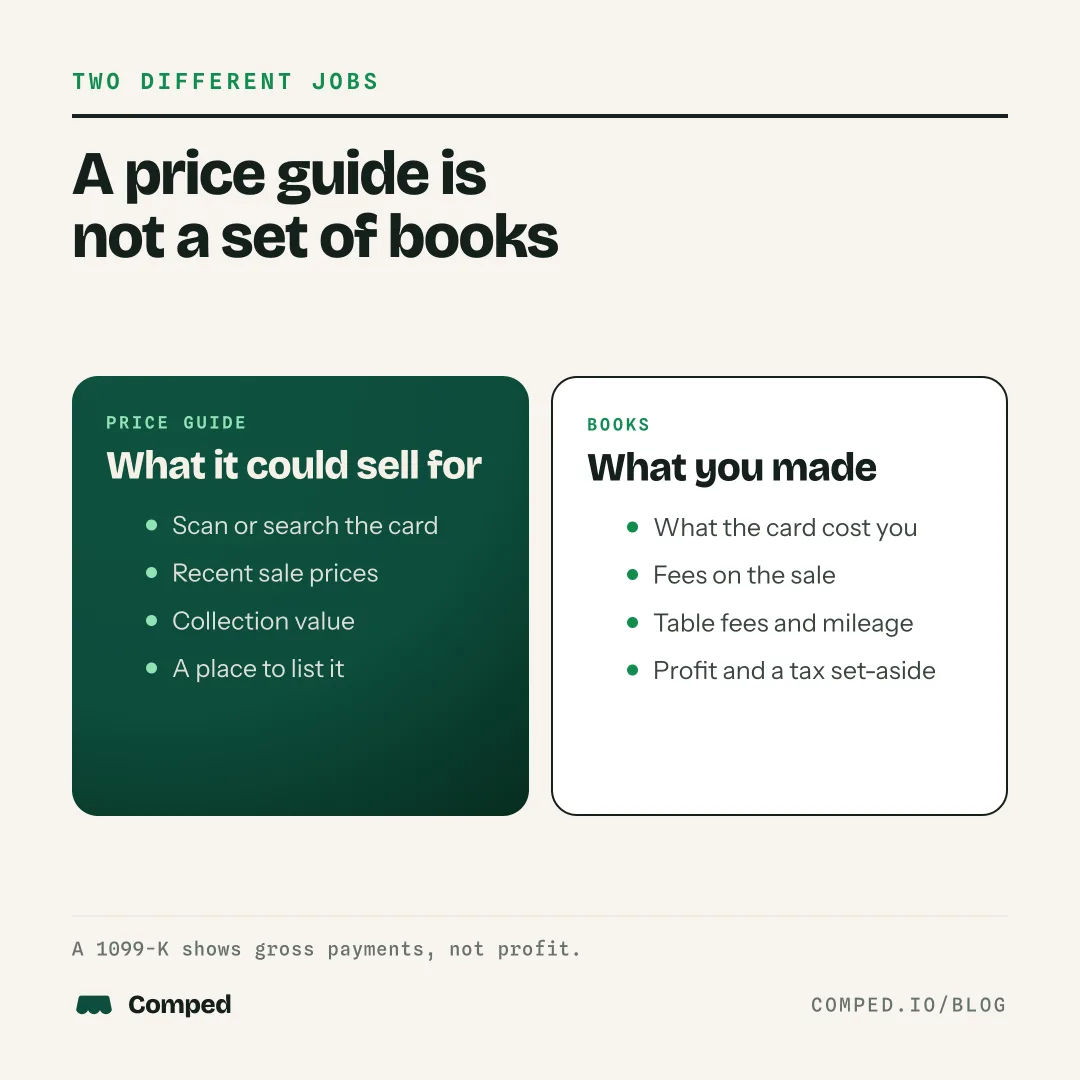
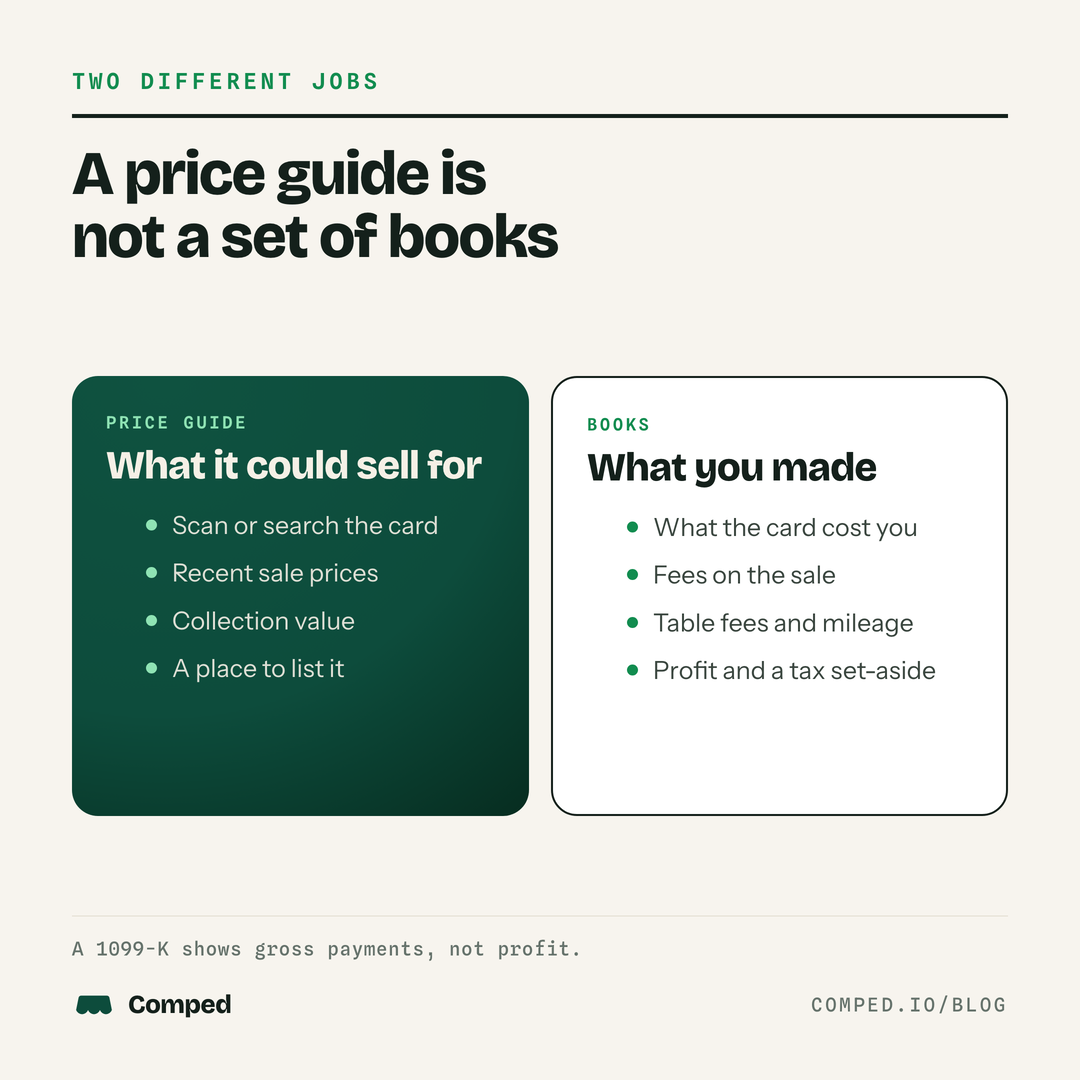
That is not a flaw in a price guide. It is a different job. A collection value tells you what your cards could sell for. Your books tell you what you made.
The gap shows up in January. A 1099-K reports gross payments, with no subtraction for fees, refunds or what you paid for the cards. The seller supplies those numbers. The 1099-K guide for card sellers shows how, and the cost basis guide covers cards bought with cash or by trade.
Which one for which job
Pick by the job, not the brand. A price app and a set of books do different jobs, so using two tools is normal.
| The job | What its page points to |
|---|---|
| Find out what a raw card is from a photo | CollX or Ludex. Both describe a photo scan. |
| Sell to buyers inside the app | CollX, on its marketplace |
| Turn a scan into an eBay listing | Ludex, US only, 5 a month free and 50 or 250 on paid plans |
| Study years of sales on one card before a big buy | Card Ladder PRO, "all-time sales history from every marketplace" |
| Get the collection out as a spreadsheet | CollX Pro, a CSV with pricing |
| Know the profit on a card after cost and fees | None of the three. Comped, or a spreadsheet. |
| Hand a preparer the year's sales, costs and write-offs | None of the three. Comped's tax export, or a spreadsheet. |
Who each one suits
Pick by where your cards sell. Going by what each page says:
- CollX suits a seller who wants buyers inside the same app that scans the card, and a CSV of the collection on Pro.
- Ludex suits a seller who lists on eBay and wants the listing built from a scan. Lite at $4.99 a month covers one sport or card game category.
- Card Ladder suits a dealer who prices buys and sales from deep sales history and wants price alerts. Its page does not describe selling.
- Comped suits a part-time dealer or card show vendor on iPhone who wants the buy, the sale, the trade, the cost and the write-offs in one record.
Scan accuracy
We did not test scan accuracy, and we found no published test with a named method and sample. Some comparison articles quote accuracy percentages for these apps without saying who ran the test or on which cards. Treat those as claims.
Run your own test before you pay. Scan ten cards you know well: a base card, a numbered parallel, a refractor, a rookie with several variations, a vintage card and a graded slab. Count how many come back as the exact card, then compare the price shown with the last few sold listings you can find yourself. A wrong parallel is the costly miss, because the price can be off by a multiple.
At a card show
At a table, a price app answers one question: what does this card sell for today. That decides your offer. The card show buy percentages guide covers how much of that price dealers pay, and the buy percentage calculator does the math.
The second question is what you paid and what you made, and it comes up months later. A dealer's routine that covers both:
- Look the card up and agree on a price.
- Write the buy down before the seller leaves: the card, the price, cash or trade, and the seller's name.
- When it sells, record the price, the fees and where it sold.
- At year end, total sales, cost of the cards sold, fees and expenses.
Step 1 is what CollX, Ludex and Card Ladder describe. Steps 2 to 4 are bookkeeping. How to track card show sales lists what each record needs.
Where Comped fits
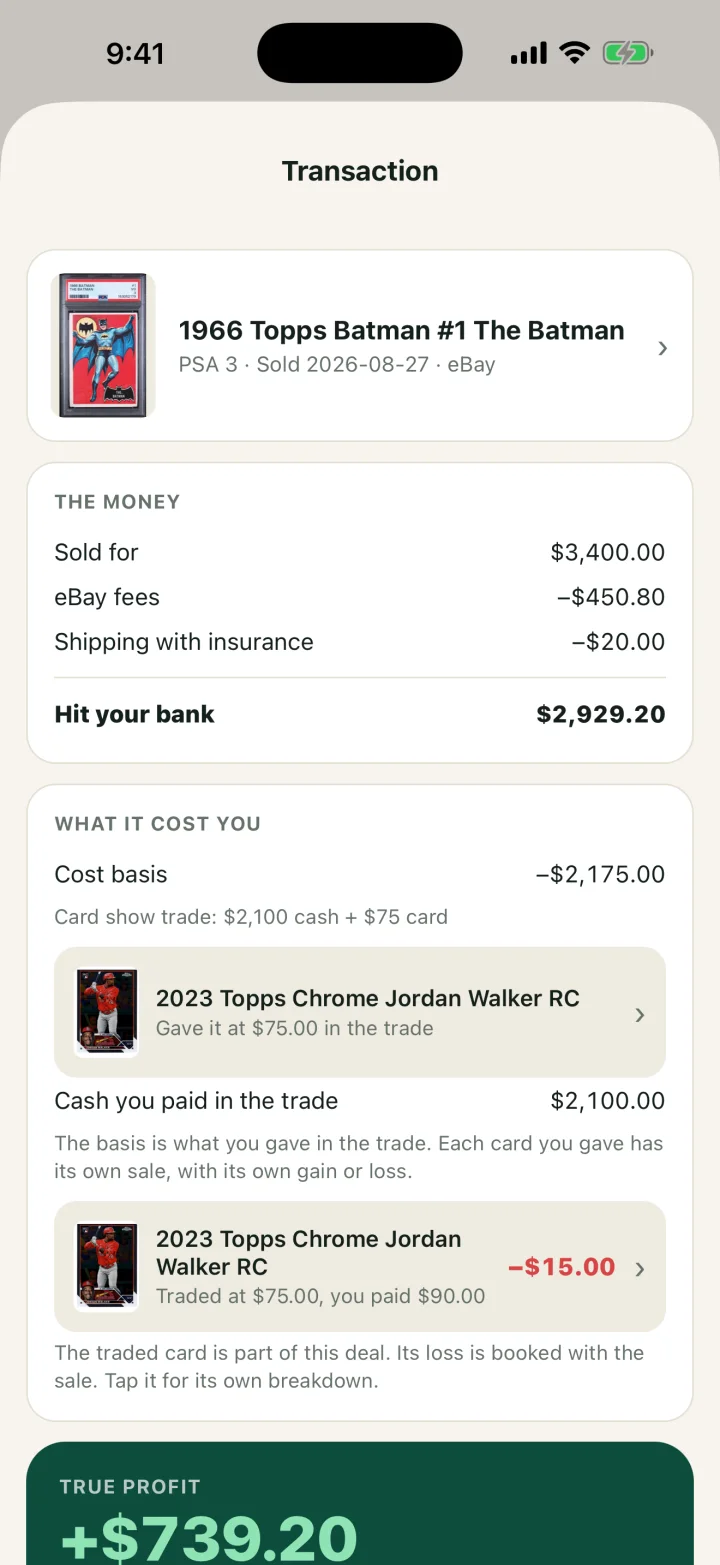
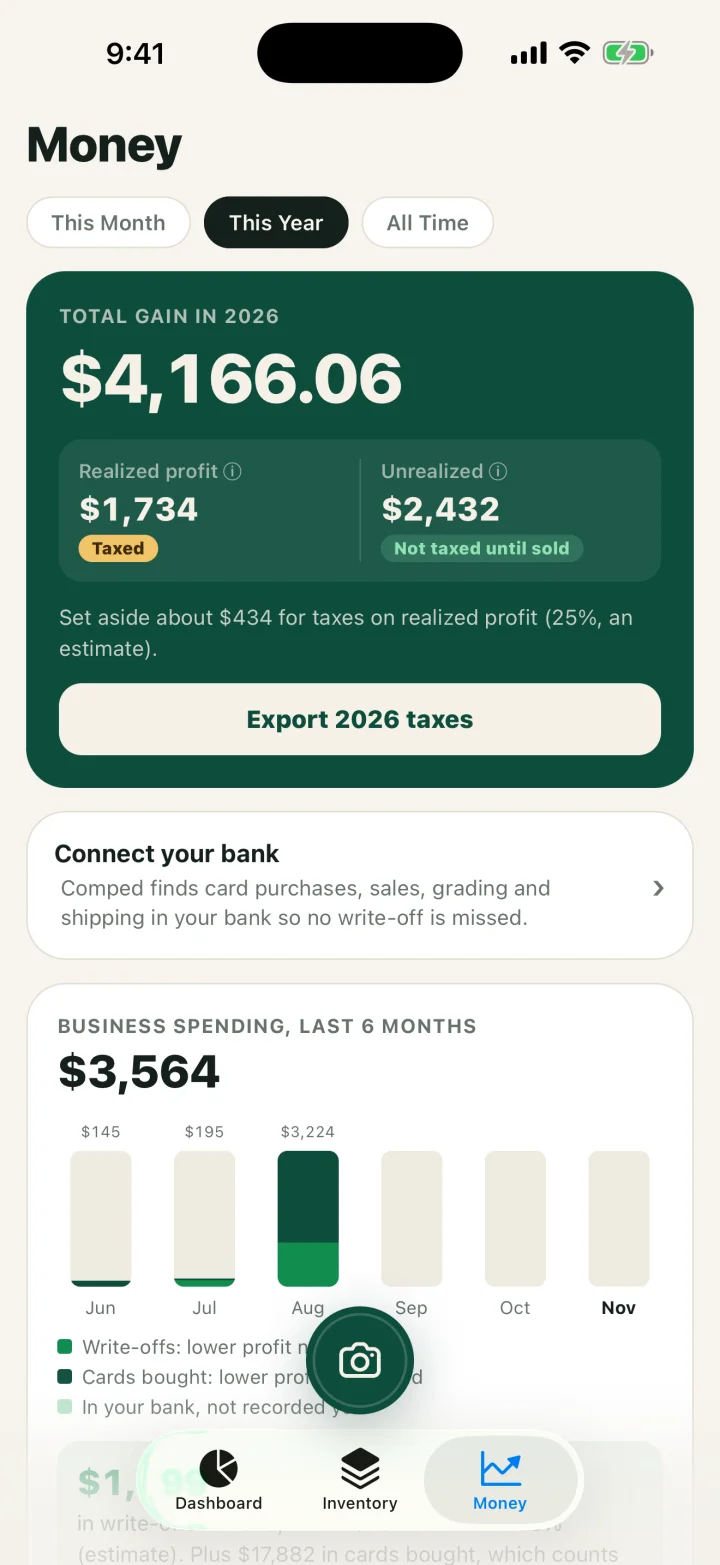
Comped is a record of deals, not a marketplace or a price guide. It scans a card or slab, shows a market value from recent sales with a price line and current listings, and records the buy, the sale or the trade with the card's cost. Profit comes out after cost and fees, with write-offs and a tax set-aside beside it. These are captures of the current app with demo data.
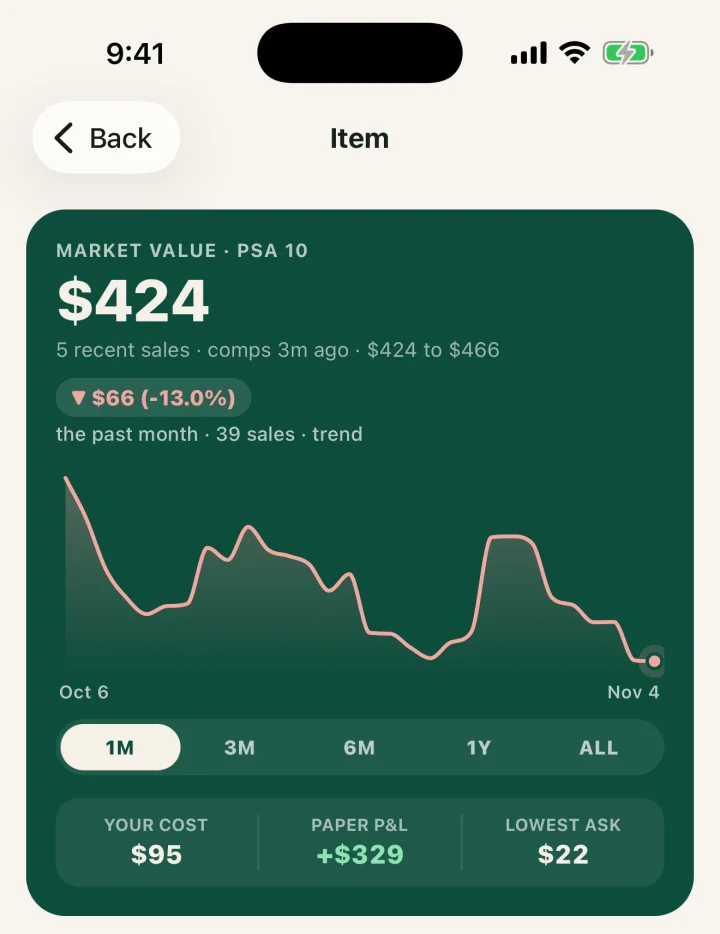
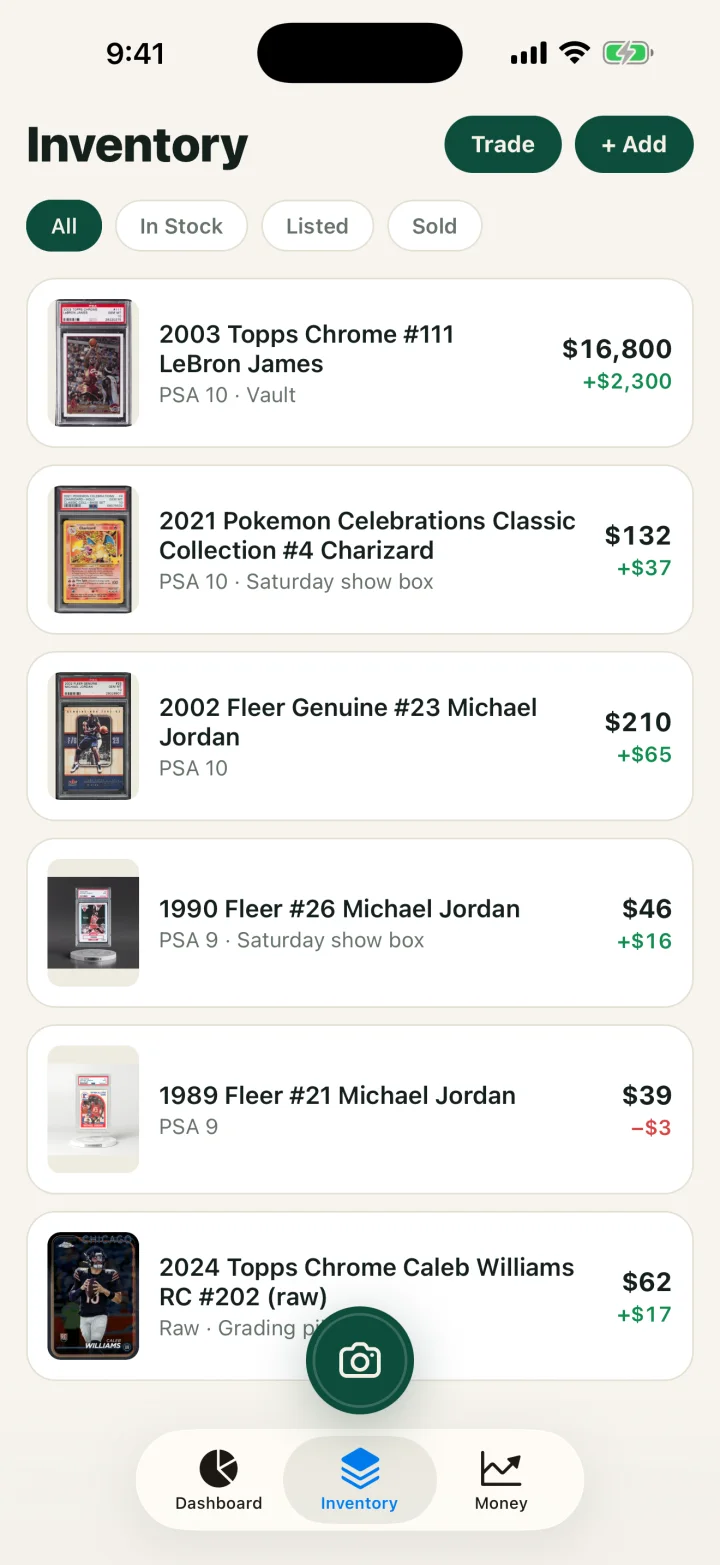
The sale screen subtracts fees, shipping and cost to reach true profit. The Money tab totals realized profit for the year and exports it as a CSV: a Schedule C style summary, then every sale, card bought and write-off.
For someone searching for a Card Ladder alternative, the honest answer depends on the job. For years of sales history and price alerts, Card Ladder's page describes exactly that. For profit and cost on your own deals, that is the job of bookkeeping for card dealers.
Comped's limits, plainly:
- iPhone only. No Android app and no web app.
- No marketplace and no eBay listing tool. You sell wherever you already sell.
- The only export is the tax CSV for a year. It does not prepare or file a return.
- No years of sales history or price alerts. It shows recent sales and current listings.
- The free plan scans 5 cards a week. Unlimited scans and the bank feed need Pro.
- No sales tax. It does not compute, record or file it.
If you want the books in a spreadsheet instead, the free card inventory and profit spreadsheet has the same columns. Tools built for the table are in card show vendor apps compared.
Related guides
- Card show vendor apps compared: eight tools for the table, checked the same way.
- Bookkeeping for card dealers: the records a dealer keeps and why.
- The 1099-K for card sellers in 2026: why gross payments are not profit.
FAQ
CollX vs Ludex: which is better for selling?
They sell in different places. CollX's page describes buying and selling on its own marketplace. Ludex's page describes building an eBay listing from a scan, for US sellers, with 5 listings a month on the free plan and 50 or 250 on paid plans.
Is CollX free?
The download is free, and its page says a free collection holds under 500 items. CollX Pro was $9.99 a month or $99.99 a year on November 13, 2026, and adds unlimited items and a CSV export of the collection.
How much is Ludex premium?
Ludex's membership page lists three paid plans: Lite at $4.99 a month or $44.99 a year, Standard at $9.99 or $89.99, and Pro at $24.99 or $239.99. The free plan lists unlimited scans, 60 saved cards and 5 eBay listings a month.
What is Card Ladder used for?
Its App Store page describes card values, daily sales recaps and an index, and on PRO, all-time sales history and collection tracking. It is a research tool. The page does not describe selling a card or keeping costs and profit.
Is there a Card Ladder alternative for dealers?
It depends on what you use it for. Card Ladder PRO costs $19.99 a month or $199.99 a year and its page describes sales history, collection value and price alerts. For profit after cost on your own deals, you need a bookkeeping record instead.
Can I use CollX and Ludex together?
Yes. Nothing on either page stops you, and both have free plans. Neither page describes profit after cost, so a second record for your books is still needed.
Do CollX, Ludex or Card Ladder track profit?
None of the three pages we read on November 13, 2026 mentions profit after cost and fees. They describe collection or portfolio value, which is what cards could sell for. CollX's release notes mention setting a purchase price and date on a card.
Can I use these apps for taxes?
None of the three pages mentions taxes, the 1099-K, expenses or mileage. CollX Pro lists a CSV export of your collection with pricing. A tax return needs what you paid, what you sold for and your fees, so keep that record somewhere.
SOURCES
- CollX, checked November 13, 2026.
- CollX Pro, checked November 13, 2026.
- CollX: Sports Card Scanner, App Store, checked November 13, 2026.
- Ludex, checked November 13, 2026.
- Ludex membership plans, checked November 13, 2026.
- LUDEX Sports Card Scanner +TCG, App Store, checked November 13, 2026.
- Card Ladder, App Store, checked November 13, 2026.
- Form 1099-K FAQs: general information, IRS, checked November 2026.
This is general information for card sellers, not tax or legal advice for your situation. Rules change and states differ; a CPA who knows your numbers wins every time.