Who gets a 1099-K from Fanatics Collect?
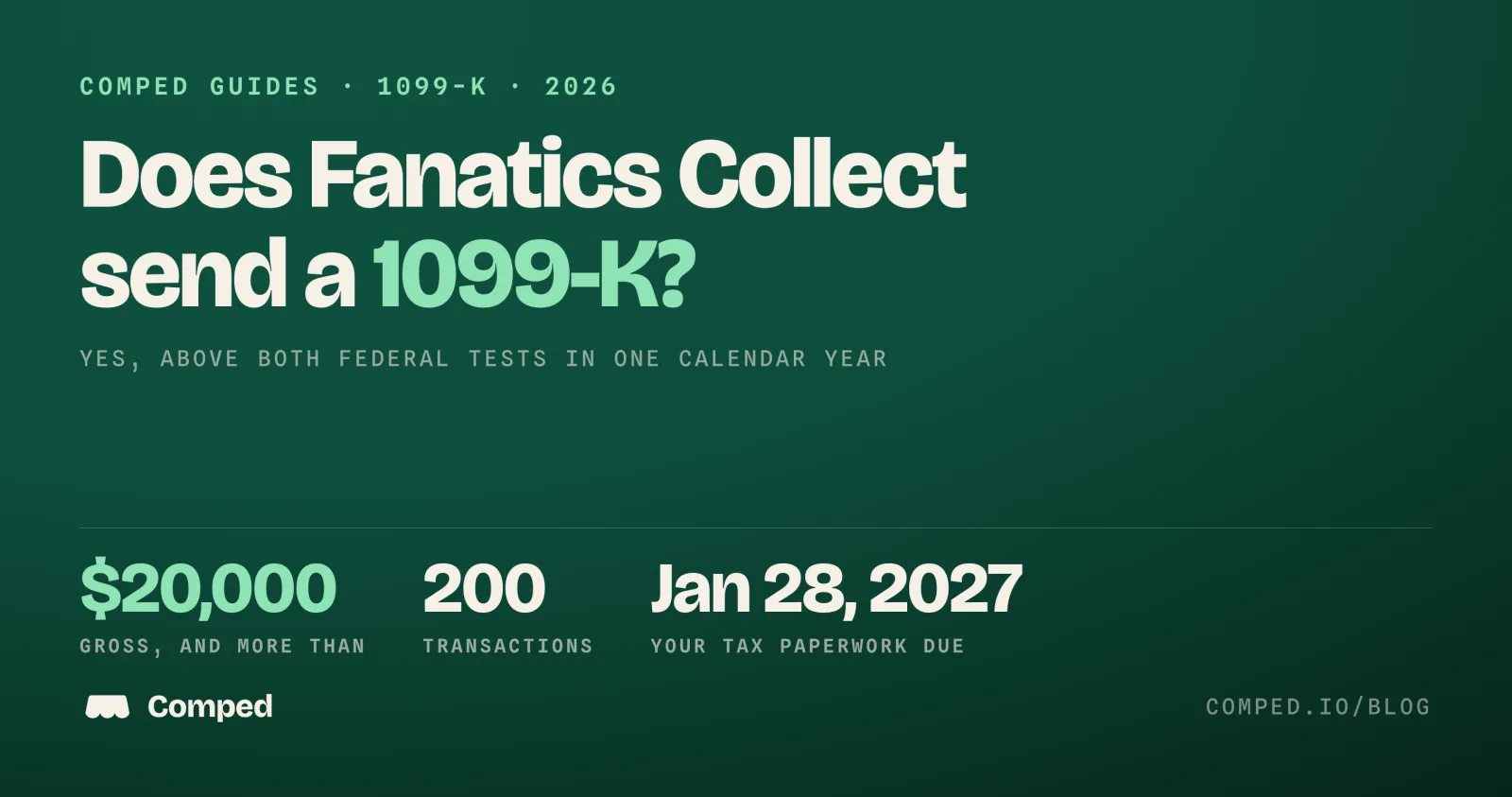
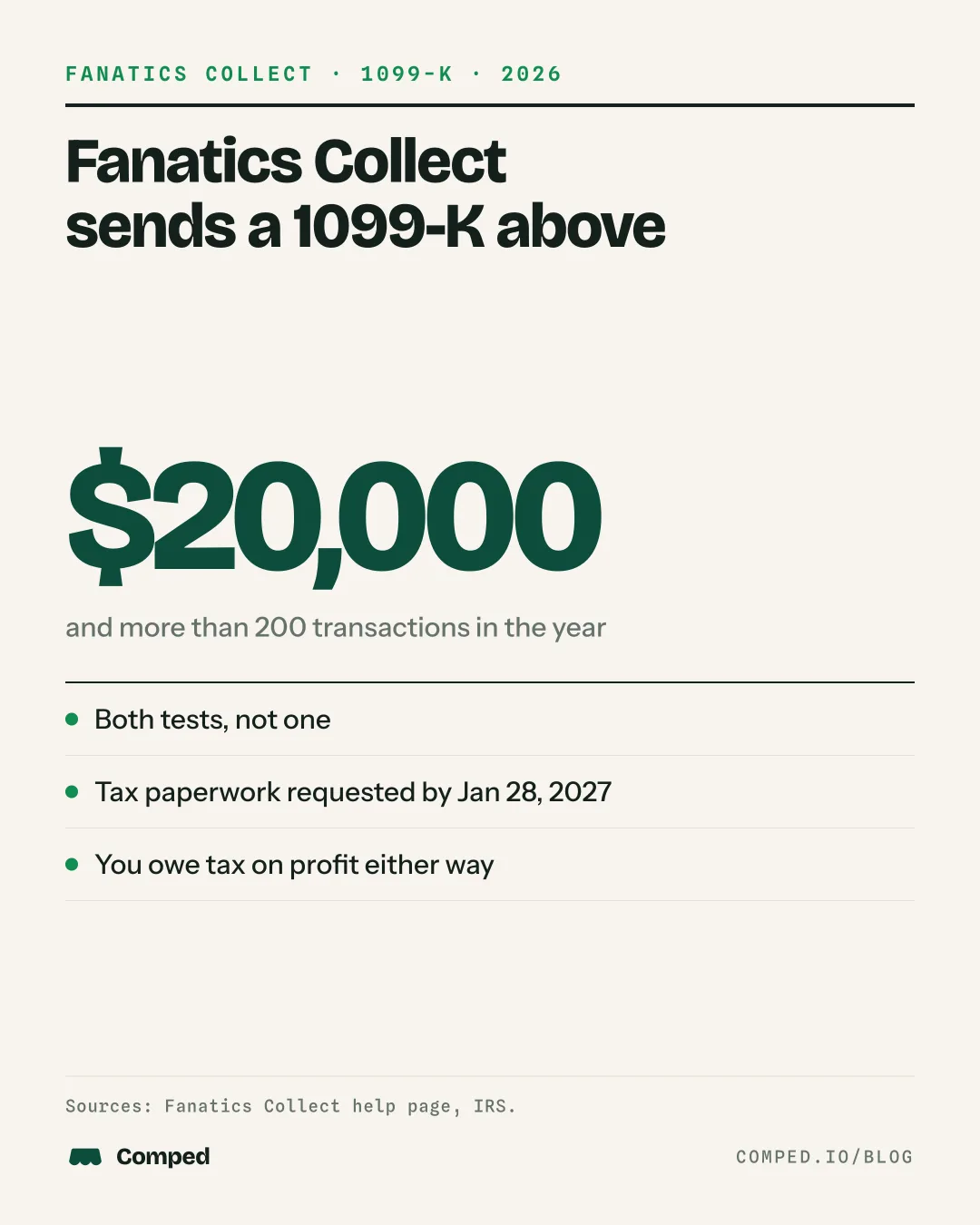
Sellers with more than $20,000 in gross payments and more than 200 transactions on Fanatics Collect in the calendar year. That is the figure on Fanatics Collect's 1099-K help page, and it matches the federal rule. The same page asks sellers to submit the tax documentation it requests by 28 January 2027, for 2026 reporting. That is the date for your paperwork. The page does not say when the form itself is sent.
The federal rule comes from the July 2025 tax law. The IRS FAQs say a marketplace is not required to file unless gross payments exceed $20,000 and transactions exceed 200. The $600 threshold and the $5,000 phase-in were cancelled for 2025 onward. The 1099-K guide for card sellers compares every platform side by side.
Do I need to pass both tests, or just one?
Both. A seller over $20,000 with 200 or fewer transactions is under the federal line. So is a seller with 500 small sales that total $12,000. This matters on Fanatics Collect, where a few graded cards can pass $20,000 in a handful of sales.
| Your 2026 Fanatics Collect sales | Gross | Transactions | Federal 1099-K |
|---|---|---|---|
| A few high-end slabs | $48,000 | 35 | No, the count test is not met |
| Many low-priced cards | $12,000 | 500 | No, the dollar test is not met |
| A steady selling year | $31,500 | 240 | Yes, both tests are exceeded |
These rows are examples, not Fanatics Collect data. Each platform counts only its own payments, so eBay or Whatnot sales do not add to the Fanatics Collect total. Tax is owed on the profit in all three rows.
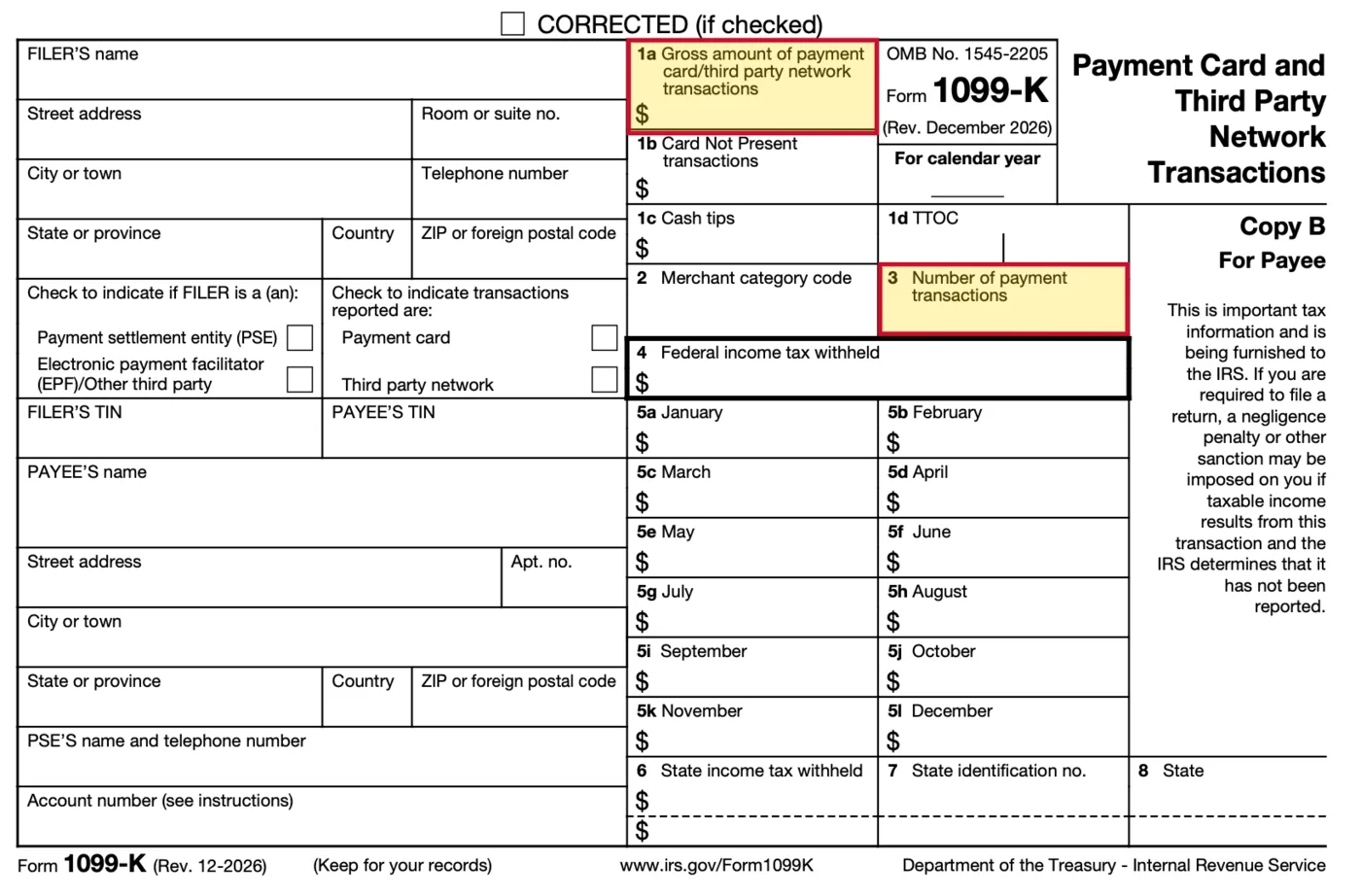
The two tests are two boxes on the form. Box 1a is the gross and Box 3 is the number of payment transactions, which the form's instructions say does not count refunds.
Your state can change the answer. The IRS says on its 1099-K page that you may receive a form even when payments are under the federal threshold. Several states require reporting at lower amounts. The 1099-K threshold by state table lists them.
What is the tax documentation Fanatics Collect asks for?
It is one or more tax forms Fanatics Collect asks you to complete, due by 28 January 2027 for 2026 reporting. The help page says it uses the information to determine your tax status and, when applicable, to issue an accurate Form 1099-K.
- Watch for an email from fanatics@vendorinfo.com with instructions specific to your account. That is the sender the help page names.
- Register or sign in with the same email as your Fanatics Collect account.
- Follow the link and complete the tax form or forms it asks for.
The page says US sellers whose sales meet or exceed the IRS reporting threshold need to submit. International sellers send a Form W-8BEN, or another W-8, by email to its Collector Experience team. It also says accounts without valid tax documentation after the deadline may face restrictions, including limited access to certain features.
What number does the form show?
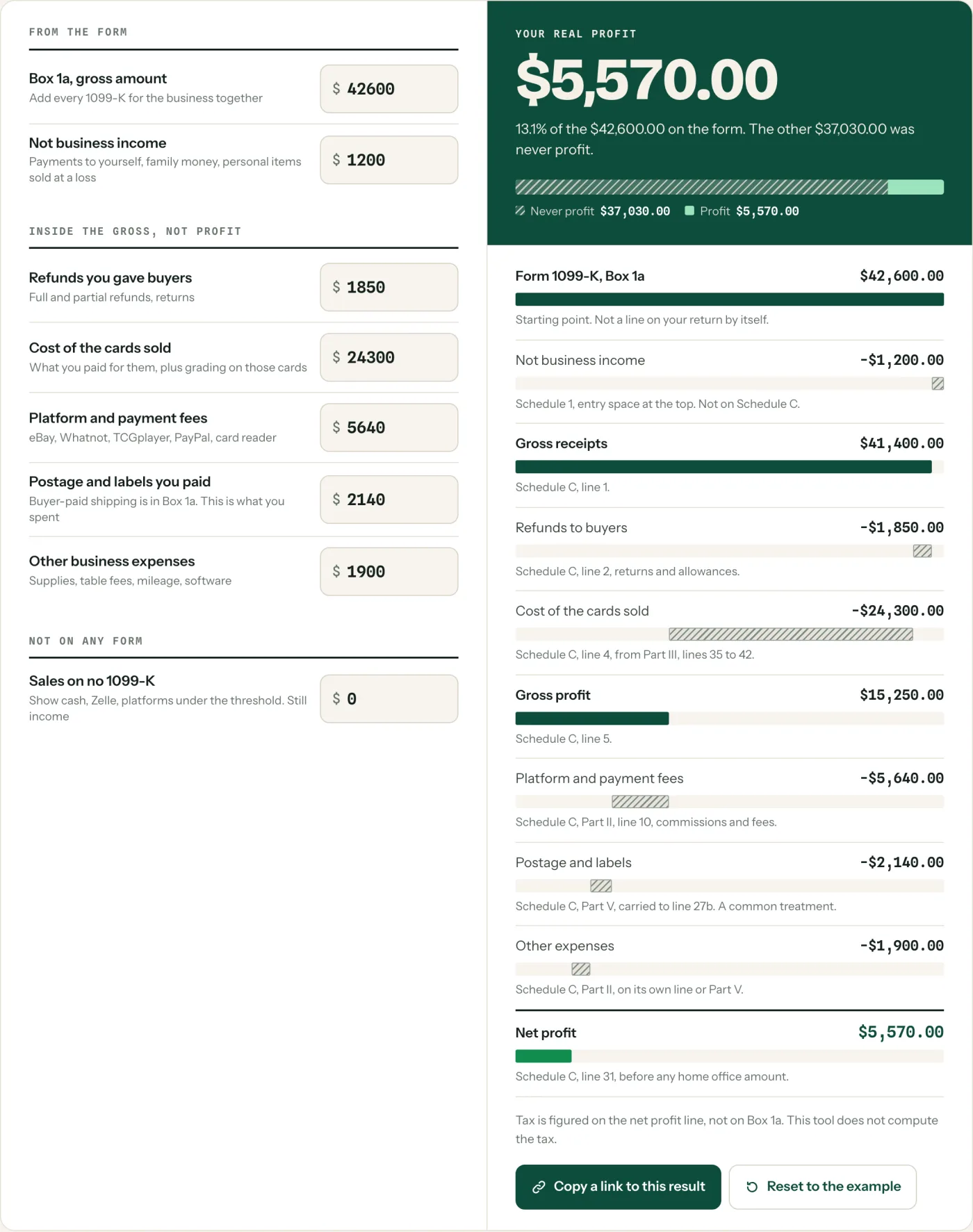
It shows gross payments, not what reached your bank. The IRS FAQs say Box 1a is not adjusted for fees, credits, refunds, shipping, cash equivalents or discounts. You subtract those yourself on the return, along with what each card cost you.
A FANATICS COLLECT YEAR, WORKED
Say a dealer sold $31,500 of cards across 240 sales in 2026. Round, hypothetical figures.
The form says $31,500. The taxable number is $7,500. The gap only closes if you can show the fees and the cost of each card. The 1099-K reconciliation calculator runs the same subtraction with your figures.
What counts as the cost of a high-end card?
What you gave to get it, in cash and in cards, plus what you paid to grade it. On a five-figure slab this is the number that decides the tax, and Fanatics Collect has no record of it.
| How you got the card | Its cost | The record that proves it |
|---|---|---|
| Bought for cash at a show | The price paid | A written receipt with the seller's name, date, item and price |
| Bought on a platform | The price paid, including any sales tax charged to you | The order record or statement |
| Received in a trade | The fair market value of the card on the trade date | A note of both cards, the agreed values and the date |
| Bought raw, then graded | The price paid plus the grading fee. Our reading; no IRS guidance exists | The purchase record and the grading invoice |
A trade is barter under Tax Topic 420: the value of the card you receive is income in that year and becomes the new card's cost. Cost basis for cards bought with cash or by trade works through each row, and the grading fee guide covers the last one.
Do I owe tax if Fanatics Collect sends no form?
Yes. The IRS FAQs say all income, no matter the amount, is taxable unless the tax law says it is not. Fanatics Collect's own page says the same: you are responsible for reporting all taxable income, even if you do not receive a Form 1099-K.
A collector who sells three cards for $48,000 gets no federal form and may owe the most tax of anyone on this page. With no form, do three things:
- List your sales for January 1 to December 31 from your Fanatics Collect account.
- Total the sale prices, the fees kept and any refunds.
- Match each sale to its cost, then report on the schedule that fits you, in the table below.
Reporting sales under $20,000 covers a full return with no form in hand.
Where do Fanatics Collect sales go on my return?
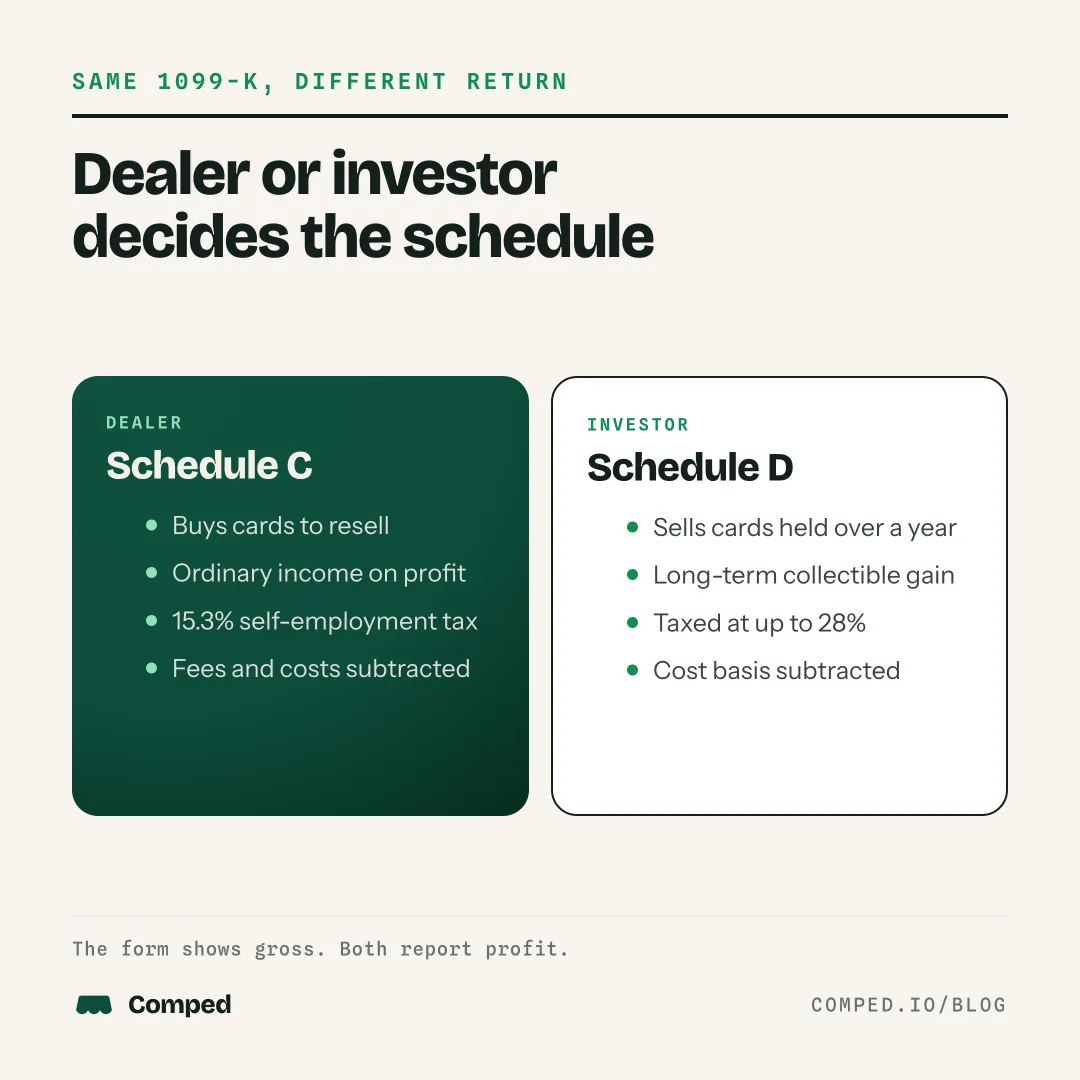
That depends on whether you sell as a dealer, an investor or a hobby seller. The 1099-K does not decide it. Your activity does.
| You are | Where the sales go | How profit is taxed |
|---|---|---|
| A dealer who buys to resell | Schedule C | Ordinary income, plus 15.3% self-employment tax on net earnings of $400 or more |
| An investor selling cards held over a year | Schedule D | Long-term collectible gain, taxed at up to 28% |
| A hobby seller | Schedule 1 (Form 1040), line 8 | Ordinary income on sales less cost of goods; no expense deductions |
The IRS says a sole proprietor reports 1099-K payments on Schedule C, on its page What to do with Form 1099-K. The same page sends a personal item sold at a gain to Form 8949 and Schedule D. Trading cards are treated as collectibles in practice, and Tax Topic 409 gives the 28% maximum rate. Hobby or business covers the factors the IRS weighs, and the master tax guide covers the dealer's return.
What do I do when the form arrives, or is wrong?
Check it against your sales history first, then ask Fanatics Collect to correct anything that is off. File on time either way.
- Check the name and the last four digits of the tax ID.
- Compare Box 1a with the total of your sale prices for the year, and Box 3 with your count of sales.
- Use the monthly boxes, 5a to 5l, to find any month that does not match.
- If the form is wrong, ask Fanatics Collect for a corrected one. The IRS says it cannot correct a 1099-K. Only the issuer can.
- Keep the original form and every message about the correction.
If the corrected form does not arrive before the deadline, file with your real numbers. Keep the form and your own sales records together in case the IRS asks about the difference.
What does Fanatics Collect's page not say?
Four things a seller would want, as read on 13 November 2026. Do not assume an answer to any of them.
- The date the form is sent. Only the 28 January 2027 paperwork deadline is given. The IRS due date for the seller's copy of any 2026 form is 1 February 2027.
- How the form is delivered, by mail or download.
- Any state threshold below the federal one.
- What its gross includes, such as fees, shipping or tax charged to buyers.
One question does have an answer on the form itself. The instructions on Form 1099-K say the dollar amount of each transaction is determined on the date of the transaction. Our reading: a sale counts in the year it happened, whether or not you have withdrawn the money from your account.
Which records should I pull, and by when?
Pull your 2026 sales history from Fanatics Collect and match each sale to what the card cost. You need the sale price, the fees kept, any grading or shipping you paid, and the purchase record for each card.
The purchase record is the hard one. A card bought for cash at a show has no invoice unless you made one. Comped records the card, price, venue and date when you scan a buy at the table. The cost is on file when the card sells. Card sales with no receipts covers what to do when the record is missing.
| Date | What happens |
|---|---|
| 31 December 2026 | Last day of sales on a 2026 form |
| 15 January 2027 | Fourth estimated tax payment for 2026, per IRS Form 1040-ES |
| 28 January 2027 | Fanatics Collect's deadline to submit requested tax documentation |
| 1 February 2027 | IRS due date for the seller's copy of a 2026 Form 1099-K, per Publication 1099 |
| 15 April 2027 | 2026 return due, per the IRS |
How this looks in the Comped app
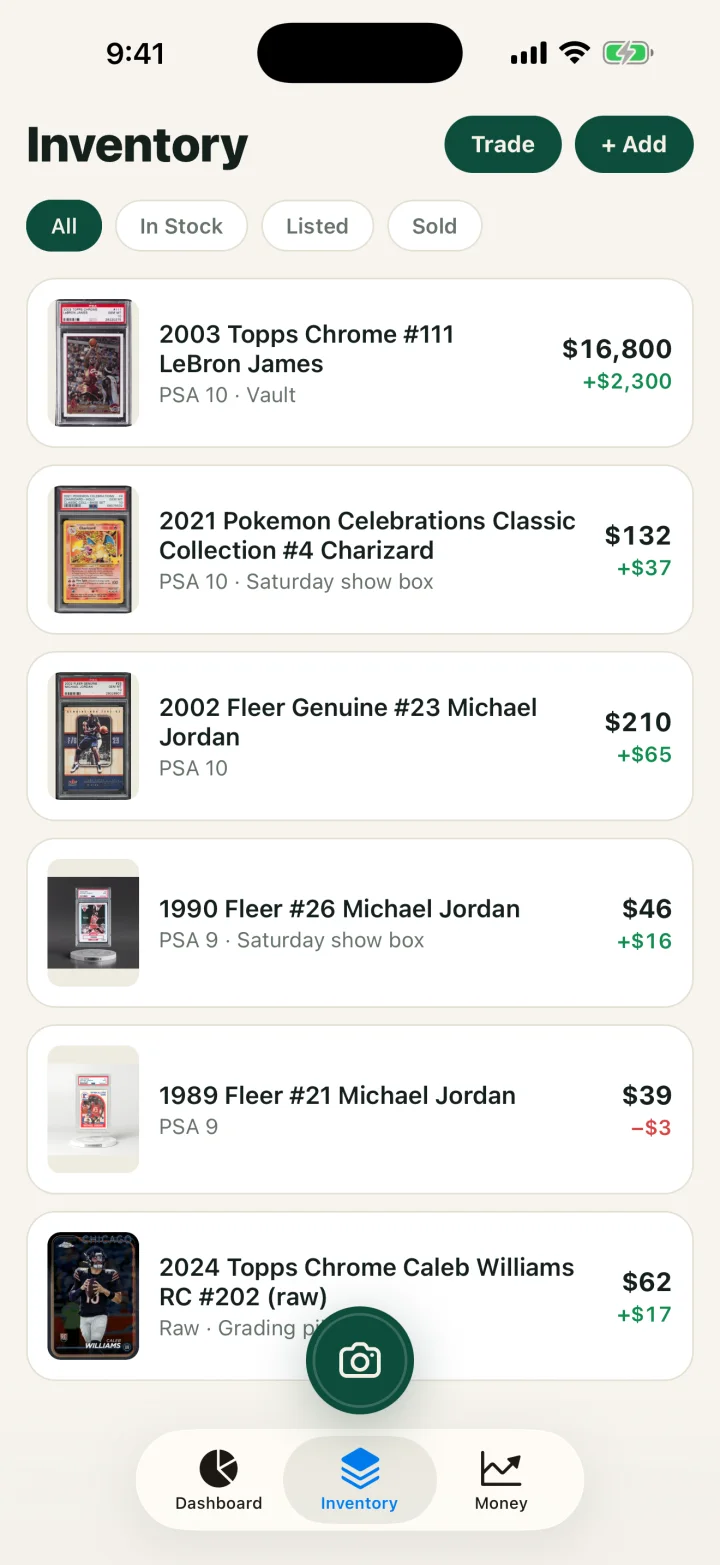
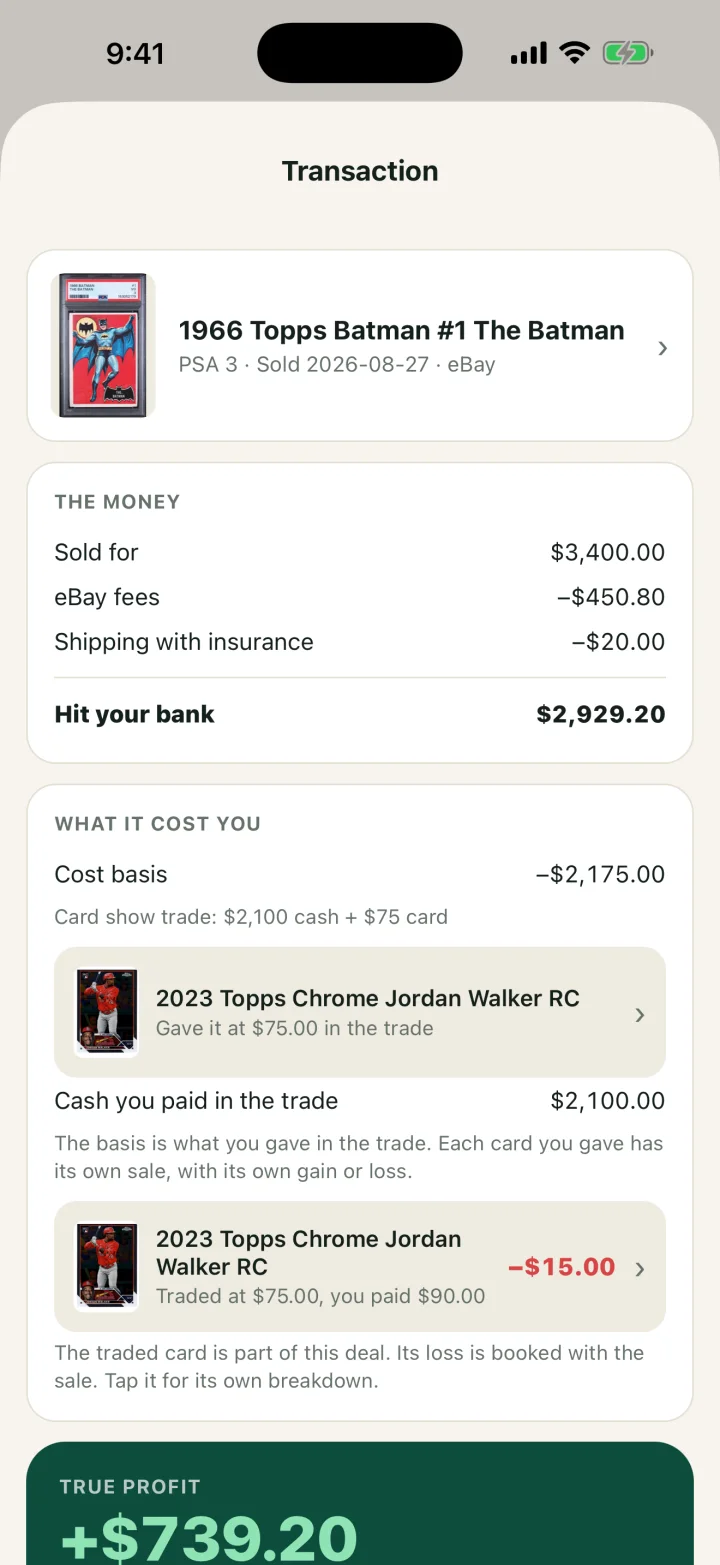
Inventory lists each card with its current value and its gain against cost, so the cost of a slab is known before it is listed. A sale's Transaction screen shows the price, fees, shipping, cost basis and true profit, including a card given in trade.
Related guides
- The Card Vendor's Master Guide to Taxes: where 1099-K income lands and what a dealer subtracts.
- The 1099-K for card sellers in 2026: every platform's threshold in one table.
- Hobby or business when you sell cards: which schedule your sales belong on.
- 1099-K vs your real profit calculator: turn Box 1a into the taxable number.
FAQ
Does Fanatics Collect send a 1099?
Yes, a Form 1099-K, to sellers with more than $20,000 in gross payments and more than 200 transactions in the calendar year. Its help page asks sellers to submit requested tax documentation by 28 January 2027 for 2026 reporting.
I sold one card for $25,000 on Fanatics Collect. Will I get a 1099-K?
Not under the federal rule, because one sale does not exceed 200 transactions. Your state may require reporting at a lower amount. The profit on the card is taxable whether or not a form arrives.
Do I owe tax if I never got a 1099?
Yes. The IRS says all income, no matter the amount, is taxable unless the tax law says it is not. The threshold controls the paperwork a marketplace files, not the tax on your profit.
Is it profit or the whole sale that is taxed?
Profit. The form shows gross payments, and you subtract fees, shipping, refunds and the cost of each card on your return. You need records of those amounts to subtract them.
Do my eBay sales count toward the Fanatics Collect threshold?
No. Each platform applies the $20,000 and 200 tests to its own payments. All of the sales still belong on your return, with or without forms.
When does Fanatics Collect send the 1099-K?
Its help page does not give a date. It gives 28 January 2027 as the deadline for sellers to submit tax documentation for 2026 reporting. The IRS due date for the seller's copy of a 2026 form is Monday, 1 February 2027.
I got an email from fanatics@vendorinfo.com asking for tax forms. Is it real?
That is the sender address Fanatics Collect's help page names for its tax documentation request. The page says to register or sign in with the same email as your Fanatics Collect account and follow the link. If in doubt, reach the form through the help page or contact support.
If I leave the money in my account, is the sale still reported?
The Form 1099-K instructions say each transaction's amount is determined on the date of the transaction. Our reading is that a sale counts in the year it was made, not the year you withdraw. Fanatics Collect's page does not address it, so ask a CPA about your own return.
SOURCES
- 1099-K forms, Fanatics Collect, checked November 2026.
- IRS issues FAQs on Form 1099-K threshold under the One Big Beautiful Bill, IRS, checked November 2026.
- Understanding your Form 1099-K, IRS, checked November 2026.
- Form 1099-K FAQs, general information, IRS, checked November 2026.
- What to do with Form 1099-K, IRS, checked November 2026.
- Form 1099-K (Rev. December 2026) and its instructions for payee, IRS, checked November 2026.
- Publication 1099 (2026), IRS, checked November 2026.
- Tax Topic 420, bartering income, IRS, checked October 2026.
- Tax Topic 409, capital gains and losses, IRS, checked October 2026.
- Form 1040-ES, Estimated Tax for Individuals, 2026, IRS, checked October 2026.
- When to file, IRS, checked November 2026.
This is general information for card sellers, not tax or legal advice for your situation. Rules change and states differ; a CPA who knows your numbers wins every time.