Collection value is not profit
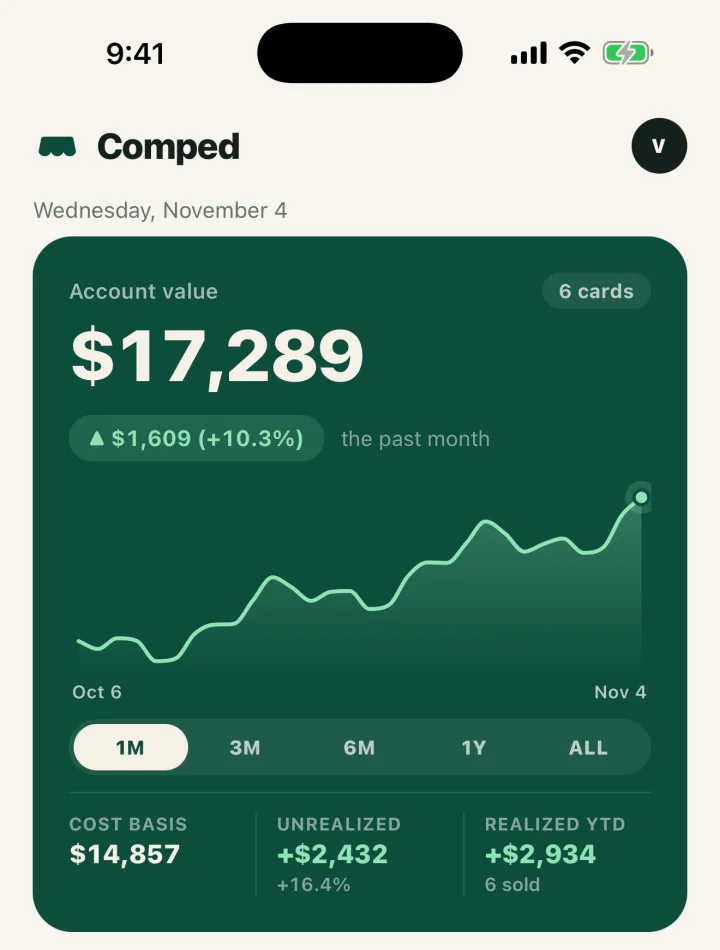
A profit tracker needs what you paid, not only what the cards are worth. Comped's home screen shows both: the value of what you hold, its cost basis, the unrealized gain between them, and the gain realized on cards you have sold this year.
Unrealized gain is not income. Tax is owed on profit when a card sells, whether or not a form arrives. The guide to selling Pokemon cards and taxes covers what a seller owes in 2026.
What it tracks on each Pokemon card
Comped tracks one card from the buy to the sale. The table lists what is saved at each point.
| Point in the card's life | What Comped saves |
|---|---|
| You scan it | Character, year, set, card number and parallel. On a slab, the grader, grade and cert number |
| You check the price | A market value from recent sales, a price line and current listings |
| You buy it | Price paid, where you bought it, the date and your photo of the card |
| You hold it | Cost, market value and the paper gain or loss between them |
| You spend on it | Grading, shipping and supplies as write-offs |
| You trade it | The value agreed, the gain or loss on the card going out, and the cost of the card coming in |
| You sell it | Sale price, fees, shipping, the card's cost and the true profit |
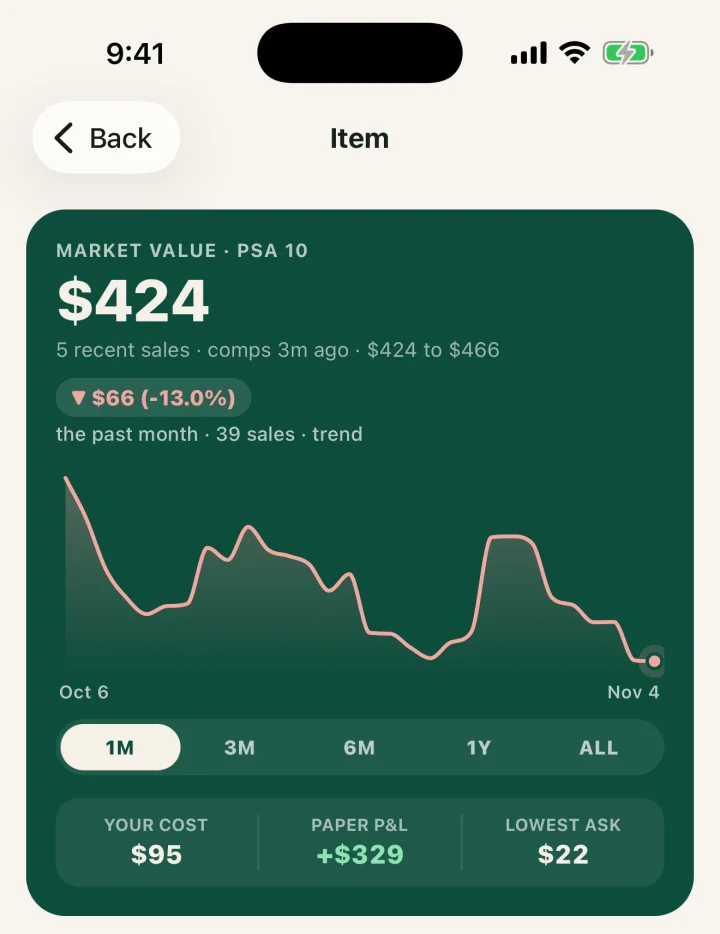
Each card you hold has its own page. The one below is a graded Charizard from the demo account: the PSA 10 market value, a one month price line, what the owner paid and the paper gain.
A sale looks for the card in your inventory, by cert number first and then by description. A match marks the card sold and moves its cost into the profit on that sale.
Profit on one card
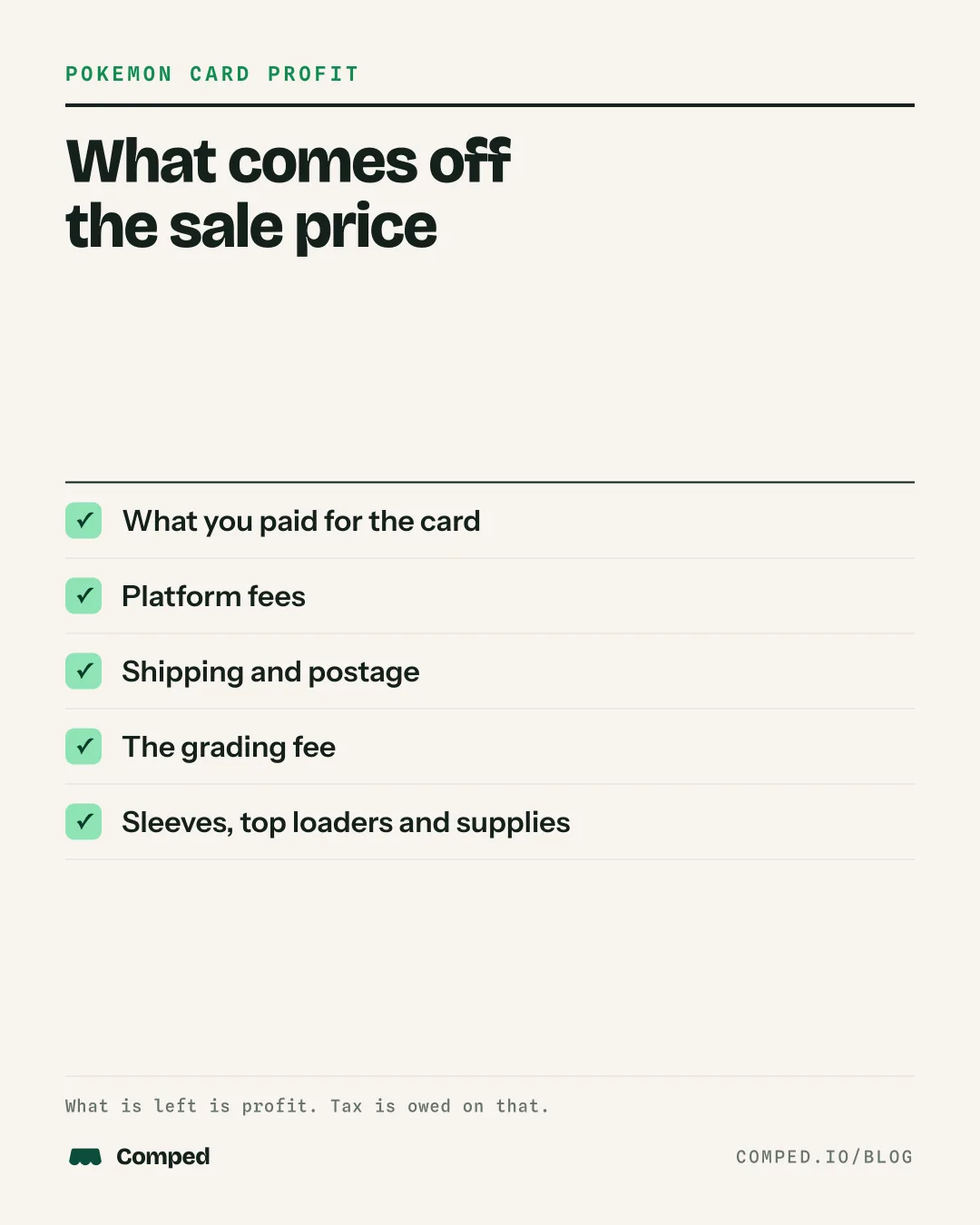
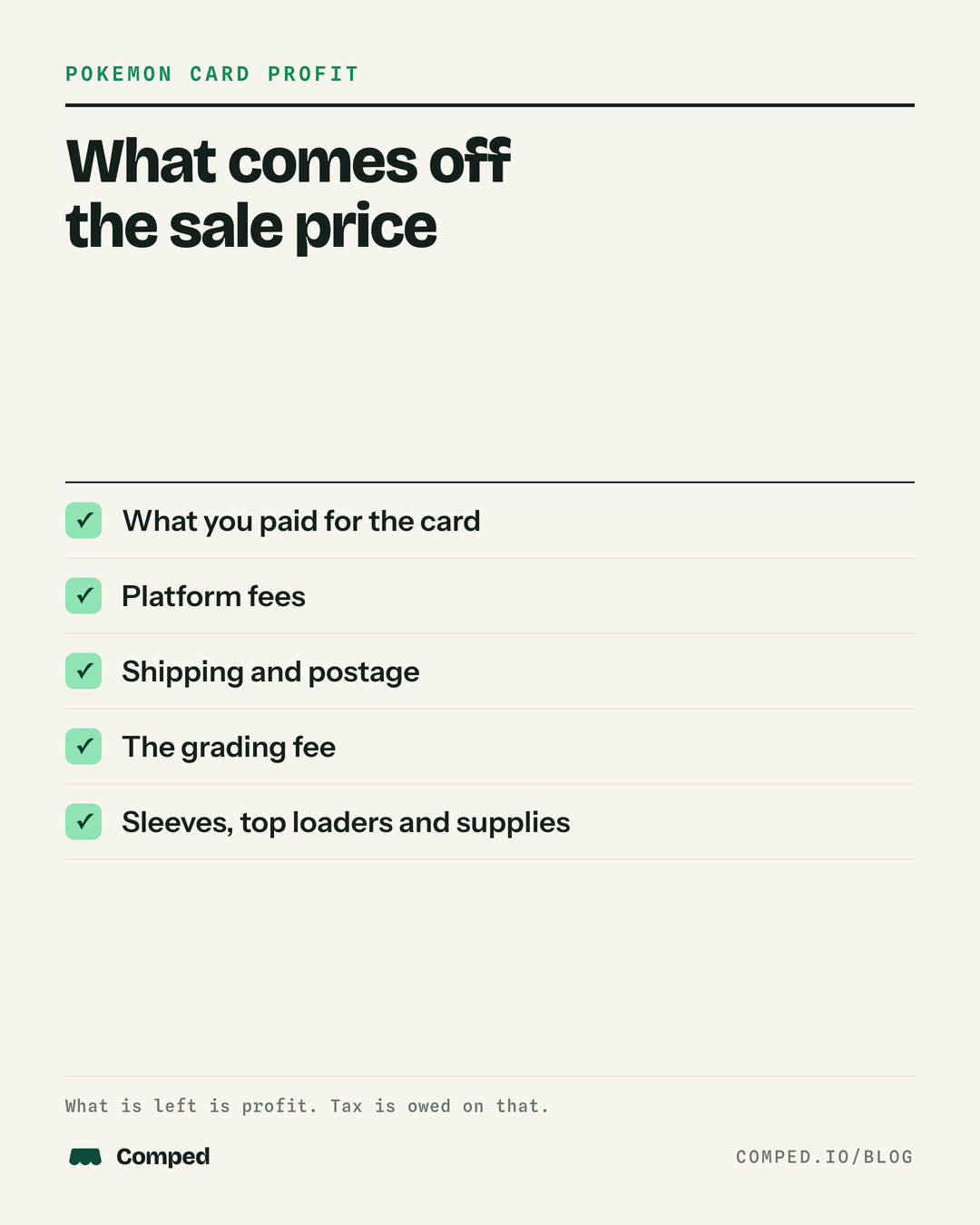
Profit on a card is the sale price minus its cost, the platform fees and the costs of selling it. The figures below are an example to show the math, not a real sale or a price guide.
AN EXAMPLE DEAL, NOT A REAL SALE
An Umbreon VMAX 215/203 from Evolving Skies, bought raw for cash at a show and sold on eBay. The prices are made up. The fee is eBay's rule in our October 2026 fee research.
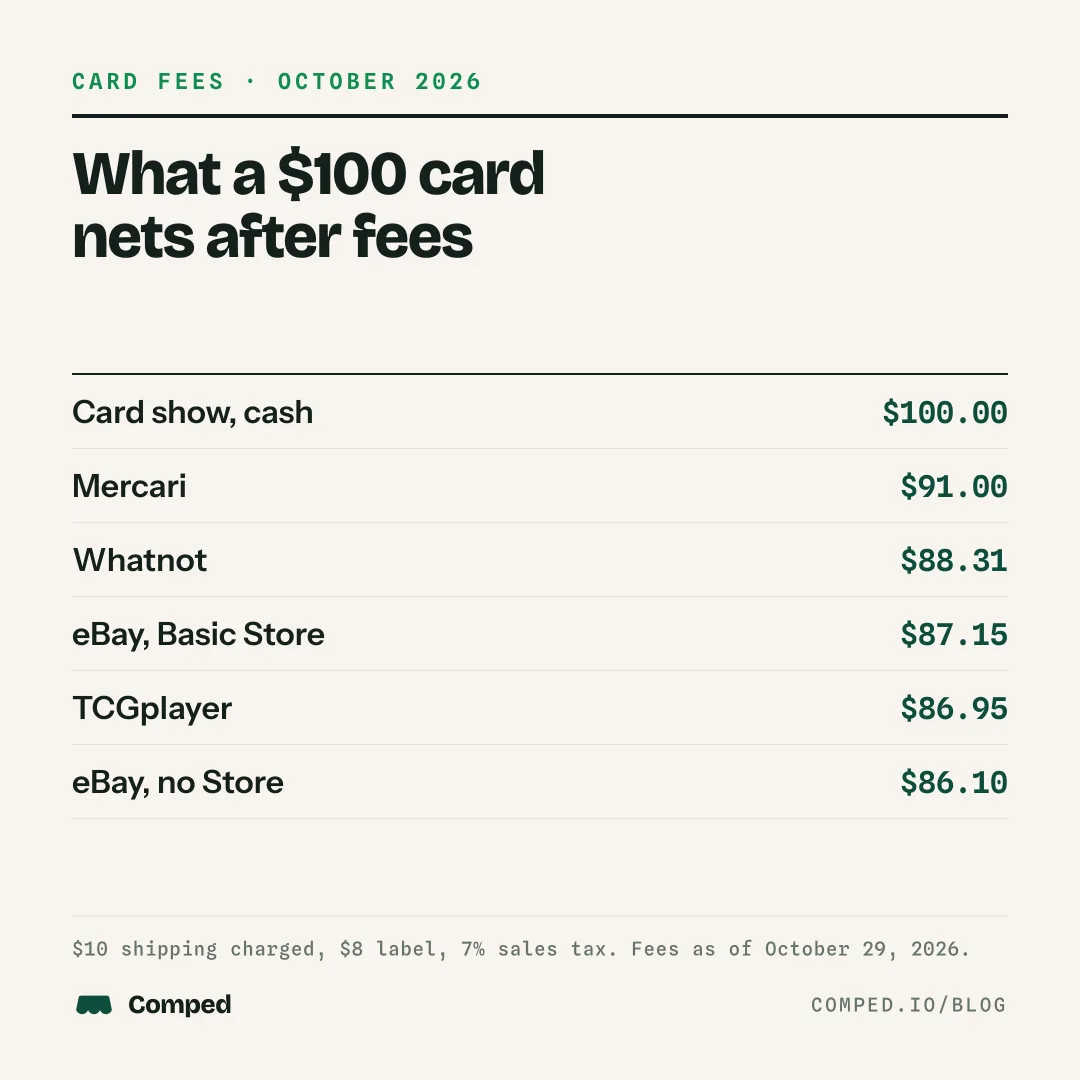
The seller who tracks only the $850 thinks the card made $250. In Comped you enter the fee amount from the payout report; the app does not calculate a platform's fee. To get the figure before you list, the card profit calculator runs each platform's rules. With $10 shipping charged, an $8 label and 7% sales tax, a $100 card nets $86.10 on eBay, $86.95 on TCGplayer and $88.31 on Whatnot. Cash at a show keeps the full $100.00.
Pack pulls and grading fees
A card pulled from a pack still has a cost: its share of the pack or box. No IRS ruling is specific to cards, so sellers split the box cost across the cards they keep and sell. The cost basis calculator splits a box, a lot or a break, and you enter the result as the card's cost in Comped.
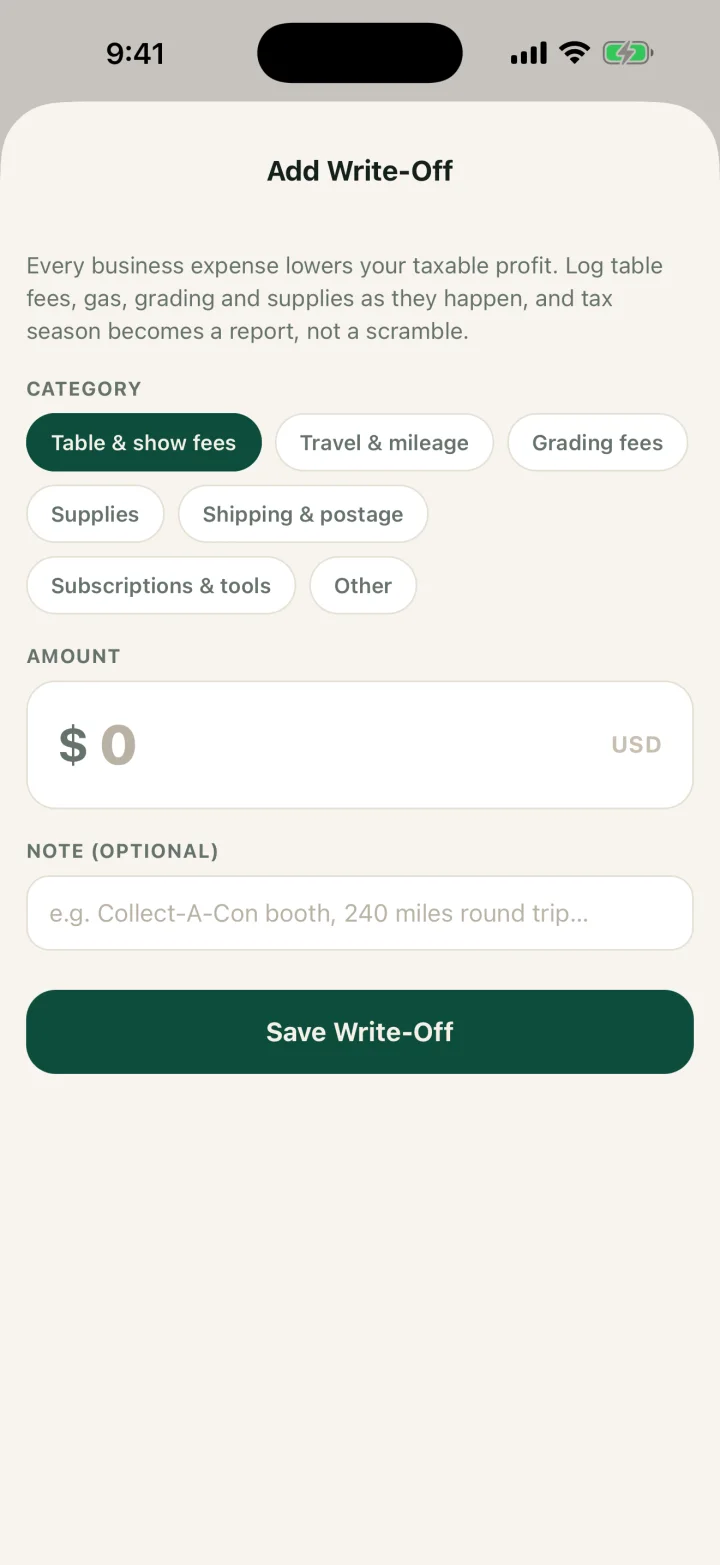
Grading fees go in as a write-off. Pick the Grading fees category, enter the amount and add a note with the submission. When the slab comes back, scan it, and the record carries the grade and cert.
No IRS guidance is specific to grading fees. The guide on whether grading fees are deductible gives our reading of how a dealer treats them.
The year: realized profit and the tax file
The Money tab adds the year up and labels each part. Realized profit is marked Taxed. Unrealized gain is marked Not taxed until sold. Below them is a set-aside estimate at 25% of realized profit.
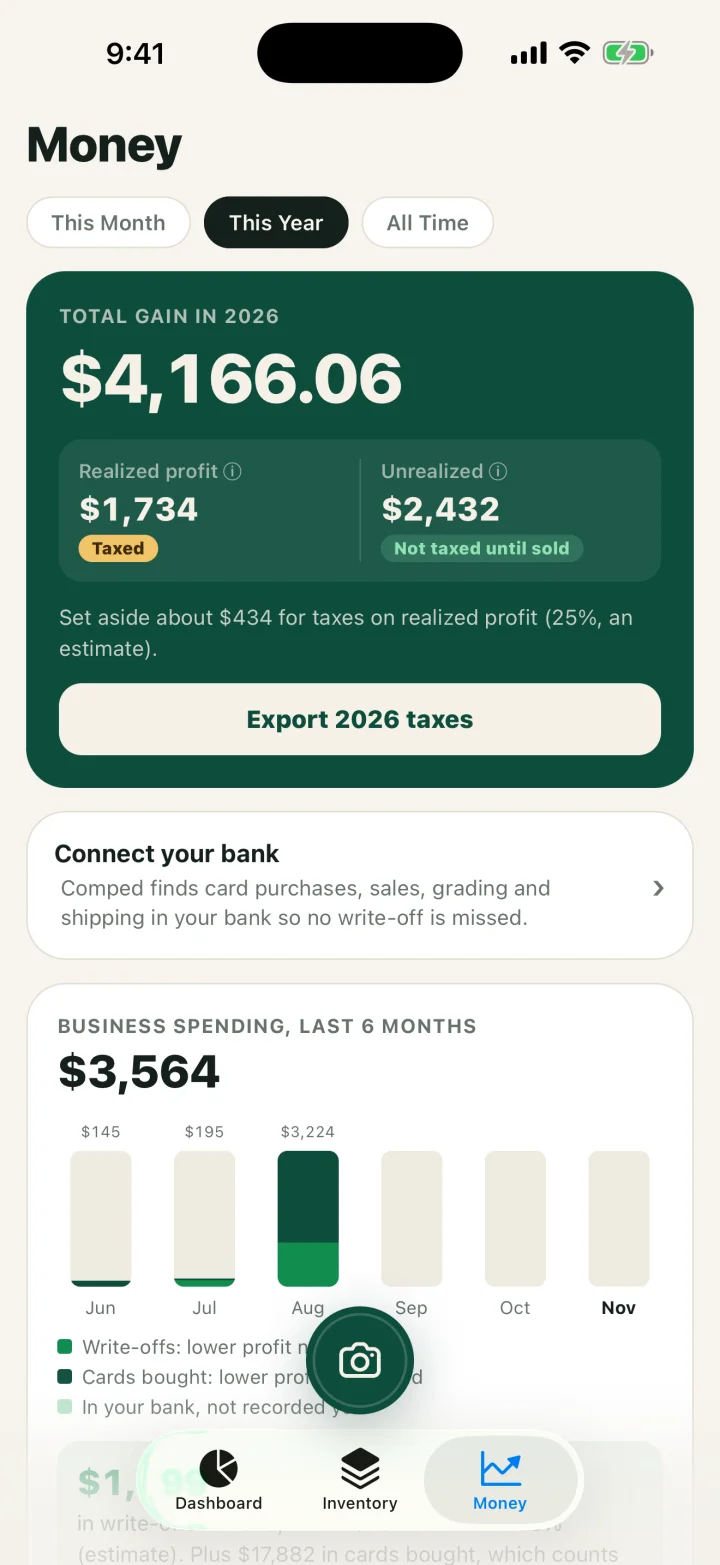
Export taxes makes a CSV for the year: a Schedule C style summary, then every sale, every card bought and every write-off. A 1099-K reports gross payments, before fees, shipping and what you paid for the cards, so this file is where those numbers come from.
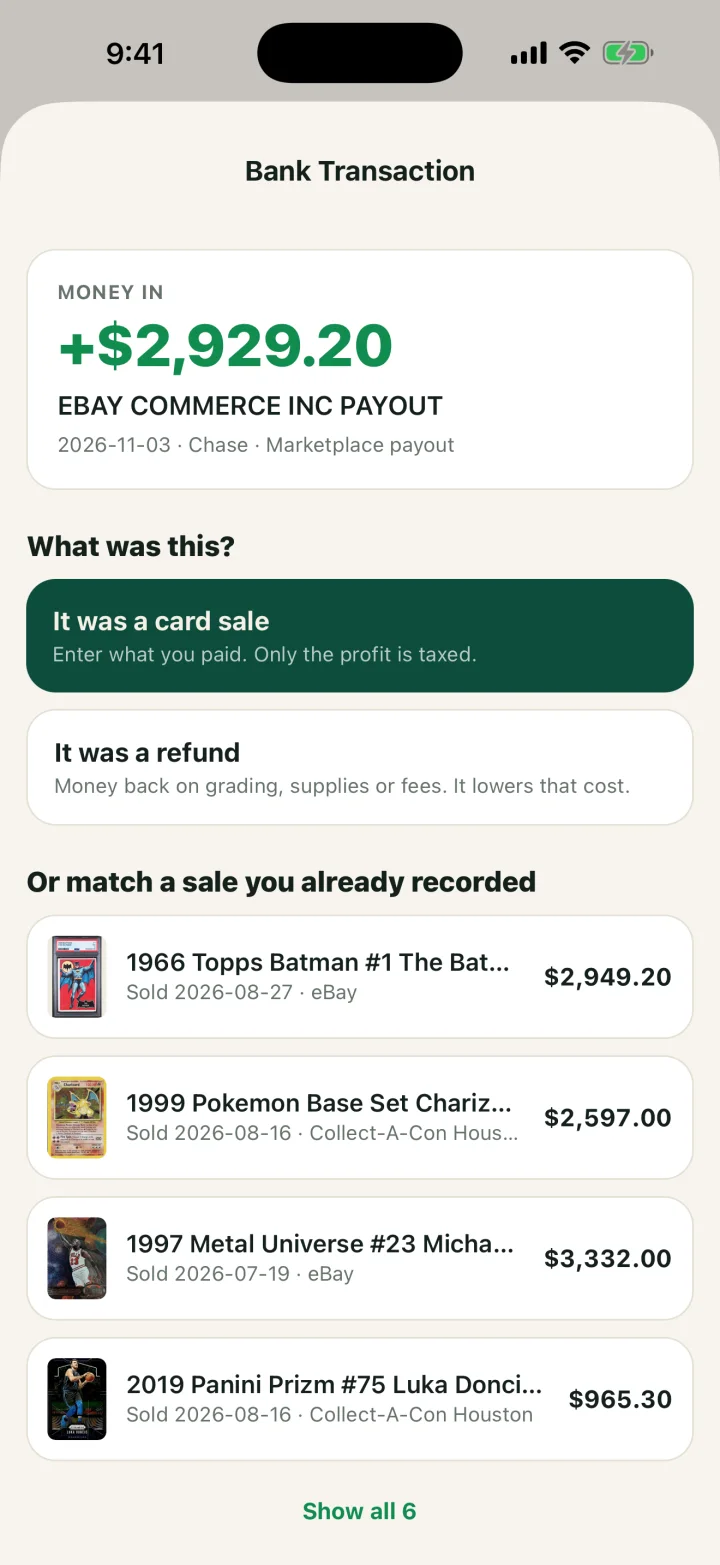
On Pro, a linked bank account flags deposits that look like marketplace payouts. You mark each one as a card sale or a refund, or match it to a sale you already recorded.
Free plan, price and online use
Comped is free to download, and the free plan keeps every record, including trades and the tax export. It includes 5 scans a week, and the count resets every Monday. Searching for a card by name or typing it in does not use a scan.
Pro costs $16.99 a month or $99 a year. It adds unlimited scans and the bank link.
Comped runs on iPhone. There is no web version to open in a browser. For a tracker on a computer, the free card inventory and profit spreadsheet works in Excel or Google Sheets, and it takes Pokemon cards.
Who it suits and what it does not do
Comped suits a Pokemon seller who buys singles and slabs, sells them at shows or online, and wants the profit on each one. It is not a collection checklist, and it has limits to know before you download.
- It runs on iPhone only. There is no Android app and no web version.
- It does not track set completion or a wishlist.
- It scans and prices single cards and slabs. Sealed product has no scan or price.
- It does not calculate platform fees or import your eBay, TCGplayer or Whatnot sales. You enter the sale and the fee.
- It does not file a tax return, and it does not compute or file sales tax.
- It does not take card payments. It records the sale you made.
- It is not tax advice. The set-aside is a savings habit, not a tax calculation.
Related guides
- Selling Pokemon cards and taxes: what a Pokemon seller owes in 2026 and on which form.
- Card profit calculator: profit on one card after eBay, Whatnot, TCGplayer or show cash.
- The card vendor's master guide to taxes: cost basis, inventory and the forms.
FAQ
Is there a free Pokemon card profit tracker?
Yes. Comped's free plan records buys, sales, trades, inventory, write-offs and profit, and exports the year for taxes. It includes 5 camera scans a week, and cards you search for or type in do not count against that.
Can I use the tracker online?
No. Comped is an iPhone app and has no web version. Sellers who want a browser tool can use the free inventory and profit spreadsheet on comped.io in Google Sheets.
Do I need to enter what I paid?
Yes. Without the cost, an app can only show what a card is worth. Comped asks for the price when you record the buy, and that number is what comes off the sale later.
Does it track raw cards or only slabs?
Both. A raw card is identified by character, set, card number and parallel. A slab adds the grader, the grade and the cert number.
Does it track sealed product?
Not as a priced item. Comped scans and prices single cards and slabs. A box you open is handled by splitting its cost across the cards you keep and sell.
What is the cost basis for a card pulled from a pack?
Its share of what the pack or box cost. No IRS ruling is specific to cards, so a reasonable split across the cards you keep and sell is the usual method.
Is it profit or the whole sale that is taxed?
Profit. A seller subtracts what the card cost and the costs of selling it. That only works if the cost was recorded, which is why the tracker asks for it at the buy.
Does a rise in my collection's value count as income?
No. A gain on a card you still hold is unrealized. Comped shows it apart from realized profit and labels it as not taxed until sold.
SOURCES AND SCOPE
Features described from the Comped iPhone app, version 1.2.2, November 13, 2026. Screens show demo data. Prices are in US dollars. The example deal uses made-up prices and is not sales data; its eBay fee follows our fee research dated October 29, 2026. The 1099-K rule is from the IRS Form 1099-K FAQs. Read our sources and editorial standards.
This is general information for card sellers, not tax or legal advice for your situation. Rules change and states differ; a CPA who knows your numbers wins every time.